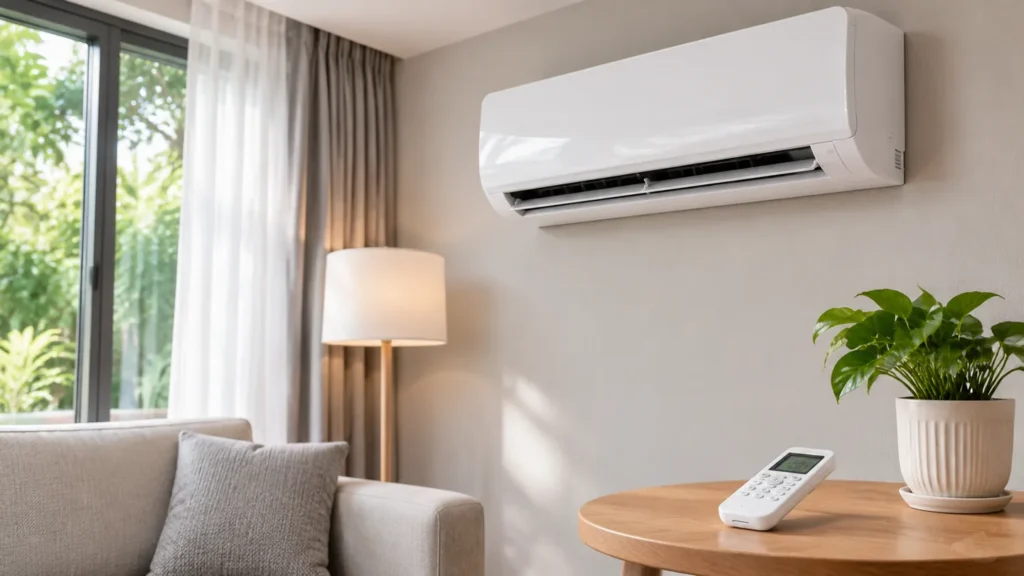
Air conditioning is the process of controlling indoor air conditions to improve comfort or meet specific process requirements. A residential cooling system uses a refrigeration cycle to move heat from indoors to outdoors while providing some dehumidification and air circulation. Fresh-air ventilation, precise humidity control, and heating depend on the equipment and supporting systems installed.
Complete air conditioning addresses temperature, humidity, air cleanliness, and airflow distribution. Residential systems focus mainly on cooling. Hotels, office buildings, shopping centers, and industrial facilities may also use outdoor-air ventilation, filtration, zoning, and building automation to meet the needs of different spaces.
Concept |
Quick Explanation |
Important Detail |
|---|---|---|
Air Conditioning |
The process of conditioning air; also used to describe AC systems |
Humidity control and fresh-air functions depend on the equipment and system design |
AC |
Common abbreviation for air conditioning; often used for cooling equipment |
Standard abbreviation for air conditioning |
HVAC |
Heating, Ventilation and Air Conditioning |
The broader system covering heating, ventilation, and air conditioning |
How Does Air Conditioning Work?
A typical vapor-compression air conditioner transfers heat from inside a building to the outdoors through refrigerant evaporation, compression, condensation, and expansion. An indoor fan moves room air across a cold coil and supplies the cooled air back to the space.
The Refrigeration Cycle
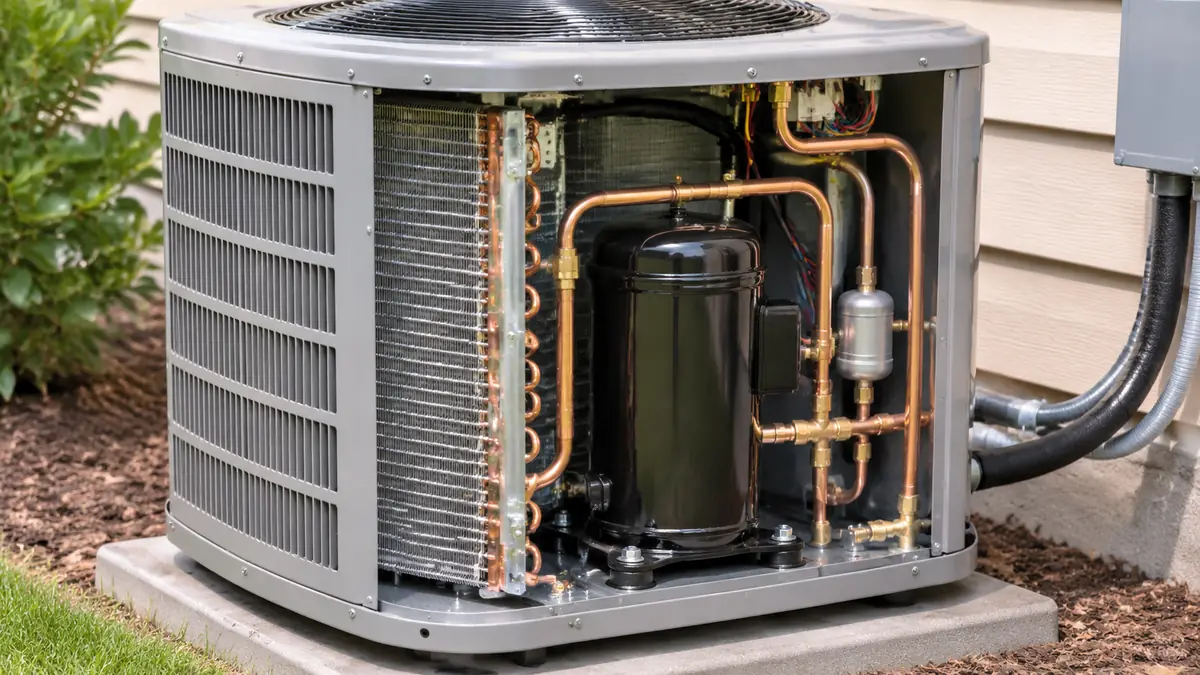
The refrigeration cycle is a closed loop consisting of an evaporator, compressor, condenser, and expansion device. Refrigerant absorbs heat and evaporates on the low-pressure side, then releases heat and condenses on the high-pressure side. The process repeats continuously.
Stage |
What Happens |
What You May Notice |
|---|---|---|
1. Evaporation: Heat Absorption |
Low-pressure refrigerant absorbs heat from indoor air in the evaporator and vaporizes |
Supply air cools; moisture may condense on the coil |
2. Compression: Pressure Rise |
The compressor turns low-pressure vapor into hot, high-pressure vapor |
The compressor and outdoor unit begin running |
3. Condensation: Heat Rejection |
Hot refrigerant releases heat in the outdoor condenser and becomes high-pressure liquid |
The outdoor unit exhausts warm air |
4. Expansion: Pressure Drop |
An electronic expansion valve or capillary tube lowers refrigerant pressure and temperature |
Refrigerant is ready to absorb heat again |
Note: Actual systems also contain fans, piping, controllers, and protective devices. Refrigerant flow direction and component locations vary by equipment design, including heat pumps with reversing valves.
System Diagram: Where Do Heat and Air Flow?
Refrigerant circulates through sealed tubing while indoor and outdoor air pass over separate heat exchangers. The two air streams remain separate. The outdoor heat exchanger releases the heat carried out of the building.
Flow Path |
Simplified Path |
|---|---|
Refrigerant circuit |
Indoor evaporator → compressor → outdoor condenser → expansion device → indoor evaporator |
Indoor air |
Room return air → filter → evaporator → indoor supply air → room |
Outdoor air |
Outdoor air → outdoor heat exchanger → warm air discharged outdoors |
Condensate |
Moisture on indoor coil → drain pan → drain line |
The simplified flow paths show how system components interact. Follow the manufacturer’s model-specific wiring and piping instructions during installation.
What Are the Advantages and Disadvantages of Air Conditioning?
The main benefits of air conditioning are cooling, better thermal comfort, and some moisture removal during cooling. Costs include the equipment, installation, electricity, noise management, and routine maintenance. The right system depends on climate, cooling load, operating hours, existing ductwork, and ventilation requirements.
Benefits • Improves thermal comfort during hot weather • Helps control some indoor moisture and stabilize temperature • Can improve usability with filtration, zoning, and automation |
Drawbacks • Equipment, installation, and electricity costs • Requires filter cleaning, drain maintenance, and electrical service • Some units create noise, occupy space, or face outdoor-unit restrictions |
Advantages
A properly sized and installed air conditioner can maintain a more consistent indoor temperature in hot, humid weather. Moisture condenses on the evaporator coil and drains away. Multiroom systems can also provide separate zones based on how and when spaces are used.
- Improved comfort: Maintain appropriate temperatures and air velocities in occupied areas to reduce hot spots.
- Moisture removal: When the evaporator is below the air’s dew point, the system removes both sensible and latent heat. Precise humidity control requires suitable humidity sensing and independent dehumidification capability.
- Flexible applications: Equipment and controls are available for single rooms, entire homes, hotel rooms, and large shopping centers.
- Automation and zoning: Scheduling, occupancy sensing, and variable-capacity operation can reduce unnecessary runtime.
Disadvantages
The lifetime cost of air conditioning includes equipment and installation, filter cleaning, coil and drain maintenance, electricity for compressors and fans, and space for outdoor units.
- Upfront cost: Multi-split, ducted, and chilled-water systems require piping, equipment, and installation work that varies with building conditions and project size.
- Energy costs: Runtime, outdoor temperature, building envelope, thermostat settings, and equipment efficiency all affect electricity bills.
- Noise and airflow: Bedrooms and offices require attention to indoor-unit sound pressure, air velocity, and discharge direction.
- Ventilation needs: Standard split systems mainly recirculate indoor air. Required outdoor air comes from separate ventilation equipment or systems with a dedicated fresh-air feature.
- Maintenance and environmental impact: Refrigerant leaks, clogged filters, and improper refrigerant recovery can increase costs and environmental impacts.
What Are the Main Components of an Air Conditioner?
The refrigeration system has four core components: a compressor, condenser, expansion device, and evaporator. Fans, filters, temperature sensors, control boards, refrigerant piping, and a condensate drain system support continuous cooling, dehumidification, and air circulation.
Four Core Refrigeration Components
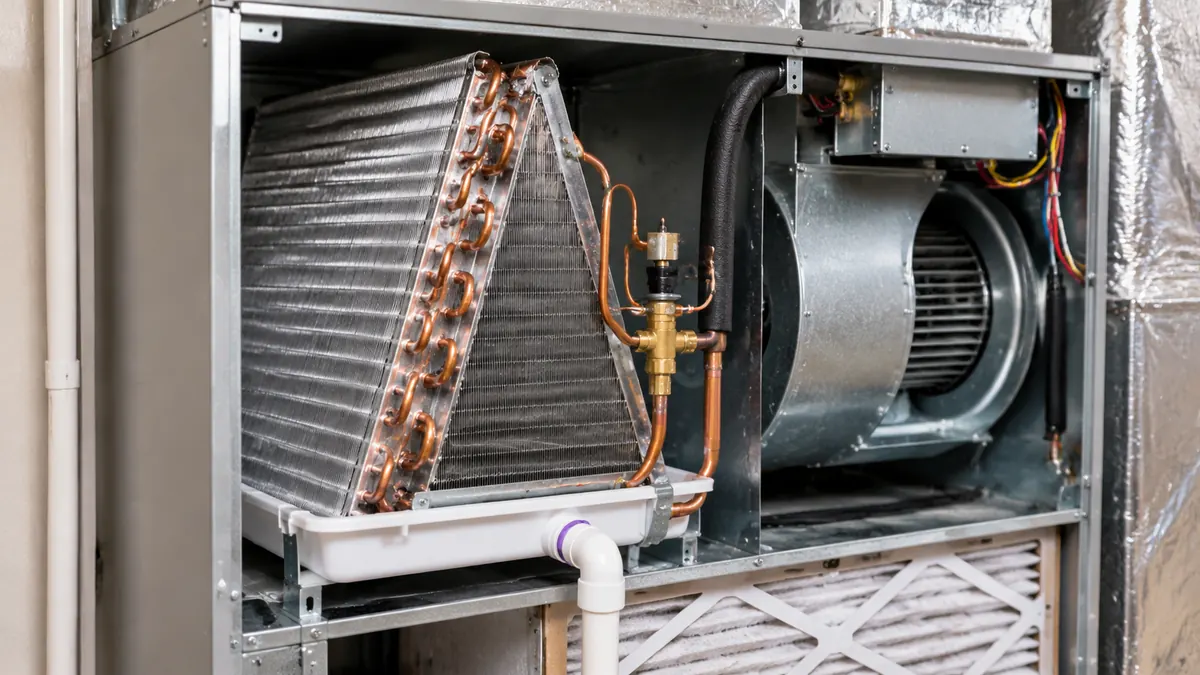
These four components raise refrigerant pressure, release heat to the surroundings, reduce refrigerant pressure, and absorb heat from indoor air. The table below connects each function with common signs of trouble.
Component |
Main Function |
Common Problem Signs |
|---|---|---|
Compressor |
Creates the pressure difference that drives refrigerant circulation |
Won’t start, frequent safety trips, insufficient capacity |
Evaporator |
Absorbs indoor heat in cooling mode |
Icing, dirty coil, abnormal dripping |
Condenser |
Releases heat outdoors in cooling mode |
Poor heat rejection, abnormal system pressures |
Expansion device |
Meters refrigerant and produces a pressure drop |
Unstable refrigerant feed, poor temperature control |
Indoor/outdoor fans |
Move air across heat exchangers |
Low airflow, increased noise |
Filter/condensate drain |
Capture some particles and remove condensate |
Restricted airflow, water overflow |
Sensors/control board |
Monitor temperatures and coordinate compressor and fans |
False alarms, abnormal cycling |
Compressor
The compressor raises low-pressure refrigerant vapor from the evaporator to a higher pressure and temperature so the refrigerant can release heat outdoors. It is a major electricity-consuming component in a typical vapor-compression system.
Common compressor designs include rotary, scroll, and reciprocating types. Fixed-speed units adjust average capacity by cycling on and off, while inverter-driven units change speed to follow the load. With frequent cycling, unusual noise, overheating trips, or failure to start, technicians should check the capacitor, contactor, power supply, controls, refrigerant circuit, and compressor condition in a logical sequence.
Condenser
The condenser releases heat carried by hot, high-pressure refrigerant to outdoor air or cooling water, allowing the vapor to condense into liquid. In most residential split systems, the condenser is inside the outdoor unit.
Dirt on the outdoor coil, blocked fins, and recirculation of discharge air can raise condensing temperature, increase power draw, and trigger high-pressure protection. Shut off power before cleaning, use a manufacturer-approved method, and protect the fins and electrical components.
Expansion Device
The expansion device meters high-pressure liquid refrigerant into the low-pressure evaporator side and creates the pressure drop needed for cooling. Common types include capillary tubes, thermostatic expansion valves (TXVs), and electronic expansion valves (EEVs).
A TXV adjusts refrigerant flow based on evaporator outlet superheat. An EEV responds to electronic control signals to regulate its opening. Poor refrigerant feed can cause reduced heat transfer, frost, or protective shutdowns. Diagnosis requires superheat, pressure, temperature, and airflow measurements.
Evaporator
The evaporator is the indoor heat-absorbing coil. Low-pressure refrigerant evaporates inside it as an indoor fan moves return air across the coil. When the coil surface is below the air’s dew point, water vapor condenses and drains away.
Clogged filters, low airflow, dirty coils, and blocked drains reduce cooling and moisture removal and can lead to icing, leaks, and odors. Evaporator maintenance should cover airflow, heat-transfer surfaces, and condensate drainage.
How Do Fans, Filters, Controls, and Drains Work Together?
Fans move air across the heat exchangers; filters capture particles and protect the coil; controls regulate operation based on temperature and safety signals; and the drain pan and piping remove condensate. The rate of room cooling depends on how well these components work together with the refrigeration circuit.
A dirty filter restricts return airflow and slows cooling. A clogged drain can make water overflow from the indoor unit. Routine maintenance should cover both airflow and drainage.
Air Conditioning Control Systems
Air conditioning controls receive temperature readings and user commands, then coordinate cooling, heating, fan speed, airflow direction, and schedules. Common interfaces include wireless remotes, wired controllers, smart thermostats, and building management systems (BMS).
Wireless Remote Controls
Wireless remotes are common with wall-mounted splits, some ceiling cassettes, and residential floor-standing units. They let users set temperature, mode, fan speed, timers, and sleep functions.
Infrared remotes must point toward the receiver. Units with RF, Wi-Fi, or app connectivity can receive commands through other wireless interfaces. Multiroom projects should configure device addresses or groups so each command reaches the intended indoor unit.
Wired Controllers
Wired controllers are common in hotel rooms, offices, hospitals, and larger multi-split or ducted systems because they can be wall-mounted and connected reliably to the unit’s control board.
Features may include on/off control, setpoints, schedules, permission limits, fault codes, and coordination among indoor units. Power may come from the HVAC equipment or batteries, depending on the model.
Smart Thermostats and Building Management Systems
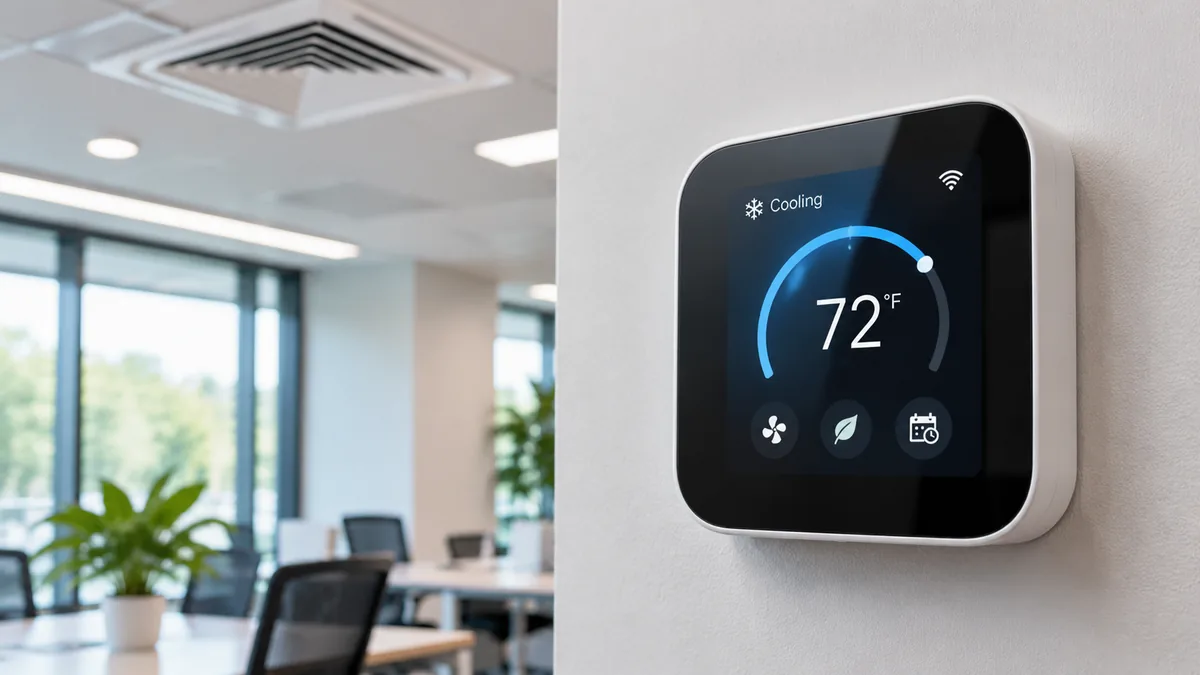
Smart thermostats support scheduling and remote control in homes. BMS platforms monitor and coordinate multiple devices, energy use, and alarms in commercial buildings.
Check communication compatibility, local control during network outages, sensor location, and support for heat-pump auxiliary heat, variable-air-volume terminals, or outdoor-air equipment. Phone-app support alone does not establish system compatibility.
Capacity Modulation Technologies
Capacity modulation adjusts compressor or system output to follow changes in cooling load, reduce cycling, and improve part-load control. Compare technologies by modulation range, control accuracy, complexity, and measured efficiency.
On/Off Cycling
On/off control regulates average cooling capacity by starting and stopping the compressor. It is simple, but at low loads the compressor cycles more often and room temperature fluctuates more.
Oversized equipment makes this problem more noticeable, especially in humid climates where continuous moisture removal matters. Appropriate control deadbands and correct sizing are more useful than simply shortening the time between cycles.
Hot-Gas Bypass
Hot-gas bypass routes some high-pressure discharge gas to the low-pressure side or evaporator inlet to keep a system stable at low load. Bypass uses additional energy and is mainly a stability-control method.
This approach serves specialized process cooling or low-evaporating-pressure protection. Designers should evaluate efficiency penalties, oil return, and the compressor operating envelope. Residential comfort systems more commonly use variable-speed or staged-capacity control.
Multiple Compressors in Parallel
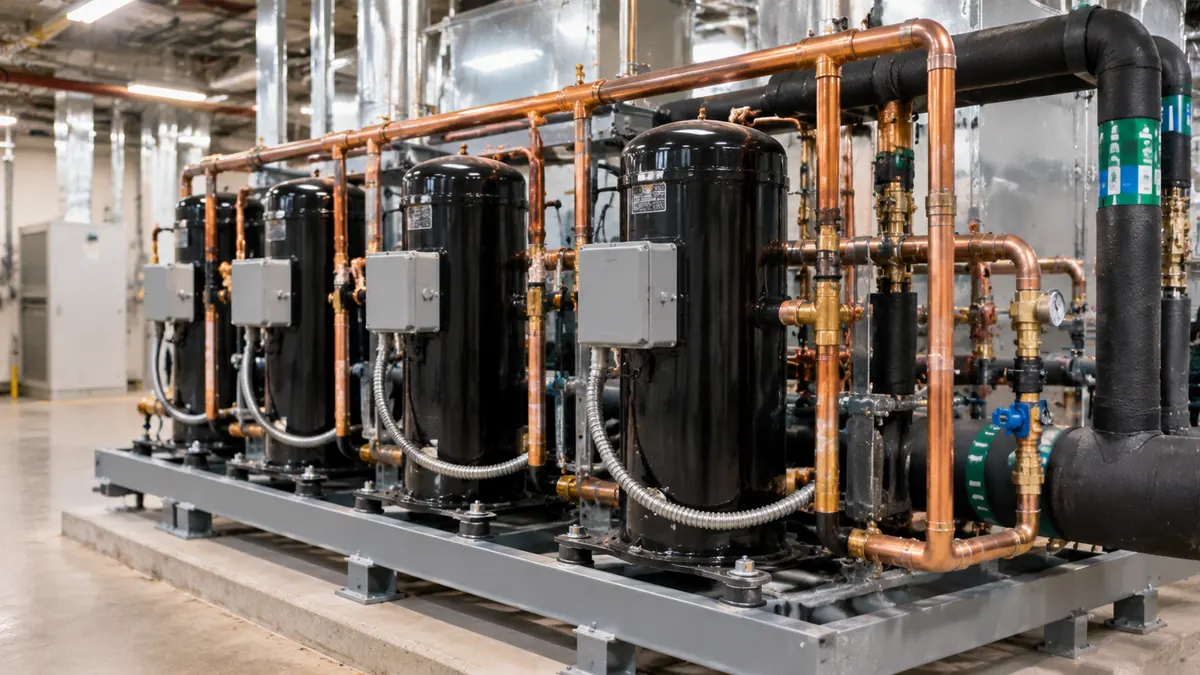
Multiple compressors operating in parallel can match changing loads through staged operation. This arrangement is common in larger chillers and commercial refrigeration systems.
The controller selects how many compressors run and coordinates runtime balancing, oil management, and short-cycle protection. Benefits include capacity staging and opportunities for redundancy, with more complex piping, controls, and protection.
Mechanical Modulation and Digital Compressors
Mechanical or digital modulation changes effective compression time or displacement to adjust average cooling output rather than changing motor speed.
Compare manufacturers’ part-load efficiency curves, modulation ranges, and noise data at the actual operating conditions when evaluating these technologies.
Variable-Speed Compressors (Inverter Technology)
A variable-speed compressor uses an inverter drive to change motor speed. It reduces output when cooling demand falls, helping stabilize indoor temperature and improve efficiency across different loads.
Check minimum stable capacity, allowable outdoor temperatures, and control logic. If a room’s load falls below the compressor’s minimum capacity, the system will still cycle on and off.
Note: Liquid injection manages temperatures under certain compressor operating conditions. Its purpose differs from on/off cycling, staging, and variable-speed capacity control.
System Design and Key Specifications
Start air conditioner sizing with the design cooling load, then check sensible heat, latent heat, airflow, cooling capacity, and efficiency. Floor area helps estimate project size, while actual equipment sizing depends on the building envelope, solar gain, occupants, ventilation, and local design weather. Oversizing can cause frequent cycling and poor moisture removal.
Cooling Load
Cooling load is the rate at which heat must be removed to maintain a design indoor condition, expressed in kW or BTU/h. Heat enters through the building envelope, sunlight, occupants, lights, equipment, outdoor air, and infiltration. U.S. residential projects can use ACCA Manual J to calculate load.
Sensible Heat
Sensible heat changes air temperature with little direct effect on moisture content. Sunlight through windows and heat from lighting, for example, raise the indoor dry-bulb temperature. Compare the unit’s rated sensible cooling capacity with its total capacity.
Latent Heat
Latent heat is associated with changes in water vapor content. Occupants, outdoor humidity infiltration, cooking, and ventilation add latent load. When the cooling coil falls below the dew point, moisture condenses and drains away. In humid climates, evaluate dehumidification and part-load performance.
Airflow
Airflow is the volume of air passing through a unit or supplied to a space per unit of time, commonly expressed in CFM or m³/h. Too little airflow reduces heat transfer and increases icing risk; too much can weaken dehumidification and increase noise. Check duct static pressure, supply and return paths, and room air distribution.
Cooling Capacity
Cooling capacity is the rate of heat removal; electrical input power is the rate of electricity use. One U.S. refrigeration ton equals 12,000 BTU/h, or about 3.517 kW of cooling capacity. An 18,000 BTU/h unit provides about 1.5 tons of cooling. Determine electrical input from rated power data and efficiency.
Application |
Key Specifications to Check |
Site Conditions to Check |
|---|---|---|
Single bedroom |
Room cooling load, sound pressure, minimum modulation capacity |
Afternoon sun, window area, number of occupants |
2,000 sq ft whole-home AC |
Room-by-room loads, ducts, system capacity, SEER2 |
Climate, insulation, ceiling height, airtightness |
Hotel room in a humid climate |
Sensible heat ratio, latent capacity, drainage, outdoor air |
Occupancy rate, outdoor wet-bulb temperature |
Large office |
Zone cooling loads, design airflow, AHU/FCU selection |
Occupant density, lighting, equipment, ventilation |
Types of Air Conditioners
Air conditioners can be classified by system design as split, packaged, ducted, or central chilled-water systems, and by installation as window, wall-mounted, ceiling cassette, or floor-standing units. Smart controls describe a feature; ground-source heat pumps describe a heating and cooling source. The table separates these classification methods.
Classification Basis |
Typical Types |
|---|---|
System configuration |
Single-split, multi-split, VRF/VRV, packaged, central chilled-water |
Service area |
Single room, multiple rooms, entire home, centralized commercial |
Indoor-unit installation |
Wall-mounted, ducted, ceiling cassette, floor-standing, through-the-wall |
Energy source and function |
Cooling-only AC, air-source heat pump, ground-source heat pump |
Control method |
Fixed-speed on/off, variable-speed capacity control, smart connectivity |
Single-Split and Multi-Split Air Conditioning Systems
Best for: Homes with several bedrooms, small offices, and retrofits without extensive ductwork. Single-split systems serve one zone; multi-split systems support independent control of multiple zones.
Energy efficiency: Single-zone and residential multi-split ratings apply to the matched indoor/outdoor combination. ENERGY STAR criteria for residential split-system cooling equipment are SEER2 ≥15.2 and EER2 ≥12.0; for split-system heat pumps, they are SEER2 ≥15.2, EER2 ≥11.0, and HSPF2 ≥7.8. Larger commercial VRF systems use IEER instead. For example, the U.S. federal minimum for cooling-only VRF units rated 65,000–135,000 BTU/h is IEER 15.5. These are certification or regulatory thresholds; check the certification record for each model’s actual rating.
Price: $2,500–$6,000 for a single-zone split system; $6,500–$15,000 for a multi-split system serving about 3–5 zones, including standard installation.
Benefits • Flexible room zoning with separate setpoints and schedules • Most retrofits avoid installing a complete supply duct network • Different indoor-unit styles can suit different rooms |
Drawbacks • Simultaneous operation is limited by outdoor-unit capacity and matched configuration • More indoor units and longer piping complicate installation • Fresh air requires a compatible feature or separate ventilation |
Overview
A single-split system connects one indoor unit to one outdoor unit. A multi-split system connects several indoor units to one outdoor unit. The right configuration depends on room count, simultaneous use, allowable refrigerant piping runs, and maintenance access.
Central Air Conditioning Systems
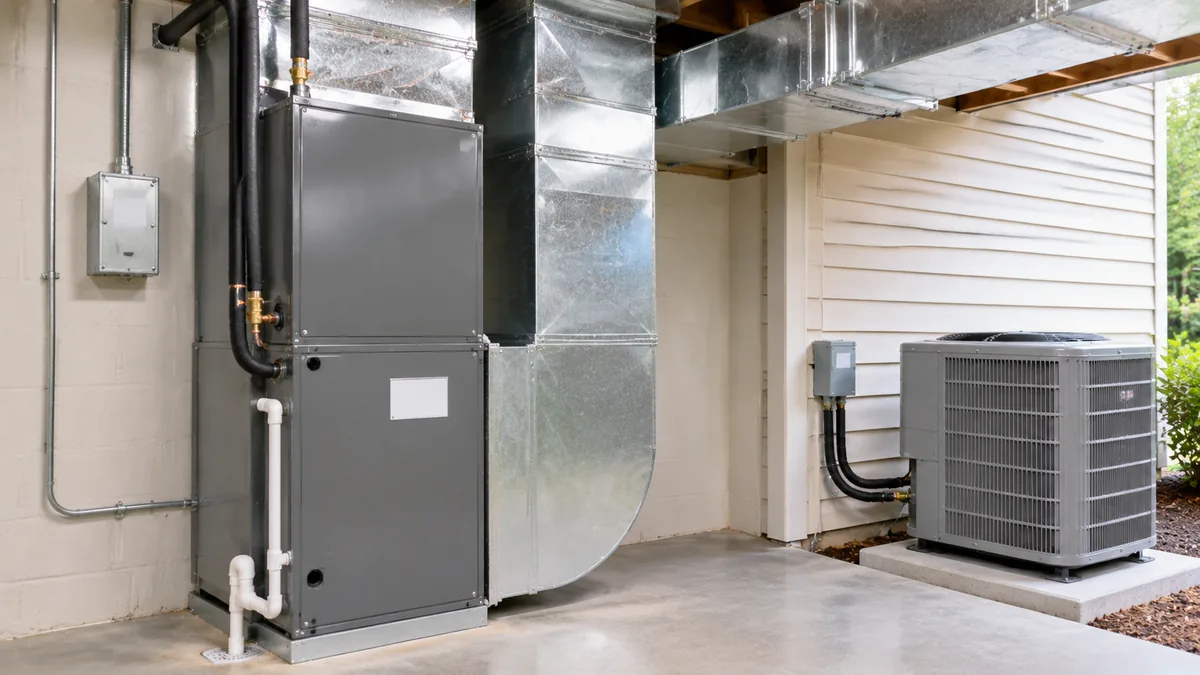
Best for: Detached homes with existing ductwork, larger multiroom homes, and buildings that need a single duct network to serve multiple rooms.
Energy efficiency: ENERGY STAR criteria for residential ducted split central air conditioners are SEER2 ≥15.2 and EER2 ≥12.0; for residential packaged central air conditioners, SEER2 ≥15.2 and EER2 ≥11.5. For comparison, a U.S. Department of Energy publication lists SEER2 values of 13.4 (lower efficiency), 15.2 (ENERGY STAR tier), and 23.5 (a listed high-efficiency model). Actual seasonal consumption also depends on duct leakage, fan operation, and cooling demand.
Price: $5,300–$10,500 for a U.S. home with serviceable existing ducts, including standard installation.
Benefits • One duct network serves multiple rooms with fewer visible devices • Centralized filtration, scheduling, and whole-home temperature control • Replacing a unit is simpler when suitable ducts already exist |
Drawbacks • Duct leakage and poor insulation increase consumption • A single thermostat may create uneven room temperatures • New ducts or major zoning changes can increase project scope |
Overview
Residential central air conditioning distributes cooled air through supply and return ductwork to several rooms. Homes needing room-by-room temperature control require additional zone thermostats, dampers, and supply-air balancing.
Central Chilled-Water Cooling Systems
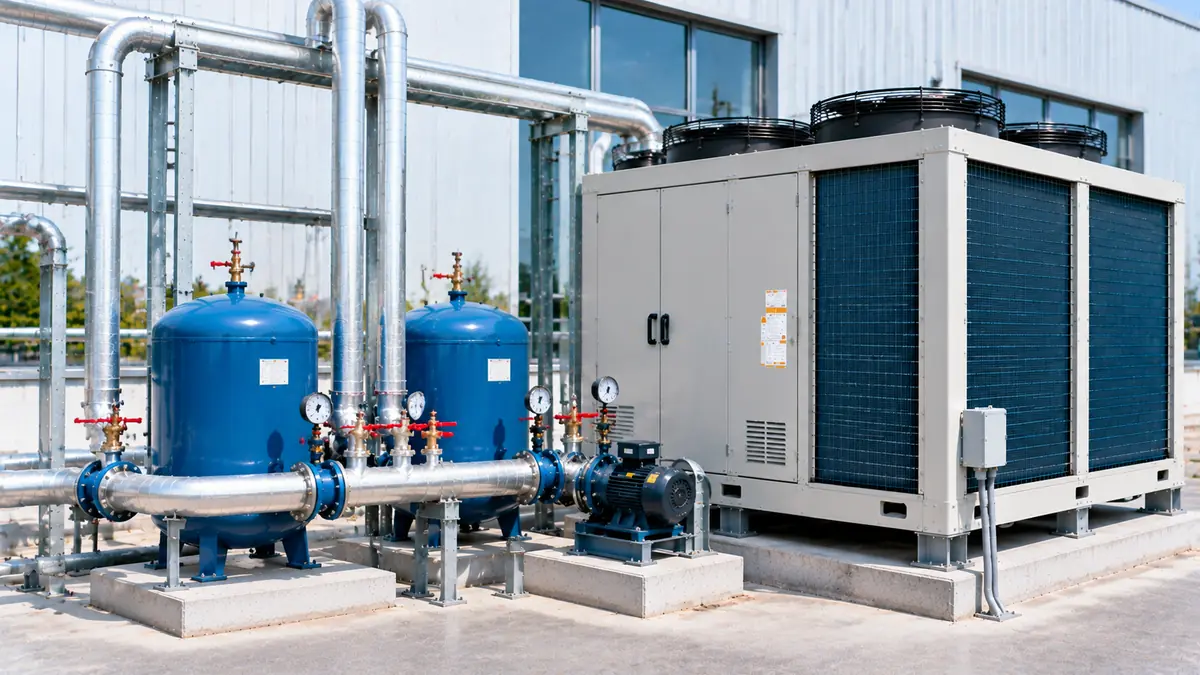
Best for: Large offices, shopping centers, campuses, and multi-zone commercial buildings that need centralized cooling capacity.
Energy efficiency: For a 75–149 refrigeration-ton water-cooled positive-displacement chiller, the U.S. DOE/FEMP optimized full-load purchasing limit is ≤0.701 kW/ton, with an integrated part-load value (IPLV) of ≤0.560 kW/ton. A 100-ton chiller operating at that full-load operating point draws about 70.1 kW for the chiller alone. Chilled-water pumps, condenser-water pumps, cooling towers, and AHUs/FCUs consume additional power. This value applies to the cited equipment class and is not a universal chiller rating.
Price: $200,000–$500,000 as an estimated budget for a commercial chilled-water system of about 100 tons; equipment and construction scope vary by project.
Benefits • Central control of large loads and numerous terminals • AHUs and FCUs can be selected for different zones • Supports plant-level staging and centralized monitoring |
Drawbacks • More extensive initial piping, mechanical-room work, and commissioning • Chilled-water systems need water quality, valve, and pump maintenance • Whole-building energy includes chillers, pumps, and terminals |
Overview
A central chilled-water system combines a chiller, chilled-water pumps, distribution piping, and air-side terminals such as AHUs and FCUs. It serves large buildings with many zones and long operating hours and can work alongside outdoor-air systems and building automation.
Portable Air Conditioners
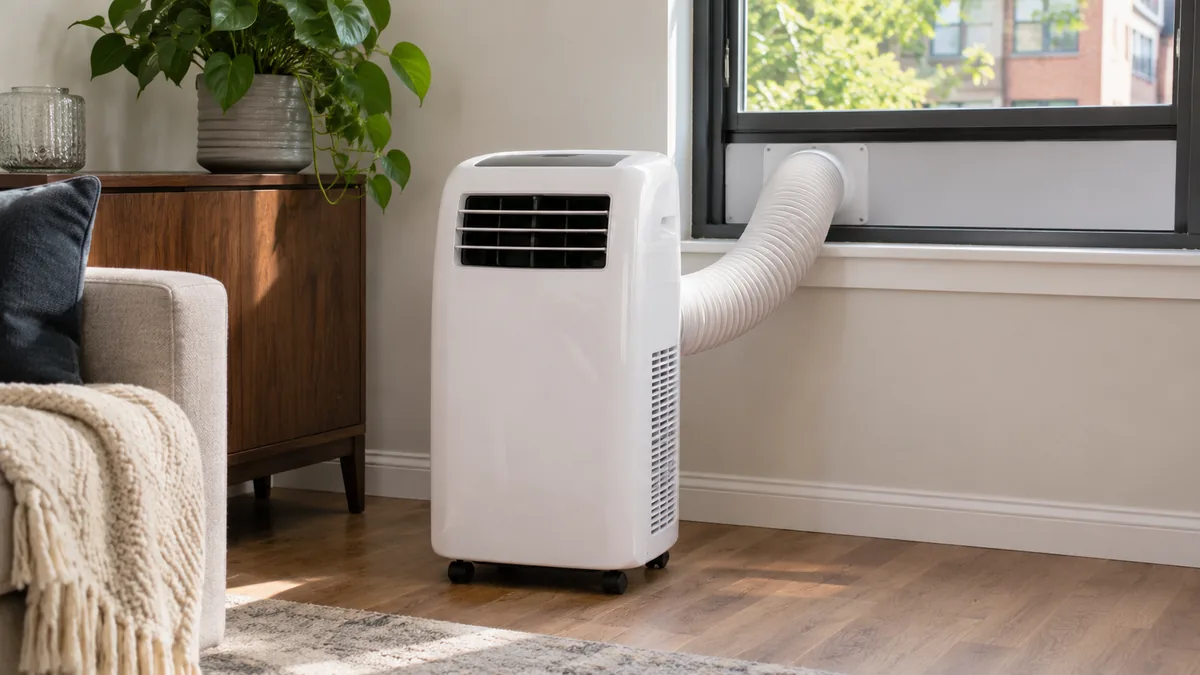
Best for: Rental homes, temporary cooling, and individual rooms where permanent AC installation is restricted but a suitable exhaust opening is available.
Energy efficiency: Beginning January 10, 2025, the U.S. minimum CEER for portable air conditioners is calculated from seasonally adjusted cooling capacity (SACC): CEER ≥ 1.04 × SACC ÷ (3.7117 × SACC^0.6384). For example, a model rated at 8,000 BTU/h SACC has a minimum CEER of about 7.22; at 10,000 BTU/h SACC, the minimum is about 7.83. Compare SACC and CEER together for portable units. Window units use their own rated-capacity categories and CEER requirements.
Price: $250–$950 for a single unit, equipment only.
Benefits • Move the unit without permanently installing an outdoor unit • Suitable for temporary use or rooms with installation restrictions • Reuse the same unit in different rooms |
Drawbacks • Compressor remains indoors, increasing noticeable noise • Exhaust hose occupies a window and can increase infiltration • Sensitive to drainage, hose bends, and air leaks |
Overview
A portable air conditioner houses the compressor, evaporator, and condenser in one indoor cabinet that can be moved between rooms. Its exhaust hose must vent condenser heat outdoors during operation.
Window Air Conditioners and Packaged Terminal Units (PTACs)
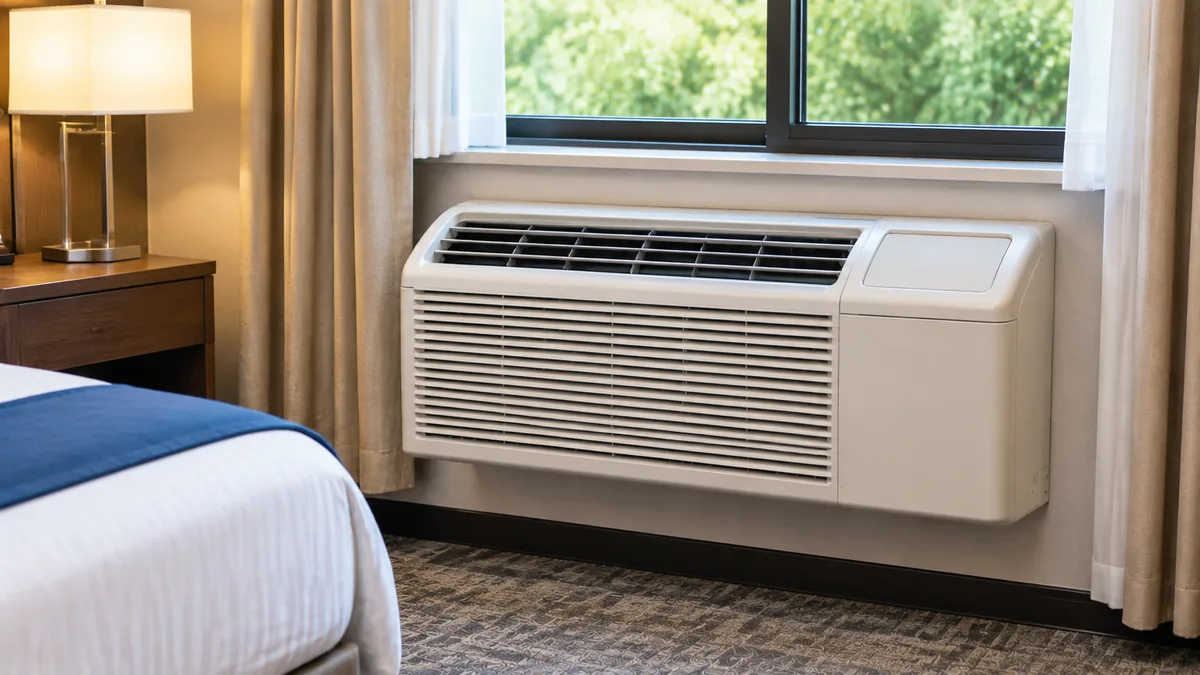
Best for: Window units suit single rooms with compatible windows; PTACs suit hotels, dormitories, apartments, and other projects requiring independent room control.
Energy efficiency: For window units manufactured on or after May 26, 2026, without reverse-cycle heating, with side louvers, and rated 8,000–13,900 BTU/h, the U.S. federal minimum is CEER 16.0. PTACs use EER ratings. For example, the 12,000 BTU/h Amana PTH124J lists EER 11.3, while the roughly 12,000 BTU/h Friedrich PZE12K3SC lists EER 10.8. Compare each category under its applicable test method.
Price: $300–$1,100 for a window unit with standard installation; $1,200–$3,500 for a PTAC replaced in an existing room opening.
Benefits • Window units are compact and cool a single room • PTACs provide room-level controls and straightforward replacement • Neither requires whole-home central ducts |
Drawbacks • Window units face window type, support, and daylight limits • PTACs must match wall sleeves and intake/exhaust paths • Noise and building openings need attention |
Overview
A window air conditioner fits into a window opening, while a PTAC fits into a dedicated exterior-wall opening and sleeve. Both are room-level packaged units, but their openings, airflow paths, and replacement dimensions follow different product specifications.
Packaged Air Conditioners
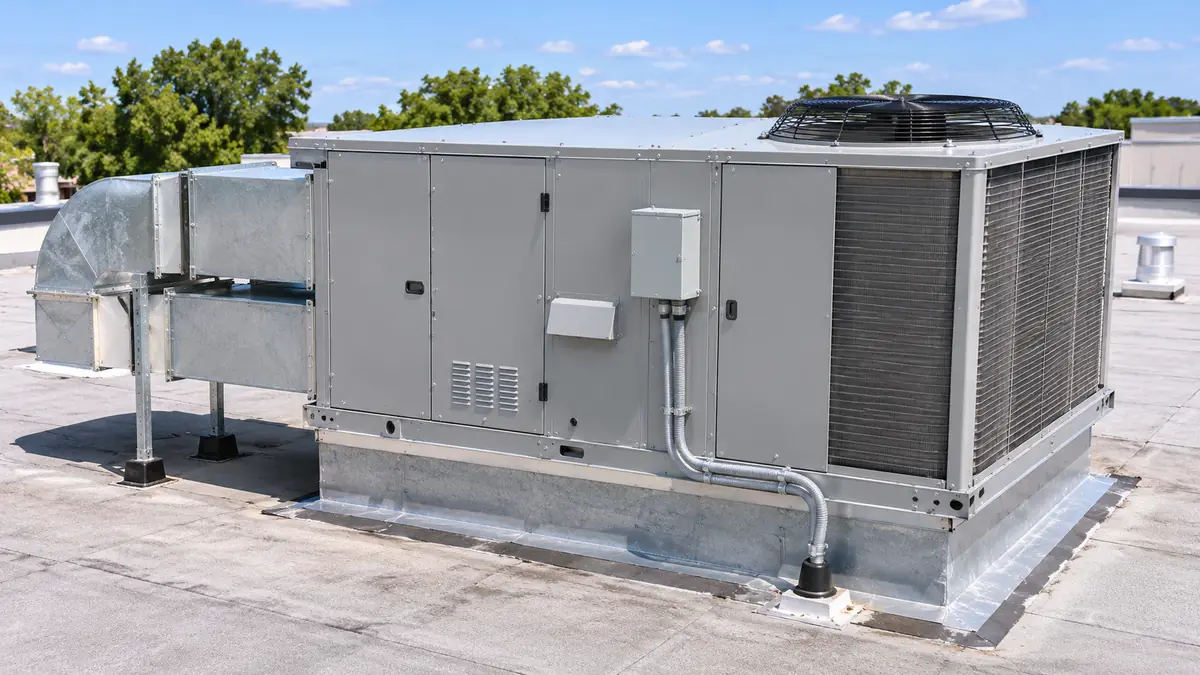
Best for: Homes and small to midsize commercial buildings with an outdoor platform, rooftop, or other dedicated installation location, especially where a single packaged unit connects to ductwork.
Energy efficiency: ENERGY STAR criteria for residential packaged air conditioners are SEER2 ≥15.2 and EER2 ≥11.5. For commercial rooftop units rated 65,000–135,000 BTU/h with electric resistance heat or cooling only, ENERGY STAR criteria include EER ≥12.7 and IEER ≥18.0. Residential products use SEER2/EER2, while commercial products use EER/IEER according to capacity and configuration.
Price: $5,000–$12,500 for a residential packaged-unit replacement, including standard installation.
Benefits • Main refrigeration components share one cabinet • Reduces onsite refrigerant piping between indoor and outdoor sections • Works with existing commercial ductwork |
Drawbacks • Uses roof or outdoor building space • Rigging, roof penetrations, and vibration isolation complicate installation • Poor placement can increase noise and service costs |
Overview
This category includes packaged ducted units and commercial rooftop units (RTUs), with the major refrigeration components inside a single cabinet. Ductwork carries conditioned air into the building. Window and portable models are separate room-level packaged categories covered above.
Ductless Mini-Split Air Conditioning Systems
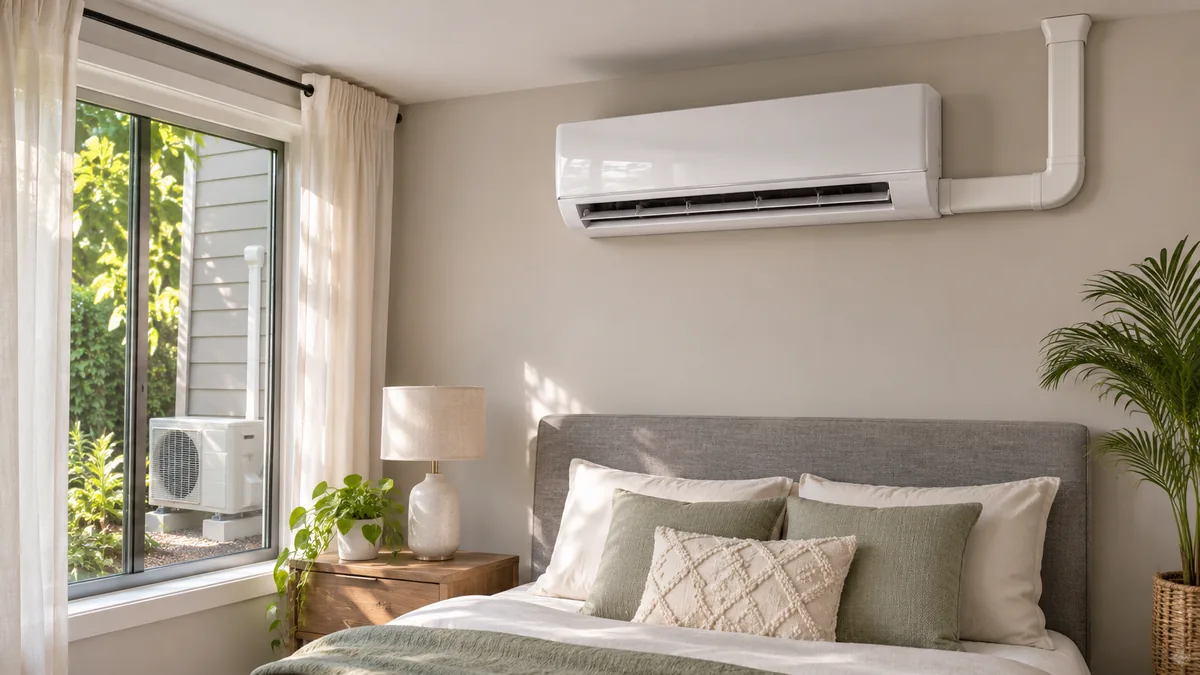
Best for: Bedrooms without central ductwork, home additions, converted garages, and small spaces requiring precise single-zone control.
Energy efficiency: ENERGY STAR criteria for residential ductless split heat pumps are SEER2 ≥15.2, EER2 ≥11.0, and HSPF2 ≥7.8. To qualify for the cold-climate designation, ductless systems also need HSPF2 ≥8.5 and must meet low-temperature capacity requirements. For cooling-only residential split systems, the criteria are SEER2 ≥15.2 and EER2 ≥12.0. These are minimum certification thresholds; actual matched-system ratings may be higher.
Price: $2,500–$6,000 for a single-zone system with standard installation.
Benefits • No whole-home supply ducts, reducing duct distribution losses • Independent room control supports different schedules • Various indoor-unit styles suit walls or suspended ceilings |
Drawbacks • Every zone needs a suitable indoor-unit location • Standard units do not supply outdoor air automatically • Installation quality affects drainage, noise, and capacity |
Overview
A ductless mini-split uses wall-mounted, cassette, or other indoor units to deliver air directly to a room. Unlike a ducted split system, it does not require a whole-home supply duct network.
Ground-Source Heating and Cooling Systems
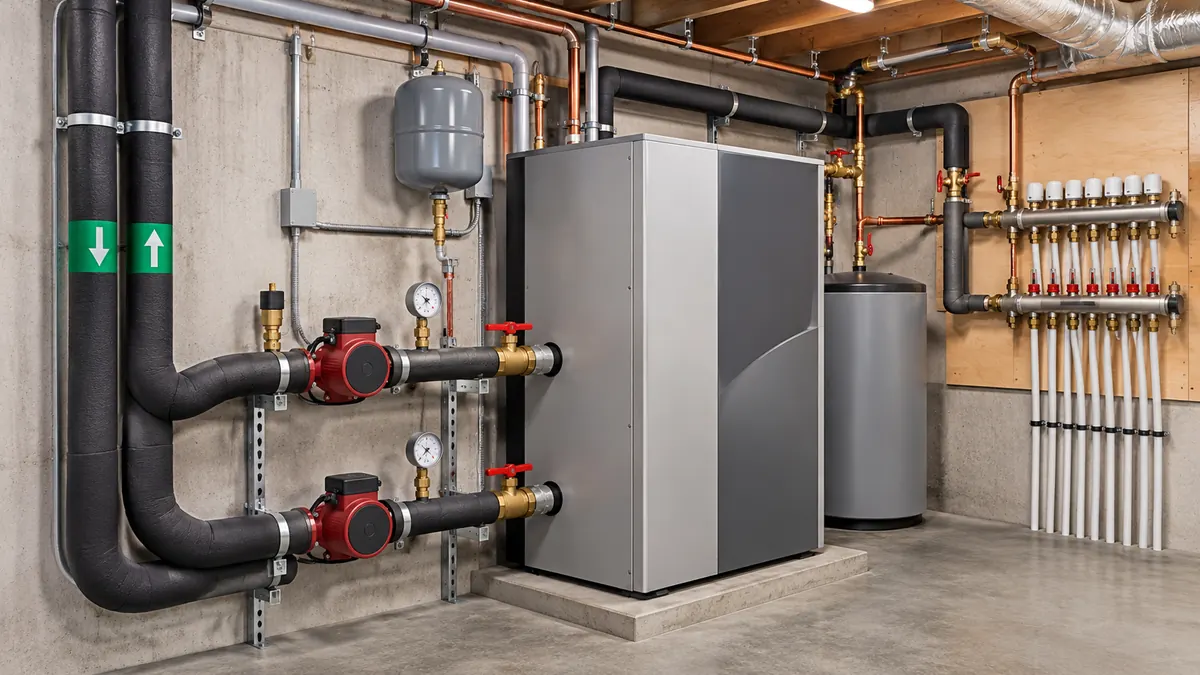
Best for: New buildings or major renovations with suitable ground heat-exchange conditions, a long expected service life, and steady heating and cooling demand.
Energy efficiency: ENERGY STAR criteria for geothermal heat pumps depend on system type. Closed-loop water-to-air systems require EER ≥17.1 and heating COP ≥3.6; open-loop water-to-air systems require EER ≥21.1 and COP ≥4.1; closed-loop water-to-water systems require EER ≥16.1 and COP ≥3.1. EER measures cooling efficiency and COP measures heating efficiency. Project-wide consumption must also account for ground-loop pumps and indoor terminals.
Price: $15,000–$40,000 as an estimated installed residential budget, including the ground heat-exchange loop.
Benefits • Ground exchange temperatures are comparatively stable • One system can heat and cool • Works with hydronic distribution and long-term zoning plans |
Drawbacks • Drilling, ground loops, and civil work raise upfront cost • Site geology and groundwater limit design options • Long-term thermal balance and pump power require analysis |
Overview
Ground-source heat pumps exchange heat with soil or water through a ground loop and a refrigeration system. Compressors and circulation pumps still use electricity. Long-term economics depend on annual loads, geology, design life, and ground-loop installation cost.
Built-In Wall-Mounted and Through-the-Wall Air Conditioners
Best for: Apartments, hotels, and renovation projects with exterior-wall constraints, a need to preserve window space, and suitable existing wall openings.
Energy efficiency: For packaged through-the-wall room air conditioners manufactured on or after May 26, 2026, without reverse-cycle heating or side louvers and rated 11,000–13,900 BTU/h, the U.S. federal minimum is CEER 13.9. For a built-in split system that falls under the ENERGY STAR residential split central-air category, the applicable threshold is SEER2 ≥15.2 and EER2 ≥12.0. Identify the product category before applying its efficiency standard.
Price: $900–$3,500 for a packaged through-the-wall unit; $2,500–$6,000 for a built-in split system, depending on equipment and installation scope.
Benefits • Preserves more window space than a conventional window unit • Existing sleeves can simplify replacement for compatible models • Can be integrated neatly into the building facade |
Drawbacks • Wall openings need careful insulation and weather sealing • Sleeve dimensions and heat-rejection airflow must match the model • Poor installation can cause thermal bridges, leakage, or noise |
Overview
“Built-in wall-mounted” and “through-the-wall” describe installation methods. The actual refrigeration design may be packaged or split. Check each model’s outdoor-air intake and discharge requirements in the manufacturer specifications.
Smart Air Conditioners
Best for: Homes, hotels, and small commercial spaces that need remote operation, schedules, occupancy-based control, or energy monitoring.
Energy efficiency: A smart air conditioner uses the efficiency rating of its underlying equipment type. For example, a cooling-only U.S. window unit manufactured on or after May 26, 2026, with side louvers and rated 8,000–13,900 BTU/h has a federal minimum CEER of 16.0. An ENERGY STAR residential split air conditioner meets SEER2 ≥15.2 and EER2 ≥12.0. Wi-Fi, schedules, and sensors change operating strategy; the model’s certified CEER or SEER2 determines its certified efficiency.
Price: $230–$750 for a Wi-Fi window unit, equipment only; $2,500–$6,000 for a smart single-zone split system with standard installation.
Benefits • Remote adjustment of setpoints, modes, and schedules • Sensors can reduce operation in empty rooms • Provides access to alerts and some energy-use data |
Drawbacks • Online functions depend on compatibility and cloud services • Fixed-speed equipment retains its on/off control logic • Cybersecurity, privacy, and long-term support need planning |
Overview
Smart AC adds connectivity, sensors, and automated controls to window, split, and central systems. It describes control features rather than a separate refrigeration design, so a smart unit also belongs to a conventional equipment category.
Ceiling Cassette Air Conditioners
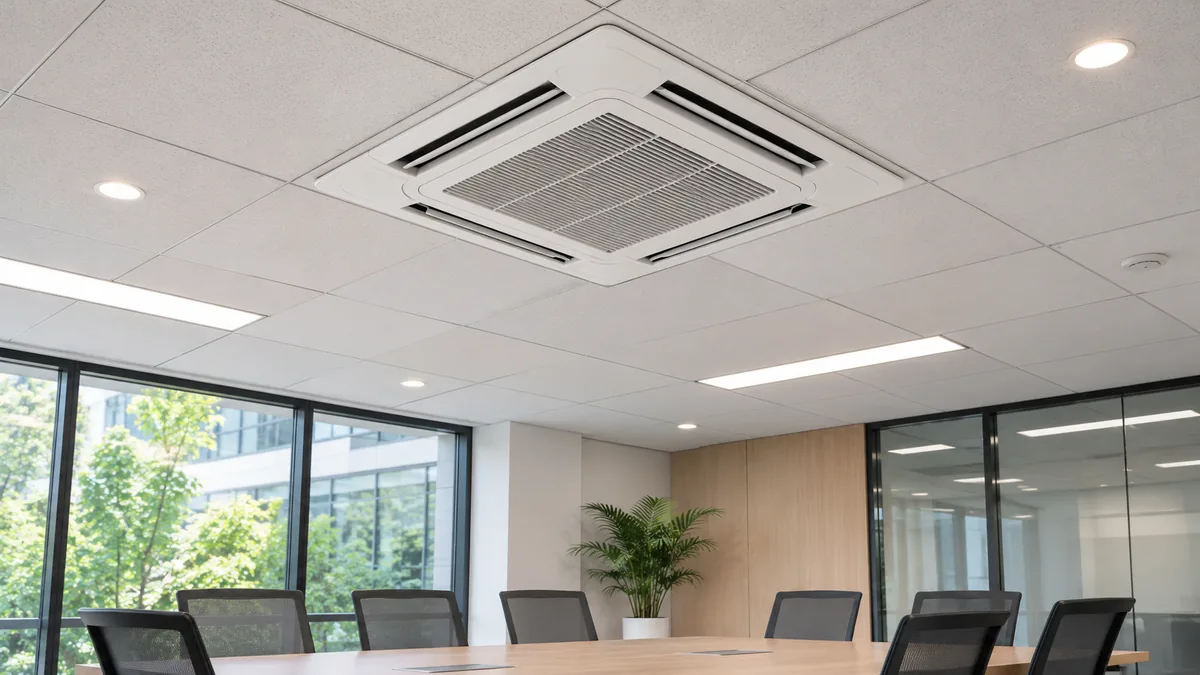
Best for: Offices, retail stores, meeting rooms, and open spaces with suspended ceilings that benefit from multidirectional airflow.
Energy efficiency: A ceiling cassette is an indoor-unit configuration, so efficiency is rated for the matched indoor/outdoor system. With an ENERGY STAR residential split cooling system, the requirement is SEER2 ≥15.2 and EER2 ≥12.0. With a commercial cooling-only VRF system rated 65,000–135,000 BTU/h, the U.S. federal minimum is IEER 15.5. Compare certified performance for the specific indoor/outdoor combination.
Price: $3,000–$8,500 for a single-zone cassette split system with standard installation.
Benefits • Recessed indoor unit preserves wall space • Multidirectional airflow covers open areas • Can be part of single-split or multi-zone VRF controls |
Drawbacks • Requires ceiling clearance and maintenance access • Condensate pumps and drains require maintenance • Poor diffuser placement can blow directly onto occupants |
Overview
A ceiling cassette is a recessed indoor terminal connected to a split or VRF outdoor system. Its panel sits flush with a suspended ceiling, preserving valuable wall space.
Floor-Standing Air Conditioners
Best for: Large living rooms, stores, display areas, and spaces where wall-mounted or ceiling-mounted indoor units are impractical.
Energy efficiency: Floor-standing describes the indoor-unit configuration; efficiency is rated for the complete system. With an ENERGY STAR residential split cooling outdoor unit, eligibility criteria are SEER2 ≥15.2 and EER2 ≥12.0. With a split heat pump, the criteria are SEER2 ≥15.2, EER2 ≥11.0, and HSPF2 ≥7.8. Use model-specific ratings and load data to estimate annual energy use.
Price: $3,000–$5,000 for a single-zone floor-standing split system with standard installation.
Benefits • Can be placed without high wall mounting • Delivers focused airflow to larger open areas • Service and cleaning points are relatively accessible |
Drawbacks • Takes up usable floor space • Poor placement can short-circuit supply and return air • Large open spaces may need multiple units based on load and coverage |
Overview
A floor-standing AC has an indoor cabinet positioned at floor level and typically connects through refrigerant piping to an outdoor condenser. It works where wall or ceiling space is limited.
How Do Air Conditioner Types Compare?
Start with the space and how it will be used. Then compare installation requirements, control options, noise, rated efficiency, and lifetime cost. Different equipment categories use different efficiency metrics rather than a universal 1–10 efficiency score.
Type |
Best For |
Main Advantage |
Main Limitation |
Price Range (USD) |
Energy Efficiency (Specific Metric) |
|---|---|---|---|---|---|
Single-zone split |
Bedroom, single room |
Independent controls, relatively quiet |
Requires an outdoor unit and refrigerant piping |
$2,500–$6,000 |
SEER2 ≥15.2 |
Multi-split |
Multiroom homes |
Fewer outdoor units, flexible zoning |
Simultaneous loads and piping are more complex |
$6,500–$15,000 |
SEER2 ≥15.2 |
Window AC |
Single room with compatible window |
Compact installation, manageable initial cost |
Window constraints and noise |
$300–$1,100 |
CEER 16.0 |
Portable AC |
Temporary room, rental |
Easy to move |
Exhaust takes window space; more indoor noise |
$250–$950 |
CEER ≥7.22 |
Ducted central AC |
Whole home with ducts |
Whole-home cooling, discreet appearance |
Requires proper supply and return duct design |
$5,300–$10,500 |
SEER2 ≥15.2 |
PTAC |
Individual hotel or apartment room |
Room-level controls, modular maintenance |
Wall opening and building facade requirements |
$1,200–$3,500 |
EER 10.8–11.3 |
Chilled-water system |
Large mall, high-rise office |
Centralized cooling for large loads |
Complex plant room, piping, and upkeep |
$200,000–$500,000 |
Full load ≤0.701 kW/ton |
VRF/VRV |
Multiroom offices and hotels |
Flexible zones and indoor-unit coordination |
Controls, piping, and ventilation coordination |
$30,000–$85,000 |
IEER ≥15.5 |
Packaged AC |
Homes and small commercial duct systems |
Integrated equipment, fewer field connections |
Roof/outdoor space and lifting requirements |
$5,000–$12,500 |
SEER2 ≥15.2 |
Ductless mini-split |
Ductless room or addition |
Room zoning without central ducts |
Wall penetrations and drains need planning |
$2,500–$6,000 |
SEER2 ≥15.2 |
Ground-source heat pump |
Long-term residential or retrofit use |
Stable ground exchange; cooling and heating |
High drilling and loop installation costs |
$15,000–$40,000 |
EER ≥17.1 (cooling) |
Through-the-wall / built-in |
Apartment or room with an existing wall sleeve |
Preserves windows; fits wall opening |
Sleeve fit, water sealing, and airflow |
Packaged: $900–$3,500 |
Packaged CEER ≥13.9 |
Smart AC |
Room requiring remote or scheduled controls |
Convenient scheduling and remote adjustments |
Connectivity and compatibility checks |
$230–$750 |
Window CEER 16.0 |
Ceiling cassette |
Suspended-ceiling office or meeting room |
Multidirectional airflow; frees walls |
Requires ceiling clearance and drainage |
$3,000–$8,500 |
Split SEER2 ≥15.2 |
Floor-standing AC |
Living room, shop, limited wall space |
Works where wall and ceiling placement is difficult |
Uses floor space; airflow can be blocked |
$3,000–$5,000 |
SEER2 ≥15.2 |
DC-Powered vs. AC-Powered Air Conditioners
The main differences between DC- and AC-powered air conditioners are their input power sources and conversion paths. Most household units use the AC power grid, while DC models are designed for batteries, energy storage, or solar DC buses. Check input voltage, protection devices, and controller requirements.
Comparison |
AC-Powered Air Conditioner |
DC-Powered Air Conditioner |
|---|---|---|
Power source |
Typically 120V/240V or another regional AC utility supply |
Designed for batteries, DC buses, or solar PV systems |
Motor and compressor |
Fixed-speed or inverter; an inverter generally rectifies AC before producing controlled output |
Often uses a dedicated controller; internal power electronics may drive compressor and fans |
Efficiency comparison |
Use whole-system SEER2, EER, COP, or measured kWh |
Account for DC conversion, batteries, and solar-path losses in total system energy use |
Typical application |
Grid-connected homes and commercial buildings |
Off-grid systems, battery storage, solar DC projects |
“AC” means air conditioning in HVAC discussions and alternating current in electrical discussions. An inverter air conditioner can receive AC utility power and convert it internally to DC and back to controlled AC. A DC-powered unit receives DC power directly into its electronics.
Portable vs. Window Air Conditioners: Which Is Better?
Choose a window air conditioner for a room with a compatible window where permanent cooling is needed. Choose a portable unit for rentals, short-term use, or rooms where the equipment must be moved. A single-hose portable unit can create negative indoor pressure, so seal the exhaust connection carefully.
Comparison |
Portable AC |
Window AC |
|---|---|---|
Typical U.S. purchase price |
$250–$950 |
$300–$1,100 |
Efficiency label |
DOE SACC and CEER; test methods differ from window units |
Rated BTU/h, CEER, and window compatibility |
Main advantage |
Portable; connects to outdoor exhaust when operating |
Hot-side components are mostly outside; convenient for permanent use |
Main limitation |
Exhaust hose, sealing, indoor noise |
Window frame, dimensions, mounting, drainage |
Best choice |
Short-term rental, temporary cooling, no suitable window installation |
Fixed bedroom, home office, or single room with long-term use |
Compare effective cooling performance using the correct test methods, then check window support, exhaust sealing, indoor noise, local electricity prices, and expected usage. Portable units use SACC for seasonally adjusted capacity, while window units use the rated capacity defined for their category.
How to Choose Based on Your Needs
For one bedroom, compare single-zone mini-splits and compatible window units. For whole-home cooling with existing ducts, compare ducted central AC and ducted heat pumps. For independent control across several rooms, compare multi-splits and multiple single-zone systems. For a standard hotel room, compare PTACs, fan coil units, and multi-split options based on maintenance and room-level control. For large offices and shopping centers, assess building loads, heating and cooling sources, ventilation, and operations first.
What’s the Difference Between Air Conditioning, AC, and HVAC?
Air conditioning refers to the process or system used to condition indoor air. AC is its common abbreviation. HVAC covers heating, ventilation, and air conditioning as an integrated building system.
Comparison |
Air Conditioning |
AC |
HVAC |
|---|---|---|---|
Full meaning |
The process of conditioning air |
Abbreviation for Air Conditioning |
Heating, Ventilation and Air Conditioning |
Everyday meaning |
Air treatment process or system |
Usually cooling equipment or function |
Integrated building heating, ventilation, and cooling |
Cooling only? |
Depends on configuration: can include cooling, heating, dehumidification, and airflow control |
Often refers to cooling in everyday use |
Covers heating and ventilation as well |
Always supplies fresh air? |
No |
No |
Includes ventilation design; specific outdoor-air equipment depends on building needs |
Typical settings |
Indoor environmental conditioning |
Residential splits and window units |
Whole-home systems, offices, shopping centers |
How the Three Terms Relate
HVAC is the broader framework for building heating, ventilation, and cooling. Air conditioning refers to controlling indoor air conditions and the equipment that does so. AC is the usual abbreviation and often means cooling equipment in everyday speech.
For example, an office may use a heat pump or chiller for heating or cooling, an AHU for air treatment and distribution, outdoor-air equipment for ventilation, and a BMS for automatic control. In everyday conversation, “turn on the AC” means switching on the cooling function.
Air Conditioning: In More Detail
In engineering, air conditioning can involve sensible cooling, latent heat removal, humidification, filtration, and airflow distribution. A residential comfort system and a laboratory with precise temperature and humidity requirements need different equipment, sensors, and control accuracy.
AC: In More Detail
AC may refer to cooling equipment or simply the action of turning on cooling. Common residential examples include window units, single-zone splits, and ducted central systems. Technical documents should clarify whether AC means the cooling equipment or the broader air conditioning system.
HVAC: In More Detail
HVAC emphasizes system coordination: heating supplies warmth or a heat source in winter, ventilation manages outdoor air and exhaust, and air conditioning manages indoor air conditions. HVAC design also includes load calculations, controls, airflow, filtration, and maintenance.
Which Air Conditioner Works Best in Different Spaces?
Choose equipment based on floor area, occupant density, changing loads, noise targets, and outdoor-air needs. Bedrooms emphasize quiet operation and nighttime comfort; living rooms emphasize coverage and balanced airflow; shopping centers must handle high occupancy, ventilation, zoning, and central control.
Bedrooms
For a bedroom, prioritize equipment that meets the room’s cooling load, operates quietly, and maintains a stable temperature. A single-zone ductless mini-split is a common option; homes with suitable existing ducts can also use central AC.
System Type
A single-zone mini-split works well in a bedroom without ducts. A window unit suits rooms with compatible windows and limited budgets. Central AC serves homes with suitable ductwork and a need for whole-home cooling. For temporary use, a portable unit can vent through a well-sealed opening to the outdoors.
Air Treatment
An indoor-unit filter primarily captures dust and larger particles. A coil below the air’s dew point condenses and removes some moisture. To address fine particles, odors, and allergens, select appropriate filtration, air cleaning, and ventilation based on the pollutant.
Zone Control
A dedicated bedroom unit can provide nighttime cooling without cooling an entire home. For multi-split systems that connect several indoor units to one outdoor unit, confirm independent room controls, outdoor-unit capacity, and simultaneous-use assumptions.
Ventilation
Most bedroom split systems recirculate indoor air and do not bring in outdoor air. Enclosed bedrooms need existing mechanical ventilation, controlled window opening, or another suitable outdoor-air source, especially when several people sleep in the room.
Living Rooms
Living-room cooling loads depend on floor area, how often doors and windows open, and occupant activity. Check design cooling capacity, airflow coverage, and noise, then account for ceiling height, orientation, and openings when sizing the system.
System Type
An open-plan living room may use a higher-capacity wall-mounted split, floor-standing unit, ducted split, or central AC. If the living room connects to a dining area and hallway, include the full conditioned area and its solar, lighting, and occupancy loads in the calculation.
Air Treatment
Where a kitchen opens to the living room, a range hood or dedicated exhaust handles cooking moisture and odors. The air conditioner controls temperature and some humidity, while ventilation supplies outdoor air.
Zone Control
Living rooms and bedrooms often have different schedules. Separate living and sleeping areas into zones with their own setpoints and schedules to reduce cooling in unoccupied spaces.
Ventilation
Frequent door opening brings warm, humid outdoor air indoors, increasing cooling and latent loads. Address entrance airflow, building airtightness, ventilation methods, and outdoor conditions during system design.
Shopping Centers
Shopping centers commonly use central plants, rooftop units, or large VRF/VRV systems with AHUs, FCUs, and outdoor-air equipment. Retail areas, restaurants, corridors, and other spaces are separated into controllable zones.
System Type
Large malls may use chillers with air handling units. Smaller stand-alone stores often use packaged rooftop units or VRF/VRV. Zoning across floors and tenants depends on occupancy type, shaft space, and operations.
Air Treatment
High-occupancy areas need outdoor air as required by the ventilation design. Restaurants, restrooms, and mechanical rooms need exhaust and pressure control suited to their function. Filter selection must also account for available static pressure and maintenance capability.
Zone Control
Separate control for atriums, retail units, dining areas, and back-of-house spaces helps avoid operating the whole building at peak load. Business hours, customer traffic, and sunlight affect each zone’s cooling demand.
Ventilation
Coordinate outdoor-air supply, exhaust, and building pressure. When using energy recovery or economizer control, check whether outdoor temperature and humidity conditions support additional outdoor airflow.
Types of Commercial Air Conditioning Systems
Commercial air conditioning combines heating and cooling sources, air handling terminals, outdoor-air ventilation, exhaust, and building controls. Offices, shopping centers, and hotels use different system combinations based on zone loads, schedules, and indoor air quality requirements.
System |
Suitable Buildings |
Main Features |
Key Design Considerations |
|---|---|---|---|
Chiller + AHU/FCU |
Large offices, mixed-use complexes |
Central plant, chilled-water distribution |
Piping, pumps, terminals, water treatment |
VRF/VRV |
Multiroom offices, hotels |
Refrigerant distribution, multiple zones |
Refrigerant piping, power, simultaneous load |
Rooftop unit (RTU) |
Retail, single-story commercial |
Integrated unit with duct delivery |
Roof loading, ducts, outdoor air, economizer |
Ducted split |
Small to midsize offices |
Central indoor unit + ducts |
Static pressure, supply/return air, zoning |
DOAS |
Commercial buildings requiring separate ventilation |
Handles outdoor-air loads separately from space loads |
Dehumidification, energy recovery, control integration |
How Does Office Building Air Conditioning Work?
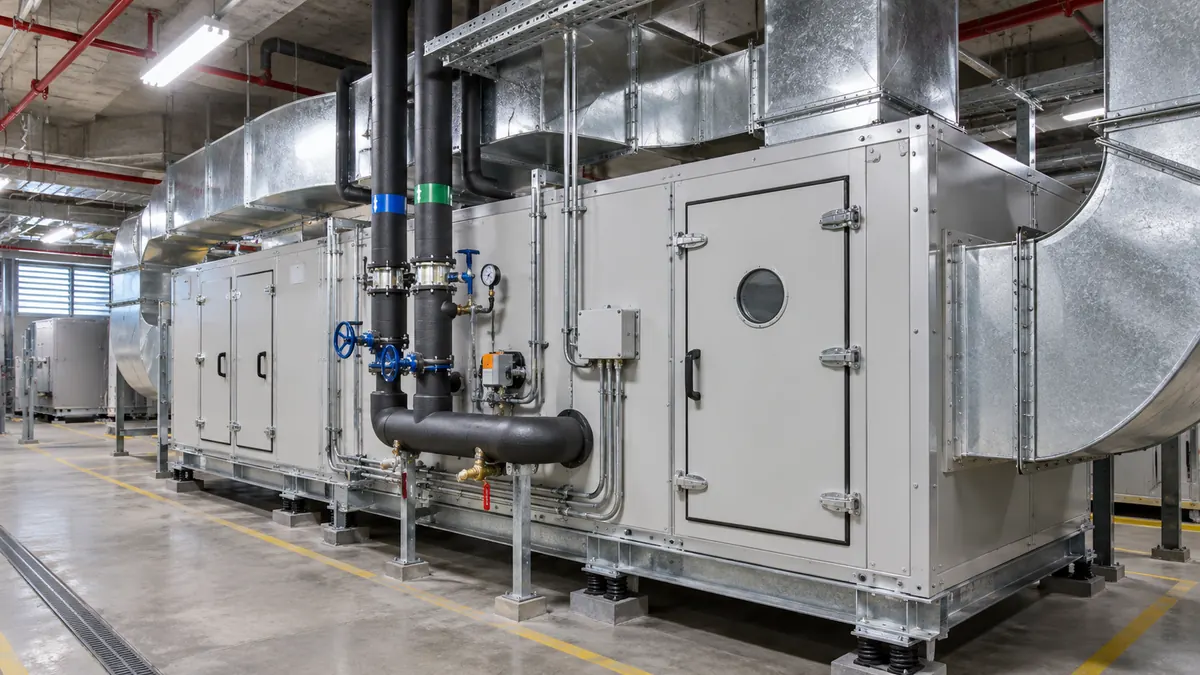
Heating and cooling equipment generates the required capacity, AHUs/FCUs or ducts deliver conditioned air to office spaces, ventilation equipment brings in outdoor air, and zone controllers and the BMS coordinate operation under changing loads.
- Heating or cooling: Chillers, heat pumps, or other equipment generate the required heating or cooling capacity.
- Air distribution: AHUs, FCUs, ducts, and diffusers handle terminal heat exchange and airflow delivery.
- Zoning: Open offices, meeting rooms, and private offices operate on different schedules and loads.
- Ventilation and filtration: Dedicated or integrated systems bring in outdoor air, filter it, and remove stale indoor air.
- Automatic control: The BMS adjusts equipment based on temperature, schedules, operating status, and energy data.
How Should AC Be Used in Different Office Areas?
Occupancy density, equipment heat, and schedules vary significantly across office spaces. Separate operating strategies help maintain both comfort and efficiency when a single temperature and airflow setting would not suit every zone.
Area |
Load Characteristics |
Control Priority |
|---|---|---|
Open-plan office |
Concentrated occupancy, computers, lighting |
Occupancy schedule, local airflow, zone temperature |
Private office |
Different operating schedules |
Individual thermostat or appropriate grouping |
Conference room |
Short periods of high occupancy |
Occupancy detection, ventilation response, precooling |
Server room |
Continuous year-round equipment heat |
Dedicated cooling, redundancy, alarms |
Lobby/public areas |
Door infiltration and changing visitor flow |
Entrance airflow, infiltration load, scheduled control |
How Can Office Buildings Reduce Air Conditioning Energy Use?
Reduce the actual cooling load, then adjust chillers, fans, pumps, and zone-level equipment to match demand instead of running them at fixed output.
Options include variable-speed compressors and fans, sensible scheduling, zoning, coordination between heating and cooling sources, coil maintenance, and improved airtightness. Outdoor-air economizer control should account for the enthalpy, humidity, and air quality of the outside air.
Office zones can use energy-saving setpoints after hours. Server rooms and essential ventilation zones continue operating as designed. Meeting rooms can be precooled based on bookings and expected occupancy to limit wasted runtime.
Why Do Air Conditioners Use Electricity?
The compressor, indoor and outdoor fans, and controls account for most air conditioner electricity use. Bills depend on input power, runtime, outdoor weather, building load, setpoint, and efficiency. Cooling capacity measures heat removal, while electrical input power measures consumption; check both separately.
Compressor Power Consumption
The compressor creates the pressure difference required for refrigerant circulation and is one of the system’s major electrical loads. Outdoor temperature, condenser cleanliness, and indoor demand affect power draw and runtime. Inverter-driven compressors change speed to match part-load demand.
Energy Efficiency
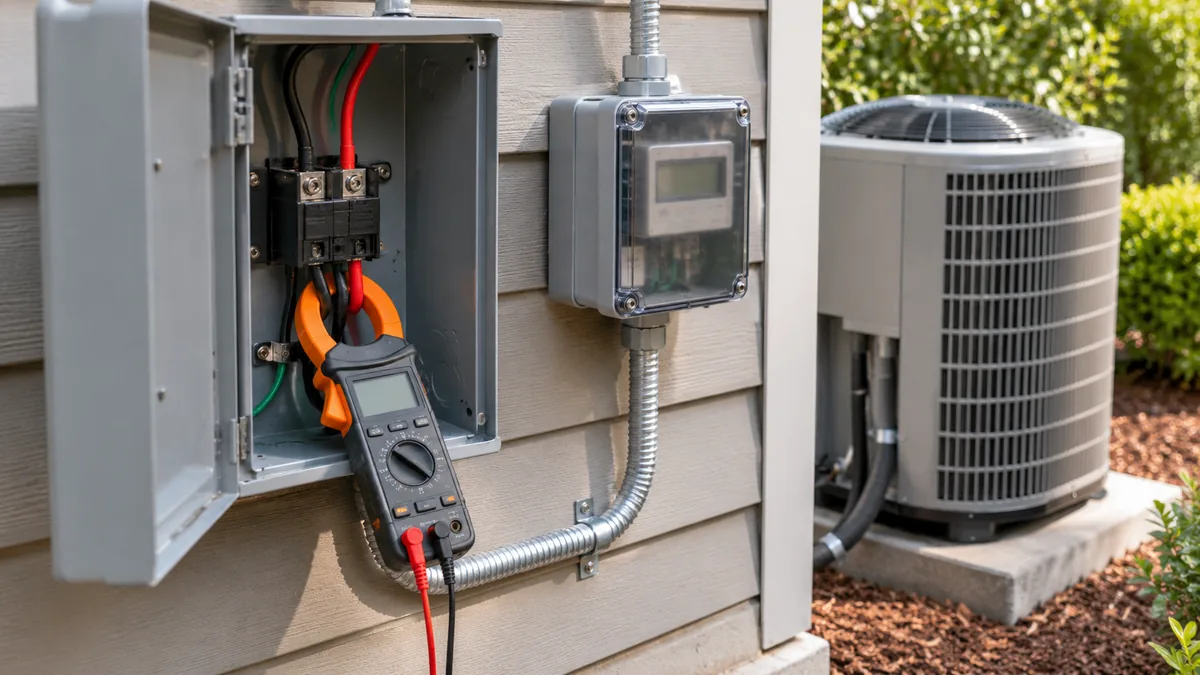
Efficiency describes how much heat an air conditioner can remove for a given amount of electricity. U.S. residential central AC commonly uses SEER2, while window and certain other room units use CEER. Other markets use EER, SEER, CSPF, and ISEER. Compare equipment under the same applicable standard, capacity category, and test conditions.
Metric |
Meaning |
How to Interpret It |
|---|---|---|
SEER2 |
U.S. residential seasonal cooling efficiency metric |
Higher values are more efficient within the same equipment class and test standard |
CEER |
Combined energy efficiency ratio for room AC |
Includes applicable standby/off-mode energy consumption |
EER |
Energy efficiency ratio under a specified condition |
Useful for same-condition comparisons; differs from seasonal performance |
COP |
Heating or cooling output ÷ electrical input |
Dimensionless; specify the heating or cooling conditions |
Operating Hours
Estimated electricity cost = average input power (kW) × operating hours × electricity rate ($/kWh). For example, a unit averaging 1.2 kW for 12 hours a day at $0.20/kWh costs 1.2 × 12 × $0.20 = $2.88 per day. This illustration assumes an average power draw; use measured operating data for actual costs.
For inverter units, base cost calculations on measured average power across the operating cycle. Use the nameplate maximum input for electrical sizing and protective device checks.
How Does Air Conditioning Improve Summer Comfort?
Air conditioning makes hot weather more comfortable by lowering air temperature, removing moisture, and circulating air. Comfort also depends on humidity, air speed, radiant heat from sunlight, clothing, and activity level. Efficient operation coordinates airflow with occupancy schedules.
Can Air Conditioners Filter Indoor Pollutants?
Air conditioner filters capture airborne particles, with effectiveness determined by filter rating, installation seals, and upkeep. Smoke, odors, and other pollutants may require source control, outdoor-air ventilation, and dedicated air-cleaning equipment.
Address cooking emissions, smoke, and high particle concentrations at the source first. Then select filtration or standalone air cleaners that match the pollutant, airflow, and system static pressure. Cleaning a filter restores airflow; its filtration rating comes from the filter specification.
How Can You Save Electricity Without Sacrificing Comfort?
During summer, set the thermostat as high as is comfortable. Combine that setting with shading, airtightness improvements, clean filters, and fans that improve air movement to reduce cooling energy use.
In spaces left empty for long periods, raise the cooling setpoint appropriately for the equipment and climate. The U.S. Department of Energy gives an example of setting back the thermostat by 7–10°F for about eight hours a day. Heat pumps may require different scheduling based on their control strategy.
What Temperature Should You Set the AC to While Sleeping?
There is no single ideal sleeping temperature for everyone. Some households can begin with a trial setting around 24–26°C (75–79°F), then adjust for humidity, bedding, airflow direction, and personal comfort.
If the room feels muggy, check relative humidity and air distribution. If it feels too cold, raise the setpoint or reduce or redirect airflow away from the bed. Infants, older adults, and people with special health needs may require different indoor conditions.
Can an Air Conditioner Dehumidify a Room?
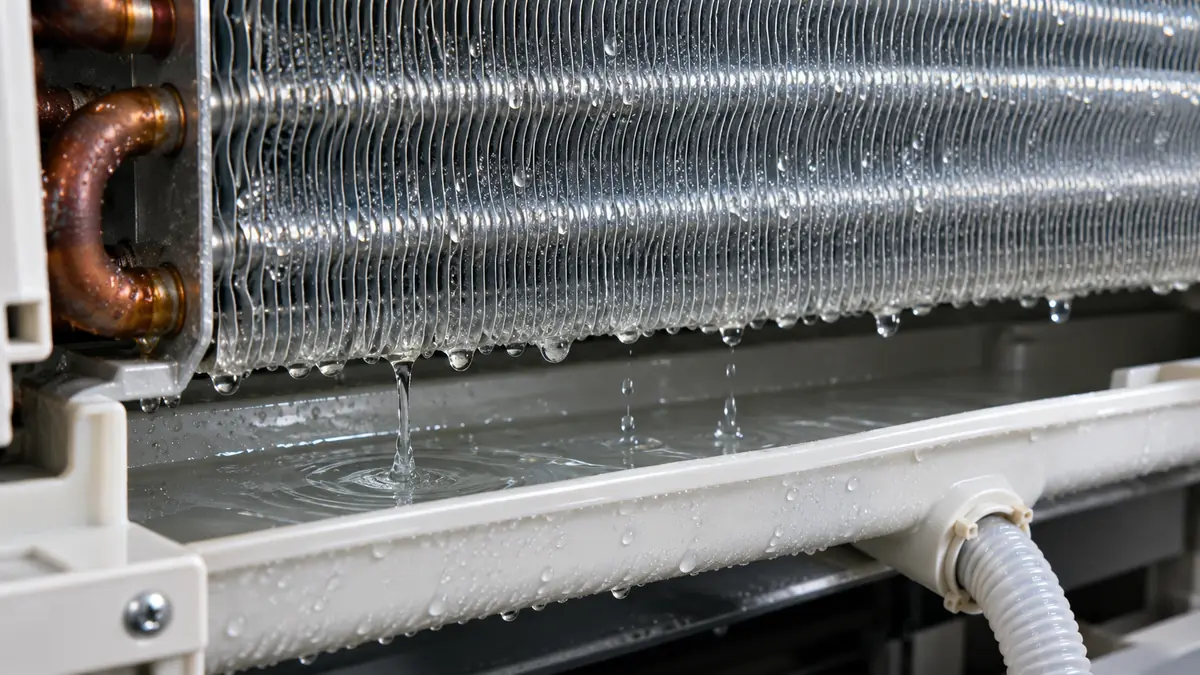
An air conditioner removes moisture when its evaporator coil is below the air’s dew point. Maintaining a specific relative humidity requires enough latent cooling capacity, adequate runtime, and proper humidity controls. High-moisture spaces may need a separate dehumidifier.
In humid regions, an oversized unit or frequent short cycles can satisfy the temperature setpoint while leaving humidity high. Check condensate drainage, fan control, dehumidification settings, and whether a dedicated dehumidifier is needed.
Why Does a Room Still Feel Uncomfortable When the Supply Air Is Cold?
Comfort depends on temperature, humidity, and air distribution. Outdoor-air infiltration, supply-air short-circuiting, inadequate airflow, and poorly matched capacity can create uneven temperatures.
Measure indoor temperature and relative humidity, inspect supply diffuser locations, and consider sun exposure and occupied areas to evaluate cooling performance and airflow distribution.
How to Maintain an Air Conditioner
Air conditioner maintenance includes routine cleaning, seasonal inspections, and professional service. Occupants can clean removable filters, keep air openings clear, and watch for drainage or operating problems. Work involving charged capacitors, contactors, refrigerant piping, and electrical measurements belongs to qualified technicians.
How to Clean and Maintain Your AC Yourself
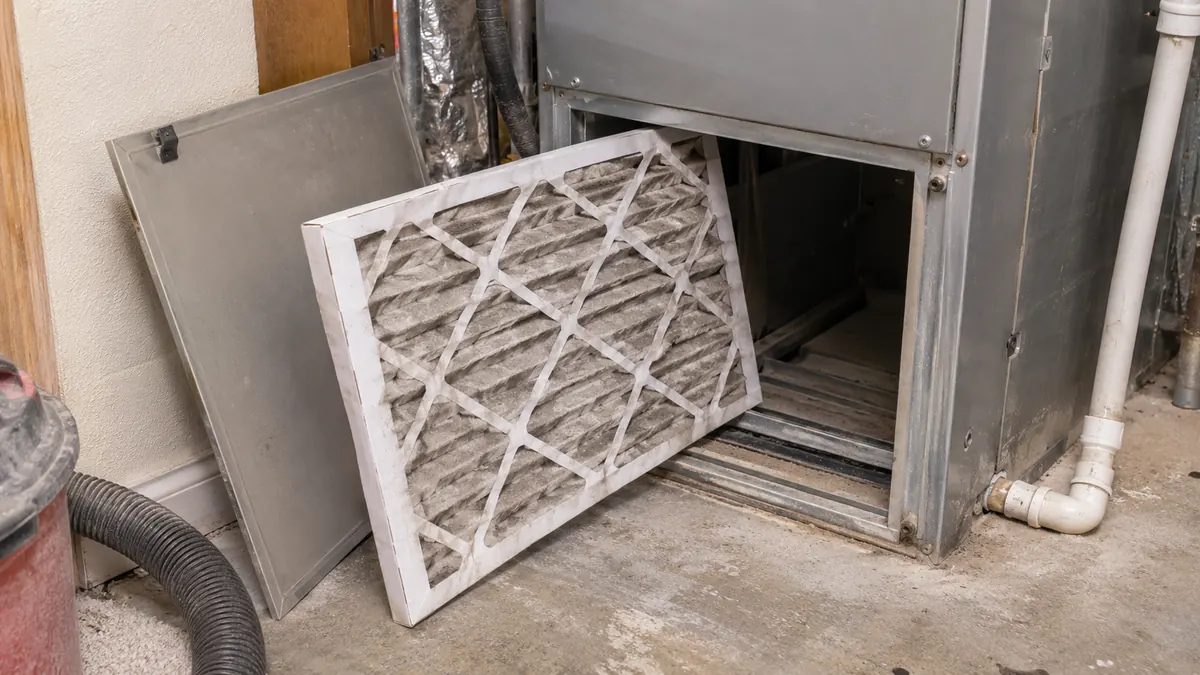
Turn the equipment off and disconnect the appropriate power supply before cleaning. Follow the manufacturer’s instructions for removable filters, inspect supply and return openings, remove obstructions around the outdoor unit, and check condensate drainage. Qualified technicians should handle electrical compartments and refrigerant circuit work.
- Filters: Inspect every 1–2 months during heavy-use seasons and more often in dusty homes, homes with pets, or continuously operated systems. Follow the filter manufacturer’s instructions for washing and drying.
- Indoor vents: Remove accessible dust with a soft brush or damp cloth, and keep furniture and curtains away from supply and return openings.
- Outdoor unit: Clear leaves and debris so heat-exchanger airflow remains unobstructed. Avoid spraying water directly into electrical enclosures or fan motors.
- Condensate drain: Look for bent drain hoses and overflowing water. Shut the system down immediately if water reaches wall cavities or electrical outlets.
- Operating notes: Record unusual sounds, odors, error codes, frequent cycling, and declining cooling to help technicians diagnose problems.
How Often Should a New Air Conditioner Be Serviced?
Inspect filters after the first 1–3 months of the initial cooling season based on dust buildup. Schedule at least one professional system inspection a year for residential equipment; high-use and commercial systems should follow the manufacturer’s maintenance schedule.
The first professional inspection should check installation quality, drainage, wiring, compressor startup and steady operation, indoor and outdoor airflow, and alarms. Refrigerant charge and leak checks should be based on actual diagnostic findings, with any needed refrigerant work performed during qualified service.
Troubleshooting
Start by distinguishing power or control problems, restricted airflow, condensate issues, and refrigerant-circuit faults. Users can first check settings, error codes, filters, and visible leaks. High-voltage and refrigerant diagnostics require trained service personnel.
How Are Capacitors, Contactors, Refrigerant, and Electrical Systems Checked?
Capacitors and contactors are electrical components, while refrigerant circulates in a sealed, pressurized circuit. Owners can note whether the outdoor unit starts, makes unusual sounds, trips the breaker, or displays a fault code. Technicians should handle capacitance testing, live contactor diagnostics, refrigerant pressure measurements, and leak testing.
Component/System |
Common Warning Signs |
Safe Next Step |
|---|---|---|
Capacitor |
Outdoor fan/compressor hard starting, humming, intermittent operation |
May hold a dangerous charge after power is off; leave testing and replacement to qualified technicians |
Contactor |
Outdoor unit does not respond, damaged contacts, unusual clicking |
Technician isolates power, then checks coil, contacts, and control circuit |
Refrigerant circuit |
Reduced cooling, localized frost, oil staining, alarms |
Rule out airflow problems first; qualified personnel handle leaks, repairs, recovery |
Wiring/controls |
Breaker trips, error codes, unresponsive thermostat |
Confirm external power and settings; do not repeatedly reset a tripping breaker or touch exposed terminals |
In the United States, technicians who open, charge, or recover refrigerant from covered equipment must meet EPA Section 608 certification requirements. Other jurisdictions have their own refrigerant and electrical safety rules.
What Should You Do if the AC Stops Cooling, Leaks, or Smells Bad?
If the unit is not cooling, check the mode, setpoint, filters, and supply and return airflow. For leaks, turn the unit off and inspect visible drainage. For odors, distinguish accumulated moisture or dust from signs of electrical overheating. Smoke, burning smells, repeated breaker trips, or water near electrical components require immediate shutdown and professional service.
Symptom |
What You Can Check First |
When to Request Service |
|---|---|---|
Runs but won’t cool |
Cooling mode, setpoint, doors/windows, filter, clear outdoor unit |
Continues not cooling, coil icing, outdoor unit won’t run, fault code |
Indoor unit leaks water |
Turn off; inspect visible drain bends or overflowing pan |
Persistent drips, ceiling damage, drain-pump alarm |
Musty or damp smell |
Clean removable filters, confirm drain clears, keep airflow unobstructed |
Odor persists, visible mold, drainage issue |
Burning odor or smoke |
Switch off and disconnect power immediately |
Request immediate professional inspection; do not restart |
How Does Maintenance Differ for Central, Split, Window, and Portable AC?
Maintenance depends on system design. Central AC calls for duct, return-air, and drainage checks; split units require attention to indoor and outdoor coils and piping connections; window units need window sealing and outdoor drainage checks; and portable units need exhaust-hose and condensate management.
Maintaining Central Air Conditioning
Clean or replace return-air filters as instructed, keep supply and return vents clear, check visible duct joints for leaks, and confirm that the drain line and pan work. Inspect coils, fans, thermostat controls, and performance each cooling season. Larger duct systems may also need airflow testing to investigate temperature differences between zones.
Maintaining Single-Split and Multi-Split Systems
Clean indoor filters and keep outdoor air intakes and discharges clear. Watch for indoor-coil frost, drainage backup, and unusual vibration. In multi-split systems, check capacity when indoor units run together, controller fault codes, and piping insulation; use manufacturer procedures for service diagnostics.
Maintaining Window Units and PTACs
After disconnecting power, clean removable filters, inspect window mounts or wall sleeves, check outdoor ventilation and weather seals, and clear condensate drains. PTACs also require sleeve compatibility, separation of indoor and outdoor air paths, and proper sealing after replacement.
Maintaining Portable Air Conditioners
Check that the exhaust hose is connected, free of sharp bends, and within the manufacturer’s recommended length. Seal window-kit joints, empty the condensate tank or connect the drain as specified, and leave sufficient clearance around wheels, intakes, exhausts, and the back of the unit. Because the compressor is indoors, investigate unusual operating noise as well.
Sources for this section: U.S. Department of Energy, “Maintaining Your Air Conditioner”; ENERGY STAR air conditioner maintenance guidance; and U.S. EPA Section 608 refrigerant management information.
Frequently Asked Questions
These questions cover everyday use, equipment selection, operating cost, basic operation, and commercial air conditioning applications.
Will Running an Air Conditioner for 12 Hours Straight Burn Out the Compressor?
A variable-speed AC can run continuously at low speed within its design conditions. Warning signs include never reaching the set temperature, ice formation, and fault alarms. Check airflow, coils, the refrigerant circuit, and cooling load if these occur.
What Are the Two Main Types of Air Conditioners?
By system design, air conditioners can be split or packaged. By service area, they can be room units or central systems. By function, they can be cooling-only models or reversible heat pumps. Specify the classification you mean before comparing equipment.
How Long Does a Home HVAC System Usually Last?
Service life depends on equipment type, installation, climate, and maintenance. Compressors, heat exchangers, fans, piping, and controls have different lifespans. Consider manufacturer warranties, replacement-part availability, and local service support when planning replacement.
Which Air Conditioner Brands Should You Avoid?
Evaluate brands by the certifications and energy labels available in your market, model-specific performance, installation service, warranty support, and spare parts. Select a model that also matches the room load and operating conditions.
What Is Air Conditioning, and Is It the Same as Refrigeration?
Air conditioning means controlling indoor air conditions; in everyday use, it also refers to equipment that cools a room through a refrigeration cycle. Broader air conditioning may address humidity, air cleanliness, and airflow, depending on the installed system.
Do Standard Split Air Conditioners Bring Fresh Air in From Outdoors?
Most residential split systems recirculate indoor air, while the outdoor unit rejects heat outdoors. Enclosed rooms need a unit with a dedicated outdoor-air connection or a separate mechanical ventilation system to bring in fresh air.
How Does an Air Conditioner Cool a 15 m² (161 sq ft) Bedroom?
The indoor fan moves room air across the evaporator, where refrigerant absorbs heat and then releases it outdoors. A 15 m² floor area alone does not determine required cooling capacity. Window area, sun exposure, ceiling height, occupants, and insulation also matter.
Can a Smart Thermostat Turn a Fixed-Speed Air Conditioner Into a Variable-Speed Unit?
A smart thermostat can improve scheduling, temperature settings, and occupancy-based operation. Equipment designed for inverter or staged capacity control can adjust output when it receives compatible commands. Fixed-speed equipment continues to operate through on/off cycling.
Why Does Bedroom AC Noise Need to Be Measured Beyond 1 Meter?
Nighttime comfort is affected by fan noise, refrigerant flow sounds, and structure-borne vibration. When comparing systems, check the measurement distance, operating speed, and acoustic metric stated in the manufacturer’s specifications.
Is It Cheaper to Leave the AC Running All Day Than to Turn It Off Until Evening?
Raising the cooling setpoint when a space is empty can reduce energy use. Return to a comfortable setting when the space is occupied. Humid rooms, process spaces, and heat-pump systems may need different moisture-control strategies; record and compare actual electricity meter readings.
How Much Does It Cost to Run a 1.2 kW Air Conditioner for 12 Hours a Day?
At an average input of 1.2 kW, 12 operating hours, and $0.20/kWh, the daily cost is 1.2 × 12 × $0.20 = $2.88. Obtain average input power from measured operating data or an electricity meter.
What’s the Difference Between Air Conditioning and Heating? Can a Heat Pump Do Both?
A cooling-only air conditioner lowers indoor temperature in summer; a heating system provides warmth in winter. A reversible heat pump switches the same refrigeration circuit between cooling and heating. Winter suitability depends on local design temperature, available low-temperature heating capacity, and the building’s heating load.
Can a Fan Cool a 100 sq ft Room Without Air Conditioning?
A fan increases air movement and can improve how cool a person feels. Shading, insulation, and nighttime ventilation can lower indoor heat gains. When active cooling is needed, options include heat-pump cooling, evaporative cooling in dry climates, or another suitable mechanical cooling method.
How Much Does Central Air Conditioning Cost for a 2,000 sq ft House in the U.S.?
For a 2,000 sq ft U.S. home with usable existing ductwork, a conventional central AC installation has an illustrative budget of about $7,500–$15,000. New ducts, electrical upgrades, and complex installation work cost extra. Determine equipment tonnage with Manual J or an equivalent load calculation, and include the indoor coil, outdoor unit, labor, and permits in quotes.
Can an Air Conditioner Keep a Room at 75°F (24°C) and 50% Relative Humidity?
Maintaining 50% relative humidity requires sufficient latent capacity, humidity sensors, and independent dehumidification control. Standard temperature-controlled AC primarily follows room temperature; high-humidity applications may need a separate dehumidifier.
Can a Ductless Mini-Split Heat a Bedroom in Winter?
A reversible heat-pump model can provide heating by changing the direction of refrigerant flow. Cooling-only models lack that feature. In cold climates, check low-temperature heating capacity, defrost operation, and the need for backup heat.
Do Air Conditioners and Refrigerators Use the Same Cooling Principle?
Many use the same vapor-compression cycle: evaporating to absorb heat, compressing, condensing to release heat, and expanding the refrigerant. They differ in operating temperature range, heat-exchange space, loads, and controls.
What Happens Inside the Compressor When Central AC Starts?
After the controller confirms a cooling call and checks protective conditions, the compressor starts, raises the pressure of low-pressure refrigerant vapor, and drives circulation. Rotary, scroll, and reciprocating designs, as well as fixed- and variable-speed controls, use different startup methods.
Do Ductless Mini-Splits and Ducted Central AC Use the Same Refrigeration Cycle?
Many use the same four fundamental refrigeration stages. The main differences are how air is distributed, indoor-unit design, and control strategy. Central ducted systems deliver air through ducts; ductless systems deliver it directly from indoor units.
Does a 2,000 sq ft Home Always Need a 4-Ton Central Air Conditioner?
Required cooling depends on climate, ceiling height, insulation, window orientation, airtightness, occupants, and equipment heat. Calculate room-by-room loads, then choose a unit that meets design sensible and total cooling requirements, with acceptable part-load and dehumidification performance.
Does a 12,000 BTU/h Air Conditioner Use 12,000 BTU of Electricity Every Hour?
A 12,000 BTU/h rating describes cooling capacity, equivalent to about 3.52 kW of heat removal. Electrical input depends on operating efficiency and the unit’s rated power consumption.
Why Does the Room Feel Humid After the AC Reaches Its Set Temperature?
Check latent load, oversized capacity, supply-fan control, and infiltration of humid outdoor air. Measure relative humidity, condensate production, and the unit’s cycling pattern to determine why moisture remains high.
Why Is the Air Blowing From the Outdoor AC Unit Hot During Cooling?
The outdoor condenser releases heat absorbed from indoors plus some of the compressor’s electrical input as heat. Warm exhaust air is a normal part of the cooling process.
Can a Home Air Conditioner Replace a Fresh-Air Ventilation System?
A standard residential split unit mostly recirculates room air, and its filter captures particles. Outdoor-air ventilation requires a dedicated intake connection or a separate ventilation system.
What Size Window AC Is Suitable for a 180 sq ft Bedroom?
ENERGY STAR’s preliminary room-air-conditioner sizing chart gives about 6,000 BTU/h as a starting point for 150–250 sq ft under typical room conditions. Adjust for strong sun exposure, occupancy, kitchen heat, and window conditions; use a load calculation for final sizing.
Why Can a Single-Hose Portable AC Pull Hot Outdoor Air Into the Room?
A single-hose portable unit uses some indoor air to cool its condenser and then exhausts that warm air outdoors. The resulting negative pressure can draw untreated outdoor air through door gaps and other openings. A dual-hose unit reduces that effect by using a separate intake path, although sealing still matters.
Can a Shopping Center’s VRF System Handle Fresh-Air Ventilation by Itself?
VRF systems handle space heating and cooling loads. Commercial buildings use dedicated outdoor-air equipment or a DOAS to provide required ventilation, dehumidification, and exhaust.
Why Should Meeting Room AC Respond to Changes in Occupancy?
Crowded meetings cause short-term increases in sensible and moisture loads and require additional ventilation. Controls can respond to booking schedules, occupancy sensors, airflow demand, and outdoor-air capacity.
Can a Standard Home Mini-Split Replace Dedicated Cooling in a Server Room?
Server rooms require cooling designed around year-round equipment heat. Check continuous-operation reliability, sensible heat ratio, alarms, redundancy, and equipment layout.
Why Are Some Rooms Hot and Others Cold With Ducted Central Air Conditioning?
Common causes include duct leakage, poor air balancing, blocked return paths, different room cooling loads, and a thermostat location that does not represent all rooms. Inspect supply and return airflow and load conditions before deciding whether zoning is needed.
Will Setting the AC to 64°F (18°C) Cool a Room Faster Than 75°F (24°C)?
Lowering the setpoint on a fixed-speed AC usually extends the cooling run. Variable-speed systems may also change compressor speed according to their controls. A suitable setpoint helps balance comfort and electricity use.
Can Window and Through-the-Wall Air Conditioners Be Swapped Directly?
Check intake and exhaust locations, side ventilation, condensate drainage, wall or window support, and sleeve compatibility. Use models specifically approved for the existing opening.
Should a Hotel Room Use a PTAC or a Fan Coil Unit?
Compare outdoor-air arrangements, heating and cooling sources, room controls, maintenance access, noise, exterior-wall openings, drainage, and lifetime cost. PTACs often fit standardized independent guestrooms; central chilled-water and VRF solutions suit other building layouts and operating needs.
How Often Should You Clean an Air Conditioner Filter?
Follow manufacturer instructions and inspect more often when dust or operating hours are high. Clean or replace filters sooner if return airflow decreases, dust builds up, or energy use rises.
Is Water Dripping From an Air Conditioner in Cooling Mode Normal?
Condensate leaving through the designed drain is normal. Water dripping from the indoor cabinet, ceiling, or wall indicates a need to check drain blockages, drain slope, insulation, or coil icing.
Which Specification Matters Most When Buying a Heat Pump AC for Cold Climates?
Check heating capacity at the local winter design temperature, low-temperature efficiency, defrost operation, and coordination with any auxiliary heat source.
Does a Larger Chiller Always Save More Electricity in a Commercial Building?
Chiller efficiency depends on annual load profiles, the number of operating chillers, part-load performance, pumps, and heat-rejection equipment. Staging equipment to match demand and optimizing controls can improve annual plant performance.
Conclusion
Air conditioning manages indoor air conditions, most commonly by moving heat from indoors to outdoors. Choose equipment by defining the space and how it will be used, calculating the load, comparing efficiency metrics under the same standard, checking ventilation and humidity control, and then selecting an appropriate system and control strategy.
For bedrooms, focus on comfort, noise, and individual zone control. Office buildings also need coordinated heating and cooling sources, air distribution, outdoor-air ventilation, and automation. Keep cooling capacity separate from electrical input, refrigeration separate from ventilation, and equipment categories separate from optional features.
Sources
External Sources Used to Support the Article
U.S. Department of Energy: Residential central air conditioning and efficiency selection: https://www.energy.gov/cmei/femp/purchasing-energy-efficient-residential-central-air-conditioners
U.S. Department of Energy: Air-source heat pumps provide both heating and cooling: https://www.energy.gov/cmei/femp/purchasing-energy-efficient-residential-air-source-heat-pumps
U.S. Department of Energy: Proper residential equipment sizing and Manual J: https://www.energy.gov/sites/default/files/2021-08/ES-HomeHeatingandCooling_081221.pdf
U.S. Department of Energy: Room air conditioner efficiency and selection: https://www.energy.gov/cmei/femp/purchasing-energy-efficient-room-air-conditioners
U.S. Department of Energy: Home energy savings and thermostat setbacks: https://www.energy.gov/sites/prod/files/2022-08/energy-saver-guide-2022.pdf
U.S. Environmental Protection Agency: Ventilation, filtration, and indoor air quality: https://www.epa.gov/indoor-air-quality-iaq/improving-indoor-air-quality
ENERGY STAR: Room air conditioner sizing by floor area: https://www.energystar.gov/products/room_air_conditioners
2026 U.S. installation cost source (industry estimate, not an official price): https://www.pickhvac.com/centralized-air-conditioning-price-installation-costs/
ENERGY STAR: Residential central AC and heat pump SEER2/EER2/HSPF2 criteria: https://www.energystar.gov/products/air_source_heat_pumps/key-product-criteria
ENERGY STAR: Room air conditioner CEER criteria and products: https://www.energystar.gov/products/room_air_conditioners/key_product_criteria
U.S. federal regulation 10 CFR §430.32: Minimum CEER standards for units manufactured from May 26, 2026: https://www.law.cornell.edu/cfr/text/10/430.32
U.S. federal regulation 10 CFR §431.97: VRF IEER/COP requirements by capacity: https://www.law.cornell.edu/cfr/text/10/431.97
U.S. DOE/FEMP: Chiller kW/ton and IPLV criteria by capacity: https://www.energy.gov/cmei/femp/purchasing-energy-efficient-electric-chillers
ENERGY STAR: Ground-source heat pump EER and COP criteria: https://www.energystar.gov/products/geothermal_heat_pumps/key_product_criteria
ENERGY STAR: Commercial packaged and rooftop equipment EER/IEER criteria: https://www.energystar.gov/products/light_comm_heating_cooling/light_commercial_hvac_key_product_criteria
Natural Resources Canada: Portable AC SACC/CEER minimum formula (same as U.S. DOE): https://natural-resources.canada.ca/energy-efficiency/energy-efficiency-regulations/portable-air-conditioners
Amana: PTAC PTH124J (12,000 BTU/h, EER 11.3) product specifications: https://www.amana-ptac.com/products/ptac/pth124j—standard-efficiency
Friedrich: ZoneAire Select PTAC PZE12K3SC (12,000 BTU/h, EER 10.8) official specifications: https://www.friedrich.com/hubfs/2026%20Literature%20PDFs/2026%20Brochures/BR_PTAC_REV%2009-26-25.pdf
U.S. Department of Energy: Maintaining Your Air Conditioner (filters, coils, drains): https://www.energy.gov/energysaver/maintaining-your-air-conditioner
U.S. EPA: Section 608 certification and refrigerant service scope: https://www.epa.gov/section608/section-608-technician-certification-requirements
U.S. EPA: Frequently asked questions about refrigerant management under Section 608: https://www.epa.gov/section608/epas-refrigerant-management-program-questions-and-answers-section-608-certified