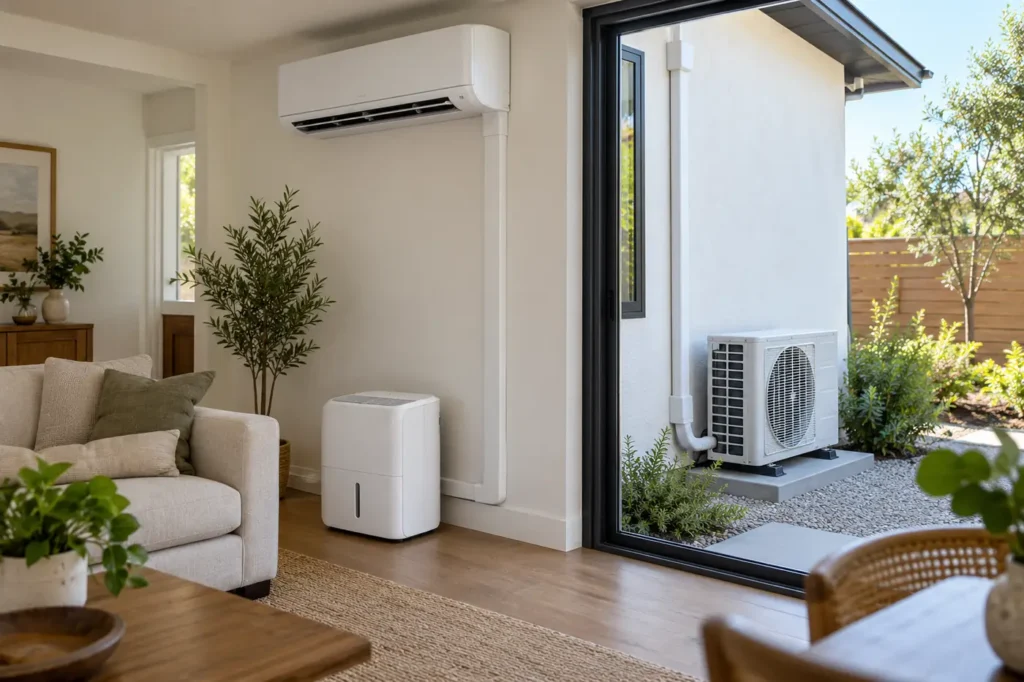
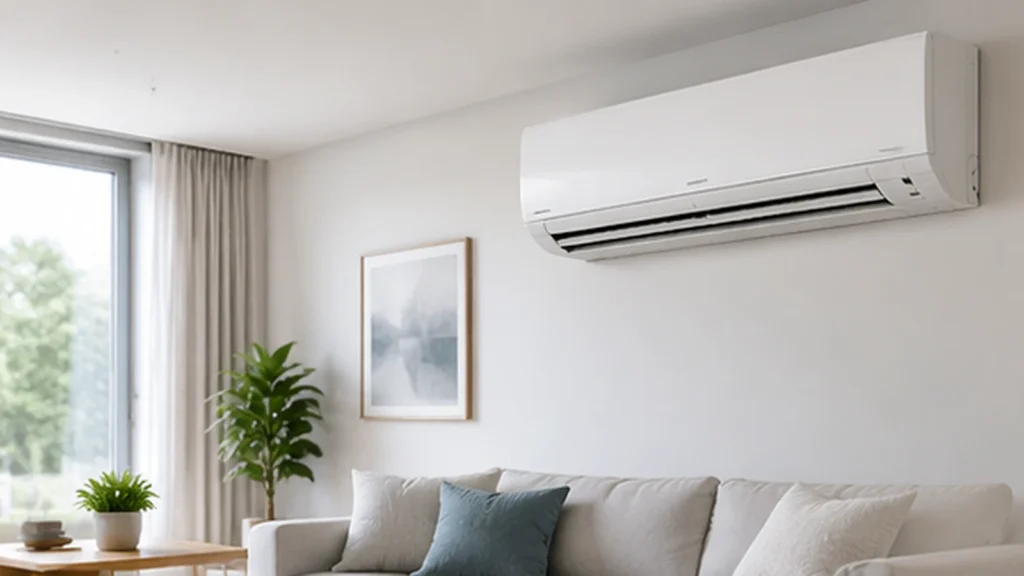
Air conditioner vs dehumidifier: choose an air conditioner when the room needs cooling, and choose a dehumidifier when excess moisture is the main problem but the temperature is already comfortable. An air conditioner can cool and remove moisture at the same time. A dehumidifier removes moisture without providing useful room cooling. If a space stays damp even while the AC reaches its temperature setting, the two may need to work together.
The better choice depends on two separate readings: room temperature and relative humidity (RH). A room can feel cold and damp, or hot and damp, and those conditions call for different equipment. This guide explains the difference, AC Dry mode, combined operation, electricity costs, and a practical way to decide.
Air Conditioner vs Dehumidifier: What Is the Main Difference?
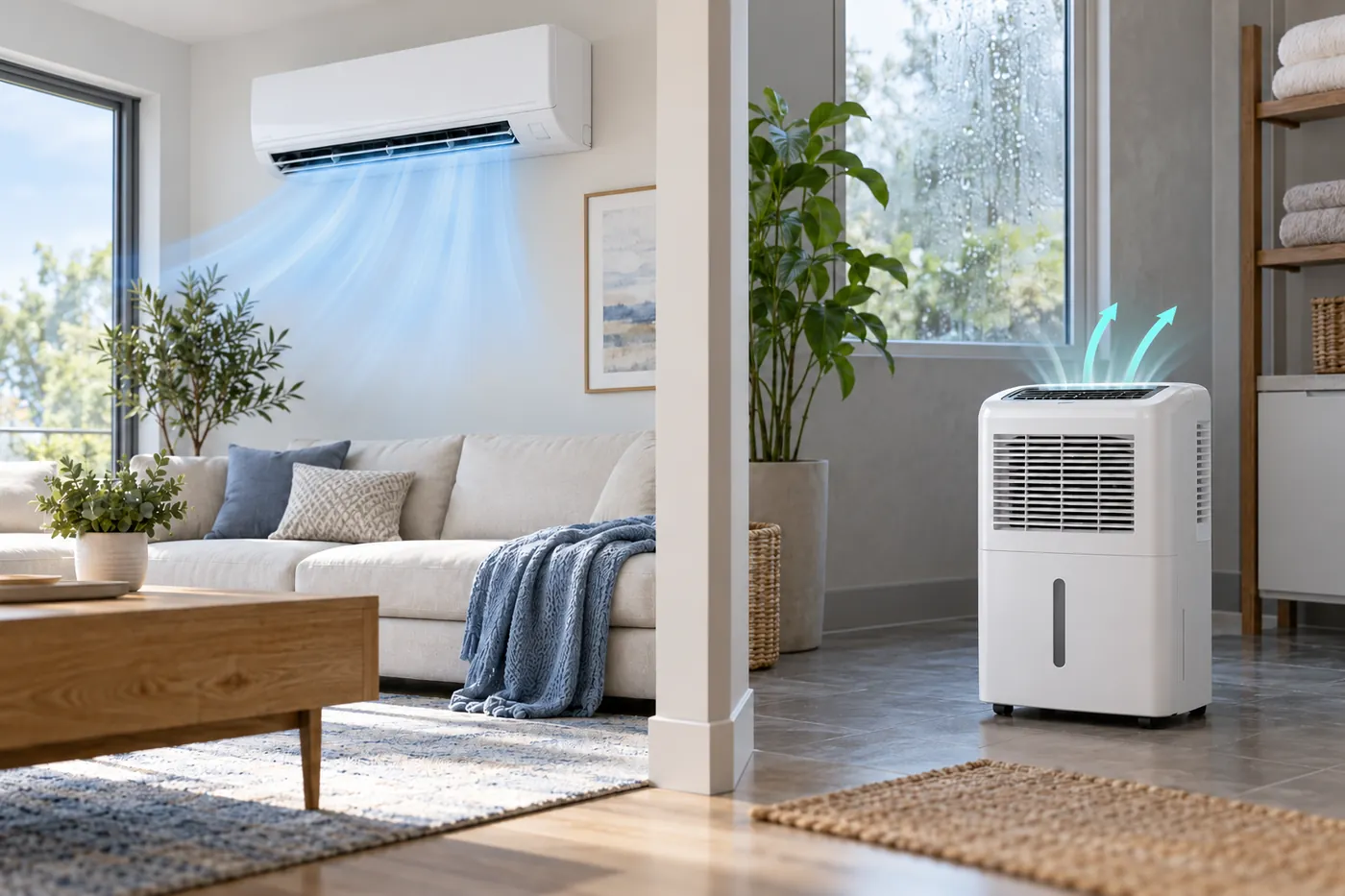
An air conditioner is designed to lower indoor temperature; a dehumidifier is designed to lower indoor moisture. Both can collect water from humid air, but they send heat to different places and respond to different controls. That difference matters most when the room is humid but no longer needs cooling.
| What to compare | Air conditioner (AC) | Dehumidifier |
|---|---|---|
| Main task | Cools the room and may also remove moisture | Removes moisture and controls humidity |
| Room temperature | Usually lowers it in cooling mode | Usually raises it slightly during operation |
| Where heat goes | Outside the cooled space in a normal split/window AC setup | Back into the treated space in a typical portable refrigerant dehumidifier |
| What starts operation | Temperature demand, with model-dependent humidity controls | Humidity demand, usually from a humidistat |
| Moisture removal | Depends on coil temperature, runtime, airflow and indoor conditions | Dedicated moisture-removal operation, with performance depending on conditions |
| Water handling | Condensate drain or a collection tank on some portable ACs | Bucket, drain hose or permanent drain |
| Best first choice | Hot room that needs cooling | Comfortable or cool room that stays damp |
A portable air conditioner and a portable dehumidifier are not the same appliance, even if both have a compressor and a drain. If temperature is the main unmet need, start with cooling. If humidity is the unmet need, start with dehumidification.
How Do Air Conditioners and Dehumidifiers Remove Moisture?
Most refrigerated air conditioners and dehumidifiers remove water by cooling humid air below its dew point so moisture condenses onto a cold coil. They differ mainly in what happens to the heat afterward.
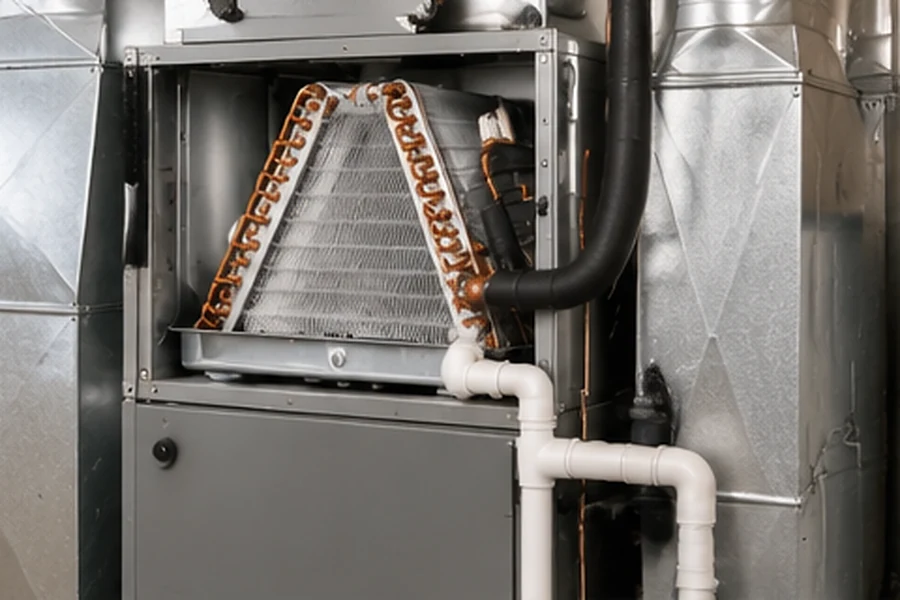
In an air conditioner, a fan moves indoor air across the cold evaporator coil. When the coil surface is cool enough, water condenses and runs to a drain. The refrigeration system then sends the removed heat outdoors. This produces two results: sensible cooling (lower air temperature) and latent cooling (moisture removal). The U.S. Department of Energy’s Building America guidance explains this distinction.
For the indoor coil, outdoor condenser, refrigerant lines and condensate path in a split system, see our mini split air conditioner guide.
A common compressor-based dehumidifier also condenses water on a cold coil. But its warm condenser is in the same room or air stream, so the outlet air is dry and usually a little warmer. The unit’s electric power also ends up as heat in the space. A desiccant dehumidifier uses moisture-absorbing material rather than relying only on that cold-coil process; its energy and temperature effects depend on the design.
Relative humidity is temperature-dependent. Cooling air can increase its RH even if the amount of water vapor stays unchanged. So a lower RH reading after operation can be useful, but it should be read together with temperature and evidence that water has been removed. Actual water removal depends on coil temperature, airflow, cooling runtime and the room’s moisture load. Check temperature and RH across several cooling cycles, and check condensate drainage when accessible.
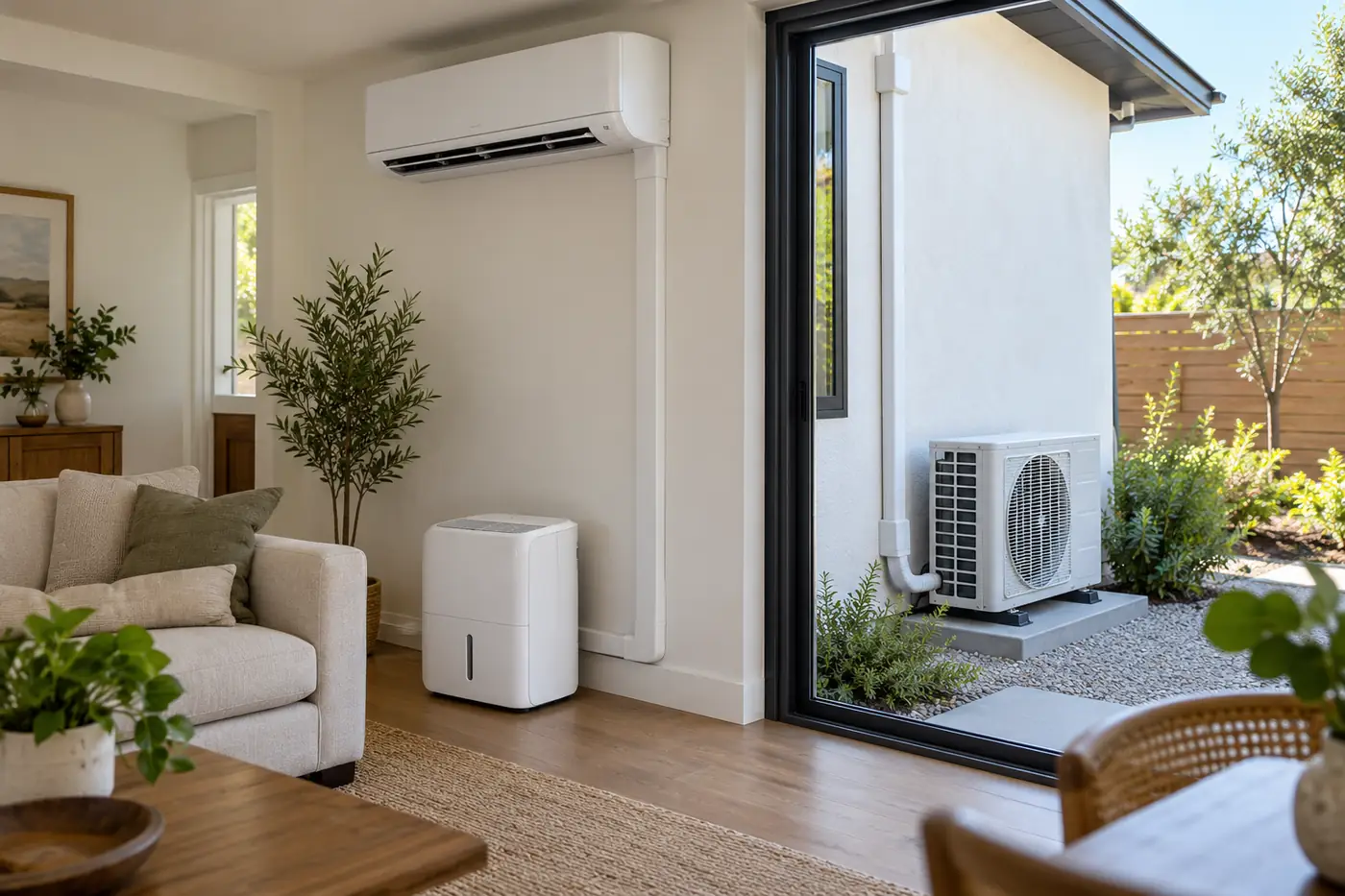
Which Should You Use for Heat, High Humidity, or Both?
Use AC when the space is too warm, a dehumidifier when it is damp but cool enough, and both when cooling alone cannot maintain the humidity target. Start with the actual conditions rather than the season or the device name.
| Situation | Better first step | Why and when to change the choice |
|---|---|---|
| Hot and humid room, above desired temperature | Run appropriately sized AC in cooling mode | Cooling can remove heat and some moisture together; add humidity control only if RH stays high after temperature is controlled |
| Mild, rainy day; comfortable temperature but sticky room | Use a dehumidifier | Running AC only for moisture may make the room uncomfortably cold |
| Cool, damp basement | Fix water entry first, then use a dehumidifier rated for the room temperature | Cooling is not the task; a standard refrigerant dehumidifier may frost in cooler spaces |
| Room cools quickly but remains clammy | Check AC sizing, control mode, airflow and runtime | The thermostat may be satisfied before sufficient moisture is removed |
| Moisture after showering, laundry or cooking | Vent moisture to the outside and check for leaks | Dehumidification can help, but it cannot stop a continuing water source |
| Building with fresh-air and humidity loads during mild weather | Assess independent humidity control and ventilation design | The moisture load may remain high while little sensible cooling is needed |
For a practical starting target, the U.S. Environmental Protection Agency advises keeping indoor RH below 60%, ideally around 30%–50% when possible. Use a hygrometer to track RH along with room temperature. If RH stays above the target after the AC reaches its temperature setting, check moisture sources and assess separate humidity control. In very cold weather, even lower indoor RH may be needed to limit window condensation.
If the space has wet drywall, standing water or a hidden leak, repair the water source promptly. A larger AC or dehumidifier should not be the first response to a continuing leak.
Do Air Conditioners Dehumidify Enough on Their Own?
Yes, an air conditioner can provide enough dehumidification when its cooling runtime and moisture-removal capacity match the space. It may not do so on mild, humid days or in a building where the AC shuts off quickly once the temperature is reached.
The thermostat mainly responds to temperature. If the cooling demand falls before the moisture has been removed, the compressor or cooling output may decrease while indoor moisture remains. This is one reason a room can be cool but clammy. An oversized system may also satisfy the temperature setting quickly, leaving less opportunity for moisture removal. Actual behavior differs by system and controls.
Our air conditioner sizing guide explains how cooling load, equipment capacity and short cycling affect selection.
If humidity stays high, take these steps before assuming that a bigger AC is needed:
- Measure temperature and RH at about the same times while the room is occupied, including when cooling starts and stops.
- Check whether the unit is actually cooling and whether the condensate drain is flowing when moisture is being removed.
- Check the fan and humidity settings against the manufacturer’s instructions. On some systems a continuously running indoor fan can return moisture from a wet coil to the air after cooling stops.
- Inspect filters, airflow and drainage and arrange qualified service if the coil freezes, water leaks indoors or cooling performance is abnormal.
- Compare the moisture problem with the cooling load. If the room reaches its temperature target but RH remains high, a dedicated dehumidifier or an approved humidity-control configuration may be more effective than lowering the thermostat.
For system choices rather than this moisture question, see our guide to AC system types.
What Is Dry Mode on an Air Conditioner?
Dry mode is an AC control setting intended to remove moisture with less emphasis on cooling the room. On compatible models, the unit changes compressor and/or fan operation to encourage condensation on the indoor coil. The exact sequence and whether you can select a humidity setpoint depend on the model.
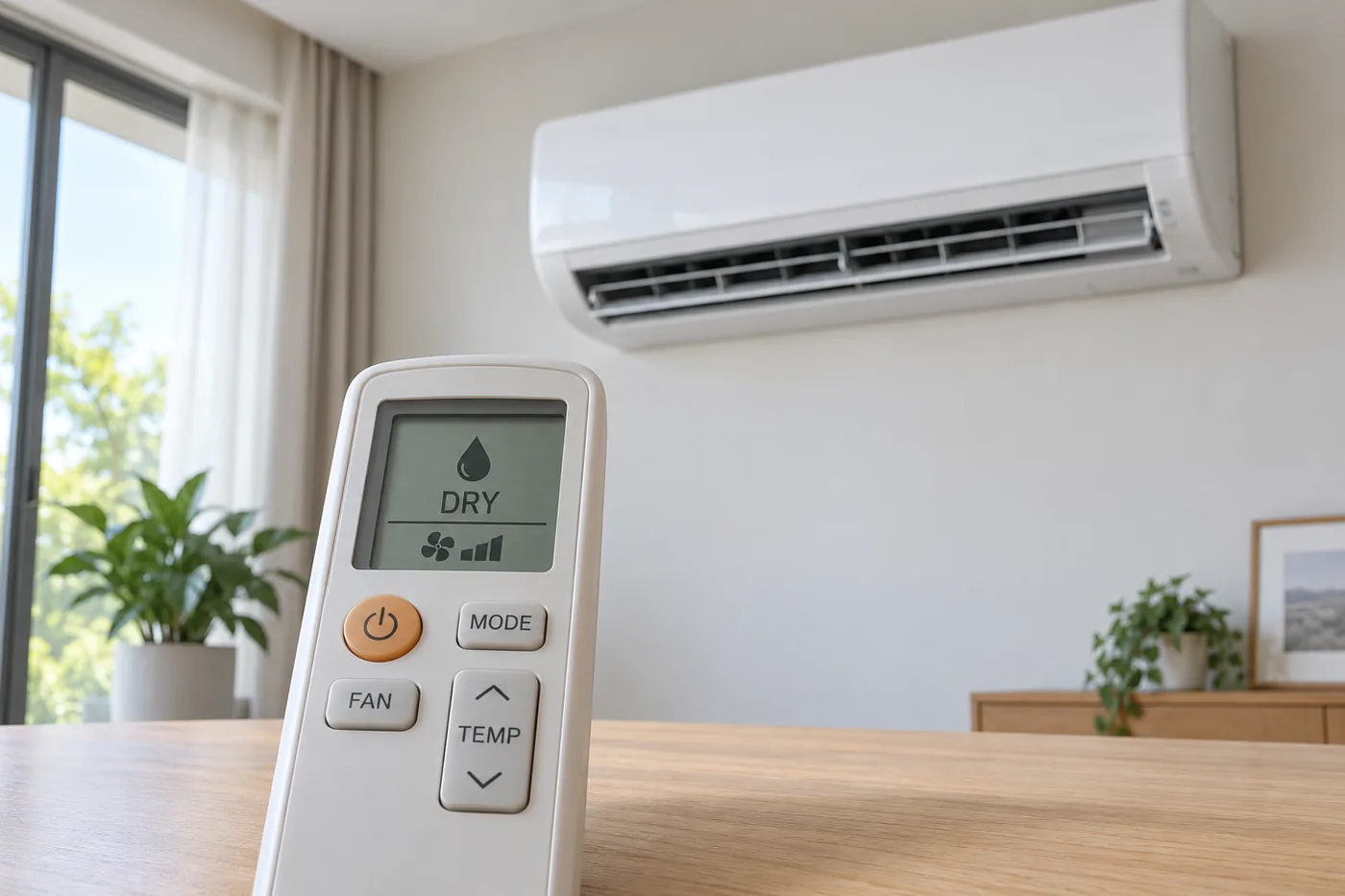
Dry mode can be useful on a humid day when the room is close to a comfortable temperature and you do not need strong cooling. It still relies on a cold enough coil and a route for condensate. It may cool the room somewhat, and it is not the same as a stand-alone dehumidifier with independent humidity control.
Dry mode is a humidity-related operating setting, whereas inverter technology adjusts compressor speed as cooling demand changes. Our inverter air conditioner guide explains that difference in control.
Choose Cool mode when indoor temperature is too high. Try Dry mode when moisture is the main discomfort and the manufacturer supports it. After running Dry mode, check room temperature and RH to see how both change. If RH stays high, review the equipment controls and operating conditions; a separate dehumidifier may be the right next step. Some ACs have no Dry mode at all.
Can You Run a Dehumidifier with an Air Conditioner?
Yes. Running a dehumidifier with an air conditioner can make sense when the AC keeps the temperature comfortable but indoor humidity remains too high. The dehumidifier can continue removing moisture when the AC does not need to cool, while the AC handles the room’s heat load.
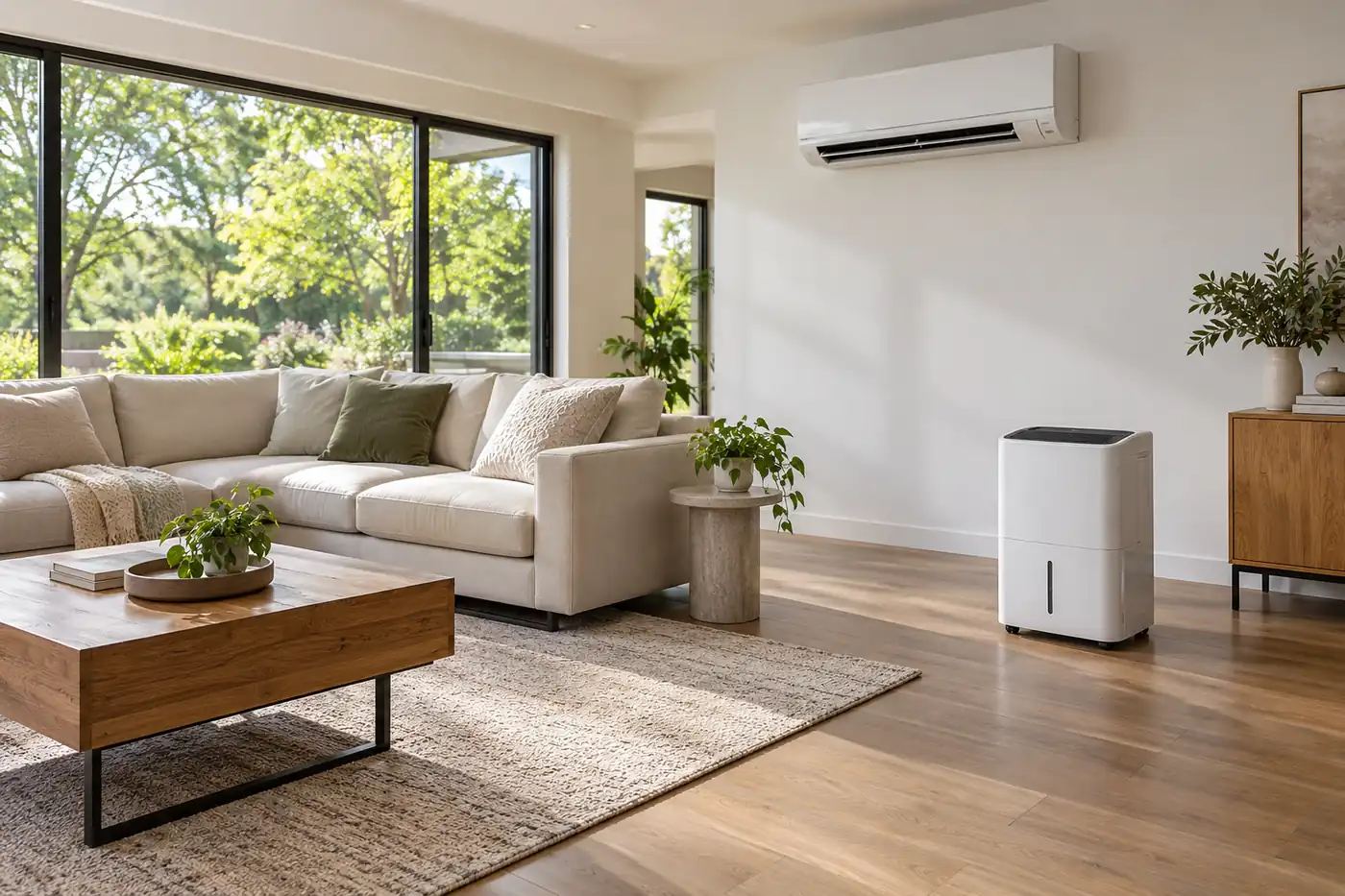
A typical portable dehumidifier releases heat indoors. During hot weather, that heat may increase AC runtime. Compare the combined electricity use of both appliances at similar temperature and RH targets when deciding how to run them.
For a single room, place a portable dehumidifier where air can enter and leave freely. Keep doors and windows managed for the intended controlled area, empty its bucket or use a correctly routed drain, and choose a humidity setpoint based on actual readings. Do not place a unit where water, cords or drainage create a hazard. A central or duct-connected dehumidifier should be installed according to its approved duct, airflow, drainage and control requirements; do not connect units into ductwork arbitrarily.
Try the pair as a system: record indoor temperature, RH, how long each unit runs, and total electricity over comparable weather and use. If RH improves but the room gets warmer and the AC runs much longer, adjust the controls or reassess the equipment arrangement. If water is entering from outdoors or a leak, solve that cause as well.
Which Uses Less Electricity: a Dehumidifier or an Air Conditioner?
Neither is always cheaper. A dehumidifier often uses less power than a large AC while it is running, but total cost depends on hours, capacity, weather and whether the AC must remove the dehumidifier’s added heat. The right comparison is the energy needed to reach the same temperature and humidity result, not just the watt rating on the label.
Use the basic electricity calculation:
Electricity (kWh) = average input power (kW) × operating hours. Cost = kWh × electricity price per kWh.
For a simple arithmetic example, suppose one appliance averages 400 W for 6 hours and another averages 1,200 W for 4 hours, with electricity priced at $0.20/kWh:
| Illustrative operation | Calculation | Electricity | Cost |
|---|---|---|---|
| Device A | 0.4 kW × 6 h | 2.4 kWh | $0.48 |
| Device B | 1.2 kW × 4 h | 4.8 kWh | $0.96 |
This illustrative calculation shows how average power and runtime affect electricity cost. For a practical comparison, measure electricity use while maintaining the same room temperature and RH targets. If both run together, add both devices’ measured energy and account for any change in AC runtime. A plug-in energy meter can help with a portable dehumidifier; whole-system AC use may require the thermostat’s operating record plus electrical monitoring or an appropriate energy measurement.
For more detail on estimating AC-only electricity use from input power, operating hours and electricity rates, see our AC running cost guide.
Dehumidifier efficiency is commonly reported as integrated energy factor (IEF), in liters of water removed per kWh, while AC cooling efficiency uses different measures. Use IEF to compare dehumidifiers under defined test conditions. To compare operating cost with an AC, measure the kWh needed to reach the same room temperature and RH targets. ENERGY STAR’s dehumidifier criteria explain IEF and the product categories.
How Do You Check Humidity and Choose the Right Dehumidifier Capacity?
Measure room temperature and RH, find the moisture source, then choose enough water-removal capacity for the conditions. A room’s floor area alone does not tell you its moisture load. A small laundry area with wet clothes can need more moisture removal than a larger, dry room.
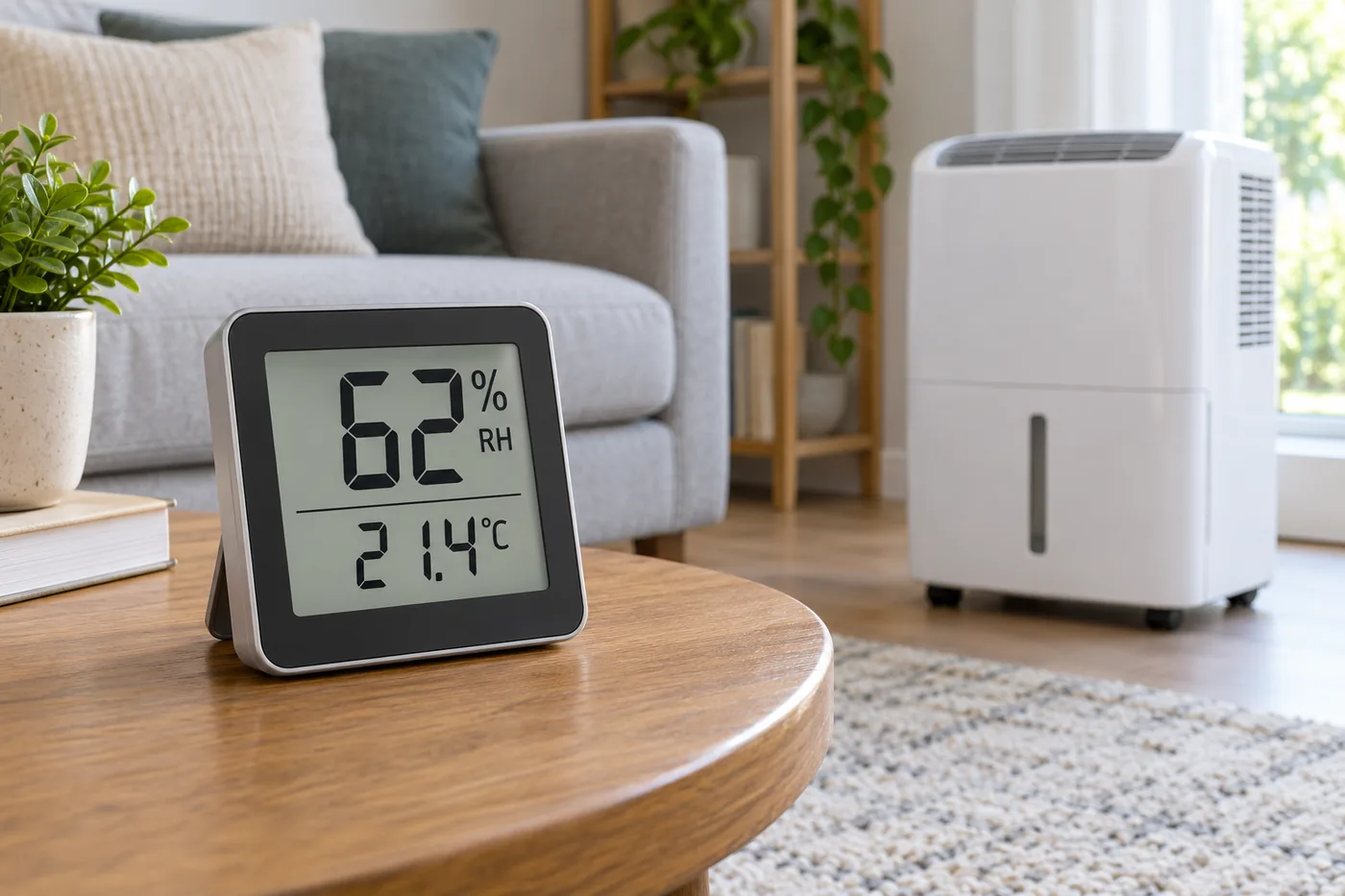
A practical check is to place a hygrometer away from the AC outlet, window, shower steam or direct sun. Record temperature and RH in the morning, afternoon and after the AC has run for several days. Compare readings with comfort and moisture conditions: musty odors, visible condensation, damp surfaces and whether the humidity rises when cooling stops.
When selecting a dehumidifier, check:
- Capacity: rated water removed per 24 hours, often listed in US pints/day. One US liquid pint is about 0.473 L. A 30-pint/day rating corresponds to about 14.2 L/day under its specified test conditions. Actual water collection varies with room temperature, RH, operating time and incoming moisture.
- Room conditions: floor area, actual dampness, outdoor air entering the space, laundry or other moisture sources, and operating temperature.
- Controls and drainage: target-RH humidistat, automatic shutoff, bucket size, continuous drain path and service access. Bucket size is not the same as daily moisture-removal capacity.
- Temperature rating: a cool basement may need a model designed to work at lower temperatures. ENERGY STAR notes that standard units can experience frost when indoor temperature falls below about 65°F (18°C).
- Efficiency: compare products of the same class using relevant test data and IEF (L/kWh), not just advertised room coverage.
The ENERGY STAR dehumidifier guide provides capacity guidance by dampness and room size. Use it to narrow options, then check the actual model’s rated conditions and intended temperature range. Whole-home systems also need correct airflow and duct planning.
When Does a Building Need Separate Humidity Control?
A building needs independent humidity control when its moisture load remains significant even though little cooling is required. This can occur in well-insulated buildings, humid climates, or spaces with outdoor-air ventilation, high occupancy or recurring moisture-producing activities. An AC selected only for peak-temperature cooling may not handle those periods well.
Designers separate the sensible load (heat that raises air temperature) from the latent load (moisture that must be removed). Then they compare the actual equipment’s output and controls at design and part-load conditions. A suitable approach could be approved AC dehumidification controls, a dedicated dehumidifier or properly designed outdoor-air treatment. Ventilation still needs to be provided; recirculating or drying room air does not replace the fresh-air requirement.
This is especially relevant for hotels, commercial rooms and other spaces where comfort depends on keeping both temperature and RH under control. The DOE’s hot-humid climate research summary describes why a lower temperature load can leave moisture needs unmet.
When comparing split AC configurations for a project, browse our air conditioner product range to identify relevant system families, then review each model’s conditions and performance data.
For air-conditioner specification work, we can review cooling capacity, airflow, operating conditions and published moisture-removal information together. For example, our Airproz R410A T1 inverter AC specification includes a moisture-removal field alongside cooling specifications. Use that moisture-removal figure together with its test conditions. Confirm the test temperature and RH if they are not stated, then compare applicable moisture-removal performance with the building’s latent load and target RH. A dedicated dehumidifier remains a separate equipment decision if the project needs one.
What Should You Check If Humidity Stays High?
If the room stays humid, first determine whether the moisture comes from a source, from inadequate removal, or from the way the equipment is controlled. The fix is different for each cause.
| What you observe | Check first | Useful next action |
|---|---|---|
| RH remains high although room temperature is comfortable | AC cycles, Dry mode operation, indoor humidity readings | Try appropriate moisture-control settings, then assess a dehumidifier if the moisture load remains |
| Indoor walls, ceilings or floor are visibly wet | Plumbing, roof, ground or envelope leaks | Stop the water source and dry affected materials promptly; do not rely on appliances alone |
| RH rises soon after AC stops | Fan behavior, moist outdoor-air entry, room activities | Check controls, ventilation conditions and moisture sources; compare readings across cycles |
| Dehumidifier runs but the bucket stays nearly empty | Humidity setting, temperature, air filter, frost or blocked airflow | Confirm the room really is humid, inspect the unit and use a low-temperature-rated model if needed |
| AC does not cool and humidity is high | Filter, coil ice, condensate drainage and actual cooling operation | Follow safe owner checks and arrange HVAC service for refrigeration or electrical faults |
| Both appliances run but bills rise sharply | Both run hours, target settings, drain and added heat | Compare whole-system energy at similar temperature/RH targets; adjust equipment and source control |
If the room is both too warm and too humid, check the cooling fault as well as the moisture source. Our AC not cooling troubleshooting guide organizes the first checks by symptom.
Keeping drains and equipment clean helps prevent the moisture-control equipment from becoming another moisture problem. When work involves refrigerant circuits or electrical repair, use qualified service as required by the equipment and local rules.
Conclusion: Air Conditioner or Dehumidifier?
Choose an air conditioner when you need to cool a hot room, a dehumidifier when a comfortable-temperature room is too damp, and both when AC cooling alone cannot hold the humidity target. The decision is not based on which device extracts more water in a single hour. It is based on whether the room needs heat removed, moisture removed, or both.
Measure temperature and RH, address leaks and moisture sources, check how the AC behaves after reaching its setting, and compare the total energy needed for the desired conditions. For projects requiring equipment selection, share the room or building use, climate, temperature/RH targets, cooling load and available power through our contact page so we can discuss suitable AC options and the data needed for humidity-control design.
Frequently Asked Questions
My AC cools the room, but humidity is still high. What should I do?
Check indoor temperature and relative humidity after the AC reaches its setting, then review cooling runtime, fan controls, moisture sources and drainage. If the room is comfortable but stays damp, dedicated dehumidification may be needed instead of lowering the thermostat.
On a rainy day when the room is not hot, should I run AC or a dehumidifier?
Use a dehumidifier if humidity is high and the temperature is already comfortable. AC may cool the room more than you want. Still ventilate moisture sources appropriately and repair any leaks.
Will running a dehumidifier with AC always lower the power bill?
No. A portable dehumidifier adds heat to the room, which can increase AC runtime. Compare the total measured kWh of both appliances at similar temperature and humidity targets, not only their listed watts.
What if the dehumidifier develops frost in a cool basement?
Switch it off and let it defrost according to its manual. Check the operating-temperature rating; some standard refrigerant models struggle below about 65°F (18°C). A low-temperature-rated product and control of water entry may be necessary.
Can a dehumidifier or air conditioner fix a water leak or existing mold?
No. These devices remove moisture from air; they do not repair plumbing, roof or foundation leaks or remove existing mold. Fix the moisture source and dry damaged materials promptly, then use appropriate humidity control to reduce future dampness.