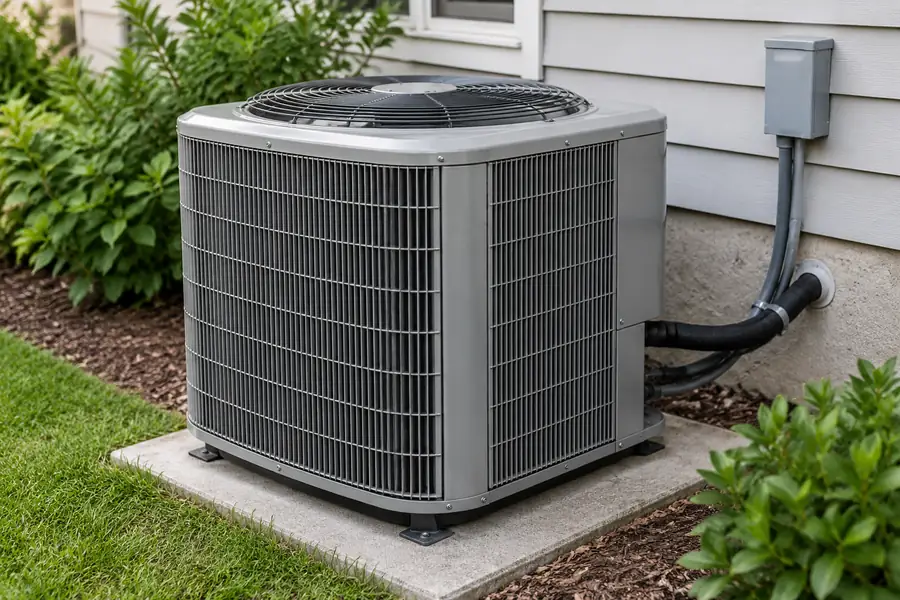
An inverter air conditioner is an AC that can speed up or slow down its compressor to match how much cooling a room needs. When the room is hot, the AC can work harder. As it cools, the compressor can slow down rather than relying mainly on full-speed cooling and repeated stops—much like easing off the accelerator after a car reaches cruising speed. With a suitable model and correct sizing, this can keep room temperature steadier, reduce noise at low output, and save electricity.
What Is an Inverter Air Conditioner?
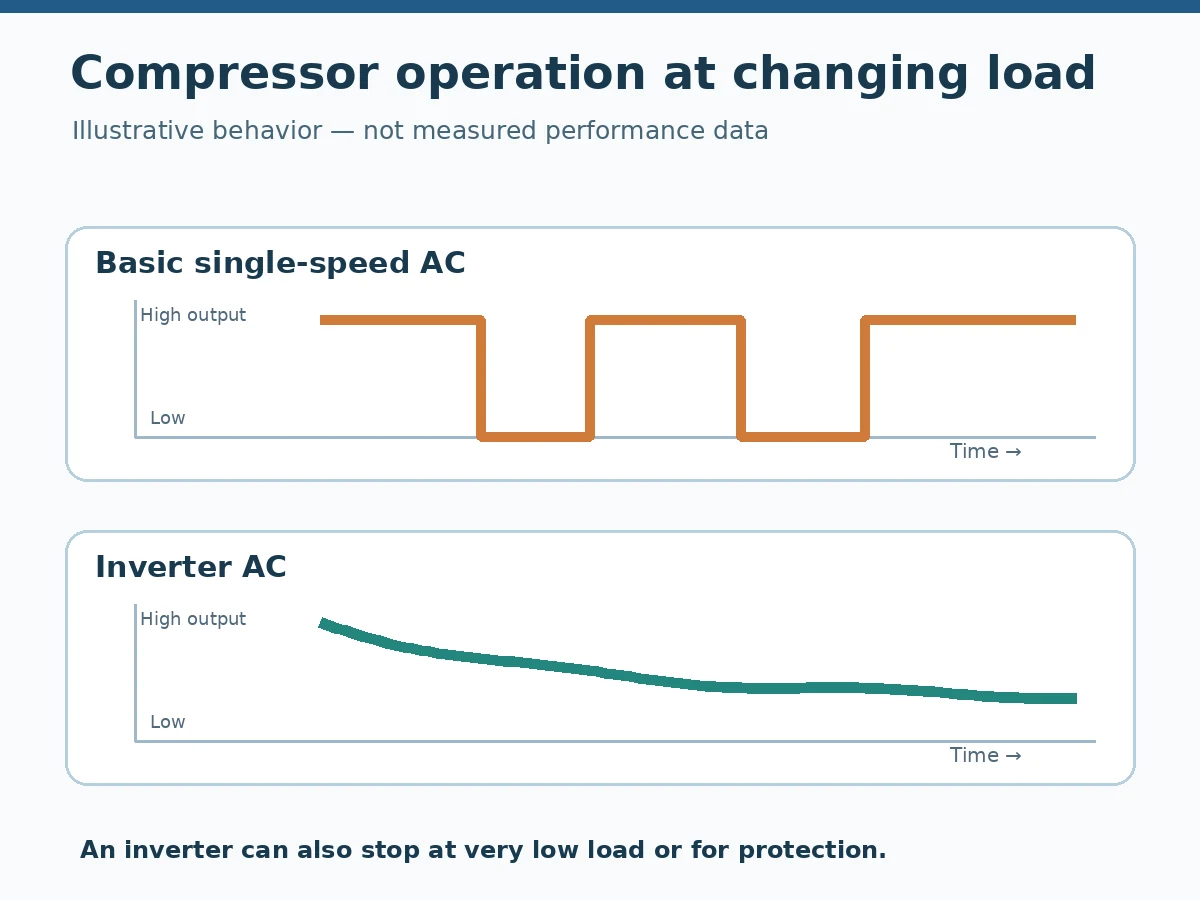
An inverter AC changes how fast its compressor runs to match the cooling needed. A basic fixed-speed AC mainly runs its compressor at one speed and turns it off when the room reaches the target temperature. The word “inverter” refers to the control method, not to a separate category of refrigeration equipment.
The compressor circulates refrigerant through the system so heat can move from the room to the outdoors. In an inverter system, the controller requests more or less output while an inverter drive changes the electrical supply delivered to the compressor motor. The air conditioner still uses an evaporator, condenser, refrigerant circuit, fans and expansion device, just like other vapor-compression AC systems.
| Term | What it means | Why it matters |
|---|---|---|
| Inverter / variable-speed AC | Compressor motor speed can change over a designed operating range. | Helps the system match cooling output to changing room demand. |
| Fixed-speed / single-speed AC | Compressor mainly operates at one speed or is off. | Handles reduced demand mainly by cycling the compressor on and off. |
| Cooling load | Heat the AC needs to remove at a particular moment. | Helps determine the cooling capacity the room or building needs. |
| Part-load operation | Cooling at less than the equipment’s rated full output. | Shows how the system responds when less cooling is needed than at full output. |
An inverter system may be a wall-mounted split AC, a ductless mini-split, a window unit or another compatible design. Learn how these system formats differ in our guide to types of AC systems.

How Does an Inverter Air Conditioner Work?
An inverter AC works in four steps: sensors measure room conditions, the controller sets the cooling demand, the inverter changes compressor motor speed, and the refrigeration system adjusts cooling output. The steps below show how these parts work together.
- Check the room: Sensors report the temperature and other conditions.
- Choose the output: The controller decides whether the room needs more or less cooling.
- Set compressor speed: The inverter drive changes the motor’s speed.
- Keep the room comfortable: The system delivers cooling as demand changes, within the model’s operating limits.
The power electronics control motor speed; the refrigeration circuit still carries heat from the room to the outdoors. The technical steps below explain each part.
Step 1: The sensors and controller determine demand
A room-temperature sensor, the selected temperature and other operating inputs help the control board decide the required cooling output. The outdoor controller also monitors relevant operating limits, which can include refrigerant temperatures, current and compressor protection signals. The exact sensors and control algorithm vary by model.
Step 2: Power electronics vary the compressor’s electrical supply
Many inverter ACs first change the incoming alternating current (AC) into direct current (DC) with a device called a rectifier. A section called the DC link helps supply the next circuit. The inverter drive then creates controlled electrical power for the compressor motor. Changing that motor power lets the motor run at different speeds. The printed circuit board (PCB) and its power components handle this job; the remote control only sends user commands.
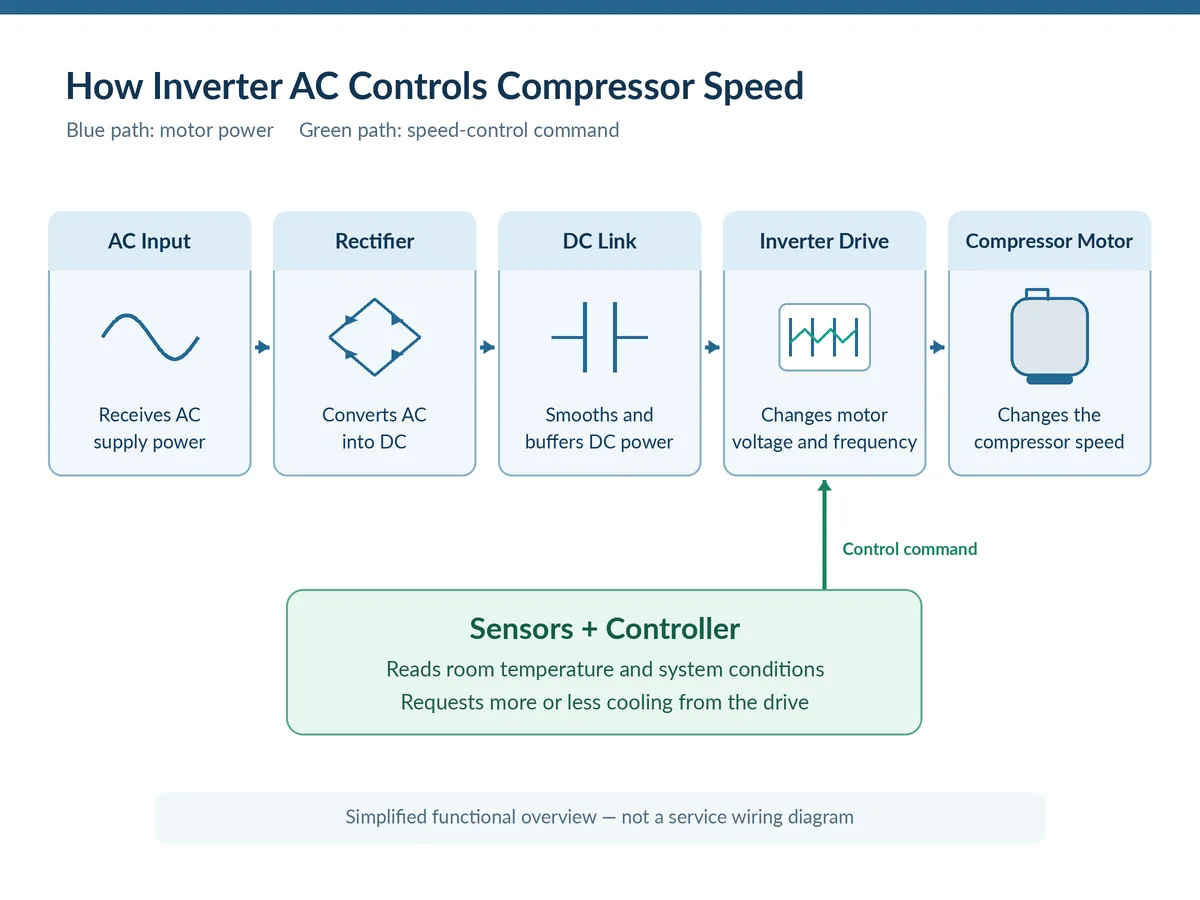
The motor supply is not simply the unchanged 50 Hz or 60 Hz grid waveform. Drive frequency, voltage and motor control are coordinated by the equipment’s electronics; they are not settings an owner should adjust manually.
Step 3: Compressor speed changes cooling output
A compressor running faster generally circulates more refrigerant and enables more cooling, subject to the equipment’s operating envelope. Slowing down reduces available cooling output and often lowers electrical input. Indoor and outdoor fan speeds and expansion-device operation may also change so the refrigeration system operates properly.
The evaporator absorbs heat from indoor air. The compressor raises refrigerant pressure; the outdoor condenser rejects heat; the expansion device reduces pressure before the refrigerant returns to the indoor coil. Changing compressor speed changes capacity; it does not change the basic direction of heat removal in cooling mode.
Step 4: The AC reduces output near the set temperature
When a room is hot, the control system may request relatively high output. As the cooling load falls, the compressor may slow down and continue operating rather than repeatedly returning to full output. This is particularly useful in rooms with long operating hours and changing loads from sunlight, occupancy or equipment.
Can an inverter compressor turn off? Yes. It can keep running at a lower speed while cooling demand remains within its control range. When demand falls below its minimum output, the thermostat calls for a stop, or the system enters protection, the compressor can stop.
What Are the Inverter Compressor, PCB and Control Board?
The compressor moves refrigerant, the controller decides what output is needed, and the inverter power electronics drive the compressor motor at the requested speed. These functions can be on separate boards or integrated into one assembly, depending on the design.
In simple terms: the controller makes the decision, the inverter drive carries it out, and the compressor moves the refrigerant.
| Component | Main job | What to check if comparing models |
|---|---|---|
| Compressor | Compresses refrigerant and circulates it through the circuit. | Mechanical type, permitted speed/capacity range, approved refrigerant, service support. |
| Control PCB / main controller | Reads sensors, manages operating modes and protects the system. | Diagnostic functions, protection limits, availability of replacement parts. |
| Inverter PCB / power module | Produces electronically controlled motor power from a DC supply. | Model-specific power supply, surge/voltage protections, parts availability. |
| Temperature and system sensors | Provide feedback about the room and system conditions. | Correct sensor specifications and compatible replacement parts. |
| Fans and expansion control | Support airflow and refrigerant flow across varying output. | Full-system performance at the relevant indoor/outdoor conditions. |
An inverter compressor is not a separate mechanical family. Rotary and scroll describe how refrigerant is compressed; inverter describes how the motor is controlled. Our HVAC compressor types guide explains that distinction in more detail.
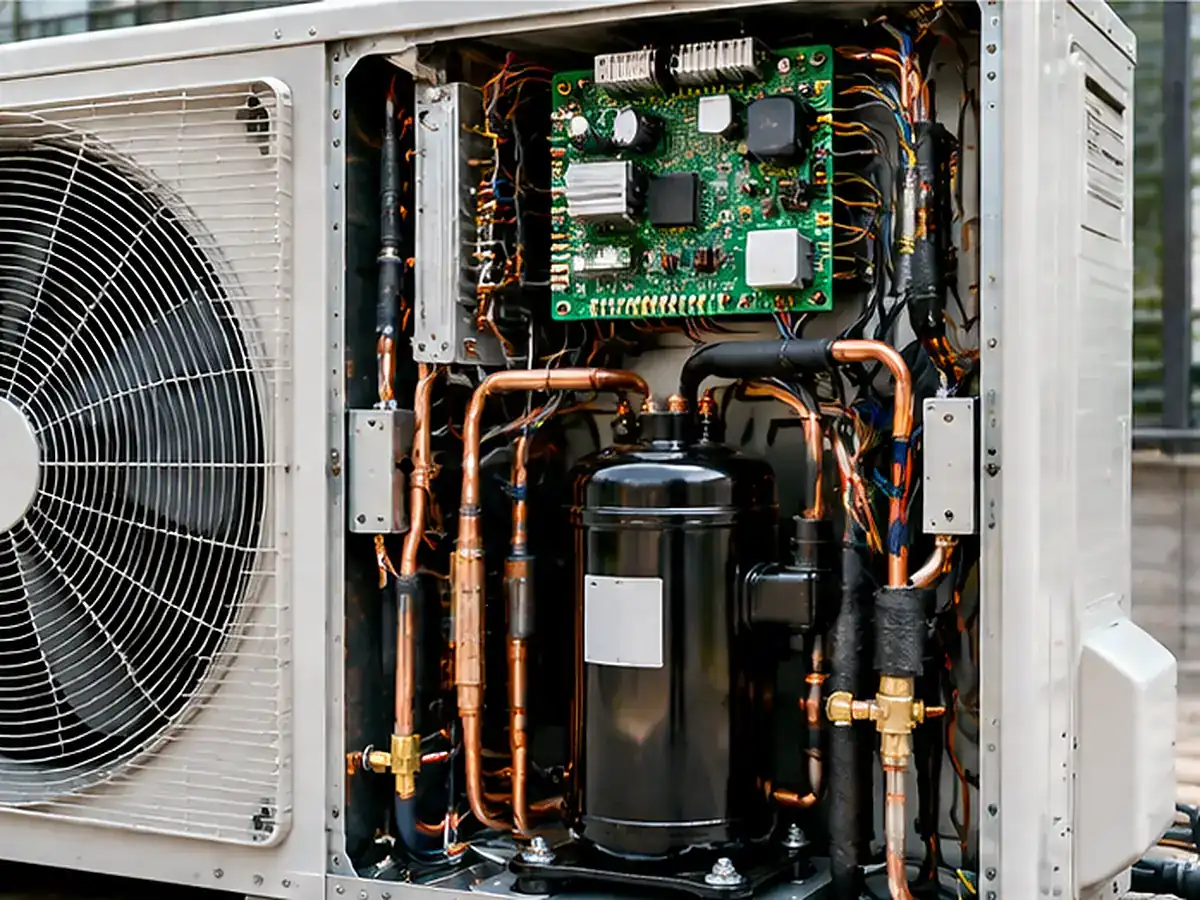
A failed inverter PCB can stop a compressor, but similar symptoms can also result from electrical supply, sensors, communication or refrigerant-system faults. A qualified technician should identify the cause using the model’s diagnostic procedures. Inverter boards can retain hazardous high voltage even after power is disconnected; internal diagnosis belongs to qualified service personnel.
These educational illustrations show common inverter AC components and operating concepts. For model-specific wiring and servicing, use the equipment’s service documentation.
Inverter AC vs Non-Inverter AC: What Is the Difference?
Inverter AC adjusts compressor capacity, while a basic non-inverter AC mainly controls room temperature by turning a single-speed compressor on and off. This affects how the two systems respond after the room has cooled, not just how quickly they start.
| Comparison | Inverter / variable-speed AC | Basic fixed-speed AC |
|---|---|---|
| Compressor control | Changes motor speed within a designed range. | Mainly runs at one speed or stops. |
| Cooling as demand falls | Can continue at reduced output. | Cycles on and off more often when load is below full capacity. |
| Room temperature | Can reduce swings when appropriately controlled. | More dependent on thermostat cycling and system sizing. |
| Sound | Can be quieter at reduced compressor and fan speed. | Full-speed operating noise whenever compressor is on. |
| Electricity use | Often benefits from efficient part-load operation; check test ratings. | Depends on rated efficiency, installation, load and cycling. |
| First cost | Commonly higher for comparable equipment. | Commonly lower. |
| Electronics and service | More complex drive/control electronics; verify local support. | Usually simpler compressor control; still needs proper service. |
| Best comparison metric | Actual matched-system ratings and operating conditions. | Same ratings, capacity and operating conditions. |
Two-stage AC is a separate option between basic single-speed and continuously variable-speed designs. A system also may have a variable-speed fan while retaining a fixed-speed compressor. Read the actual compressor specification rather than judging by the words “smart” or “multi-speed” on the box.
What happens during a typical day of cooling?
Early in a hot afternoon, both systems can provide strong cooling. After the room nears its set temperature, an inverter AC can slow its compressor, while a basic fixed-speed AC mainly cycles its compressor on and off. This difference is most noticeable during long periods when less cooling is needed.
At night, a properly sized inverter system can often run at reduced output and sound levels. It can also stop when the cooling demand is below its minimum output. For long cooling periods with changing loads, compare efficient inverter models first; for occasional-use rooms, compare the total cost of suitable inverter and fixed-speed options.
Does Inverter AC Save Electricity? How Much?
Yes. An efficient inverter AC can reduce electricity use by lowering compressor output when a room needs less cooling. The amount depends on the exact models and operating hours. For example, if two suitable systems average 1.1 kW and 0.8 kW over 8 hours a day, the difference is 72 kWh over 30 days, or $14.40 at $0.20/kWh. These values illustrate the calculation; they are not measured savings from an Airproz model.
When a room needs less cooling, an inverter compressor can reduce its output instead of running mainly at full speed. The resulting electricity use also reflects the compressor, fans, heat exchangers, humidity, climate, installation and controls. Monthly energy cost comes from total kilowatt-hours (kWh) used over time, rather than a brief starting-current peak.
There are two different claims to check: how efficiently the unit can run under part-load conditions and how much electricity it will actually use in your room. A seasonal label helps with the first; measured or well-estimated kilowatt-hours help with the second.
Compare the correct efficiency rating
For US central ducted split AC, a current SEER2 rating helps compare seasonal cooling efficiency when systems are rated on the same basis. For eligible US room/window AC, CEER is used. Other markets and product classes may use SEER, EER, CSPF or local energy labels. Do not compare different rating systems as though they were one scale. Check the exact model, test basis, capacity and climate relevance.
The US ENERGY STAR room air conditioner guide explains the efficiency and comfort benefits of variable-speed room AC compressors. The US Department of Energy’s central AC purchasing guidance provides context for model-specific SEER2 comparisons.
Estimate electricity cost from measured or credible average power
The simplest practical calculation is electricity (kWh) = average input power (kW) × operating hours. Multiply kWh by the local electricity price to estimate cost. When a variable-speed system changes power over the day, use its measured or justified time-weighted average, not one instantaneous watt reading.
Illustrative calculation: Assume two similarly suitable systems average 1.1 kW and 0.8 kW of electrical input over 8 hours per day for 30 days. The values are hypothetical and show how to estimate cost; they are not measured results for an Airproz model.
| Example | Average power | 30-day energy | At $0.20/kWh |
|---|---|---|---|
| Example unit A | 1.1 kW | 264 kWh | $52.80 |
| Example unit B | 0.8 kW | 192 kWh | $38.40 |
| Difference | 0.3 kW | 72 kWh | $14.40 |
In this example, the $14.40 monthly cost difference follows from the assumed average power values. For a real installation, use a comparable operating-hour profile and whole-unit electricity data, including fans and controls, alongside your local tariff.
Three mistakes when estimating inverter AC costs
- Using maximum watts for every hour: The input power of an inverter system changes with load. Use measured or justified average input power for the period.
- Mixing efficiency labels: SEER, SEER2 and CEER are not interchangeable numbers. Compare like product classes and test methods.
- Counting only start-up current: A brief current spike does not show monthly consumption. The electricity bill depends on total kWh over time.
What do published Airproz inverter AC specifications show?
The Airproz public product page lists R32-9K AS at 2,500 W rated cooling capacity with cooling SEER 6.1 and R32-18K AS at 5,100 W with cooling SEER 6.2. Both are listed for single-phase 220–240 V / 50 Hz supply. The figures come from the Airproz R32 SA series product page; use the current datasheet and applicable test report for final model approval.
| Published model | Rated cooling capacity | Published cooling SEER | Listed power supply |
|---|---|---|---|
| R32-9K AS | 2,500 W (nominal 9,000 BTU/h class) | 6.1 (SEER, not SEER2) | Single-phase 220–240 V / 50 Hz |
| R32-18K AS | 5,100 W (nominal 18,000 BTU/h class) | 6.2 (SEER, not SEER2) | Single-phase 220–240 V / 50 Hz |
What this means: Capacity and published cooling SEER differ between these two models. For project selection, also request minimum cooling output, rated and part-load electrical input, performance at the intended outdoor temperature, and the applicable market test documentation. The table uses SEER, so compare it with figures rated under the same method—not US SEER2.
What Are the Advantages and Disadvantages of Inverter AC?
The main advantages are adaptable cooling, potentially lower part-load energy use, steadier temperatures and quieter low-speed operation. The main disadvantages are usually higher first cost and more complex electronics and repair support. The size of each benefit varies by model and application.
Main advantages
- Comfort: Output can track gradual load changes rather than relying mainly on full-speed cooling and long off periods.
- Part-load performance: Efficient variable output can reduce electricity use when the cooling load is well below peak.
- Sound: Lower compressor and fan speeds can reduce operating sound, although the complete model and installation still matter.
- Capacity flexibility: A suitable modulation range helps respond to daytime sun, occupancy and other varying heat loads.
- Project fit: Apartments, bedrooms, guest rooms and offices with long run hours may benefit from steadier temperature control.
Main disadvantages and limits
- Higher upfront price: Comparable inverter models may cost more; check the actual difference, not just product-category assumptions.
- Control-board repairs: Power electronics and specific replacement PCBs can be expensive or harder to obtain in some markets.
- Electrical compatibility: The unit must match local voltage, frequency, protection and power quality requirements; inverter is not a substitute for proper electrical design.
- Minimum capacity: An oversized unit may cycle even at its lowest compressor speed, reducing the expected comfort advantage.
- Variable results: Poor sizing, dirty coils, restricted airflow, incorrect refrigerant charge or extreme outdoor conditions can reduce efficiency and cooling.
Inverter AC reliability is shaped by compressor construction, PCB quality, heat-exchanger protection, installation, outdoor conditions and maintenance. Accessible spare parts and qualified local service make repairs easier over the system’s operating life.
What does this mean for maintenance costs? Routine filter cleaning and keeping airflow clear are broadly similar to other AC types. Repairs involving an inverter power board, sensors, compressor drive or model-specific parts may need specialized diagnostics. Check local technician capability and board availability before you choose a model, especially for projects using many identical units.
Is an Inverter AC Worth It?
Yes—an efficient, properly sized inverter AC is usually worth the extra cost for rooms cooled for many hours each day, especially when demand changes and quieter low-speed operation matters. For rooms used only occasionally, a fixed-speed AC may cost less overall. Compare the installed-price difference, expected annual electricity savings, and service support before choosing.
| Your situation | What to favor | Why / what to verify |
|---|---|---|
| Bedroom or apartment used through the night | Well-sized efficient inverter AC | Low-load sound, minimum capacity and actual efficiency. |
| Hotel with many occupied rooms | Inverter shortlist with verified service support | Long run hours, indoor sound and replacement PCB availability. |
| Office with changing occupancy and sunlight | Variable-capacity system suited to the load profile | Seasonal performance, controls and peak design capacity. |
| Occasional-use room with limited budget | Compare inverter and fixed-speed total cost | Low annual hours can make a higher purchase price harder to recover. |
| Very hot region or weak local grid | Climate-rated, electrically compatible model | Capacity at outdoor design temperature and actual electrical protection. |
| Existing AC that is properly sized and efficient | Compare replacement costs before changing | “Inverter” alone is not a reason to discard functioning equipment. |
A practical payback check
For two suitable installed systems, divide the extra installed cost of the inverter option by its estimated annual electricity-cost saving on the same cooling duty. This gives a simple payback period in years. When making the final decision, also compare expected service costs and how many years you plan to use the AC.
Illustrative payback: If an inverter option costs $300 more installed and the expected electricity saving is $60 per year, simple payback is five years ($300 ÷ $60). These are assumed values; a real comparison uses local quotes, tariffs and realistic running hours.
Is Inverter the Same as Split AC, Mini-Split or Dual Inverter?
These terms describe different things. Inverter refers to compressor speed control. Split and mini-split describe how indoor and outdoor equipment is arranged. Dual Inverter is a manufacturer term for certain inverter-compressor designs, including some dual-rotary arrangements. A split or mini-split can also be an inverter AC, and some inverter models are marketed as Dual Inverter.
A ductless mini-split uses indoor and outdoor equipment joined by refrigerant piping, typically serving one or more zones without conventional ductwork. The number of zones, approved combinations and whether it also heats the room depend on the model. See our mini-split AC explanation for system-layout details.
The precise meaning of Dual Inverter varies by manufacturer. Compare complete models using tested efficiency, cooling capacity, minimum output, sound ratings, and service support under relevant conditions.
What Should You Check Before Choosing an Inverter Air Conditioner?
Check six things before choosing an inverter AC: (1) cooling capacity and minimum output, (2) efficiency under the relevant test method, (3) performance in your climate, (4) voltage and frequency, (5) indoor and outdoor noise, and (6) installation, maintenance, and local service support. Distributors and project buyers should request these details for the exact indoor/outdoor model combination and destination market.
- Size and minimum output: Calculate the cooling load; compare both design-point capacity and low-load modulation data when available. Excess capacity can lead to cycling and humidity complaints.
- Efficiency on the same rating basis: Compare model-specific, applicable SEER2/CEER/SEER/EER or local energy labels rather than mixing methods.
- Climate and ambient limits: Check cooling performance at the actual outdoor design condition, especially for hot-climate installations. A T1/T3 label without a model performance table is not sufficient.
- Electrical design: Confirm supply voltage and frequency, circuit requirements, protections, local installation rules and documented control-board protections.
- Noise: Compare indoor and outdoor sound ratings under the same mode, distance or test standard; sound power and sound pressure are not interchangeable.
- Installation and maintenance: Verify matched indoor/outdoor components, refrigerant piping limits, airflow, drainage, service access and qualified commissioning.
- B2B documentation: Request the exact model datasheet, applicable test report, regional certification/energy-label documents, warranty terms, PCB availability and support process.
Airproz lists R32 and R410A inverter split AC families in its air conditioner category. Narrow the range by destination market, room load, electrical supply and required efficiency, then review the current documents for each selected model.
What documents should a distributor or project buyer request?
Request a technical pack for the exact indoor/outdoor model combination: current datasheets, rated cooling performance and efficiency at relevant conditions, electrical requirements, operating limits, installation instructions, and applicable market approvals or energy labels. Also confirm replacement PCB and sensor availability, warranty terms and technical support.
Airproz lists R32 SA inverter models with different capacities and published seasonal efficiency figures. Use the series page to shortlist models, then verify the quoted configuration, current performance documents and destination-market requirements before issuing a purchase order.
How Can You Tell Whether an Inverter AC Is Working Properly?
Check three things: the room cools toward its set temperature, airflow stays normal, and no persistent fault code appears. An inverter compressor may speed up, slow down, or stop as cooling demand changes. Use the symptom table below if cooling remains weak or a fault returns.
| What you notice | What it may mean | Practical next action |
|---|---|---|
| Compressor changes speed | Often normal load matching | Check whether the room stays comfortable. |
| Compressor sometimes stops | Can be normal at low load or during protection | Watch for persistent comfort problems or fault indications. |
| Cooling remains weak | Airflow, sizing, refrigerant or control issue | Check safe airflow basics; arrange service if it continues. |
| A fault code repeatedly returns | System has detected an abnormal condition | Record the full code and exact model; consult authorized service. |
| Unit repeatedly trips protection | Possible electrical or equipment problem | Stop repeated resets and request qualified diagnosis. |
Start with safe observations: confirm cooling mode and set temperature, clean accessible filters as directed, check unobstructed indoor/outdoor airflow, and record when cooling is weak or fault codes appear. Do not open the outdoor electrical enclosure or touch the inverter PCB. A qualified technician may need to investigate sensors, electrical supply, refrigerant conditions and controller diagnostics if poor cooling or repeated faults persist.
Inverter Air Conditioner FAQ
Does an inverter AC compressor run all the time?
No. An inverter compressor can keep running at a lower speed as cooling demand falls. It can also stop when demand is below its minimum output, the thermostat calls for a stop, or a protection limit is reached.
Does inverter AC use less electricity at night?
Yes, an efficient inverter AC can use less electricity at night when the room needs less cooling. The compressor can slow down as the temperature stabilizes. Compare actual kWh use under your nighttime conditions and tariff.
Does an inverter AC save electricity at low cooling loads?
Yes, an efficient inverter AC can save electricity at low cooling loads within its effective speed range. Performance depends on the model’s part-load efficiency and correct sizing; the compressor may cycle below its minimum output.
Is an inverter AC the same as a DC inverter AC?
Usually, both terms describe electronically controlled compressor-speed technology. Many systems change incoming AC power to DC before creating controlled motor power. Compare rated performance to judge efficiency.
Is a dual inverter better than a normal inverter AC?
Not necessarily. Dual Inverter is a manufacturer-specific term for certain compressor designs. Choose a Dual Inverter model when its tested efficiency, noise, capacity range, and service support fit your needs better than the alternatives.
Does an inverter AC need a special thermostat?
Not always. Some inverter ACs require a manufacturer-specific communicating controller, while others support specified standard thermostats. Check the exact model’s installation guide for compatible controls and wiring.
Can voltage fluctuations damage an inverter AC PCB?
Yes. Voltage disturbances can damage inverter control electronics. Use equipment matched to local voltage and frequency and follow the manufacturer’s electrical protection requirements.
Is inverter AC maintenance more expensive?
Routine maintenance is usually similar, but repairs can cost more if an inverter control board or another specialized component fails. Filter cleaning and airflow checks are comparable to those for fixed-speed units; check local repair and replacement-part support before buying.
Can an inverter air conditioner also heat?
Yes, if the model is a reversible heat pump. A cooling-only inverter AC provides cooling, while a reversible model can both cool and heat by switching refrigerant flow.
The Bottom Line: What Is an Inverter Air Conditioner?
An inverter air conditioner uses electronic control to adjust compressor speed as cooling demand changes. This lets a well-designed system maintain steadier temperatures, operate more quietly at reduced output, and use electricity efficiently during suitable part-load conditions.
For bedrooms, hotels, offices and other spaces that need cooling for long hours, a properly sized, efficient inverter AC is often a strong choice. Compare the model’s cooling capacity, seasonal efficiency, operating conditions and total ownership cost to select the right system.
Comparing Inverter AC Models for Distribution or a Project?
Share your destination country, intended application, cooling load or capacity range, climate, voltage and frequency, and approximate order requirements. Airproz can help you identify relevant air conditioner product families and the technical documents to review for each model.
Review the available R32 SA inverter series, then contact Airproz about your project to discuss suitable model options, documentation, availability and quotation details.