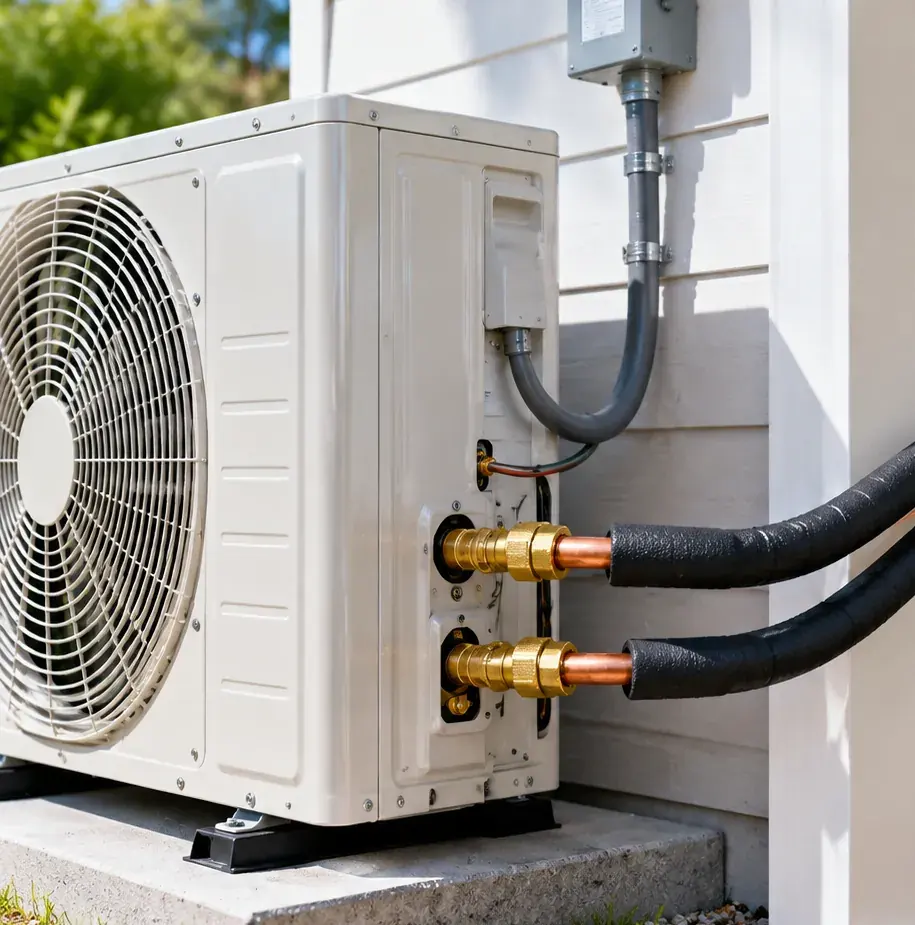
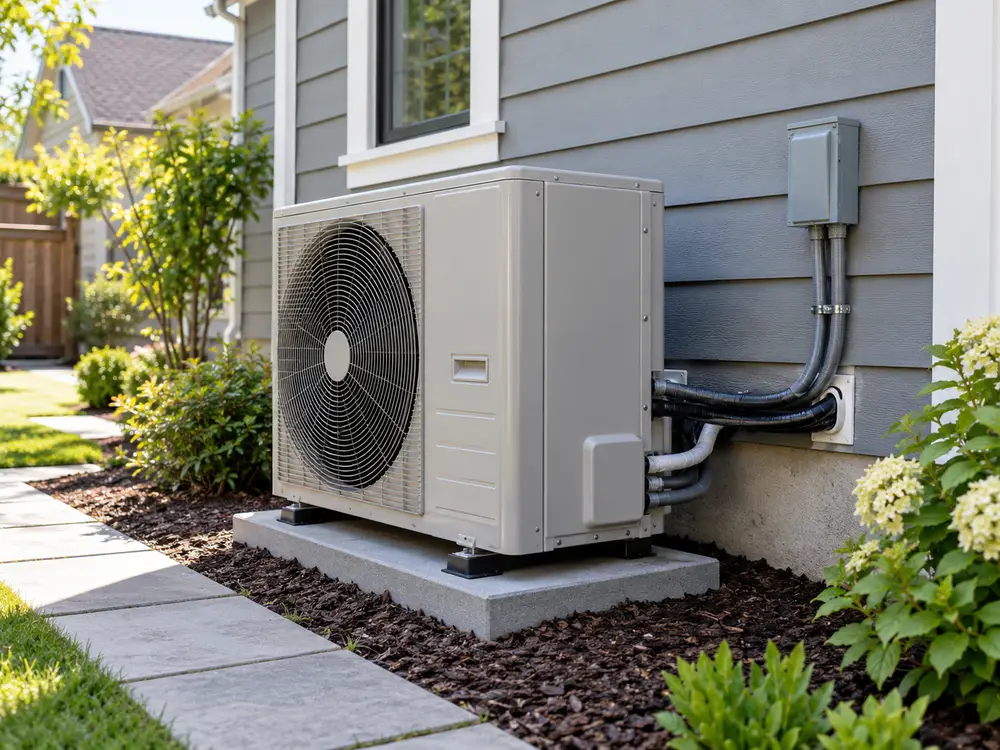
The main types of heat exchangers used in heating, ventilation and air conditioning (HVAC) and heat pump systems are finned-tube coils, microchannel coils, plate heat exchangers, shell-and-tube exchangers, coaxial or tube-in-tube exchangers, and air-to-air energy-recovery exchangers.
At Airproz, we do not choose a heat exchanger from its size, type name or nominal kW alone. We first look at the real job it must do. That includes the two fluids or air streams, the amount of heat to transfer, inlet and outlet temperatures, flow rates, pressure drop, refrigerant conditions, water quality, corrosion, freezing risk, service method, installation space and market requirements.
Engineers call this set of real working conditions the operating point. Once we know it, we can compare which heat exchanger construction fits the project and which options should be ruled out.

Which heat exchanger type should you start with?
The application gives you a useful starting point. After that, check what can rule the option out, such as too much pressure drop, dirty water, freezing, corrosion, difficult cleaning or code requirements.

| Project condition | Good type to check first | Why it may fit | When it may not fit | What to check |
|---|---|---|---|---|
| Air ↔ refrigerant | Finned-tube or microchannel coil | Built for air flow on one side and refrigerant on the other | Corrosion, dirt, frost, repair limits or air-pressure loss are a problem | Airflow, outdoor conditions, humidity, refrigerant circuiting, defrost and drainage |
| Clean liquid ↔ liquid | Plate heat exchanger | Compact and can work with a small temperature difference between the two fluids | Dirty water, too much pressure drop, freezing or cleaning limits create risk | Heat duty, both flow rates, inlet/outlet temperatures, pressure drop, fluid type and water quality |
| Large duty or frequent mechanical service | Shell-and-tube | Robust construction with many design and service options | Space, bundle-removal room, vibration or project cost do not fit | Design pressure and temperature, materials, service clearance and code requirements |
| Compact refrigerant ↔ water/brine duty | Brazed plate or coaxial | Both are common in heat-pump packages | Water quality, freezing, solids, materials or field-service needs change the risk | Minimum flow, glycol, water chemistry, pressure drop, freeze protection and refrigerant conditions |
| Treated pool water | Approved corrosion-resistant water-side exchanger | Pool-water chemistry has a major effect on material choice | The material is not approved for the actual disinfectant or water chemistry | Pool chemistry, flow, bypass arrangement, target temperature and exact model material |
| Exhaust air ↔ outdoor air | Plate core, rotary wheel or heat pipe | Recovers heat from ventilation air | Leakage, frost, contamination, pressure drop or moisture-transfer needs do not fit | Heat-recovery effectiveness, pressure drop, leakage, frost control, fan impact and cleaning access |

First, separate the exchanger type from the job it does
Three heat-exchanger terms are often mixed together. Keeping them separate makes specifications and quotations much easier to understand.
Construction means the physical type of exchanger, such as finned-tube, microchannel, plate, shell-and-tube or coaxial.
Duty means the job the exchanger is doing. It may evaporate refrigerant, condense refrigerant, remove superheat, recover heat or keep two fluid circuits separate.
Flow arrangement means how the two streams move compared with each other. Common arrangements include counterflow, parallel flow and crossflow.
This matters because a condenser is a job, not one fixed construction. A brazed plate, finned-tube, microchannel, shell-and-tube or coaxial exchanger can act as a condenser if it is designed for that duty. The same idea applies to an evaporator.
In a reversible heat pump, the same physical exchanger may do a different job in heating and cooling mode. Counterflow is also not a separate exchanger family; it only describes the flow direction.
ASHRAE’s heat-exchanger guidance explains the engineering basis for heat transfer in HVAC and refrigeration systems. When you send us a project, we also separate construction from duty so a vague request such as “need a condenser” does not lead to the wrong quotation.

Main types of heat exchangers used in HVAC and refrigeration
The table below shows where each construction is commonly used and what you should check before choosing it.
| Heat exchanger type | Typical HVAC use | Main advantage | What to check |
|---|---|---|---|
| Finned-tube coil | Air ↔ refrigerant; air ↔ water/glycol | Flexible and widely used for air-side heat transfer | Airflow, dirt, corrosion, frost/defrost and condensate |
| Microchannel coil | Air ↔ refrigerant | Compact with low internal refrigerant volume | Repair method, contamination, corrosion and circuit compatibility |
| Brazed plate | Refrigerant ↔ water/brine; clean liquid ↔ liquid | Compact with strong heat transfer | Narrow passages, pressure drop, fouling, freezing and material/braze compatibility |
| Gasketed plate-and-frame | Water/glycol ↔ water/glycol; district and hydronic loops | Can be opened, serviced and sometimes expanded | Gaskets, fouling, design pressure/temperature and maintenance access |
| Shell-and-tube | Liquid ↔ liquid; refrigerant ↔ liquid; phase-change duties | Robust, configurable and serviceable | Space, bundle access, vibration, fouling and pressure drop |
| Coaxial / tube-in-tube | Refrigerant ↔ water/brine | Simple continuous liquid path for selected heat-pump duties | Pressure drop, materials, service method and available capacity |
| Air-to-air plate / wheel / heat pipe | Exhaust air ↔ outdoor air | Recovers energy from ventilation air | Frost, leakage, pressure drop, condensate, moisture transfer and contamination |
Finned-tube and microchannel coils

If one side of the heat transfer is outdoor air or duct air, an air coil is usually the first type to check. In a finned-tube coil, fluid flows through tubes and thin metal fins add more surface area for air to pass over.
These coils are common in air handlers, fan coils, evaporators, condensers, air-source heat pumps and dry coolers. The tube and fin design can be adjusted for airflow, moisture removal, refrigerant flow and outdoor conditions.
Do not choose only from face area or nominal kW. Check airflow, air speed, entering-air temperature and humidity, fin spacing, condensate drainage, corrosion exposure, refrigerant or water distribution, frost, defrost and fan pressure.
A microchannel coil uses many small refrigerant passages. It can reduce size and internal refrigerant volume. Before choosing it, also check repair method, cleaning practice, contamination, corrosion between different metals and the exact pressure and refrigerant limits.
Plate heat exchangers

A plate heat exchanger is often a good starting point for clean liquid-to-liquid systems. It can provide a lot of heat-transfer area in a small space.
Corrugated plates create narrow flow channels between the two liquids. This can allow the two fluids to leave at temperatures quite close to each other. Engineers call this a close temperature approach.
There are two common plate constructions you should not confuse. A gasketed plate-and-frame exchanger can normally be opened for cleaning, gasket replacement or plate changes. A brazed plate heat exchanger (BPHE) is permanently joined and is usually much more compact.
We often use gasketed plate-and-frame units when service access matters. They are common in water/glycol systems, hydronic separation and district-energy systems.
AHRI’s liquid-to-liquid heat-exchanger program ties ratings to defined test conditions. This is important when you compare quotations: use the same flows, temperatures and fluid properties, not just the same kW value.
Brazed plate exchangers are common in compact heat pumps and refrigeration equipment. Danfoss technical documentation lists heat pumps, chillers, evaporators and condensers among common BPHE applications.
Because a BPHE cannot be opened like a gasketed plate unit, water quality and freeze protection become especially important. Check strainers, glycol concentration, cleaning method, minimum flow, pressure drop and the risk of water freezing inside the narrow passages.

Shell-and-tube heat exchangers
Shell-and-tube exchangers are often worth checking when you need a strong mechanical design, larger flow passages or easier internal service.
One fluid flows inside tubes. The other flows around the tubes inside the shell. The design can change by using different tube sizes, tube lengths, numbers of passes, baffles, shell arrangements and materials.
Some designs allow the tube bundle to be removed for service. That can be useful, but it also means you need enough space in the plant room to remove it.
Do not use a simple rule such as “always put the dirty fluid in the tubes.” The better side depends on fouling, corrosion, viscosity, pressure, phase change, cleaning, containment cost, velocity and vibration.
TEMA publishes mechanical-design standards for shell-and-tube exchangers. Your project may also need pressure-vessel or local-market rules. Put these requirements into the specification instead of assuming the construction name covers them.

Coaxial and tube-in-tube heat exchangers
Coaxial and tube-in-tube exchangers are also used in some refrigerant-to-water, water-source, geothermal and hot-water systems.
Their liquid path can be more open than the narrow channels inside a plate exchanger. This can help in some systems with debris or where a simple continuous flow path is useful.
That does not make them freeze-proof or fouling-proof. Compared with a brazed plate exchanger, a coaxial unit may need more space. Compared with shell-and-tube, it can be simpler but may not be the best answer for very large duties.
Check water quality, glycol or brine, pressure drop, freezing risk, refrigerant conditions, materials, available space and the service method before choosing between these types.
Air-to-air heat exchangers for ventilation energy recovery
Ventilation energy recovery has a different goal. The system uses outgoing exhaust air to preheat or precool incoming outdoor air.
Common technologies include plate exchangers, rotary wheels and heat pipes. AHRI Guideline W covers these air-to-air energy-recovery technologies.

Do not choose only from a headline recovery-efficiency number. Check the pressure drop on both air streams, winter frost control, leakage or carryover, extra fan energy, condensate drainage, contamination, cleaning access and whether moisture transfer is wanted or not.
Heat exchanger terms that are easy to confuse
Evaporator and condenser describe the job, not the construction
An evaporator is the exchanger where refrigerant absorbs heat and boils. A condenser is the exchanger where refrigerant releases heat and condenses.
Those names do not tell you the physical construction. The hardware may be finned-tube, microchannel, brazed plate, shell-and-tube, coaxial or another suitable design.
In an air-source heat pump running in heating mode, the outdoor exchanger commonly acts as the evaporator. The indoor or water-side exchanger commonly acts as the condenser. In cooling mode, a reversible system can switch those jobs.
This is why “I need a refrigeration heat exchanger” is not enough for a useful quotation. We also need the refrigerant, operating temperatures and pressures, flow rates and whether the exchanger will evaporate or condense refrigerant.
Airproz’s guide to how an air-to-water heat pump works explains the refrigeration cycle. The heat pump schematic diagram guide shows where the main components appear in a system drawing.
“Secondary heat exchanger” depends on the system

“Secondary heat exchanger” is not one fixed construction.
In a condensing gas furnace, it usually means the downstream exchanger that removes more heat from the flue gas. In a water-based HVAC system, “secondary” may simply describe an exchanger between a primary loop and a secondary loop.
The actual hardware could be plate-and-frame, brazed plate, shell-and-tube or another type.
For a useful request for quotation (RFQ), name the two circuits, the job and the likely construction. For example: “water-to-water plate heat exchanger separating the main heat-pump loop from a glycol secondary loop.” Then add the real operating conditions.
“Heat transfer unit” and “heat exchange unit” may mean different things
These terms can refer to very different scopes.
In heat-exchanger calculations, NTU means number of transfer units. It is a dimensionless engineering value used in performance calculations. It is not a piece of equipment.
In district heating or packaged systems, a “heat exchange unit” may mean a complete station. That package may include the exchanger, pumps, valves, controls, expansion equipment and meters.
Before we quote, tell us whether you need only the exchanger core, an insulated and valved assembly, or a complete hydraulic skid.
How to choose the right heat exchanger type
There is no safe one-input shortcut. Start with the amount of heat that must move between the two sides. Engineers call this the heat duty.
Then check the temperatures, flows, pressure drop, fluids, materials, freezing risk, water quality, service needs and local requirements. A building area or one nominal kW number is not enough to choose the exchanger.

A plate exchanger may be a good choice when the fluids are clean, the plant room is tight and the two leaving temperatures need to be close. But the same design may be a poor choice if the water is dirty, the pump cannot handle the pressure drop, freezing is likely or the exchanger must be opened for mechanical cleaning.
Shell-and-tube may become more attractive when you need larger flow passages, more mechanical flexibility or easier internal service. The important point is to match the construction to the real project conditions.

Common heat exchanger problems and what they usually mean
If an exchanger “loses efficiency,” that description alone does not tell you the cause. First find the physical reason. The correct fix may be cleaning, flow correction, a material change, a control change or a different exchanger type.
Fouling and scale: deposits build up on the heat-transfer surface. They add thermal resistance and can also reduce the flow area. You may see a larger temperature difference than before, higher pressure drop, lower flow, longer compressor run time or less heating/cooling capacity. Check pressure drop, flow, temperatures, water chemistry, strainers and cleaning history.
Air-side blockage and frost: dirt, grease, blocked filters or ice reduce airflow through a coil. Check airflow, fan operation, coil condition, static pressure, defrost, drainage and the frost pattern before increasing coil size.

Freezing: low flow, the wrong glycol concentration, bad sensors, control faults or circulation loss can freeze water inside an exchanger. Narrow passages can be damaged quickly if local ice blocks the flow. Check flow proving, glycol, sensors, pumps, low-temperature limits and shutdown controls.
Corrosion, erosion and poor flow distribution: aggressive water, salt, incompatible metals, too much velocity, poor refrigerant distribution or uneven airflow can cause leaks and leave part of the exchanger underused. Check materials, water analysis, velocity, circuiting, orientation, leak-test results and temperature measurements across the exchanger.
How the right exchanger changes with the application
Air-to-water space-heating heat pump
An air-to-water heat pump normally uses an air coil outdoors and a refrigerant-to-water exchanger on the water side.
The water-side exchanger does not work independently from the rest of the heat pump. Compressor load, refrigerant flow, defrost and water flow all affect the result.
Check performance at the outdoor temperature used for system sizing and at the heating-water temperature the building needs. Also check water flow, pressure drop, glycol, freeze protection, defrost drainage and the hydraulic layout.
If you already know these project conditions, the Airproz space-heating heat pump range can help you identify the right product family.

Pool heat pump
For pool heat pumps, water chemistry is part of the heat-exchanger choice. The water-side material must be compatible with the disinfectant and chemistry used in the pool.
Titanium is widely used for pool heat exchangers, but do not assume every model uses it. Check the exact product specification.
For an Airproz pool heat-pump RFQ, send the pool volume, target water temperature, outdoor design temperature, water flow or bypass arrangement, power supply, quantity, destination market and any special water-chemistry requirement. The Airproz swimming pool heat pump category shows the current product-family direction.

Commercial hydronic separation or district loop
If two water or glycol circuits need to exchange heat without mixing, a gasketed plate exchanger is often a useful first option. It is compact and can be opened for service.
Choose another type if dirty water, special pressure/temperature conditions, code requirements or the maintenance plan make a plate exchanger unsuitable.
Check water quality, flow, temperature approach, pressure drop, isolation method, fouling allowance and service access on both circuits. If an AHRI liquid-to-liquid rating is required for the market and product, confirm the exact model and its rating conditions.
Commercial chiller or reversible heat-pump system

In a chiller or reversible heat pump, you cannot select the water-side exchanger from nominal tonnage alone.
Check minimum water flow, leaving-water temperature, refrigerant duty, compressor operating limits and control logic. Also confirm whether the exchanger will act as an evaporator, condenser or both in different modes.
The final check needs water flow, pressure drop, freeze protection, water quality and capacity at the required entering and leaving temperatures.
Water-source or ground-source heat pump
For groundwater, source-water or ground-loop systems, the source fluid has a major effect on the exchanger type.
Glycol or brine changes both heat transfer and pressure drop. Open groundwater may bring scale, solids or corrosion. Low source temperatures increase the chance of freezing.
Before choosing coaxial, plate or another refrigerant-to-liquid exchanger, provide the source-temperature range, fluid composition, flow, water analysis where needed, pressure-drop limit, cleaning method and refrigerant conditions.
Ventilation heat recovery
For exhaust-air heat recovery, compare plate cores, rotary wheels and heat pipes using the real ventilation conditions.
Check leakage, pressure drop, frost, moisture transfer and maintenance access. When it applies, AHRI 1060/1061-rated metrics can help you compare performance on a defined basis.

How heat-exchanger requirements connect to an Airproz heat pump
The heat exchanger is only one part of the complete system. Once we know the operating conditions, we can match the exchanger requirements to the right heat-pump family.
We then confirm the exchanger construction from verified model data before making a final model recommendation.
| Your application | Airproz product family to check | What we need to confirm next |
|---|---|---|
| Space heating, cooling and domestic hot water (DHW) | Space Heating Heat Pumps | Outdoor design temperature, leaving-water temperature, load, flow, power supply, operating mode and model-specific exchanger construction |
| Residential or commercial pool heating | Swimming Pool Heat Pumps | Pool load, target temperature, outdoor conditions, water flow/bypass, chemistry, quantity and exact model material |
| Large hot-water, pool or space-heating project | Commercial Heat Pumps | Required capacity, operating temperatures, electrical supply, controls, installation limits and final model data |
Compare Airproz Heat Pump Product Families

What should a heat exchanger quotation include?
A useful quotation should let you see exactly how the exchanger was rated. If two suppliers use different temperatures, flows or fluid properties, you cannot decide which exchanger is better from the kW figure alone.
| The quotation should state | Why it matters |
|---|---|
| Heat duty at a stated operating point | Stops you comparing nominal capacities measured under different conditions |
| Entering and leaving temperatures on both sides | Shows the real temperature program and temperature approach |
| Flow on both sides | Needed to check heat transfer and hydraulic performance |
| Pressure drop on both sides | Shows the pump or fan penalty and whether the system can handle it |
| Operating and design pressure/temperature | Defines the mechanical limits |
| Wetted materials and joining/gasket materials | Helps check corrosion and fluid compatibility |
| Water, brine or glycol assumptions | Fluid properties change heat transfer and pressure drop |
| Fouling or water-quality assumption | Connects a clean laboratory rating to real service conditions |
| Connections, dimensions, weight and service clearance | Shows whether the unit can actually be installed and maintained |
| Cleaning and service method | Shows how the exchanger can be maintained over its life |
| Applicable rating or code basis | Helps confirm market and compliance requirements |
| Model-specific exchanger construction | Stops a general product-family claim from being treated as a model fact |

Weak quotation: “100 kW plate heat exchanger.”
Useful quotation: “100 kW at stated inlet/outlet temperatures, flow rates, fluid properties and pressure drops,” with materials, design pressure/temperature, fouling assumptions, connections and service method also stated. The second version gives us enough information to compare designs properly.
What we can check early—and what still needs project data
We can often identify a suitable product family before every detail is known. We cannot responsibly choose an exact model from one capacity number alone.
| What can give us an early direction | What we still need for an exact model |
|---|---|
| Application and required function | Outdoor design temperature and all required operating modes |
| Approximate heating/cooling duty | Entering and leaving water temperatures at the design point |
| Destination market | Voltage, phase, frequency and certification requirements |
| General product-family direction | Water flow or pump data, allowable pressure drop, glycol and water quality where relevant |
| General installation concept | Space, piping, noise, drainage, controls and service constraints |
| Initial exchanger type | Verified model-level exchanger construction and operating limits |

What to send Airproz for a useful heat-pump RFQ
An RFQ is a request for quotation. To prepare one that is technically useful, send the project information that can change the product choice.
For most heat-pump projects, send the application, heating/cooling duty, outdoor design temperature, entering and leaving water temperatures, available flow or pump data, glycol if used, power supply, destination market, certification needs, operating modes, installation limits, quantity and a hydraulic or system drawing if available.
For pool projects, also send pool volume, target water temperature, water-side arrangement and chemistry limits. For source-water projects, add the source-fluid temperature range and water or brine information.
We use these conditions to identify the right Airproz product family, show what information is still missing, and confirm the model-level exchanger construction and operating limits before the final quotation.

If you send the application, design temperatures, required capacity, flow or pump data, power supply, destination market, installation limits, quantity and available drawings, we can narrow the product family and tell you what still needs to be confirmed before an exact-model quotation.
Send Your Heat Pump Project Conditions
Frequently asked questions
What are the main types of heat exchangers in HVAC?
For HVAC and heat-pump systems, the main construction types are finned-tube and microchannel coils, plate heat exchangers, shell-and-tube exchangers, coaxial or tube-in-tube exchangers, and air-to-air energy-recovery exchangers. Evaporator and condenser describe the job the exchanger does, not the construction type.
Which is better: plate or shell-and-tube heat exchanger?
Neither is always better. Plate exchangers often fit compact systems with clean fluids. Shell-and-tube can make more sense when larger passages, mechanical strength or service access matter more. Compare both types at the same temperatures, flows, pressure drops, materials, fouling conditions and maintenance plan.
Is a condenser a type of heat exchanger?
A condenser is a heat-exchanger duty. It releases heat while refrigerant or another vapor condenses. The actual condenser may be finned-tube, microchannel, brazed plate, shell-and-tube, coaxial or another suitable construction.

What is a secondary heat exchanger?
The meaning depends on the system. In a condensing furnace, it is usually the downstream exchanger that removes more heat from flue gas. In a hydronic system, “secondary” may simply describe an exchanger between a primary and secondary loop. When requesting a quote, state the two circuits, the duty and the actual exchanger type.
What information is needed to size or select a heat exchanger?
You need both media, heat duty, inlet and outlet temperatures, flow rates, allowable pressure drop, operating and design pressure/temperature, fluid properties, water quality or fouling information, material limits, phase-change duty if present, and installation/service conditions. Heat-pump projects also need the outdoor design temperature and required water temperature.
How should you compare two heat exchanger quotations?
Compare them at the same operating point. Check heat duty, inlet/outlet temperatures, flow rates, pressure drop, fluid properties, materials, fouling assumptions, service method, dimensions and the rating or code basis. Do not compare nominal kW alone.
What heat exchangers does Airproz use in heat pump systems?
The exchanger construction depends on the product family and application. For example, current Airproz commercial swimming-pool heat-pump data specifies titanium water-side heat exchangers. For other heat-pump families, we confirm the exact model construction from verified product data instead of assuming it from the application alone.