
Quick answer: R454B and R410A are in a similar pressure range, but they do not share the same pressure-temperature relationship. A PT chart links refrigerant pressure to saturation temperature—the equilibrium temperature that matches that refrigerant pressure. For R454B, use saturated vapor/dew data for superheat and saturated liquid/bubble data for subcooling. Do not use an R410A PT scale for R454B, and do not treat a PT-chart pressure as a universal operating or charging target. Using the wrong refrigerant PT reference can change the saturation temperature used in a superheat or subcooling calculation and can lead to the wrong service conclusion.
Which Situation Are You In?
Start with the task you are actually trying to complete. The same pressure number can mean something different when the refrigerant, calculation purpose, or operating condition changes.
| Your situation | What you need first | Start here | What you need to decide |
|---|---|---|---|
| I only need a pressure or saturation-temperature value. | Refrigerant + pressure or temperature | PT Calculator | Use the correct R454B or R410A PT value. |
| I am calculating superheat. | Refrigerant + suction pressure + suction-line temperature | R454B vapor/dew guidance | Use the correct saturation reference before calculating superheat. |
| I am calculating subcooling. | Refrigerant + liquid pressure + liquid-line temperature | R454B liquid/bubble guidance | Use the correct saturation reference before calculating subcooling. |
| My gauge pressure looks unusual. | Refrigerant + operating mode + airflow/load + line temperatures | PT chart limits | Separate PT conversion from an equipment or charge diagnosis. |
| I am selecting a refrigerant platform for a new project. | Target market + application + approved equipment platform | New-project boundary | Do not use pressure similarity alone to select the refrigerant platform. |
R454B vs R410A PT Calculator and Quick Reference
Use the calculator and lookup on this page when you need to convert pressure and saturation temperature or compare R454B with R410A.
Before using any value, confirm four things:
- Which refrigerant is actually in the equipment? R454B and R410A do not share one PT relationship.
- What are you trying to do? A simple PT lookup, a superheat calculation, a subcooling calculation, and diagnosis of an unusual running pressure are different tasks.
- For R454B, are you using saturated vapor/dew or saturated liquid/bubble? The correct reference changes with the calculation purpose.
- Is the pressure value in psig rather than psia? Mixing gauge and absolute pressure gives the wrong conversion.
R454B has temperature glide, meaning its saturated-liquid and saturated-vapor temperatures are slightly different at the same pressure. That is why one R454B pressure can give you a bubble temperature for subcooling and a dew temperature for superheat.
PT Calculator
Select the refrigerant, the vapor/dew or liquid/bubble reference, and the conversion direction. Results stay inside the manufacturer-published data range. Exact manufacturer data is labeled Published; values calculated between two published data points are labeled Interpolated.
The calculator will not calculate values outside the manufacturer-published data range.
Result: Enter a value and select Calculate.
Quick R454B vs R410A Pressure Comparison
Compare the refrigerants only at the same saturation temperature and the same vapor/dew or liquid/bubble basis.
Saturated vapor / dew — used for superheat reference
| Saturation temperature | R410A | R454B |
|---|---|---|
| 40°F | 118.4 psig | 107.0 psig |
| 50°F | 142.6 psig | 129.3 psig |
Saturated liquid / bubble — used for subcooling reference
| Saturation temperature | R410A | R454B |
|---|---|---|
| 90°F | 275.4 psig | 260.0 psig |
| 110°F | 366.4 psig | 345.9 psig |
| 120°F | 419.4 psig | 395.7 psig |
These published comparison points show the practical rule: R454B and R410A are close enough to look familiar, but not close enough to share one PT scale. There is no single psi correction that converts an R410A PT value into an R454B value.
Project-selection boundary: This pressure comparison helps you read PT and service data; it does not decide which refrigerant platform is the better choice for a new HVAC project. For a broader A2L refrigerant selection discussion, see R32 vs R454B: differences, safety, cost, and selection.
Save or Print the Quick Reference
Need the comparison in the field? Use the short reference above without downloading the full source tables.
The quick reference uses the matched Chemours comparison points shown above. It is a PT reference, not a model-specific charging chart.
Same Pressure, Different Meaning: What Changes the Answer?
| Situation | What changed? | What happens? | What to do |
|---|---|---|---|
| Same 118 psig, R410A vs R454B | Refrigerant | The saturation temperature changes. | Select the refrigerant specified for the equipment first. |
| Same R454B pressure, superheat vs subcooling | Calculation purpose | The required dew/bubble reference changes. | Use vapor/dew for superheat and liquid/bubble for subcooling. |
| Correct refrigerant, wrong psig/psia basis | Pressure units | The PT conversion becomes wrong. | Confirm gauge pressure versus absolute pressure before lookup. |
| Correct PT value, unusual running pressure | Operating condition | Airflow, load, mode, controls, or installation conditions can change the actual gauge reading. | Check the operating condition and exact equipment procedure before diagnosing charge. |
What Goes Wrong If You Use the Wrong PT Scale?
| Step | Value or approach | Result |
|---|---|---|
| Gauge reading | 118 psig | The measured pressure is the same. |
| Suction-line temperature | 55°F | The measured line temperature is the same. |
| If the refrigerant is R410A | Use about 40°F saturated-vapor temperature | 55°F − 40°F ≈ 15°F superheat. |
| If the refrigerant is R454B | Use 45.1°F saturated-vapor/dew temperature | 55°F − 45.1°F = 9.9°F superheat. |
Nothing changed in the gauge reading or line-temperature measurement. Only the refrigerant PT reference changed, but the calculated superheat changed by about 5°F. That difference can change how a technician interprets the system.
These are calculation examples, not universal target superheat values. The target for a specific system must come from the exact equipment manufacturer’s procedure.
Full PT Lookup
The full lookup should keep the refrigerants and phase references separate.
For R410A, the full reference uses Arkema’s published saturation data with separate saturated-liquid and saturated-vapor values. For R454B, the lookup keeps the published Lennox liquid/vapor source points used by the calculator; Arkema’s current Forane Technical Digest provides an independent refrigerant-manufacturer cross-check for the 5°F R454B PT points.
Full Source Lookup
Choose a refrigerant to display its manufacturer-published data points. Core answers stay visible above; technicians who need the full source data can expand this table without making the main article harder to scan.
For R410A enter temperature °F; for R454B enter pressure psig.
Show full published source table
Expanded Lookup and Interpolated Values
When the exact manufacturer data point exists, the result is labeled Published. Interpolated means the calculator has calculated a value between two manufacturer-published data points.
The calculator will not calculate values beyond the manufacturer-published data range.
Expanded 1°F Lookup
Generate an integer-temperature lookup for one refrigerant and vapor/liquid reference. Exact manufacturer data points are labeled Published; values calculated between those points are labeled Interpolated.
Show expanded lookup
| Temperature (°F) | Pressure (psig) | Status |
|---|
Safety boundary: This PT guide is for pressure-temperature lookup and interpretation; it is not a complete refrigerant service procedure. R454B is an A2L refrigerant. For U.S. residential and light-commercial AC/heat-pump context, the U.S. EPA SNAP listing identifies R454B as A2L and acceptable subject to use conditions. Work that opens or services the sealed refrigerant circuit—including charging, recovery, leak repair, or brazing—must follow the exact equipment manufacturer’s instructions and applicable local requirements and should be handled by appropriately qualified HVAC personnel. For a specific unit, its charging label and service manual take priority over this general reference.
How to Read R454B PT Values Correctly
The fastest rule is simple:
Calculating superheat? Use saturated vapor / dew.
Calculating subcooling? Use saturated liquid / bubble.
Which R454B Reference Should You Use?
| What you are checking | Where temperature is measured | PT reference | Calculation |
|---|---|---|---|
| Superheat | Suction / vapor line | Saturated vapor / dew | Line temperature − saturation temperature |
| Subcooling | Liquid line | Saturated liquid / bubble | Saturation temperature − line temperature |
If you cannot identify whether you are checking the suction/vapor side or the liquid side, do not choose a PT reference yet. Identify the measurement point and task first.
Use Saturated Vapor / Dew for Superheat
Superheat tells you how far the measured vapor-line temperature is above the refrigerant’s saturated-vapor temperature at the measured pressure.
For R454B:
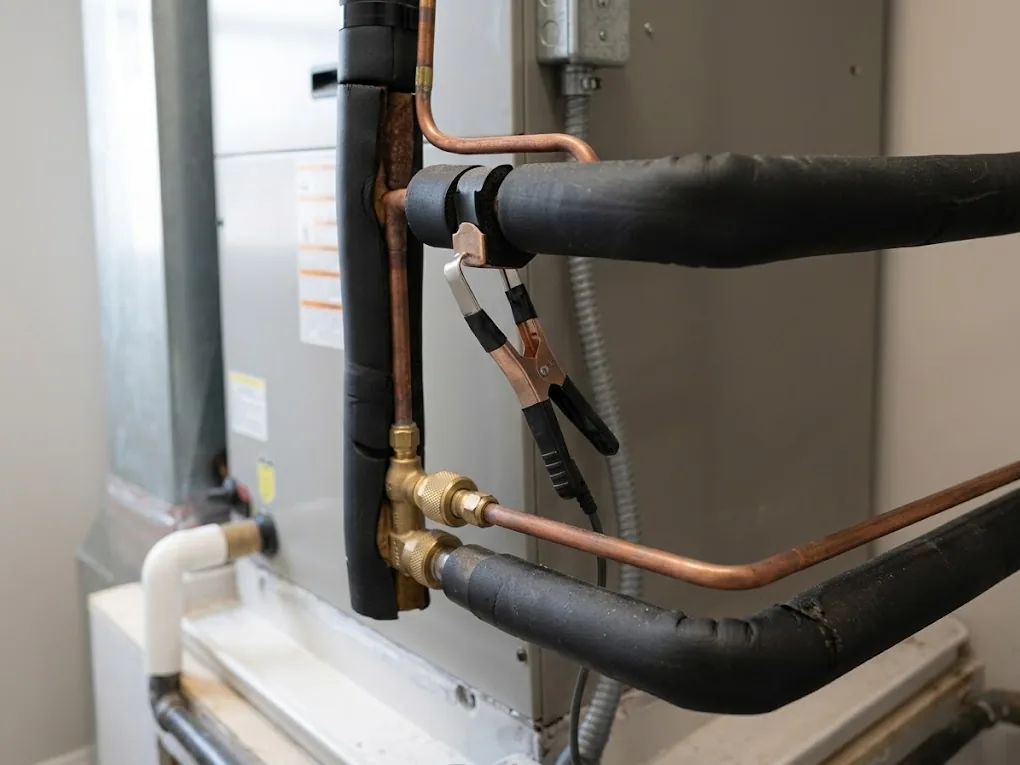
Superheat = measured suction-line temperature − saturated vapor/dew temperature
At 118 psig, the Lennox R454B table lists a saturated-vapor temperature of 45.1°F. If the measured suction-line temperature were 55°F:
55°F − 45.1°F = 9.9°F superheat
That is an arithmetic example from the published PT value. It is not a universal R454B superheat target. The required target must come from the exact equipment manufacturer’s procedure.
Use Saturated Liquid / Bubble for Subcooling
Subcooling tells you how far the measured liquid-line temperature is below the refrigerant’s saturated-liquid temperature at the measured pressure.
For R454B:
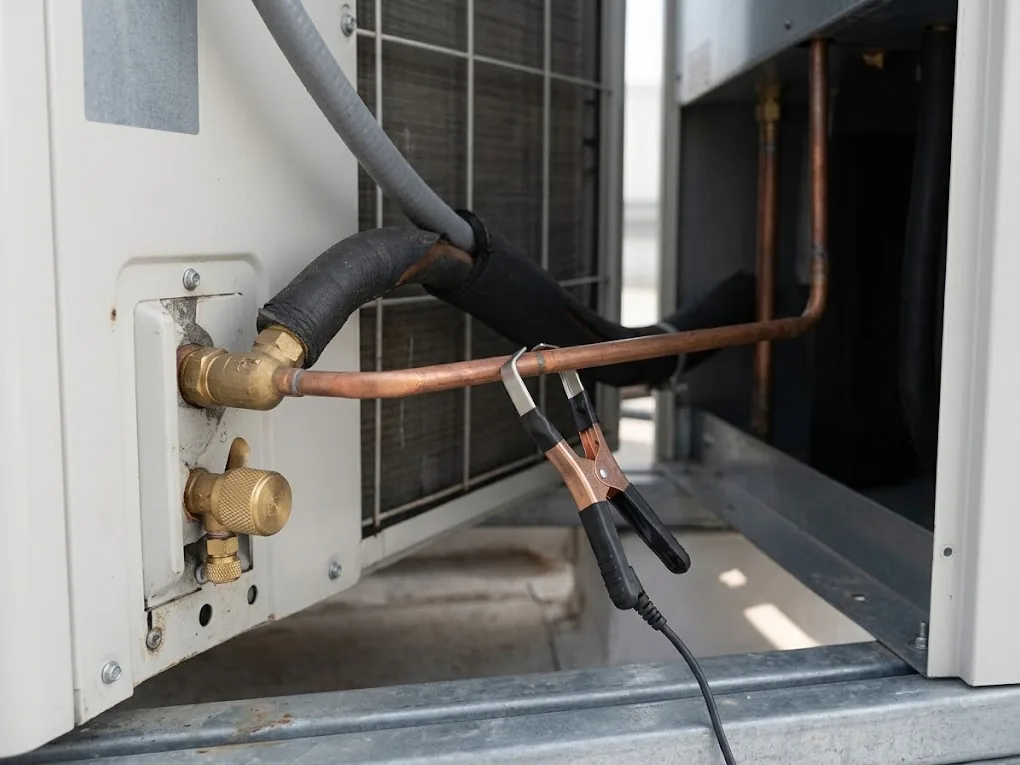
Subcooling = saturated liquid/bubble temperature − measured liquid-line temperature
At 300 psig, the Lennox R454B table lists a saturated-liquid temperature of 99.8°F. If the measured liquid-line temperature were 90°F:
99.8°F − 90°F = 9.8°F subcooling
Again, this is a calculation example, not a universal charging target.
The important step comes before the arithmetic: choose the correct R454B phase reference first.
How Different Are R454B and R410A Pressures?
R454B does not have one fixed pressure difference from R410A.
At 40°F on the saturated-vapor reference, the published comparison is 118.4 psig for R410A and 107.0 psig for R454B. At 90°F on the saturated-liquid reference, it is 275.4 psig for R410A and 260.0 psig for R454B.
So a shortcut such as “subtract 15 psi from R410A” does not work reliably.
The correct comparison method is:
same saturation temperature → same vapor/dew or liquid/bubble basis → correct refrigerant PT data
If any one of those inputs changes, the comparison changes.
The pressure ranges can look familiar because R454B was developed for applications that have historically used R410A-class systems, but that similarity does not make the two PT relationships interchangeable.
What a PT Chart Can—and Cannot—Tell You
A PT chart answers one specific question:
At this refrigerant pressure, what is the corresponding saturation temperature—or vice versa?
It does not tell you what every running air conditioner or heat pump should show on its gauges.
Saturation Temperature Is Not Outdoor Air Temperature
If the outdoor air is 90°F, that does not mean you should look up 90°F in a PT chart and expect the running system pressure to equal that value.
The temperature in a PT relationship is the refrigerant’s saturation temperature at the condition being evaluated. Outdoor temperature, indoor load, airflow and heat-exchanger conditions influence system operation, but they are not interchangeable with refrigerant saturation temperature.
PT Pressure Is Not a Universal Operating Pressure
Actual system pressures vary with equipment design, indoor-unit match, airflow, load, ambient conditions, operating mode and installation conditions. On an inverter air conditioner, variable compressor speed can also shift the operating pressure while the system is still responding normally to load.
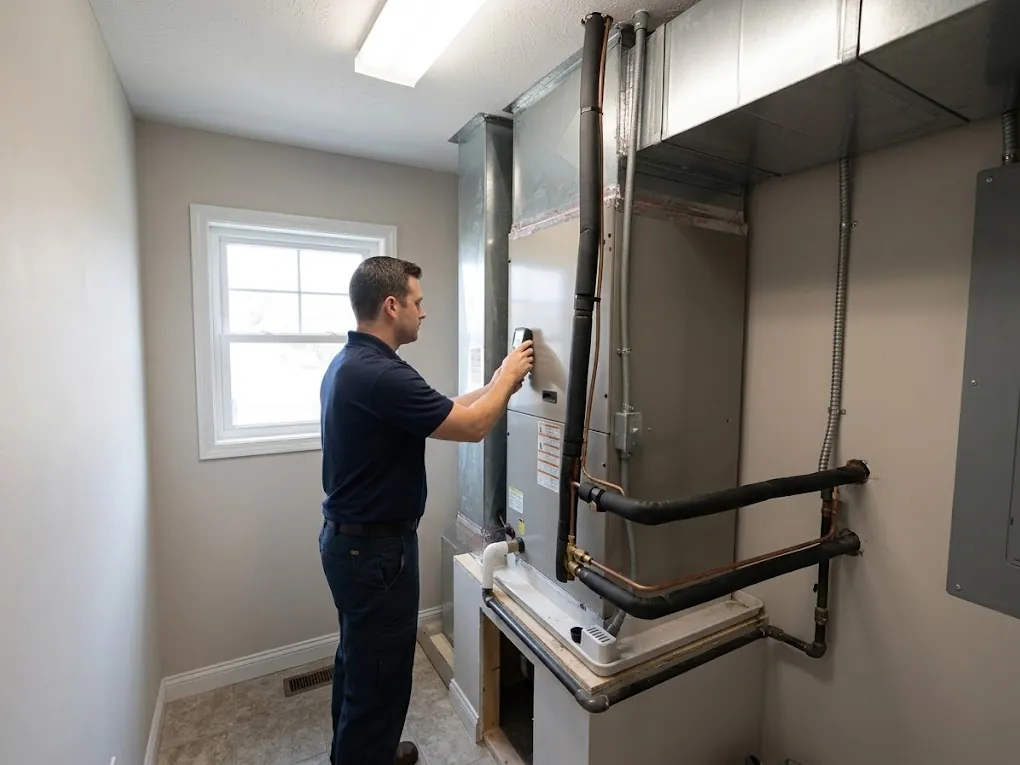
A correct PT conversion and an unusual running pressure can both be true at the same time. The refrigerant PT relationship may be correct while airflow, load, operating mode, equipment controls, or installation conditions make the actual gauge pressure different from what you expected.
That is why a generic statement such as “R454B should run at X psi” is incomplete unless the equipment and operating condition are also defined.
Common Shortcuts That Lead to Wrong Conclusions
| Shortcut | Why it fails |
|---|---|
| “R454B is close to R410A, so I can use the same PT chart.” | The pressure ranges are similar, but the PT values are not identical. |
| “This pressure is lower than I expected, so the system must be low on refrigerant.” | Running pressure also changes with load, airflow, operating mode, ambient conditions, controls, and equipment design. |
| “The PT chart says 45°F, so the suction line should measure 45°F.” | The PT value is the refrigerant saturation temperature, not the measured suction-line temperature. |
| “R454B and R410A have similar pressures, so they are interchangeable.” | Pressure similarity does not prove equipment approval, component compatibility, safety classification, or service suitability. |
If the Pressure Looks Wrong, Check These Before Assuming Refrigerant Charge
| Check | What you need to know | What it can tell you |
|---|---|---|
| Refrigerant identity | Nameplate or approved refrigerant for the exact equipment | Which PT relationship applies. |
| Pressure units | Whether the reading is psig or psia | Whether the pressure-to-temperature conversion is valid. |
| Measurement side / task | Suction/vapor for superheat or liquid for subcooling | Which R454B vapor/dew or liquid/bubble reference applies. |
| Operating mode | Cooling, heating, defrost, or another manufacturer-defined mode | Whether the gauge reading is being interpreted in the correct operating context. |
| Airflow and load | Airflow condition and current heating/cooling load | Whether operating conditions may be shifting the actual running pressure. |
| Line temperature | Measured suction-line or liquid-line temperature | Allows superheat or subcooling to be calculated instead of judging the system from pressure alone. |
| Exact equipment procedure | Model-specific service information and required measurements | Controls the final model-specific service or charge decision. |
If these inputs are missing, the PT chart can still convert pressure and saturation temperature, but it cannot responsibly tell you that the system is undercharged, overcharged, or faulty. If the real question is whether the unit shows signs of low refrigerant, check the symptom pattern and leak evidence before treating pressure alone as proof of charge loss.
Stop here and switch to the exact equipment service procedure if you cannot confirm the installed refrigerant, pressure units, the correct R454B vapor/dew or liquid/bubble reference, or the measurements required by the manufacturer. Do not turn an uncertain PT lookup into a charge diagnosis.
After refrigerant identity, units and operating conditions are confirmed, abnormal pressure can still come from the refrigerant-control or liquid-line side. If those checks point there, review the expansion valve or metering device and the filter drier before assuming the charge itself is the cause.
Related Airproz guide: For a separate overview of charging workflow and safety boundaries, see how to fill a heat pump with refrigerant safely. The exact unit procedure still takes priority.
Can You Use R410A Pressure Rules for R454B?
No. Use the PT data for the refrigerant actually listed on the equipment.
R410A experience can help you recognize the general pressure class, but it does not make an R410A PT scale valid for R454B.
For R454B, also make sure the chart, gauge or app clearly distinguishes:
- saturated vapor / dew for superheat;
- saturated liquid / bubble for subcooling.
If the R454B reference does not identify which phase basis it is showing, verify that before using the number.
Similar Pressure Does Not Mean Refrigerant Interchangeability
Pressure similarity does not authorize a refrigerant replacement.
R454B is an A2L refrigerant, while R410A is A1. The equipment, components, controls, service procedures and safety requirements must be suitable for the specified refrigerant.
Do not interpret a similar pressure range as permission to put R454B into equipment designed and approved for R410A. Use the refrigerant specified by the equipment manufacturer.
Related PT reference: The same rule applies when you work with R32: use the PT relationship for the refrigerant actually in the equipment. For R32 pressure-to-saturation lookup, use our R32 PT chart.
How to Verify a Pressure Reading Before You Act
Before using a gauge reading for superheat, subcooling or diagnosis, run through this short check.
1. Confirm the Refrigerant
Check the equipment nameplate and service documentation. Do not select the PT scale from memory or from what refrigerant is common in similar-looking equipment.
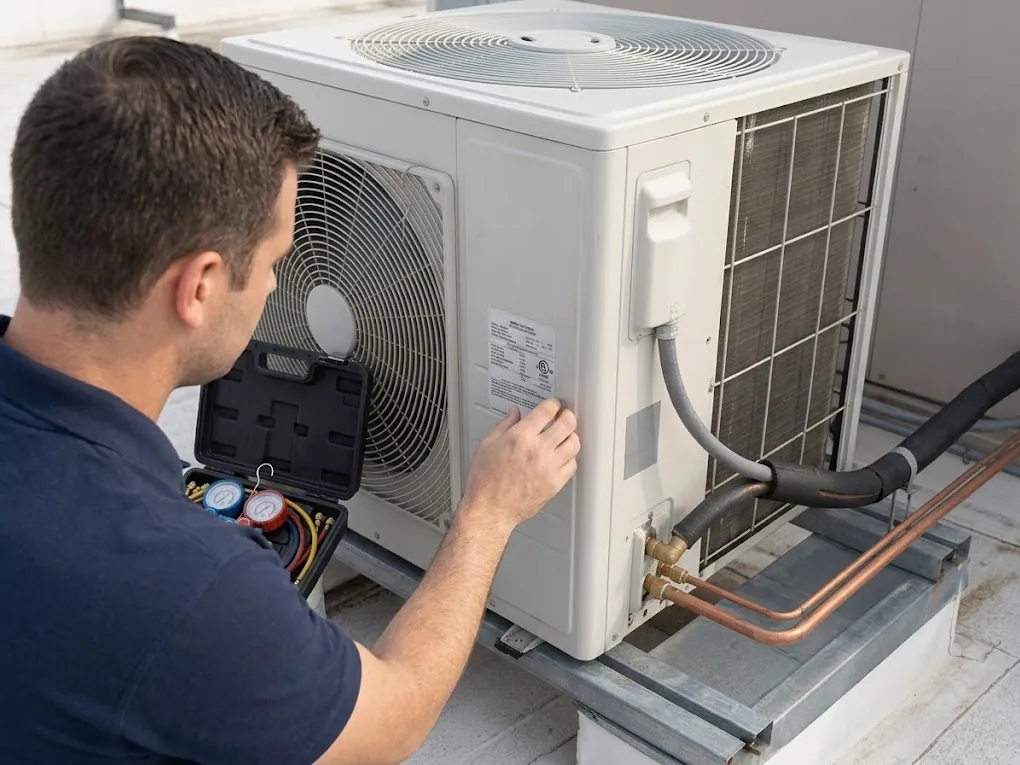
2. Confirm the Pressure Units
The pressure values on this page use psig, or pounds per square inch gauge.
Do not mix psig with psia, or absolute pressure. They use different reference points.
3. For R454B, Confirm Vapor/Dew or Liquid/Bubble
For superheat, use saturated vapor / dew.
For subcooling, use saturated liquid / bubble.
This is part of correctly reading R454B, not an optional refinement.
4. Confirm What the Temperature Represents
Use refrigerant saturation temperature for the PT relationship. Do not substitute outdoor-air temperature, return-air temperature or supply-air temperature.
5. Compare the Result With the Equipment Procedure
If the goal is only pressure-to-temperature conversion, the PT lookup may be all you need.
If the goal is to decide whether a system is correctly charged or operating correctly, continue with the manufacturer’s service procedure and the other required measurements. A PT value is an input to that decision, not the entire decision.
PT Lookup or System Selection?
| If your question is… | Use |
|---|---|
| What saturation temperature matches this pressure? | This PT guide and calculator |
| Which R454B reference should I use for superheat or subcooling? | This PT guide |
| Is this unit undercharged, overcharged, or operating correctly? | The exact OEM service procedure plus the required operating measurements |
| Which refrigerant platform should a new HVAC project use? | A refrigerant/system selection review, not PT pressure alone |
| Which Airproz documentation applies to an existing Airproz unit? | Airproz model-specific document verification |
How Airproz Verifies an Airproz System
For Airproz equipment, our technical team checks the exact model, specified refrigerant, applicable service documentation, and operating condition before applying model-specific guidance.
| What to send | What Airproz can help verify |
|---|---|
| Model number and serial number when available | Which Airproz product documentation applies to that exact unit. |
| Clear nameplate photo and refrigerant shown on the unit | The refrigerant specified for that model and the correct PT/service reference family. |
| Pressure/temperature condition being reviewed | Whether the current task is a PT lookup, superheat/subcooling check, or a question that requires more operating data. |
| Cooling/heating mode and relevant operating condition | Which additional measurements or model-specific instructions are still needed before a service conclusion is made. |
The exact unit procedure remains the controlling reference. Our role here is to help identify the applicable Airproz documentation and the next information needed—not to replace the equipment-specific service instructions with a generic pressure target.
Selecting a Refrigerant Platform for a New Project?
PT pressure alone should not decide whether a new HVAC project uses R454B, R410A, R32, or another approved refrigerant platform. The decision changes when the project conditions change.
| Project input | Why it can change the decision |
|---|---|
| Target market and local requirements | Allowed refrigerants, safety requirements, documentation, and available equipment platforms can differ by market. |
| Application and required capacity | The equipment type and duty determine which approved system families are relevant. |
| Approved equipment platform | The refrigerant must match the equipment design, components, controls, and manufacturer approval. |
| Certification requirements | Project or market acceptance may depend on the certifications required for the selected equipment. |
| Service capability | A2L handling requirements and local service capability can affect installation and lifecycle planning. |
| Project lifecycle and replacement strategy | Future service, replacement, and documentation needs may affect the preferred platform. |
PT pressure is one refrigerant characteristic, not a complete system-selection rule. It should not override equipment approval, safety requirements, certification, application fit, or the approved options actually available for the project.
For the separate selection task, use the refrigerant-platform comparison linked in the engineering path below rather than using PT pressure as the selection rule.
Need an Airproz model checked? Send the model number, serial number if available, nameplate information, refrigerant shown on the unit, operating mode, and the pressure/temperature condition you are reviewing. Send model details for technical review.
Continue With the Right Engineering Path
| If you need to… | Continue with… |
|---|---|
| Compare refrigerant platforms for a new HVAC project | R32 vs R454B: differences, safety, cost, and selection |
| Look up R32 pressure and saturation temperature | R32 PT chart |
| Review charging workflow and service safety boundaries | How to fill a heat pump with refrigerant safely |
| Understand where pressure and phase changes fit in the cooling cycle | air conditioner refrigerant-cycle diagram |
| Confirm which Airproz documentation applies to an existing unit | Send the model details for technical review |
R454B vs R410A: Practical Takeaway
- Use PT data for the refrigerant actually listed on the equipment.
- For R454B, use vapor/dew for superheat and liquid/bubble for subcooling.
- Do not convert R410A values to R454B with a fixed psi offset.
- Do not treat a PT value as a universal operating or charging target.
- For equipment-specific service decisions, verify the result against the manufacturer’s procedure.
Frequently Asked Questions
Are R454B and R410A pressures the same?
No. They are in a similar pressure range, but their PT values are not identical. Compare them at the same saturation temperature and the same vapor/dew or liquid/bubble basis.
Do I use dew or bubble for R454B?
Use saturated vapor/dew for superheat and saturated liquid/bubble for subcooling.
Can I use an R410A PT chart for R454B?
No. Use PT data for the refrigerant in the equipment. Using the wrong scale can give you the wrong saturation temperature and therefore the wrong superheat or subcooling interpretation.
Can a PT pressure tell me whether the refrigerant charge is correct?
Not by itself. PT data converts pressure and saturation temperature. Charge verification requires the exact equipment procedure and the other measurements specified by the manufacturer.
Why can the same gauge pressure mean something different on R454B and R410A?
Each refrigerant has its own pressure-temperature relationship. At roughly 118 psig, R410A saturated vapor is about 40°F while R454B saturated vapor is about 45.1°F. If the measured suction-line temperature is 55°F, that difference changes the calculated superheat from about 15°F on R410A to 9.9°F on R454B. These are calculation examples, not universal target values.
R454B vs R410A PT Quick Reference
Superheat: use vapor/dew. Subcooling: use liquid/bubble. Confirm the refrigerant and pressure units before using the reference.
| Reference | Temp °F | R410A psig | R454B psig |
|---|---|---|---|
| Vapor/dew | 40 | 118.4 | 107.0 |
| Vapor/dew | 50 | 142.6 | 129.3 |
| Liquid/bubble | 90 | 275.4 | 260.0 |
| Liquid/bubble | 110 | 366.4 | 345.9 |
| Liquid/bubble | 120 | 419.4 | 395.7 |
Source: Chemours Pressure-Temperature Guide for A/C. PT values are reference data, not model-specific charging targets. For R454B, use the correct dew/bubble basis. airproz.com/blog/410a-pt-chart/