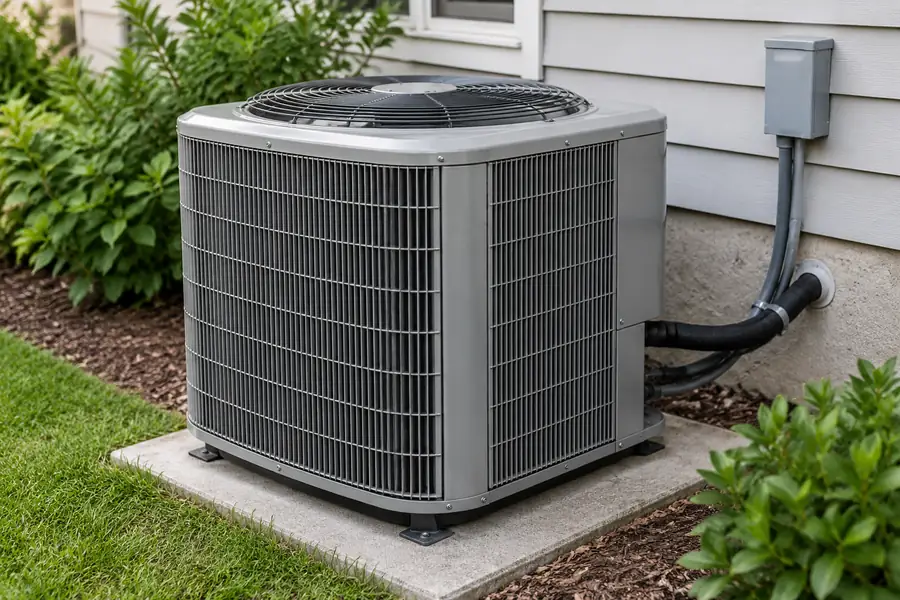
Air conditioner freon refill cost for a U.S. home is commonly about $200–$500 for a basic professional recharge, according to published 2026 residential cost guides. That is not automatically the total bill to find and fix a refrigerant leak. Ask whether the estimate includes diagnosis, the specified refrigerant and amount, charging labor and final checks. Leak detection, repairs, difficult access, or a full recovery and recharge can add charges. A properly sealed air conditioner should not need scheduled refrigerant refills. Have a qualified technician confirm the fault and follow the equipment’s approved service instructions.
Many people say “Freon” when they mean any AC refrigerant. Freon is actually a trade name, and your system may use R-22, R-410A, R-32, R-454B, or another specified refrigerant. The nameplate, not the age of the house, tells you what belongs in your unit. Here is how to estimate the complete bill, decide whether refrigerant is really the problem, and avoid paying for repeated top-offs.
How Much Does an Air Conditioner Freon Refill Cost?
For U.S. residential central AC and installed mini-split systems, $200–$500 is a guide price for a basic recharge service—not a complete leak-repair quote. A quote for a measured addition after diagnosis may differ greatly from one that includes recovery, opening and repairing the circuit, evacuation and a full recharge. Compare the actual work, not just the word “recharge.”
| Work described on the quote | Published U.S. reference range | What to check |
|---|---|---|
| Recharge service, without major repair | $200–$500 | Amount and type included; service fee and testing |
| Refrigerant leak diagnosis | $100–$450 | Whether diagnosis is included in the repair estimate |
| Leak repair, depending on location | $250–$1,600 | Accessibility, parts, labor and testing |
| Evaporator coil repair or replacement | About $600–$2,000 | Coil availability, labor, refrigerant and warranty |
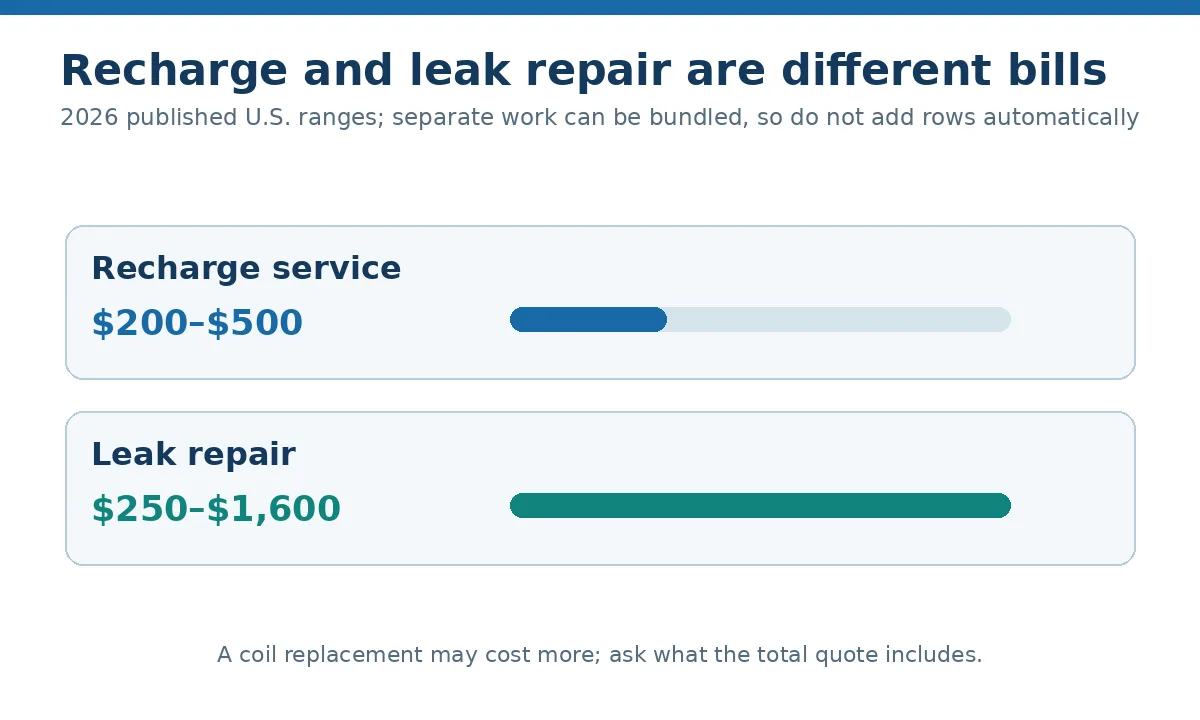
These are broad, overlapping 2026 U.S. guide ranges. Contractors may combine diagnosis, repair and refrigerant charging in one price. Add only separately billed work, and check whether the coil repair already includes refrigerant recovery, recharge and final testing. A difficult coil replacement or an older R-22 system can cost more.
Three different jobs may be called a “recharge”
Contractors may use “recharge” for a measured refrigerant addition, a full recovery and recharge after circuit work, or recharging after a coil replacement. These jobs require different parts, labor and testing. Match the quote to the actual work before comparing prices.
| Service described | What the job involves | What to confirm in the price |
|---|---|---|
| Measured refrigerant addition | After diagnosis and any approved repair, the technician adds only the amount needed using the model’s specified method. | Leak diagnosis, repair, refrigerant quantity, service charge and verification |
| Recovery, circuit work and full recharge | Refrigerant is recovered as needed, the circuit is serviced, checked for leaks, evacuated as specified and restored to the required charge. | Recovery, repair, pressure/leak testing, evacuation, full charge and final checks |
| Coil replacement and system restoration | An approved coil is replaced, and refrigerant-circuit work and testing restore the system to service. | Matching coil, access labor, warranty credit, refrigerant handling, charging and testing |
Why two homes can receive very different prices
One home may need an accessible service-valve repair and a small measured charge. Another may have a leak buried in the indoor coil, require recovery and evacuation, and need a hard-to-find replacement part. The second job takes more labor even if the same amount of refrigerant was lost. Local labor rates, the model’s specified refrigerant, warranty coverage and whether the system needs a partial or full recharge all affect the total.
The correct refrigerant charge depends on the exact model, factory charge and, for some split systems, installed line length. The technician uses the model’s approved charging method and operating checks.
Factory charge is not the amount missing. Suppose a unit’s label lists a factory charge of 8 lb. That is a starting specification, not the amount automatically added at each service visit. The technician determines the required service quantity from the fault, work performed and approved charging instructions. Use the quantity actually billed for the work instead of multiplying the nameplate amount by a per-pound rate.
What Is Included in the Recharge Quote?
A useful AC recharge quote lists diagnosis, any needed leak repair, the specified refrigerant and quantity, charging labor, and final testing. If the refrigerant circuit must be opened, it should also state the recovery, evacuation and leak checks required for that job. Check which services are bundled or credited before comparing the total or the per-pound rate.
| Quote item | What it pays for | Important question |
|---|---|---|
| Call-out and diagnosis | Visit, initial airflow and system checks | Is this credited against the repair? |
| Leak location and repair | Testing, parts, access and labor | Where is the leak and what will be fixed? |
| Refrigerant | Correct type and measured amount | How many pounds are included, and what is the added-pound rate? |
| Recovery and evacuation, if required | Safe handling and removal of air/moisture | Is this included or charged separately? |
| Final operation check | Charge verification, cooling and leak checks | What results will the technician record? |
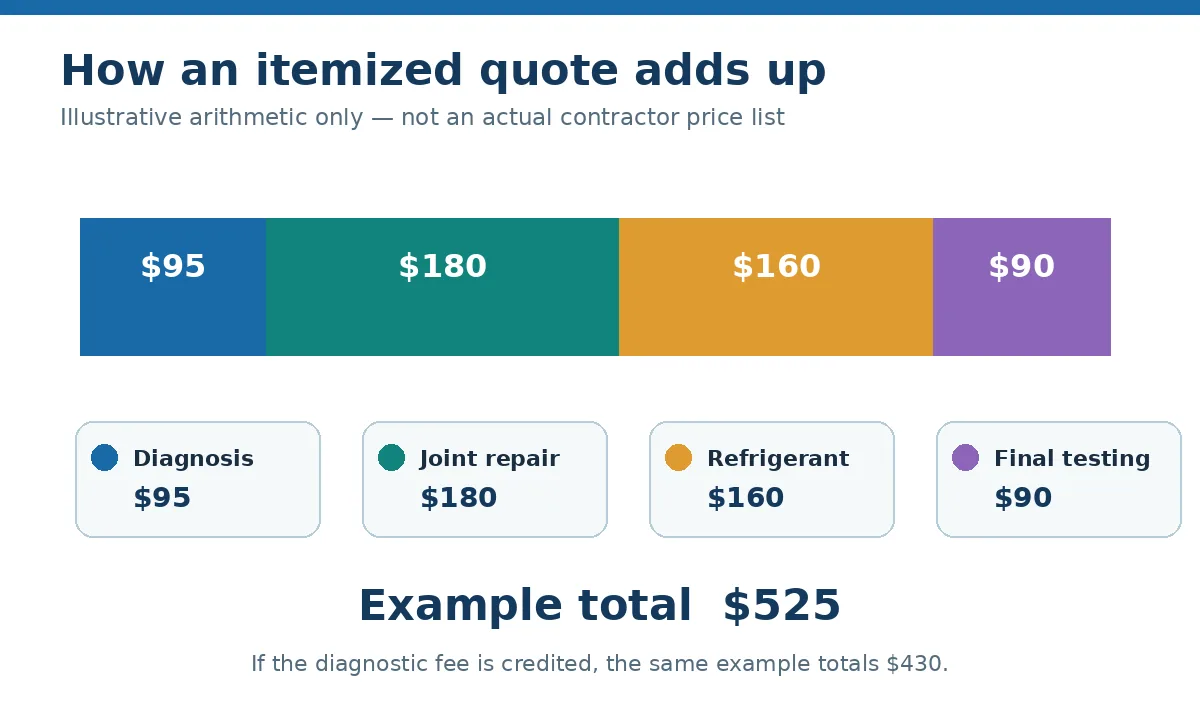
How a $525 AC Service Bill Can Become $430
Suppose a contractor lists $95 for diagnosis, $180 for an accessible joint repair, $160 for two pounds of the specified refrigerant, and $90 for final service and testing. The total is $525. If the $95 diagnostic charge is credited to the repair, the same work costs $430. Both totals cover the same service; the difference is the credit.
Compare the work before the total. For a competing quote, check that the leak test, proposed repair, refrigerant type and amount, recovery or evacuation work, final checks and written warranty cover the same tasks. If a lower quote omits one of those services, request its price before comparing the totals.
Estimate rule: total cost = diagnosis + approved leak repair + refrigerant and charging labor + any necessary recovery, evacuation and verification, minus any overlapping charges or credits. Use the confirmed fault, measured refrigerant work and itemized labor charges to finish the estimate. Subtract service credits and bundled items once.
When Does an Air Conditioner Actually Need Refrigerant?
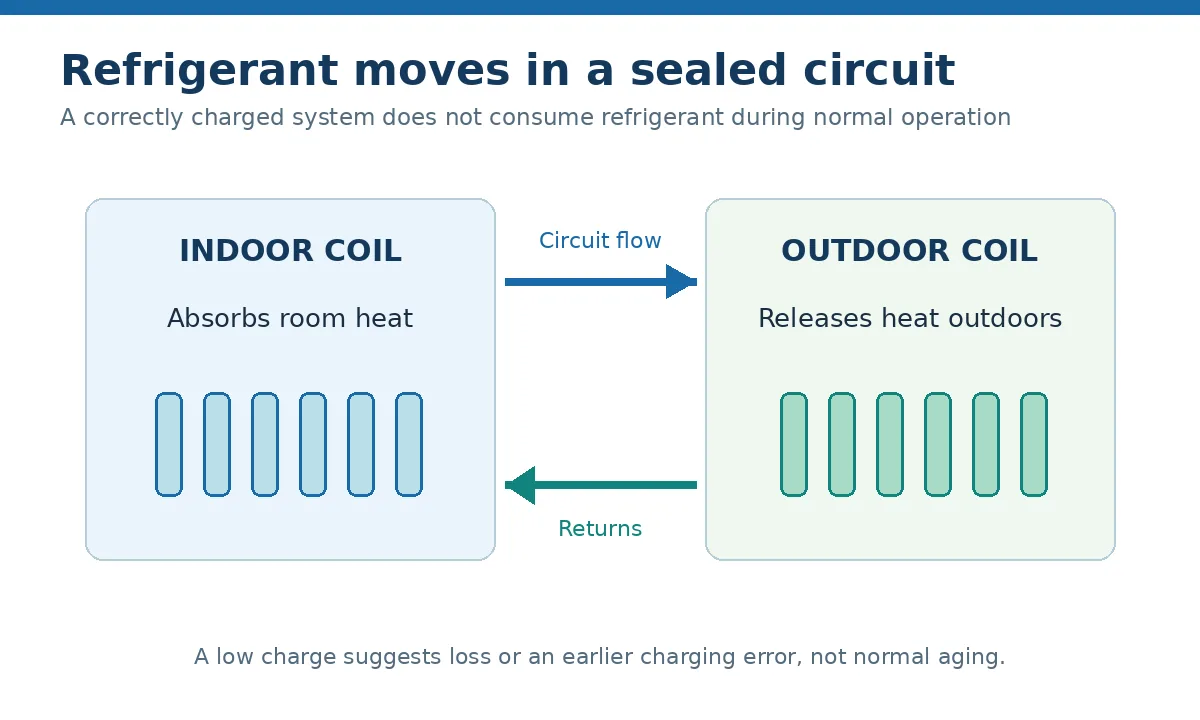
Usually only after a leak has reduced the charge, or when an installation or past service left an incorrect charge. Refrigerant moves around a closed circuit; it does not get used up each season. In a sound system it can remain for the useful life of the equipment. Age alone, even 20 years, does not create a refill schedule.
Signs that should prompt a check, not an automatic refill
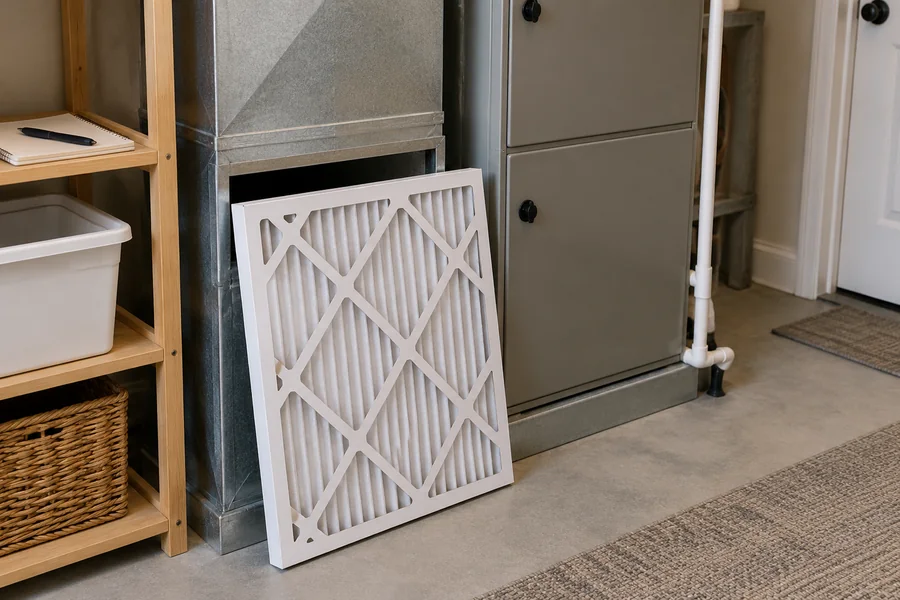
Warm supply air, longer running without reaching the set temperature, ice on the indoor coil or larger suction line, and an unusual hiss near refrigerant connections can be signs of a refrigerant-system problem. But none proves that the system is undercharged. A blocked filter, dirty coil, blower fault, incorrect controls or poor airflow can also reduce cooling and contribute to icing.
| What you notice | Check safely first | What a professional may need to distinguish |
|---|---|---|
| Warm air from vents | Cooling mode, setpoint, startup delay | Controls, outdoor operation, airflow and refrigerant circuit |
| Weak air movement | Accessible filter and blocked return or supply vents | Blower, duct or coil restriction |
| Ice on coil or line | Stop cooling; note where ice is visible | Airflow fault versus refrigerant or control problem |
| AC runs for a long time | Temperature trend and outdoor conditions | Load, air delivery and actual cooling performance |
| Hissing near a line | Do not touch the connection | Leak location and whether the sound is from the refrigerant circuit |
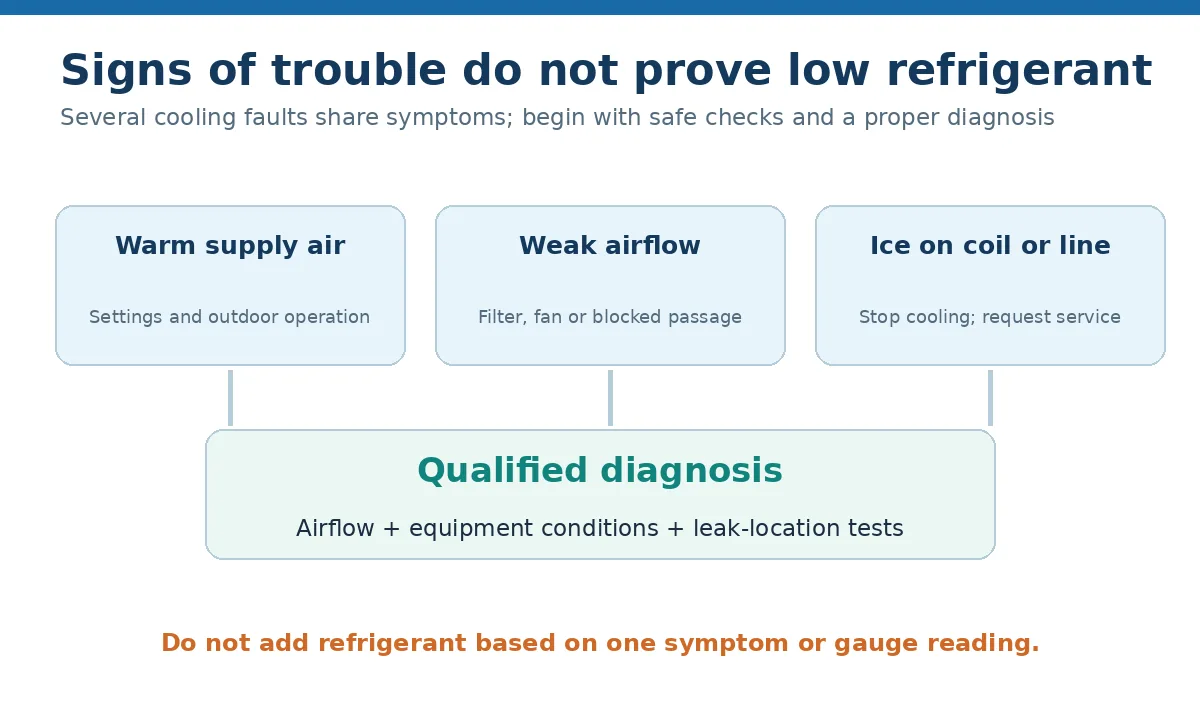
If ice appears, stop cooling and request service. Do not keep running the compressor while the coil is frozen. A burning smell or repeated breaker trip also calls for stopping the system safely and arranging qualified electrical service, not a refrigerant top-off.
Our separate guide to signs of low refrigerant in an air conditioner goes deeper into the symptoms. For cooling complaints that may have other causes, use what to check when an air conditioner is not cooling.
What about an AC that has never cooled properly?
If the AC has never cooled properly since installation, ask the installer to check setup and commissioning, including airflow, controls, system sizing and any refrigerant adjustment required for the installed line length. If it cooled well for years and then weakened, a new leak becomes more likely. Both situations need testing before refrigerant is added.
How Does a Technician Confirm and Repair a Refrigerant Problem?
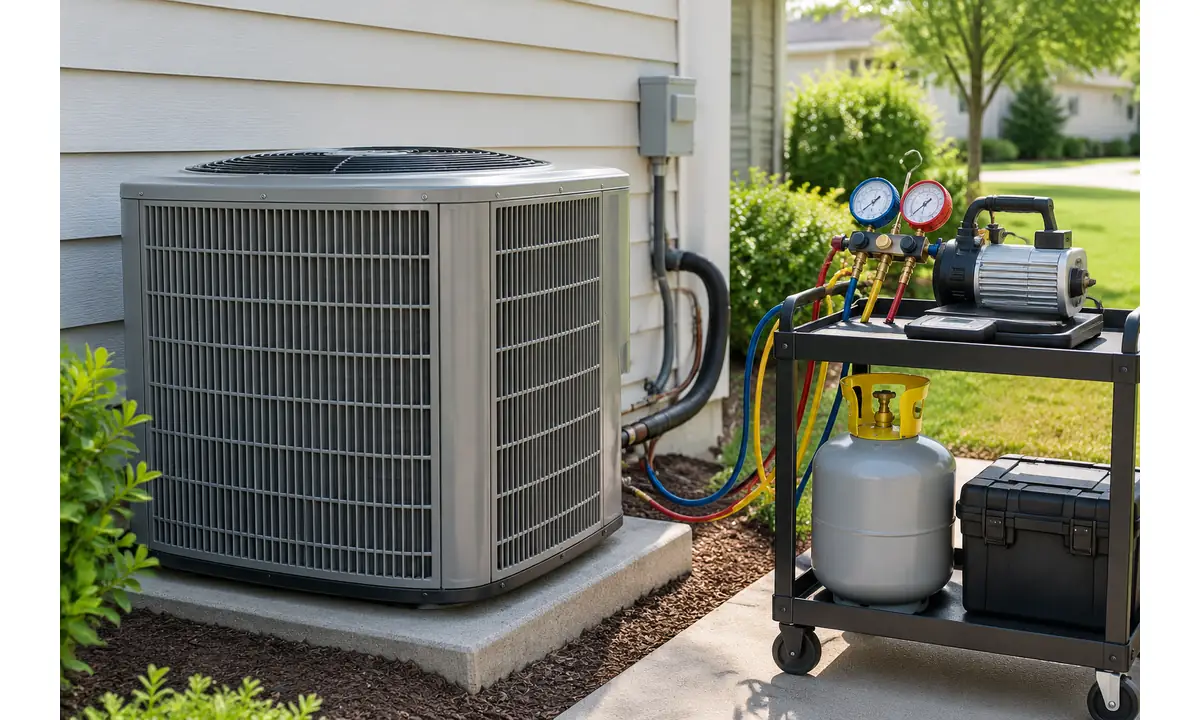
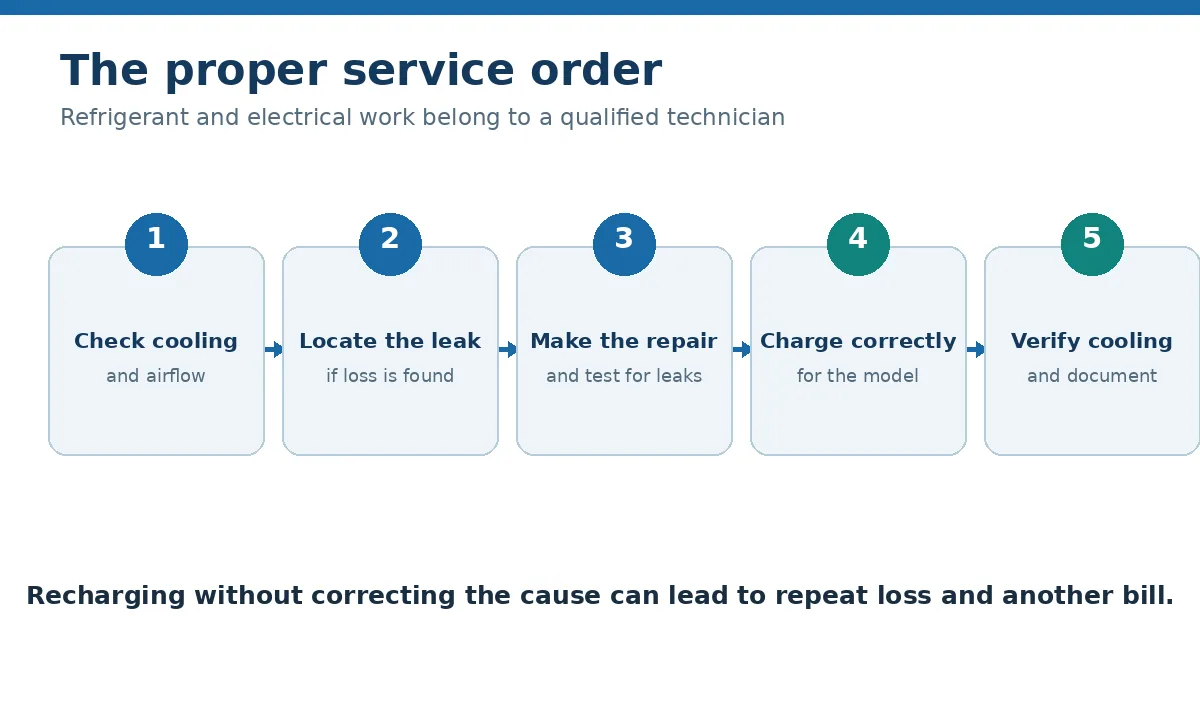
A qualified technician should check airflow and controls first, test the refrigerant circuit, and locate any suspected leak before adding refrigerant. If a leak is found, the technician explains the repair, performs the required circuit work, restores the specified charge and verifies cooling and leak-tightness. A single pressure reading cannot confirm the whole problem.
- Confirm the complaint. Record the model, refrigerant on the label, cooling settings, indoor and outdoor conditions, and airflow. Check other causes of poor cooling.
- Test the refrigerant circuit. Use equipment-approved measurements and, when loss is suspected, a method that can locate the leak. A low pressure reading alone is not a complete diagnosis.
- Explain the repair. Identify a leaking valve, line, joint or coil, then price the appropriate repair or replacement and check part availability.
- Repair and verify. Recover refrigerant where required, make the approved repair, test for leakage, evacuate as the manufacturer specifies and charge by the correct method. Charging and testing details depend on the refrigerant and equipment.
- Confirm operation. Recheck for leaks and record the final charge and running conditions. Ask for the results on the invoice.
If the first visit does not locate a suspected leak: ask which joints, coils and lines were tested, which areas remain unchecked, what test comes next and what it will cost. If the technician proposes a temporary recharge to restore cooling, ask about the likely limitations and the follow-up inspection in writing. A temporary recharge is not proof that a leak was repaired.
In the United States, EPA Section 608 certification covers refrigerant work that can release refrigerant, including connecting gauges and adding or removing refrigerant from stationary systems. EPA also restricts refrigerant sales and generally prohibits intentional venting during service. Federal leak-repair requirements vary by refrigerant, appliance category and charge size. For a home system, ask the certified technician to find the cause of refrigerant loss and explain the repair before authorizing another charge.
Do not use a car-AC refill can, an improvised adapter or a different refrigerant because it costs less. Keep R-22, R-410A, R-32 and R-454B separate and follow the label and approved service manual. Our refrigerant charging guide for heat pumps covers the technician-level process as a separate topic.
How Much Does an AC Refrigerant Leak Repair Cost?
Published 2026 U.S. guides put many residential AC refrigerant leak repairs at about $250–$1,600, while difficult coil repairs or replacements can cost more. An accessible valve or copper joint is often simpler to repair than a hidden line or failed evaporator coil. Compare the full repair quote, including any separate refrigerant work and final testing.
| Found problem | General cost direction | What changes the decision |
|---|---|---|
| Service valve or accessible seal | Often the simpler repair | Part available; fitting can be reached and verified |
| Accessible copper joint or line | Labor varies with access | Whether damaged piping can be repaired safely |
| Hidden refrigerant line | Can involve substantial access work | Wall or ceiling access, run length and restoration |
| Indoor evaporator coil leak | Often a major repair | Matching coil, warranty and removal labor |
| Outdoor condenser coil leak | May be a large replacement job | Coil availability and condition of the outdoor unit |
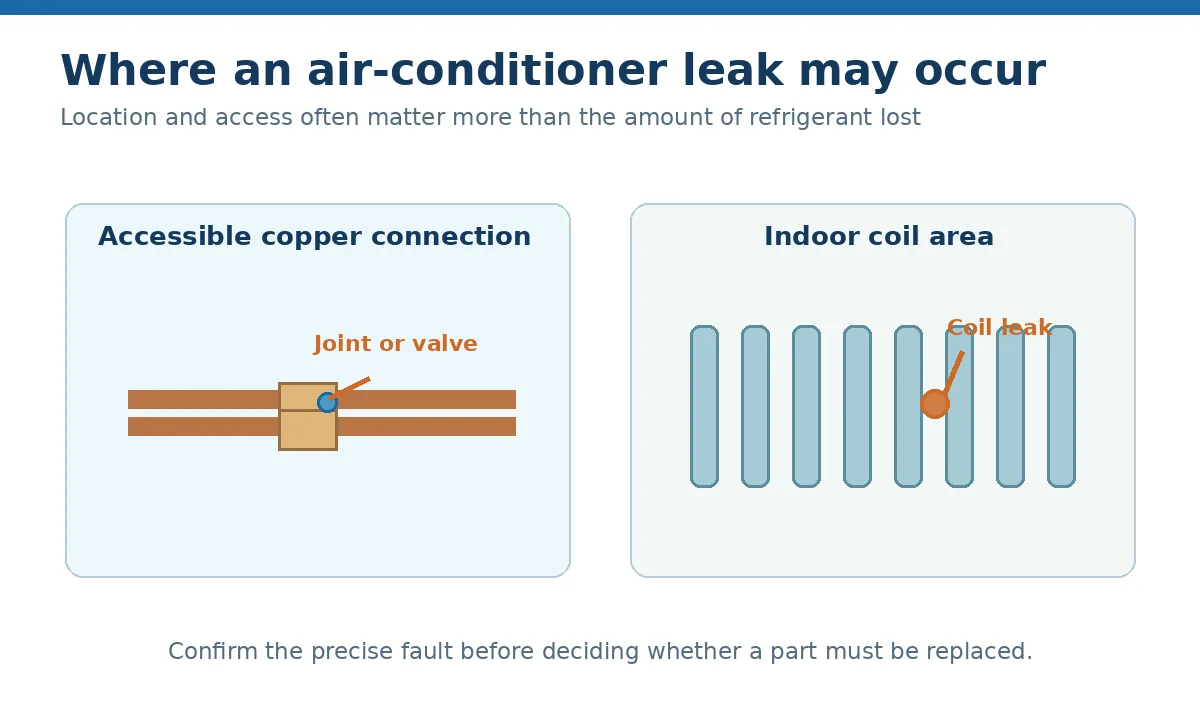
Repair prices change most with access, replacement-part cost and the work needed to reopen and test the refrigerant circuit. Even a small leak may require extensive labor when the failed part is hard to reach. Ask for the exact leak location, approved repair method and complete bill after recharging. Also check what the warranty actually pays: a covered replacement coil may still leave diagnosis, access labor, refrigerant, recovery, evacuation and verification for you to pay. Have the contractor list covered parts and your remaining charges separately.
Is a temporary top-off worth paying for?
A temporary top-off is usually poor value as a repeat repair because refrigerant can escape again while the leak remains. In an urgent situation, a technician may discuss a short-term option within applicable refrigerant-handling rules. Ask how cooling will be restored, what it will cost, what the limits are and when the leak will be repaired.
Does Refrigerant Type Change the Price?
Yes. The refrigerant on the equipment nameplate matters to the price, but the price basis matters just as much. A refrigerant-only supply price is not what a contractor necessarily bills for an installed pound. A billed rate may reflect handling and charging labor, while diagnosis, leak repair and some other service work may still be separate. Compare prices using the same refrigerant, publication year, installed-or-material-only price basis, labor scope and billed unit.
Trane’s April 2025 AC recharge guide listed the following approximate installed-per-pound reference ranges. For a current local quote, ask for the refrigerant type, billed quantity, labor and any separate diagnostic or repair charges.
| Type | Price basis | What to check |
|---|---|---|
| R-22 | About $100–$250 per installed pound (Trane, April 2025) | Legacy refrigerant supply and repair costs may be high; check full repair economics. |
| R-410A | About $40–$90 per installed pound (Trane, April 2025) | Used in many existing systems; verify local service charges and what the rate includes. |
| R-32 | No directly comparable Trane 2025 installed-pound range in this source | Obtain a current model-specific local quote, including required service procedures. |
| R-454B | No directly comparable Trane 2025 installed-pound range in this source | Obtain a current model-specific local quote; do not use an R-410A rate as its substitute. |
| Refrigerant on the nameplate | What to know for the quote |
|---|---|
| R-22 (HCFC-22) | Older systems; new U.S. production and import ended in 2020, but recovered, reclaimed or previously produced R-22 can service existing units. Supply and total repair economics matter. |
| R-410A | Common in installed systems; existing units can continue to be serviced with the correct refrigerant and compatible components. |
| R-32 | Used only in systems designed for it. A2L is a refrigerant safety class meaning lower flammability; the exact equipment installation and service instructions still apply. |
| R-454B | Used in newer systems designed for it; follow the model-specific A2L safety procedures. It is not a drop-in replacement for R-410A. |
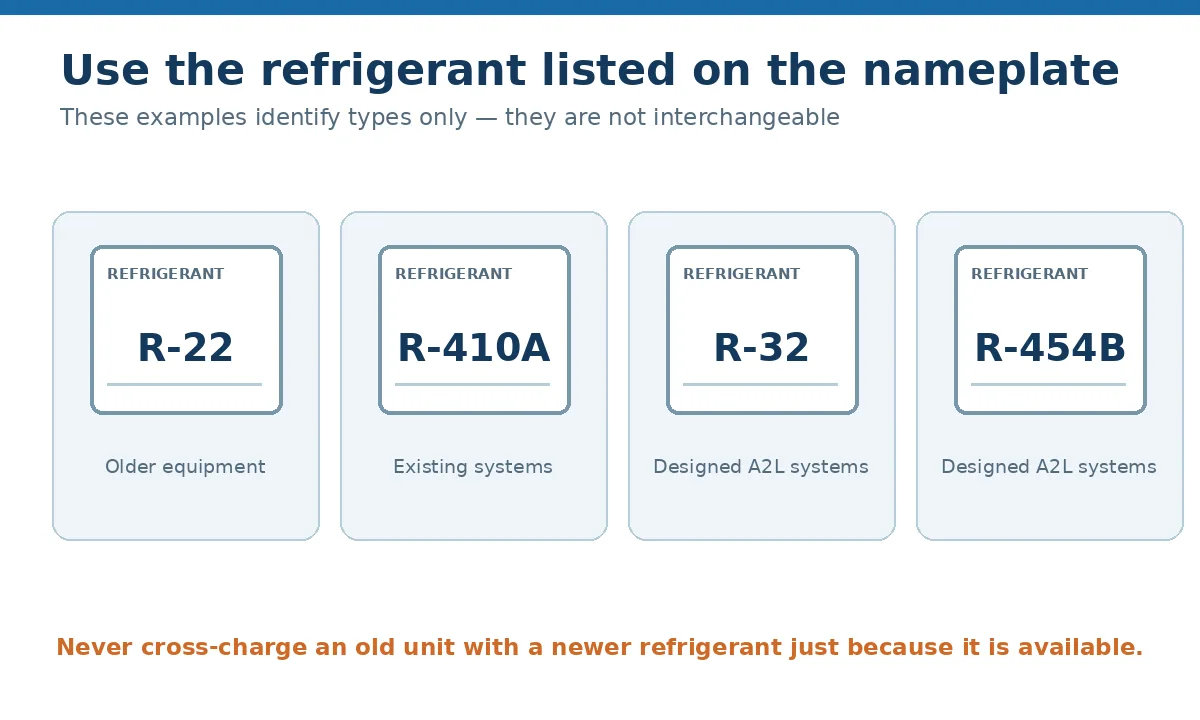
Do not assume that an older R-410A unit must be replaced solely because newer equipment uses other refrigerants. EPA allows ongoing repair of existing R-410A systems, including suitable replacement components. Likewise, an R-22 system is not legally forced to be replaced just because of its refrigerant, although high service cost may make replacement more sensible.
When you request a quote, give the unit model and specified refrigerant. Ask for the amount to be charged, the per-pound billing basis and the full repair scope. For technical differences between refrigerants in newly designed systems, read our R32 and R454B comparison.
How Often Does a Home Air Conditioner Need Freon?
There is no normal annual, five-year or twenty-year refill interval. A sealed system is not supposed to consume refrigerant. Regular maintenance means checking airflow, filters, coils, drains and operating condition, not adding a set amount of refrigerant every visit.
A 20-year-old air conditioner may still hold its correct refrigerant charge. But at that age, a significant leak or major coil failure raises a different question: is the overall system in good enough condition to justify the repair? If the same system needs refrigerant again soon after a recharge, treat it as a reason to investigate a leak or a prior charging error rather than paying for another routine top-off.
Keep the previous service invoice. It should show the refrigerant, measured amount added, reason for the work and repair performed. That history can help a second technician avoid starting from zero.
Should You Recharge, Repair or Replace the Air Conditioner?
Correct the charge if testing finds an installation or past-service charging error without a leak. Repair and recharge when a confirmed leak is practical to fix and the rest of the AC is in good condition. Compare replacement when leaks keep returning, a major coil or compressor repair is costly, or the system still cannot meet the home’s cooling needs. Use the full out-of-pocket repair price after warranty coverage when comparing options.
| Your situation | Most useful next move | Why |
|---|---|---|
| Newer unit, accessible leak, otherwise good condition | Quote repair, correct recharge and testing | Addresses the cause without replacing working equipment |
| Repeated refrigerant loss after service | Find and document the leak before another charge | Repeating the same action may only repeat the cost |
| Older R-22 system, major coil failure | Compare full repair total with a new system | Refrigerant and compatible part supply can change the economics |
| Low charge suspected but airflow is poor | Diagnose airflow first | Extra refrigerant cannot fix a blocked filter or failed blower |
| Replacement planned | Check building load, compatible indoor/outdoor units and correct refrigerant | Matching the old nameplate tonnage alone can repeat sizing or compatibility problems |
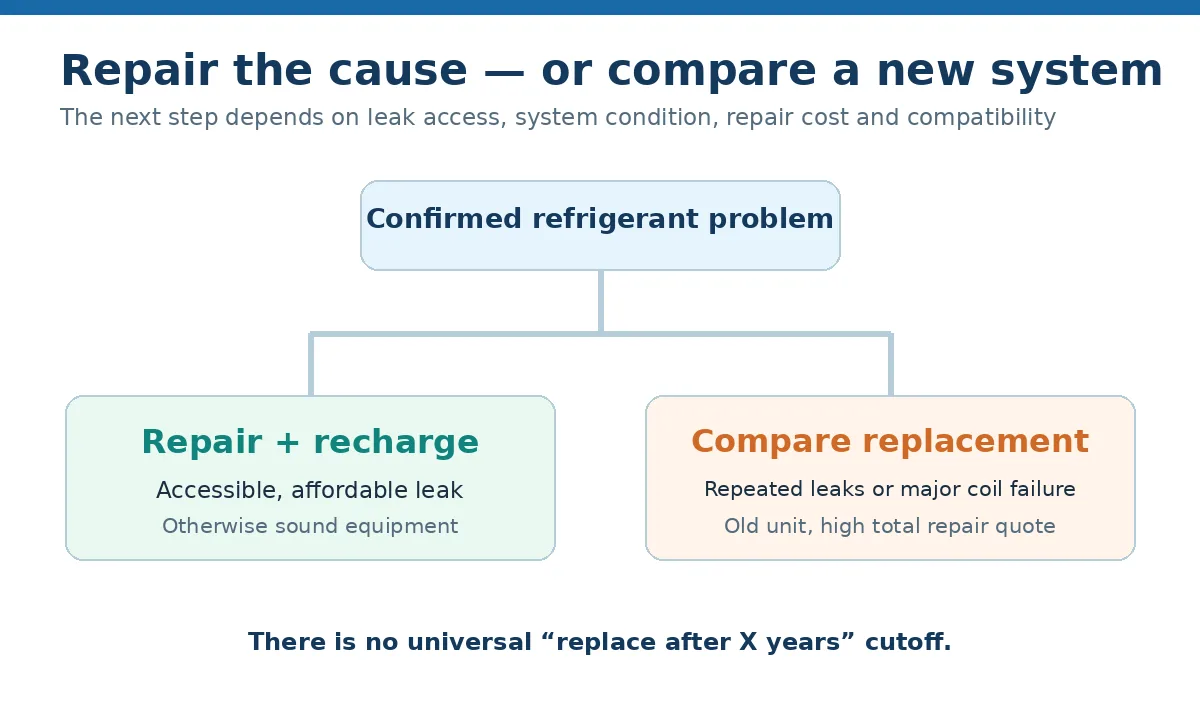
Worked comparison: If an eight-year-old system needs a $450 complete joint repair and its other parts are sound, repairing it can be a reasonable first choice. If a much older system has recurring leaks and a $2,300 coil replacement quote, compare that complete cost with a like-for-like or improved replacement proposal, expected efficiency, warranty, ductwork and installation changes.
Compare what you would actually pay, after warranty coverage. Get an itemized repair proposal showing any covered part or labor credits and the remaining diagnostics, refrigerant, labor and testing costs. Compare that out-of-pocket repair total with a complete, correctly sized replacement proposal. Look at recent repair history, other failing components, the matched indoor and outdoor equipment, installation changes and warranty terms. Use the total you would pay after warranty coverage to decide which option makes more sense for this specific system.
When comparing a new system, ask about delivered cooling capacity for your design conditions and the correct indoor/outdoor match, not only the refrigerant or sticker efficiency. At Airproz, our air-conditioner product range includes documented R-32 and R-410A model families for different project and market requirements. For an equipment replacement or distribution project, share the destination market, building application, cooling load, power supply and required certifications. We can help compare suitable Airproz system families.
How to Avoid Paying Twice for a Freon Refill
Before approving the job, ask the contractor to show what failed and what will be done to prevent the refrigerant from escaping again. This matters more than choosing the lowest advertised per-pound price.
- Check the nameplate. Write down the model, refrigerant type and any available service history without opening sealed or electrical panels.
- Ask for the fault finding. Was poor airflow ruled out? Where was the leak located, and how was it confirmed?
- Ask for the complete scope. Get diagnosis, parts, refrigerant amount, recovery/evacuation and final testing in writing. Clarify which charges are bundled.
- Ask about the repair warranty. Find out whether both parts and labor are covered and whether the leak is expected to be permanently corrected.
- Keep the results. Retain the invoice, repair location, refrigerant amount and final operating checks so future service teams have a useful starting point.
For a building with many split units, record the equipment model, location, leak history and refrigerant type separately for each unit. One repeated failure pattern may call for changes to installation practices or component selection, not a larger supply of refrigerant. If you are planning replacement equipment or a new product program, send us the location, required capacity and market requirements so we can check an appropriate Airproz system family.
Frequently Asked Questions
Can I recharge my home air conditioner myself?
No, not as an ordinary homeowner maintenance task. In the United States, opening the stationary refrigerant circuit and adding or removing refrigerant generally requires an EPA Section 608-certified technician. Incorrect charging and handling can damage equipment and release refrigerant. Check the filter and settings you are allowed to access; leave gauges, leak repair and charging to qualified service.
Why did my AC need more refrigerant just one year after a recharge?
A leak may not have been repaired, a different leak may have developed, or the previous charge may have been incorrect. Ask for a leak-location test and the earlier invoice, not another refill by default. A proper diagnosis also checks airflow and operating conditions.
Will a 20-year-old air conditioner automatically need Freon?
No. Refrigerant does not expire on a 20-year schedule. If the old unit is low, find the cause. A major repair on an aging system should be compared with replacement cost and compatible refrigerant availability.
How many pounds of Freon does my AC need?
There is no reliable universal number based only on floor area or cooling tonnage. The nameplate and installation manual specify the design charge and adjustments that may apply to the actual line length. A technician determines what is missing and verifies the result using the correct method.
Does warm air always mean low refrigerant?
No. Settings, restricted airflow, dirty coils, electrical faults and compressor or control problems can also cause poor cooling. Start with safe checks and have the system diagnosed before authorizing refrigerant work.
Is it legal to service an older R-22 or R-410A system?
Yes, U.S. rules allow appropriate servicing of existing systems. R-22 production and import ended in 2020, but reclaimed or previously produced material can service existing R-22 equipment. Existing R-410A equipment can also be repaired using compatible parts and the correct refrigerant. Rules for newly installed systems are a separate question.
What should I do if the evaporator coil keeps leaking?
Ask for a documented leak diagnosis, a quote for an approved coil repair or matching replacement, and a comparison with complete system replacement. Repeated top-offs do not solve a damaged coil. Check the component warranty and whether the repair includes evacuation, recharge and final leak verification.
The Bottom Line
For a U.S. home, air conditioner freon refill cost is commonly about $200–$500 for a basic professional recharge, but the total can be much higher when leak location and repair are included. A sealed AC does not need periodic refills. The right order is diagnose the cooling problem, locate and fix any leak, then charge and verify the system using its specified refrigerant. If the repair is expensive or keeps recurring, compare the full repair bill with an appropriate replacement—not just the price of refrigerant per pound.
Planning an air conditioner replacement project or distribution range? Tell us the destination market, project type, building cooling load or required capacity, power supply, applicable certification needs and planned quantity. We can help you check the suitable Airproz equipment family and refrigerant platform. For leak diagnosis or refrigerant recharge in an existing U.S. home, contact a qualified local HVAC technician.