Quick answer: The best air conditioner for a garage used every day is often a properly sized ductless mini split, especially if the garage has no window and you want quiet, year-round cooling. For occasional use, a window AC can cost less if you have a suitable window. A through-the-wall AC can work when a permanent wall opening is permitted. A portable AC is easier to move, but it still needs a safe route to exhaust heat outdoors. No ordinary compressor-based air conditioner can cool a closed garage without rejecting its heat somewhere else.
Your choice changes with insulation, garage-door use, available wall or window openings, climate, electricity, and whether you also need winter heating. First fix major air leaks and decide how you will use the space. Then compare equipment against a cooling-load calculation, not floor area alone.
Which Air Conditioner Is Best for Your Garage?
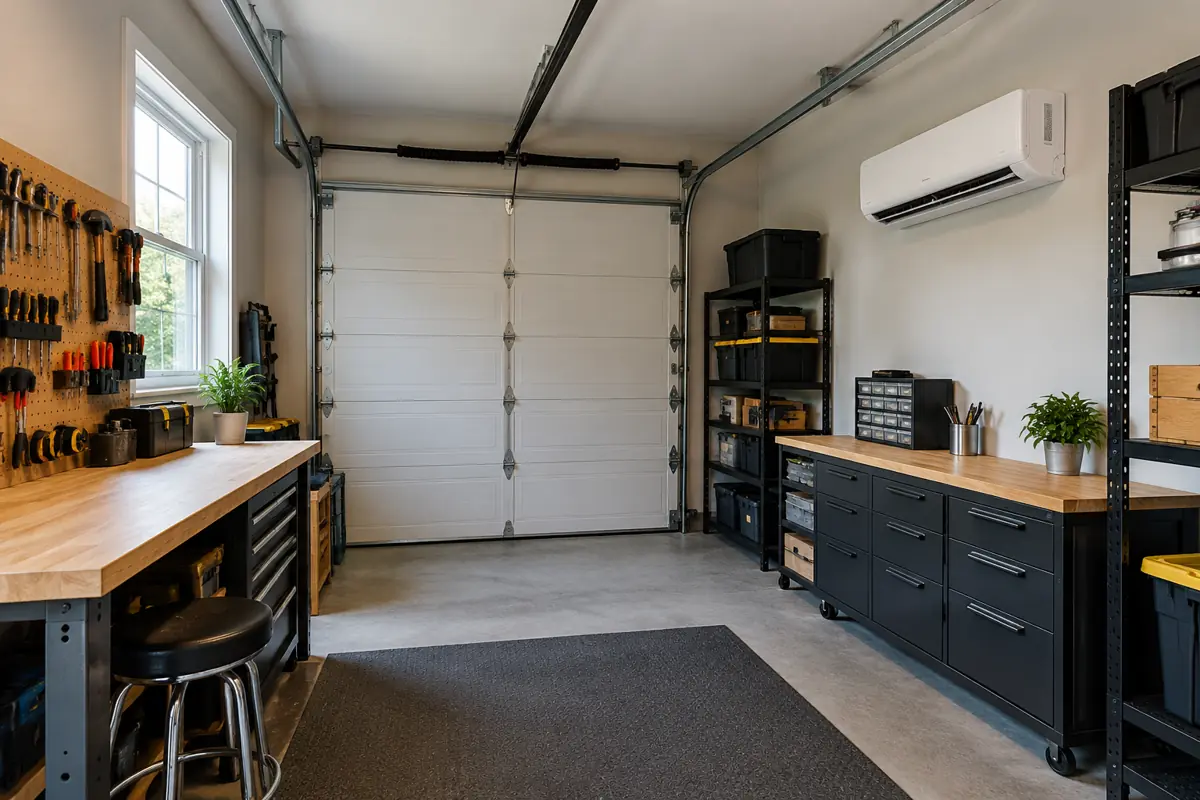
Choose a ductless mini split for a regularly occupied, insulated garage; choose a window or through-the-wall unit when you want a lower-cost permanent cooling solution; choose a vented portable unit when changes to the building must be limited. The best option is the one that can reject heat outdoors, cover the actual cooling load and fit the way you use the garage.
| Garage condition | First option to review | Why it fits | What may change the decision |
|---|---|---|---|
| Workshop or home gym used daily | Ductless mini split | Quiet indoor operation, dedicated cooling, optional heat-pump heating | Upfront work, outdoor-unit location and power supply |
| Garage with a suitable window, used sometimes | Window air conditioner | Simple unit and generally lower installation work | Window security, size, sealing and support |
| Garage with no window but an approved exterior wall opening | Through-the-wall AC or mini split | Permanent route for heat to leave the garage | Wall structure, sleeve, clearances and installation cost |
| Rented garage or occasional summer projects | Dual-hose portable AC with outdoor exhaust | Movable unit with limited permanent modification | Safe exhaust path, noise, condensate and real rated capacity |
| Garage needs both summer cooling and winter heat | Reversible mini split heat pump | One matched system can heat and cool | Cold-weather heating output and defrost performance |
| Garage door stays open during much of the work | Air movement and task-specific ventilation first | Conditioning open outdoor air is often wasteful | If doors can stay closed, reconsider a dedicated AC |
Check what you can actually install before comparing BTU labels. After choosing a likely AC type, confirm where it can release heat outdoors, which wall or window changes are allowed, whether the electrical supply is suitable and how condensate will drain. These checks help you narrow the models that fit your garage.
- Outdoor heat outlet: A mini split needs an outdoor condenser position; a window or through-wall unit needs a suitable opening; a portable AC still needs an outdoor exhaust route.
- Permission and support: Check ownership rules, wall or window suitability, local permits, structural support and any garage-to-home fire separation before cutting an opening.
- Power: Match the chosen model’s nameplate voltage, frequency and electrical requirements to a suitable circuit.
- Water: Identify where condensate will drain without wetting stored items or tools.
A unit that fits an ordinary bedroom may struggle in a garage with bare walls, an uninsulated overhead door and tools that release heat. The table gives you a starting direction. The next step is to check the limits of each system. Our guide to air conditioner types explains how these systems differ in other rooms as well.
How Do Different Garage AC Types Compare?
Mini splits usually offer the strongest long-term setup for a closed, regularly used garage, but window and through-wall units can be more economical for simpler jobs. Portable units trade convenience for more indoor noise and difficult exhaust arrangements.
Ductless Mini Split Air Conditioner for a Garage
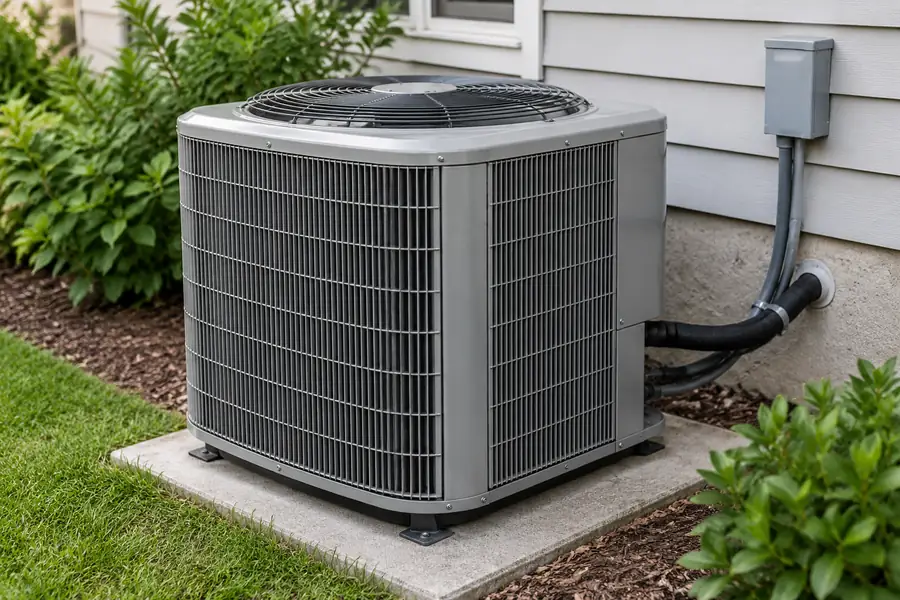
A mini split puts the indoor air handler on a wall and the compressor/condenser outdoors. Refrigerant piping and wiring connect them through a sealed wall penetration. Because the hot side stays outdoors, you do not need a garage window. An inverter model can adjust compressor output as the garage load changes, but you still need to compare each model’s minimum and maximum output.
For a garage gym or workshop used on most days, this is the first choice to examine. Place the indoor unit where air can reach the occupied area without blowing dust across a bench. Make sure the outside unit has approved airflow and service clearances. A cooling-only mini split will not provide winter heat; a reversible heat-pump model may, with heating output verified at your winter design temperature.
For a closer look at indoor and outdoor units, pipe routing, and single-zone versus multi-zone layouts, read our guide to how mini split systems work and how to choose one.
Portable Air Conditioner for a Garage
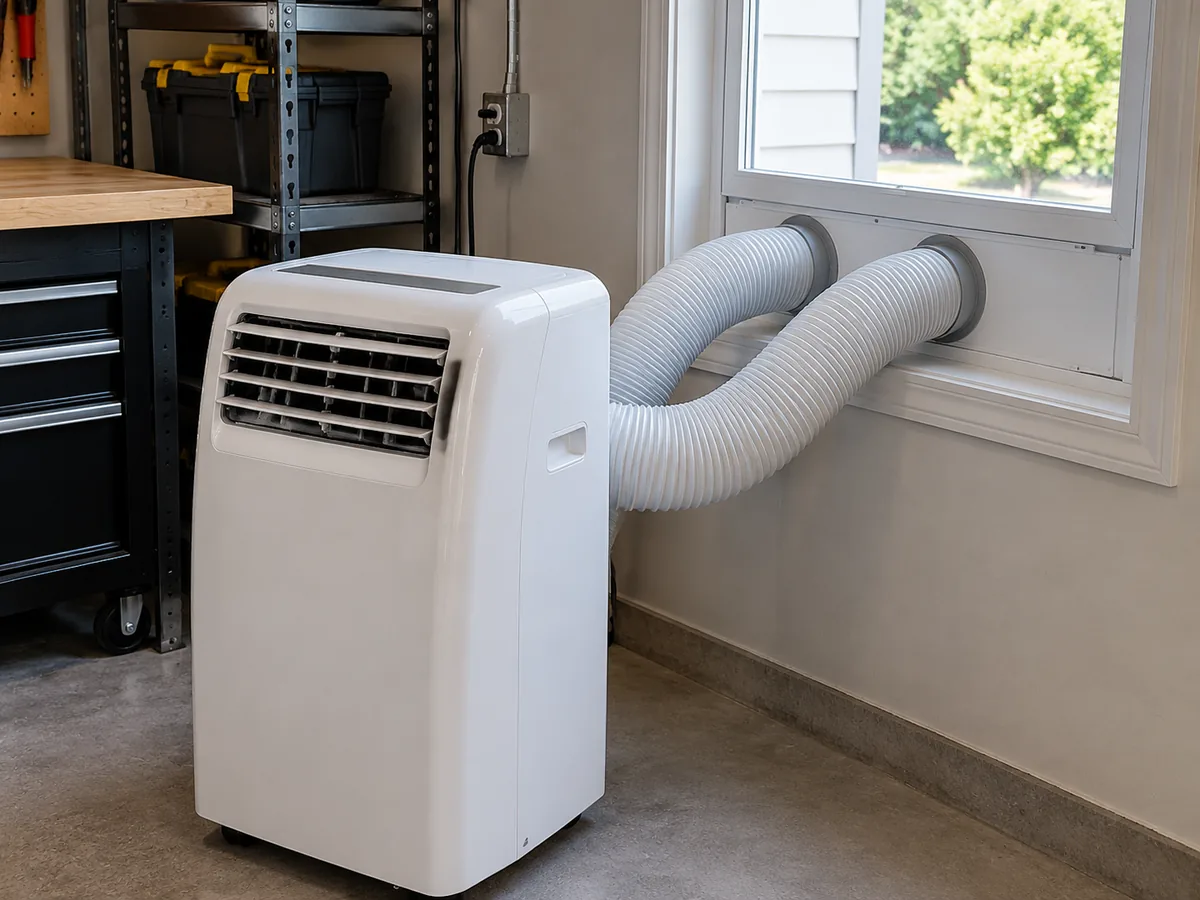
A portable AC works when you cannot easily install fixed equipment and you can vent the unit outdoors. The exhaust hose carries heat away. A unit exhausting into the garage, attic or another enclosed space will not cool the garage as intended. If there is no window, a professionally approved wall or door-panel exhaust arrangement may be needed; do not crush a hose under a garage door or compromise a fire-rated separation.
Portable AC labels may show an ASHRAE cooling-capacity BTU figure and a DOE seasonally adjusted cooling capacity (SACC). These are different rating procedures, so compare portable units using the same method; where both models list DOE SACC, compare their SACC ratings. The US Department of Energy’s portable AC test guidance explains its rating method. Check the exact manual for permitted ambient temperatures, hose length and routing, condensate handling, noise and required electrical supply. A dual-hose design may reduce hot replacement air drawn through leaks, but real performance still depends on the model and installation. Keep the hoses as short and straight as the manual permits.
Window Air Conditioner for a Garage
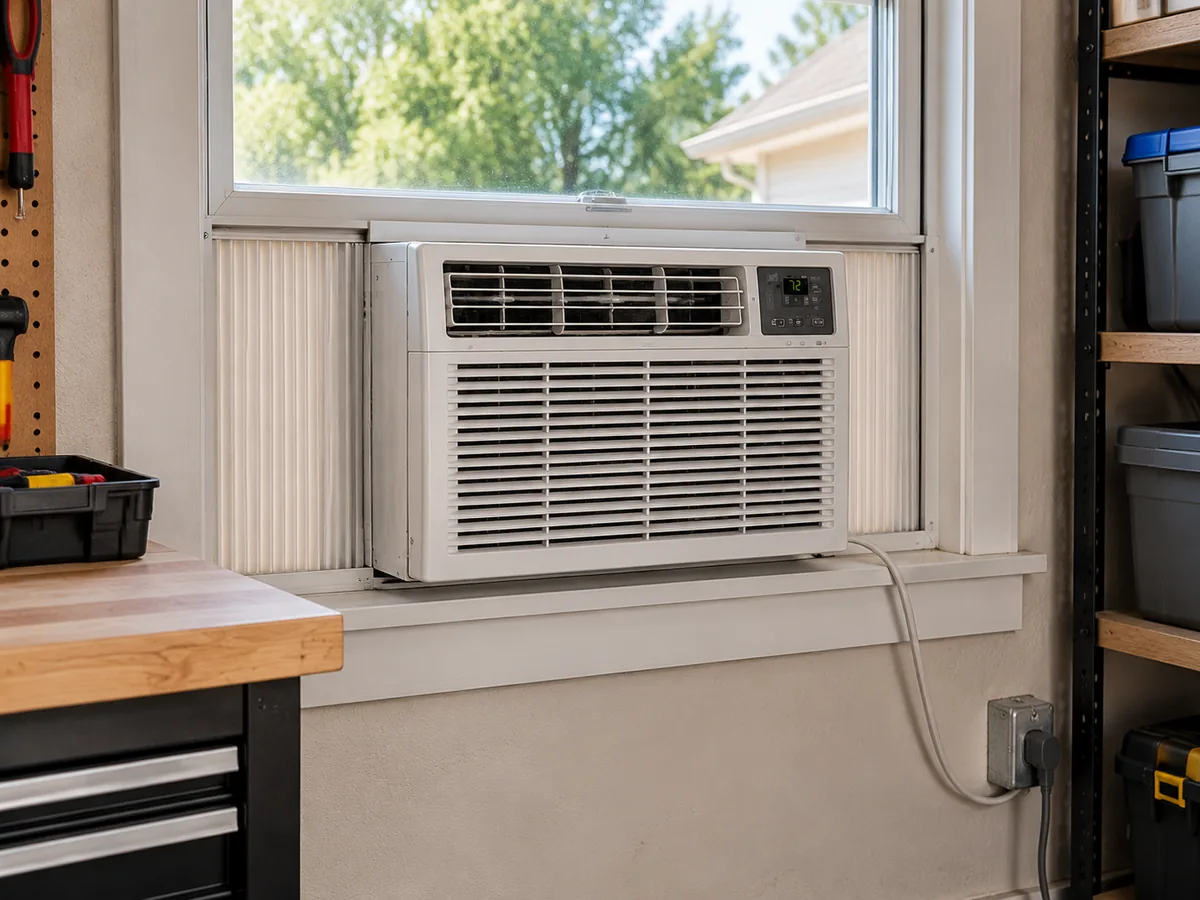
A window unit can suit a garage that has a suitable window with secure structural support. Most of the equipment sits at the window opening, allowing heat to leave outdoors. Measure the opening before choosing a model; seal the sides and follow the manufacturer’s bracket, slope and drainage instructions. Check that the window still meets local safety and security needs. For a garage without a window, choose a purpose-built through-wall model and its approved sleeve. Use a window model through a wall only if the manufacturer explicitly permits that installation.
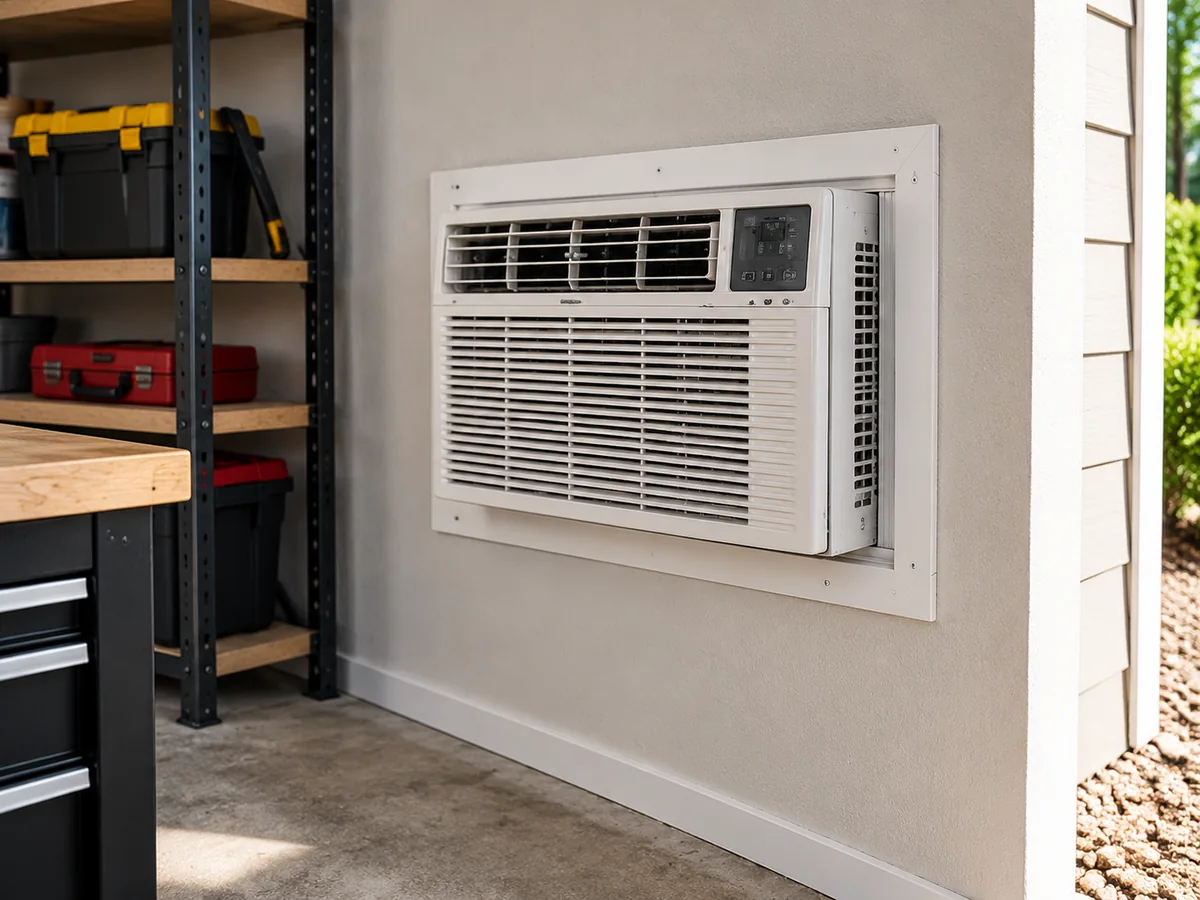
Through-the-Wall Air Conditioner for a Garage
A through-the-wall model is designed for installation in a compatible sleeve through an exterior wall. It can be a good choice for a windowless garage when you want a fixed system but do not need a separate outdoor condenser. The sleeve, wall support, water management and outside air clearances must match the specific unit. Check structural framing, electrical work, local permits and any required fire-resistance rating before cutting the wall.
Garage Heater and Air Conditioner in One Unit
A reversible mini split heat pump can cool in summer and heat in winter. Start with the local winter design temperature, then estimate the garage’s heat loss at that condition and check how much heat the exact model delivers there. Nominal heating BTU does not tell you its output on the coldest design day. Review defrost behavior and whether supplementary heat is needed. If output falls short, improve insulation, choose a suitable cold-climate system or plan safe backup heat. An AC with simple resistance heating is not automatically as efficient in heating mode as a heat pump.
If the same system must also heat the garage in winter, our guide to air-source heat pump pros and cons explains how low-temperature output, defrost, and backup heat affect the choice.
Can You Air Condition a Garage With No Windows?
Yes. A garage without windows can use a ductless mini split, an approved through-the-wall unit, or a portable AC with a proper exterior exhaust. No-window does not mean no heat outlet. The condenser on a mini split releases heat outside; a through-wall unit sends it through its outdoor section; a portable unit uses a hose.
A so-called ventless air conditioner is often an evaporative cooler, not a refrigerant-based room air conditioner. It cools by evaporating water and adds moisture to the airstream. It may help in a dry climate with enough fresh airflow, but it cannot offer the same temperature and humidity control as a true AC in a closed, humid garage. Fans likewise move air or ventilate; they do not remove room heat below outdoor air temperature on their own.
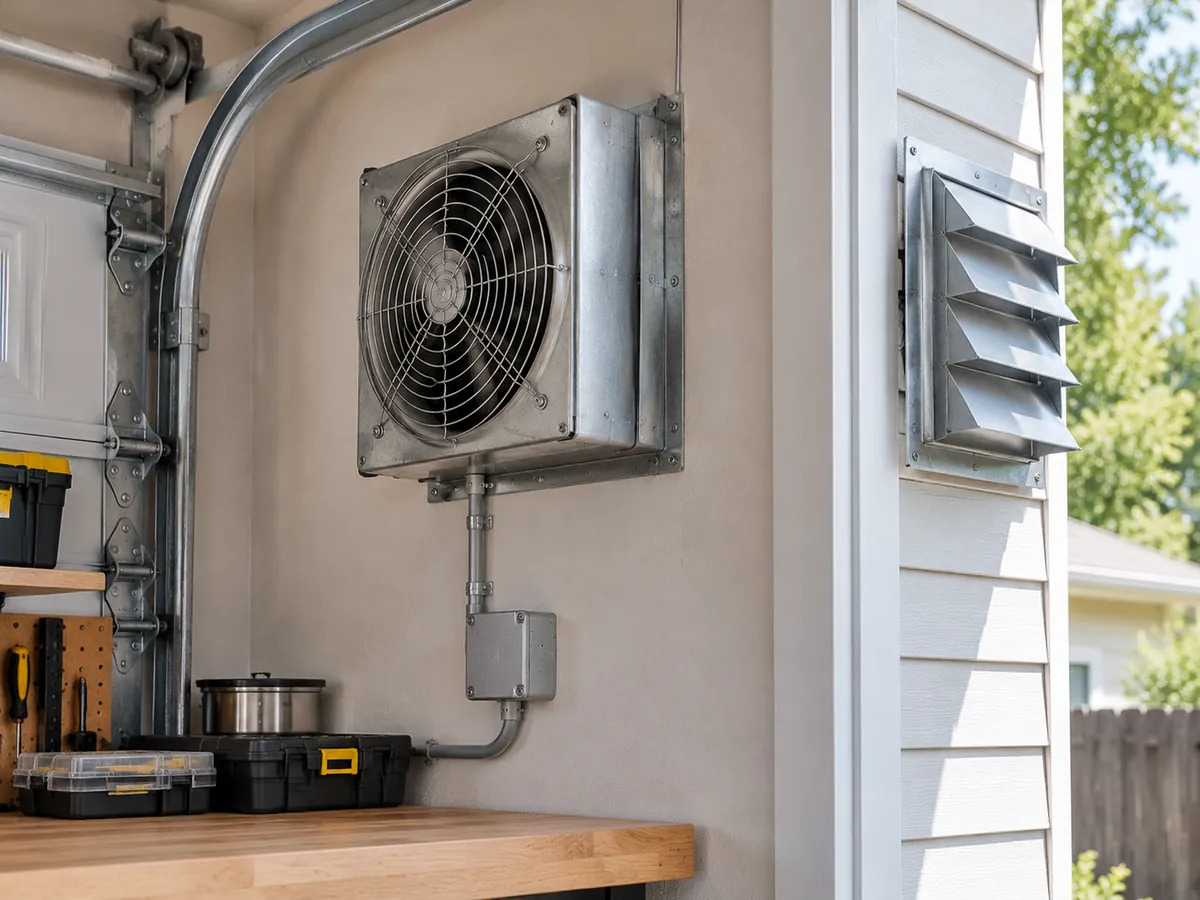
Before selecting a no-window option, find a suitable exterior wall location and check which penetrations are permitted. For an attached garage, do not route exhaust or return air into the house. Keep the garage’s air system separate from household ductwork and protect the required garage-to-home separation. Where fumes, engines, painting or welding are involved, arrange appropriate source extraction or ventilation separately from comfort cooling.
First decide which problem you are solving:
- People working or exercising: Plan active cooling with outdoor heat rejection, suitable capacity and a way to keep the garage closed during cooling.
- Damp tools or stored goods: Identify the moisture source and check whether humidity control or a suitable dehumidifier meets the need; a dehumidifier is not a replacement for comfort cooling.
- Exhaust or hazardous fumes: Arrange appropriate ventilation or source extraction for the task. Recirculating comfort AC and a general dehumidifier do not make engine exhaust, paint or welding fumes safe.
What Size Air Conditioner Do You Need for a Garage?
Start with the garage’s actual cooling load, including the overhead door, roof, insulation, air leakage and equipment heat. Use the room-size table below to identify a starting capacity class. For the garage itself, check the roof, door, sun exposure, outside-air leaks and heat from equipment before finalizing the load estimate.
For an ordinary enclosed room with an approximately 8-foot ceiling, the ENERGY STAR room air-conditioner sizing chart offers an early comparison by floor area. This ordinary-room reference is not a calculated garage design load. A sun-exposed overhead door, bare roof, frequent door openings, higher ceiling, humid outdoor air and heat from tools can change garage cooling demand substantially. For final equipment selection, use a room-by-room residential load method such as ACCA Manual J where applicable, or an equivalent local load-design method.
| Ordinary room area | ENERGY STAR room AC reference |
|---|---|
| 150–250 sq ft | 6,000 BTU/h |
| 300–350 sq ft | 8,000 BTU/h |
| 400–450 sq ft | 10,000 BTU/h |
| 450–550 sq ft | 12,000 BTU/h |
| 550–700 sq ft | 14,000 BTU/h |
| 700–1,000 sq ft | 18,000 BTU/h |
Use the calculated peak load to narrow the equipment options. Compare each model’s delivered output at design conditions, its minimum steady output if it can modulate, and whether the air reaches the occupied work area. An oversized fixed-speed unit may cycle off before removing enough moisture. For portable models, compare DOE SACC ratings with the same rating method rather than relying only on the nominal BTU label.
Example: An Insulated 400 sq ft Garage
Suppose a 20 × 20 ft garage has insulated walls and door, a sealed ceiling and one normally closed overhead door. Its floor area is 400 sq ft. The ENERGY STAR chart shows about 10,000 BTU/h for an ordinary 400–450 sq ft room with an 8-foot ceiling. Use that figure as the room-size starting reference, then estimate the garage load using its location, roof, door, air leaks, moisture and internal heat. Compare available models’ delivered cooling output and low-load operation with that result.
Now suppose the same garage has a bare roof, afternoon sun on the large door and frequent openings. First plan the insulation and door seals you will actually install, then record how long and how often the door opens. Recalculate the load for those conditions. If much of the work takes place with the door open, consider task-specific airflow or safe ventilation instead of assuming that a larger AC alone will maintain a stable room temperature.
For a quick calculation of your floor area, multiply length in feet × width in feet. For a 22 × 24 ft two-car garage, the area is 528 sq ft. That number starts the conversation; a detailed load calculation should then use location, desired indoor conditions, exposed surfaces, insulation, sun, infiltration and tools.
How Should You Prepare a Garage Before Installing AC?
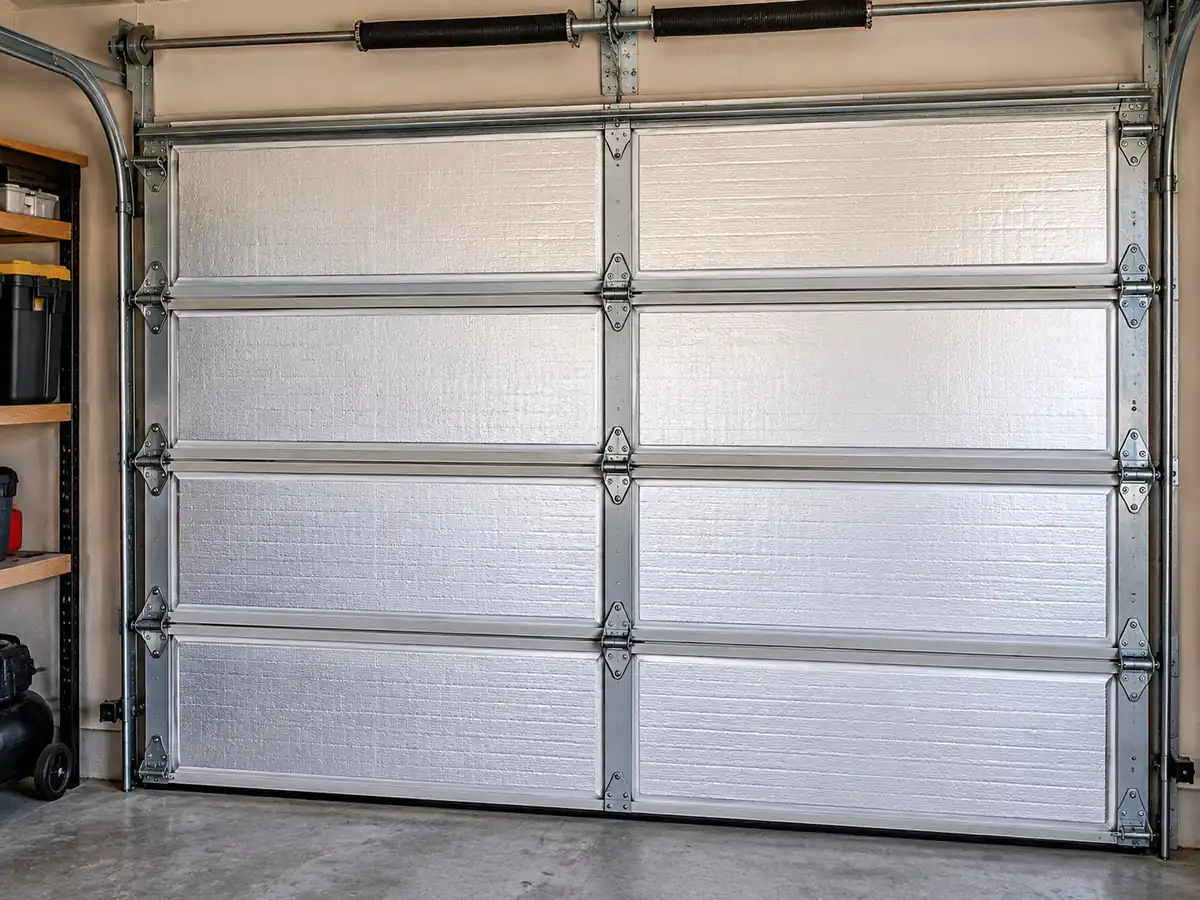
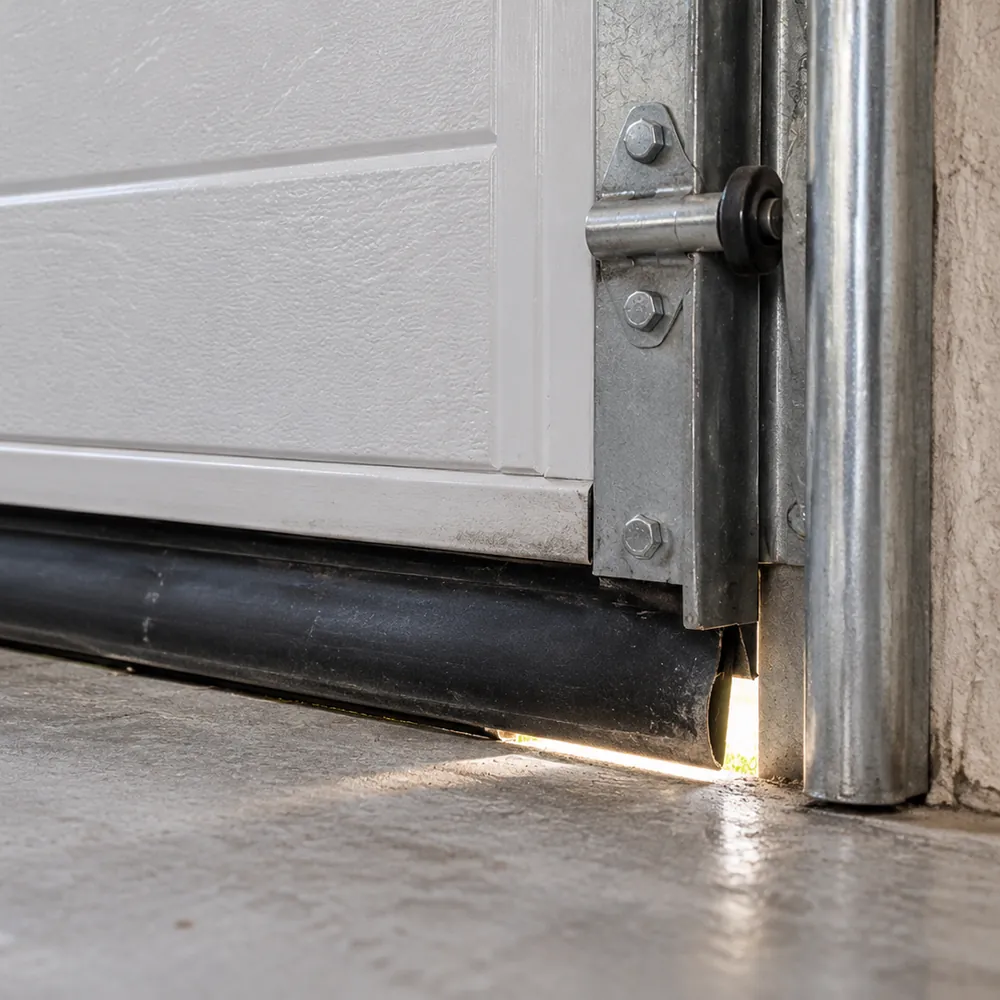
Seal the garage door and fix major insulation gaps before you spend money on extra cooling capacity. The more outdoor heat you let in, the harder the equipment must work. Improving the building first can change which capacity class is appropriate.
- Decide the use and schedule. A weekend workshop, daily gym and garage with engines running have different temperature and ventilation needs. Keep the overhead door shut during ordinary cooling when safe to do so.
- Check the building shell. Record roof/ceiling and wall insulation, overhead door insulation, weatherstripping and gaps near the frame. Check whether the wall shared with the home remains properly separated and sealed.
- Mark heat and moisture sources. Sun on the roof and door, warm cars after arrival, freezers, compressors and other tools can change the load. Note the power and operating hours of major equipment rather than adding a blanket BTU allowance.
- Find an outdoor heat-rejection route. A mini split needs an outdoor unit. A portable unit needs outdoor exhaust. A window or through-wall unit needs the opening and clearances stated in its manual.
- Check electrical supply and condensate drainage. Have a qualified installer assess the circuit, breaker, disconnect and local electrical rules for the exact equipment. Plan where water from cooling will drain without reaching tools or stored items.
- Keep ventilation separate. AC mostly recirculates garage air. Vehicle exhaust, fuel vapors, paints, solvents and welding fumes require their own safe handling and ventilation controls.
Never idle a vehicle in a garage, even with the main door open. Cooling equipment is not carbon monoxide protection. For attached garages, the 2024 International Mechanical Code generally forbids return air from a garage entering a dwelling HVAC system; it includes an exception for a dedicated system serving only that garage. Verify your locally adopted code and site conditions.
How Much Does Garage AC Cost to Install and Run?
Compare the entire installed job before comparing monthly electricity use. A low equipment price may not include wall or window work, an outdoor mount, electrical upgrades, condensate drainage or commissioning. The exact items depend on the type of AC and site.
| Cost part | What affects it |
|---|---|
| Equipment | Cooling and heating capacity, system type, efficiency, controls and approved model for the destination market |
| Mounting and building work | Window bracket, through-wall sleeve or outdoor condenser support, permitted opening, sealing and access |
| Electrical and condensate work | Supply compatibility, circuit or disconnect changes, permitted wiring and safe drainage |
| Operation and upkeep | Electricity price, average input, operating hours, filter care and model-specific service |
For equipment you already have or a model with known electrical input, estimate the running cost separately:
Energy (kWh) = average electrical input (kW) × running hours. Cost = energy (kWh) × electricity price ($/kWh).
Suppose a portable AC averages 1.1 kW while cooling, runs four hours on 20 days and the electricity price is $0.18/kWh. Energy is 1.1 × 4 × 20 = 88 kWh, and cooling electricity costs 88 × $0.18 = $15.84 for those 20 sessions. To estimate your own cost, replace these assumed inputs with your unit’s average cooling power, expected running hours and electricity rate.
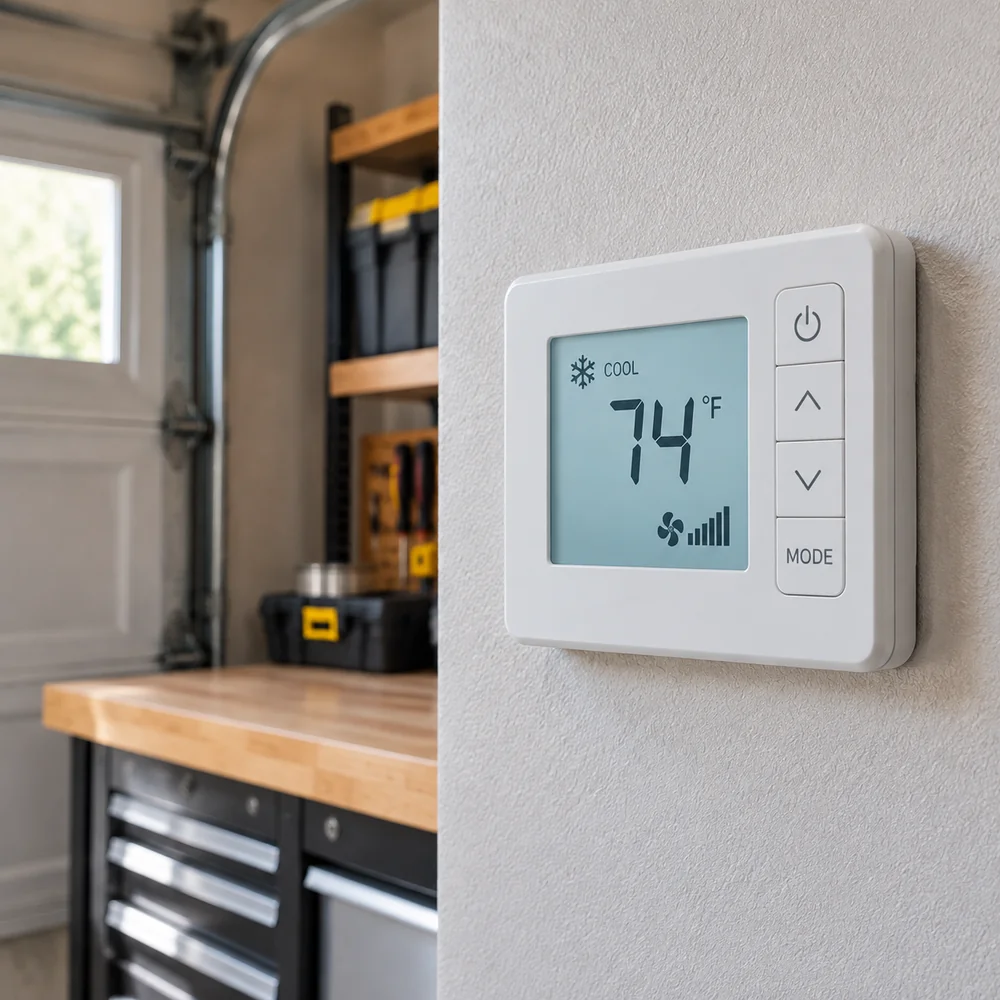
For a fair comparison, request quotes for the same garage condition, design load, comfort target and usage schedule. Ask which work, permits and startup checks the quote includes. If the garage needs winter heating, compare the model’s verified heating output and seasonal energy use at local conditions too. The cheapest unit to buy is not always the least expensive option for daily use.
How Do You Check a Garage AC Installation Before Using It?
After startup, check that heat leaves outdoors, airflow is steady, condensate drains safely and the specified electrical protection is in place. Complete the model-specific mounting, wiring and refrigerant installation checks before regular use.
For a mini split, the installer should verify mounting, clearances, matching indoor/outdoor model numbers, permissible line lengths, insulation, leak and evacuation work, correct charge method, drainage and electrical protection. Our split AC installation guide covers the related work in more detail. Refrigerant work in the United States falls under applicable EPA Section 608 technician requirements. For portable and room units, check approved exhaust or sleeve installation, air sealing, water drainage and the correct circuit. Do not use extension cords as a substitute for the circuit specified in the manual.
Check which appliances share the garage circuit, including a freezer, garage-door opener or power tools. Have a qualified electrician compare the combined loads with the AC nameplate and verify the required voltage, current and circuit protection before installation.
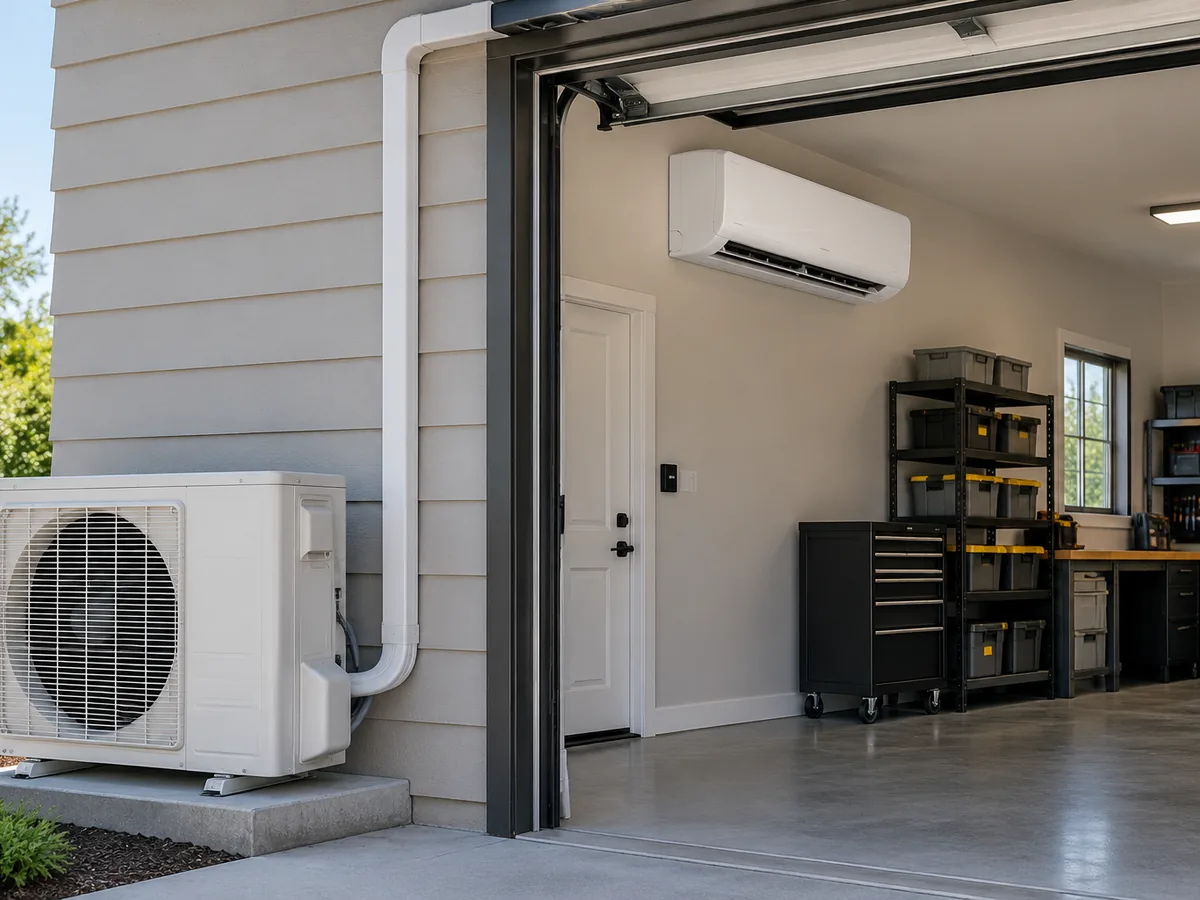
Then run the unit in the normal occupied setup with the garage door closed. Look for steady airflow, no exhaust recirculation, no leaks and a temperature trend consistent with the calculated load and current weather. If the garage stays hot, first check whether the door or vents are open, the exhaust is actually reaching outdoors, the filter is blocked or the unit is operating outside its rated conditions. If those checks do not explain the problem, have a technician assess the system rather than adding refrigerant or guessing at pressure settings.
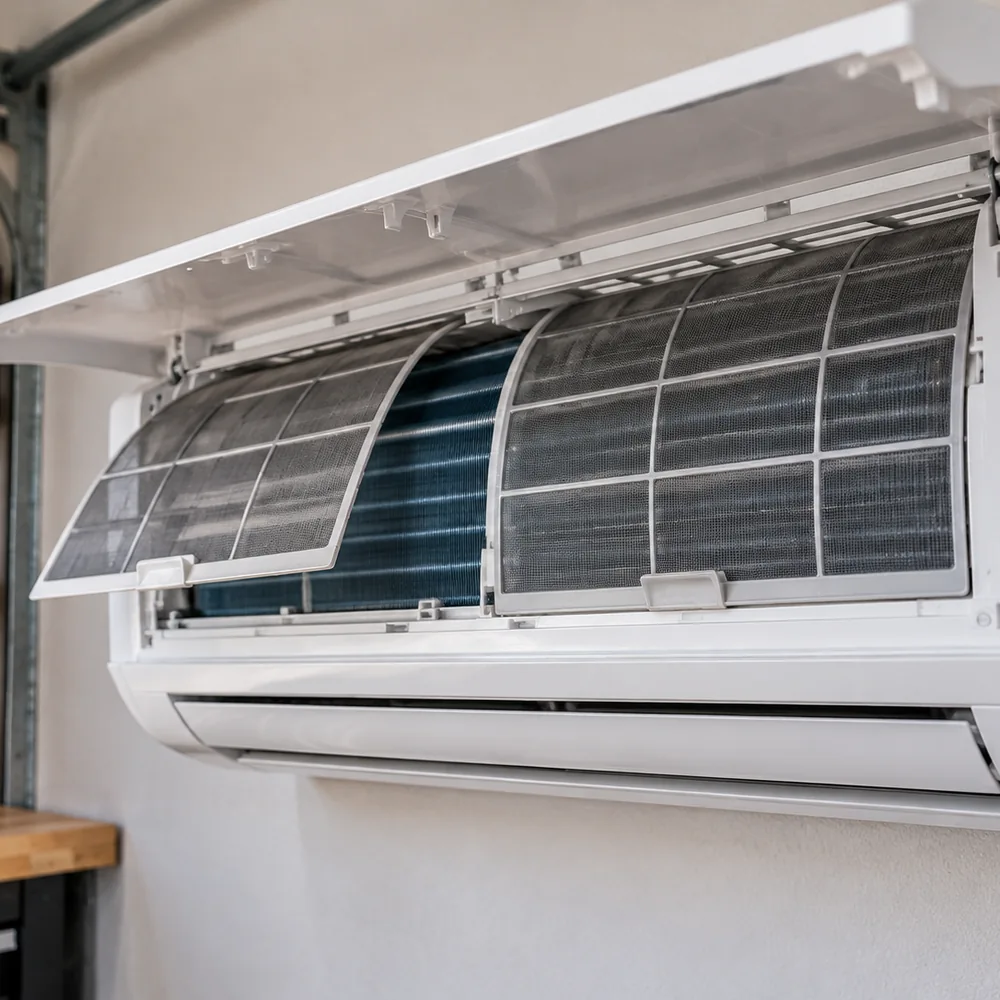
If the garage stays warm after these checks, use our guide to why an air conditioner is not cooling to separate airflow, controls, and equipment faults from a true capacity problem.
When Should You Discuss an AirProz Split AC Project?
For multiple garage workshops, residential development projects or an OEM air-conditioning range, we can help review suitable AirProz split AC product families. Our published air conditioner series include R32 and R410A T1 inverter families. We use your destination market, electrical supply and calculated cooling or heating load to shortlist relevant series, then check the applicable model specifications and installation limits.
Send us these details to check a suitable product and request a quotation:
- Market and quantity: destination country, number of units and any required market documents.
- Site and use: garage length, width and height; insulation and overhead-door conditions; daily use and desired indoor temperature.
- Heating and cooling: calculated design cooling load and winter heat requirement, if available.
- Site services: voltage, frequency, outdoor-unit position, line-route limits and drainage constraints.
Contact our team with the project details. We can help narrow suitable configurations and share the available model specifications and installation requirements for your project.
Conclusion: What Is the Best Air Conditioner for a Garage?
For a well-insulated garage used often, start by comparing ductless mini split systems against the real cooling and heating loads. For occasional use with a suitable window, a window AC may cost less. A through-the-wall unit offers another permanent option where an exterior wall installation is allowed. A portable AC can work when it has safe outdoor exhaust, but no ordinary AC is truly ventless.
Keep ventilation for fumes separate, improve the door and insulation before final sizing, and compare the exact model’s delivered output and electrical requirements. That approach gets you a garage cooling solution that fits the space instead of simply a bigger BTU label.
Frequently Asked Questions
Will a portable air conditioner cool a two-car garage?
It can cool an insulated two-car garage if its rated capacity covers the calculated load and its exhaust reaches outdoors. Measure the garage and compare SACC-rated portable capacity, noise, power and hose design. Poor insulation or frequent door opening can make a portable unit unsuitable.
Can a garage air conditioner work without a window?
Yes. A ductless mini split uses an outdoor condenser, and an approved through-wall AC rejects heat through an exterior wall. A portable AC still needs an exhaust route outdoors. A machine advertised as ventless may be an evaporative cooler rather than a true refrigerant AC.
Is a 12,000 BTU air conditioner enough for a 400 sq ft garage?
A 12,000 BTU-class unit can suit some insulated 400 sq ft garages if its delivered cooling covers the calculated peak load and it works well at lower loads. ENERGY STAR lists about 10,000 BTU/h for an ordinary 400–450 sq ft room with an 8-foot ceiling; this is an ordinary-room reference. The garage roof, overhead door, sunlight, moisture and heat-producing equipment affect the actual load. Calculate the garage load, then check the exact model’s delivered capacity and minimum output under relevant conditions.
Can I connect my garage to my home’s central AC ducts?
Do not connect a garage return-air opening to the home’s HVAC system. Garage air may contain vehicle fumes and chemicals, and mechanical codes restrict this arrangement. Consider a dedicated garage system and ask the installer to check the locally adopted code and the required garage-to-home separation.
Is a mini split worth it for a garage gym?
For a gym used most days, it is often worth comparing because it can cool quietly, offers flexible output on suitable inverter models and may also heat in winter. For only a few hot weekends each year, a less expensive window or vented portable unit could be more practical.
Does a ventless air conditioner remove humidity in a garage?
A typical ventless evaporative cooler adds moisture to the air while it cools by evaporation. It is not a replacement for a compressor-based AC where you need moisture removal, especially in a humid climate. If humidity control matters, choose equipment whose cooling and dehumidification performance matches the garage conditions.