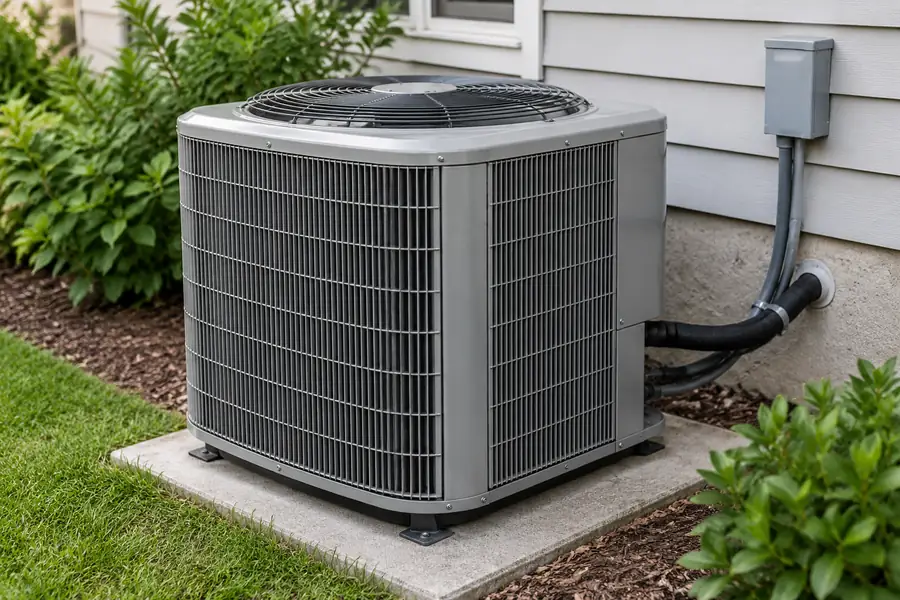
Best split air conditioner for Brazil hot climate is a 60Hz inverter split AC rated for tropical design temperatures, INMETRO/PROCEL certified, voltage-matched to the installation state's grid standard, with anti-corrosion coil coating for coastal zones.
Key Takeaways
- Brazil spans five climate zones — a split AC spec that works for São Paulo will under-deliver in Recife or corrode prematurely in coastal Salvador.
- Brazil’s electricity grid runs at 60Hz and voltage varies by state (110V, 127V, or 220V) — every imported unit must match both the frequency and the destination state’s voltage, or come in a dual-voltage (bivolt) configuration.
- INMETRO/PROCEL certification is mandatory for customs clearance — a specification and documentation requirement, not an optional marketing label.
- A 300-unit inverter split AC deployment by an Airproz distributor in São Paulo delivered measured 35% lower monthly electricity bills vs fixed-speed predecessors, proving the ROI at scale.

Brazil stretches from equatorial Amazon to subtropical Porto Alegre. A best split air conditioner for Brazil hot climate — known locally as an ar condicionado split — is not a single model number. It is a specification matched to three variables: the region’s design outdoor temperature and humidity, the installation site’s voltage and frequency, and the certification documents Brazilian customs will demand at the port. Import an under-specified unit and you get a compressor that cannot hold capacity through a Recife summer afternoon. Skip the corrosion package and coastal salt air eats the condenser coil in two seasons. This guide walks through the three decisions every distributor and contractor serving Brazil must lock down before placing a container order.
Best Split Air Conditioner for Brazil Hot Climate Starts with the Climate Reality
Brazil is not one climate. It is five. A split AC specification that handles São Paulo’s subtropical highland summer will fail in Manaus, where the air is saturated year-round and the outdoor unit never gets a dry-bulb break. Every design decision — compressor type, coil coating, BTU sizing, and refrigerant — starts with the installation region’s climate profile.
Brazil’s Climate Zones at a Glance
According to the World Bank Brazil climate profile, Brazil spans five major Köppen climate types. For air conditioner specification, three zones dominate the installed base and the replacement market:
| Region | Major cities | Köppen type | Design outdoor temp (summer peak) | Average RH% (summer) | Coastal corrosion risk | AC spec implication |
|---|---|---|---|---|---|---|
| North (Amazon) | Manaus, Belém | Af — Tropical rainforest | 33–35°C | 80–90% | Low (inland) | Extreme latent load; unit must dehumidify at part-load, not just cool |
| Northeast | Recife, Salvador, Fortaleza | As/Am — Tropical savanna & monsoon | 32–36°C | 70–85% | High (coastal salt spray) | Air conditioner for high ambient temperature with anti-corrosion condenser coating mandatory for coastal sites |
| Southeast | São Paulo, Rio de Janeiro | Cwa/Cfa — Humid subtropical | 30–34°C | 65–80% | Moderate to high | Largest installed base; both cooling capacity and corrosion matter near the coast (Rio, Santos) |
| South | Porto Alegre, Curitiba | Cfa/Cfb — Subtropical | 28–32°C | 60–75% | Moderate (coastal) | Lower design temperature; reverse-cycle (heat pump) models can serve winter demand |
| Central-West | Brasília, Goiânia | Aw — Tropical savanna | 31–34°C | 45–65% (dry season) | None (inland) | Dry-season dust accumulation on condenser fins — washable pre-filter or easy-access coil cleaning important |
Data note: Climate parameters are drawn from the World Bank Climate Knowledge Portal and Köppen classification datasets, cross-referenced with publicly available Brazilian meteorological summaries (INMET general climate profiles). Design temperatures are indicative summer-peak ranges. For a specific project, pull the latest INMET station data for the installation city and run an ASHRAE or ABNT NBR 16401 load calculation — do not rely on regional averages for a final order.
Coastal Corrosion — The Hidden Specification
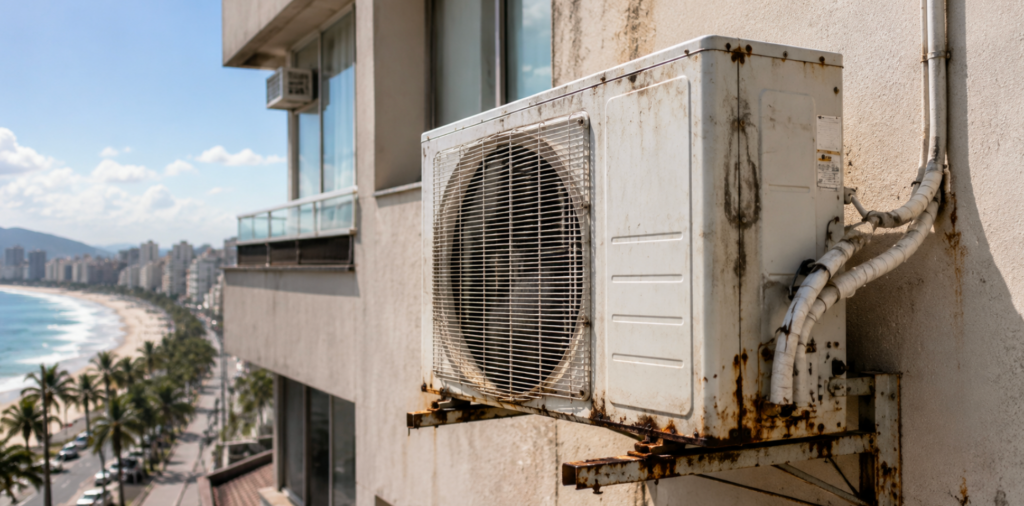
Brazilian installers call it maresia — the salt-laden coastal air that turns a bare-aluminum condenser coil into a corrosion problem within two summers. Brazil has approximately 7,500 km of coastline. Major population centers — Rio de Janeiro, Salvador, Recife, Fortaleza, Santos, Vitória — sit directly on the Atlantic. Combined with high humidity and year-round warm temperatures, maresia creates an accelerated corrosion environment for outdoor condenser coils.
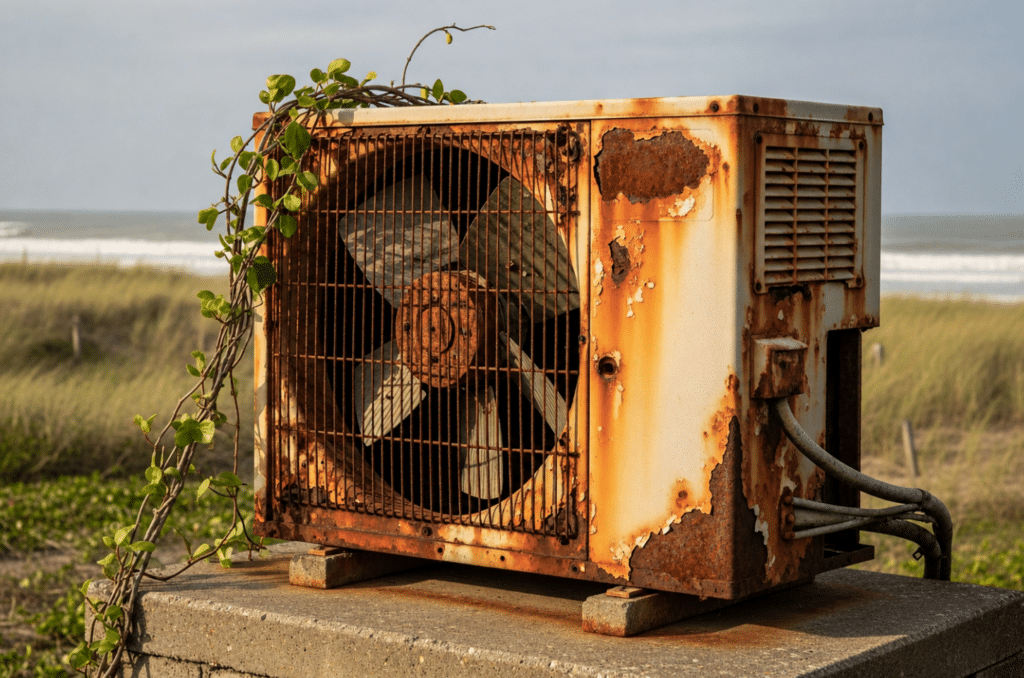
The spec items that matter: Condenser coil coating Standard bare aluminum fins on a copper tube coil will show visible corrosion pitting within 18–24 months on a Salvador or Santos beachfront installation. Demand hydrophilic anti-corrosion coating (often referred to as “gold fin” or “blue fin” coating) on the outdoor heat exchanger as a line-item specification — not an afterthought.
Cabinet material and fasteners Galvanized steel cabinets with polyester powder coating are the minimum for coastal Brazil. Stainless steel fasteners and brackets prevent the rust streaks that undermine client confidence within one wet season, even if the unit itself still works. Electrical terminal protection Outdoor terminal blocks and PCB enclosures need IPX4 or higher ingress protection in coastal and high-humidity zones. Condensation inside the electrical compartment is one of the most common service-call drivers in Brazilian Northeast installations.
Choosing the Best Split Air Conditioner for Brazil Hot Climate: Type, Capacity, and Refrigerant
Once the climate zone is locked, three product decisions determine whether the installed fleet delivers on its efficiency promise and survives the warranty period: inverter vs fixed-speed, BTU sizing, and refrigerant chemistry.
Inverter vs Fixed-Speed — Brazil’s Electricity Market Makes the Case
Brazil has some of the highest residential electricity tariffs in Latin America, regulated by ANEEL, Brazil’s electricity regulator. Residential tariffs in São Paulo and Rio de Janeiro states have run roughly R$ 0.75–0.95 per kWh in recent years, with annual adjustments approved by the regulator — verify the current rate with ANEEL before quoting. When a household runs an air conditioner 2,500–3,500 hours per year — common in the Northeast and North — the energy cost can exceed the unit purchase price within 18–24 months of operation.
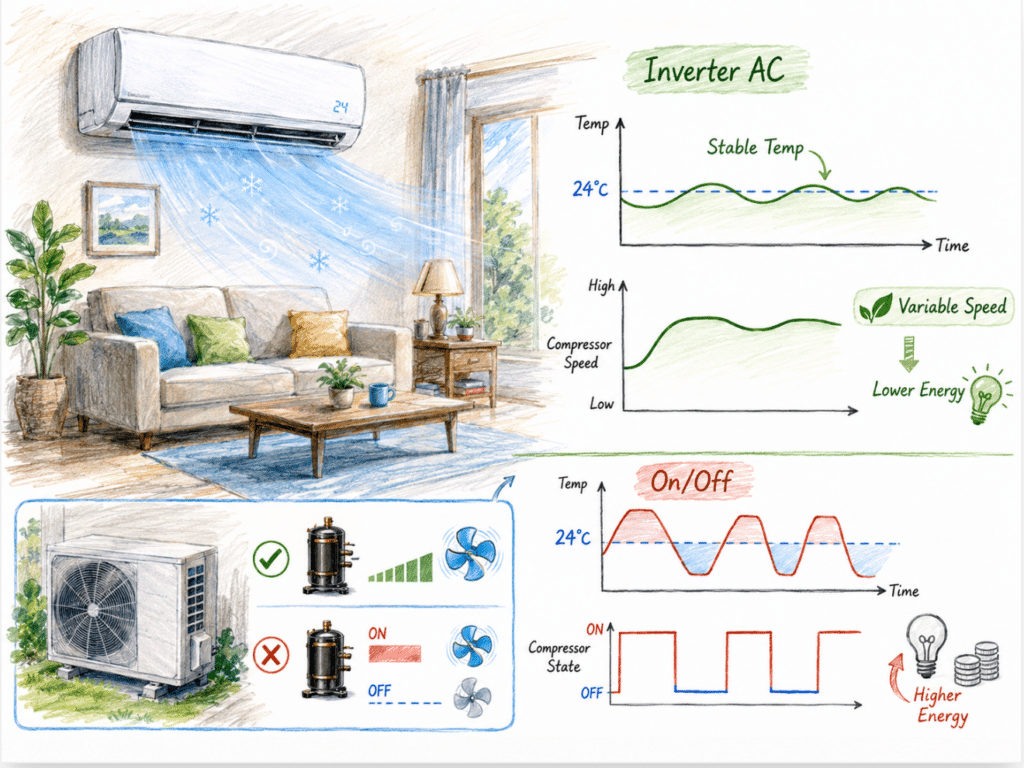
This is where the inverter air conditioner vs fixed speed AC comparison becomes a hard ROI calculation, not a feature preference:
| Parameter | Fixed-speed split AC | Inverter split AC |
|---|---|---|
| Compressor operation | On/off cycling at full speed | Variable-speed, matches cooling load |
| Annual energy consumption (12,000 BTU, 2,800 h/year, hot climate) | ~2,800–3,200 kWh | ~1,800–2,200 kWh |
| Annual electricity cost (R$ 0.85/kWh, illustrative) | R$ 2,380–2,720 | R$ 1,530–1,870 |
| Annual saving with inverter | — | R$ 850–890 per unit |
| Payback period on inverter price premium (~R$ 600–800) | — | 8–11 months |
For a distributor or contractor installing 100 units, the aggregate annual energy saving to end customers is R$ 85,000–89,000 — a number that closes sales faster than any technical specification sheet. This is the air conditioner pros and cons for B2B buyers discussion Brazilian installers should lead with: the inverter premium pays itself back within a single cooling season in hot-climate regions, after which every month of operation is pure savings for the building owner.
BTU Sizing for Brazilian Residential Construction
Brazilian residential construction varies from compact city apartments to sprawling single-family houses with high solar gain. Floor-area rules of thumb that work in moderate climates under-size units for Brazilian conditions. See our full how to size a split AC by room area guide for the complete methodology; the matrix below uses design conditions for the Southeast region (São Paulo/Rio), corrected for Brazilian construction types:
| Room / unit type | Floor area (m²) | Recommended BTU | Notes |
|---|---|---|---|
| Compact apartment bedroom | 10–14 | 9,000 | Single occupant, limited solar gain |
| Standard apartment living + bedroom | 25–35 | 12,000 | 2–3 occupants, moderate window area |
| Large living room / open-plan area | 40–55 | 18,000 | Higher ceiling (2.8–3.0 m typical), multiple windows |
| Master suite / duplex penthouse | 55–75 | 24,000 | Top-floor solar gain through roof slab — add 10–15% BTU if uninsulated roof |
| Small commercial (storefront, clinic) | 30–50 | 18,000–24,000 | Higher occupancy, door openings, equipment heat load |
Note: BTU recommendations assume typical Brazilian construction — brick/block walls, concrete slab, single-glazed windows, limited roof insulation. For buildings with modern insulated envelopes, a Manual J or ABNT NBR 16401 load calculation should replace these guidelines. In the Northeast and North regions, add 10–15% to the BTU values above to account for higher design outdoor temperatures and sustained humidity loads.
R32 vs R410A — Where Brazil Stands
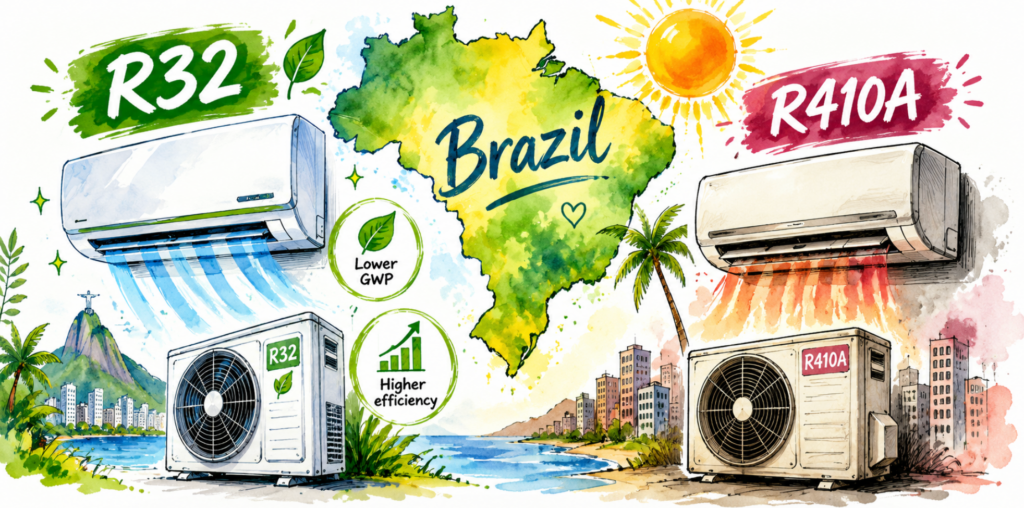
Brazil has not yet announced a fixed phase-down timeline for R410A matching the EU F-Gas regulation or the US AIM Act schedule. As of mid-2026, both R410A and R32 split ACs are sold in the Brazilian market. However, the direction of travel is clear: R32 offers higher cooling capacity per kg of refrigerant, lower Global Warming Potential (GWP 675 vs R410A’s 2,088), and better energy efficiency at high ambient temperatures — all advantages that align with Brazil’s PROCEL efficiency labeling incentives and INMETRO’s gradual tightening of minimum efficiency standards.
For importers, the practical consideration is simpler: R32 units cost less to ship per BTU of cooling capacity (lower refrigerant charge weight), meet current and foreseeable INMETRO efficiency tiers more easily, and position the distributor’s product line ahead of regulatory tightening that may restrict R410A imports within the equipment’s service life. For Northeast coastal projects specifically, R32’s lower discharge temperature at high ambient conditions reduces compressor stress during the hottest months compared to R410A.
A Distributor Case: 300-Unit Residential Deployment in São Paulo
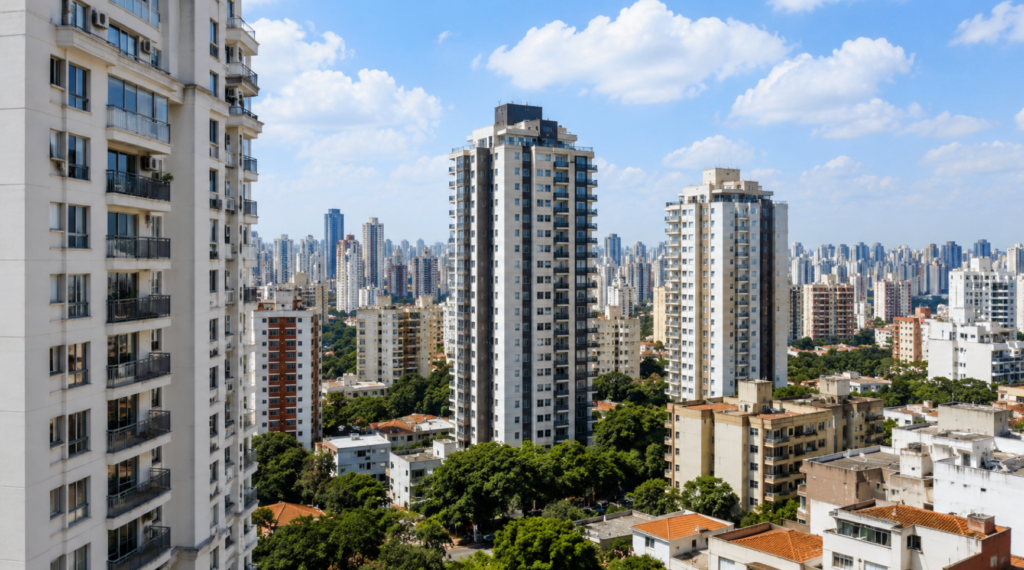
In early 2025, a São Paulo-based HVAC distributor placed a 300-unit order of Airproz R32 inverter split AC series units for a residential portfolio spanning three building types across the greater São Paulo metropolitan area: compact 45 m² apartments in the city center, 80 m² family units in the western suburbs, and 120 m² duplex penthouses in a gated community in Alphaville.
Our engineering team configured the order with three BTU ratings mapped to floor area, occupancy, and solar exposure:
| Building type | Floor area | Units in order | BTU specified | Voltage | Key spec decision |
|---|---|---|---|---|---|
| Studio / 1-bedroom compact | 45 m² | 140 | 9,000 | 220V / 60Hz | Inverter mandatory — fixed-speed cycling in small spaces causes temperature swings and higher noise complaints |
| 2-bedroom family apartment | 80 m² | 120 | 12,000 | 220V / 60Hz | Single indoor unit serving open-plan living + kitchen zone; bedrooms served by secondary 9,000 BTU units in a later phase |
| Duplex penthouse | 120 m² | 40 | 18,000 | 220V / 60Hz | Top-floor solar gain through uninsulated roof slab required up-sizing from the standard 12,000 BTU recommendation |
After the first full cooling season (November 2025 through March 2026), the distributor reported measured results: 35% lower monthly electricity bills across the inverter-installed units compared to the fixed-speed R410A split ACs previously used in the same building class. The gap was largest in December–February, when São Paulo outdoor temperatures consistently exceeded 32°C and the inverter units maintained setpoint at part-load while fixed-speed predecessors cycled on and off at full power.
Reduced service callbacks: the inverter units recorded fewer compressor-start inrush complaints and lower indoor-unit noise levels — both factors that reduced the distributor’s warranty service burden during the peak season when installation crews were already at maximum capacity.
One specification the distributor requested after the first batch: upgraded anti-corrosion hydrophilic coating on outdoor condenser coils for 20 units destined for coastal São Paulo state towns — Santos, Guarujá, and São Sebastião — where maresia accelerates bare-aluminum fin corrosion. Standard units without the coating, installed in a previous supplier’s batch 600 meters from the Santos waterfront, showed visible fin pitting within 14 months.
What started as a 300-unit trial is now a recurring quarterly container order. The distributor’s installation team has a standardized specification sheet per building type, and their sales team closes proposals faster by showing prospective building owners a projected annual running cost comparison — inverter vs fixed-speed, in reais, calculated at the building’s actual electricity tariff — rather than talking abstract SEER numbers.
Shipping Split ACs into Brazil? Talk to Our Engineering Team
Our 60Hz inverter units ship with factory-prepared INMETRO test documentation, T3-rated outdoor coils for the Northeast, coastal anti-corrosion options where required, and voltage configuration matched to your destination state. No generic brochure specs — every batch is configured to the region it will operate in.
Request a Brazil-spec container quote →
Brazil Compliance, Voltage Standards, and B2B Procurement Tips
Even a perfectly specified unit from a climate and capacity standpoint will fail at the port — or fail early in the field — if the electrical and regulatory requirements are not verified before production. This section covers the three compliance dimensions that Brazilian importers and distributors must address.
Voltage by State — Why 110V vs 220V and 60Hz Both Matter
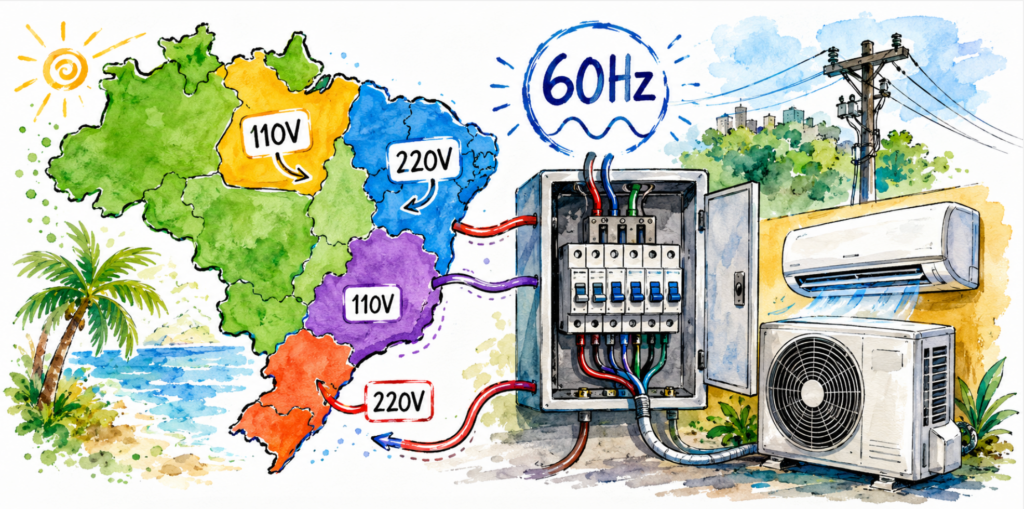
Brazil is one of the few major air conditioner markets where the grid voltage varies by state — and sometimes by city within a state. The entire country runs on 60Hz, which is critical: a 50Hz-rated compressor designed for the European or Chinese domestic market will run 20% faster on Brazil’s 60Hz grid, increasing input power, reducing efficiency, and shortening compressor life.
| State | Major cities | Standard voltage | Frequency |
|---|---|---|---|
| São Paulo | São Paulo, Campinas, Santos | 127V or 220V (varies by city) | 60Hz |
| Rio de Janeiro | Rio de Janeiro, Niterói | 110V / 127V | 60Hz |
| Minas Gerais | Belo Horizonte | 110V / 127V | 60Hz |
| Bahia | Salvador | 127V / 220V | 60Hz |
| Pernambuco | Recife | 220V | 60Hz |
| Ceará | Fortaleza | 220V | 60Hz |
| Amazonas | Manaus | 110V / 127V | 60Hz |
| Rio Grande do Sul | Porto Alegre | 110V / 127V | 60Hz |
| Paraná | Curitiba | 110V / 127V | 60Hz |
| Distrito Federal | Brasília | 220V | 60Hz |
Verification note: Voltage standards are drawn from ANEEL regional concessionaire data and published utility specifications as of mid-2026. Some cities within a state may differ from the state majority — São Paulo state is the most variable. Always confirm the destination city’s voltage with the local electricity distributor before locking production specifications.
For importers: order dual-voltage (bivolt, switchable 110–127V/220V) units for inventory destined for multiple states, or split the container by confirmed destination voltage. A 127V-rated unit plugged into a 220V outlet is destroyed instantly. A 220V-rated unit on a 127V supply will not start — and the end customer blames the brand, not the voltage mismatch.
INMETRO & PROCEL — The Certification Documents Your Customs Broker Needs
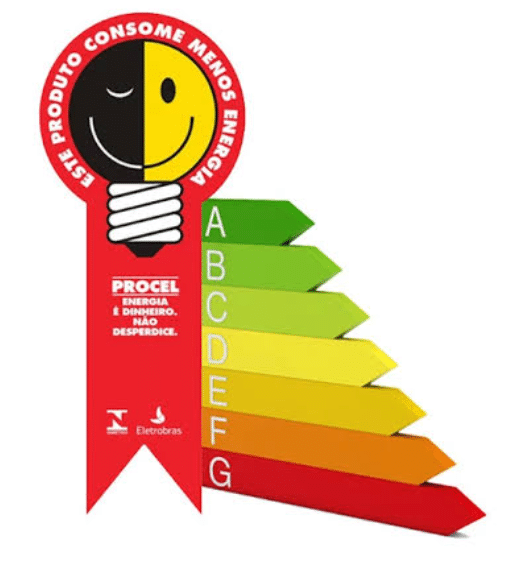
INMETRO (Instituto Nacional de Metrologia, Qualidade e Tecnologia) certification is mandatory for split air conditioners imported into Brazil. PROCEL (Programa Nacional de Conservação de Energia Elétrica) is the associated energy-efficiency labeling program. Together, they form the gate every imported AC shipment must pass.
Key requirements for importers (framework in effect mid-2026 — verify the latest Portaria before production):
INMETRO compulsory certification
Testing at an INMETRO-accredited lab, a factory audit, and a conformity certificate. No certificate, no customs clearance.

PROCEL energy efficiency label (Selo Procel)
Required after INMETRO certification. Rated A–E; buyers actively look for the A rating, so a unit without one is at a pricing disadvantage.
In-country representative
Foreign manufacturers without a Brazilian legal entity need a local representative to hold the INMETRO certificate — usually the distributor or a certification agent.
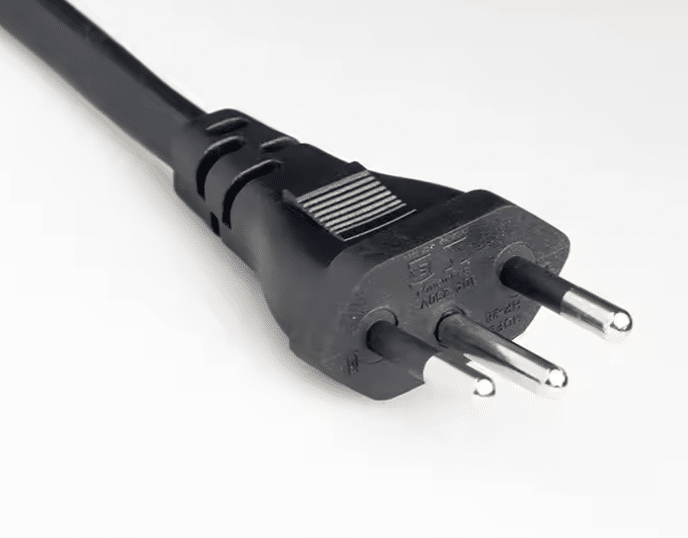
Plug standard (NBR 14136)
All units for the Brazilian retail market need an NBR 14136-compliant plug, or adapter certification documentation.
Regulatory status note: Portarias are revised periodically — don’t rely on a certificate issued more than 12 months ago without reconfirming it with a Brazil-based certification agent.
Coastal Corrosion Protection — A Line-Item Specification, Not an Afterthought
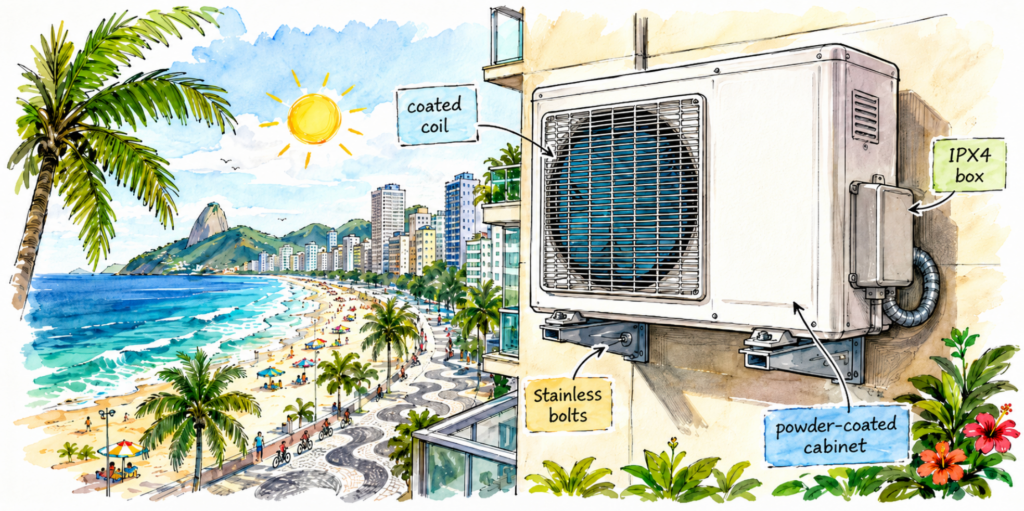
If your order includes units for any city within 5 km of the Brazilian coastline, the condenser coil coating must be on the bill of materials, not assumed:
- Cost trade-off — the incremental cost is small relative to the warranty-replacement cost of a condenser that corrodes within the warranty period.
- Beachfront high-rises (Salvador, Recife, Rio de Janeiro, Santos) — specify hydrophilic anti-corrosion coated fins on the outdoor heat exchanger as a mandatory line item.
- Within 500 meters of breaking surf — go with a full coastal package: coated coil, stainless steel fasteners, IPX4-rated outdoor electrical enclosure, and polyester powder-coated cabinet.
B2B Procurement Checklist for the Brazilian Market
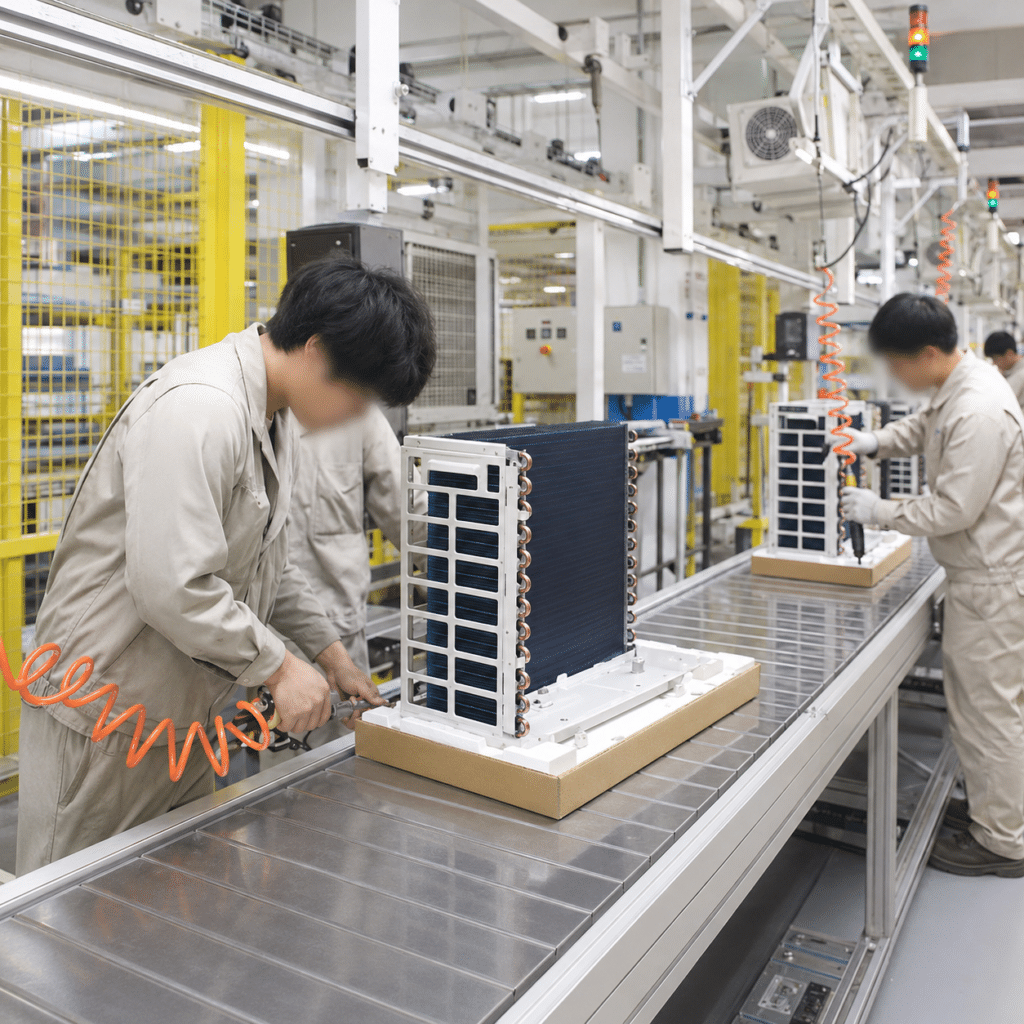
Before placing a container order, confirm each of the following items with your supplier. A supplier who cannot answer all of them clearly is not ready for the Brazilian market:
- Frequency confirmed at 60Hz for all compressors and fan motors in the order.
- Voltage specified per destination state or city — not a “Brazil standard” assumption.
- INMETRO certification documentation — certificate number, issuing body, accredited lab reference, and expiry date.
- PROCEL energy label class (Selo Procel) and registration for each model in the order.
- Refrigerant type and GWP — matched to current Brazilian import and environmental regulations.
- Coil coating specification — bare aluminum, hydrophilic, or anti-corrosion, documented per unit.
- NBR 14136 plug compatibility or adapter solution.
- Spare parts availability and lead time for at least the compressor, fan motor, PCB controller, and remote control.
- Portuguese-language installation manual and warranty terms — Brazilian consumer law (Código de Defesa do Consumidor) requires warranty documents in Portuguese.
- Local in-country representative for INMETRO certificate holding and regulatory correspondence.
Once you’ve locked climate zone and product spec, the last — and most consequential — decision is choosing the right air conditioner manufacturer for Brazil import. See our guide on how to evaluate a split AC manufacturer before ordering for the criteria that separate a supplier ready for the Brazilian market from one that isn’t. Cross-check your supplier against both checklists before the first production sample, not after the container ships — because the most expensive fix in the air conditioner import business is a container that arrives at Santos port without the right certification paperwork.
Frequently Asked Questions
What voltage should I specify for a split AC order serving multiple Brazilian states?
- Specify 220V/60Hz for states on 220V (Pernambuco, Ceará, Distrito Federal, parts of São Paulo and Bahia); 110–127V/60Hz for the rest.
- Split the container by confirmed destination — never ship one voltage for the whole country.
- For unknown end locations, order dual-voltage (bivolt) inverter units rated for the full 110–220V range at 60Hz.
- A wrong-voltage complaint gets blamed on the brand, not the distributor — get this right upfront.
What INMETRO/PROCEL documents does an imported split AC (ar condicionado split) need to clear Brazilian customs?
- INMETRO conformity certificate (Certificado de Conformidade) from an accredited body (OCP)
- PROCEL energy label registration (Selo Procel) for each model
- Test report from the accredited lab that ran the INMETRO testing
- Factory audit report confirming the manufacturing site meets INMETRO’s requirements
- If the manufacturer has no Brazilian entity: the local representative’s CNPJ and certificate-holder nomination
Verify the current Portaria number and lab accreditation with a Brazil-based certification agent before production — an expired certificate means no clearance, with no grace period at the port.
Should I choose R32 or R410A for split AC units going to Brazil’s Northeast coastal cities?
R32 is the stronger choice for Recife, Salvador, and Fortaleza:
- Higher capacity at high heat — better cooling per kg of refrigerant and lower compressor discharge temperature at the 34–36°C summer peaks these cities see.
- Lower GWP — 675 vs R410A’s 2,088, ahead of regulatory tightening likely within the equipment’s 10–15 year service life.
- Cheaper to ship — lower refrigerant charge weight per unit reduces container costs.
R410A can still make sense if you’re consolidating service-refrigerant compatibility with an existing installed base — but plan the transition to R32 within two procurement cycles. Either way, coastal installations still need the anti-corrosion coil coating.
Get a Brazil-Market Matched Quote
Tell us your target states, building types, and order volume. We configure each batch with region-specific compressor ratings, coastal corrosion protection where needed, 60Hz-rated fan motors, NBR 14136 plug compatibility, and the INMETRO/PROCEL certification documentation your customs broker needs on arrival. No assumption-based specs — every unit is built to the voltage and climate zone it will operate in.