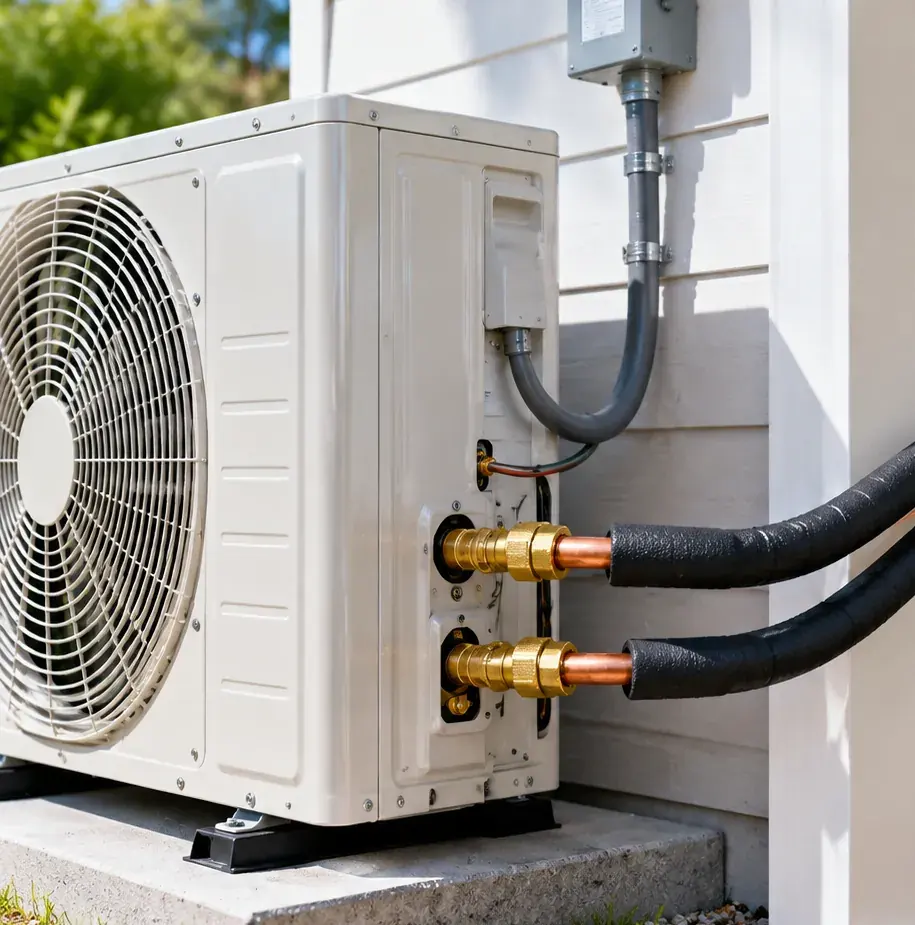
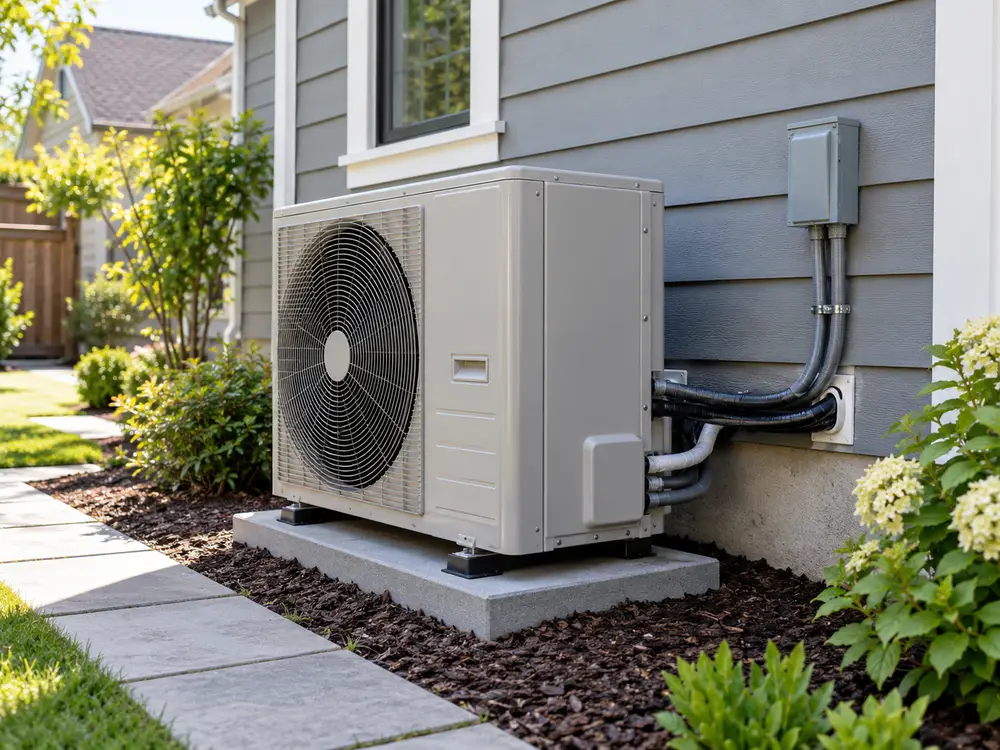
Quick answer: In a ducted split AC system, the indoor air handler moves room air through the cooling coil and supply ducts. The outdoor AC condenser releases the heat carried away by the refrigerant. They work together as two different parts of the cooling system.
Some homes use a furnace blower with a separate cooling coil instead of a standalone air handler. If you are replacing an older system, start by recording the indoor and outdoor model numbers. The sizing and matching section below explains how to check the proposed combination.
What Is the Air Handler on an AC Unit?
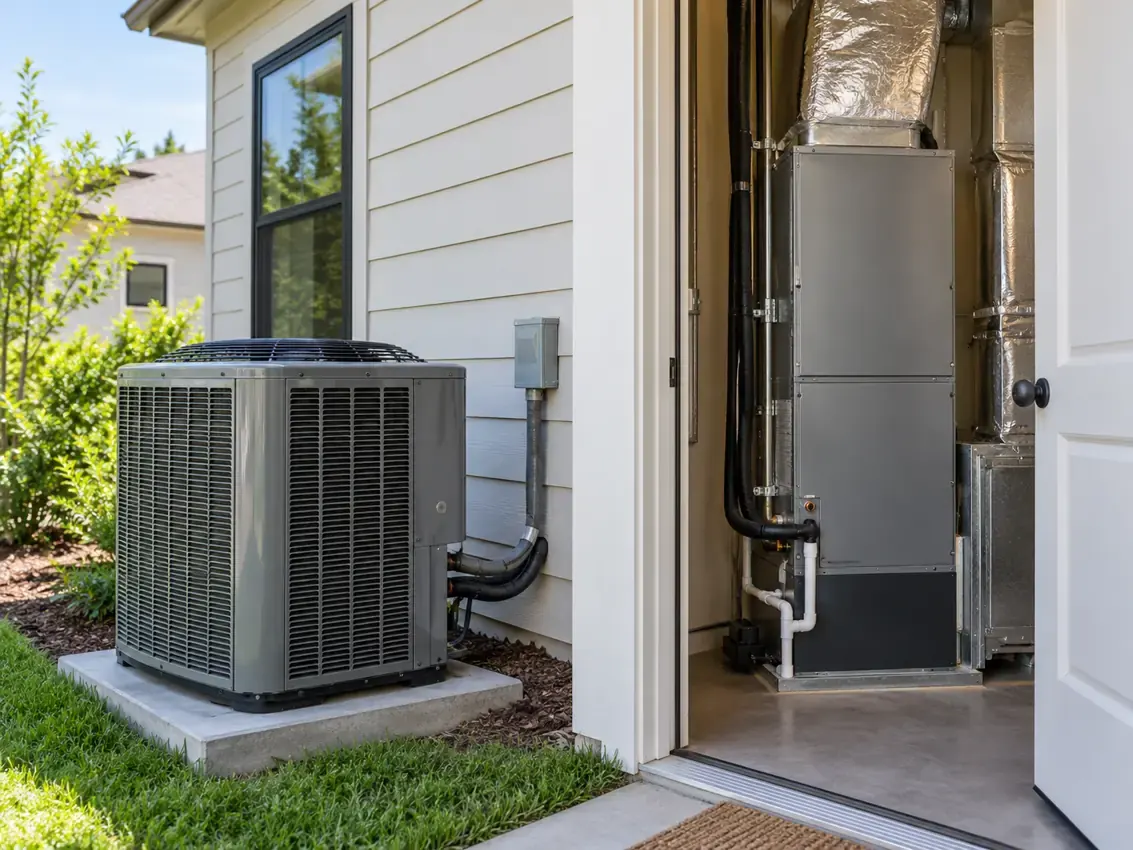
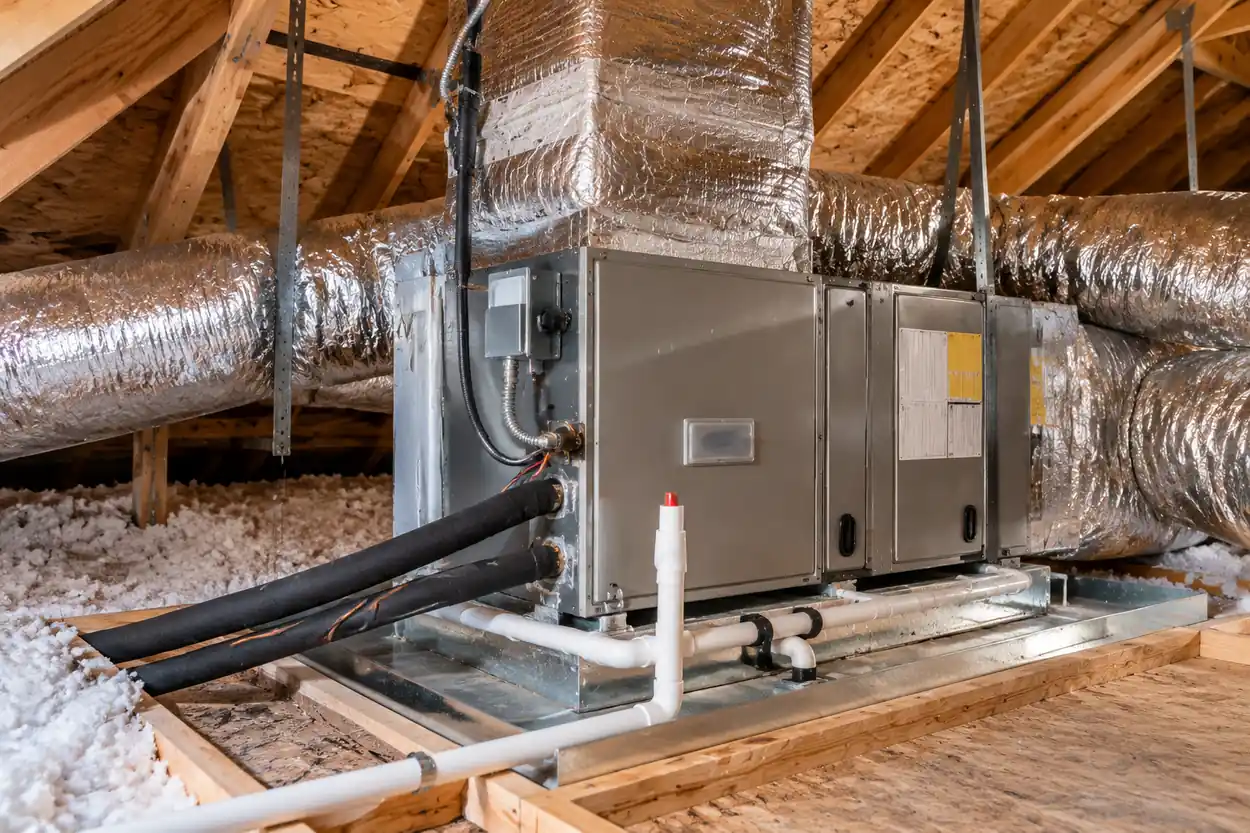
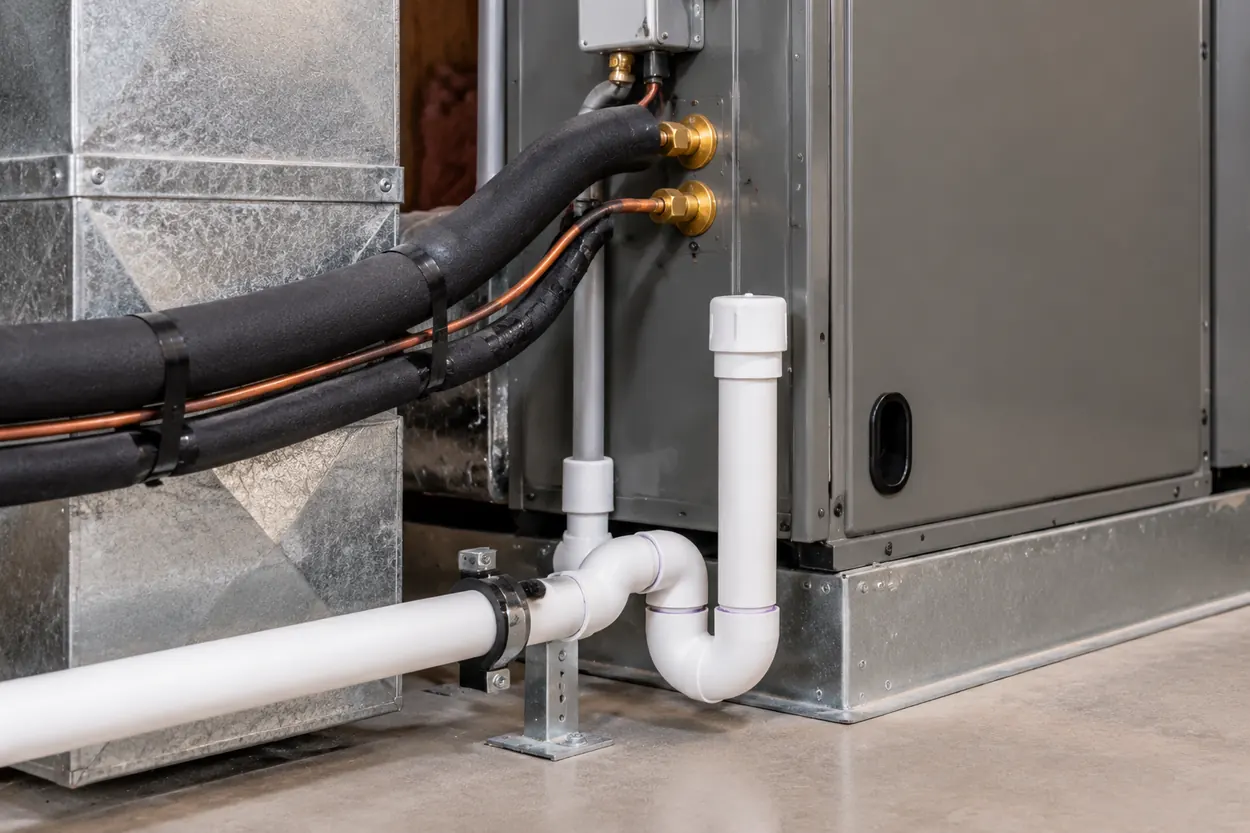
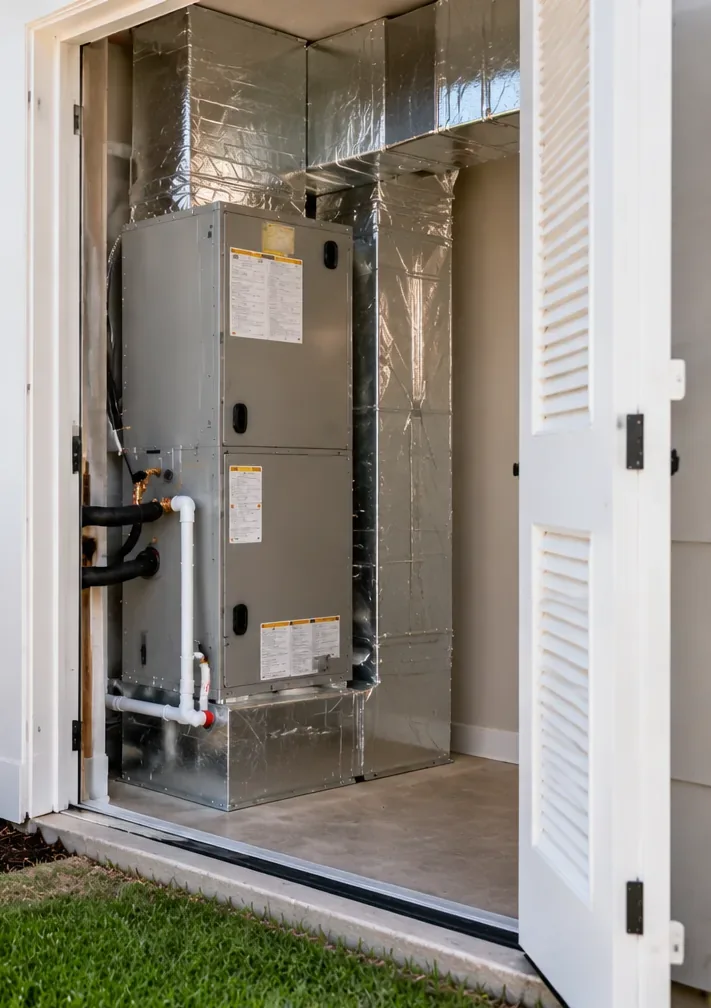
The air handler is usually the indoor cabinet that moves conditioned air through a ducted home. It is not the outdoor condenser you see beside the house. The indoor cabinet is commonly in a utility closet, attic, basement, garage mechanical area, or dedicated equipment room. Look for a large sheet-metal cabinet connected to a return-air duct and supply plenum. In some installations the indoor cooling coil sits above or alongside a furnace rather than in a standalone air-handler cabinet.
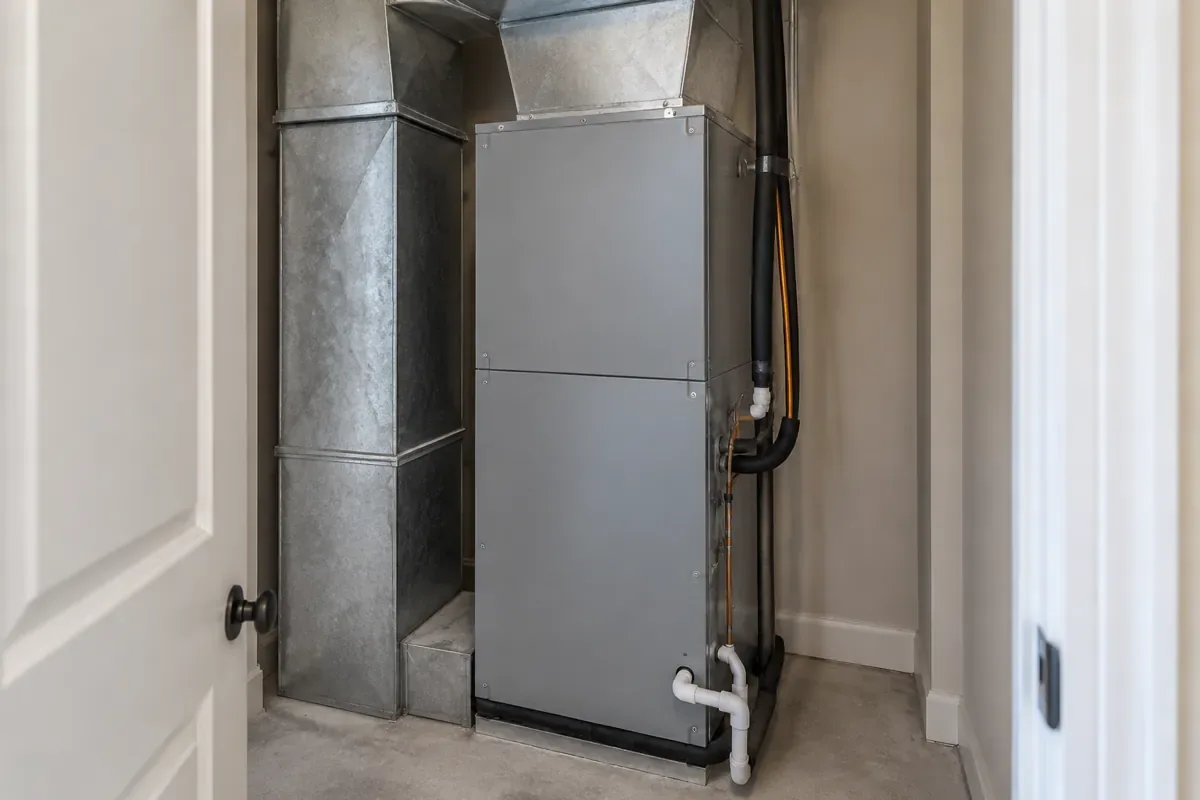
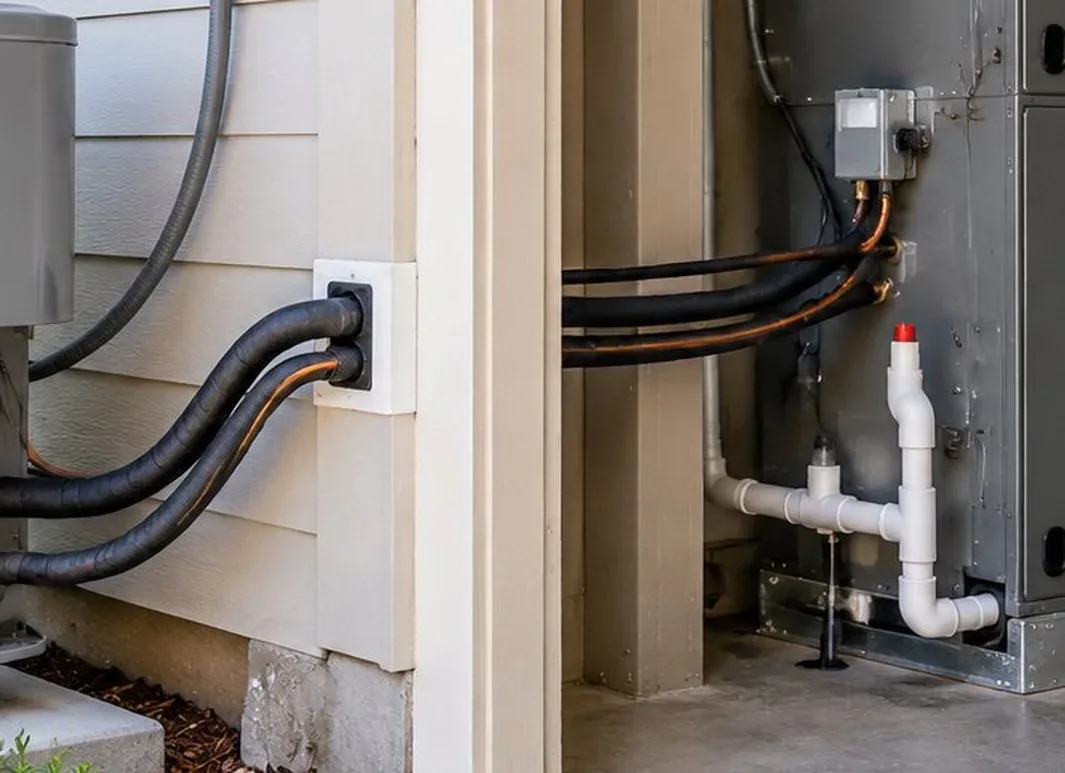
When people say “air handler on an AC unit,” they may be describing the indoor half of a split system. The air handler is often connected to the outdoor unit by insulated refrigerant lines and connected to ductwork on the air side. These connections serve different jobs: refrigerant transfers heat, and ducts deliver conditioned air to the rooms.
What parts are inside the air handler?
| Part | What it does | What to check |
|---|---|---|
| Blower and motor | Pull return air through the equipment and send supply air through ducts | Airflow settings, unusual noise, motor operation |
| Indoor evaporator coil | Absorbs heat from indoor air during cooling and removes some moisture | Coil condition, refrigerant match, drainage |
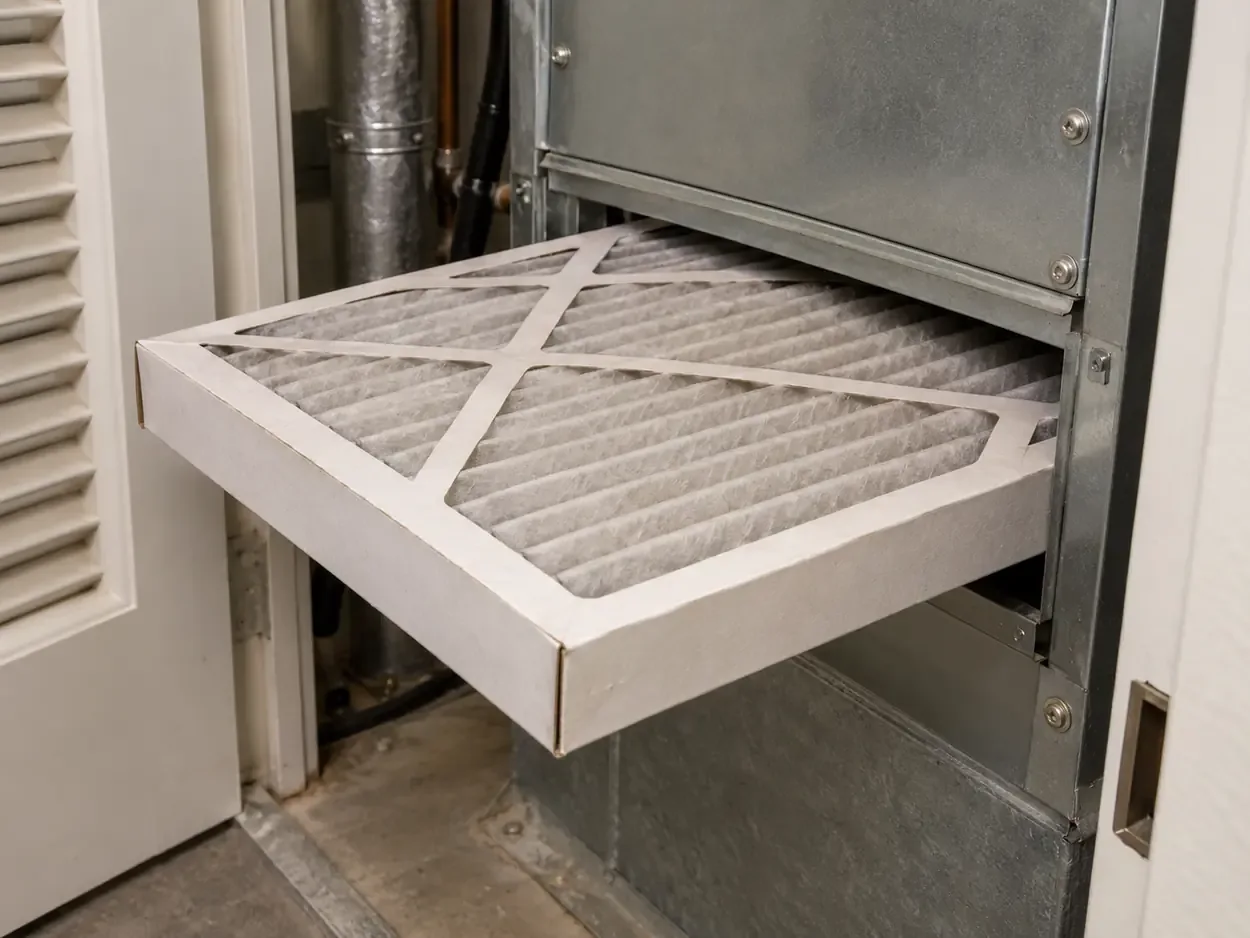
| Filter or filter rack | Holds a filter that captures airborne particles | Correct size, access, pressure drop |
| Drain pan and condensate line | Carry away water produced during cooling | Blockage, slope, leak protection |
| Controls and sensors | Coordinate blower speed, outdoor equipment and safety functions | Approved wiring and control sequence |
| Optional electric heat kit | Provides resistance heat in systems designed for it | Heat-kit approval, wiring, circuit capacity |
Equipment layouts differ. A separate air handler may contain the indoor coil and blower, while a home with a gas furnace may use the furnace blower and a separate cooling coil. Compare the actual manufacturer’s cabinet drawing before ordering parts.
What do single-speed, multi-speed and variable-speed blowers mean?
Single-speed motors generally use one operating speed. Multi-speed motors offer several selectable speeds. Variable-speed motors can adjust airflow more gradually when supported by the controls and system design. Compare blower options using the manufacturer’s airflow table, supported controls and the ducts’ expected resistance. These details show whether the blower can deliver the airflow the rooms need.
An indoor blower that varies its airflow and an inverter-controlled outdoor compressor perform different jobs. For compressor capacity control, read how an inverter air conditioner controls compressor speed.
Where can you find the air handler in your home?
Follow the return-air duct or filter location toward the indoor equipment. A closet may have a tall vertical cabinet; an attic installation may use a horizontal cabinet suspended or supported above the ceiling; a basement may have an upflow cabinet next to the ducts. The model plate is commonly on the exterior panel. Do not remove electrical or refrigerant access covers to find it. If you have a gas furnace with a blower, you may have an indoor coil above the furnace and no standalone air handler.
Check service access before choosing the location. The filter should slide out, the required service panels should open, and the condensate drain and any secondary leak protection should be reachable. An attic installation also needs safe service access. Use the clearance requirements for the exact model rather than one fixed dimension for every air handler.
Air Handler vs. AC Unit: What Is the Difference?
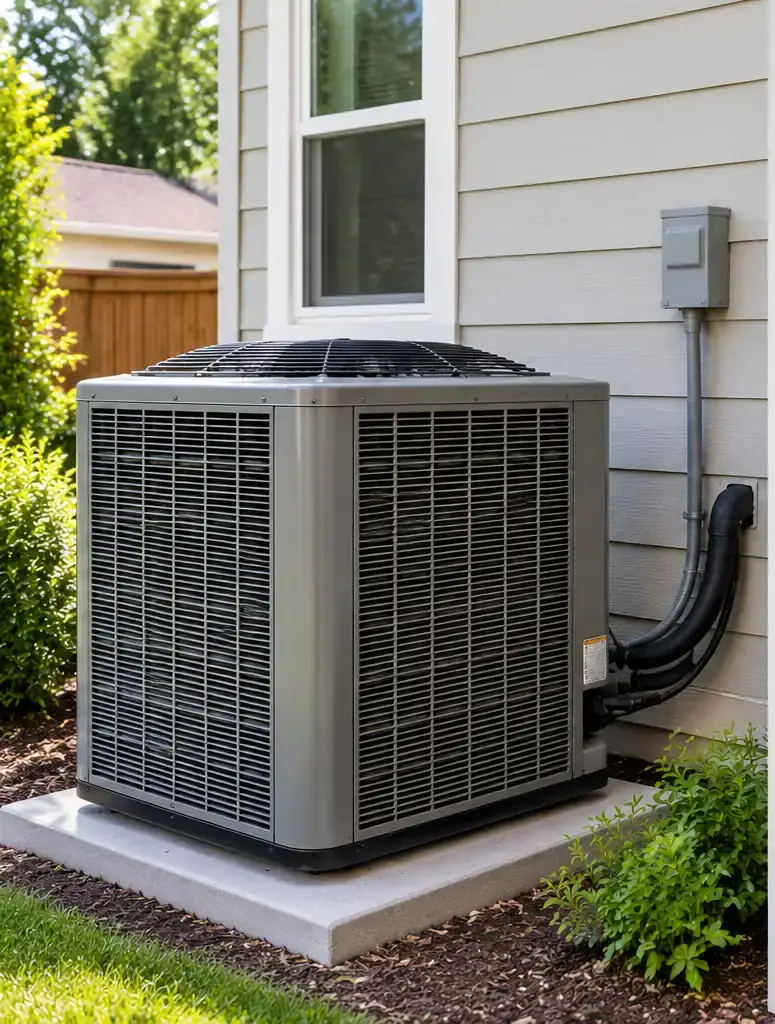
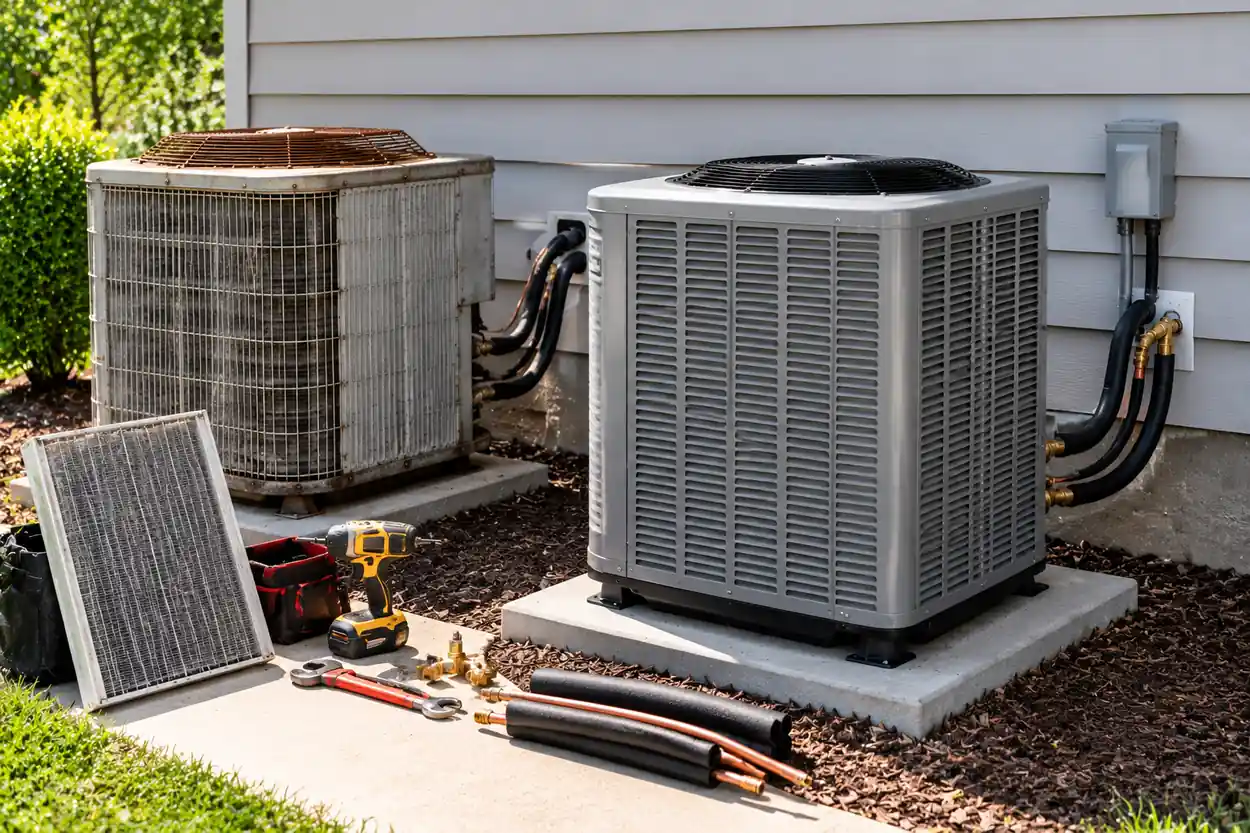
The AC unit moves heat through the refrigerant circuit; the air handler moves indoor air across the coil and through the ducts. Together, the indoor and outdoor assemblies perform central cooling. “AC unit” is sometimes used for the entire installed system, so check whether a quote means the outside unit only or both units.
| Comparison | Outdoor AC condenser | Indoor air handler |
|---|---|---|
| Common location | Outside on a pad or roof | Indoors in closet, attic or mechanical space |
| Main job in cooling | Compress refrigerant and reject heat outdoors | Move room air across the indoor coil and into ducts |
| Main equipment | Compressor, outdoor coil, fan, controls | Blower, indoor coil, pan, filter arrangement, controls |
| Main connections | Refrigerant, electrical power, control wiring | Refrigerant, supply/return ducts, drain, power and controls |
| Main check before replacement | Outdoor model, capacity, refrigerant, electrical data | Indoor model, coil and blower match, static-pressure capability |
| Can it cool rooms alone? | Not as a complete ducted split system | No: it needs a suitable refrigeration or heating source |
The distinction also explains a common symptom: if the outdoor fan and compressor run but little air comes from the vents, investigate indoor airflow before assuming the outdoor AC is too small. If air blows normally but stays warm, the cause could be elsewhere in the cooling system, controls or airflow path.
Does every AC need a separate air handler?
No. The system design determines who moves the air.
- Split central AC with an electric indoor air handler: The standalone air handler commonly contains the blower and coil.
- Central AC with a gas furnace: The furnace blower distributes air; the cooling coil may be in a separate cabinet above the furnace. A separate air handler is often unnecessary.
- Ducted heat pump: An indoor air handler commonly serves cooling and heating; it may also contain an approved auxiliary heater. See air conditioner vs. heat pump when comparing cooling-only and heating-and-cooling systems.
- Ductless mini split: A wall, ceiling or concealed indoor unit has its own fan, but it is not the same as a large central ducted air handler. Our mini split air conditioner guide explains how cooling reaches individual rooms without central ducts.
- Packaged AC: Major cooling components and the air-moving section are integrated in one packaged assembly, rather than two conventional split-system cabinets.
The U.S. Department of Energy’s split-system equipment lookup separately identifies outdoor units, indoor units and, where relevant, air movers. That is a useful reminder not to confuse cabinet names with the actual matched assembly.
If you are choosing between central ducts, ductless cooling and packaged equipment, compare the types of air conditioning systems before selecting the indoor layout. For larger buildings, the FCU vs. AHU comparison explains the different roles of fan coil units and central air-handling units.
How Do an AC Unit and Air Handler Work Together?
There are two different paths. Air moves from your rooms through the return duct, filter, indoor coil and supply ducts. Refrigerant moves through sealed tubing between the indoor coil and outdoor condenser to carry heat outside. Air from the outdoor condenser does not normally enter your home through those refrigerant pipes.
- The thermostat requests cooling and the system starts its approved control sequence.
- The indoor blower pulls room air through the return path and filter.
- Refrigerant in the indoor coil absorbs heat from that air. Moisture may condense on the cool coil and drain away.
- The blower delivers the cooled air through supply ducts to the rooms.
- Refrigerant carries the absorbed heat to the outdoor equipment, which rejects it outside.
- The system cycles or modulates according to the selected controls and demand.
Airflow is part of cooling performance. If the filter is blocked, return ducts are too small, or the blower cannot overcome duct resistance, the coil may get too cold and freeze. That can lead to weak cooling, poor humidity control or water problems. A larger outdoor unit will not repair a restricted return duct. The installer should measure airflow or appropriate pressure/temperature indicators using the procedure for the exact equipment.
When ice has already formed on the indoor coil, use our guide to AC system freeze-up causes and safe checks to plan the first response and identify which conditions need professional diagnosis.
A normal residential air handler mostly recirculates indoor air. If your project needs ventilation, plan a separate outdoor-air intake or a documented ventilation component; neither the outdoor AC cabinet nor a standard return duct automatically provides it.
Can You Pair a 2-, 3-, 4-, or 5-Ton AC Unit With Any Air Handler?
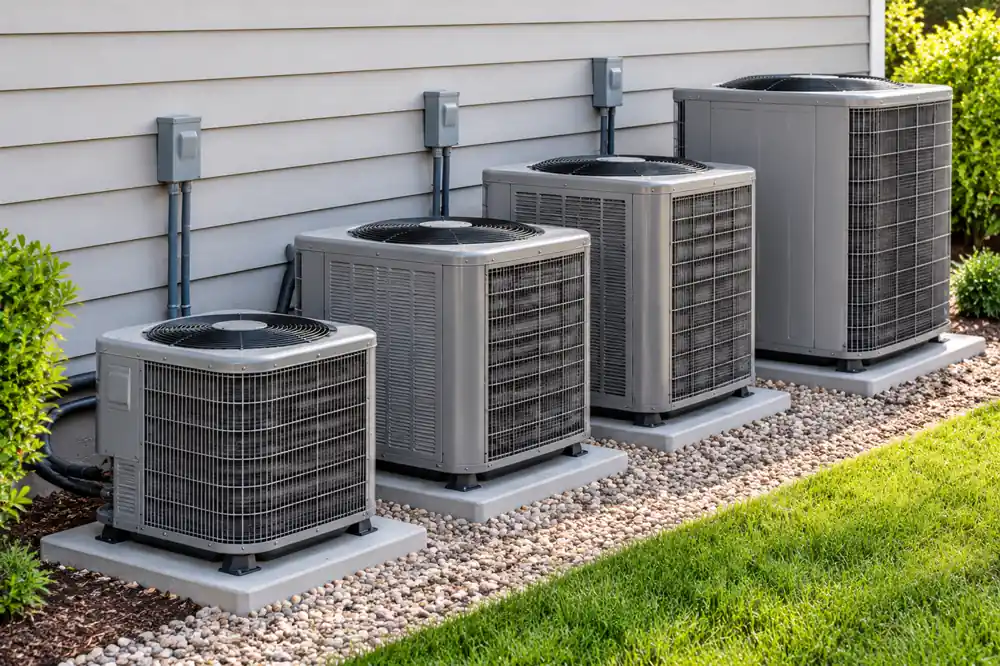
No. Use tonnage to identify a cooling-capacity class, then confirm the exact indoor–outdoor match. The manufacturer must approve the combination of outdoor condenser and indoor coil or air handler, and the blower must deliver the design airflow through the ducts. One refrigeration ton equals 12,000 BTU/h of nominal cooling capacity; the home’s cooling load and the approved equipment data determine the final selection.
| Common nominal size | Nominal capacity | What the size tells you | What it does not prove |
|---|---|---|---|
| 2-ton AC unit with air handler | 24,000 BTU/h | A typical capacity class | That it suits a particular floor area or duct system |
| 3-ton AC unit with air handler | 36,000 BTU/h | A typical capacity class | That any 3-ton-labeled coil and blower are approved |
| 4-ton AC unit with air handler | 48,000 BTU/h | A typical capacity class | That the existing return ducts can deliver enough air |
| 5-ton AC unit with air handler | 60,000 BTU/h | A typical capacity class | That rated output and airflow hold under all conditions |
What does CFM mean for air-handler sizing?
CFM means cubic feet per minute: the volume of air the blower moves. Cooling capacity and airflow are different checks. Carrier gives roughly 800 CFM for a 2-ton system and 2,000 CFM for a 5-ton system as reference examples. For the specific home, set the design airflow using the selected equipment’s data and check blower performance at the actual external static pressure.
External static pressure is the resistance the blower works against in the ducts, filter and other connected parts. Higher resistance can reduce delivered airflow. Compare the manufacturer’s blower table with the design airflow and the pressure or airflow measured at the finished installation.
A larger tonnage label does not automatically mean better comfort. Oversizing may cause short cycles or uneven humidity removal; undersizing may leave rooms hot at design conditions. A good initial choice starts with a building cooling-load calculation. For U.S. residential projects, ACCA Manual J, Manual S and Manual D respectively address loads, equipment selection and duct design. They are related checks, not three interchangeable names for one calculation.
How to verify a matched indoor and outdoor system
- Identify every unit. Record the full outdoor condenser model and the indoor coil or air-handler model. If a gas furnace provides the blower, include its model.
- Verify the permitted combination. Compare those exact model numbers with the manufacturer’s published matching information. For an AHRI-certified combination, obtain the Certified Reference Number or certificate and check the AHRI Directory. A certificate applies to its listed combination, not to every product from the same brand.
- Check the building load. Compare the proposed system’s performance at the design conditions with the home’s load calculation. Do not select capacity from square footage alone.
- Confirm the blower can deliver air. Have the contractor compare the blower’s performance table with the design airflow and expected filter and duct resistance, called external static pressure.
- Check the rest of the system. Verify the allowed refrigerant, the metering device (the part controlling refrigerant flow into the coil), controls, power supply, drain route, and any approved heat kit.
- Check the finished installation. Ask for the commissioning record: relevant airflow or pressure measurements, refrigerant-system checks, working condensate drainage, and normal operation under the tested conditions.
Example: A homeowner is offered a 3-ton indoor unit for an existing 3-ton condenser. Compare both complete model numbers with the approved matched-system listing. If the blower cannot deliver the design airflow through the ducts, select a compatible indoor configuration or correct the duct restriction before installation.
What proof should the contractor show before you buy?
Keep three records: the complete model list, the manufacturer’s approved matching record (or applicable AHRI certificate), and the installation startup report. Together with the load and duct assessment in the steps above, they connect the proposed equipment to the finished installation.
Should You Replace the AC Unit and Air Handler Together?
Repair the failed part when the diagnosis and repair cost support it. Replace only the indoor assembly when the outdoor unit is sound and the replacement has a documented approved match. Replace both when a supported combination is unavailable or the equipment condition and total repair cost favor a new matched system.
| Current situation | Practical direction | Evidence to ask for |
|---|---|---|
| Outdoor condenser failed, indoor equipment is relatively sound | Evaluate keeping the indoor side first | Approved combination, coil condition, refrigerant/control compatibility |
| Indoor blower or controls failed, outdoor unit is sound | Compare repair with replacing the indoor section | Fault diagnosis, parts price, remaining service life, approved match |
| Old refrigerant system and no documented new indoor/outdoor match | Compare a full matched replacement | Supported models, new refrigerant components and commissioning scope |
| Indoor coil leaks and condenser is near end of service life | Price an integrated system alongside separate repairs | Repair cost, warranty terms, downtime, whole-system quote |
| Ductwork is undersized or return air is restricted | Correct the air-delivery problem before upsizing | Load, fan table, static pressure, duct assessment |
| Converting AC plus furnace to ducted heat pump | Re-design the entire heating/cooling arrangement | Heating load, backup heat, power and controls, approved match |
Use the diagnosis, equipment condition and approved model combination to choose among these options. If the ducts are restricted, include the duct correction in the work scope; fitting a larger outdoor condenser does not remove that airflow restriction.
How do you compare repair, indoor replacement and full replacement?
| Option | When to consider it | What to compare |
|---|---|---|
| Repair the failed part | One fault is confirmed and the rest of the system is serviceable | Fault report, installed repair price, parts availability, warranty |
| Replace only the indoor section | Existing outdoor unit is healthy and a listed, supported match is available | Exact model pairing, coil and blower data, refrigerant/control match, installed work |
| Replace the complete matched system | No viable match, repeated major failures, or total project value favors a new matched system | Load-based capacity, equipment list, ducts, startup tests, downtime, warranty, total scope |
Compare the complete installed scope, startup testing, warranty and total cost of each option before selecting the repair or replacement.
If breakdowns are becoming frequent or cooling remains poor after repairs, the guide on when to replace an air conditioner helps you review the signs that justify a replacement discussion.
Can you replace the air handler without replacing the condenser?
Yes, when a listed replacement is compatible and the existing condenser is in good condition. Have the technician verify the model combination, coil/refrigerant compatibility, airflow and any warranty limits before ordering. If no supported combination exists, compare a complete matched replacement rather than improvising with a physically fitting cabinet.
How Much Does a New AC Unit and Air Handler Cost?
Start by identifying the work being priced: indoor air-handler replacement, outdoor AC replacement, or a complete matched system. Use the U.S. estimates below for the corresponding work category, then compare local itemized quotes with the same equipment and labor scope.
| Budget question | Published U.S. reference | What the figure covers |
|---|---|---|
| Air handler alone: what might replacement cost? | $1,800–$3,500, with $2,800 reported average | Angi’s September 2026 new air handler plus professional installation; not a full condenser replacement |
| Standard-efficiency central AC replacement: initial budget? | $5,000–$8,300 | HomeGuide’s published installed entry-level central AC reference; check exactly which indoor parts the quote includes |
| Mid-range central AC replacement: initial budget? | $8,300–$12,500 | HomeGuide’s published installed mid-range reference; not a universal combined air-handler price |
Cost source and scope: Angi’s September 18, 2026 air-handler estimate covers a new indoor air handler with typical professional installation in the U.S. HomeGuide’s July 25, 2025 estimate covers installed central AC replacement by efficiency class for a reference home, excluding ductwork modifications or replacement. Use each range for its own work category when building a budget.
For additional context, This Old House’s October 2026 AC cost research reports survey-based price differences by unit size and brand. Installation access, efficiency and required duct or electrical work can change the final quote as much as the selected capacity class.
Why can two 3-ton AC replacement quotes be so different?
Example (hypothetical): Quote A replaces the outdoor condenser and performs refrigerant checks, keeping the existing indoor coil and blower. Quote B replaces the condenser and a documented compatible indoor air handler, including drain adjustments and startup tests. Both could be advertised as a “3-ton AC replacement,” but the included equipment and labor are different.
Put both quotes into one itemized comparison: outdoor unit, indoor coil or air handler, refrigerant work, drains, electrical work, startup testing, warranty and exclusions. Mark each item as replaced, retained, modified, tested or excluded, then compare the full installed totals and expected downtime.
What should a complete replacement quote include?
Ask the installer to write down the actual outdoor condenser model, indoor air-handler/coil model, rated combination, removal and disposal, electrical work, refrigerant line assessment, condensate drain, controls, duct changes, permits, testing, warranty and exclusions. Include local taxes and access work where relevant. If one quote is condenser-only and another includes a new indoor air handler, their totals do not compare the same job.
Budget each 2-, 3-, 4- or 5-ton system from the actual equipment models and installation scope. Efficiency class, duct and refrigerant-line changes, electrical work, permits, access and local labor can all change the total.
How Can You Tell Whether the Air Handler or AC Unit Has a Problem?
Start with what the system is doing: no indoor airflow, normal airflow without cooling, ice, a water leak or unusual noise. Use the table to choose the first safe check. Note the observations without opening live equipment or touching refrigerant lines.
| What you notice | What might be happening | First useful check / next action |
|---|---|---|
| Thermostat calls for cool but no air at registers | Fan control, blower, power, condensate safety switch | Check thermostat mode, breaker and accessible filter; arrange service if fan still fails |
| Normal airflow but air is not cooling | Outdoor unit, refrigerant circuit, control or coil issue | Check whether outdoor unit is running; have technician diagnose before charging refrigerant |
| Weak air at several vents | Dirty filter, return restriction, blower or duct issue | Replace accessible filter if needed; get airflow and static pressure checked |
| Ice on line or coil | Airflow restriction or refrigerant-system problem | Turn cooling off; follow equipment guidance and arrange service; don’t chip away ice |
| Water around indoor equipment | Blocked drain, damaged pan, condensate pump problem | Stop operation if water threatens electrics or property; have drainage repaired |
| Loud rattling or scraping indoors | Blower wheel, mount, bearing, debris | Shut the equipment off if noise suggests damage; inspect professionally |
If the blower is moving air but the rooms are still warm, follow the separate checks on why an air conditioner is not cooling to narrow down the problem.
Safe owner checks: Review thermostat settings, note whether the indoor blower and outdoor unit run, and inspect an accessible filter. Stop operation if water reaches electrical equipment or the sound suggests damage. A technician should test the suspected fault and then confirm the original symptom is gone: the blower delivers air, the drain carries water away, or the system cools under the tested conditions.
What Information Should You Send Before Buying or Replacing a System?
Send the equipment details and building conditions that change the match—not just the tonnage. For a homeowner, the local contractor should measure and specify the installation. For an HVAC distributor or project buyer, the same inputs help screen possible equipment families before selecting exact models.
- Current indoor and outdoor model numbers, and whether the indoor blower comes from a furnace or standalone air handler.
- Cooling and heating load calculations if available, plus location/design weather and building or project use.
- Size and condition of existing ducts; measured airflow and external static pressure when available.
- Power supply, thermostat/control type, refrigerant and existing line-set details.
- Ceiling/closet/attic access, unit orientation, drain route and maintenance clearance.
- Destination country, required efficiency rating/certification, quantity and project delivery needs.
Airproz’s published AC range focuses on wall-mounted split air conditioners. For these projects, select indoor and outdoor models from the documented matched product family. A central ducted design requires its own air-handler product family, with matching data for the destination market.
For wall-mounted split AC projects rather than central ducted air-handler replacement, review the R32 inverter wall-mounted split AC series and the R410A T1 inverter split AC series. Compare each specific model’s published capacity, electrical supply and destination-market requirements before selecting a product family.
Conclusion: Do You Need an AC Unit and an Air Handler?
A ducted split AC needs an outdoor cooling unit and a working indoor blower and cooling-coil arrangement. The indoor part may be a standalone air handler or a furnace blower with a separate coil. For replacement, identify the failed part, verify the approved indoor–outdoor combination, confirm airflow through the ducts and compare the complete installed scope. These checks help you select a system that fits the building and can be serviced reliably.
Frequently Asked Questions
Is an air handler the same as an AC unit?
No. A separate air handler normally contains the blower and indoor coil, while an outdoor central AC condenser contains the compressor and outdoor coil. Together they provide cooling. In casual conversation, “AC unit” can mean the entire system, so check what the equipment quote includes.
Where is the air handler on an AC unit?
It is generally inside the home in a closet, attic, basement or equipment room, connected to ductwork. The outdoor condenser is outside. Some homes use a furnace blower and separate indoor coil rather than a standalone air handler.
Can a 3-ton AC unit work with a 4-ton air handler?
Sometimes. A 3-ton outdoor condenser can work with a differently labeled indoor assembly when the manufacturer lists that exact combination. Compare both complete model numbers, the indoor coil and airflow requirements, and the applicable AHRI listing before ordering.
Does an air handler bring fresh outdoor air into the home?
Usually not. A standard residential air handler recirculates indoor return air. An outdoor-air connection or a separate ventilation system must be included and designed if the building needs mechanical fresh-air supply.
Can I run my central AC without an air handler?
A ducted split system needs a working indoor blower and cooling coil arrangement. That function may be supplied by a standalone air handler or by a furnace blower paired with an indoor coil. The outdoor condenser alone cannot deliver cooled air through your ducts.
Why does my air handler run while my AC does not cool?
The thermostat may be set to run the indoor fan without cooling, or the outdoor condenser may have a power, control or component fault. A blocked filter, poor airflow or refrigerant problem can also affect cooling. Check the thermostat settings and accessible filter, note whether the outdoor unit starts, and ask a technician to confirm the cause and verify the result after repair.
Should I buy a 5-ton AC and air handler for a large house?
Only if the calculated cooling load and selected equipment data support that size. A bigger house does not automatically need 5 tons. Windows, insulation, climate, occupants, internal heat and ducts all affect the result. Use a load calculation and select the indoor/outdoor combination and duct airflow together.