R290 GWP quick answer: R290 is refrigerant-grade propane. Its 100-year global warming potential (GWP100) compares the warming effect of a released amount of gas with the same mass of CO₂ over 100 years. Current EU Regulation 2024/573 Annex VI lists R290 at 0.02. An older EU reference and a specified U.S. EPA SNAP listing show 3, while EPA Technology Transitions lists 3.3. Use the value required by the reporting method. R290 is A3 (higher flammability), so a low GWP does not prove that an installation is safe or permitted.
What Is R290, and What Is Its GWP Today?
R290 is refrigerant-grade propane (C3H8). It is a hydrocarbon refrigerant that does not damage the ozone layer. Under the current EU reference, its 100-year GWP is 0.02; U.S. EPA tables also publish 3 and 3.3 for different purposes. These values describe the climate effect of released refrigerant. They do not tell you how much electricity a heat pump uses or whether it can be installed safely.

R290 also has an A3 safety classification under the ASHRAE refrigerant safety system. The letter A means lower toxicity. The number 3 means higher flammability. In simple terms, R290 has very low direct climate impact, but the product and installation must be designed around a flammable refrigerant.
In the EU, Regulation (EU) 2024/573 lists propane (R290) at GWP100 = 0.02 in Annex VI. The value comes from the IPCC Sixth Assessment Report. The European Commission also uses 0.02 in its heat-pump refrigerant guidance. Check the rule that applies to your equipment and reporting purpose.

Why Is R290 GWP Reported as 0.02, 3 or 3.3?
R290 does not change when you see GWP values of 0.02, 3 or 3.3. The numbers come from different published climate assessments and regulatory tables. The current EU reference uses 0.02; a specified U.S. EPA SNAP listing uses 3; and the EPA Technology Transitions reference uses 3.3. Check the named program before using a figure.
Global warming potential (GWP) compares how much a released gas warms the climate with the same mass of carbon dioxide (CO2). GWP100 looks at the effect over 100 years. The value can change when an official assessment or regulation uses a different set of reference data.
Older EU Regulation (EU) No 517/2014 listed propane (R290) at GWP 3 in Annex IV for mixture calculations. The current Regulation (EU) 2024/573 lists GWP100 0.02 in Annex VI. In the United States, an EPA SNAP end-use listing shows 3, while the EPA Technology Transitions reference lists 3.3. These are different published accounting references, not different grades of propane. Keep the exact table and reporting purpose with the number; product safety and market rules are separate checks.
| Where the number comes from | R290 value shown | What you should do |
|---|---|---|
| Historical EU Regulation (EU) No 517/2014, Annex IV | GWP = 3 | Historical EU reference for non-fluorinated substances in mixture calculations; do not substitute it for the current Annex VI value. |
| Current EU Regulation (EU) 2024/573, Annex VI | GWP100 = 0.02 | Use this value when the current EU Annex VI reference is required. |
| U.S. EPA SNAP listing for self-contained room air conditioning (within its residential/light-commercial AC category) | GWP = 3 | Check the SNAP rule for that specific equipment type and its use conditions. This listing does not approve every R290 heat pump. |
| U.S. EPA Technology Transitions GWP reference (40 CFR 84.64) | GWP100 = 3.3 | Use the designated program table when the Technology Transitions calculation requires it. |
If a brochure gives an R290 GWP number without naming the data source and edition, treat that number as unverified. For a tender or environmental declaration, use the reporting method and reference required by that document. Do not substitute a value from another regulatory table.
Before using a GWP figure, check three items: the named regulation or dataset, the reporting purpose, and the equipment category. A refrigerant value in one EPA SNAP end-use listing is not approval for a different heat-pump design.

Which R290 GWP Value Should You Use for a Real Project?
Use the GWP number required by the rule or calculation you are following. For the current EU Annex VI reference, that is 0.02. For U.S. EPA Technology Transitions calculations, it is 3.3. The value 3 applies to the relevant SNAP listing that prints it, not to every product. Your tender or environmental report may require a different stated dataset.
A tender, product declaration or environmental report may specify its own recognized reporting dataset. Identify that dataset before calculating emissions, and keep its reference with the result. These reporting questions are different from checking whether the product can be sold or installed.
Do not mix EU and U.S. GWP numbers in one calculation. Keep the chosen reference next to the reported value, and confirm any separate requirements for selling or installing the equipment in the destination market.
Does R290 Make an Air Conditioner or Heat Pump More Environmentally Friendly?
Using R290 can reduce the direct climate impact of refrigerant leaks compared with a higher-GWP refrigerant, when you compare them on the same GWP basis. It does not guarantee that the whole air conditioner or heat pump has lower emissions. Electricity use, efficiency, the refrigerant charge, leaks, manufacture and end-of-life recovery also matter.
Illustration only: Under the U.S. EPA Technology Transitions reference, releasing 1 kg of R290 corresponds to 3.3 kg of CO2-equivalent from the refrigerant itself; a 0.1 kg release corresponds to 0.33 kg. These are arithmetic examples, not measured leakage from an actual unit, and exclude electricity and manufacturing emissions.
Even two R290 heat pumps can have different lifetime emissions because they may have different refrigerant charges, leakage rates and electricity use. A lower refrigerant GWP reduces the warming effect per kilogram released on the same accounting basis; it does not prove lower whole-system emissions. For a fair comparison, use consistent refrigerant-loss assumptions, seasonal electricity consumption in the local climate, the local electricity emissions factor and the same study period. Without those inputs, report a refrigerant-related comparison rather than a whole-system saving.
How Does R290 GWP Compare with R32 and R410A?
Using the same U.S. EPA Technology Transitions 100-year reference, R290 has a GWP of 3.3, R32 has 675 and R410A has 2,088. This tells you how their direct warming effects compare per kilogram released. It does not tell you which complete heat pump is safest, most efficient or best for your home. The current EU R290 value is 0.02 under its own basis.
| Refrigerant | EPA GWP100 reference | Flammability and use precautions |
|---|---|---|
| R290 (propane) | 3.3 | A3, higher flammability; purpose-designed equipment only. |
| R32 | 675 | A2L, lower flammability; not nonflammable. |
| R410A | 2,088 | A1 in common classifications; GWP alone does not determine suitability. |
For the same mass released, the listed GWP values describe the difference in direct climate impact. To estimate refrigerant-related CO2-equivalent, multiply the mass of refrigerant released by its GWP using one consistent method. Electricity-related emissions must be assessed separately. The GWP ratio is not a whole-system emissions or energy-saving percentage.
Use one reference method when comparing GWP numbers. R290, R32 and R410A cannot simply be poured into the same equipment: the compressor, refrigerant circuit, charge and safety design must suit the chosen refrigerant. Compare complete heat-pump models at the same heating or cooling conditions before choosing. For an equipment-level check, the R32 monobloc space-heating heat pump page publishes performance at specified air and water temperatures; compare those test conditions with the selected R290 model rather than using GWP alone to infer efficiency.
Can an R290 Heat Pump Really Catch Fire or Explode?
Yes, but the risk depends on the conditions. R290 can create a fire or explosion hazard if propane leaks, reaches a flammable concentration and then meets an ignition source. This is different from saying an R290 heat pump is naturally explosive during normal operation.

For a particular site, the risk changes with refrigerant charge, leak location, ventilation and nearby openings. That is why a clearance used for a different unit or building cannot establish the safety of this installation.
OSHA lists propane’s lower explosive limit at about 2.1% by volume and its upper explosive limit at about 9.5%. Propane vapor is also heavier than air. This is why drains, pits, wells, low-level openings and poorly ventilated spaces can matter around an installation.
The lower and upper explosive limits describe the flammable concentration range of propane mixed with air; they are not permitted site concentrations, installation clearances or a do-it-yourself pass/fail test. Use the exact product’s installation rules and a qualified site safety assessment rather than declaring a location safe from the 2.1% figure alone.
An outdoor unit beside an open, well-ventilated area and one beside a basement opening or drain can present different leak-accumulation conditions. If the proposed location also has nearby ignition sources, the installer must check the exact unit’s required exclusion zones and site restrictions before proceeding. Do not assume a generic distance is safe.
Before installing a unit, check nearby doors, windows, drains, pits, low areas and possible ignition sources against the exact model’s installation instructions. Record these conditions on a site drawing for the installer’s safety review.

Low GWP does not mean low fire risk. The A3 rating still applies, and refrigerant work requires qualified technicians. A propane leak can also displace oxygen in enclosed spaces, while liquid refrigerant may cause cold burns.
What Makes an R290 Heat Pump Safer in Real Use?
An R290 heat pump is safer when its design, refrigerant charge and installation location meet the requirements for that exact model. Outdoor placement alone is not enough. The installer must consider where leaked gas could collect, airflow and nearby ignition sources.
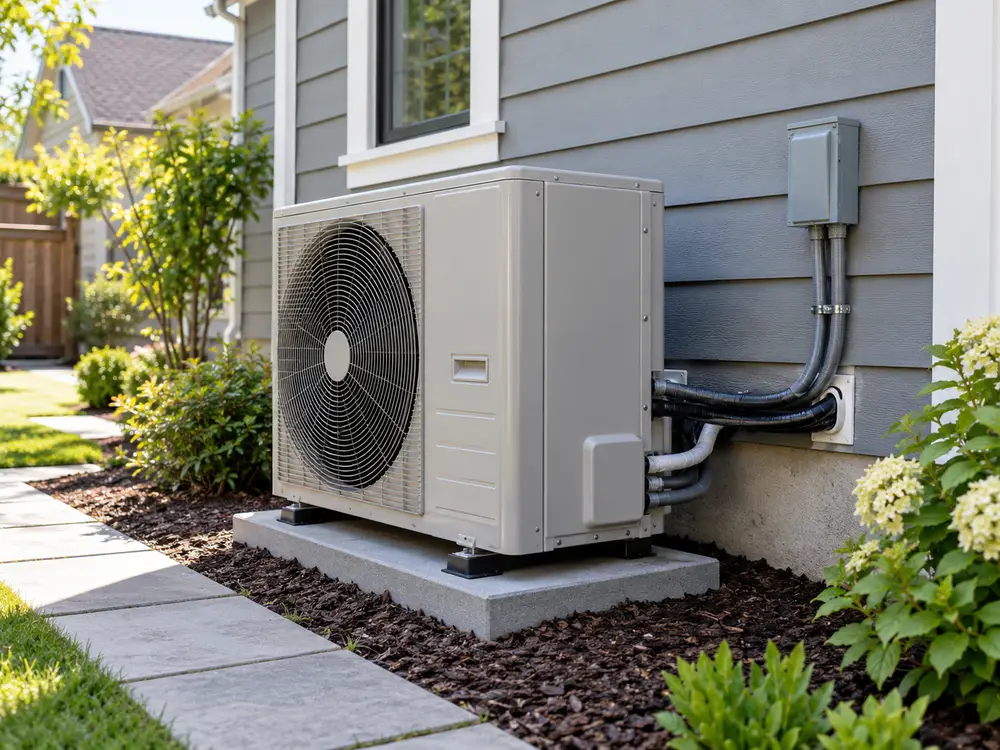
Many R290 air-to-water heat pumps use an outdoor monobloc design. The refrigerant stays inside the outdoor unit, while water pipes carry heat to the building. This can avoid running refrigerant pipes indoors, although the outdoor location still needs to meet the model’s safety instructions.
Keeping the refrigerant circuit outdoors can avoid refrigerant piping through occupied rooms, but it does not remove outdoor propane-leak risks. If an outdoor monobloc has water-filled pipes or components exposed to freezing weather, a power outage or loss of circulation may allow freezing and damage. Check the exact model’s permitted freeze-protection method, exposed pipework and power-outage conditions; a control that needs electrical power cannot be assumed to protect the circuit when that power is lost.
“Outdoor monobloc” describes where the refrigerant circuit is located; it is not a universal installation clearance. Check the selected model’s refrigerant charge, exclusion zones, allowable nearby openings and drainage conditions in that model’s installation manual. Different products may need different safeguards. For general siting, airflow and defrost-drainage checks, use the air-source heat pump installation guide; the exact R290 model manual still controls its refrigerant safety-zone requirements.

Check the safety standard and market approvals for the exact unit. IEC 60335-2-40 contains safety requirements for heat pumps and air conditioners using refrigerants in classes A1, A2L, A2 and A3. Local rules may also cover building location, fire safety, electrical work and pressure equipment. A standard’s existence does not prove that a particular unit is certified.
The exact product may also use safety features such as refrigerant compartment design, leak detection, ventilation, shut-off control or protected electrical parts. The exact solution depends on the product. We do not treat a general “R290 ready” statement as proof that a unit is right for your site.

Installer and service skills matter too. Charging, refrigerant recovery, leak testing, pressure work and final commissioning should follow the manufacturer’s instructions and local rules. Our position is simple: R290 should not be rejected only because it is flammable, but it should not be approved only because its GWP is very low.
What Information Should You Compare in an R290 Heat Pump Datasheet?
For each R290 model, check its refrigerant charge and installation rules first. Then compare the heating output and coefficient of performance (COP)—the heat delivered for each unit of electricity used—at the outdoor and water temperatures your project needs. Also check water flow, power supply, noise and market documents. A model’s nominal output or highest water temperature does not prove its performance in winter.
A product page can show the refrigerant and general equipment type. For an exact model, check refrigerant charge, winter design-point heating output, installation instructions and documents required for the destination market. Product-page summaries cannot replace those model-specific records.
| What to check | Why it matters |
|---|---|
| Refrigerant charge and installation information | Shows whether the proposed site meets the exact model’s R290 installation restrictions. |
| Heating output and COP at the required outdoor and water temperatures | Shows whether heating output at the design condition is sufficient. Nominal capacity alone is not enough. |
| Water temperature, flow and electrical requirements | Shows whether the heat pump can connect properly to the planned system. Check the model’s required water flow against the planned pipework resistance and available pump head; nominal heating capacity alone does not confirm adequate flow. |
| Operating and sound limits | Shows how climate, location and project noise restrictions affect equipment suitability. |
Three figures answer different questions. Rated output describes performance at a stated test point. Design-point output shows what the model can deliver at your required outdoor and leaving-water temperatures. Actual system performance can change again with defrost cycles, water flow, control settings, backup heat and installation quality. Check the published operating-point data first; do not infer seasonal results from a single rating. When comparing published COP values, confirm the same outdoor and heating-water temperatures, the stated test method and which electrical inputs are included. Depending on the reported boundary, circulation pumps or auxiliary heating may add electricity use that is not represented by a single catalogue COP.
A single published heating-output point does not prove that the same heat reaches the building throughout defrost periods. If the site can experience frosting conditions, check the exact model’s defrost information and the system’s heat-delivery strategy against the building load, required water temperature and any backup-heating controls. If those documents do not establish adequate heat delivery for the design, keep the model choice provisional.

What Is Changing in R290 Regulation and Market Use?
EU rules are restricting certain fluorinated refrigerants in stages, with different dates and conditions for different equipment types. This is one reason more projects are considering low-GWP R290. But R290 is flammable, so you still need to check whether the exact unit and installation meet your country’s rules.

In the EU, Regulation 2024/573 introduces staged restrictions on fluorinated greenhouse gases in stationary air-conditioning and heat pumps. R290 is not an F-gas. For a specific product, identify the equipment category, the date its placing-on-the-market rule applies, and any conditions or exceptions in that provision. Low GWP alone does not prove that a unit has the required product approvals, may be installed at the proposed site or will achieve a stated heating performance.
Fraunhofer ISE reported R290 concepts for multi-family buildings in 2026, covering design heating loads of 23–93 kW. That research does not prove a particular Airproz unit has the same capacity or is approved for every market. IEA Heat Pumping Technologies Project 64 also examines the safe use of flammable refrigerants. For U.S. projects, check the specific EPA SNAP application and conditions.
How to Choose an R290 Heat Pump for Your Project
If you are assessing an R290 heat pump rather than only its GWP, start with the building’s winter design heat load and the heating-water temperature it needs. Compare the exact model’s published output at those conditions, then check its A3 siting limits, electrical supply, defrost, controls and destination-market documents. These project conditions affect equipment suitability, not R290’s GWP.
- Where will the heat pump be used? Confirm the destination country, equipment category and relevant market rules. These determine the GWP reporting basis and documents required.
- How much heat is needed on a cold winter day? Record the outdoor design temperature, required heating-water temperature and heating capacity at those conditions. A catalogue rating measured at a different point may not be enough.
- Which product family fits the job? Compare the refrigerant circuit, equipment type, refrigerant charge and published model data.
- Is the installation location suitable? Check nearby openings, pits, drains, low areas, service access and ignition sources against the exact model’s installation instructions.
- Will the unit work with the rest of the system? Compare the power supply, water-side design, sound limits, defrost behavior, controls and service access.
- Can a specific model be confirmed? First compare its tested output at the required temperatures and the market documents that apply to it. If key information is missing, keep the choice provisional.
When the building needs higher water temperatures in colder weather, check the model’s heating output and electrical demand at those conditions. Defrost, backup heat and control settings may also affect the system’s demand on the power supply and the heat actually delivered. Confirm the supply limits and relevant control requirements from the model data and the installation design; do not size electrical equipment from nominal heating kW alone.

Common Mistakes When Choosing an R290 Heat Pump
Common mistakes include using one R290 GWP number for every country, treating low GWP as proof of fire safety, and choosing a heat pump from its advertised kW or maximum water temperature alone. Check the relevant reporting rule, the unit’s installation requirements and its actual winter heating output.
| Common mistake | What you should do instead |
|---|---|
| “R290 GWP is always 3.” | Check the source. EU rules show 0.02; EPA Technology Transitions shows 3.3; a SNAP listing shows 3. |
| “R290 GWP is always 0.02.” | Do not use the EU Annex VI value in a different regulatory calculation unless that method requires it. |
| “Low GWP means low safety risk.” | Treat climate impact and flammability as separate issues. |
| “Outdoor installation removes the risk.” | Still check doors, windows, drains, pits, low areas and possible ignition sources. |
| “A 20 kW model gives 20 kW everywhere.” | Check heating capacity at your outdoor design temperature and required water temperature. |
| “75°C maximum heating-water temperature means full heating output at 75°C.” | Maximum leaving-water temperature is not a promise of full capacity or COP at that temperature. |
“R290 + kW” Is Not a Complete Heat-Pump Specification
“R290 + 20 kW” is not enough to choose an exact model. You also need the outdoor winter design temperature, heating-water temperature and required output at those conditions. The electrical supply, site safety requirements and destination market can change which unit is suitable.
If a cold design day coincides with a high heating-water temperature and a high building heat load, a nominal 20 kW label is not enough to prove the unit will meet demand. Compare the model’s output at that exact operating point with the calculated load, then check defrost and any required backup heat. If the documented output is insufficient, the system design or candidate model needs to change.
You can also compare refrigerants in our R290 vs R32 guide and review EU market context in our R290 EU advantages guide.

What Information Is Needed to Check an R290 Heat Pump?
The data needed for an R290 GWP claim are the reporting program, reference edition and refrigerant identity. Checking a specific heat pump requires different information: the winter design heat load, outdoor and heating-water temperatures, power supply and site constraints. None of these project conditions changes the refrigerant’s GWP value.
Useful project information to record:If an exact model is being reviewed, record the following technical inputs and compare them with the model’s published specifications and installation instructions. Unit quantity and delivery timing are optional project-planning details for a later enquiry, not technical inputs to the GWP calculation.
- destination country and applicable equipment market;
- building application and heating capacity needed at the design condition;
- outdoor winter design temperature and required leaving-water temperature;
- available electrical supply;
- proposed installation area, nearby openings, pits, drains and confined low spaces;
- noise limits, if relevant to the project;
- site drawings or photos showing equipment placement constraints.
Which Documents Should You Check Before Selecting an R290 Heat Pump?
Check the model’s heating output and efficiency at your design temperatures, refrigerant charge and installation limits, water and electrical requirements, noise data and destination-market documents. When reviewing piping or control drawings, a heat pump schematic diagram can help distinguish the refrigerant loop, water-side connections and electrical controls. Use the exact model’s installation manual to confirm the actual layout. A model choice remains provisional until the necessary evidence has been checked.
| What to check | Why it matters |
|---|---|
| Equipment type and candidate model family | Compare system architecture and application fit before identifying an exact model. |
| Heating output at the required design condition | Catalogue nominal capacity may differ from delivered heating output at the outdoor and water temperatures your project needs. |
| COP and other comparable test results | Compare efficiency at stated operating points rather than treating a rated COP as year-round performance. |
| Required and maximum heating-water temperatures | A maximum water-temperature figure is not a guarantee of full heating capacity or COP at that temperature. |
| Refrigerant charge and installation instructions | Verify the installation area, allowable siting conditions and R290 safety restrictions for the exact model. |
| Electrical, sound and water-side requirements | Check whether the unit can connect to the planned system and meet site noise and service requirements. |
| Destination-market product documents | Check applicable declarations, product category and regulatory requirements without assuming market approval. |
| Outstanding information before model selection | Identify missing design-point output, site or compliance evidence before treating a model as confirmed. |
| Confidence in the model choice | Distinguish a possible equipment type from a shortlisted or confirmed model; confidence depends on the completeness of verified documents. |

Frequently Asked Questions
Is R290 the same as propane?
Yes. R290 is the refrigerant designation for propane that meets refrigeration-grade purity requirements. Do not replace it with ordinary fuel propane.
Is R290 safer than R32?
Not for every type of risk. R32 is A2L and less flammable than A3-rated R290, while R290 has much lower direct GWP. Compare the complete equipment, required performance, local rules and installation location before choosing.
Does R290 GWP tell you which heat pump to choose?
No. R290 GWP describes the direct warming potential of released refrigerant under a specified reference; it does not rate a heat pump’s heating output, efficiency or installation safety. For a specific model, check performance at the building’s design temperatures, the refrigerant charge, A3 installation instructions and electrical requirements.
R290 GWP: What to Remember
R290 has very low direct GWP, but the value to report depends on the required reference: 0.02, 3 or 3.3 in the cited EU and U.S. tables. Its A3 flammability must be assessed separately. The refrigerant’s GWP does not measure a heat pump’s electricity use or lifetime emissions. Before choosing a model, compare actual operating-point performance and the safety and market requirements for the exact installation.
What to do next: For a GWP claim, record the exact official reference and reporting purpose before using the number in a document. For a whole-system environmental claim, compare refrigerant leakage assumptions and seasonal electricity use under the same climate and calculation method. For a proposed installation, have a qualified installer check the exact model’s safety instructions against the site conditions.
Questions About an R290 Heat Pump?
If you have a specific heating project, Airproz’s contact page is available for questions about the listed R290 product options. A final model choice still needs the right design-point performance and installation and market documents.
For a project enquiry, share the destination country and application, expected heating load on the coldest design day, required water temperature and any relevant power or site constraints. Quantity, timing and drawings can be added when available.
Related Airproz product pages: R290 monobloc space-heating heat pumps and R290 commercial heating/cooling heat pumps. Published product descriptions are not substitutes for exact-model documentation or local approvals.