EU regulators are accelerating the phase-out of high-GWP refrigerants, and distributors are scrambling to find compliant alternatives before 2026 deadlines hit. Understanding the R290 heat pump advantages EU 2026 regulations are pushing toward helps buyers make confident sourcing decisions now, rather than facing supply gaps later. This guide covers why R290 has become the go-to refrigerant for European heat pump water heaters, how it stacks up against R32, and what to check before choosing a manufacturer.
R290 Heat Pump Advantages EU 2026: What’s Driving the Shift
The push toward R290 isn’t happening in isolation — it’s the direct result of regulatory pressure, efficiency demands, and a maturing supply chain across Europe. For B2B buyers, recognizing the R290 heat pump advantages EU 2026 standards are built around makes it easier to evaluate which units are worth specifying now versus which may face compliance issues within the next product cycle.
Low GWP and EU F-Gas Regulation Requirements
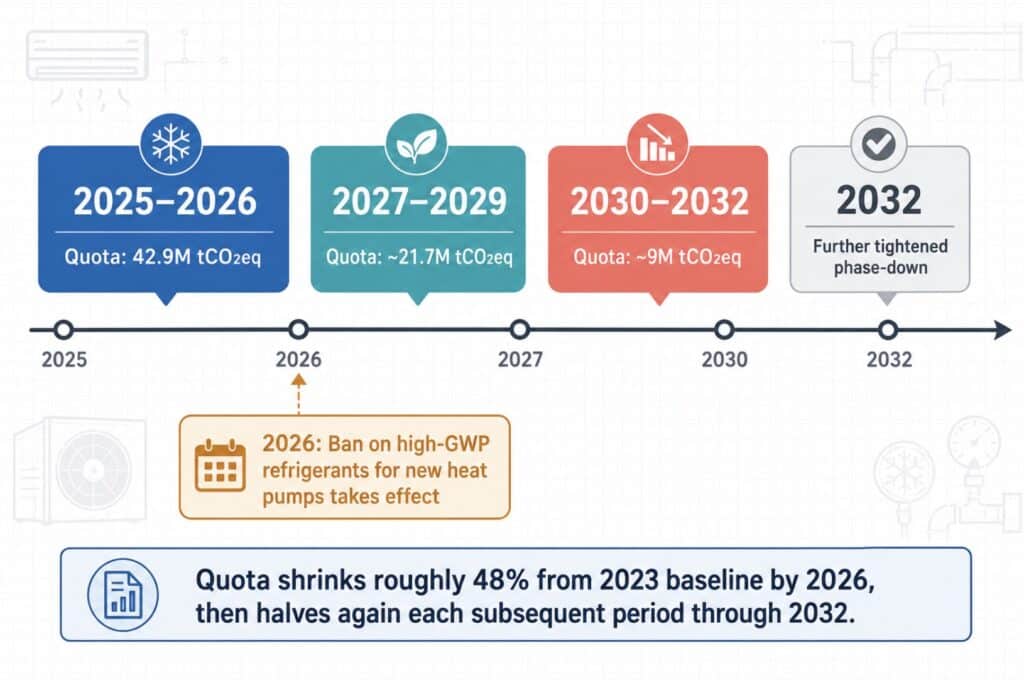
R290 (propane) has a Global Warming Potential of just 3, compared to over 2,000 for many legacy refrigerants still found in older heat pump water heater models. The EU’s revised F-Gas Regulation (EU) 2024/573 entered into force in March 2024 and progressively reduces quotas for HFCs through a multi-year phase-down schedule, with total quotas roughly halving again for the 2027-2029 period. For distributors and engineering firms, this means units relying on R32 or R410A may face shrinking availability and rising costs as manufacturers shift production toward R290-based systems. Specifying R290 now isn’t just about environmental compliance — it’s a way to future-proof procurement against tightening import quotas and potential phase-down penalties.
OEM sourcing strategy for compliant heat pump systems
Energy Efficiency Gains with Propane-Based Systems
Beyond regulatory compliance, R290 delivers measurable performance benefits. Propane’s thermodynamic properties allow heat pump water heaters to achieve higher COP (Coefficient of Performance) ratings, particularly in mid-to-low ambient temperatures common across Northern and Central Europe. This translates directly into lower operating costs for end users — a key selling point when positioning R290 units to commercial clients focused on long-term ROI. Combined with the regulatory tailwinds above, the efficiency gains reinforce why R290 is becoming the default specification for new EU installations rather than a niche alternative.
Understanding the EU’s Heat Pump Refrigerant Phase-Out Timeline
For distributors planning product lines two or three years out, regulatory dates matter as much as technical specs. A clear heat pump refrigerant phase out 2026 guide helps separate near-term obligations from longer-term planning, so sourcing decisions made today don’t become liabilities once new quota thresholds take effect.
Key Compliance Deadlines Distributors Should Track
Under Regulation (EU) 2024/573, the F-gas quota for 2025-2026 is set at roughly 42.9 million tonnes CO2eq, representing a 48% reduction from 2023 levels. For the following period, 2027-2029, the total available quota will be halved again to about 21.7 million tonnes CO2eq. A specific ban on high-GWP refrigerants (GWP ≥ 2,500) for air conditioning and heat pump equipment takes effect in 2026, with a limited derogation for reclaimed or recycled gases extending to 2032.
For B2B buyers, this means 2026 isn’t a single cutoff date — it’s the start of a steeper quota curve that will continue tightening through 2030. Distributors stocking R32-based systems should treat 2026-2027 as the window to transition product lines, rather than waiting for a hard deadline that, in practice, arrives gradually through shrinking supply and rising costs.
What Happens to Existing R32 Inventory?
Existing R32 equipment already placed on the market isn’t immediately banned from use — the phase-down primarily restricts new placement on the market and servicing options going forward. However, the new regulation also restricts the use of virgin high-GWP refrigerants for servicing and maintenance of existing systems starting in 2025, with only reclaimed or recycled gases permitted under derogation. In practice, this means R32 inventory already in distribution channels can still be sold and installed in the near term, but maintenance contracts and spare parts strategies should account for shrinking access to virgin refrigerant for servicing.
For OEM brands and distributors, this creates a practical transition strategy: continue moving existing R32 inventory through standard sales channels while shifting new product development and reordering toward R290-based platforms — avoiding stranded stock while aligning future catalogs with the post-2027 quota environment.
EU F-gas Portal and quota system
R290 vs R32: A Side-by-Side Comparison for EU Buyers
Choosing between refrigerants isn’t just a technical detail — it directly affects compliance timelines, installation costs, and long-term product positioning. A practical R32 vs R290 heat pump water heater comparison helps distributors and engineering firms weigh near-term affordability against long-term regulatory alignment.
R290 (Propane)
- GWP: ≈3 (very low)
- Efficiency: Higher than R32, especially in cold climates, stable down to -20°C
- Safety: A3 (flammable) — needs leak detectors, limited charge, proper ventilation
- Installation: More complex, requires sealed components + safety hardware (IEC 60335-2-40)
- Cost: Higher upfront, but immune to future phase-down costs
- EU Outlook: Already meets 2026’s GWP <150 requirement
R32
- GWP: ≈675 (moderate)
- Efficiency: COP 3-5 in moderate/warm climates
- Safety: A2L (mildly flammable) — easier to install
- Installation: Compatible with existing R410A production lines
- Cost: More affordable today
- EU Outlook: Compliant now, but facing tightening quotas
For EU buyers, the table above highlights a clear trade-off: R32 offers a lower entry cost and simpler installation today, while R290 positions product lines for the stricter GWP thresholds taking effect from 2026 onward. Distributors serving Northern European markets — where cold-climate performance matters most — will find R290’s efficiency advantage particularly compelling, as it maintains efficiency even at -20°C, where many heat pumps struggle.
how to choose the right manufacturer
How R290 Heat Pump Advantages EU 2026 Translate to Buyer Decisions
Specifications on paper only matter if they translate into outcomes that matter to end customers — lower bills, reliable performance, and systems that don’t need replacing when regulations shift again. Understanding R290 heat pump advantages EU 2026 standards favor isn’t just a compliance exercise; it directly shapes which products move faster through distribution channels and which installations generate fewer callbacks.
Performance in Cold Climate Conditions
For markets across Northern and Central Europe, winter performance is often the deciding factor in product selection. R290’s thermodynamic properties allow it to maintain stable heating output and higher COP even as outdoor temperatures drop well below freezing — a scenario where many conventional systems see efficiency drop sharply. For distributors serving Scandinavia, the Baltics, or Alpine regions, this cold-weather reliability reduces the risk of underperformance complaints and supports stronger seasonal coefficient of performance (SCOP) ratings used in EU energy labeling.
This is also where R290 differentiates itself most clearly from R32 in practical terms: the efficiency gap widens as temperatures fall, making R290 units a stronger fit for any project where winter heating load is a primary design consideration.
Suitability for Residential vs Commercial Applications
R290 heat pump water heaters aren’t a one-size-fits-all product — their suitability depends heavily on installation context. For residential applications, compact R290 units are increasingly viable as manufacturers adopt the safety measures required under A3 classification, including hermetically sealed components and limited refrigerant charge volumes that keep installations within safe limits for enclosed spaces.
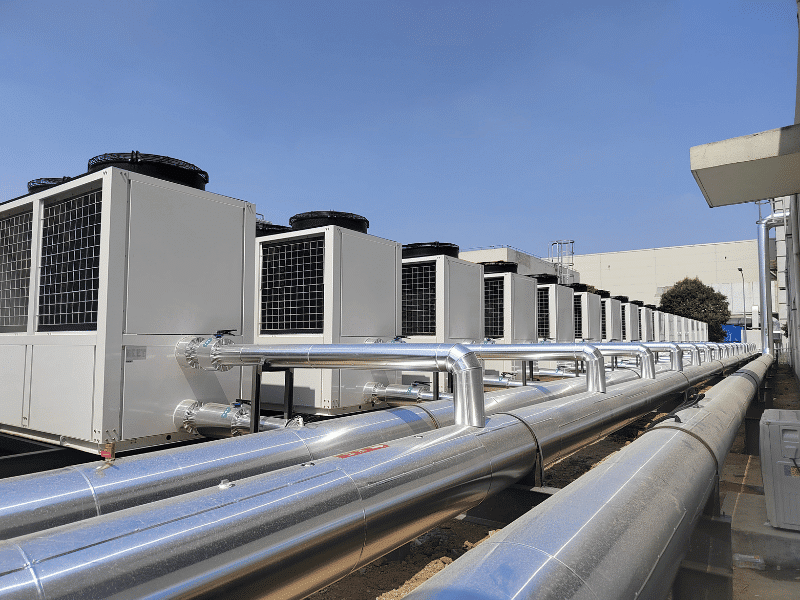
commercial heat pump water heater for hotel
For commercial applications — hotels, multi-unit residential buildings, or facilities with higher hot water demand — the calculus shifts. Larger systems require more refrigerant charge, which means safety infrastructure (ventilation, leak detection, outdoor placement) becomes a more significant part of the installation cost. This doesn’t make R290 unsuitable for commercial use, but it does mean distributors should position residential-scale R290 units differently from commercial-scale specifications, and engineering firms should factor safety infrastructure into project quotes from the outset.
Choosing an R290 Heat Pump Water Heater Manufacturer EU Buyers Can Trust
Technical specifications only matter if the supplier behind them can deliver consistent quality, certification, and support at scale. For distributors and OEM brands, finding an R290 heat pump water heater manufacturer EU regulations require — one that combines compliance documentation with production flexibility — is often the difference between a smooth product launch and months of compliance delays.
CE Certification and Safety Standards Checklist
Before finalizing any sourcing agreement, distributors should confirm that potential suppliers can provide complete documentation for CE certified heat pump water heater units — not just a certificate, but the underlying test reports and technical files that EU market surveillance authorities may request.
A practical checklist should include:
- CE Declaration of Conformity covering the specific model and refrigerant charge
- EN 60335 series compliance (household and similar electrical appliance safety)
- IEC 60335-2-40 compliance for the A3 refrigerant safety requirements specific to R290 systems
- Energy labeling documentation aligned with EU energy efficiency requirements (ERP/SCOP data)
- F-Gas Regulation compliance records, confirming refrigerant sourcing and reporting obligations under Regulation (EU) 2024/573
- Factory audit reports or third-party quality inspection records, particularly important for OEM partnerships where consistency across production batches matter
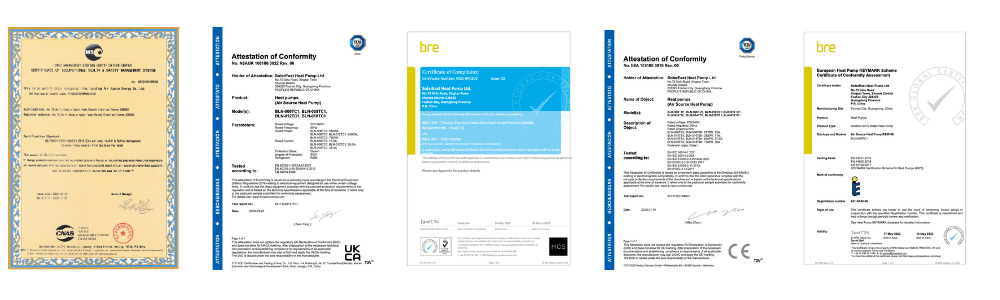
Suppliers who can readily produce this documentation — rather than promising to “arrange it later” — are generally a stronger long-term fit, especially for buyers who will need to pass this documentation downstream to installers or end clients.
OEM and Private Label Options for Growing Product Lines
For distributors and brand owners looking to expand their EU product catalog without building manufacturing capacity from scratch, OEM and private label arrangements offer a practical path forward. A manufacturer capable of supporting private label heat pump water heater programs typically provides flexibility across branding, packaging, and documentation — allowing buyers to bring R290 units to market under their own brand while leveraging the manufacturer’s certification and production infrastructure.
When evaluating OEM partners, key questions include: Can the manufacturer support custom branding on both the unit and packaging? Are minimum order quantities (MOQs) realistic for your market size? Can technical documentation (manuals, CE files, energy labels) be issued under your brand name where required? And critically — does the manufacturer have an established track record producing R290 units specifically, rather than adapting R32 production lines on short notice?
For a broader framework on evaluating manufacturers across these criteria — certification, OEM flexibility, MOQ structures, and after-sales support — see our B2B heat pump manufacturer buying guide.
FAQ
What makes R290 a preferred refrigerant for EU heat pump water heaters?
R290 (propane) has a GWP of just 3, far below R32’s ~675, putting it well within the GWP limits the EU is introducing for new heat pumps from 2026. Combined with strong cold-climate efficiency, this makes R290 a forward-compatible choice as R290 heat pump advantages EU 2026 regulations take fuller effect, rather than a refrigerant that may need replacing again within a few years.
Is CE certification mandatory for R290 units in the EU?
Yes. Any heat pump water heater placed on the EU market — regardless of refrigerant type — must carry CE marking backed by a valid Declaration of Conformity. For CE certified heat pump water heater units using R290 specifically, this also includes compliance with IEC 60335-2-40 for A3 refrigerant safety requirements, in addition to standard electrical and energy labeling documentation.
How does R290 compare to R32 in terms of safety and efficiency?
In a typical R32 vs R290 heat pump water heater comparison, R32 is classified A2L (mildly flammable) and is generally easier to install with fewer safety modifications, while R290 is classified A3 (highly flammable) and requires leak detectors, ventilation, and limited refrigerant charge. On efficiency, R290 generally outperforms R32 in colder ambient conditions, with the performance gap widening as temperatures drop.
When does the EU refrigerant phase-out fully take effect?
There isn’t a single cutoff date — the heat pump refrigerant phase out 2026 guide timeline involves a 2026 ban on high-GWP refrigerants (GWP ≥ 2,500) for new air conditioning and heat pump equipment, followed by progressively shrinking F-gas quotas through 2027-2029 and again through 2030-2032 under Regulation (EU) 2024/573. For distributors, this means 2026 marks the start of accelerating restrictions rather than a final deadline.
Sourcing R290 heat pump water heaters for the EU market? Contact Airproz for CE-certified specs, technical datasheets, and OEM partnership options.