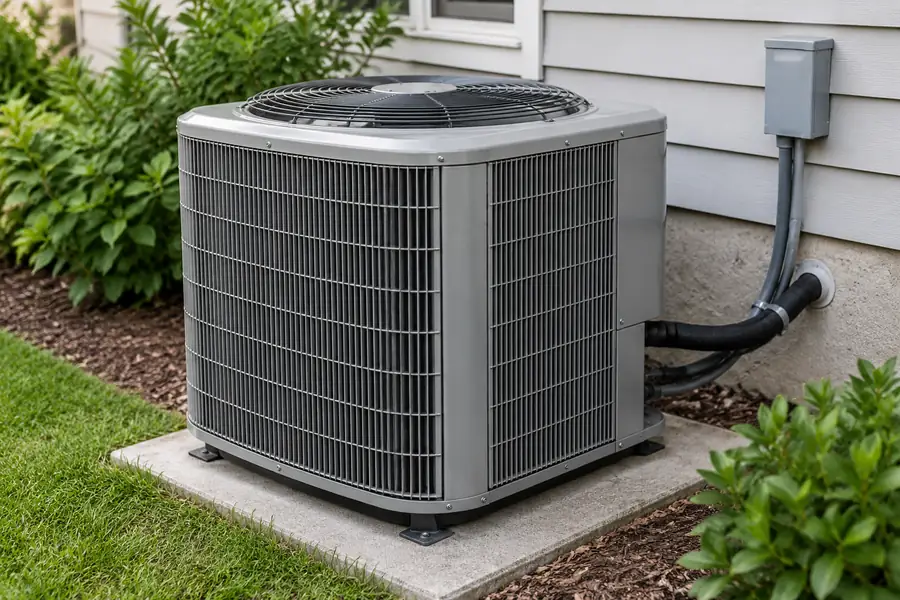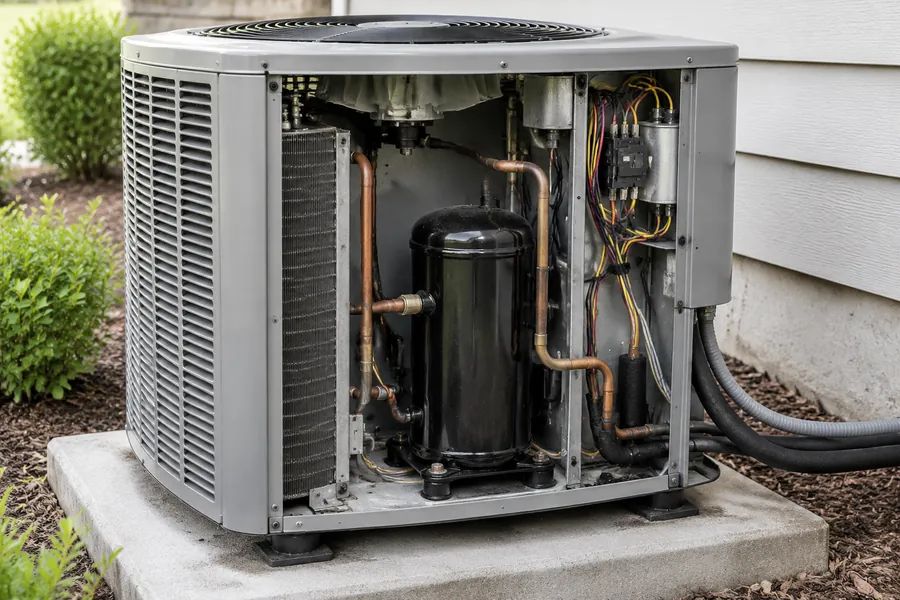
For many new residential and light-commercial comfort HVAC systems, a scroll compressor is a strong starting choice because its compression process is smoother and suitable models can support efficient system designs. Consider a reciprocating compressor when its approved operating conditions, an existing plant or a serviceable semi-hermetic design make it the better fit. Compare exact equipment models for energy efficiency, installed noise and service requirements at the same operating conditions, then confirm the performance of the complete air conditioner or heat pump.
In this guide, scroll compressor vs reciprocating compressor means a comparison of the compression mechanism, not a comparison of “inverter” versus “non-inverter.” Both compressor families have different motor, capacity-control and enclosure options. You will find a quick decision table, an explanation of the parts, a fair efficiency comparison, specification requirements and a replacement procedure.
Scroll vs Reciprocating Compressor: Quick Comparison
Choose a scroll as an initial option for many comfort-cooling systems; shortlist a reciprocating model when pressure/temperature duty or internal repair access makes the piston design more suitable. The manufacturer’s approved envelope and measured equipment performance determine the final selection.
Swipe the table horizontally to view all columns.
| Decision factor | Scroll compressor | Reciprocating compressor | Evidence to check before selecting |
|---|---|---|---|
| Mechanical process | Two interleaved scroll elements form shrinking refrigerant pockets | One or more pistons compress vapor through suction and discharge valves | Compressor model and permitted refrigerant |
| Vibration and pulsation | Generally smooth compression and lower pressure pulsation | Cyclic pressure pulses; multi-cylinder designs and mounts change the result | Complete-unit sound power or comparable sound pressure with rating conditions |
| Main internal losses | Scroll leakage; off-design over/under-compression; mechanical losses | Clearance-gas re-expansion; valve pressure drop/leakage; friction | Delivered capacity and measured input power at matching duty points |
| Capacity control | Fixed speed, staging, digital scroll and purpose-built variable speed | Fixed speed, cylinder unloading on suitable models, staging and purpose-built variable speed | Part-load capacity/input data, minimum stable output, cycling and oil return |
| Maintenance | Many HVAC types are sealed hermetic and replaced as an assembly | Hermetic types are also sealed; semi-hermetic models may be internally serviced | Hermetic/semi-hermetic construction, parts access, service and downtime plan |
| Typical fit | Residential/light-commercial AC, rooftop systems, heat pumps, some chillers | Selected HVAC, refrigeration and existing serviceable plants | Refrigerant, temperature range, controls, uptime priorities |
| Air conditioner price | No reliable type-only premium | No reliable type-only discount | Complete installed system quotation and operating-cost assumptions |
For a split air conditioner, first identify the actual compressor in its technical specification. Many small wall-mounted splits use a rotary compressor rather than either of these two designs. A product described as an inverter split AC tells you how output is controlled, not whether its compressor is scroll, reciprocating or rotary. For a broader family overview, read our HVAC compressor types guide.
Fast choice by application
- New comfort AC or a compact rooftop unit: start with the scroll options approved for your refrigerant and design ambient, then verify seasonal efficiency and sound of the complete unit.
- Air-source heat pump: scroll may fit well, but compare heating output and COP at the coldest design condition and required supply temperature; vapor injection is a model-specific feature.
- Older semi-hermetic commercial plant: check whether cylinder unloading, stocked valve parts and accessible internal repairs justify retaining reciprocating technology.
- Noise-sensitive hotel or residential project: shortlist a well-isolated scroll-based unit, then demand measured outdoor and indoor unit sound data.
- Direct compressor replacement: match the duty point, electrical system, controls, refrigerant and piping—not just horsepower or nominal tons.
Use the comparison to shortlist suitable compressors, then confirm capacity, efficiency and operating limits using the exact model specifications and the decision table below.
How Do Scroll and Reciprocating Compressors Work?
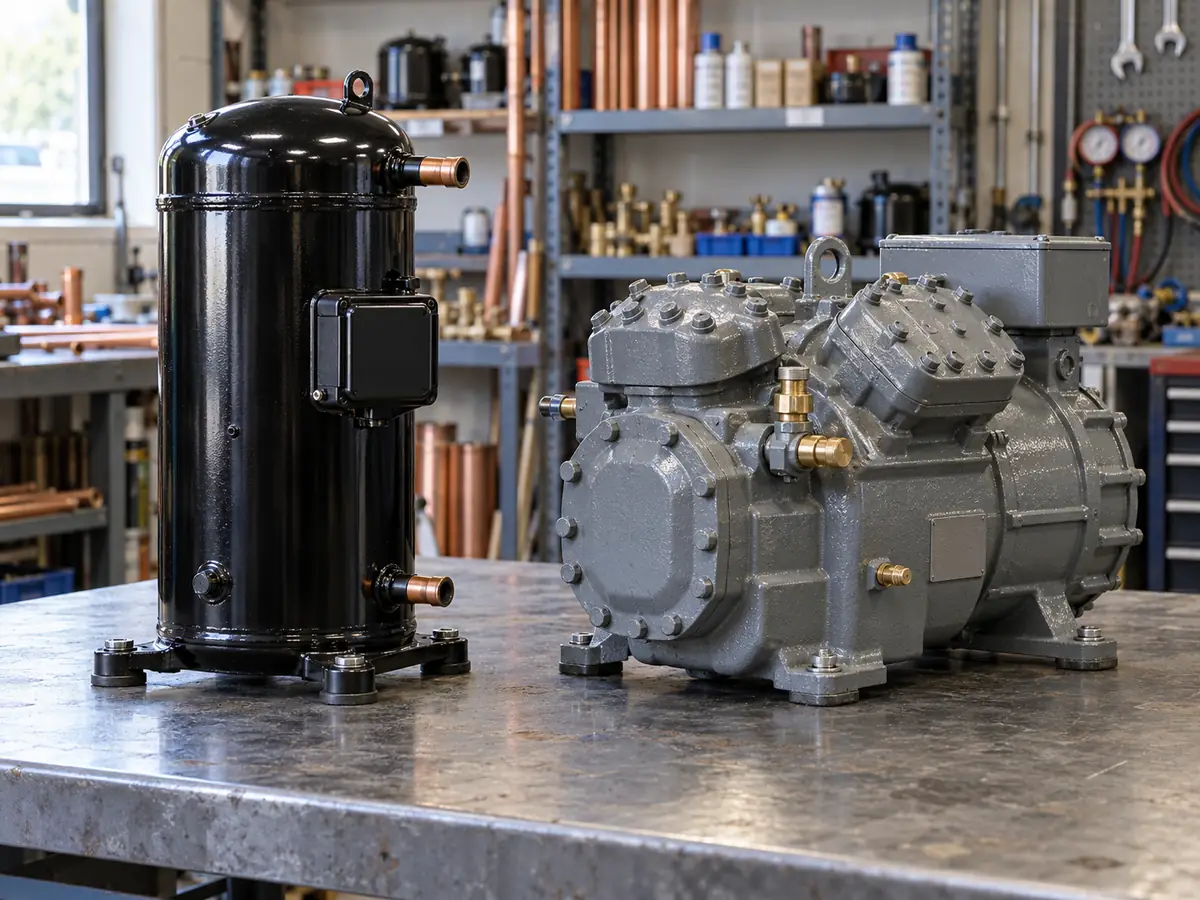
A scroll compressor traps refrigerant vapor between a fixed spiral and an orbiting spiral, then compresses it as the pockets move inward and become smaller. A reciprocating compressor moves a piston inside a cylinder to draw vapor through a suction valve and discharge it after compression. Both are positive-displacement designs, but their different moving parts create different pulsation, mechanical-loss and service characteristics.
Scroll compressor working principle and parts
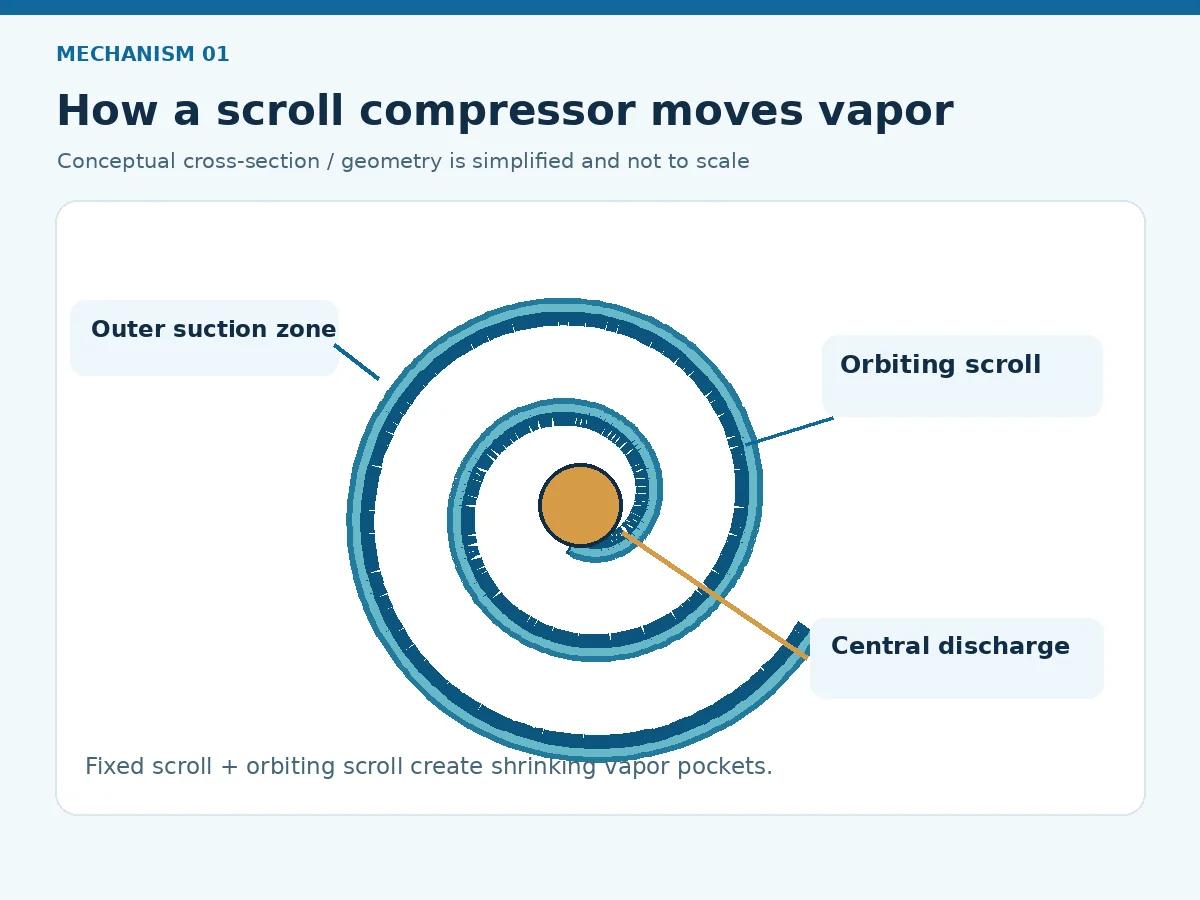
A scroll compressor has a fixed scroll and an orbiting scroll. The moving scroll travels around a small orbit without spinning around its own axis. Refrigerant enters near the outside, forms sealed pockets and moves toward the central discharge as pocket volume decreases. An electric motor, crankshaft/eccentric drive, bearings and oil system support the motion. The exact construction may also contain an internal check valve, discharge-temperature protection or special injection features, depending on the model.
Its flow is comparatively smooth. A conventional scroll avoids piston clearance-gas re-expansion and conventional cylinder suction valves, while its efficiency and service performance depend on scroll geometry, internal leakage, friction, lubrication, motor design and operating conditions.
Reciprocating compressor working principle and parts
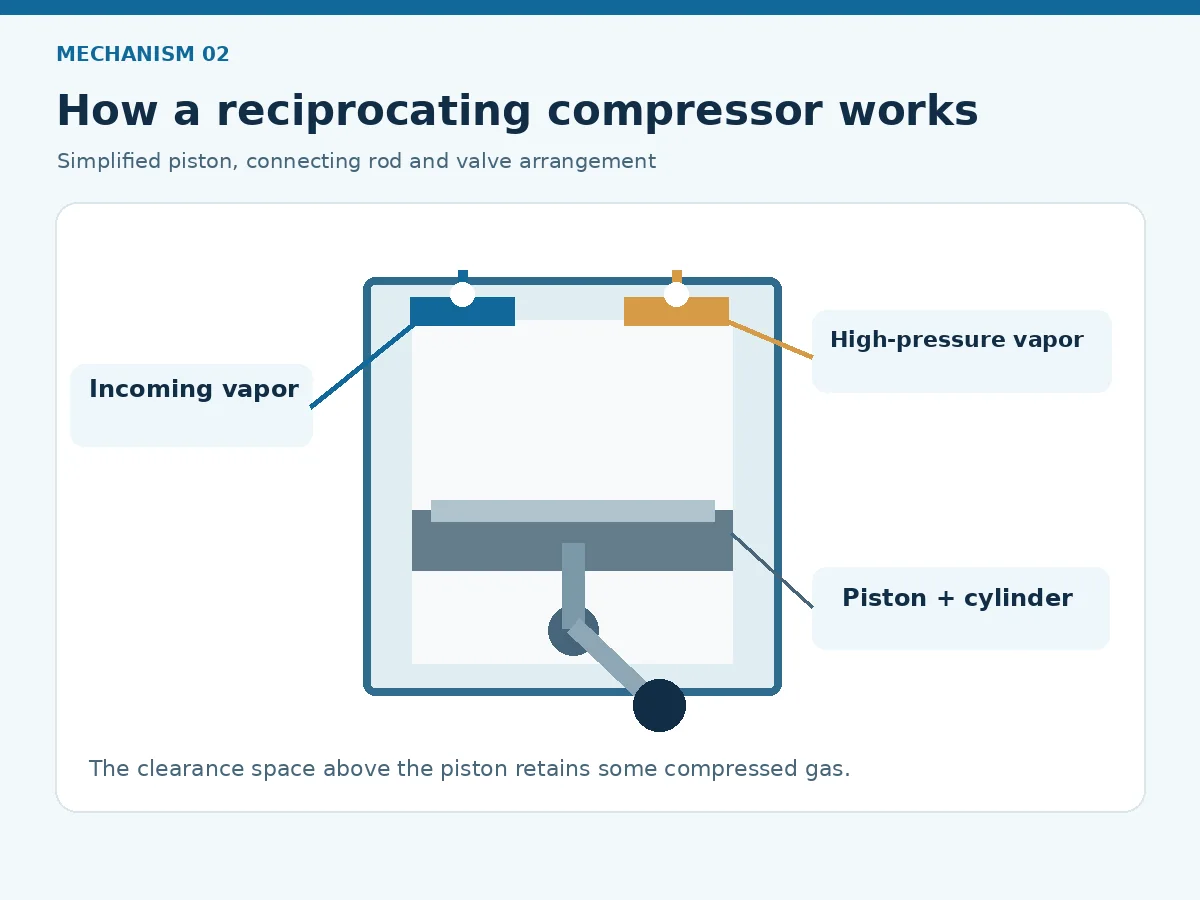
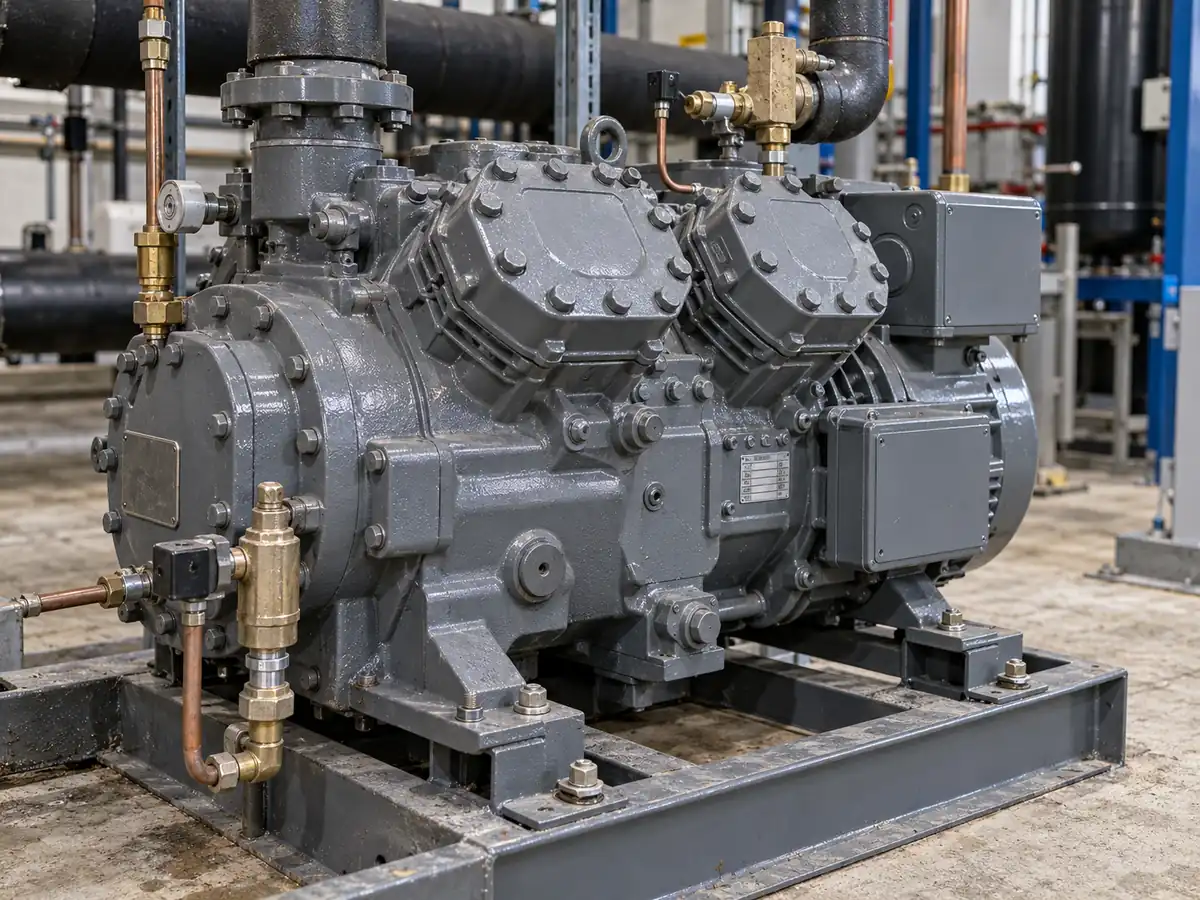
A reciprocating compressor uses a crankshaft, connecting rod, piston, cylinder and suction/discharge valves. On the suction stroke the pressure drop admits refrigerant vapor; on the compression stroke the piston raises its pressure until the discharge valve opens. The clearance space above the piston retains some compressed gas, which expands on the next stroke and reduces the amount of fresh vapor admitted. Valve pressure losses and wear also matter.
Some reciprocating designs use multiple cylinders and capacity-unloading controls. A fully sealed reciprocating compressor cannot be rebuilt simply because it contains pistons. A semi-hermetic model with an accessible bolted casing may allow internal service; a hermetic model normally does not.
Why the mechanisms affect efficiency: piston clearance-gas re-expansion and valve pressure losses differ from scroll leakage and over- or under-compression away from the scroll’s designed internal volume ratio. The dominant losses at the required pressure ratio and speed determine the input power of each specific design.
Compressor type, inverter control and casing are three different questions
Swipe the table horizontally to view all columns.
| Question | Examples | Why it matters |
|---|---|---|
| What compresses the vapor? | Scrolls, pistons or a rolling-piston rotary element | Mechanical process, pulsation and potential losses |
| How is capacity controlled? | Fixed speed, staged compressors, digital modulation, approved variable speed | Part-load behavior, lowest stable capacity and cycling |
| Can the casing be opened? | Hermetic versus semi-hermetic construction | Repair access, replacement strategy and downtime |
Inverter control adjusts speed in approved variable-speed systems; motor speed, fans, mounting, refrigerant piping and outdoor-unit panels determine the installed sound performance.
Which Is More Energy Efficient in HVAC?
Scroll compressors are often more energy-efficient than conventional single-stage reciprocating designs in comparable residential and light-commercial comfort-cooling applications, particularly near their intended design conditions. Their compression process avoids piston clearance-gas re-expansion and conventional suction-valve losses. Reciprocating designs can be competitive or more suitable at particular pressure ratios or in specialized multi-stage duties. For purchasing decisions, compare the two actual models at the same refrigerant conditions, delivered capacity and electrical input.
Match these specifications before comparing efficiency
| Required matching data | Why a mismatch makes the result misleading |
|---|---|
| Refrigerant and lubricant | Fluid properties and approved application limits differ |
| Evaporating saturation temperature / suction condition | Sets suction pressure, density, mass flow and required lift |
| Condensing saturation temperature / discharge condition | Sets required pressure rise and discharge-temperature stress |
| Suction superheat and, where relevant, liquid subcooling | Affect the rating basis and delivered refrigerating capacity |
| Useful cooling or heating capacity at the point | Makes sure both options deliver a comparable load |
| Compressor power input and auxiliary/whole-unit power | Differentiate compressor efficiency from complete-system efficiency |
| Speed, controls, outdoor condition and load fraction | Determine how equipment behaves during part-load operation |
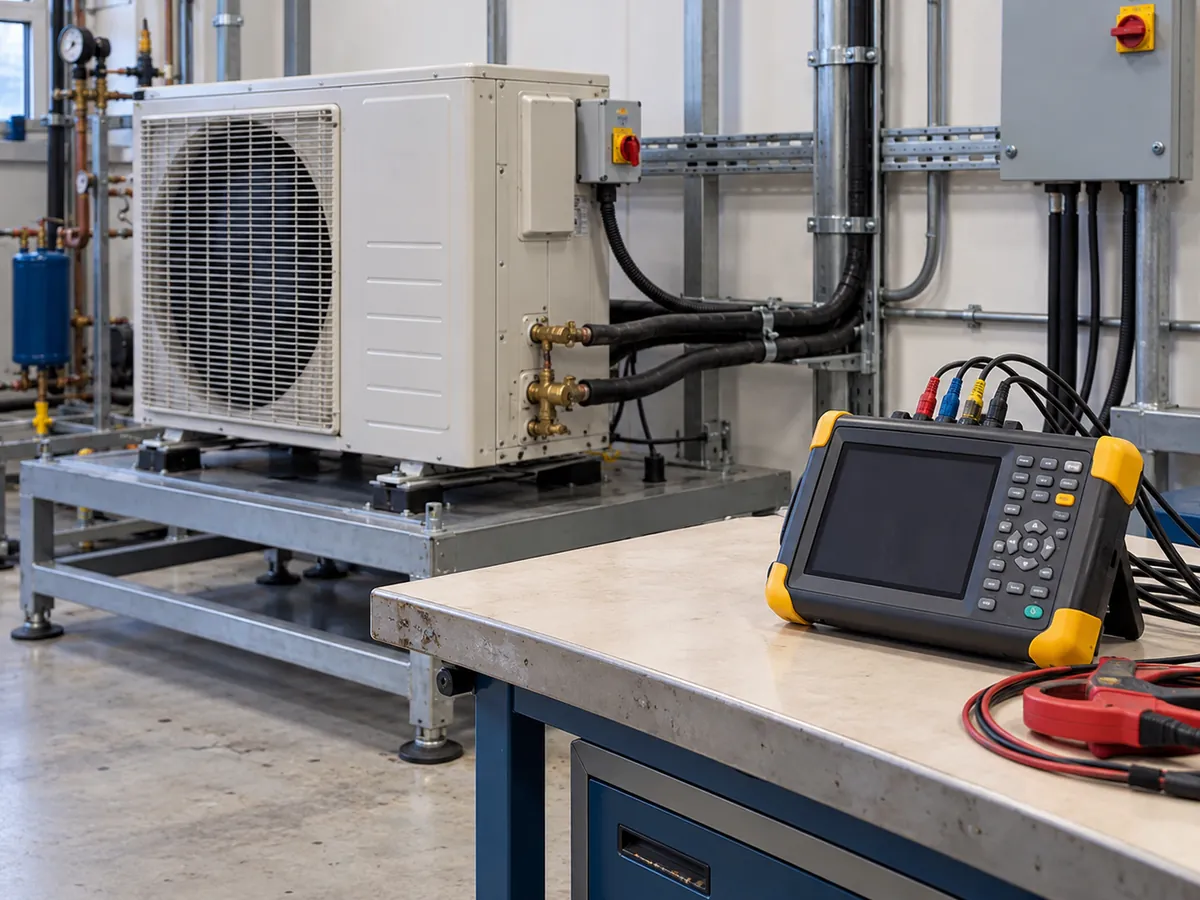
A manufacturer compressor map provides capacity, input watts, mass flow, discharge temperature and approved operating limits for the exact model and rating point. For a purchased HVAC system, compare EER, SEER2 or IEER for cooling and COP, HSPF2 or relevant seasonal heating data under the applicable market test method. Compressor-level maps measure the compression process; complete-equipment ratings capture the assembled system. AHRI Standard 540 describes a reporting framework for positive-displacement refrigerant compressor ratings.
The complete air conditioner or heat pump also consumes fan, pump, control and auxiliary energy. Use compressor performance maps to compare mechanisms and complete-equipment ratings to compare the systems offered in supplier quotations. For annual operating costs, combine the relevant part-load performance with a representative load and operating-hour profile.
Example: power and running cost at the same delivered capacity
Suppose two complete cooling systems each deliver 10 kW of cooling at the same conditions. If one uses 3.0 kW of electricity and the other 3.3 kW, their point-in-time cooling efficiency ratios are 10/3.0 = 3.33 W/W and 10/3.3 = 3.03 W/W. At 1,600 equivalent running hours and $0.18/kWh, the 0.3 kW input difference equals 480 kWh or $86.40 in this illustrative scenario.
Calculation scope: These numbers are illustrative inputs for a matched-duty comparison, not measured scroll-versus-reciprocating results. For a project estimate, substitute actual model ratings, representative operating hours and your electricity tariff. The calculator below applies the same method to the values you enter.
When Does the More Expensive HVAC System Pay Back?
Simple energy-only payback = additional installed cost ÷ estimated annual electricity savings. For example, if one complete system has an assumed $600 higher installed price and saves the illustrative $86.40/year calculated above, its simple energy-only payback is 600 ÷ 86.40 ≈ 6.9 years. Use actual installed quotations and a defensible annual operating profile for the purchasing decision.
For a purchasing decision, also compare maintenance, service downtime, expected replacement costs and any residual value. Estimate annual electricity savings using the operating-hour distribution and the appropriate seasonal or part-load performance data.
Compare power input at equal output
Enter inputs at the same delivered capacity and rating condition. The calculator estimates electricity use and cost for your specified comparable operating hours.
Energy difference = (A power − B power) × comparable hours. Costs multiply that result by the tariff; negative values mean A uses less. Only valid for the same output and operating profile.
Part-Load Control: Why the Drive and System Matter
Part-load control matters because HVAC equipment frequently operates below its maximum cooling or heating demand. Matching compressor output to that demand can reduce unnecessary on/off cycling, improve temperature stability and, in a properly designed system, improve seasonal efficiency. Scroll systems can use staging, digital modulation or approved variable speed; suitable reciprocating systems can use staging, cylinder unloading or approved variable-speed control. The control method, not the compressor family name alone, determines the available capacity range.
Swipe the table horizontally to view all columns.
| Capacity-control method | How output changes | What to verify |
|---|---|---|
| Fixed-speed cycling | Compressor stops and starts to meet load | Cycling frequency, comfort stability and restart limits |
| Multiple-compressor staging | Capacity changes in discrete stages | Stage sizes and lowest available output |
| Digital modulation (on applicable scrolls) | Effective pumping time is varied, not motor speed | Input power and efficiency at stated modulation levels |
| Approved variable speed | Motor speed changes within an approved range | Minimum stable speed, envelope, oil return and part-load performance |
A digital scroll changes effective pumping time through a specific unloading mechanism; it is not the same as changing the motor speed. A multi-scroll rack can turn units on or off. A semi-hermetic reciprocating plant may unload cylinders while the motor runs. Each method has different efficiency and minimum-capacity behavior.
Before choosing, request the capacity and electric input at 100%, a normal mid-load point and the minimum sustained load for the relevant ambient conditions. Ask what happens below minimum output: whether the unit cycles, stages another compressor, uses bypass or changes speed. Check minimum on/off times, oil return, suction conditions and control stability. A standard fixed-speed compressor should not be connected to an arbitrary variable-frequency drive: approval and speed limits belong to the exact model application bulletin.
Noise, Vibration, Reliability and Repair
Scroll compressors generally have smoother compression pulses and lower inherent mechanical pulsation than conventional reciprocating designs. Their fewer major moving elements remove some piston-and-valve wear mechanisms, while serviceable semi-hermetic reciprocating compressors can offer greater access for internal repairs. Installed noise and operating reliability also depend on the actual equipment, lubrication, system protection, fans, cabinet, piping and mounting. Compare complete-unit sound ratings and the specified repair strategy for the models being considered.
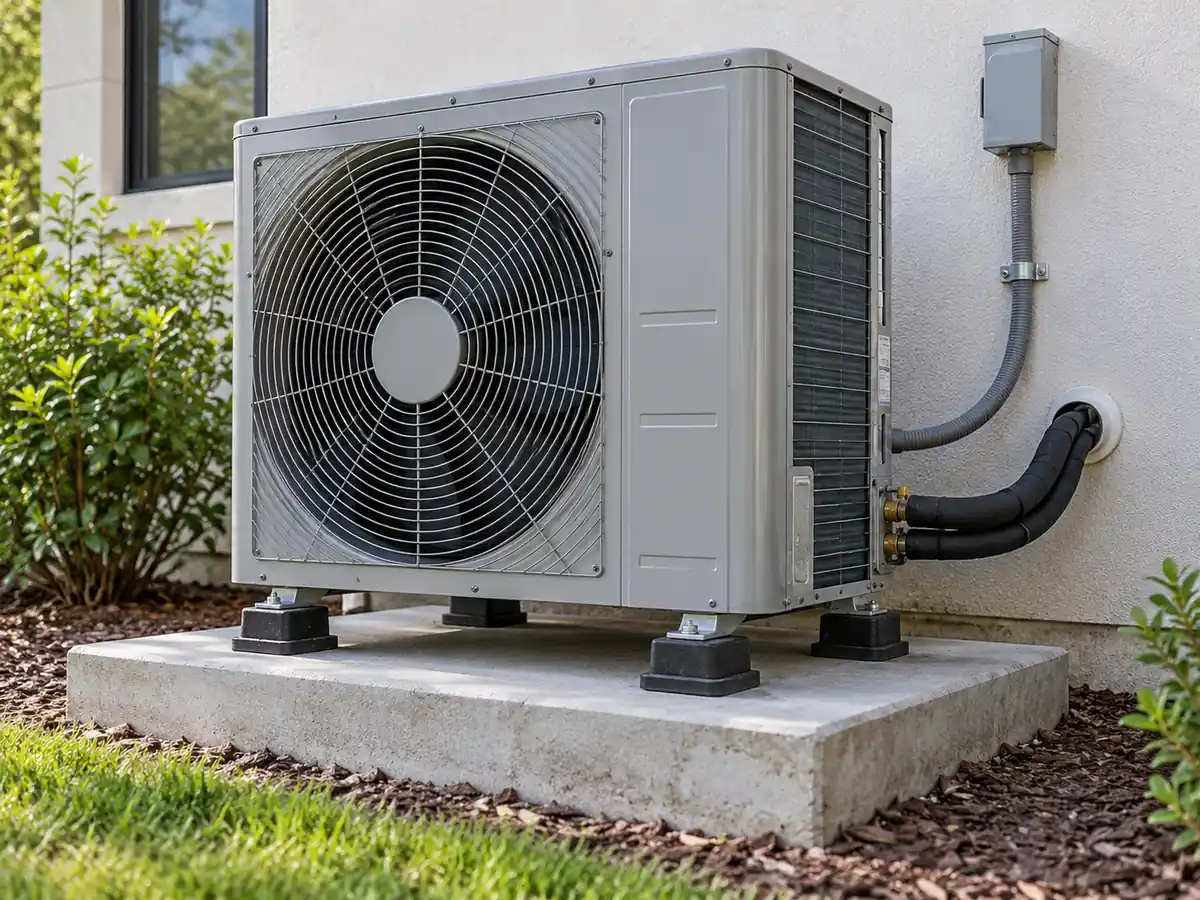
How to compare published noise data: match sound power with sound power, or sound pressure with sound pressure measured under equivalent conditions. Request the measurement standard or method, operating mode, load and ambient conditions. For sound pressure, check the microphone position and distance. Outdoor-unit fans, surrounding reflective surfaces, pipe supports and mounting can change the installed result.
Which one lasts longer?
Scroll compressors have fewer piston- and valve-related wear points, which can reduce certain mechanical maintenance risks in comfort HVAC service. Reciprocating compressors include valves, pistons and related wearing components, but properly applied designs of both types can deliver long service life. The operating temperature, lubrication, refrigerant cleanliness, cycling rate and protective controls have a major influence on actual lifespan; use model-specific service history rather than assuming a fixed number of years.
Which one costs less to maintain?
For typical sealed hermetic AC compressors, scroll and reciprocating types both normally use whole-assembly replacement after a major internal failure. A repairable semi-hermetic reciprocating compressor may cost less to restore when valves or other internal components can be serviced with available parts and labor. Scheduled maintenance and total service cost also depend on access, warranty, downtime, local technician availability and the actual equipment design.
Operating Envelope, Refrigerant and Failure Risks
Running a compressor outside its approved temperature, pressure, speed or refrigerant limits raises the risk of excessive discharge temperature, lubrication problems, protection trips and premature damage. Scroll and reciprocating models both have defined operating envelopes. Comfort cooling, high-temperature heat pumps and low-temperature refrigeration place different demands on capacity, refrigerant handling, oil return and protective controls. Select a model whose published envelope covers the required evaporating and condensing conditions.
Refrigerant selection affects lubricant, electrical safety provisions and operating limits. Verify the exact compressor approval for the specified refrigerant and oil, including system safety and destination-market requirements. Approval for R410A does not establish compatibility with R32, R290 or R454B.
How Operating Conditions Change the Choice
Swipe the table horizontally to view all columns.
| Application | Main engineering concern | Required model or system evidence |
|---|---|---|
| Residential comfort cooling | High outdoor ambient and fluctuating indoor load | Rated capacity/input, minimum output, sound and operating envelope |
| Cold-climate air-source heat pump | Low ambient heating and required supply temperature | Heating capacity, COP, defrost behavior and approved heating limits |
| Low-temperature refrigeration | High pressure ratio and discharge-temperature stress | Approved refrigeration envelope, oil management, and cooling/injection needs if specified |
Failure Symptoms and First Checks
Swipe the table horizontally to view all columns.
| Observed symptom | Possible causes to test | Useful next diagnostic step |
|---|---|---|
| High discharge temperature or frequent protection trip | Excessive lift, poor heat rejection, low refrigerant flow, bad controls | Review conditions against envelope; check airflow/waterflow, pressures, superheat and discharge sensor |
| Liquid floodback or slugging | Expansion control fault, transients, low load or refrigerant migration | Evaluate suction superheat, oil and control setup; identify root cause before restart |
| Reduced reciprocating output | Leaking valves, mechanical wear or system-side restrictions | Compare operating capacity/pressures to a valid performance map before opening the compressor |
| Short cycling | Overcapacity, thermostat/pressure control, refrigerant migration | Review runtime, shutdown intervals, control staging and protection logic |
| Excessive transmitted vibration | Mounting, piping contact, fan imbalance or compressor pulses | Inspect supports and measure complete-unit vibration/sound at the relevant conditions |
| New compressor installed but target temperature is not achieved | Capacity mismatch, expansion-control settings, piping, airflow or control fault | Confirm commissioning measurements and the selected compressor performance map before declaring the conversion acceptable |
Use this table to prioritize root-cause checks before approving a compressor replacement. Refrigeration and electrical service must be performed by appropriately qualified technicians following the equipment manufacturer’s safety instructions. Resolve the failure cause before installing a new compressor.
Air Conditioner Compressor Specifications: What to Request
Request the exact compressor or AC unit model, refrigerant, cooling or heating capacity, power input, rating conditions and approved operating limits before comparing supplier quotations. Include noise, electrical supply and service requirements for distributor, contractor and project-buyer decisions.
| Request from the equipment supplier | Required detail |
|---|---|
| System identity | Outdoor-unit model, indoor-unit match if applicable, compressor manufacturer and exact model |
| Compression architecture | Scroll/reciprocating/rotary; hermetic or semi-hermetic; fixed/staged/digital/variable speed |
| Refrigerant circuit | Approved refrigerant, oil type, charge, approved operating range and required protection |
| Duty-point output | Heating/cooling capacity in kW or Btu/h and matching electric input, with rating temperatures |
| Seasonal and part-load data | Applicable complete-unit test/rating basis, capacity and watts at relevant part-load points |
| Electric supply | Voltage, phase, frequency, running current, starting requirements, drive compatibility |
| Sound and mechanical | Declared unit noise, dimensions, service clearances, mounting and piping connections |
| Service and certification | Warranty/parts strategy, intended destination market and verifiable unit documentation |
Copyable Compressor and HVAC Specification Request
Use this short request when contacting suppliers. Complete what you know; unknown operating conditions should be resolved before final model approval.
Edit the copied text with your project details before sending it to a supplier.
What about split AC compressors and Airproz models?
Airproz’s published R410A ASF fixed-speed split AC specification identifies rotary GMCC/GREE compressors for its listed models. Small wall-mounted split systems may use rotary, scroll or other compressor designs depending on the actual model. An inverter designation describes approved capacity control, not the compression mechanism. Explore the Airproz air conditioner range and review the specific product sheet for the proposed equipment.
For heat pumps, start with the required building load and supply temperature, then review the space-heating heat pump range and the compressor construction, heating capacity and operating limits of each proposed model.
When requesting an Airproz model comparison, provide required capacity, design temperatures, electrical supply, installation constraints and destination market. These details support a model-specific recommendation based on published equipment specifications.
Scroll or Reciprocating: Which Should You Choose?
Choose a scroll compressor as a first option for many new residential and light-commercial comfort HVAC systems when smooth operation, compact packaging and a suitable efficient system design are priorities. Choose a properly rated reciprocating compressor when existing piston-based plant compatibility, repairable semi-hermetic construction or specialized refrigeration duty gives it a practical advantage. Use the application table below to identify candidates, then confirm the required capacity, efficiency, sound and service conditions against actual model specifications.
Swipe the table horizontally to view all columns.
| Project condition | Sensible first shortlist | Confirm before specifying |
|---|---|---|
| New residential or light-commercial comfort air conditioning | Scroll-based complete units where offered; also compare the actual rotary-based split AC choices | Complete-system efficiency, sound, design ambient, refrigerant and service |
| Low-temperature refrigeration or high pressure ratio | Compressor models explicitly approved for that refrigeration duty, regardless of family | Approved envelope, discharge-temperature limits, oil management, required injection/cooling and service support |
| Heat pump with cold-weather or high-water-temperature duty | Models explicitly approved for the heating temperature lift, scroll or otherwise | Heating capacity/COP at design ambient and required water temperature, injection features and limits |
| Existing large serviceable semi-hermetic plant | Serviceable reciprocating replacement, or a justified complete-system redesign | Spare parts, unloading, redundancy, life-cycle cost, room/connection constraints |
| Quiet hospitality or occupied-building application | Low-noise finished units; scroll often a useful starting point | Unit sound at the rating condition and installed acoustic path |
| Replacement of a failed hermetic compressor | OEM-approved replacement architecture | Exact performance, refrigerant, electrical/control fit, piping and protections |
A practical selection sequence
- Define the duty: cooling/heating load, design temperatures, humidity needs, annual hours and minimum load.
- Remove incompatible models: refrigerant, voltage, safety requirements and operating-envelope limits.
- Compare performance fairly: same duty point, delivered capacity, total electric input and relevant part-load results.
- Check operation: installed sound, modulation/staging, oil return, protection and maintenance accessibility.
- Compare total cost: equipment, installation/reconfiguration, operating energy, parts, downtime and service labor.
Can a Scroll Compressor Replace a Reciprocating Compressor?
Yes, a scroll compressor can replace a reciprocating design when the replacement is manufacturer-approved for the required duty-point capacity, refrigerant, lubricant, electrical supply, controls and operating limits. Treat the change as an engineered compressor selection: a matching horsepower rating or mounting footprint alone does not establish compatibility.
- Record the existing compressor and unit model, refrigerant, oil, electrical data, controls and rating conditions.
- Establish actual required capacity and input power at the evaporating/condensing condition; a nominal “5-ton” label is not enough.
- Verify the proposed replacement’s operating envelope, discharge temperature, starting/drive requirements and refrigerant approval.
- Check oil return, piping geometry, connection sizes, mounting, charge, accumulator/crankcase-heater needs and safeties as applicable.
- Have the manufacturer or responsible system engineer approve the control sequence, commissioning tests and warranty implications.
Replacement Approval and Commissioning Checks
Stop the conversion plan if refrigerant compatibility, required-duty capacity, operating envelope, electrical supply, oil management, protection logic or manufacturer approval cannot be verified.
Swipe the table horizontally to view all columns.
| Stage | Check or record | Decision standard |
|---|---|---|
| Before approval | Model/refrigerant identity, capacity at actual duty, power/controls, oil and piping | Manufacturer or responsible engineer confirms compatibility and necessary redesign |
| During commissioning | Suction/discharge conditions, inlet superheat where applicable, discharge temperature, electrical input and protection status | Measurements remain within the model and system limits |
| Before acceptance | Delivered capacity and target temperature, stable controls, noise/vibration and safety protections | System meets project requirements under relevant operating conditions |
Where essential compatibility data are unavailable, use an approved OEM compressor replacement or have a qualified designer evaluate a complete refrigeration-circuit redesign before proceeding.
Frequently Asked Questions
Is a scroll compressor better than a reciprocating compressor for air conditioning?
For many new comfort HVAC installations, yes—a scroll is a strong starting choice for smooth operation and suitable efficient equipment designs. Confirm the complete system’s capacity, sound and efficiency at the required conditions; small split air conditioners may instead use rotary compressors.
What data should I request before comparing scroll and reciprocating compressor quotations?
Request exact compressor and equipment model numbers, refrigerant, capacity and total electrical input at matched conditions, plus operating envelope, sound data, warranty and service provisions. For complete AC or heat pump units, include the relevant seasonal or part-load ratings. Compare installed quotations on the same duty and service scope to identify the better total-cost option.
Why can two scroll compressors use different amounts of electricity?
Their motor design, displacement, built-in volume ratio, approved speed range and applied operating conditions differ. Complete-system fans, heat exchangers and controls also change consumption. Compare delivered output and measured electrical input under matching conditions.
Is a scroll compressor quieter?
Its compression process is typically smoother, often reducing mechanical pulsation. For the installed result, compare complete-unit sound ratings at equivalent loads and methods, including the effects of fans, casing, mounts and piping.
Are reciprocating compressors obsolete?
No. Their piston technology remains useful in selected HVAC and refrigeration duties, especially where exact model operating limits and semi-hermetic service access suit the plant.
Is a scroll compressor the same as an inverter compressor?
No. Scroll describes a mechanical compressor type; inverter describes approved variable-speed control. A scroll may be fixed speed or variable speed, and a variable-speed split AC may use rotary technology.
Is a reciprocating compressor repairable while a scroll is not?
Hermetic scroll and reciprocating compressors are generally replaced as sealed assemblies. Some semi-hermetic reciprocating models allow internal repairs to valves, pistons and other accessible parts. Repair strategy depends on the actual casing and model.
Can I use the same horsepower scroll to replace a reciprocating compressor?
No. Horsepower does not confirm matching refrigerant capacity, electrical compatibility, duty limits or controls. Treat the change as an engineered selection.
Which compressor is best for a heat pump?
A scroll compressor is a common first choice for many modern air-source heat pumps because suitable models combine smooth compression with efficient system and capacity-control options. For high-temperature heating or demanding pressure-ratio applications, compare approved scroll and specialized reciprocating designs at the required low-ambient heating conditions. Select using delivered heating capacity, electrical input, COP and the published heating envelope.
Which air conditioner compressor is best for low noise?
Between scroll and conventional reciprocating designs, a scroll compressor is generally quieter mechanically because it produces smoother compression pulses. For a quiet installed air conditioner, compare complete-unit sound ratings under equivalent test methods and loads; fans, cabinet vibration, pipe supports and mounting can also be significant noise sources.
Conclusion: Scroll vs Reciprocating Compressor
Scroll compressors are a strong starting choice for many modern residential and light-commercial HVAC systems because of their smoother compression and available capacity-control options. Reciprocating compressors remain valuable where the pressure/temperature duty, existing equipment or a serviceable semi-hermetic design makes them suitable. For the final selection, compare actual models for refrigerant compatibility, duty-point capacity and power input, seasonal efficiency, sound, electrical requirements and long-term service costs.
Need to Compare HVAC Equipment for Your Project?
Share your cooling or heating capacity, design outdoor conditions, required supply temperature, power supply, destination market and any noise or service limits. Use the Airproz contact page to request a model-specific comparison of suitable complete HVAC equipment options. Confirm actual compressor construction and operating performance against the proposed unit’s documentation.