Airproz B2B Engineering Case Study Series · Argentina · Updated July 2026
Argentina’s air conditioner market is worth about USD 1.62 billion in 2026 and could nearly double by 20341. Local prices there also move fast — the cost of everyday goods rose over 30% in the year to mid-20262. And no split AC (locally called aire acondicionado split) can be sold there without IRAM certification, which only a locally registered company can hold. For any split air conditioner supplier Argentina buyers work with, those three facts shape pricing, specification, and distributor choice. Here’s what that looks like in practice, plus a real case from a Buenos Aires distributor.
Key takeaways
- The market is growing ~6.7% a year and could nearly double by 2034.
- Quote in US dollars and favor mid-range efficiency units — they sell better than premium ones there.
- Only a locally registered company (with a valid CUIT) can hold IRAM certification — pick a distributor who can handle that.
- A mid-range inverter split AC (Class B) is usually the best-selling spec.
Argentina’s Split Air Conditioner Market: Worth Planning For
Argentina’s AC market is forecast to grow about 6.7% a year, reaching close to USD 2.72 billion by 2034 — nearly double today’s size. Air conditioning is still far from universal in Argentine homes compared with more mature markets, which is part of why growth is expected to stay strong through the decade. The distributor relationships built now will serve that larger market later.

Demand isn’t only residential either. Retail stores, offices, and hotels across Buenos Aires, Córdoba, and Rosario buy the same product type, just with commercial warranty terms. One OEM product line can usually cover both channels.
See our guide on choosing split AC configurations for residential and light-commercial projects.
Why Global Brands Keep Investing Here
Despite the price volatility, international manufacturers keep expanding their Argentina lines rather than pulling back. Hisense launched new R32 split AC products in Argentina in 2025. Midea ran a product launch event in the country the same year. Neither company is guessing — both looked at the same growth numbers and the same inflation risk, and both decided the market was worth the extra planning it takes to sell there.
The takeaway isn’t to copy any one competitor’s exact strategy. It’s that a market attracting multiple established players at once usually has room for more than one supplier — provided you get the pricing and compliance basics right from the start.
What Fast-Moving Prices Mean for You
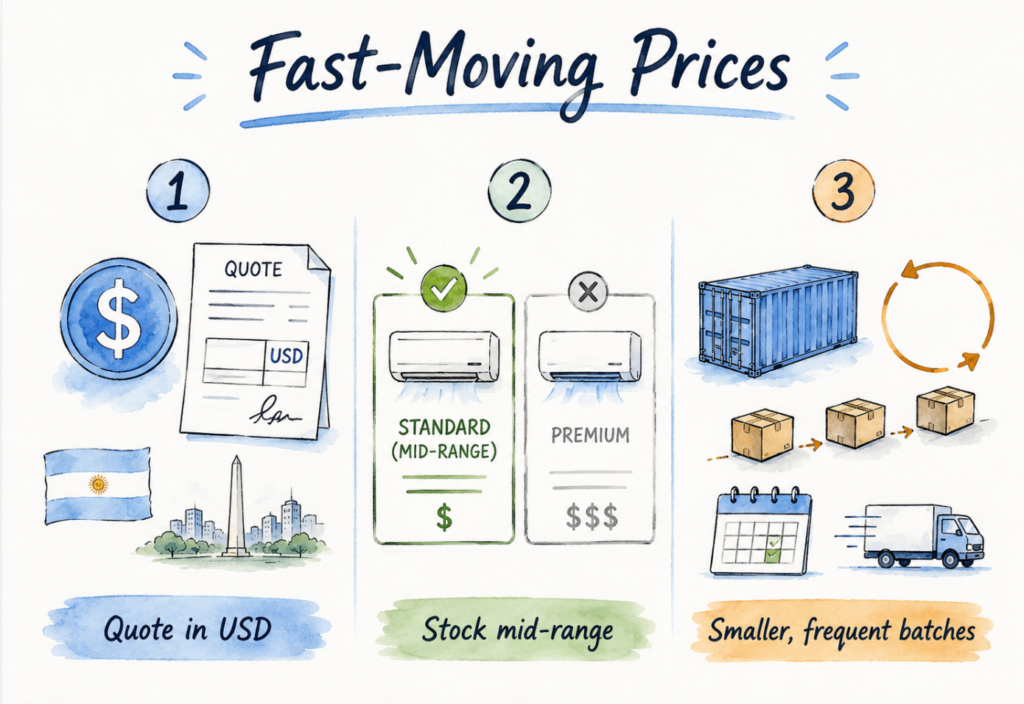
Prices in Argentina change quickly. In practice, that means three simple things.
First, quote and invoice in US dollars, not pesos. A peso price agreed in one quarter can be worth noticeably less by the next — INDEC, Argentina’s national statistics institute, publishes updated monthly figures worth checking before you quote. Local buyers already expect dollar-denominated quotes from serious suppliers.
Second, stock mostly mid-range efficiency units rather than premium ones. A high-efficiency model can cost 30–40% more than a standard one, and buyers in Argentina feel that gap immediately at the register rather than recovering it slowly through lower electricity bills.
Third, ship smaller, more frequent batches. A container that sells through in four months carries far less currency risk than one that takes a year — faster inventory turns work as a kind of built-in hedge.
Case Study: A Buenos Aires Distributor’s Order
Note: a representative example based on a typical Argentina procurement pattern. Company identity is generalized.
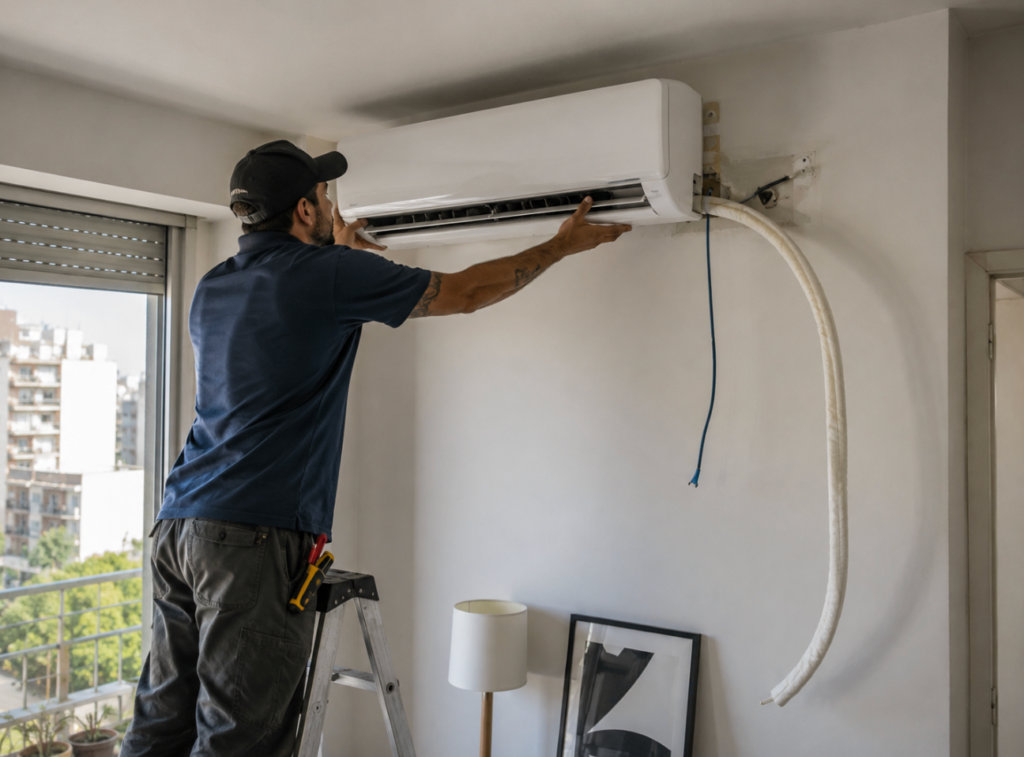
A residential HVAC distributor near Buenos Aires ordered 120 units of an R32 inverter split AC ahead of the December–February summer, when temperatures often pass 35°C. This is a typical profile for a split air conditioner distributor Argentina works with: reliable cooling, a low enough running cost to matter to their customers, and a price that wouldn’t lose the sale.
| Spec | Choice & why |
|---|---|
| Compressor | DC inverter, R32 — stable cooling, efficient in hot summers |
| Power | 220V/50Hz — one spec fits the whole country |
| Size | 12,000 BTU, known locally as una tonelada (see our room-size guide) |
| Energy rating | IRAM Class B — noticeable savings, 30–40% cheaper than Class A |
| Plug | IRAM 2073 Type I, fitted at the factory — avoids rework on-site |
The distributor’s local entity held the IRAM certificate, using its CUIT to register the application with ARCA; Airproz supplied the test data behind it. That arrangement led to a second, larger order within the same year. More on how efficiency and certification work together in our energy-efficient split AC guide.

Sourcing a split AC order for Argentina? We can supply IRAM-ready test reports and pricing built for this market.
→ Request a specification and quote
Split Air Conditioner Supplier Argentina Certification: Why It Has to Go Through a Local Partner
In plain terms: every split AC sold in Argentina needs an IRAM certificate. Only a company registered in Argentina can hold it — an overseas factory can’t. In practice, that’s your distributor.
The factory provides test reports; the distributor files the application under their own Argentine entity and holds the certificate. That makes distributor choice a compliance decision, not just a sales one — a partner who’s already certified another product line is worth more than one who hasn’t. This isn’t unique to Argentina: Mexico, Brazil, and Indonesia each have their own version. See how those compare in our Mexico guide and Brazil guide.
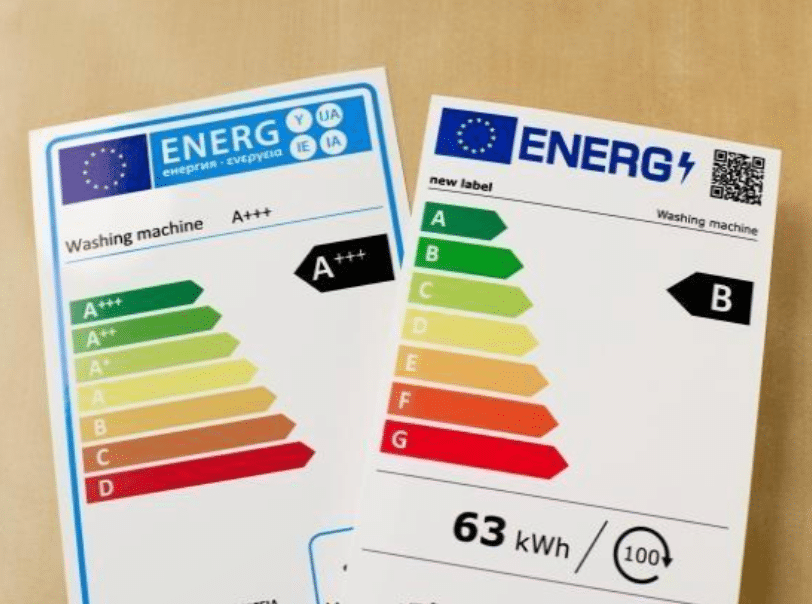
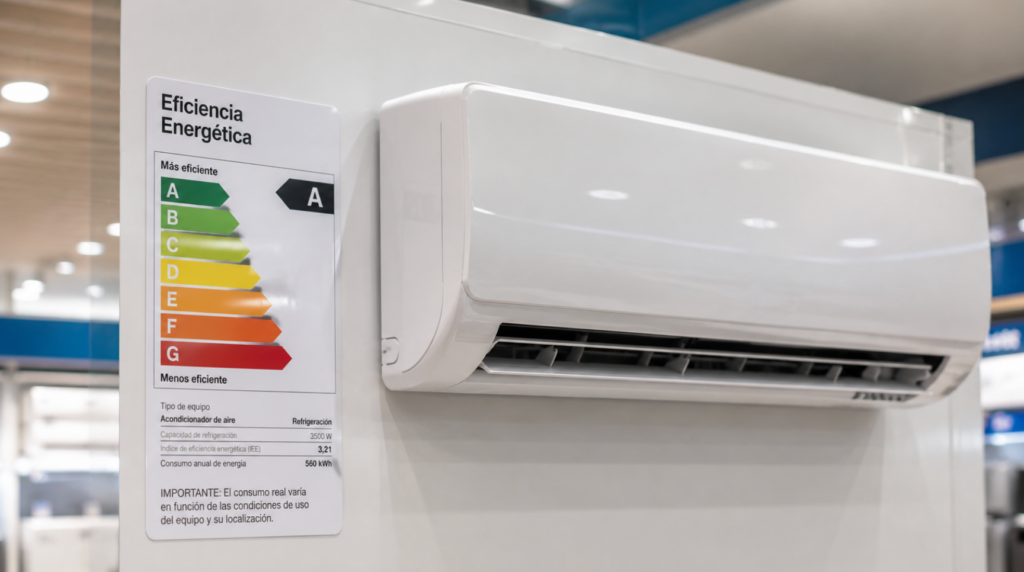
Also required: an energy label from A (best) to G (worst), based on test data your factory supplies. Even a mid-range energy efficient air conditioner rated Class B sells itself on the label; Class D or lower struggles against a similarly priced B-rated competitor. IRAM, Argentina’s national standards body, publishes the current labeling requirements and any amendments — worth checking directly before finalizing a spec.
Finding a Split Air Conditioner Supplier Argentina Buyers Can Trust
Before you sign with a distributor, ask for their CUIT — Argentina’s 11-digit tax ID number, formatted like XX-XXXXXXXX-X. Every legally registered company or self-employed professional in Argentina has one, and it’s the number the company uses to issue invoices (facturas) and clear customs.
You can verify a CUIT is active through ARCA (Agencia de Recaudación y Control Aduanero), Argentina’s national tax and customs authority — the agency that replaced AFIP in 2024. An active, valid CUIT tells you the company legally exists and can hold an IRAM certificate on your behalf. A distributor who can’t produce one, or whose CUIT comes back inactive, isn’t in a position to certify your products no matter how strong their sales pitch is.
Power and Plug: The Basics to Confirm
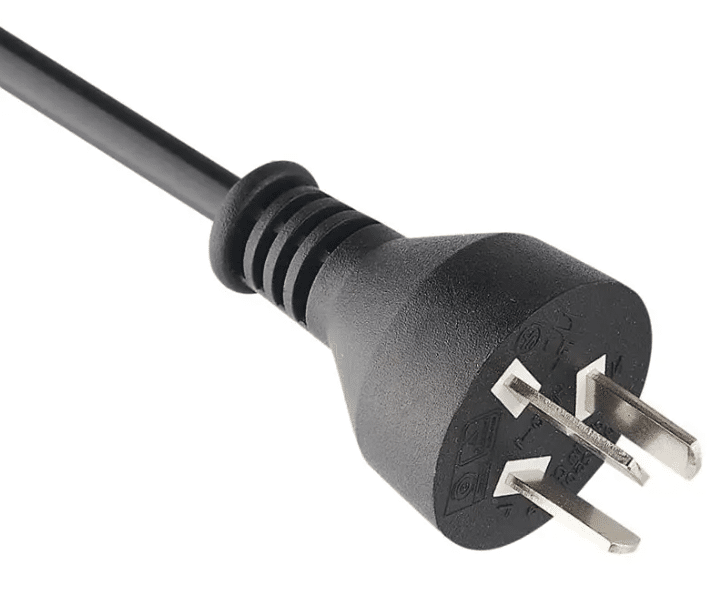
Argentina runs 220V/50Hz nationwide — confirm every component is rated for 50Hz, since a 60Hz motor loses cooling power on that supply. The plug is IRAM 2073 Type I — the same shape used in China, Australia, and New Zealand, so most exporting factories can already produce it. Getting this wrong adds to your split air conditioner installation cost, since installers have to swap the plug on-site; see our installation mistakes guide.
Quick checklist
- All parts rated for 220V/50Hz
- IRAM 2073 Type I plug fitted at the factory
- Energy label Class B or above, with test data ready
- Distributor’s CUIT verified as active through ARCA
- Distributor confirmed as IRAM certificate holder
- Quotes priced in USD
- Shorter, more frequent shipments
- R32 refrigerant, checked against current import rules
What to Look for Beyond Price
Price and certification aren’t the only things that decide whether a distributor relationship works long-term. Ask about lead times before you commit — a supplier quoting six weeks and delivering in twelve creates a stock gap right before peak summer season, which is exactly when a distributor can least afford it.

Ask whether the factory provides installation manuals and basic training material in Spanish, not just English. Installers on the ground are the ones fitting the unit, and documentation they can actually read reduces callbacks. Also ask how after-sales issues get handled — a factory that responds within a day or two to a warranty claim builds trust with a distributor much faster than one that goes quiet for weeks. None of this shows up on a spec sheet, but it’s usually what determines whether a first order turns into a second one.
Regional Differences Worth Knowing
Buenos Aires is the largest market by volume, and 12,000 BTU (una tonelada) units are the most common size there. Córdoba and Rosario have similar summer climates and generally take the same specification.
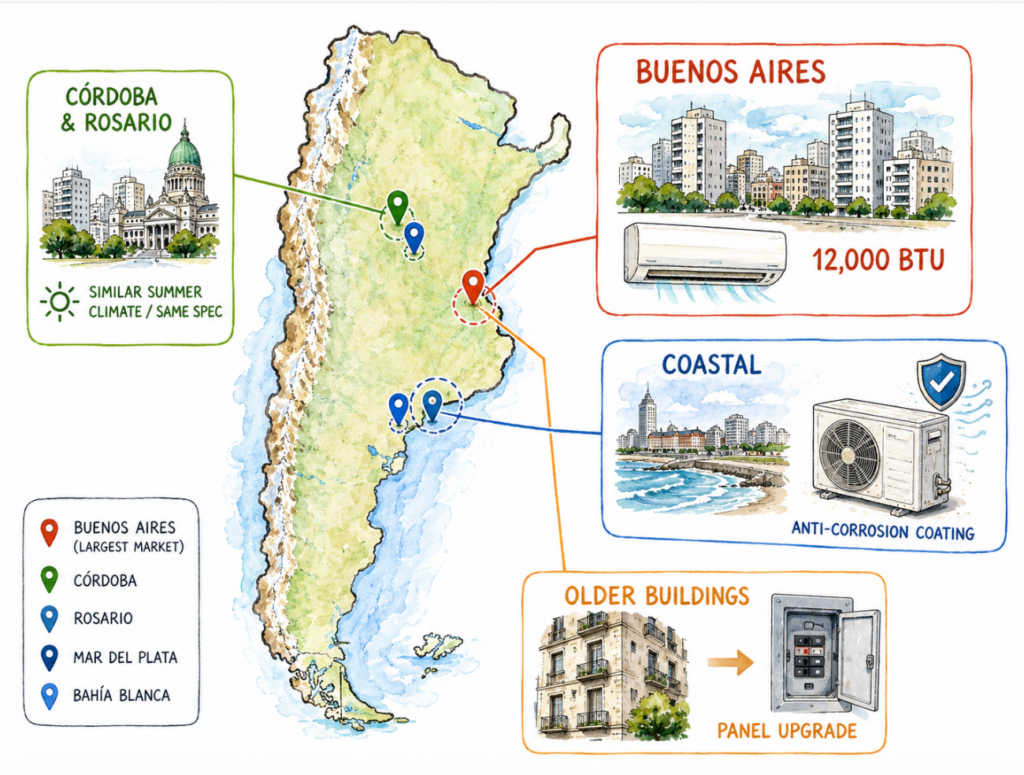
Coastal cities are different. In Mar del Plata and Bahía Blanca, salt air speeds up corrosion on outdoor units, so it’s worth budgeting for anti-corrosion coating on any coastal order. Buildings vary too — apartments built before the 1990s in Buenos Aires often lack a spare breaker slot for a dedicated AC circuit, which adds an electrical-panel upgrade to the installation cost. All of this is knowable before a container ships, so it’s worth confirming with your distributor at the quoting stage rather than after installation day.
Frequently Asked Questions
Split Air Conditioner Supplier Argentina: Does IRAM Certification Require a Local Representative?
Yes. Only a company registered in Argentina can hold the IRAM certificate — usually your distributor. The factory provides test data; the distributor files the application.
Why should split AC quotes for Argentina be priced in US dollars?
Local prices there change quickly year to year. Pricing in US dollars protects both sides from that swing, and it’s standard practice for experienced importers.
What energy label grade should I specify for split ACs sold in Argentina?
Class B on the IRAM A–G scale works best for volume sales — noticeable running-cost savings at an accessible price. Class A suits smaller, higher-budget projects.
How do I check that an Argentine distributor is a legitimate, registered company?
Ask for their CUIT and verify it’s active through ARCA (formerly AFIP), the national tax authority. An active CUIT confirms the company is legally registered and able to hold an IRAM certificate on your behalf.
What’s a realistic first order size and lead time for the Argentine market?
Many first orders land somewhere in the 100–150 unit range — large enough to be worth the IRAM certification effort, small enough to sell through in a single summer season without tying up too much working capital. Factory lead times of six to eight weeks are typical; build in extra time around each region’s peak summer months so stock arrives before the season, not during it.
Ready to configure a split AC order for Argentina? We supply IRAM-compliant documentation and factory test reports.
→ Get a specification and quotation
Published by Airproz · B2B Split Air Conditioner Manufacturer & OEM Supplier · airproz.com