Airproz B2B Engineering Case Study Series · Mexico · Published August 2026 · Reviewed by Airproz’s Engineering Team
Mexico's AC market grows at 8.42% CAGR through 2032 — and NOM-026-ENER-2015 sets the minisplit efficiency floor.
Mexico’s residential air conditioner market is growing fast. It’s on track to go from about USD 3.56 billion in 2025 to a projected USD 6.27 billion by 2032 — roughly 8.42% growth a year.1
Demand for cooling is also straining Mexico’s power grid. CFE, Mexico’s national utility, recorded a new record of about 54,300 MW in July 2026.2
For B2B buyers sourcing a split air conditioner for Mexico market (known locally as aire acondicionado tipo split), the takeaway is simple: demand is rising, and winning this market comes down to three things — the right voltage, the right corrosion protection, and a supplier who can prove their units are properly certified.
Key Takeaways
- Mexico’s residential AC market is growing at roughly 8.42% a year through 2032, and the grid is under increasing pressure from rising demand.
- Minisplit air conditioners are covered by NOM-026-ENER-2015, an efficiency standard in place since 2016 — not a new 2026 deadline. Confirm your supplier tests to this standard, not a different one.
- Mexico runs two voltage systems: 127V in most central and southern states, 220V in the north and the Yucatán Peninsula. The wrong voltage means a unit that won’t start — or gets damaged.
- A representative Yucatán distributor case shows that anti-corrosion coating for outdoor units isn’t optional near the coast — it’s the difference between zero callbacks and a ruined reputation.
Why Mexico Is a Growing Market for Air Conditioner Procurement
Mexico’s climate varies a lot by region. Coastal areas are hot and humid. The north is hot and dry. The highlands stay mild year-round.
That climate diversity is exactly why a split air conditioner for Mexico market needs regional specification, not a one-size-fits-all approach. But the bigger story for buyers working with an air conditioner supplier Mexico partners with in 2026 is simpler than the climate map: demand is climbing, fast.
A Fast-Growing Market
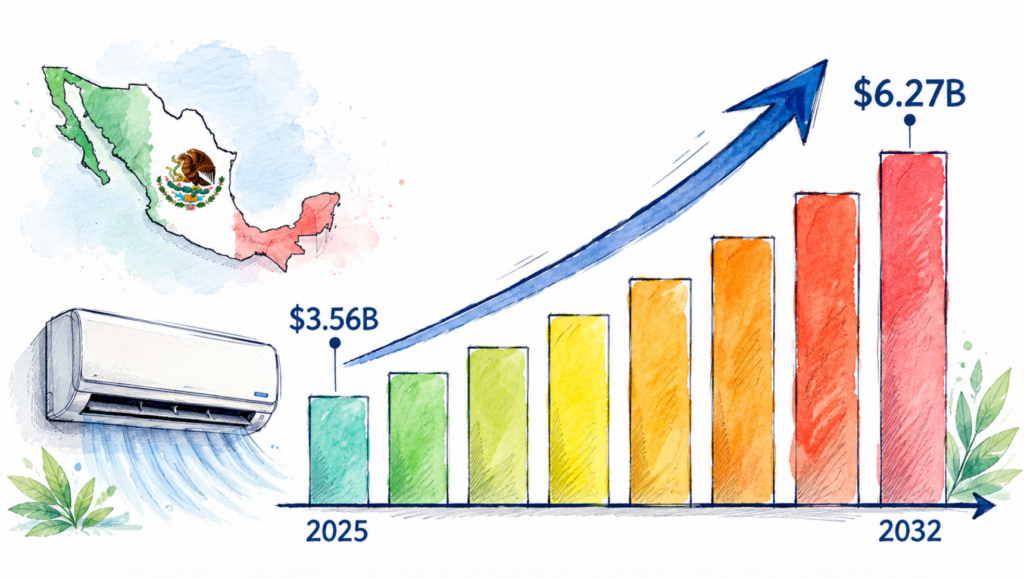
Mexico’s residential air conditioner market was worth about USD 3.56 billion in 2025. It’s expected to reach USD 6.27 billion by 2032 — a CAGR of roughly 8.42%, according to MarkNtel Advisors.
Room air conditioners, the category that includes split systems, make up about 63% of that market. In plain terms: split ACs are already the dominant product type, in a market that’s set to nearly double in size.
Why the Power Grid Matters for Procurement
Every summer, Mexico’s electricity demand climbs. Air conditioning is part of that story — so are industrial growth and expanding data centers.
In July 2026, national demand hit a new record of around 54,300 MW.2 For B2B buyers, the takeaway is simple: cooling demand in Mexico isn’t a short-term trend. That’s exactly the environment where efficiency standards and grid-friendly equipment matter more, not less.
Commercial Construction Is Adding to Demand
Growing commercial construction — logistics parks, factories, retail developments — is also driving demand for split and multi-split systems. They’re flexible and cost-effective for smaller commercial spaces.
Global manufacturers are investing in Mexican production too; Daikin, for example, has expanded manufacturing in San Luis Potosí. The takeaway for buyers: the market is growing on both the residential and commercial sides, and supplier readiness — certification, stock, lead times — is what separates a good partner from a risky one.
Representative Installation Case: A Mexican Residential Distributor’s Split AC Procurement
Note on this case: This is a representative example based on a typical procurement pattern seen across Mexico’s coastal markets — not a single, identifiable transaction. Company details are generalized.
The Yucatán Challenge
A residential HVAC distributor Mexico serving the Yucatán region — Mérida, Progreso, and nearby coastal towns — ordered 200 Airproz R32 inverter split air conditioners in mid-2025, for installation within 30 km of the Gulf coast.

Sourcing a split air conditioner for Mexico market like this one means solving three problems at once, not just picking a model off a catalog:
- Corrosion. High humidity plus salt air from the Gulf eats through standard outdoor units fast — visible pitting within 12–18 months on untreated coils.
- Voltage. The Yucatán grid runs on 220V, unlike central Mexico’s 127V. The wrong spec simply won’t work.
- Electricity cost. Mexico’s tiered residential rate (DAC) pushes high-consumption homes into pricier billing bands. An energy efficient air conditioner directly saves the customer money — it’s not just a sustainability talking point here.
What They Specified
The distributor chose a split AC configuration and sized units using standard BTU-to-room-size guidance. The final spec was based on Airproz’s R32 inverter split AC series:
| Spec | Choice | Why |
|---|---|---|
| Outdoor coil | Anti-corrosion coated fins, stainless fasteners, coated steel cabinet | Coastal salt exposure |
| Voltage | 220V / 60Hz | Matches the Yucatán grid |
| Compressor | DC inverter | Better humidity control, lower running cost |
| Refrigerant | R32 | Lower environmental impact than R410A |
| Capacity | 12,000 / 18,000 BTU | Matches typical room sizes (15–30 m²) |
The Results
About 120 sites were installed over eight weeks. Split air conditioner installation cost stayed within the expected range for the region. The main variable was line-set length on sites where the outdoor unit sat far from the indoor unit — a common issue covered in our installation mistakes guide.
After two full rainy seasons, the distributor checked in on all 200 units:
| Result | What happened |
|---|---|
| Corrosion callbacks | Zero, across all 200 units |
| Energy use vs. standard units | 25–30% lower, reported by customers |
| Performance in peak heat (36–38°C) | Full capacity maintained, no shutdowns |
| Repeat business | A second container order, expanding into Quintana Roo |
Looking for an air conditioner supplier Mexico distributors already trust for coastal-spec builds? Our OEM engineering team can confirm certification and coastal-spec configurations for your order.
→ Request Mexico-market specification support
Engineering and Compliance Basics for the Mexico Market
Getting the engineering right for a split air conditioner for Mexico market comes down to two things: voltage and certification.
Voltage: 127V vs 220V
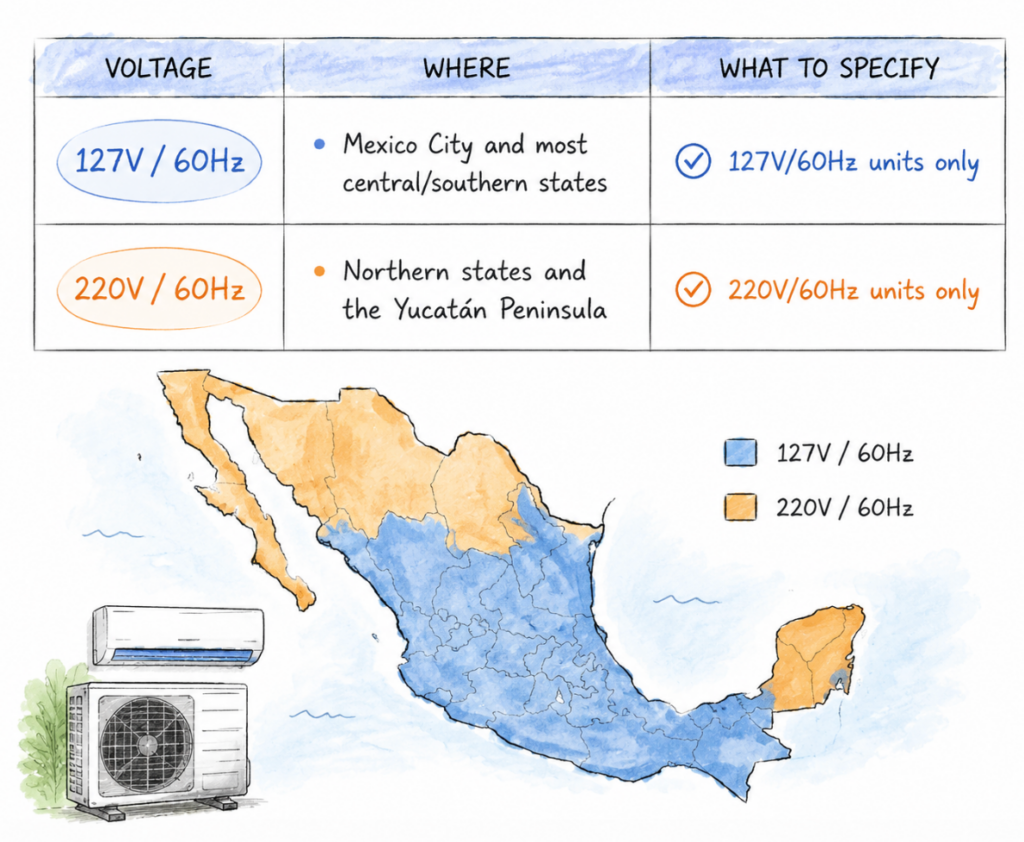
| Voltage | Where | What to specify |
|---|---|---|
| 127V / 60Hz | Mexico City and most central/southern states | 127V/60Hz units only |
| 220V / 60Hz | Northern states and the Yucatán Peninsula | 220V/60Hz units only |
Getting this wrong is one of the most common — and most expensive — mistakes for first-time Mexico buyers. Always confirm the destination state’s voltage before finalizing an order.
Certification: What You Actually Need to Ask For
Split minisplit air conditioners sold in Mexico need to meet NOM-026-ENER-2015, an energy-efficiency standard in place since 2016. This isn’t a new requirement. The risk for B2B buyers isn’t a looming deadline — it’s sourcing from a supplier who can’t actually prove their units were tested against it.
NOM-026-ENER-2015 exists to guarantee that the energy efficient air conditioner you’re importing actually meets Mexico’s minimum performance bar — not just the marketing claim on the box.
There’s a separate standard, NOM-035-ENER-2025, that some suppliers and articles mention — but it only applies to much larger rooftop package units (65,000–240,000 BTU/h), not to standard residential split ACs. If a supplier quotes you NOM-035 for a 12,000–18,000 BTU minisplit, that’s a sign to ask more questions, not less.
Before confirming an order, ask your supplier for two things: a valid energy-efficiency test report for the exact model, and confirmation that the certification body is accredited in Mexico.
Quick Procurement Checklist
- Confirm destination-state voltage (127V or 220V)
- Confirm NOM-026-ENER-2015 test documentation for the model ordered
- For coastal sites: specify anti-corrosion coil + stainless fasteners
- For northern/desert sites: specify a compressor rated for 46°C+ ambient
- For highland sites: prioritize part-load efficiency (long operating hours)
- Confirm refrigerant type (R32 recommended) and import classification
- Confirm 60Hz-rated motors and compressor
- Budget for line-set length and mounting variables beyond the standard install
- Plan regional stock by voltage and climate spec, not one national SKU
Frequently Asked Questions
1. What standard applies to split air conditioners imported into Mexico?
NOM-026-ENER-2015 sets the minimum energy-efficiency requirements for minisplit inverter air conditioners — the standard, everyday split AC most B2B buyers import. It’s been in effect since 2016. It’s sometimes confused with NOM-035-ENER-2025, a newer, separate standard that only applies to much larger rooftop package units, not residential split ACs. Always confirm which one applies to your specific product before requesting paperwork.
2. How do I know if I need a 127V or 220V unit?
It depends on the destination state. Most of central and southern Mexico runs on 127V; the north and the Yucatán Peninsula run on 220V. Check before you order — a mismatch means the unit won’t start, or could be damaged.
3. What anti-corrosion features do coastal installations need?
For sites within about 5 km of the coast, look for anti-corrosion coated fins, stainless steel fasteners, and a weather-sealed electrical enclosure. Without these, outdoor units near the Gulf or Caribbean coast typically show visible corrosion within 12–18 months.
Ready to configure a split AC order for Mexico? Whether you’re an HVAC distributor Mexico network already relies on or a first-time importer, our OEM engineering team can match your order to the right voltage, certification, and coastal-protection spec.
→ Get a Mexico-market specification and quotation
Sources: Market size and forecast data from MarkNtel Advisors. CFE/CENACE grid demand figures reported June 2025 and July 2026. NOM-026-ENER-2015 and NOM-035-ENER-2025 details based on Mexico’s Diario Oficial de la Federación (DOF); confirm current status with an accredited certification body before making compliance decisions. This article includes a representative installation case for illustrative purposes; company identities and addresses are generalized.
Published by Airproz · B2B Split Air Conditioner Manufacturer & OEM Supplier · Reviewed by Airproz’s Engineering Team · airproz.com