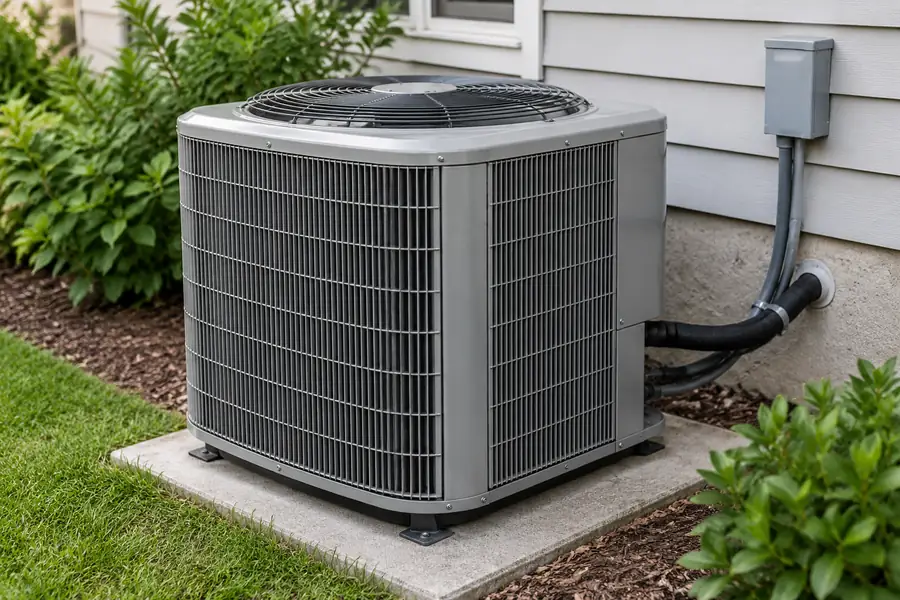
Ground source heat pump cooling removes heat from your home and releases it into the ground through a buried pipe loop or groundwater circuit. In a conventional active-cooling system, an indoor refrigerant circuit cools air or water while the ground loop carries the rejected heat away. Some ground-source systems also offer passive cooling, which uses naturally cool ground-loop fluid and circulation pumps without running the main refrigerant compressor.
Choose the cooling approach by the room temperature and moisture target, the ground-loop condition, and the equipment already installed.
- Need dependable cooling and humidity control? Start with a geothermal model rated for active cooling, plus a properly drained indoor cooling coil.
- Need relief from mild summer overheating? Passive cooling may work if the ground loop stays cool enough and the indoor terminal can remove sufficient heat.
- Already have radiators or a heating-only heat pump? Check cooling compatibility and moisture protection before planning to reuse the equipment.
How Does Ground Source Heat Pump Cooling Work?
In summer, the system takes heat out of the building, raises or transfers it to a usable temperature, and releases that heat into the ground. The ground is the heat sink: it receives unwanted indoor heat, rather than producing a stream of cold air on its own. The U.S. Department of Energy describes the same summer heat-transfer direction in its geothermal heat pump overview.
- Room air or indoor water gives up heat. A water-to-air unit draws warm return air across a cold refrigerant coil; a water-to-water unit cools a separate chilled-water circuit for fan coils or other suitable terminals.
- Refrigerant carries the heat. In a conventional vapor-compression cycle, refrigerant evaporates at the indoor heat exchanger, and the compressor raises its pressure and temperature.
- The ground-side heat exchanger receives the heat. Hot refrigerant rejects heat to water or water-antifreeze fluid in a separate heat exchanger. The refrigerant then passes through an expansion device before the next cycle.
- The ground loop rejects the heat into soil, rock or groundwater. A pump circulates fluid through buried pipes. After shedding heat, it returns to the unit to collect more.
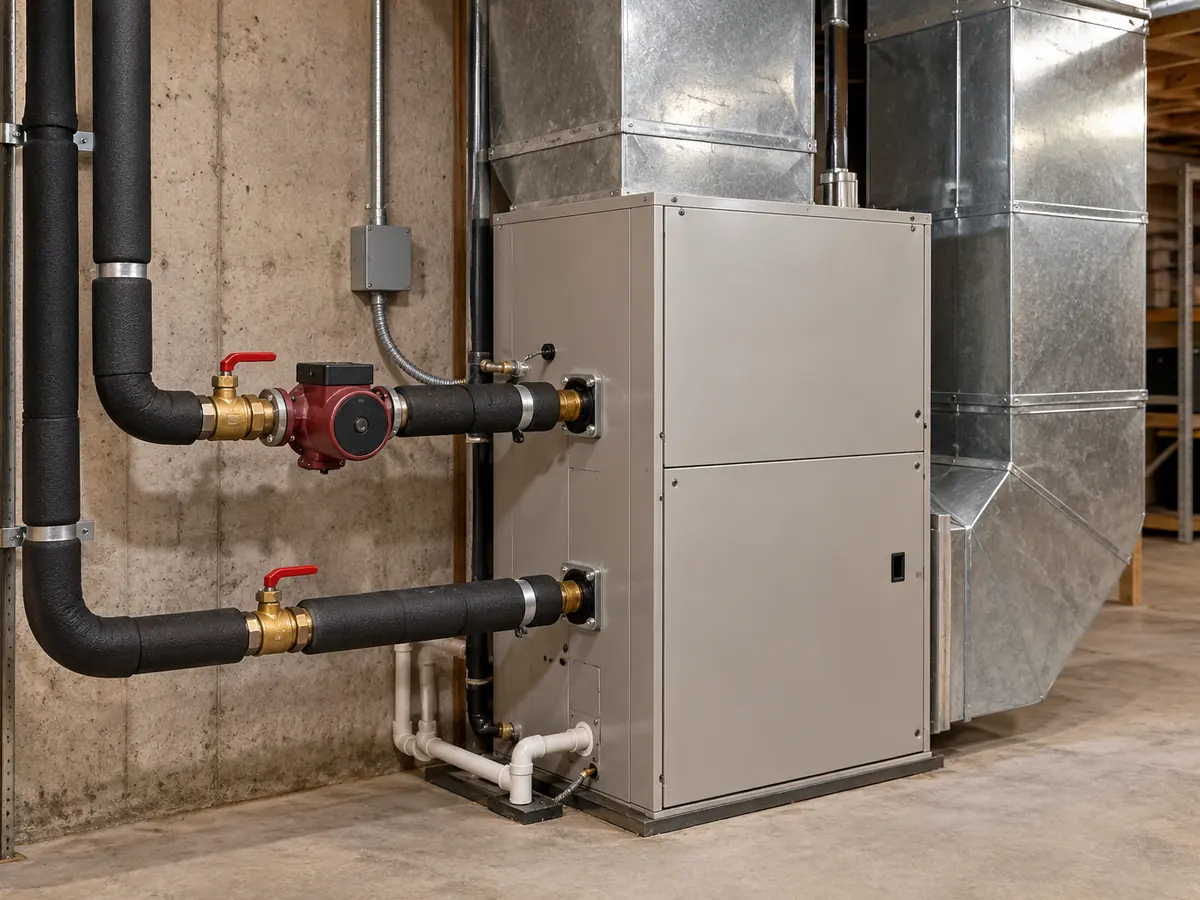
The refrigerant and the ground-loop fluid usually run in separate circuits. A typical closed-loop geothermal heat pump does not pump refrigerant through the buried plastic pipes. Direct-exchange systems use a different ground-loop arrangement and require their own design method. For more detail on fluid separation and heat transfer, see our guide to types of heat exchangers.
Cooling-mode heat balance: the ground must absorb the heat removed from the rooms plus the compressor energy that reaches the ground-side exchanger. For a simplified example, 6 kW of indoor cooling with 1.5 kW of compressor input gives about 7.5 kW of heat rejection. Use this heat balance to understand the ground’s heat-rejection duty. Size the loop with the complete system heat flows, including the relevant pumps and fans.
A reversing valve is common in reversible vapor-compression models: it changes which heat exchanger absorbs heat and which rejects it. A heating-only geothermal unit may not have the necessary cooling configuration. For a general refrigerant-path explanation, see the Airproz heat pump schematic guide.
Active Cooling vs. Passive Cooling: What Changes?
Active cooling uses the refrigerant compressor to produce a controlled cooling effect. Passive cooling transfers heat through cool ground-loop fluid and heat exchangers, with little or no compressor operation for space cooling. These modes do not deliver the same room temperature, humidity control or cooling capacity.
| Question | Active geothermal cooling | Passive ground-source cooling |
|---|---|---|
| What drives cooling? | Refrigerant compressor, loop pump and indoor fans or pumps | Ground-loop pump, building circulation and a transfer heat exchanger or coil |
| Can it cool below loop-fluid temperature? | Usually yes, within the rated equipment operating envelope | Limited by the source-fluid temperature and heat-exchanger approach temperature |
| Can it remove indoor moisture? | Yes, with a properly designed cold coil and condensate system | Not reliably by itself; separate dehumidification may be needed |
| Best use | Defined indoor temperature and humidity targets, higher cooling loads | Moderate cooling, pre-cooling or overheating reduction where ground conditions permit |
| What can reduce results? | Hotter loop fluid, poor flow, compressor capacity limits | Warming ground loop, limited temperature difference, condensation controls |
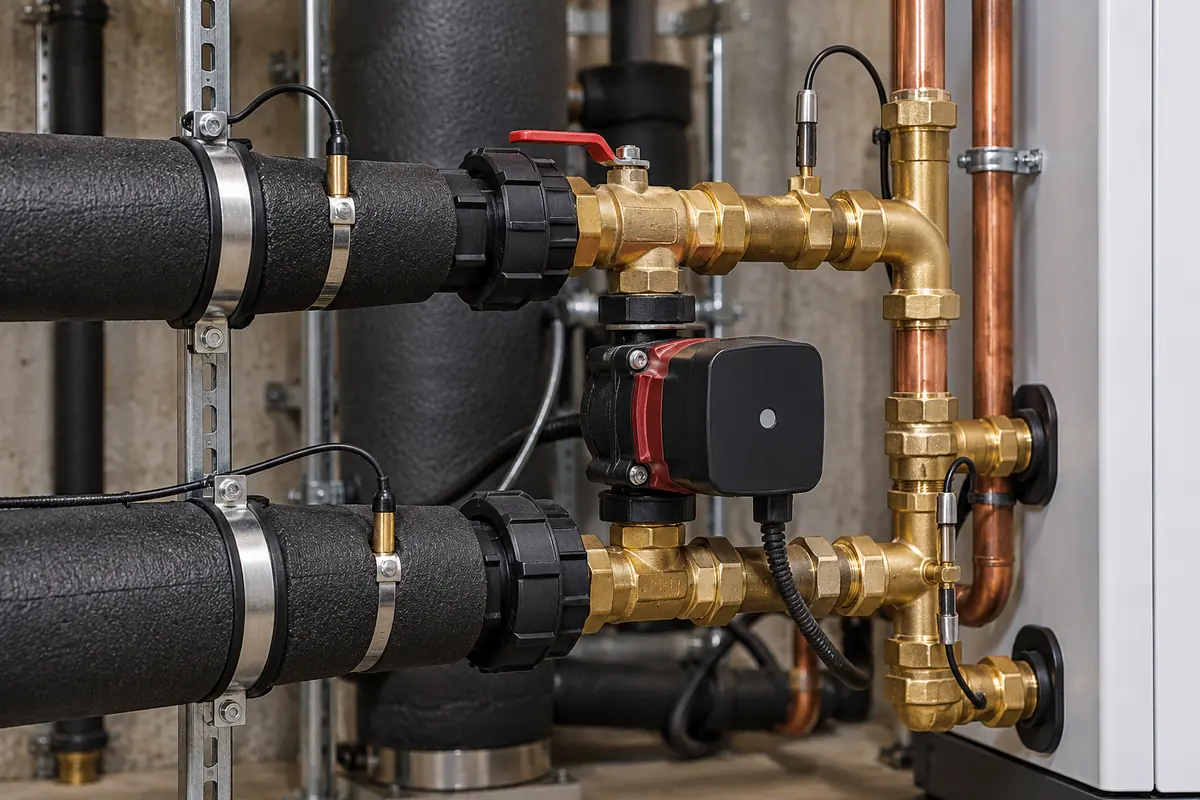
Choose passive cooling when a limited drop in room temperature is acceptable and the expected ground-loop fluid temperature remains low enough for the indoor terminal to absorb heat. For rooms with a firm temperature or humidity target—such as a busy, sunlit office or a humid home—start by checking the rated capacity of an active-cooling design. Ask how much cooling either option can deliver at the warmest expected summer loop condition, not just in early summer.
If summer humidity is high, plan how moisture will leave the building. A chilled floor or uninsulated cold pipe can sweat when its surface falls below the indoor air dew point. Put condensation control, dew-point sensors, pipe insulation and condensate drainage into the design where needed, instead of relying on a thermostat alone.
Which Ground Loop Can Support Geothermal Air Conditioning?
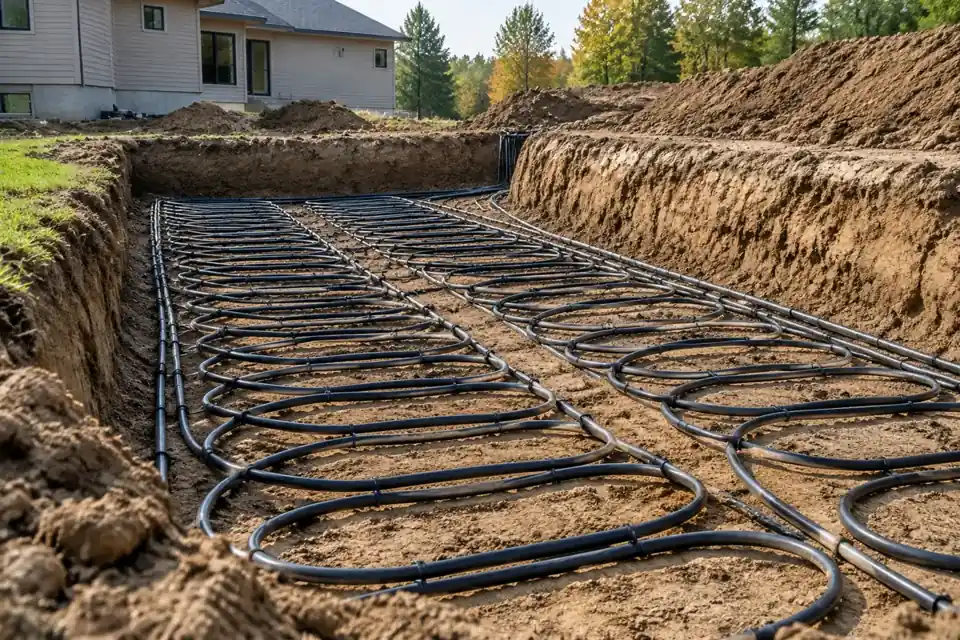
Closed loops exchange heat through sealed underground pipes; open loops move actual groundwater or other approved source water through the system. Both can support geothermal cooling, but the site, water access, soil and approvals determine which design is practical.
| Ground connection | Where it can fit | Main design issue |
|---|---|---|
| Horizontal closed loop | Sites with accessible land for trenching | Land area, pipe spacing, soil moisture, seasonal ground temperatures |
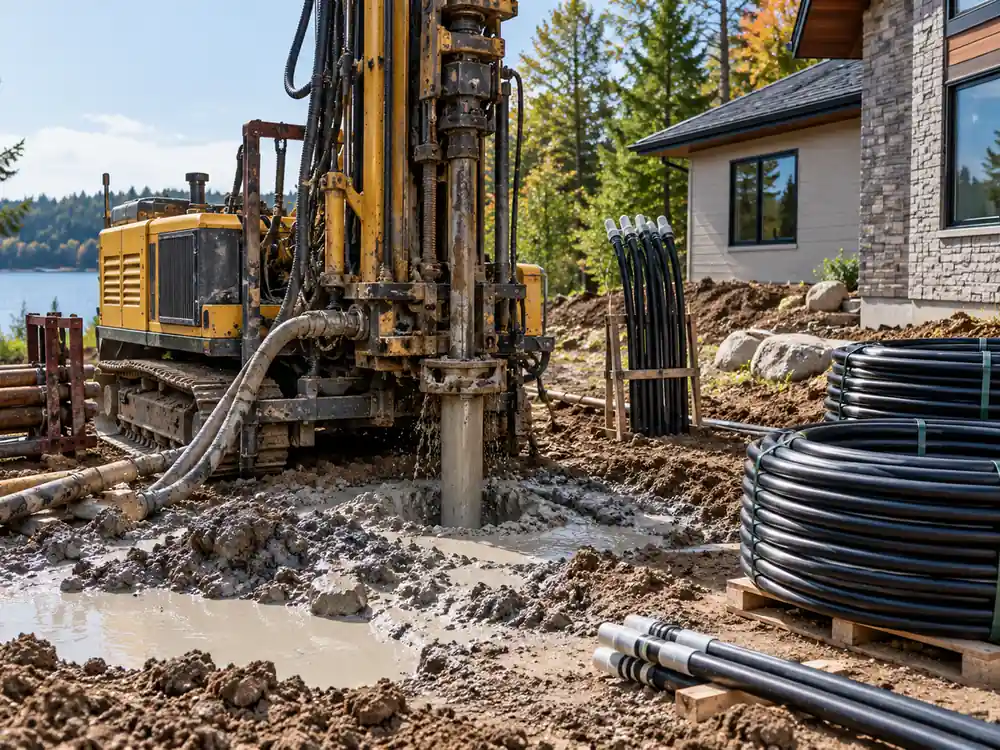
| Vertical closed loop | Land-limited properties and many larger projects | Drilling access, geology, grout, borehole field and thermal interference |
| Pond or lake closed loop | Approved water bodies with suitable size and depth | Water-body conditions, anchoring, protection and approvals |
| Open groundwater loop | Sites with sustainable, permitted water supply and discharge | Water flow, fouling, corrosion, pump energy and discharge requirements |
A sealed closed-loop geothermal heat pump usually circulates water or a water-antifreeze blend in plastic piping. An open-loop geothermal heat pump uses source water that must meet the equipment’s water-quality and flow limits; local permitting and reinjection or discharge requirements can rule it out. ENERGY STAR defines these two ground-exchange approaches separately in its geothermal product criteria.
Size the ground loop from the building’s heating and cooling loads, ground heat-transfer properties, entering-fluid temperatures, operating hours, pump energy and the annual balance of heat entering and leaving the ground. The ASHRAE ground-source guidance explains why source temperatures and equipment ratings must be checked together.
For buildings that need much more cooling than heating, review more than one summer. Repeated heat rejection can raise loop temperatures and reduce future cooling capacity. Ask for a multi-year loop-temperature estimate. If it shows a continuing rise, the designer may need more ground-exchange capacity or a hybrid heat-rejection system.
How Does Geothermal Cooling Reach Each Room?
A ground loop alone does not cool a room. You also need indoor equipment designed to deliver cooling. This is one of the most important checks when someone already has a ground-source system that was installed primarily for heating.
Water-to-air heat pumps and ducted cooling
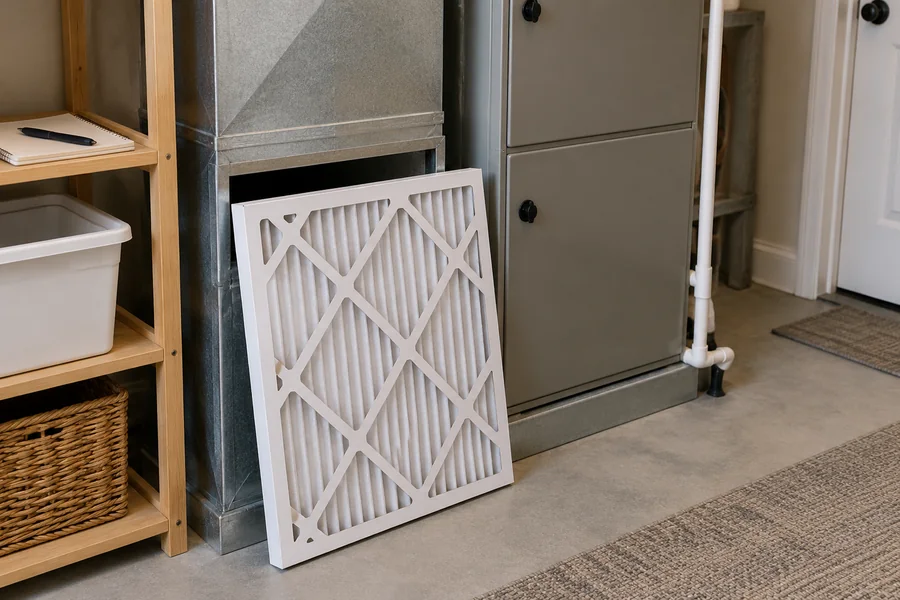
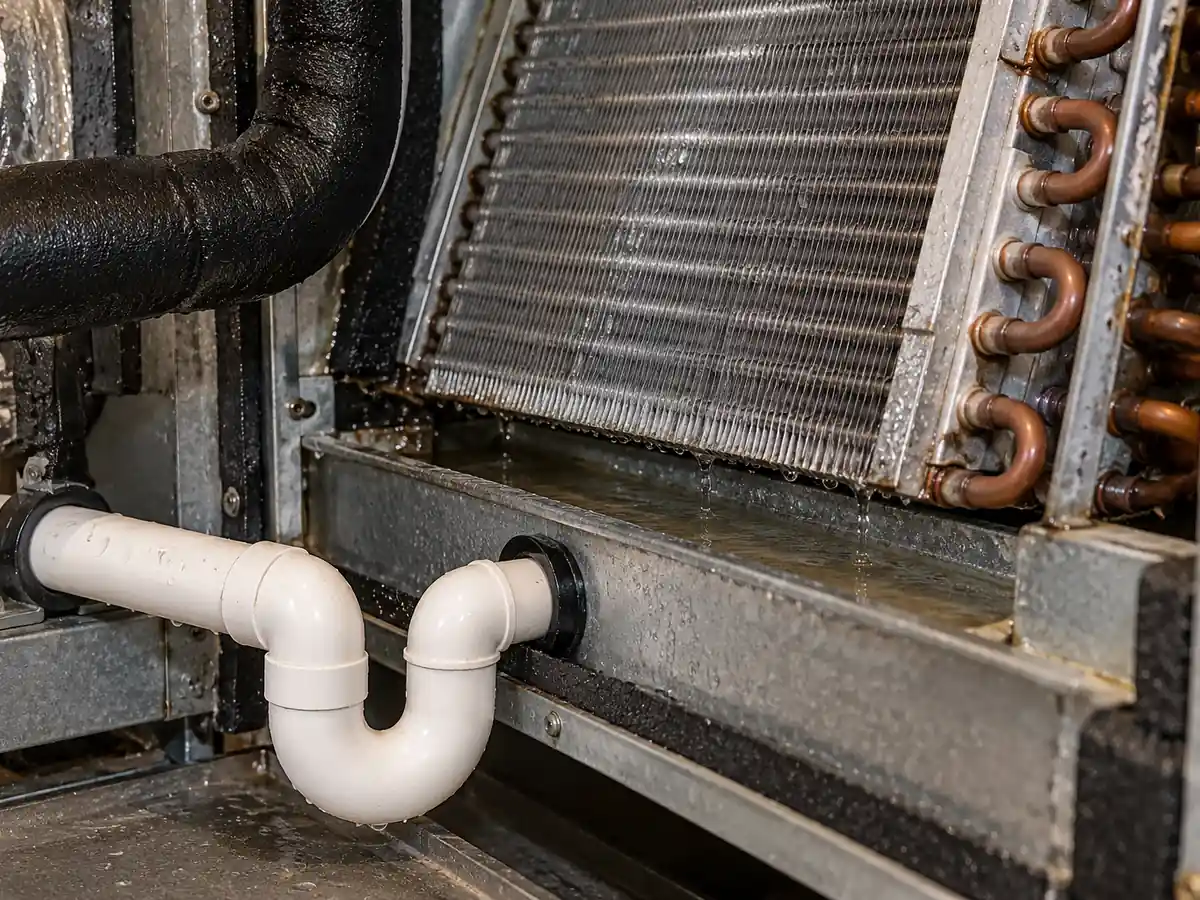
A water-to-air geothermal unit uses an indoor coil and fan to cool air that travels through ducts. It can remove moisture when the coil, airflow and drain are designed correctly. Check static pressure, fan energy, filter condition and room-by-room airflow. Ducts sized for a different heating system may not distribute the intended cooling evenly.
For multi-zone buildings, the FCU vs AHU differences guide explains how room temperature control, central ventilation and humidity removal can be divided between indoor equipment types.
Water-to-water heat pumps and chilled-water terminals
A water-to-water unit produces chilled water for compatible fan coils, air-handling units or other cooling emitters. The selected leaving-water temperature and flow rate must match the terminal’s cooling and latent-load needs. Where room humidity is high, a fan coil with safe condensate collection is often easier to manage than a plain radiator or floor circuit. For coil type, airflow and drainage details, see how a fan coil unit works.
Existing radiators or underfloor heating
Existing heating radiators often cannot provide useful cooling at a safe surface temperature. Radiant floors can work only with suitable controls, indoor humidity management and dew-point protection. A heat pump’s cooling setting does not make every heating terminal suitable for cooling.
| Existing indoor system | What to verify before adding cooling |
|---|---|
| Air ducts | Cooling airflow, room distribution, insulation and a drain for condensed water |
| Fan coil units | Cooling output at the chosen water temperature, airflow and condensate drainage |
| Heating radiators | Whether they deliver meaningful cooling without unsafe condensation; often an unsuitable choice |
| Radiant floors | Surface temperature above indoor dew point, floor construction and separate humidity control |
How Efficient Is a Ground Source Heat Pump for Cooling?
Geothermal cooling can use less electricity than an air-source system because the ground usually offers a more stable heat-rejection temperature than hot outdoor air. The actual result still depends on entering-water temperature, compressor performance, pumps, fans and seasonal load. Evaluate cooling performance across the expected summer range of entering-water temperatures and part-load conditions.
For geothermal cooling, EER is the cooling output in Btu per hour divided by electric input in watts at the stated rating point. COP in many geothermal product specifications refers to heating efficiency, so it is not interchangeable with cooling EER. ENERGY STAR’s published geothermal criteria distinguish closed-loop water-to-air (EER 17.1) from open-loop water-to-air (EER 21.1) for the listed single-stage qualification conditions. These figures describe ENERGY STAR qualification at specified test conditions. Compare project operating cost using model performance, loop or well pumping power, and local water requirements.
Illustrative power calculation: at 24,000 Btu/h of cooling and an assumed EER of 20, the rated electric input is 24,000 ÷ 20 = 1,200 W. If that exact load and input held for 6 hours a day over 30 days, energy use would be 1.2 × 6 × 30 = 216 kWh, or $38.88 at an assumed $0.18/kWh. For real operating costs, adjust for part-load operation and add any pump or fan energy excluded from the rated input.
Use the manufacturer’s extended cooling-performance table for the exact model. Request output capacity and electrical input at the project’s design entering-loop temperature, indoor cooling condition and fluid flow. Then check which fan and pump loads are already included in the rated watts, and add only the auxiliary loads that are excluded. Compare two systems at equivalent cooling duty and operating conditions. The PNNL Building America guidance recommends design-point manufacturer data instead of choosing solely from a certificate rating.
For a project budget, estimate electricity use across expected operating hours, changing summer loop temperatures and part-load conditions, using the model’s performance data and applicable auxiliary power.
Ground-source vs. air-source cooling: what changes?
| Decision factor | Ground-source cooling | Air-source cooling |
|---|---|---|
| Where heat goes | Into soil, rock or approved source water | Into the outdoor air |
| Site work | Ground-loop design, trenching, drilling or a suitable well | Outdoor unit location and its required connections |
| Initial cost | Often higher due to site investigation and ground works | Often simpler to install without a buried loop |
| Fair running-cost test | Cooling delivered and total electricity, including applicable loop pumps and indoor equipment | Same cooling duty and total electricity, including outdoor and indoor fans as applicable |
For the air-source side of this comparison, read how an air-to-water heat pump works. A reversible air-to-water unit can produce chilled water, while rejecting heat to outdoor air instead of a buried ground loop.
The better-value system depends on total installed cost, local ground-work conditions, design-point efficiency, annual electricity use and the planned ownership period. An efficient air-source system may be the better choice if drilling is difficult or the extra ground work would not be recovered during the planned ownership period.
If an air-source chilled-water system better fits the site, compare Airproz’s R290 monobloc 6/8/12 kW air-to-water series and R290 monobloc 18 kW air-to-water model. These are air-source alternatives, not ground-source heat pumps. Select by the product’s cooling output and electrical input at the required outdoor-air and water temperatures; the series label alone is not the design-point cooling capacity.
What Should You Check Before Choosing Ground-Source Cooling?
Start with the summer cooling load and humidity requirement, then confirm that both the indoor equipment and the ground loop can carry the required heat. Confirm cooling capacity at the project’s design loop temperature, then check the indoor delivery system and ground-loop heat rejection together.
- Calculate the building cooling load. Include climate, glazing, shade, ventilation, occupancy, equipment gains and both sensible and latent loads. Decide the target indoor temperature and humidity.
- Choose the delivery method. Confirm whether rooms will use ducts, fan coils or purpose-designed radiant cooling. Identify drainage and dew-point protection.
- Confirm the heat pump supports cooling. Obtain the exact model’s cooling capacity and electrical input at the project entering-ground-fluid temperature and required chilled-water or supply-air condition.
- Design the ground-side heat rejection. Use the building’s annual heating and cooling demand, ground properties, summer peak and loop temperatures. Account for heat added by the compressor and applicable pumps.
- Review the water circuit and permissions. Check actual fluid flow, pressure drop, antifreeze, air separation, pipe insulation, source-water quality and required drilling or water permits.
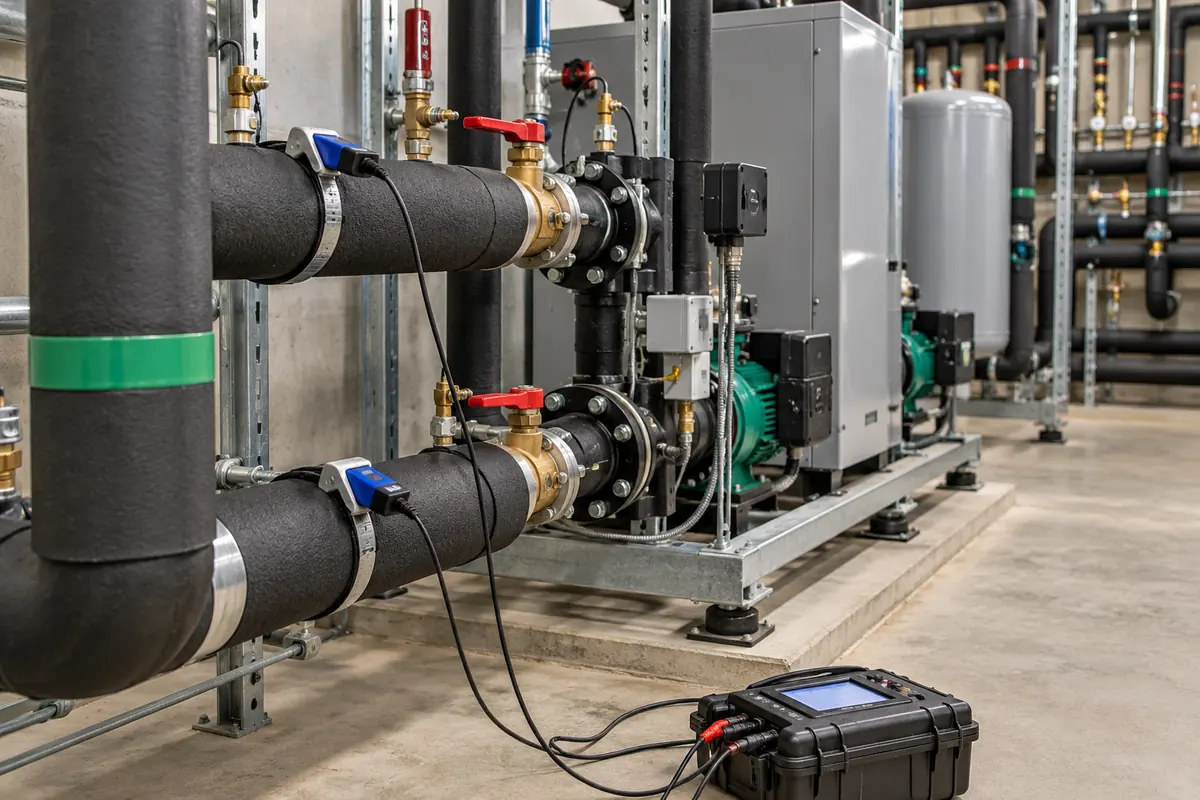
- Commission and record results. Measure source entering/leaving temperatures, loop flow, indoor supply/return conditions, electricity use and condensate operation at meaningful loads. Compare those readings with the design and model documentation.
Information to send the design team: building location; peak summer cooling and winter heating loads; annual use; desired room temperature and humidity; land, wells or groundwater information; indoor terminals; and available electrical supply. The designer uses these inputs to check equipment capacity, ground-loop performance and indoor humidity control at the project’s design conditions.
What should the designer return before equipment is ordered?
- A cooling-mode recommendation: active, passive or a combined approach, with the conditions that could change the choice.
- Capacity and power at design conditions: the model’s cooling output, input watts and relevant auxiliary loads at the worst expected summer loop temperature.
- An indoor delivery plan: target supply-air or chilled-water conditions, room distribution, condensate drainage and humidity controls.
- A ground-exchange design: site assumptions, loop sizing, expected multi-year fluid temperatures, pressure drop and pump electricity.
- A commissioning checklist: planned readings for loop temperature and flow, indoor conditions, electricity use and condensate performance, for comparison after installation.
For a ground-source project, obtain a geothermal equipment proposal and ground-loop design from qualified providers. Airproz’s published air-to-water heat pumps are air-source systems; compare them separately when an air-source approach fits the building and site. For any shortlisted air-source model, check its cooling mode, output at design conditions and required water temperatures.
Why Might Geothermal Cooling Become Weak or Uneven?
Check what changed in the indoor cooling path and ground loop before assuming the heat pump is undersized. Similar room symptoms can come from very different faults.
Start with the cooling setting, filters, room airflow and condensate drainage. If performance is still weak, a qualified technician can compare ground-loop flow and entering-water temperature with the original design and model performance data. Those measurements help distinguish a flow or control fault from a long-term heat-rejection problem.
| What you notice | First evidence to check | Useful next action |
|---|---|---|
| Supply air becomes warmer late in the season | Ground-loop entering-water temperature and compressor run time versus design values | Review long-term heat rejection and loop performance with the designer |
| Rooms feel cool but damp | Indoor relative humidity, condensate drainage, coil temperature and run time | Verify latent capacity and consider dedicated dehumidification |
| Cooling drops suddenly | Controls, fault codes, ground-flow readings, strainers and circulation pump | Restore proper flow or address recorded faults using the model’s service procedure |
| Some rooms remain hot | Room-by-room load, filter condition, duct/terminal airflow and balancing | Correct airflow or distribution before changing the heat-pump setting |
| Cold pipes or floors sweat | Indoor dew point and surface temperatures | Stop the condensation condition and revise insulation or dew-point control |
Refrigerant and electrical diagnosis, drilling and groundwater work need qualified personnel. After a repair, repeat the same relevant loop-flow, temperature, room-humidity and power checks, where applicable, and compare them with the earlier readings. A fix is complete when the measured cooling performance recovers, not merely when the fault code clears.
Ground source heat pump cooling works by moving indoor heat into the ground rather than dumping it into hot outside air. Active geothermal cooling can provide conventional room cooling and, with the right indoor coil, dehumidification. Passive cooling can reduce compressor use where ground temperatures and the desired cooling level permit, but it usually has more limited temperature and moisture control.
The deciding checks are the building’s summer load, the indoor cooling method, the entering ground-loop temperature and the loop’s ability to reject heat over time. Compare verified model performance and whole-system electrical demand before choosing an installation.
Frequently Asked Questions About Ground Source Heat Pump Cooling
Can ground-source heat pumps cool a house in summer?
Yes, if the installed heat pump and indoor distribution system support cooling. An active geothermal heat pump removes indoor heat and rejects it into the ground loop. A heating-only model or an unsuitable indoor emitter will not provide the same cooling result.
Does a geothermal heat pump need a reversing valve for cooling?
A conventional reversible vapor-compression geothermal heat pump normally uses a reversing valve to switch the refrigerant path between heating and cooling. Passive cooling may bypass the compressor instead, so its valve arrangement is different. Check the model schematic rather than assuming every unit is reversible.
Can underfloor heating pipes provide ground-source cooling?
Sometimes, but only when the controls, floor construction and moisture protection are designed for cooling. Cooling output is limited, and a floor surface below the room dew point can collect condensation. A fan coil or suitable air system is often more practical when strong cooling and dehumidification are required.
Does geothermal cooling remove humidity?
An active water-to-air system can remove moisture when its indoor coil is cold enough and has proper condensate drainage. Passive cooling or radiant cooling does not automatically dehumidify; a separate moisture-control method may be necessary in humid weather.
Is an open-loop geothermal system always more efficient?
No. Open-loop rating conditions can produce higher published EER values, but well pumping power, water quality, filtration, water disposal requirements and local groundwater permits can change the whole-system result. Compare actual installed operating conditions, not unlike-for-like labels.
Why might a ground-source heat pump fail to cool well late in summer?
Possible causes include rising ground-loop entering-water temperature, inadequate fluid flow, a fouled filter or coil, refrigerant or control faults, or an indoor cooling load above the design. Check thermostat and mode, indoor airflow, loop flow and temperatures, and the manufacturer fault record before changing system settings.