Specifying a heat pump water heater for a hotel, apartment block, or distributed energy project means one thing above all else: you cannot afford a brand that fails at scale. Engineers evaluating HPWH suppliers consistently report the same friction points — inconsistent COP data, opaque OEM terms, and certifications that don’t match the destination market. This guide cuts through the noise. Based on verified technical specs, real-world B2B procurement feedback, and 2026 refrigerant compliance requirements, we’ve ranked the ten brands that engineers actually specify and reorder. Whether you’re sourcing for Europe’s R290 mandate, Australia’s SAA-certified projects, or UAE hotel developments, this list gives you a structured starting point.
How We Evaluated These Heat Pump Water Heater Brands
Choosing the right heat pump water heater isn’t a matter of brand reputation alone — it comes down to verifiable performance data, compliance documentation, and how a manufacturer supports its B2B partners after the sale. To build this list, we combined technical benchmarking with direct feedback from engineers and procurement teams who specify HPWH systems for hotels, residential developments, and distributed energy projects across UAE, Australia, Europe, Africa, and Southeast Asia.
Each brand was scored against three criteria: efficiency performance, refrigerant compliance for target markets, and the depth of OEM/technical support available to distributors and engineering firms.
Selection Criteria — COP, Refrigerant Compliance & B2B Support
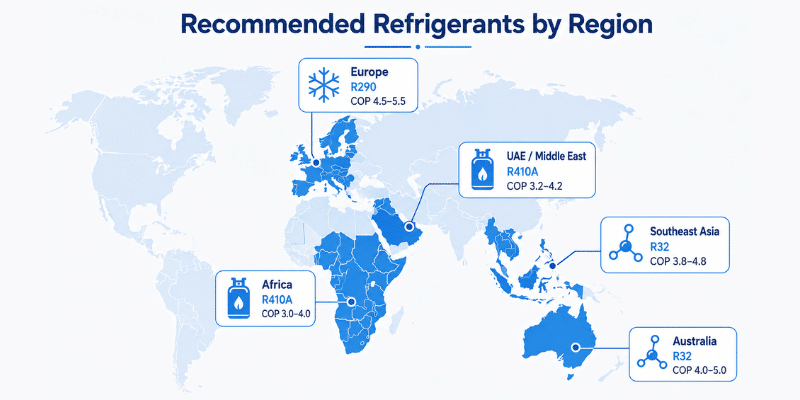
We weighted three factors equally. COP (Coefficient of Performance) measures how much heat output a unit delivers per unit of electricity consumed — and this depends more on compressor design and operating conditions than on refrigerant type alone. R410A units, for instance, can reach a COP of up to 4.3 under favorable conditions, on par with many R32 or R290 systems. For 2026 buyers, the deciding factor isn’t raw efficiency — it’s whether a refrigerant is viable in the destination market, both legally and technically.
Europe and Australia: regulatory pressure drives the shift. Under the EU’s revised F-Gas Regulation (2024/573), R32 — with a GWP of 675 — will be banned in new split heat pumps and air conditioners up to 12kW from January 1, 2027. R410A faces even tighter limits: new single-split units with less than 3kg of charge were already restricted from 2025 under the GWP 750 cap. Australia is following a similar path under its own HFC phase-down, with R32 and R290 increasingly standard in SAA-certified units.
Middle East and Africa: technical maturity, not regulatory exemption. R410A remains the practical choice here — and not simply because GWP restrictions don’t yet apply. At ambient temperatures of 45–50°C, common across the Gulf and parts of Africa, R410A compressor systems have years of high-ambient optimization behind them, with well-controlled discharge temperatures even under extreme load. R290, as an A3 flammable refrigerant, carries stricter charge limits that constrain unit capacity precisely in the high-temperature, high-capacity applications this region demands. For B2B buyers here, R410A’s combination of strong COP (up to 4.3), mature high-ambient engineering, and an established service network makes it the more reliable specification — a technical choice, not just a compliance shortcut.
Refrigerant Comparison by Region
| Refrigerant | Typical COP | GWP | Best-Fit Markets | Why |
|---|---|---|---|---|
| R290 (Propane) | 3.5 – 4.5 | ~3 | Europe, Australia | EU mandates units ≤12kW shift away from R32 by 2027; REHVAShenling preferred for low-GWP compliance |
| R32 | 3.8 – 4.6 | 675 | Transitional EU markets, parts of Asia | High efficiency, but subject to EU phase-out from 2027<sup>[2,8]</sup> |
| R410A | up to 4.3 | 2088 | Middle East, Africa, parts of Southeast Asia | Mature high-ambient performance with no GWP restriction |
Heat Pump Water Heater Energy Savings as a Core Metric
Among all evaluation factors, heat pump water heater energy savings carried particular weight — it’s the metric that most directly translates to ROI for the end client and, by extension, to a distributor’s ability to close the sale. A unit with a COP of 4.0 delivers roughly four units of heat energy for every unit of electricity consumed, compared to a 1:1 ratio for conventional electric resistance heaters. Across the brands evaluated, those demonstrating consistent energy savings in third-party test reports — not just manufacturer claims — ranked highest in our list.
Top 10 Heat Pump Water Heater Brands: Side-by-Side Comparison
For B2B buyers, the world’s most recognized heat pump water heater names aren’t necessarily the right fit — and understanding why matters more than comparing spec sheets line by line. The brands below represent the benchmarks engineers and procurement teams measure against, along with where each one tends to fall short for distributors, OEM brand owners, and multi-market projects.
Daikin & Mitsubishi Electric — The Engineering Benchmark, With No Path to Your Own Brand
Daikin and Mitsubishi Electric are frequently the names engineers reference first when discussing build quality, refrigerant control precision, and quiet operation — particularly in the European and Japanese residential markets. Their reputation is well-earned and rarely questioned on technical merit.
The limitation for B2B buyers is structural: neither brand offers meaningful OEM or private-label programs. A distributor selling Daikin or Mitsubishi Electric is selling their brand, with their terms, and their support model — there’s no path to building independent brand equity in your market.
Midea & Gree — Manufacturing Scale, Without the Compliance Groundwork Done For You
As two of the largest manufacturers globally, Midea and Gree offer significant production scale, competitive pricing, and broad refrigerant coverage across R410A, R290, and R32 — making them a common starting point when distributors first explore large-scale sourcing from China.
The challenge is what happens after the factory gate. Both brands operate primarily as large-scale OEM suppliers across countless product categories, which means distributors are often responsible for navigating market-specific certification (CE, SAA, GCC), refrigerant compliance documentation, and after-sales infrastructure largely on their own — without a dedicated B2B support structure built around heat pump water heaters specifically.
Rheem & A.O. Smith — Strong Regional Recognition, Limited Range Beyond Residential
Rheem and A.O. Smith hold dominant brand recognition in Australia and North America respectively, with established SAA, WaterMark, and CSA certification histories that give buyers in those markets immediate confidence.
Their heat pump water heater lines, however, are concentrated in residential capacities — typically under 500L. For engineering firms specifying larger commercial systems for hotels, apartment complexes, or distributed energy projects, neither brand’s HPWH range extends comfortably into that territory, and their certification footprint outside their home regions (UAE, Africa, Southeast Asia) is comparatively thin.
Panasonic & Vaillant — Ahead on R290, But Built for Single-Market Distribution

Panasonic and Vaillant have both moved meaningfully toward R290 across parts of their European ranges — positioning them ahead of the EU’s 2027 restrictions on small R32 units, and giving them strong credibility on refrigerant compliance specifically.
Their distribution models, though, are built around their home markets — primarily Europe and Japan. Neither brand has a B2B framework designed for distributors operating across UAE, Australia, Africa, and Southeast Asia simultaneously, which leaves a gap for buyers needing one supplier with cross-region certification and refrigerant flexibility built in from the start.
Stiebel Eltron — The Quality Reference Point, Not a Sourcing Option

Stiebel Eltron is often cited by European engineers as a quality reference for heat pump water heater construction and ErP documentation. Its limited capacity range (220L–300L) and absence of any OEM program, however, mean it functions more as a benchmark for “what good engineering looks like” than as a practical sourcing option for distributors or OEM brand owners.
Where Airproz Fits — Built for the Gap These Brands Leave Open

The pattern across the brands above is consistent: each excels in a specific dimension — engineering reputation, manufacturing scale, regional certification, or refrigerant compliance — but none combines all of them into a single B2B-ready package across multiple markets.
Airproz was structured around exactly that gap. Capacity coverage runs from 100L residential units to 5000L commercial cascade systems. Refrigerant options span R290, R410A, and R32, matched to what each destination market actually requires — R290 for Europe’s 2027 compliance trajectory, R410A for high-ambient performance in the UAE and Africa, R32 where it remains viable. Certification coverage includes CE, SAA, and GCC. And unlike the brands profiled above, OEM and private-label production is a core part of the business model, not a side offering — built specifically for distributors, engineering firms, and brand owners entering UAE, Australia, Europe, Africa, and Southeast Asia.
The question for B2B buyers isn’t which of the brands above is “best” in isolation — it’s which one solves the specific combination of problems your project and your market present. For many distributors operating across more than one of these regions, that combination doesn’t exist among the household names — which is the gap Airproz was built to fill.
See how Airproz’s OEM program works in practice in our B2B Heat Pump Buying Guide.
What Makes a Heat Pump Water Heater Manufacturer B2B-Ready?
The brand comparison above highlights a recurring theme: technical performance alone doesn’t determine whether a supplier works for a distributor or engineering firm. What separates a B2B-ready heat pump water heater manufacturer from a brand that simply sells good products comes down to four things — R&D depth, training and technical support before and after the sale, after-sales infrastructure, and production capacity that translates into reliable delivery.
R&D Capability and Customization Depth
Off-the-shelf products work for off-the-shelf projects. But a hotel in the UAE specifying high-ambient performance, a European distributor needing R290 conversion ahead of 2027, or an OEM brand owner requiring a specific control panel interface — none of these are served by a manufacturer that can only offer existing SKUs.
A genuine heat pump water heater OEM manufacturer maintains in-house R&D capacity to adjust refrigerant configuration, voltage standards, capacity tiers, and control logic to match destination-market requirements — rather than treating every customization request as a special, one-off project that delays the entire order. This R&D depth is also what allows a manufacturer to keep pace with shifting refrigerant regulations across multiple regions simultaneously, instead of redesigning a product line each time one market’s compliance rules change.
Pre-Sales Product Training and After-Sales Installation Support
Specifying the right configuration is only half the equation — the people selling and installing the unit need to know how to handle it correctly. As heat pump adoption accelerates across Europe, two groups in particular are entering this market without a heat pump background: distributors transitioning from boiler-based product lines, and installation teams built around traditional plumbing or HVAC work. A manufacturer that treats training as a core service — not an afterthought — directly determines how smoothly these teams convert customers and execute installations.
Pre-sales: helping boiler distributors make the leap to heat pumps
A significant share of HPWH distributors and installers in Europe are transitioning from a boiler-dominated business — a shift driven by tightening regulations on gas boiler sales and government incentive schemes favoring heat pumps. These teams understand hydronic systems and customer relationships, but heat pump sizing logic is fundamentally different: COP varies with ambient temperature and flow temperature, buffer tank sizing affects defrost cycle performance, and refrigerant choice determines installation clearance requirements in ways gas boilers never did.
A B2B-ready manufacturer doesn’t just hand over a spec sheet — it provides product training that translates this knowledge gap directly: how to size a unit against a customer’s existing radiator or underfloor system, how to position heat pump COP claims honestly against the boiler efficiency numbers customers are used to, and how to handle the sales conversation when a customer asks “why does this cost more upfront.” For a distributor making this transition, this kind of pre-sales training often determines whether their existing customer base converts — or goes to a competitor who explains it better.
After-sales: supporting in-house installation teams
Installation labor now represents a growing share of total project cost across European markets, prompting many distributors and engineering firms to bring installation in-house rather than relying on third-party contractors with limited availability and inconsistent quality. The challenge is that an in-house team built around plumbing or boiler installation typically lacks experience with refrigerant handling — particularly the safety protocols required for A3-classified refrigerants like R290, including charge limits, leak detection, and ventilation requirements that don’t apply to traditional systems.
A manufacturer offering structured after-sales installation and repair training — covering refrigerant safety procedures, commissioning checklists, and common fault diagnosis — allows a distributor’s in-house team to handle installations independently and to correct competence rather than learning through callbacks. This directly affects warranty costs, customer satisfaction, and how quickly a distributor can scale installation capacity alongside sales volume.
Production Capacity, Delivery Reliability & Warranty Coverage
Lead time promises are only as reliable as the factory’s actual production capacity. A manufacturer running near full capacity on existing contracts has little room to absorb a new distributor’s order without pushing out delivery dates — a risk that becomes critical for projects with fixed installation timelines, where a hotel’s opening date doesn’t move because a shipment is late.
Airproz operates with an annual production capacity of up to 500,000 units, giving distributors and engineering firms confidence that order volume — whether a single project shipment or an ongoing distribution agreement — won’t be the bottleneck. This capacity is backed by a 5-year warranty across the product range, paired with the pre-sales sizing support and after-sales installation training described above — reflecting the same confidence in build quality that underpins the OEM and customization capabilities discussed earlier.
Regional Buying Considerations for 2026
The evaluation criteria covered so far apply across markets — but compliance requirements, climate conditions, and incentive structures vary sharply by region. For any heat pump water heater specified across UAE, Australia, Europe, Africa, or Southeast Asia, the regional context below should shape the final decision as much as the brand or manufacturer comparison itself.
Europe — R290 Mandate & CE Certification Requirements
Europe’s refrigerant transition timeline was covered earlier, but it’s worth restating in a regional buying context: units up to 12kW using R32 (GWP 675) face an EU ban from January 1, 2027, making R290 the safer long-term specification for any project with a multi-year procurement horizon. CE certification remains the baseline requirement across all EU and EEA markets, with ErP energy labeling increasingly scrutinized by both regulators and end clients comparing efficiency claims.
For distributors specifying a heat pump water heater today, the practical question isn’t “is R32 still legal” — it’s whether a five-to-seven-year distribution agreement with a manufacturer will require a mid-contract product switch. Specifying R290-ready units now avoids that disruption.
Australia — SAA-Certified Models and Rebate Eligibility
Certification in Australia is closely tied to consumer-facing incentives, which makes it a commercial consideration as much as a compliance one. Installers must be accredited by Solar Accreditation Australia (SAA) to claim Small-scale Technology Certificates (STCs) on a customer’s behalf — and by extension, the unit itself must meet the certification standards required for STC eligibility. These STCs are worth roughly $800–$1,200 per eligible heat pump hot water system and are applied directly as a point-of-sale discount, meaning the rebate is baked into the price the end customer sees on day one.
For a distributor, this means SAA certification isn’t optional paperwork — it directly affects whether the heat pump water heater units being sold are price-competitive against rebate-eligible alternatives at the point of sale. Some states layer additional incentives on top of the federal scheme — NSW, for example, adds a further rebate of up to roughly $640 for households replacing an electric system, which can make a meaningful difference in how a distributor positions pricing in different states.
UAE & Middle East — High-Ambient Performance Above 43°C
In a region where summer ambient temperatures regularly exceed 43°C, a unit’s published COP under standard test conditions (typically rated at 7°C or 35°C ambient, depending on the standard) tells buyers very little about how it will perform in actual operating conditions. The relevant question for engineers specifying a heat pump water heater for hotels, residential towers, or labor accommodation projects in the UAE, Saudi Arabia, or broader GCC is whether the compressor and refrigerant system maintain stable output and avoid high-pressure cutouts at sustained high-ambient operation — not what the spec sheet says under European test conditions.
GCC G-Mark certification, where applicable, and verified high-ambient test data (rather than extrapolated figures) should be standard requirements in any tender for this region. R410A remains the predominant refrigerant choice here, for the high-ambient engineering maturity discussed earlier — though buyers should confirm a manufacturer’s specific high-ambient test results rather than assuming refrigerant type alone guarantees performance.

Africa & Southeast Asia — Off-Grid Compatibility and Voltage Tolerance
Grid reliability is the defining variable across much of Africa and parts of Southeast Asia. Voltage fluctuations, brownouts, and — in some regions — reliance on generator or solar-hybrid power for parts of the day mean that a unit’s tolerance for voltage variation (commonly specified as a percentage range, e.g., ±10% or wider) is as important as its rated efficiency. A heat pump water heater that trips out or suffers compressor damage during a voltage dip becomes a warranty liability and a reputational problem for the distributor, regardless of how efficient it is under stable power.
For projects in areas with limited or unreliable grid infrastructure, compatibility with solar-hybrid setups — units designed to accept variable DC or hybrid AC/DC input — is an increasingly common specification requirement, particularly for off-grid resorts, remote staff housing, and rural development projects across the region.
“Ready to specify a heat pump water heater for your region? See our B2B Heat Pump Buying Guide for full sourcing checklists by market.”
FAQ: Heat Pump Water Heater Brands Q&A
Q1: What is the most energy-efficient heat pump water heater brand for commercial use in 2026?
There isn’t a single “most efficient” brand across the board — efficiency depends on capacity range, refrigerant, and operating climate. For commercial-scale projects, brands offering R32 or R290 systems with COP ratings in the 4.0–4.5 range, combined with a capacity range that actually covers commercial loads (above 1000L), are the realistic shortlist. Airproz units reach a COP of up to 4.3 across its R290, R410A, and R32 lines, with capacity scaling to 5000L for commercial cascade systems.
Q2: Which heat pump water heater brands support R290 refrigerant for the European market?
Several major brands — including Panasonic and Vaillant — have shifted parts of their European ranges to R290 ahead of the EU’s 2027 restrictions on small R32 units. Under the EU’s revised F-Gas Regulation, R32 units up to 12kW will be banned from January 1, 2027, making R290 support a key sourcing criterion for any distributor with a multi-year procurement plan. Airproz offers R290-based heat pump water heaters with CE certification, covering capacities from 100L to 5000L.
Q3: How much energy savings does a heat pump water heater deliver compared to electric resistance heaters?
A heat pump water heater with a COP of 4.0 delivers roughly four units of heat output for every unit of electricity consumed, compared to a 1:1 ratio for conventional electric resistance heaters — translating to heat pump water heater energy savings of up to 70–75% on water heating energy costs, depending on climate and usage patterns. Third-party test reports, rather than manufacturer claims alone, should be used to verify these figures for a specific model.
Q4: Which brands offer OEM and private label heat pump water heater programs for distributors?
Among globally recognized names, Midea and Gree offer the broadest OEM capability, though distributors are typically responsible for managing market-specific certification and after-sales infrastructure independently. Brands like Daikin, Mitsubishi Electric, and Stiebel Eltron generally do not offer meaningful private-label programs. A genuine heat pump water heater OEM manufacturer — such as Airproz — combines private-label production with built-in certification support (CE, SAA, GCC) and after-sales infrastructure as part of the program, rather than leaving those elements to the distributor.
Q5: What certifications should I check when sourcing a heat pump water heater for Australia or the UAE?
For Australia, installers must hold Solar Accreditation Australia (SAA) accreditation to claim Small-scale Technology Certificates (STCs) on a customer’s behalf, so the unit itself must meet SAA-eligible standards — this directly affects end-customer pricing through the rebate. For the UAE and broader GCC, GCC G-Mark certification is the relevant standard, alongside verified high-ambient performance data for operation above 43°C, since standard-condition COP ratings don’t reflect Gulf climate performance.
Q6: What is the typical MOQ when ordering heat pump water heaters from a factory direct supplier?
MOQ varies significantly by manufacturer scale and product configuration — large manufacturers built around major appliance contracts often set MOQs suited to container-scale orders, which can be impractical for distributors testing a new market. Manufacturers structured for B2B distribution typically offer more flexible MOQ tiers, sometimes with reduced minimums for first orders or for OEM trial runs. Distributors should confirm MOQ alongside lead time and logistics support together, since a low MOQ paired with a long, unreliable lead time offers little practical advantage.
“For a full sourcing checklist, see our B2B Heat Pump Buying Guide“
Ready to Source a Heat Pump Water Heater Built for Your Market?
Whether you’re a distributor entering a new region, an engineering firm specifying units for an upcoming project, or an OEM brand owner looking to launch a private-label line — the right manufacturer should match your market’s certification requirements, climate conditions, and order volume from day one.
Airproz offers heat pump water heaters from 100L to 5000L, across R290, R410A, and R32 configurations matched to UAE, Australia, Europe, Africa, and Southeast Asia compliance standards — backed by a 500,000-unit annual production capacity, full OEM and private-label programs, and a 5-year warranty.