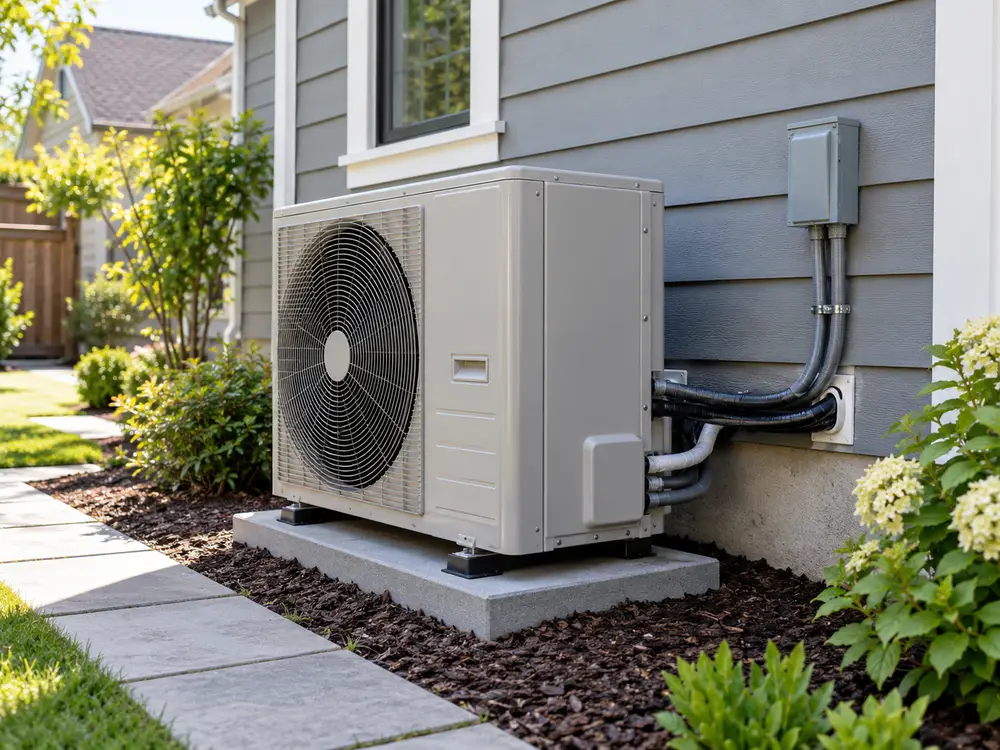
Heat pump vs solar water heater is becoming a common topic in the UAE as more homeowners, hotels, and developers look for stable and energy-efficient hot water solutions.
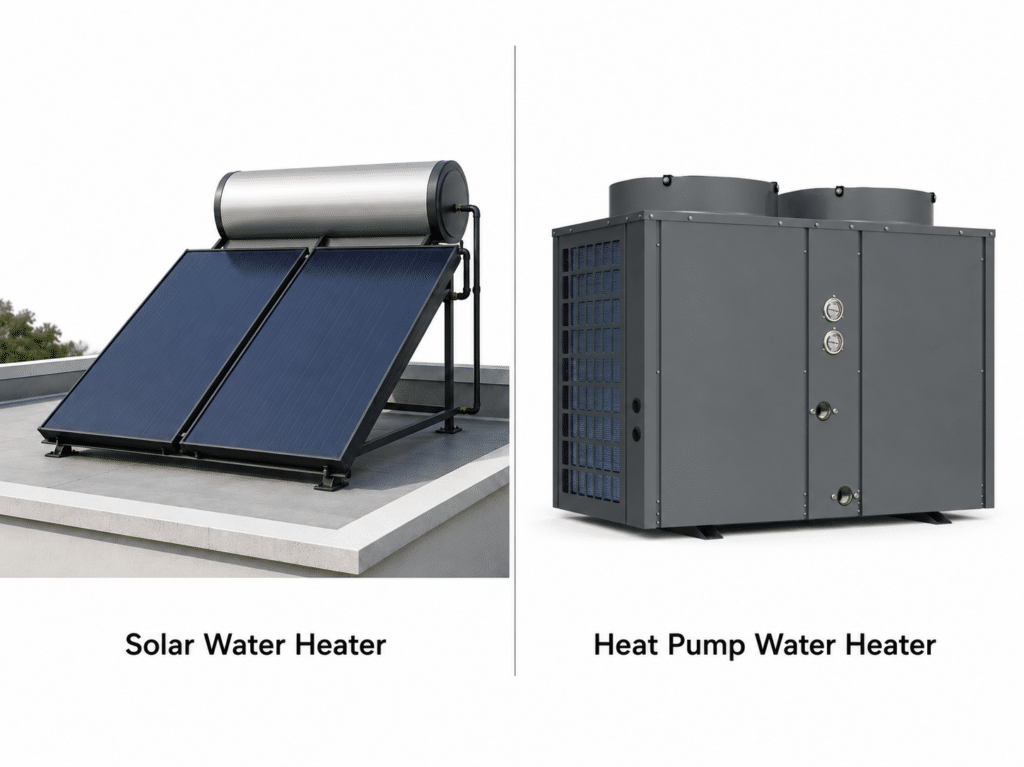
Hot water systems in the UAE face very different operating conditions compared with many other regions. High outdoor temperatures may seem ideal for solar water heating, but in real projects, stable hot water supply during night-time peak demand is often the bigger challenge.
This is especially true for hotels, apartment buildings, and villas, where hot water usage is concentrated in the evening and early morning. In these situations, system stability, recovery speed, and long-term operating cost become more important than simply relying on daytime sunlight.
Because of this, more developers and facility operators in the UAE are starting to re-evaluate the long-term performance difference between solar water heaters and heat pump systems.
For B2B buyers evaluating heat pump sourcing options, OEM production, and certifications, see our heat pump manufacturer guide.
Why Choosing the Right Water Heating System Matters in the UAE
Many people assume that the UAE’s hot climate naturally guarantees stable hot water supply. In reality, high outdoor temperatures do not always mean reliable 24/7 hot water performance. Even in hot environments, choosing the wrong system can still lead to insufficient water temperature and unstable hot water supply.
Night-time hot water demand is one of the key characteristics of the UAE market, with more than 60% of hot water usage typically occurring during evening hours. Traditional solar water heating systems rely heavily on daytime sunlight, making hot water shortages more likely at night.
Compared with solar systems, heat pumps can continue operating during the night, cloudy weather, and dusty conditions without depending on sunlight. This is why more hotels, apartments, and commercial projects in the UAE are starting to choose heat pump systems for stable long-term operation.
For example, a hotel project in Dubai previously used a solar water heating system, but guests frequently complained about unstable water temperature and insufficient hot water during peak evening hours. Dust accumulation on solar collectors reduced heating efficiency by more than 50% and increased maintenance requirements for the hotel.
After switching to a heat pump system, the project reduced overall energy consumption by approximately 30%–50% while achieving stable 24/7 hot water supply and significantly improving guest satisfaction.
How Solar Water Heaters Perform in UAE Climate
Solar water heaters do offer real advantages in the right context. For small households with low hot water demand concentrated in the afternoon and early evening, a well-maintained solar system can cover most daily needs using free sunlight. Initial installation cost is lower than a heat pump system, and in locations with consistent sunshine and minimal dust exposure, annual maintenance requirements are manageable.
However, in the UAE’s real operating environment, these advantages are often outweighed by the limitations described below.
Thanks to the UAE’s abundant sunshine, solar water heater UAE systems offer several clear advantages, but they also face limitations caused by the local climate and environmental conditions.
The biggest advantage of a solar water heater is its ability to use free solar energy to reduce electricity consumption. With strong sunlight available for most of the year, this is also one of the main reasons why many users consider solar water heater UAE cost when choosing a hot water solution.
However, solar water heaters also have obvious limitations. Since the system relies entirely on sunlight, it cannot consistently meet peak hot water demand at night, when most residents typically use hot water.
In addition, solar systems depend heavily on water storage tanks. Large-capacity storage tanks are often required, which not only take up additional space but may also lead to heat loss over time.
Environmental conditions in the UAE can further affect system performance. Frequent dust and sandstorms may cover the surface of solar collectors, blocking sunlight and reducing heating efficiency. Occasional cloudy or rainy weather can also limit solar energy supply, making it difficult to maintain a stable hot water output.
Why Heat Pumps Are Gaining Popularity in UAE
In recent years, more hotels, apartment projects, and homeowners in the UAE have started moving away from traditional solar water heating systems and choosing heat pumps instead.
The main reason is simple: stable hot water supply matters more than sunlight. In real projects, solar systems often struggle during night-time peak demand, dusty weather, or cloudy days, especially in hotels and large residential buildings where hot water usage is much higher.
By comparison, heat pump systems can keep running day and night without relying on direct sunlight. This means more stable water temperature, fewer complaints from guests or residents, and lower pressure on maintenance teams.
Many newer projects in the UAE are also looking for smarter and easier system management. Modern heat pumps support remote monitoring, temperature control, and energy management, making them much more practical for long-term commercial operation.
Although the upfront investment is usually higher than a traditional solar system, many project owners find that the lower operating costs and more stable performance make heat pumps a better long-term choice.
For a detailed breakdown of why UAE commercial projects are switching to heat pump systems, see our guide on commercial hot water system UAE.
| Application Scenario | Heat Pump | Solar Water Heater |
|---|---|---|
| Commercial Projects (Hotels / Apartments) | Suitable for 24/7 large-scale hot water supply with stable performance | Limited by sunlight and less suitable for continuous commercial demand |
| Water Supply Stability | Stable operation day and night, even during dusty or cloudy weather | Highly dependent on sunlight with unstable night-time performance |
| Smart Control & Maintenance | Supports IoT control, remote monitoring, and centralized management | Requires regular manual cleaning and maintenance |
| Installation & Space Requirements | Flexible installation with smaller space requirements | Requires large storage tanks and sufficient sunlight exposure |
| Cost & Long-Term Efficiency | Higher upfront investment but lower long-term operating costs | Lower initial cost but additional maintenance and heat loss over time |
Heat Pump vs Solar Water Heater Price in UAE (2026)
Estimated Cost Comparison in UAE (AED)
| Cost Item | Solar Water Heater | Heat Pump |
|---|---|---|
| Small Residential System (150–200L) | AED 8,000 – 12,000 | AED 12,000 – 18,000 |
| Commercial / Large Capacity System | AED 12,000 – 20,000 | AED 18,000 – 30,000+ |
| Monthly Electricity Cost | AED 200 – 400 | AED 300 – 500 |
| Annual Maintenance Cost | AED 800 – 1,500 | AED 300 – 600 |
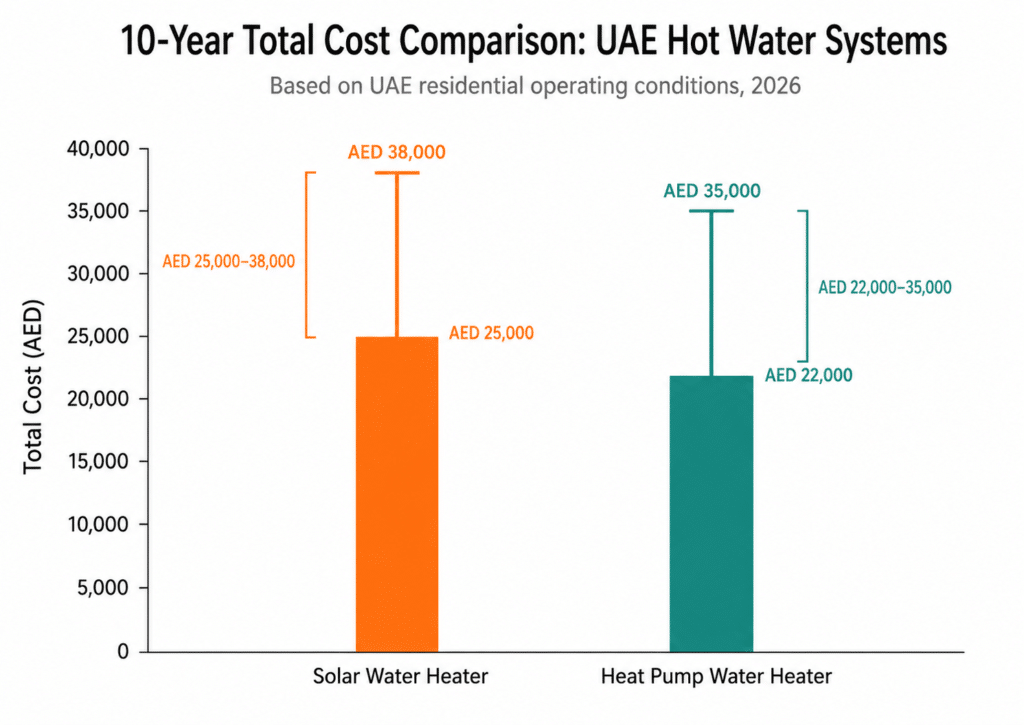
| Estimated 10-Year Total Cost | AED 25,000 – 38,000 | AED 22,000 – 35,000 |
| Estimated Payback Period | 2–3 Years | 3–4 Years |
Initial Investment
In the UAE market, solar water heaters usually have a lower upfront installation cost, making them more attractive for small households with limited budgets. Heat pump systems generally cost around 20%–40% more at the beginning, but they offer more stable water temperature, smarter control functions, and better year-round performance.
Long-Term Running Cost
Although solar systems mainly use free sunlight during the day, many projects still rely on electric backup heating at night or during cloudy and dusty weather. In real UAE conditions, dust accumulation can also reduce collector efficiency over time.
Heat pump systems consume electricity throughout the year, but their operating efficiency remains much more stable regardless of weather conditions, making long-term energy costs easier to control.
Maintenance Difference
Maintenance is another major difference often overlooked during project planning. Solar collectors in the UAE usually require cleaning 2–3 times per year due to dust and sand accumulation.
Heat pump systems use a more enclosed operating structure with automatic temperature control, resulting in lower maintenance frequency and lower annual service costs.
Which Option Offers Better Value?
For small households with relatively low daytime hot water demand, solar water heaters can still be a practical and budget-friendly option.
However, for hotels, apartment buildings, villas, and projects requiring stable 24/7 hot water supply, heat pumps are often the better long-term investment due to lower lifecycle costs, more stable performance, and easier operation management.
How to Choose Between Heat Pump and Solar Water Heater in UAE
The right choice depends on three key factors: your hot water demand pattern, your project type, and your long-term operating priorities.
Choose a solar water heater if:
- Your hot water demand is mainly during the daytime
- You are a small household with a limited budget
- Your location has minimal dust exposure and good roof access
- You can accept backup heating reliance during night-time or cloudy days
Choose a heat pump if:
- Your project requires stable 24/7 hot water supply
- You are managing a hotel, apartment building, villa, or commercial facility
- Night-time peak demand is a consistent challenge
- You want predictable long-term operating costs without weather dependency
- You need smart control, remote monitoring, or BMS integration
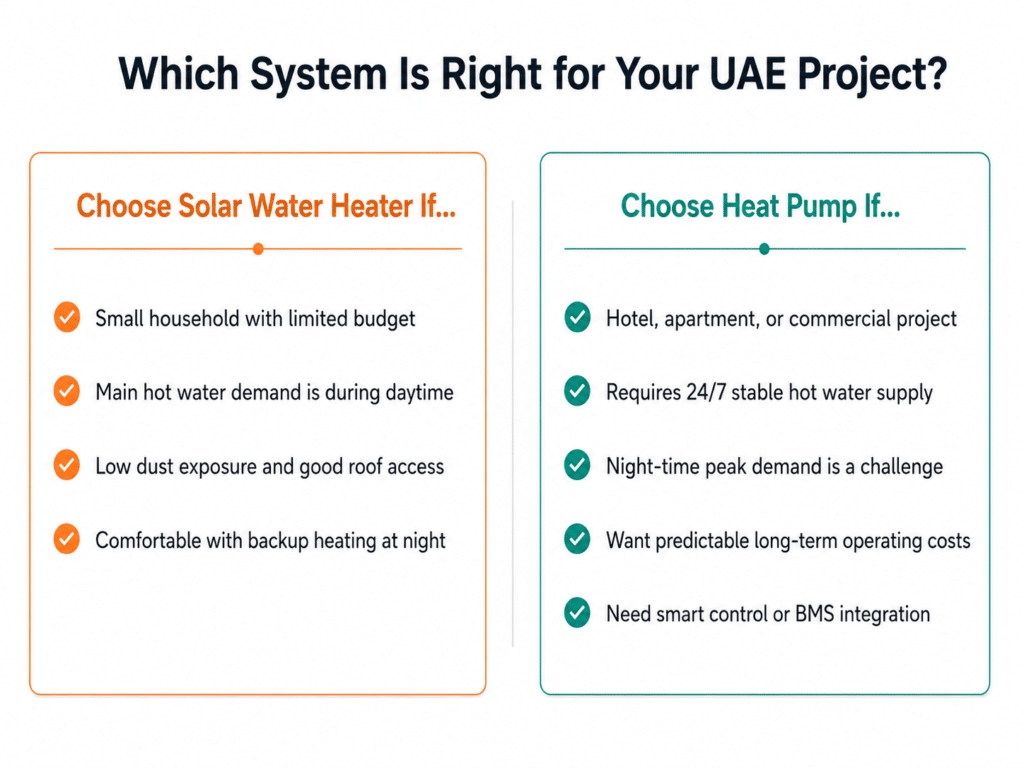
For most commercial projects in the UAE — hotels, serviced apartments, hospitals, and large residential developments — heat pump systems are the more reliable long-term choice. For small residential users with simple daytime hot water needs and a tight budget, solar remains a practical option.
Real Case Study: Heat Pump vs Solar Water Heater in UAE Hotel Project
A hotel project in Dubai with more than 80 guest rooms was facing increasing pressure on its hot water system, especially during morning check-out hours and evening shower peaks. During high occupancy periods, the hotel’s daily hot water demand exceeded 12–15 tons per day.
The original solar water heating system performed reasonably well during sunny daytime conditions. However, once occupancy rates exceeded 85%, the system began struggling during peak demand periods between 7:00–10:00 PM. Guests occasionally reported unstable water temperature, while recovery time after heavy usage became noticeably longer.
The maintenance team also faced frequent cleaning work due to dust accumulation on the solar collectors, which reduced heating efficiency by more than 50% during severe dusty conditions. In addition, the hotel needed to rely heavily on large-capacity storage tanks to maintain night-time hot water supply.
After evaluating different solutions, the hotel upgraded to a centralized heat pump system designed for commercial hot water applications.
Following the upgrade, the project achieved stable 24/7 hot water supply with outlet water temperature maintained at around 55°C–60°C during peak demand periods. According to the hotel’s operating team, overall energy consumption was reduced by approximately 30%–50%, while hot water-related guest complaints dropped significantly.
The hotel also reduced routine maintenance frequency since the new system no longer depended heavily on exposed solar collectors and oversized hot water storage.
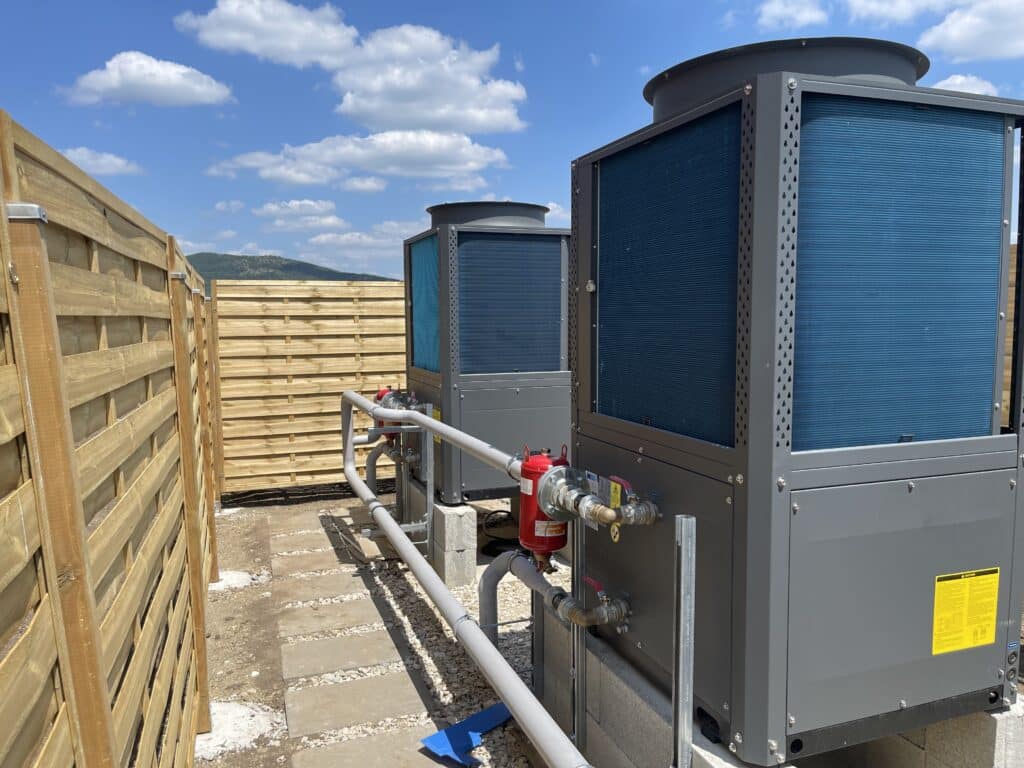
Hotel Management Feedback
“Our biggest concern was guest experience during peak evening hours. After switching to the heat pump system, hot water supply became much more stable, and complaints related to water temperature were significantly reduced.”
— Operations Manager, Dubai Hotel Project
For hotel developers in Dubai looking for more details on commercial heat pump water heater options and ROI, see our guide: commercial heat pump water heater for hotel in Dubai.
Heat Pump vs Solar Water Heater: Which One Is Better?
Heat Pump vs Solar Water Heater Application Comparison
| Application Scenario | Solar Water Heater | Heat Pump |
|---|---|---|
| Small Homes | Suitable for basic daily hot water needs with good cost performance | Also suitable, but solar systems are usually more affordable |
| High-End Villas | Hot water supply may become unstable at night or during dusty weather | Stable 24/7 hot water supply with better comfort |
| Hotels / Apartment Projects | Difficult to handle large peak demand with stable water temperature | Better for commercial projects with stable operation and centralized management |
For small households with relatively low daytime hot water demand, solar water heaters are often enough for daily use and offer better upfront cost performance.
However, for high-end homes, hotels, and apartment projects, the situation is very different. These applications require larger hot water capacity and more stable operation throughout the day. Compared with solar systems, heat pumps are not affected by sunlight conditions, night-time operation, or dusty weather, making them a more reliable and energy-efficient solution for long-term use.
Conclusion: Best Water Heating System for UAE
Choosing the best water heating system for UAE conditions is not only about using the strongest sunlight. It is about matching the system to real usage patterns, water demand, climate risks, and long-term operating costs.
For small households with limited daytime hot water demand, solar water heaters can still be a practical and cost-effective option. They make good use of the UAE’s abundant sunshine and can meet basic daily needs when storage capacity is sufficient.
However, for hotels, apartment buildings, villas, and commercial projects, heat pump systems are usually the better long-term choice. They can provide stable hot water supply day and night, without being limited by sunlight, dusty weather, or cloudy conditions. This makes them especially suitable for projects where user comfort, system reliability, and operation management matter more than upfront cost alone.
From a bigger perspective, the UAE market is moving toward smarter, more reliable, and more energy-efficient building systems. In this context, heat pumps are not just an alternative to solar water heaters. They are becoming a more practical hot water solution for projects that need stable performance, lower long-term energy use, and easier centralized management.
Overall, if the goal is simple household use, solar water heaters may be enough. But if the project requires 24/7 hot water, stable temperature, lower maintenance pressure, and long-term cost control, heat pumps are the stronger choice for the UAE market.
FAQ
Is a heat pump better than a solar water heater in UAE?
In the UAE market, the better option mainly depends on the application scenario. For small households with relatively low daytime hot water demand, solar water heaters are often enough for daily use and offer better upfront cost performance.
However, for hotels, apartment buildings, and high-end residential projects, heat pump systems usually perform better. Compared with solar water heaters, heat pumps provide more stable hot water supply and are not affected by night-time operation or dusty weather conditions.
What is the cost of heat pump vs solar water heater in UAE?
Solar water heaters usually have a lower upfront purchase cost, making them more affordable for initial installation. Heat pump systems require a higher initial investment, but they generally offer lower long-term energy consumption and simpler maintenance.
Compared with solar systems, heat pumps avoid frequent collector cleaning and large storage heat losses, making them more cost-effective for long-term operation and commercial projects.
Can solar water heaters work at night?
Solar water heaters cannot independently generate heat at night. They mainly rely on storing heat collected during the daytime, so night-time hot water supply depends entirely on stored hot water capacity.
During peak demand periods or dusty and cloudy weather conditions, stored hot water can run out quickly, leading to insufficient hot water supply or unstable water temperature.
For developers also evaluating air conditioning systems for UAE high-temperature conditions, see our guide on T3 air conditioner for Middle East and Iran projects.
What is the most energy-efficient water heater in UAE?
Considering the UAE’s climate conditions, dusty environment, and strong demand for stable 24/7 hot water supply, heat pump systems are often considered one of the most energy-efficient water heating solutions.
Compared with traditional electric heaters, gas water heaters, and standard solar systems, heat pumps offer lower energy consumption and more stable long-term operation, especially for hotels, apartments, and high-end residential projects.
Heat Pump vs Solar Water Heater: Which Is Better for UAE Homes?
For most small households in the UAE, both heat pumps and solar water heaters can provide daily hot water supply. However, the better option usually depends on hot water usage habits, installation conditions, and long-term expectations.
Solar water heaters are often chosen for their lower upfront cost and ability to use free solar energy during the daytime. Heat pump systems, on the other hand, offer more stable hot water supply during the night, dusty weather, and peak demand periods.
For users who value long-term comfort, stable water temperature, and lower maintenance pressure, heat pumps are increasingly becoming the preferred choice in the UAE market.
Heat Pump vs Solar Water Heater UAE
Is a heat pump or solar water heater better for a UAE villa? For UAE villas with consistent night-time hot water demand and limited roof space, heat pump systems generally offer more reliable performance. Solar systems work well for smaller villas with simple daytime hot water needs, but dust accumulation and night-time demand often reduce their effectiveness in real UAE conditions.
What is the typical payback period for a heat pump water heater in the UAE?
Based on UAE commercial electricity rates of AED 0.45/kWh, a commercial heat pump water heater typically achieves payback within 3–4 years compared to traditional electric heating. For projects replacing gas boilers, payback periods vary depending on local gas tariffs and system capacity.
Can a heat pump water heater operate during UAE summer temperatures?
Yes. Heat pump water heaters designed for UAE conditions are engineered to operate stably at ambient temperatures up to 43°C for standard models, and up to 52°C for T3-rated commercial units. High ambient temperature actually improves heat pump efficiency, making UAE conditions well-suited for heat pump operation.
How often does a solar water heater need cleaning in the UAE?
Due to frequent dust and sandstorms, solar collectors in the UAE typically require cleaning 2–3 times per year to maintain efficiency. Dust accumulation can reduce collector output by more than 50% during severe conditions, adding to long-term maintenance costs and workload.
Which system is better for a Dubai hotel project?
For Dubai hotel projects with continuous hot water demand across 24 hours, commercial heat pump systems are generally the preferred choice. Heat pumps provide stable water temperature during night-time peak demand, support BMS integration, and offer lower long-term operating costs compared to solar or boiler-based systems. See our detailed guide on commercial heat pump water heater for hotel in Dubai for more information.

Looking for a Reliable Heat Pump Water Heater for Your UAE Project?
Airproz supplies residential and commercial heat pump water heater systems for villas, hotels, apartments, and large-scale developments across the UAE and GCC. Our B2B team can provide product recommendations, system sizing, and factory-direct pricing.