“Commercial heat pump water heater for hotel” is becoming a major topic in Dubai’s hospitality industry as more hotel developers and MEP contractors search for lower operating costs and more energy-efficient hot water solutions in 2026.
With the rapid growth of luxury resorts, apartment hotels, and large-scale hospitality projects across the UAE, traditional boiler systems are facing increasing pressure from high electricity consumption, rising maintenance costs, and sustainability requirements. As a result, many hotel investors are now comparing commercial heat pump systems with conventional boilers and solar water heating solutions before selecting a commercial hot water system for hotels.
For B2B buyers also evaluating OEM and wholesale sourcing options for commercial heat pumps, see our heat pump manufacturer B2B sourcing guide.
Recently, discussions around commercial heat pump UAE projects have also become increasingly active across contractor forums, project bidding platforms, and hotel engineering communities. Developers are paying closer attention to system efficiency, high ambient temperature performance, operating costs, and long-term ROI when evaluating hotel heat pump project Dubai solutions.
Where Dubai Hotel Developers Find Commercial Hot Water Projects
If a hotel owner or developer plans a new hotel heat pump project in Dubai, they usually research the market through several key channels before selecting suppliers, consultants, or EPC partners.
Project Databases
Platforms such as MEED Projects, BNC Network, and ProTenders are widely used to track upcoming hotel construction projects, refurbishment programs, and major MEP packages across the UAE.
These platforms help investors understand where new hotel hot water systems may be required and which consultants or contractors are involved in the project.
EPC Tender Platforms
Through EPC tender portals and official client bidding systems, hotel developers compare proposals covering domestic hot water, chillers, ventilation, and building controls as part of one integrated package.
In many Dubai hospitality projects, a commercial heat pump solution is evaluated based on long-term operating costs, energy efficiency, and system reliability rather than as a standalone product.
Hospitality Market Reports
Dubai hospitality pipeline reports also reveal which hotel segments are expanding fastest and which existing properties are preparing for renovation.
As a result, discussions around “commercial heat pump UAE” solutions have become increasingly active, especially among hotel owners seeking lower energy consumption and improved ESG performance.
This is also one reason why demand for hotel hot water solutions in Dubai continues to grow across the hospitality sector.
For buyers comparing heat pump and solar water heating performance in UAE conditions, see our detailed guide: heat pump vs solar water heater in UAE.
Industry Events and Peer References
Many hotel operators also visit HVAC exhibitions, hotel investment conferences, and reference projects before making final decisions.
Speaking directly with existing hotel owners helps investors better understand real operating costs, maintenance requirements, and ROI under actual Dubai operating conditions.
Why “Commercial Heat Pump UAE” Is Becoming a Hot Topic in 2026?
Just a few years ago, commercial heat pumps were rarely prioritized in UAE hotel projects. In 2026, that has clearly changed. For many developers and hotel operators, the conversation is no longer about whether heat pumps are technically possible, but whether traditional boiler systems still make financial sense in long-term hotel operations.
Across recent hotel developments and retrofit projects in Dubai, three factors are consistently driving this shift: rising operating costs, stricter energy-efficiency expectations, and faster return on investment.
Where These Discussions Are Happening
Today, discussions around “commercial heat pump UAE” solutions are becoming increasingly active across several well-known industry channels, including:
- HVAC-Talk Forum
- LinkedIn HVAC Groups
- MEED Projects project discussions
- Regional MEP consultant networks
- Hotel investment conferences and HVAC exhibitions in Dubai
Through these channels, hotel developers, EPC contractors, consultants, and operators are increasingly comparing lifecycle cost, ROI, system reliability, and long-term operating efficiency rather than simply focusing on initial equipment pricing.
Why Contractors Are Reconsidering Boiler-Based Systems
For EPC contractors, reducing utility consumption is now becoming both a commercial requirement and a competitive advantage.
In many hotel projects, domestic hot water systems must support:
- High peak demand during morning and evening usage periods
- Continuous operation throughout the day
- Stable hot water supply under Dubai’s high ambient temperatures
- Limited mechanical room space in modern hotel buildings
Because of this, many contractors are actively evaluating commercial heat pump systems as a more energy-efficient alternative to conventional boiler rooms.
Compared with older electric or diesel boiler systems, properly designed heat pump solutions can significantly reduce long-term energy consumption while maintaining stable performance during continuous hotel occupancy.
Why MEP Consultants Are Focusing on Lifecycle Cost
MEP consultants in the UAE are increasingly comparing systems based on long-term operating performance rather than only initial purchase cost.
When evaluating a hotel hot water system Dubai project, consultants typically focus on:
- Annual energy consumption
- Maintenance requirements
- Equipment lifespan
- Total cost of ownership
- Long-term operating stability
In many cases, commercial heat pump systems show stronger long-term financial performance compared with traditional boiler-only configurations, especially in hotels with high domestic hot water demand.
As a result, heat pump-led solutions are now appearing more frequently in consultant reports, value-engineering discussions, and hotel retrofit proposals.
ESG Pressure and Energy Regulations Are Accelerating Adoption
Across the UAE hospitality sector, hotel projects are facing growing pressure to meet stricter green building standards, ESG expectations, and energy-efficiency targets.
Even where heat pumps are not directly required by regulation, many hotel developers are realizing that commercial heat pump systems offer one of the most practical ways to reduce energy consumption without overcomplicating system design.
This is also one reason why demand for hotel hot water solutions in Dubai continues to grow across both new construction and renovation projects.
Operating Cost Is Becoming the Real Decision Driver
For many hotel owners, domestic hot water production is one of the most stable and predictable operating expenses in the entire building.
When investors see that a commercial heat pump system can substantially reduce annual electricity or fuel costs over the next 10–15 years, the conversation quickly changes from “exploring new technology” to “protecting long-term profitability.”
For many hotel developers in Dubai, the real question is no longer whether commercial heat pumps work.
The real question is whether continuing to rely on high-energy boiler systems will remain financially sustainable in the future.
For a detailed breakdown of why UAE commercial projects are making this switch, see our guide on commercial hot water system UAE.
Popular Commercial Heat Pump Brands Used in Dubai Hotel Projects
In Dubai hotel developments, selecting a suitable hot water system is no longer just about brand preference. More project teams are now evaluating long-term operating cost, system stability, energy efficiency, and lifecycle performance before making final decisions.
As a result, discussions around “commercial heat pump UAE” solutions and system configurations are becoming increasingly common, especially during early-stage hotel design and EPC tender phases.
Different Types of Brands Used in Hotel Projects
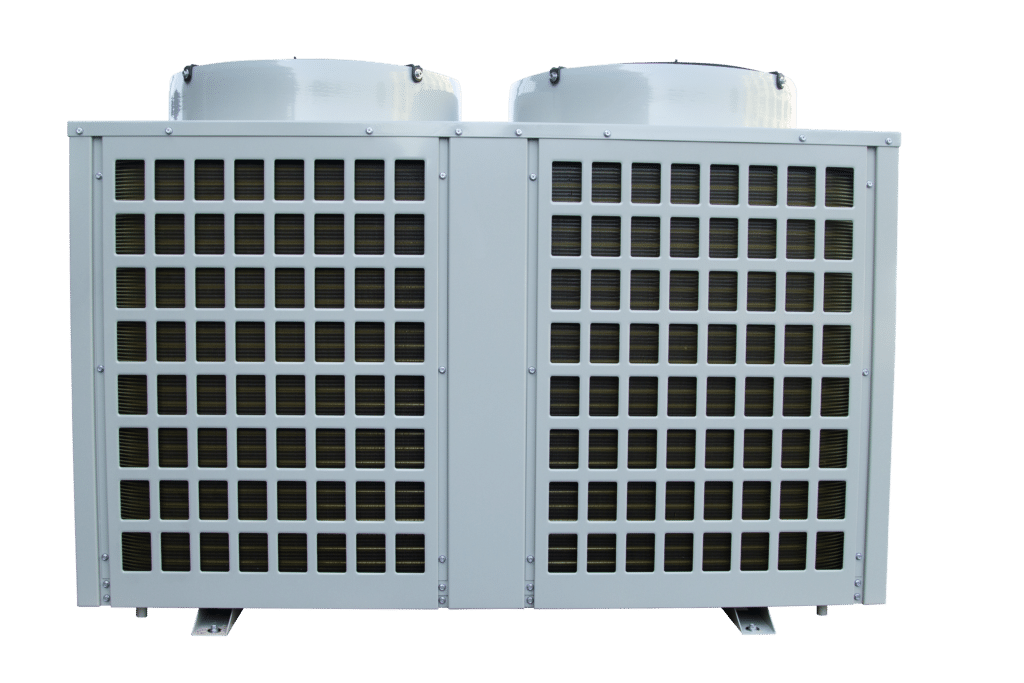
In practice, different brands usually align with different project priorities.
For high-end hotels and large hospitality developments, Daikin and Viessmann remain widely recognized. These systems are often selected for projects that prioritize proven reliability, integrated HVAC capability, and long-term operating stability.
For mid-scale hotel developments or projects with tighter budget control, Midea and other Asian manufacturers have expanded their presence in the UAE market in recent years. These brands are frequently considered when balancing initial investment with acceptable energy performance and faster project delivery.
At the same time, more project teams are also evaluating newer commercial-focused suppliers that offer greater flexibility in customization, project coordination, and UAE-specific applications.
Brands such as Airproz are increasingly appearing in these evaluations, especially on projects where standard system configurations don’t fully match operational requirements.
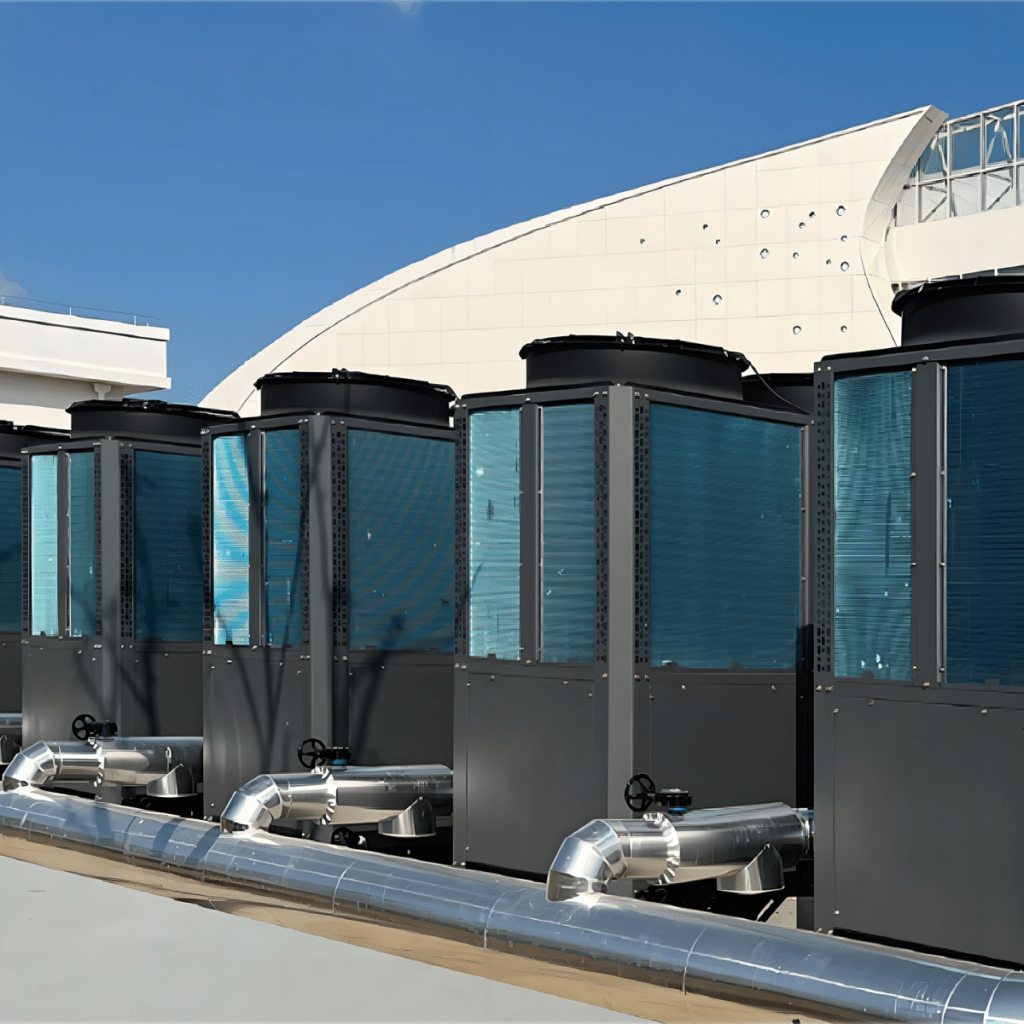
These suppliers are typically considered when:
- system layouts need to be adapted to specific building conditions
- high ambient temperature performance is critical in UAE environments
- project timelines require faster production and delivery flexibility
- closer technical coordination with EPC contractors is necessary
For hotel developers also evaluating air conditioning systems for UAE and Middle East conditions, see our guide on T3 air conditioner for Middle East projects.
Because of this, many commercial-focused suppliers are now being included in technical evaluations rather than simply positioned as alternatives to traditional HVAC brands.
How Project Teams Actually Make Decisions
In real hotel projects, developers and MEP consultants are not simply comparing brand names — they are evaluating total system performance.
Key evaluation factors usually include:
- long-term operating cost
- system stability during continuous occupancy
- energy consumption under peak hot water demand
- local after-sales response capability
- project lead time and EPC coordination efficiency
- long-term ROI and lifecycle performance
Across these discussions, project teams increasingly realize that system design and configuration often matter more than brand name alone.
Why Early System Comparison Matters
For hotel projects still in the design or specification stage, relying only on familiar boiler configurations or traditional HVAC approaches can sometimes lead to unnecessarily high long-term operating costs.
A more effective approach is to compare different commercial hot water system for hotels solutions based on actual project conditions, including:
- occupancy rate
- daily hot water demand
- available plant room space
- energy-efficiency targets
- long-term operating strategy
This is particularly important in the UAE, where high ambient temperatures and continuous hotel occupancy can significantly influence long-term system performance.
Considering a Commercial Heat Pump Water Heater for Hotel
If you are currently evaluating a hotel hot water system Dubai project, it is important to assess whether a commercial heat pump water heater for hotel can deliver better long-term operating performance compared with conventional boiler systems.
In many UAE hotel projects, decisions made during the early design stage can directly affect operating costs, energy consumption, and system flexibility for the next 10–15 years.
For projects with high occupancy rates, continuous hot water demand, and strict energy targets, comparing different system approaches early is no longer just an engineering exercise — it is a long-term financial decision.
Real Hotel Heat Pump Project Case in UAE
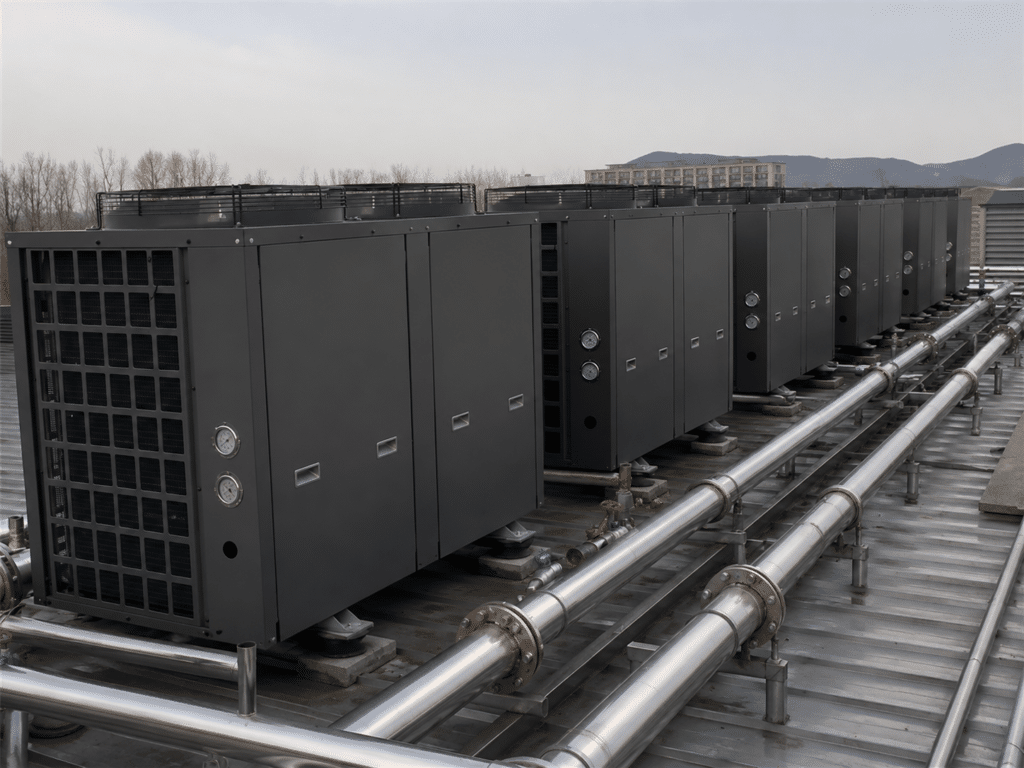
In a recent “hotel heat pump project Dubai”, a mid-size hotel with approximately 200 guest rooms upgraded its domestic hot water system by replacing traditional electric boilers with a heat pump-based commercial hot water solution.
The upgrade was implemented as part of an operational optimization plan under continuous hotel occupancy, where hot water demand remains stable throughout the year.
System Performance Comparison
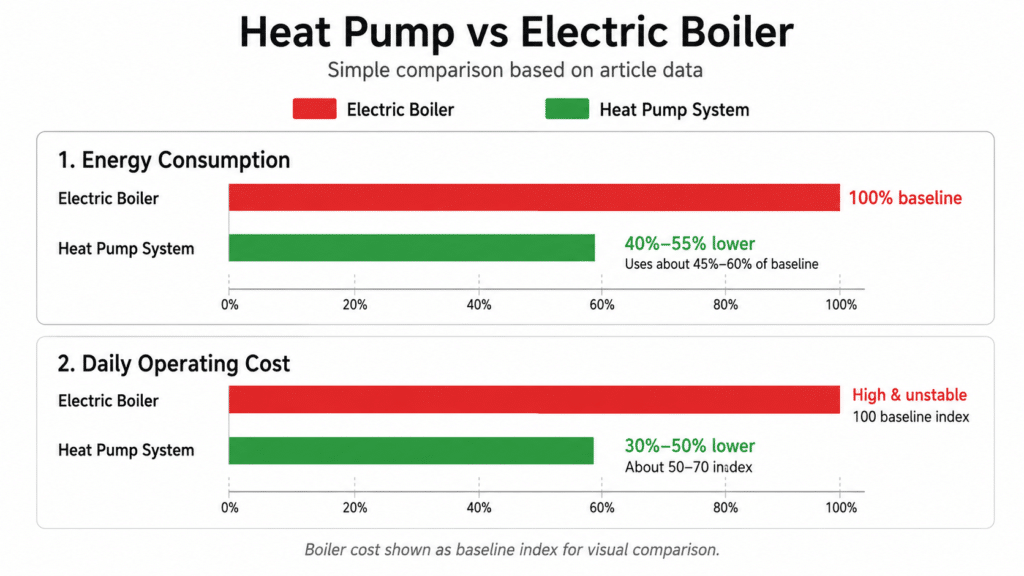
Compared with the original boiler configuration, the heat pump system delivered noticeably lower energy consumption and more stable operating performance.
| Item | Electric Boiler | Heat Pump System |
|---|---|---|
| Energy Consumption | 100% baseline | ↓ 40%–55% |
| Daily Operating Cost | High & unstable | ↓ 30%–50%, more predictable |
| Peak Electrical Load | High demand spikes | Reduced peak load impact |
| System Stability | Medium | High (with storage support) |
| Maintenance | Frequent | Reduced maintenance frequency |
Estimated Operating Results Under Dubai Conditions
Based on typical Dubai hotel operating conditions:
- Daily hot water demand: ~30 tons/day
- Heat pump COP: 3.0–3.8
- Electricity price: ~$0.10–0.13/kWh
- Continuous year-round operation
Estimated annual system performance:
- Boiler electricity consumption: ~500,000–600,000 kWh/year
- Heat pump electricity consumption: ~180,000–250,000 kWh/year
- Estimated annual electricity saving: ~$30,000–$50,000
These results are consistent with similar retrofit projects across the region operating under high ambient temperature conditions.
Project Insight
For hotels with stable occupancy and high hot water demand, system selection has a direct and measurable impact on long-term operating costs.
In this type of project, replacing a boiler system with a commercial heat pump water heater for hotels is not only an efficiency improvement, but a long-term financial decision.
For hotels operating under continuous occupancy conditions, delaying system optimization decisions can lock projects into unnecessarily high utility costs for the next 10–15 years.
How to Choose the Right Commercial Heat Pump Water Heater for Hotel
In Dubai hotel projects, choosing the right system is rarely about product brochures or headline efficiency numbers. The real question is whether the system can survive actual hotel operating conditions without causing complaints, downtime, or unexpected operating costs.
For most developers and EPC contractors, the difficult part is not understanding heat pump technology. The difficult part is making sure the system matches the hotel’s real occupancy pattern, daily hot water demand, installation constraints, and after-sales expectations.
1. Start with occupancy, not equipment size
Hotel occupancy is the first thing that should shape the system design.
A hotel with stable year-round occupancy behaves very differently from a property with strong seasonal swings or uneven weekday and weekend demand. If the system is sized only from room count, it is easy to miss the real peak load.
In practice, the question is not “how many rooms does the hotel have,” but “when do guests actually use hot water, and how much do they use at the same time?”
2. Daily hot water demand is where many projects go wrong
This is one of the most common reasons hotel hot water systems underperform.
A 150-room hotel and a 200-room hotel may look similar on paper, but their actual hot water demand can be very different once you include laundry, restaurant use, spa facilities, and guest behavior. In a typical hotel hot water system Dubai project, the real peak load often matters more than the average daily number.
If the system is undersized, guests feel it immediately during morning and evening peaks. If it is oversized, the hotel ends up paying for capacity it does not fully use.
3. Installation space often decides the final solution
In many real projects, the best technical option is not the one that gets installed.
Heat pump systems need room for the unit itself, but they also need water storage, airflow, pipe routing, and maintenance access. In retrofit projects especially, limited plant room space can rule out otherwise attractive options.
This is why commercial heat pump UAE projects often depend as much on layout and practical installation conditions as on efficiency numbers.
4. After-sales support matters more than catalog specifications
A hotel cannot afford long downtime in its hot water system.
That is why supplier selection should go beyond product data. Local support, response time, spare parts availability, commissioning support, and project coordination all matter more than a polished specification sheet.
In real projects, weak after-sales support is often what turns a good system into an operational problem.
What really matters in the end
The right commercial heat pump water heater for hotel is not necessarily the biggest system or the cheapest quotation. It is the one that fits the hotel’s actual load profile, available space, and operating conditions.
For hotel owners and consultants in Dubai, the most important decision is not whether heat pump technology works in theory. It is whether the system will still work smoothly after installation, during peak season, and over the next 10 to 15 years.
FAQ
What is the best commercial heat pump water heater for hotel in Dubai?
The best commercial heat pump water heater for hotel is the one that fits the hotel’s actual occupancy pattern, hot water demand, installation constraints, and long-term operating requirements.
In Dubai hotel projects, there is rarely a single best model for every case. Most consultants and EPC teams compare systems based on peak demand, plant room space, and local service support rather than looking only at catalog specifications.
Are heat pumps better than boilers for UAE hotels?
In many UAE hotel projects, heat pumps are a better long-term choice when the goal is to reduce operating cost and improve energy efficiency.
Boilers can still work well in some smaller or lower-budget applications. But for hotels with stable occupancy and continuous hot water demand, commercial heat pump systems usually offer better lifecycle value.
Can commercial heat pumps work in Dubai summer temperatures?
Yes, they can work effectively in Dubai summer temperatures if the system is properly designed for high ambient conditions.
In practice, performance depends more on the system design, airflow, thermal storage, and installation quality than on outdoor temperature alone.
How much energy can hotels save with heat pumps?
Energy savings depend on the hotel size, occupancy level, and daily hot water demand.
In many commercial heat pump UAE projects, hotels can achieve meaningful reductions in annual energy use and peak electrical load compared with conventional boiler systems.
What size commercial heat pump does a hotel need?
The correct system size depends on occupancy profile, peak hot water demand, laundry usage, restaurant operation, and spa or wellness facilities.
Sizing a system only by room count often leads to poor performance or unnecessary cost. In most hotel projects, the right approach is to calculate actual daily hot water usage before selecting a commercial heat pump water heater for hotels.
Looking for a Commercial Heat Pump Water Heater for Your Hotel Project in Dubai?
Airproz supplies commercial heat pump water heater systems for hotels, serviced apartments, and large-scale hospitality developments across the UAE and GCC.
Whether you are in the early design stage, comparing systems for an EPC tender, or ready to request a quote, our B2B team can provide:
- System sizing recommendation based on your room count and occupancy rate
- Energy consumption comparison vs your current boiler configuration
- Product specifications, certifications, and technical documentation
- Factory-direct pricing and lead time confirmation
→ Request a Project Quote | → View Commercial Heat Pump Range |