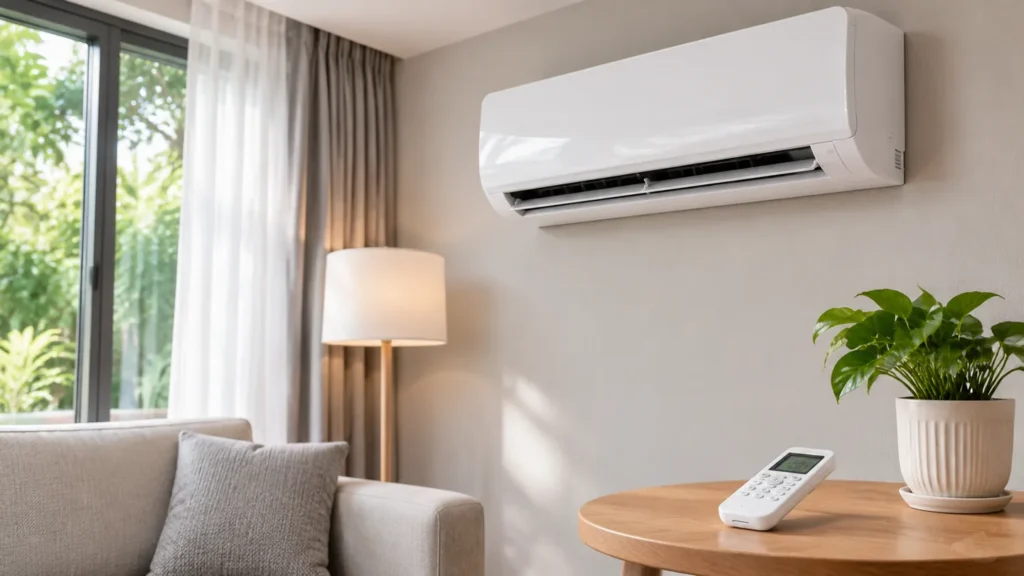
A portable air conditioning unit without hose cannot continuously cool an enclosed room if its compressor releases heat into the same space. A real room air conditioner needs a way to move that waste heat outdoors. Most products marketed as “ventless portable air conditioners” are evaporative coolers or fans, not substitutes for refrigerant AC.
Choose by your room conditions: For a hot, humid room, use a properly vented AC. For dry air with safe cross-ventilation, a water-based evaporative cooler may help people nearby feel cooler. If no outdoor heat path is allowed, a fan can improve personal comfort, but it will not provide refrigerated room cooling.
Can a True Portable Air Conditioner Cool a Room Without an Exhaust Hose?
No. A compressor-based portable AC must move the heat it collects from the room to somewhere outside that cooled space. If the condenser blows its hot air back into the same closed room, the unit will not deliver net room cooling.
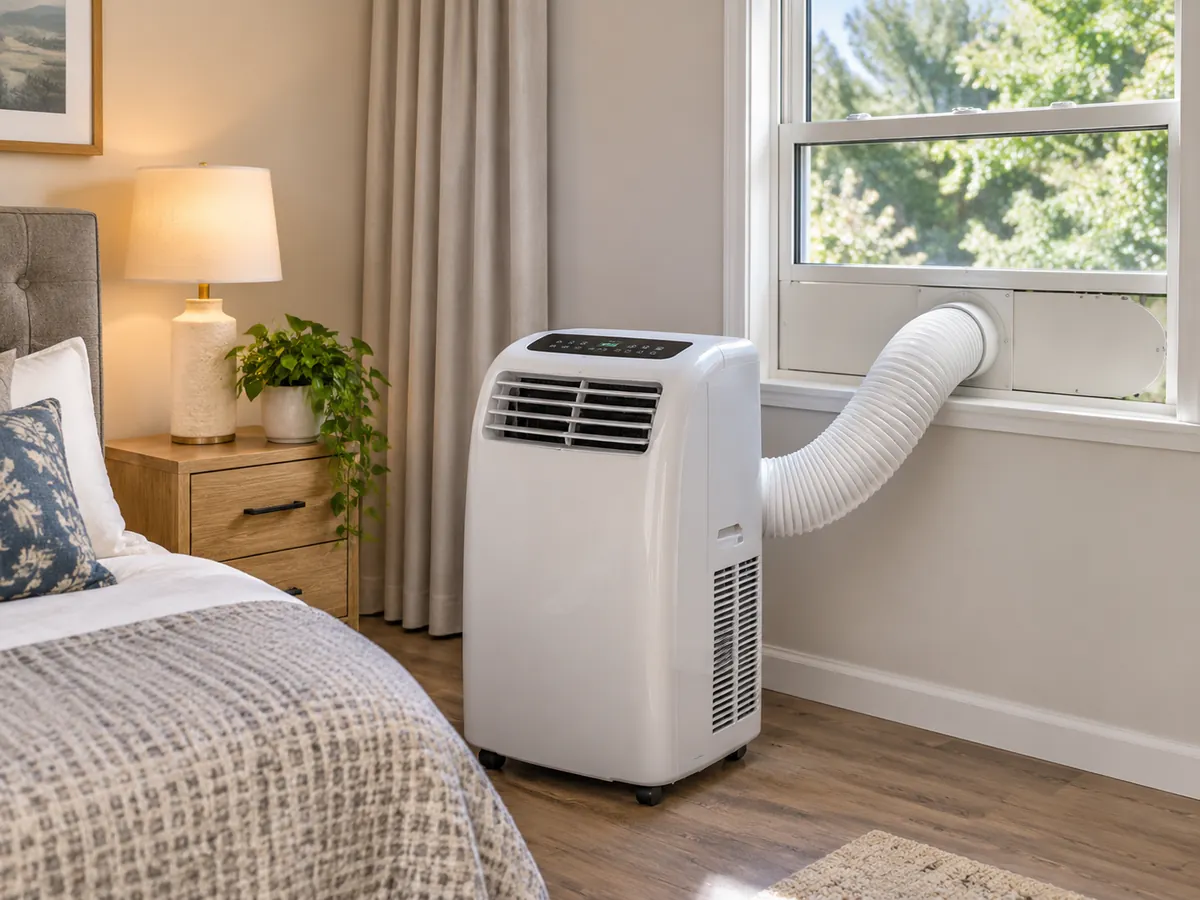
A portable air conditioner has two air paths: cool room air passes over the cold coil and returns to the room; hot air from the condenser must leave through an exhaust duct or another purpose-built heat-rejection connection. Some models use one exhaust hose, while dual-hose models use separate outdoor air intake and exhaust ducts. Two hoses are still venting.
The missing hose might be a drain hose, which carries collected water, rather than the exhaust hose, which removes heat. A unit may operate without a continuous drain hose when its condensate management permits it. That does not remove its need to exhaust hot air. In the unit’s condensate section, check whether it collects water in a tank, evaporates it during operation, or requires a drain connection. The hot-air exhaust is a separate connection.
An ordinary window air conditioner or a mini-split can cool without a portable floor unit’s flexible exhaust hose because its hot side is already outside. That is hose-free at the indoor unit, not ventless cooling.
To see how a fixed system moves heat outside without a portable exhaust hose, read our guide to how a mini split air conditioner works, including its outdoor unit, refrigerant lines and condensate drain.
Why Does a Portable Air Conditioner Need to Vent Hot Air?
The exhaust gives absorbed room heat and compressor-generated heat a way out. Refrigerant moves heat from the indoor coil to the condenser; the condenser then releases that heat outdoors.
- A fan pulls warm indoor air across the cold evaporator coil.
- The refrigerant takes up heat, and the fan sends cooler air back into the room.
- The compressor moves and raises the refrigerant pressure, allowing the condenser to give up heat.
- The exhaust duct carries the condenser’s warmed air outdoors.
If step four is missing and both sides sit inside the same room, the hot side returns at least the heat removed from the cold side, plus the electricity used by the system. Cold air at one grille does not prove that the entire room is cooling. A person in front of that grille may feel better even while the room gains heat overall.
The U.S. Department of Energy’s 2023 portable-AC test-procedure rule makes the same distinction: a spot cooler that releases its condenser heat back into the cooled space does not provide net cooling to that space.
This is why a hose cannot simply end in the same bedroom, an adjacent indoor hallway, a ceiling void, or an attic. The heat still enters a space it can warm, and venting into concealed spaces can create other building problems. Connect the model’s approved exhaust kit to an outdoor opening, and keep the duct within its stated length and bend limits. The manufacturer GE Appliances explains that a refrigerant portable AC must exhaust outdoors.
What Is a Ventless Portable Air Conditioner?
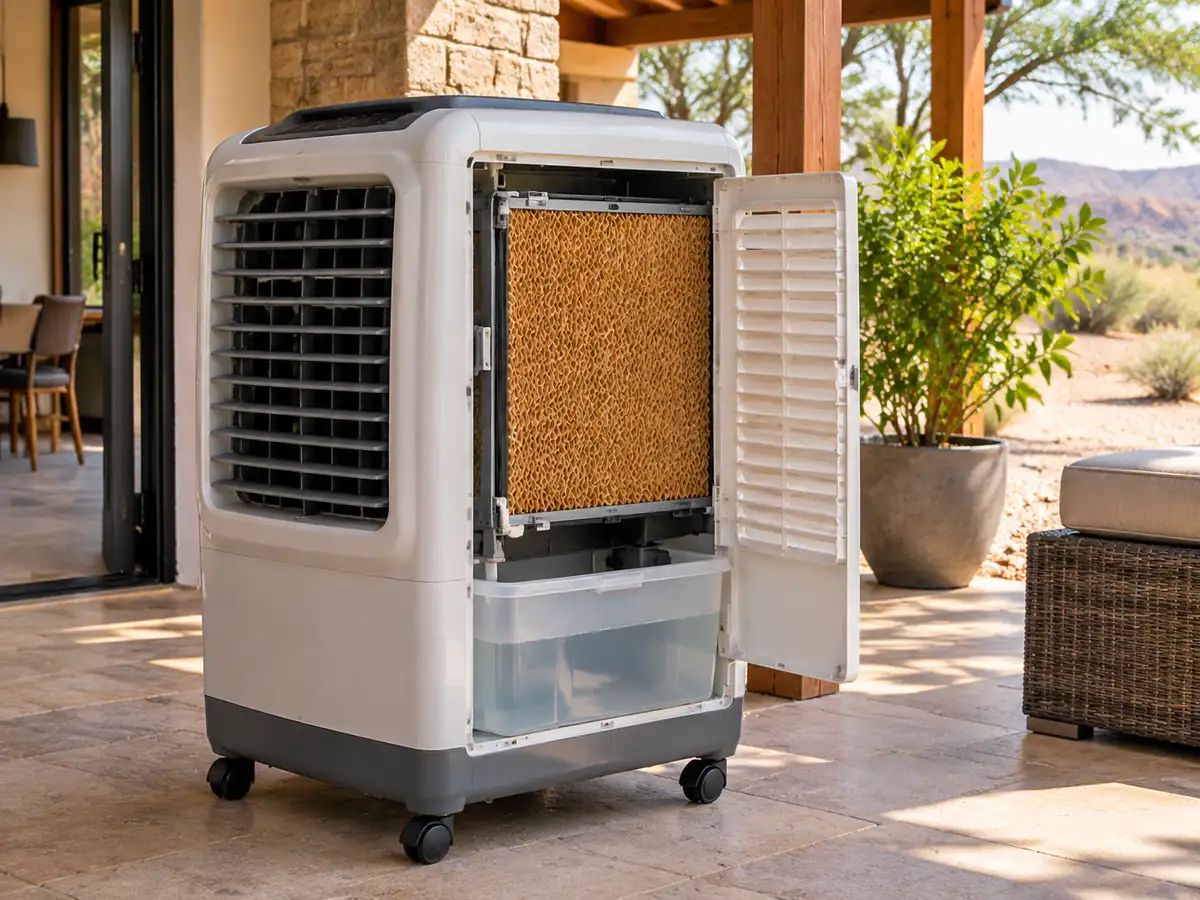
Most “ventless” products are evaporative air coolers, not compressor air conditioners. They use water evaporation and a fan instead of a refrigerant circuit and outdoor exhaust duct.
An evaporative cooler pulls air through a wet pad. Evaporating water takes heat from the passing air, so the supply air feels cooler while gaining moisture. It does not have a compressor circuit that carries the room’s heat outdoors.
Other products marketed as “hoseless air conditioning units” may be simple fans, misting fans, or battery-powered personal coolers. A fan mainly increases air movement across your skin. A tabletop box that relies on ice or frozen packs uses cooling energy stored elsewhere; once the ice melts, that temporary cooling ends. None of these is the same as an air conditioner rated to control the temperature of a full enclosed room.
Can a Compressor Spot Cooler Work Without an Exhaust Hose?
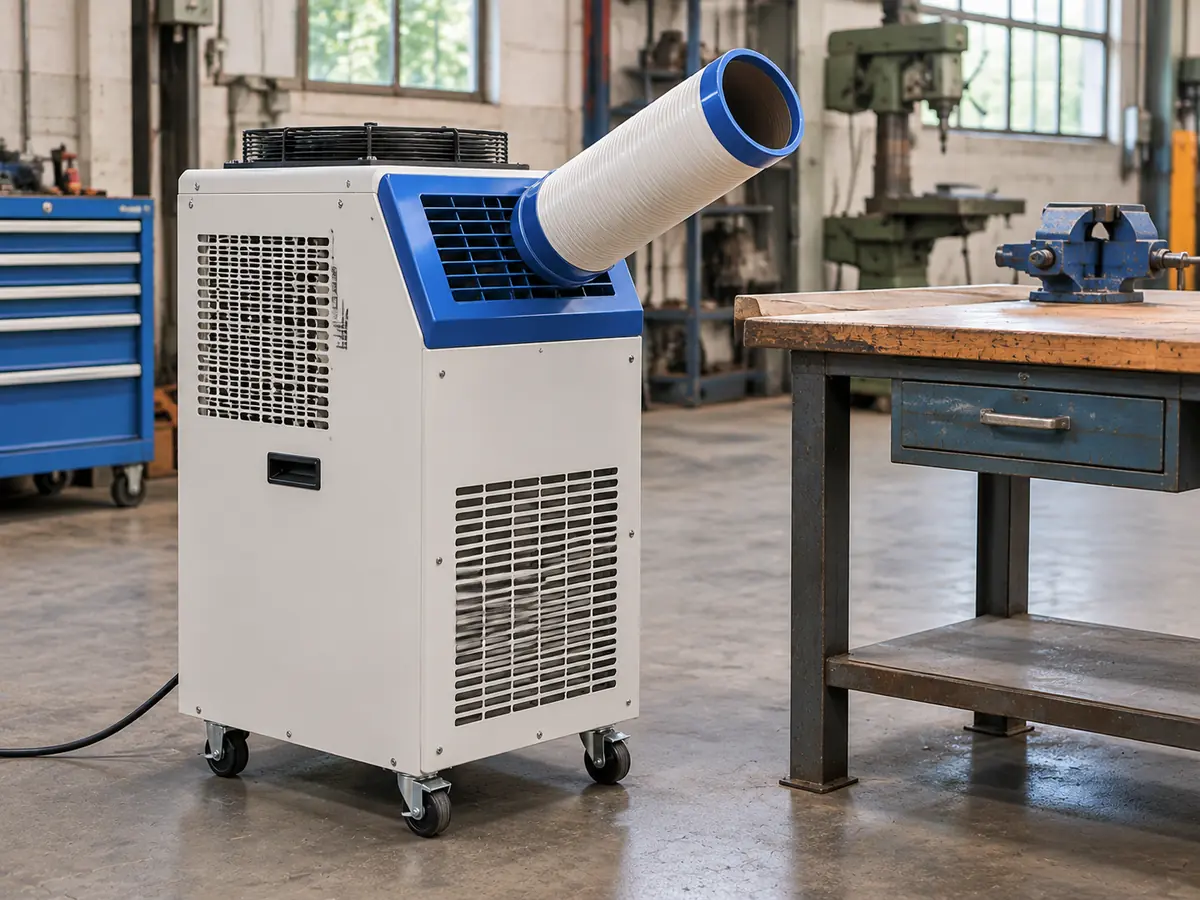
Yes, a compressor-based spot cooler can blow refrigerated air toward a person or workstation without a hose to the outdoors, but it cannot cool the entire closed room if its condenser heat stays there. It moves heat from one part of the space to another, while its electrical input adds more heat. If you need controlled room temperature, the waste heat must go outside the cooled space. This is the distinction described in the DOE portable-AC rule.
Check what the product actually uses. A water tank and wetted cooling pad point toward evaporative cooling. A refrigeration compressor, refrigerant information, and an outdoor heat rejection path identify a true air-conditioning system. The label “AC” by itself does not tell you which process is inside.
Do Ventless Portable Air Conditioners Work in Hot Weather?
An evaporative cooler can lower the air temperature leaving its pad when the air is dry and fresh air can move through the space. Its effect shrinks as humidity rises; in a sealed room, the added moisture makes continued cooling less effective.
The limit comes from the air’s wet-bulb temperature: the lowest temperature ordinary water evaporation can approach under the current air conditions. A wide gap between dry-bulb and wet-bulb temperatures gives evaporation more room to work. When the air is already damp, less water can evaporate and the temperature drop becomes small.
Check relative humidity where the cooler will actually run, and check whether you can safely keep fresh air moving through the space. Honeywell’s evaporative-cooler guidance says its coolers perform best around 60% relative humidity or below with adequate cross-ventilation. Use that humidity reading together with the incoming-air temperature and the available fresh-air path: as humidity rises, less water can evaporate and the pad provides less cooling.
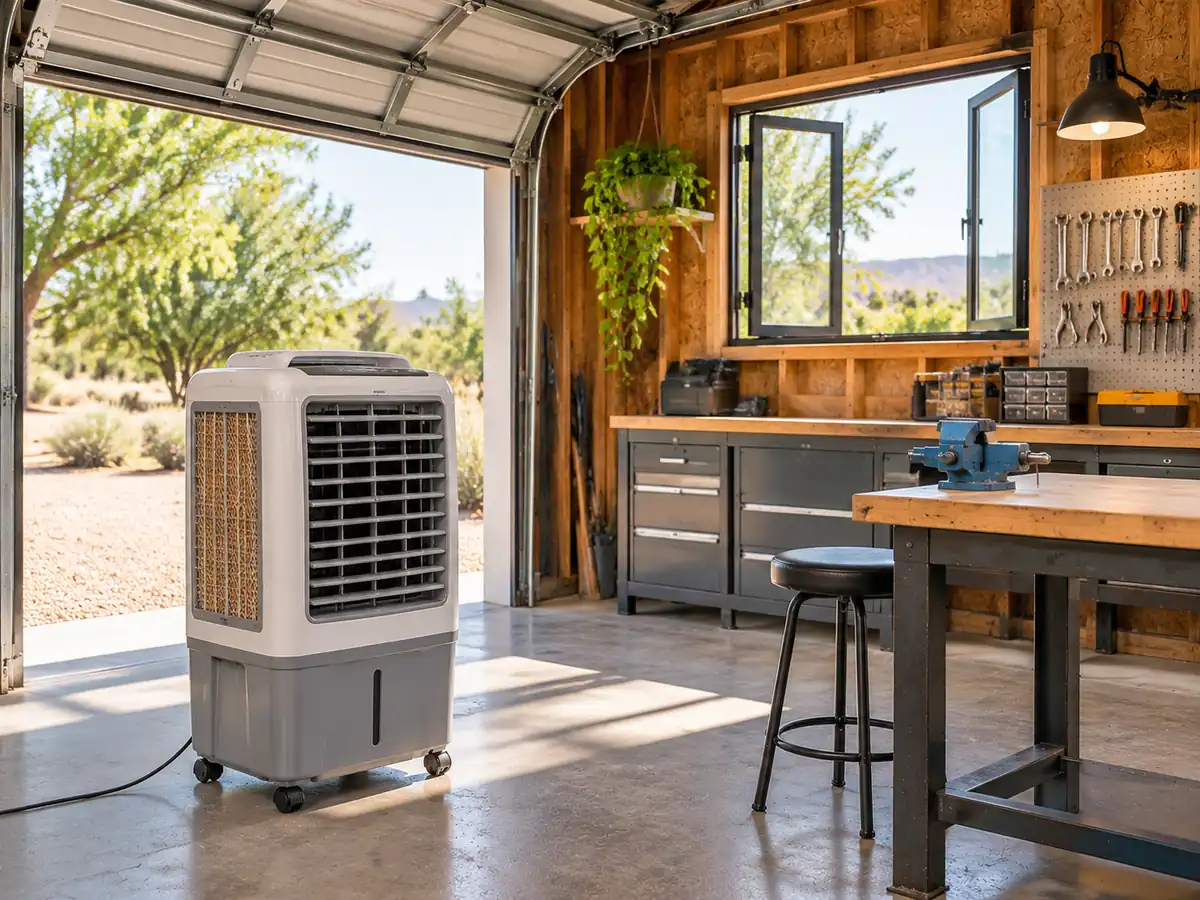
For a dry, breezy workshop or open room, you can supply outdoor air, keep a discharge opening open, and aim the cooler where people work. That helps replace the humid air it produces. In a humid bedroom with windows shut, the same machine may make the air feel sticky while failing to hold a lower room temperature.
Measure room temperature and relative humidity, not just how cold the stream feels at the nozzle. Start with a room thermometer/hygrometer, note the starting conditions, run the device as instructed, and compare the room’s conditions after use. A colder outlet stream with a rising humidity reading is not the same result as a compressor AC removing both heat and moisture.
The U.S. Department of Energy’s Building America guidance distinguishes evaporative comfort devices from room air conditioners and explains their dry-climate limits.
Ventless Cooler vs Portable AC vs Mini-Split: What Changes?
An evaporative cooler uses water evaporation to cool nearby air, adds moisture, and works best with dry, moving air. A compressor portable AC sends condenser heat outdoors through a hose, while a mini-split sends heat to a separate outdoor unit. Both compressor systems can cool an enclosed room when correctly sized and installed.
| Type | How it cools | Outdoor heat path | Effect on humidity | Best use |
|---|---|---|---|---|
| Ventless evaporative cooler | Water evaporates through a wet pad | No condenser exhaust; needs fresh-air exchange | Adds moisture | Local comfort in dry, ventilated spaces |
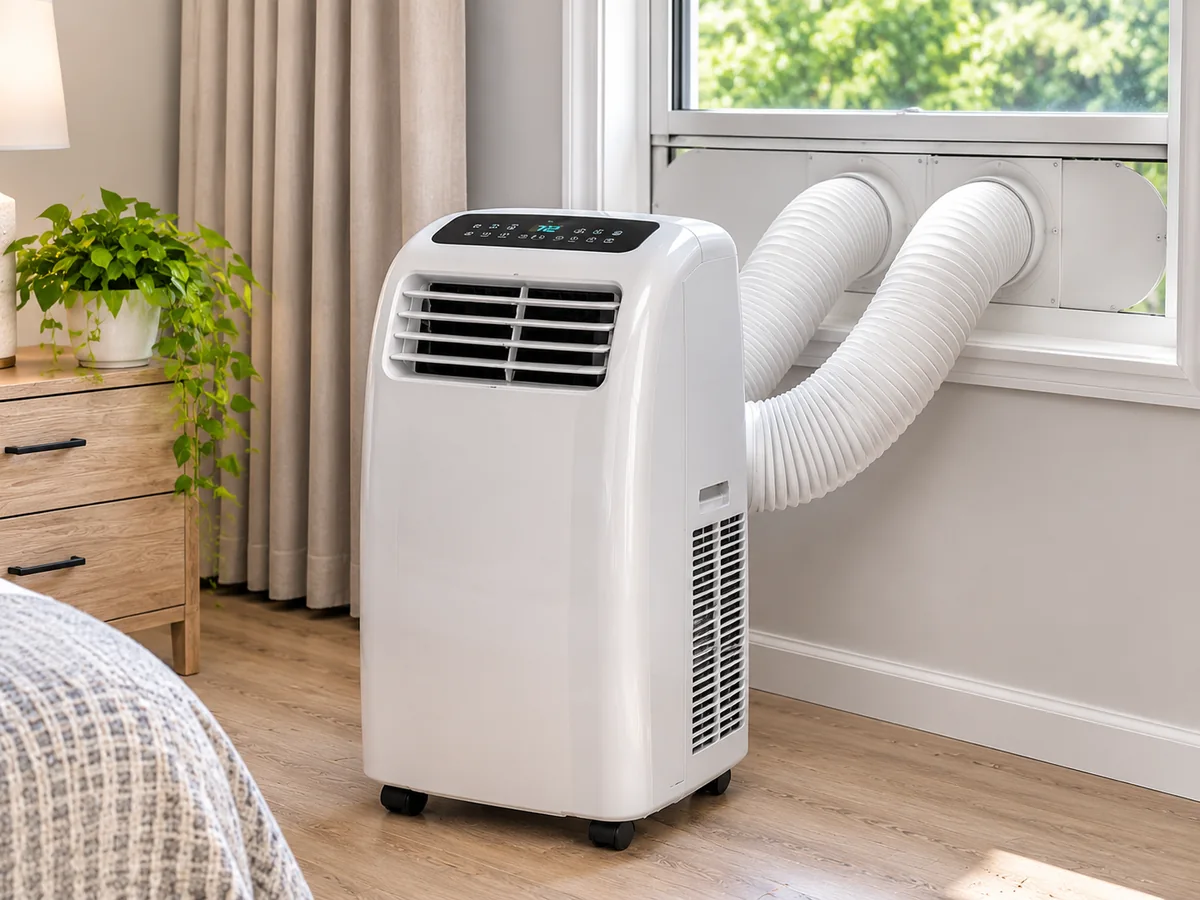
| Compressor portable AC, single hose | Refrigerant absorbs room heat | One hot-air exhaust hose to outdoors | Removes moisture during cooling | Enclosed rooms with a suitable outdoor vent route |
| Compressor portable AC, dual hose | Same refrigeration cycle | Separate outdoor intake and exhaust hoses | Removes moisture during cooling | Rooms with suitable openings; can reduce pressure-driven outside-air leakage |
| Window air conditioner | Refrigeration across a window-mounted cabinet | Condenser side faces outdoors | Removes moisture during cooling | Rooms with an approved, fitting window installation |
| Mini-split air conditioner | Indoor coil connected to outdoor unit | Outdoor condenser rejects heat | Removes moisture during cooling | Rooms or buildings needing a fixed, properly sized system |
| Fan or ice-pack personal cooler | Airflow or stored cold packs | No ongoing compressor heat exhaust | A normal fan does not remove moisture | Short-term personal comfort, not controlled whole-room cooling |
Portable AC performance comparisons should use ratings from the same test method. In the United States, the Department of Energy describes the seasonally adjusted cooling capacity (SACC) rating for portable air conditioners. Do not directly treat a portable AC’s higher advertised unadjusted BTU/h figure as equivalent to a window unit’s rating without checking how each number was measured. DOE portable air conditioner information explains the product category and its test method.
Which No-Hose Cooling Option Fits Your Room?
For a dry, safely ventilated workspace, an evaporative cooler can improve nearby comfort. For a hot, humid, closed room, choose a vented portable AC or fixed system that sends heat outdoors. If no outdoor heat path is possible, a fan can improve personal comfort but cannot replace room air conditioning.
| Your situation | Practical choice | Check before relying on it |
|---|---|---|
| Dry climate; doors or windows can stay open | Evaporative cooler plus strong cross-ventilation | Incoming air is dry; water and pad can be kept clean |
| Dry weather, but smoke or pollution makes outdoor air unsafe | Choose suitable refrigerated cooling that limits smoke entry, or use a cleaner cooled space | Check local air-quality alerts; do not open windows only to make an evaporative cooler run. Single-hose portable ACs can draw smoky air indoors through leaks, so consider the sealed installation and equipment type. |
| Hot, humid bedroom; windows normally closed | Properly vented refrigerant AC or a fixed split system | Outdoor exhaust path, room cooling load, humidity removal and noise |
| Rental; temporary installation allowed | Portable AC with the manufacturer’s window or door vent kit | Landlord/HOA rules, secure fit, drain access and electrical supply |
| No standard window, but an approved exterior wall outlet is possible | Professionally planned wall vent or mini-split | Building and fire rules, safe routing and correct installation |
| Outdoor seating area or open workshop | Fan or suitable evaporative spot cooler | Air movement helps people; do not expect controlled room temperature |
| No permitted exterior opening of any kind | Fan, shade, heat-source control, or relocation to a cooled space | These measures improve comfort but do not create compressor AC cooling |
For a sleeping room, prioritize a measured cooling result over a short blast of cold air. A high-humidity night is a poor match for a water-based cooler. If the space is very dry, take advantage of outside airflow instead of closing every window to “keep the cool in.”
When heat and wildfire smoke occur together, EPA’s wildfire indoor-air guidance advises keeping smoke out and considering how each cooling system handles outdoor air. A dry climate alone does not make open-window evaporative cooling the right choice. Check air quality, the window seal, and whether your cooling equipment brings in outside air.
For a workshop, check the actual task. Cooling one person at a bench is different from protecting temperature-sensitive equipment across the whole room. A local air stream can help the person without providing stable temperatures for the equipment.
For a garage workshop, our garage air conditioning guide compares portable, window, through-wall and mini-split options against insulation, door use and available outdoor heat paths.
How Can You Tell Whether a “Ventless AC” Listing Is a Real Air Conditioner?
To cool an enclosed room, a compressor air conditioner must use refrigerant and reject condenser heat outside that room, through an exhaust hose or an outdoor unit. A listing that mentions only a water tank, wet pad, ice, or fan speeds does not demonstrate refrigerated room cooling. Check the cooling method and heat outlet independently of the product title and claimed room size.
Use this short product check:
- Look for a refrigeration cycle. Is there a compressor, refrigerant specification, and a condenser? An evaporative pad and tank describe a different technology.
- Find the heat outlet. For a compressor unit, where does the condenser heat go? Look for the exhaust hose and window kit or an outdoor section. If the listing shows a compressor but no outdoor exhaust or outdoor condenser, find where its condenser releases heat. If that heat returns indoors, treat it as spot cooling, not closed-room AC.
- Separate exhaust and drainage. Does “no hose” mean there is no condensate drain tube, or no exhaust duct? They perform different jobs.
- Compare credible ratings. For a U.S. portable refrigerant AC, check its DOE seasonally adjusted cooling capacity (SACC), measured in BTU/h under the applicable test. Airflow in cubic feet per minute (CFM) tells you how much air moves, not how much heat an AC removes. A bare “cools 500 square feet” advertisement without conditions does not resolve the exhaust question.
- Read the installation and maintenance manual. Confirm safe outlet routing, electrical power, filter cleaning, water management, noise, and access for maintenance.
Example A — illustrative listing: “Water tank, wet cooling pad, 600 CFM airflow, no compressor or exhaust kit.” This describes an evaporative air cooler. The 600 CFM rating describes airflow; it does not rate refrigerated cooling capacity.
Example B — illustrative listing: “Refrigerant, compressor, SACC rating in BTU/h, and outdoor window exhaust kit.” This describes a portable refrigerant AC that needs to vent hot condenser air outside. If a listing leaves out the heat path, open the installation manual before choosing it.
A water-based cooler may be sold with a temperature-drop claim measured immediately after its wet pad. That is supply-air cooling, not proof of a lower steady temperature across a closed room. Ask which temperature was measured, where, at what humidity, and whether fresh air was supplied.
A compressor model with a hose is not automatically the wrong choice just because the hose is visible. The hose is how it performs the essential heat-removal job. A dual-hose model can limit negative room pressure compared with many single-hose designs, but both require a proper outdoor connection.
After checking a hose-vented model, see our portable AC exhaust and energy-saving checks for window-kit sealing, hose routing and whole-unit electricity use.
Can You Cool a Windowless Room Without a Portable AC Hose?
You can cool a windowless room with a properly installed system that rejects heat outside, but not by keeping a conventional portable AC’s hot exhaust inside the room. “No window” and “no outdoor heat path” are different problems.
| Room opening or constraint | Practical cooling route | What must fit |
|---|---|---|
| Sliding door | Compatible door-height portable-AC exhaust panel | Door opening dimensions, approved adapter and secure seal |
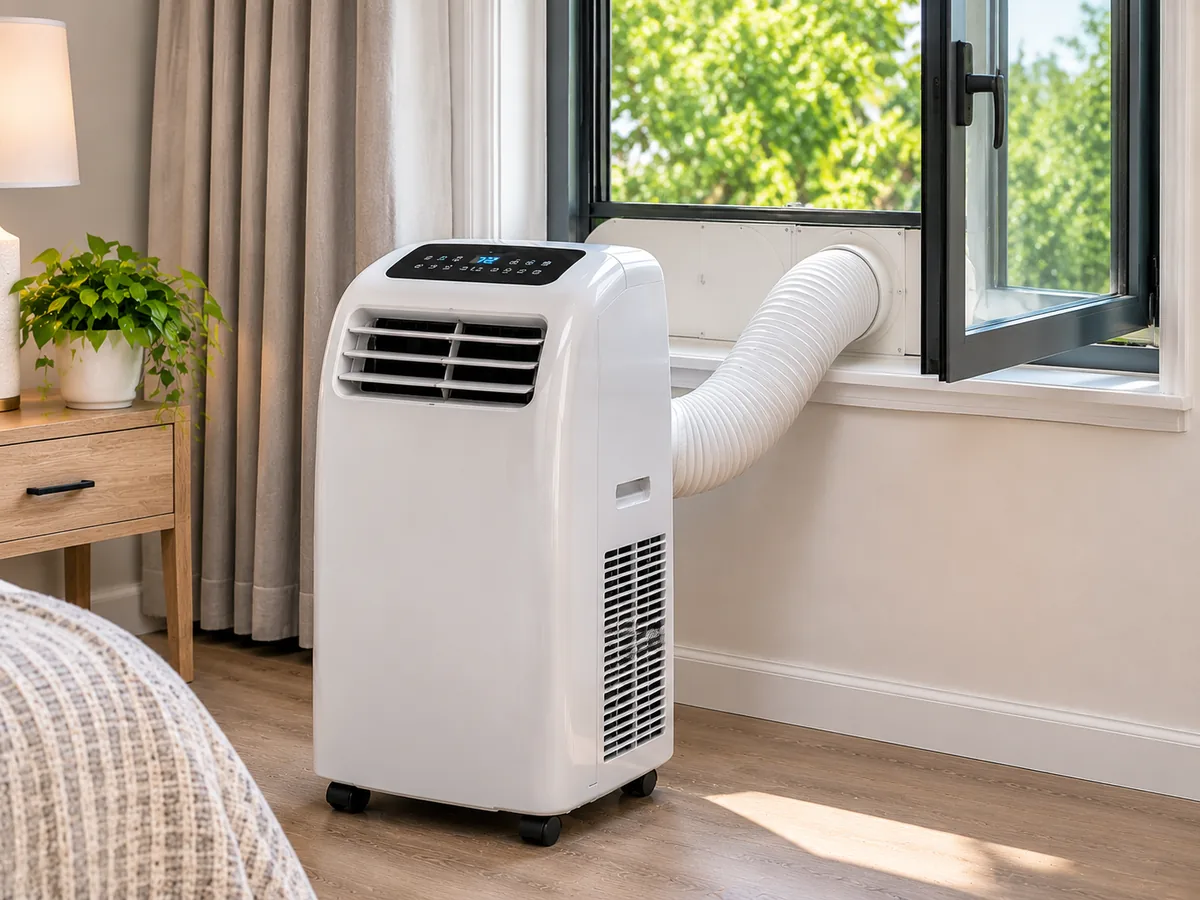
| Casement or outward-opening window | Manufacturer-supported flexible seal or properly fitted removable insert | Window motion, hose connection and stable installation |
| Permitted exterior wall opening | Manufacturer-approved duct outlet reaching outdoors | Wall permission, hose diameter, length, bends and safe discharge location |
| Permanent installation allowed | Mini-split with outdoor condensing unit | Outdoor-unit location, power, refrigerant lines, drainage and installer access |
Measure the opening and check the unit’s approved accessories before buying or modifying anything. A flexible fabric seal is not suitable for every window or model. Follow the manual’s duct diameter, length, bend and back-pressure limits; added resistance can reduce cooling or lead to overheating. Obtain landlord, building or other required approval before drilling a wall or changing a window assembly.
A mini-split gives a more permanent answer. Refrigerant lines connect the indoor coil to an outdoor condensing unit, so the room does not need a portable exhaust tube. Installation involves an approved wall penetration, appropriate power, drainage, mounting and commissioning.
If a fixed system is allowed, review the mini-split installation requirements for outdoor-unit location, wall penetrations, power, condensate drainage and commissioning.
If you are comparing fixed equipment for a bedroom, office, or project, our guide to air conditioner types explains how window units, portable units, and split systems differ.
When an exterior path is prohibited, focus on reducing solar gain, shifting heat-producing activities, using safe air movement, and accessing an already cooled area. A dehumidifier can make damp air more comfortable, but it releases its electrical and condensation heat into the room and is not a substitute for AC. Indoor exhaust into the attic or another occupied room only moves the problem.
How Should You Use a Ventless Evaporative Cooler Safely?
Give an evaporative cooler a fresh-air path, watch humidity, and keep its water system clean. It works by adding moisture, so a closed room gradually removes the very dry-air advantage it needs.
Open a suitable incoming-air path and an exit path as the maker directs. Aim the flow toward people rather than trying to use the small fan to force the whole building to a fixed thermostat setting. Check a hygrometer and the surfaces around the cooler. If humidity climbs and condensation appears, improve ventilation or stop using the water-cooling mode. The EPA’s moisture guidance recommends keeping indoor relative humidity below 60%, ideally around 30% to 50% when feasible, to help control dampness.
Why Is My Ventless Air Cooler Not Cooling Enough?
A ventless evaporative cooler often feels weak because the air is already humid, fresh-air exchange is limited, or the wet pad is not getting enough water. Check humidity and safe cross-ventilation first, then inspect the water tank, pump and wet pad.
- Check the conditions. Read the room thermometer and hygrometer. If the air is humid or outside air is smoky, do not keep adding water to chase a lower temperature.
- Check airflow and water. Where outdoor air is safe, provide the inlet and outlet openings the maker specifies. Confirm the tank has clean water, cooling mode or the pump is on, and the wet pad is clean and correctly fitted.
- Measure the result. After running the cooler under those conditions, compare room temperature and relative humidity away from the cold outlet with the starting readings.
- Change the approach if needed. If the room stays hot and damp under correct operation, use equipment that removes heat outdoors. If the pump fails or the unit leaks, stop and follow the manufacturer’s repair instructions.
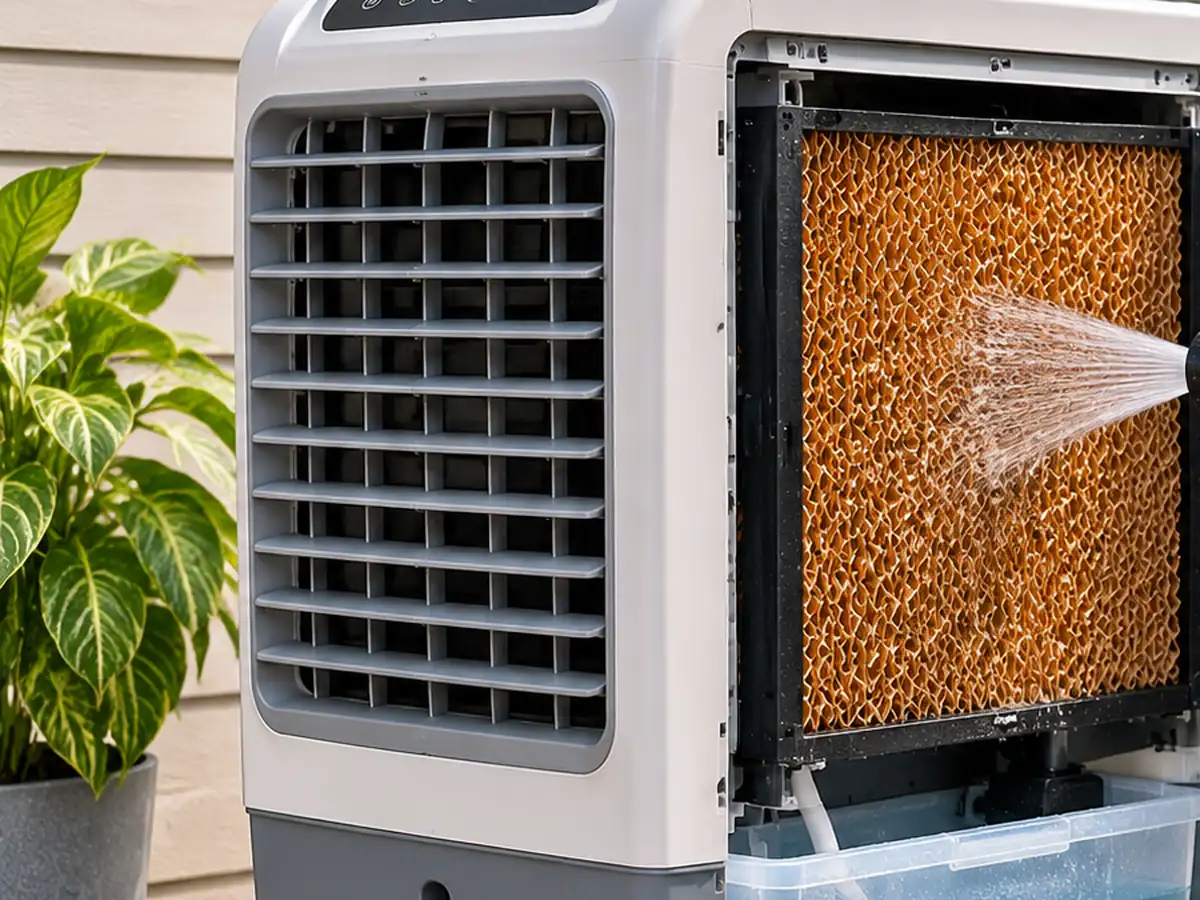
Empty stale water, clean or replace the wet pad, and dry the reservoir on the schedule in the manual. Avoid dripping water near outlets and extension cords; use a grounded supply where the appliance requires it. If you operate a refrigerant portable AC, use its approved outdoor exhaust kit instead of these evaporative-cooler instructions, keep the air path clear, and follow its condensate drainage guidance.
For a small room, it also helps to reduce heat gain at the source: close blinds against direct sun, seal obvious hot-air leaks around the correct window kit, and keep filters clear.
What Should You Choose Instead of a “Ventless Portable AC”?
Choose a hose-vented portable AC when you need temporary real room cooling, a mini-split when you can install fixed equipment, and an evaporative cooler only where dry air and ventilation make it useful.
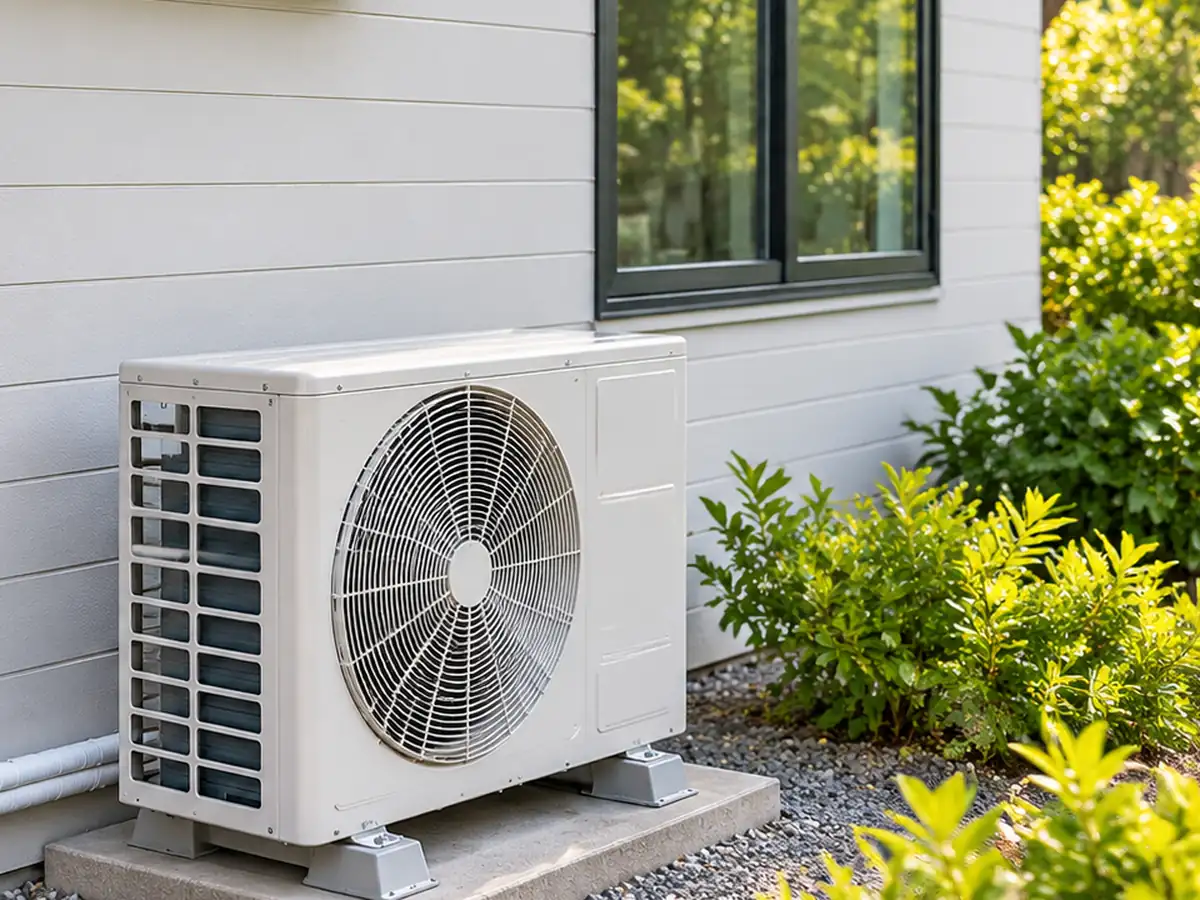
If your space stays humid and enclosed, prioritize a cooling-capacity rating, an outdoor connection, condensate handling, and acceptable noise. If your space stays dry and open, an evaporative cooler can make nearby air more comfortable without an exhaust duct, but you must provide cross-ventilation and maintain its water system.
If you choose fixed cooling, our guide to how to size a mini split for your room explains how to compare a room’s cooling load with the matched system’s delivered capacity.
To compare electricity costs, multiply the unit’s input power in kilowatts by running hours and your electricity rate per kWh. For example, an illustrative 100-watt device running 8 hours at $0.20/kWh uses 0.8 kWh and costs $0.16 in electricity. Use the actual product’s power data, hours and local tariff. Include water, pad cleaning and replacement for evaporative cooling. A cheaper fan or air cooler is not an equal cooling result to a vented AC.
For a permanent building installation, Airproz offers split air-conditioning products rather than presenting a compressor-based “no-exhaust” room cooler. Compare the room’s cooling load, electrical supply, outdoor-unit space and permission to install fixed equipment before choosing this route.
For one fixed indoor/outdoor product family, see the Airproz R32 SA split-air-conditioner specifications. The listed models use 220–240V / 50Hz power and are described for European applications. Check your destination market, electrical supply, required approvals, room load and exact model documentation before choosing this equipment.
Frequently Asked Questions
A no-hose evaporative cooler can move air without an exhaust duct, but a compressor air conditioner must reject its condenser heat outside the cooled room to provide net room cooling. The questions below cover hose use, drainage and equipment that cools only a nearby spot.
Is there a real portable air conditioner that works without a hose?
No—not a conventional compressor-based portable room AC. It needs an outdoor heat-rejection path, normally an exhaust hose. A “ventless” product is generally an evaporative cooler or fan. Some compressor spot coolers can blow cold air locally without an outdoor duct, but they release condenser heat indoors and cannot cool a closed room overall.
Can I use a portable air conditioner without connecting the exhaust hose?
No. A compressor portable AC cannot provide net room cooling when it releases its hot condenser exhaust indoors. Connect the manufacturer-approved exhaust kit to an outdoor opening before relying on the unit to cool the room.
Can I vent a portable AC into another room, ceiling, or attic?
No. Another room, a ceiling void, and an attic are not outdoor exhaust routes. The rejected heat will warm those spaces and may cause building problems. Vent directly outdoors through an approved connection, within the manufacturer’s duct limits.
Will a ventless cooler cool a bedroom with the windows closed?
No—not as a reliable way to cool a closed bedroom, especially in humid weather. An evaporative cooler needs dry replacement air and a path for moist air to leave. Otherwise, indoor humidity rises and cooling becomes less effective. For a hot, humid bedroom, use a properly vented air conditioner or a fixed cooling system.
Is a dual-hose portable air conditioner ventless?
No. A dual-hose portable AC uses one duct for outdoor condenser air intake and another to exhaust hot air outdoors. The separate ducts can reduce indoor pressure losses, but the unit still needs outdoor connections.
What is the difference between a drain hose and an exhaust hose?
A drain hose carries collected water, while an exhaust hose carries hot condenser air outdoors. Some units manage condensate without a continuous drain tube, but a compressor portable AC still needs an outdoor heat path.
Do battery-powered, ice-cooled, or USB “air conditioners” work without venting?
Yes. Some battery fans and water- or ice-assisted personal coolers run without an exhaust hose, but they do not provide the same closed-room cooling as a vented compressor AC. Ice packs store cooling produced elsewhere. A battery-powered refrigerant AC must still reject heat outside its cooled space.
The Bottom Line
A true portable air conditioner cannot keep cooling a closed room while its condenser heat stays inside. A portable air conditioning unit without hose is usually a water-based evaporative cooler or a fan, not an equal replacement for vented compressor AC.
Use a vented portable unit or fixed system when you need reliable temperature and humidity control. Use a ventless evaporative cooler for localized comfort in dry, well-ventilated conditions. The deciding question is where the heat goes, not whether the product photo shows a hose.
Planning permanent cooling for a home, shop, or building? Tell our Airproz team the room use, climate, needed capacity, power and allowed outdoor installation. We can help you compare split-system options based on the room’s cooling load, available outdoor-unit space and electrical supply.