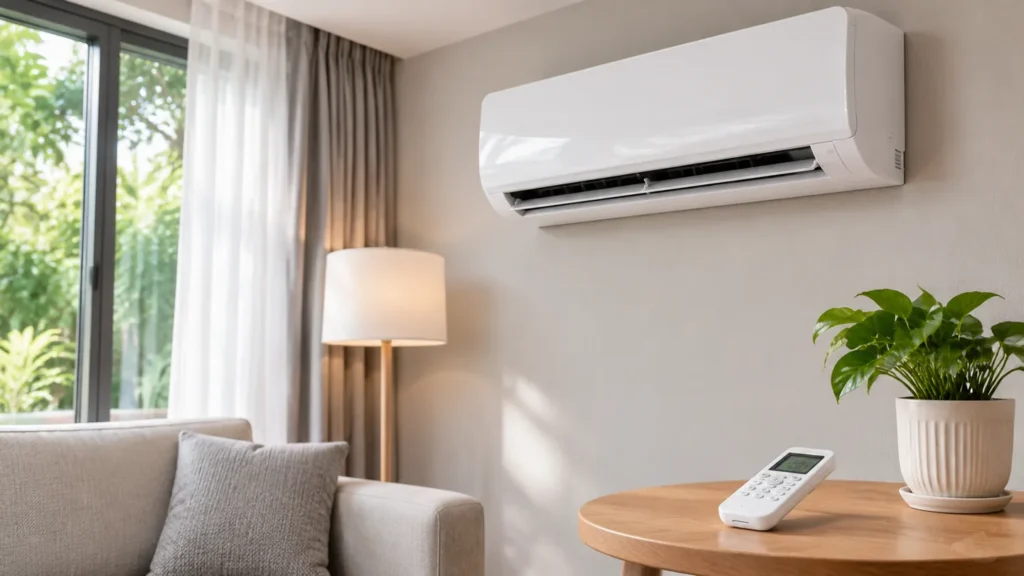
A 3.5-ton split-system air conditioner delivers 42,000 BTU/h (about 12.3 kW) of nominal cooling capacity. Choose this size for a home or light-commercial space when its calculated design cooling load is met by a verified 3.5-ton indoor/outdoor combination at the local design conditions. The equipment match—not the 3.5-ton name—determines the actual output, SEER2 rating, electrical input and coil compatibility.
The practical choice is to calculate the cooling load, compare capacity at the local design temperatures, and verify a complete indoor/outdoor system match. This guide explains how to read a 3.5-ton specification, how to compare 13.4 and 15.2 SEER2 listings, and what to confirm before ordering a 42,000-BTU split system.
What Does a 3.5-Ton Split-System Air Conditioner Deliver?
A 3.5-ton air conditioner is nominally a 42,000-BTU/h cooling system—not an appliance that consumes 42,000 BTU/h of electricity. One US refrigeration ton equals 12,000 BTU/h, so 3.5 × 12,000 = 42,000 BTU/h. Converted to SI units, the nominal cooling rate is approximately 12.3 kW of heat removed from the indoor space.
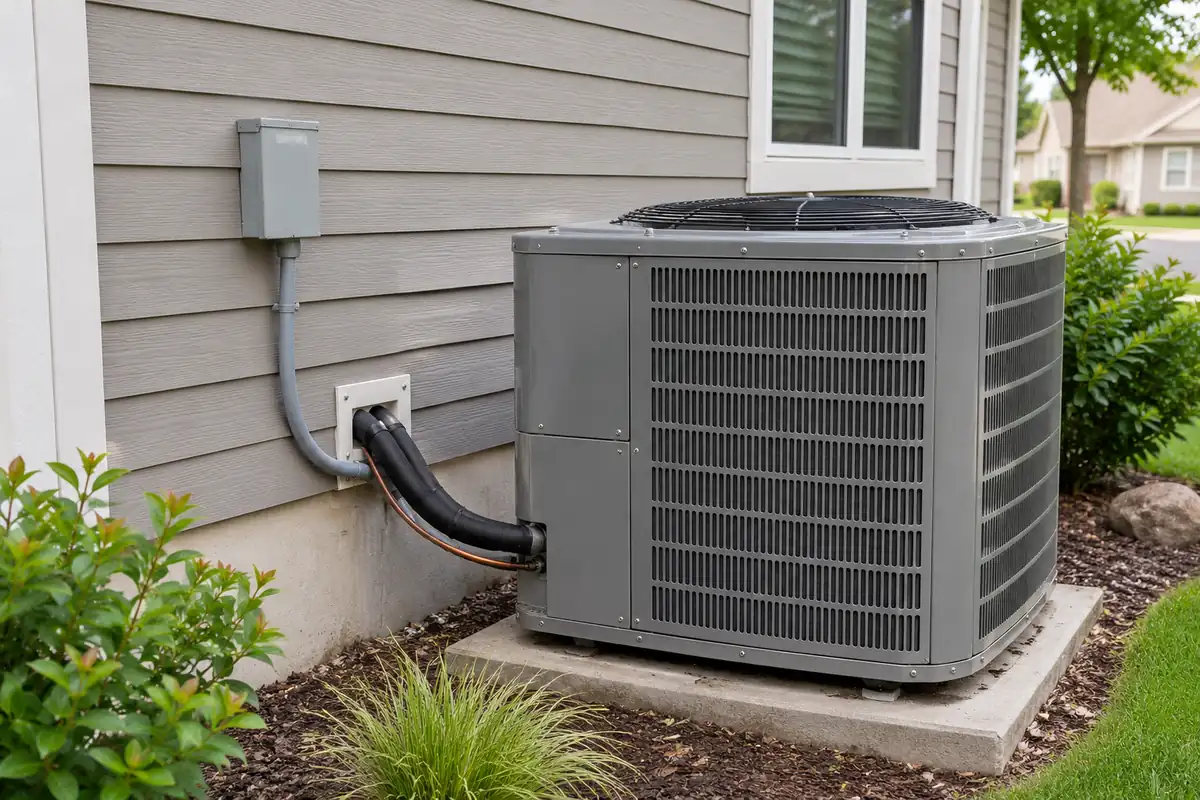
In a conventional central split system, an outdoor condenser/compressor unit works with an indoor evaporator coil fitted to an air handler or furnace. A blower moves air over that indoor coil, and ducts distribute the cooled air. A ductless mini-split is also physically split between outdoor and indoor equipment, but its product configuration and rating rules differ; do not substitute a ductless 42,000-BTU product for a ducted central AC specification without checking the project. Our guide to types of AC systems explains the differences between ducted central and ductless arrangements.
| Item | Meaning for a 3.5-ton system |
|---|---|
| Nominal cooling size | 3.5 refrigeration tons = 42,000 BTU/h ≈ 12.3 kW of cooling |
| Actual delivered cooling | Changes with outdoor temperature, indoor temperature/humidity, air volume, and the matched system |
| Sensible and latent cooling | Sensible cooling lowers air temperature; latent cooling removes moisture |
| SEER2 / EER2 | Efficiency ratings, not nominal cooling capacity or an electrical power rating |
| 3.5-ton equipment choice | Check a specific matched condenser, coil, metering device and blower arrangement |
A product named “3.5 ton” can deliver less than 42,000 BTU/h at a demanding operating point. For example, the published Goodman GLXS5BA4210A* performance table with a stated indoor-coil combination shows 40,000 BTU/h at 95°F outdoor air, at its listed indoor conditions and 1,400 CFM. The same table gives 36,750 BTU/h at 110°F. Those are data for that documented example, not universal 3.5-ton outputs. Read the selected manufacturer’s expanded performance table rather than relying on the size printed in a product title.
For broader system types and cooling-capacity definitions, see our air conditioner sizing guide.
How Much Square Footage Can a 3.5-Ton Air Conditioner Cool?
A 3.5-ton air conditioner works out to about 1,680–2,100 square feet only under an assumed 20–25 BTU/h per square foot screening calculation (42,000 ÷ 25 and 42,000 ÷ 20). Use that arithmetic to frame an early sizing question, not as the unit’s rated coverage or a recommended installation range. The correct size comes from the building’s calculated design load and the matched system’s capacity at the design conditions; two equally sized buildings can need different equipment.

Start with the building load, not floor area alone
The selection input is the design cooling load in BTU/h, including both temperature and moisture loads at the project’s design conditions. A qualified designer or contractor can use ACCA Manual J for a residential calculation, then apply Manual S and manufacturer performance tables to select equipment. DOE guidance on proper HVAC sizing explains why sizing by area alone can leave comfort and humidity problems.
Check at least climate and outdoor design temperature, insulation and air leakage, windows and solar gain, ceiling/roof exposure, occupants and internal heat, indoor humidity target, and duct location/leakage. Then compare the resulting sensible and total loads with the actual indoor/outdoor system ratings.
See why the same floor area can lead to different answers
Take a 2,000-square-foot plan. At an assumed 16 BTU/h per square foot, the arithmetic is 32,000 BTU/h; at an assumed 28 BTU/h, it is 56,000 BTU/h. If a real load calculation returned about 32,000 BTU/h, examine a matched 3-ton system first. If it returned about 56,000 BTU/h, a nominal 3.5-ton unit would need to be ruled out unless a documented design and equipment arrangement addresses that higher load. The arithmetic assumes the stated heat gain per square foot. Equipment selection requires the building’s calculated load. The next step in either case is to compare the calculated sensible and total loads with actual equipment performance.
If the verified design load and selected equipment ratings point toward 42,000 BTU/h, evaluate a 3.5-ton match. If not, compare adjacent capacities and a correctly configured variable-capacity design. Bigger is not automatically safer: oversizing can shorten cycles and reduce moisture removal, while undersizing can leave the space warm during peak load. Confirm supply airflow and duct performance as part of the same decision.
Which 3.5-Ton Split-System Specifications Matter Most?
Compare the matched-system rating, actual capacity at design conditions, refrigerant and electrical installation data before comparing headline price or SEER2. The condenser’s nominal tonnage is only the start of the specification.
| Specification | What to request and how to use it |
|---|---|
| Outdoor and indoor model numbers | Identify the exact condenser and evaporator coil/air handler or furnace pairing; include the metering device |
| Rated and expanded cooling capacity | Verify total and sensible BTU/h at the intended outdoor and indoor design conditions, plus blower airflow |
| SEER2 and EER2 | Obtain the matched-system efficiency values and certification number where applicable; compare ratings under the same test rules |
| Refrigerant | Confirm R-32 or the stated refrigerant and that both sides, controls and field requirements support it |
| Airflow / external static pressure | Check blower data against real duct resistance, filters and coil pressure drop |
| Electrical | Read voltage, phase, frequency, minimum circuit ampacity (MCA), maximum overcurrent protection (MOCP), and unit power at known conditions |
| Installation | Confirm connection sizes, allowed line length/elevation, charge rules, equipment clearances, service access and condensate management |
Is a 13.4 SEER2 or 15.2 SEER2 R-32 system the better choice?
Choose a verified 15.2 SEER2 matched system over a 13.4 SEER2 system when both meet the project’s cooling needs and the higher seasonal efficiency is worth its actual price difference. A 13.4 SEER2 match can be a lower-initial-cost option only where that efficiency level is permitted for the exact system and installation region; compare actual quotations before assuming it costs less. Verify both indoor/outdoor combinations on the same SEER2 test basis. To judge payback, compare their installed prices with estimated seasonal kWh using the local climate, cooling load and electricity tariff; a rating difference alone does not give a dollar saving.
For US projects, minimum permitted efficiency also depends on region, equipment category and date of applicable compliance. Under the regional 2023-era central-AC framework, the commonly cited minimum for split central AC below 45,000 BTU/h is 13.4 SEER2 in the North and 14.3 SEER2 in the Southeast and Southwest, with additional Southwest EER2 conditions. Therefore, do not assume a “3.5 ton 13.4 SEER2 R32 air conditioner” is suitable for installation in every US state. Verify current requirements and the equipment’s listed region-specific status before purchase. See the Goodman regional efficiency overview and the appropriate local authority.
“16 SEER” and “15.2 SEER2” use different test procedures. Do not treat them as interchangeable numerical ratings or infer a conversion from the advertising text. Compare units using the same rating basis, and request the AHRI certification number for the matched system where the certification program applies.
Does R-32 change the sizing method?
R-32 changes the refrigerant and applicable equipment/installation requirements, not the requirement to size by design load. Use only a manufacturer-approved R-32 indoor/outdoor combination and follow the equipment instructions and local rules for A2L refrigerants. Do not assume a previously installed coil, electrical control, line set or safety arrangement is compatible just because its capacity is labeled 3.5 tons.
How Do You Match a 3.5-Ton Condenser, Coil, and Air Handler?
Match the exact outdoor condenser model to a manufacturer-approved indoor coil, metering device and blower, then check the combination’s certified ratings and design-condition performance. This gives you a usable system specification instead of two separate components chosen only because each is advertised as 3.5 tons.
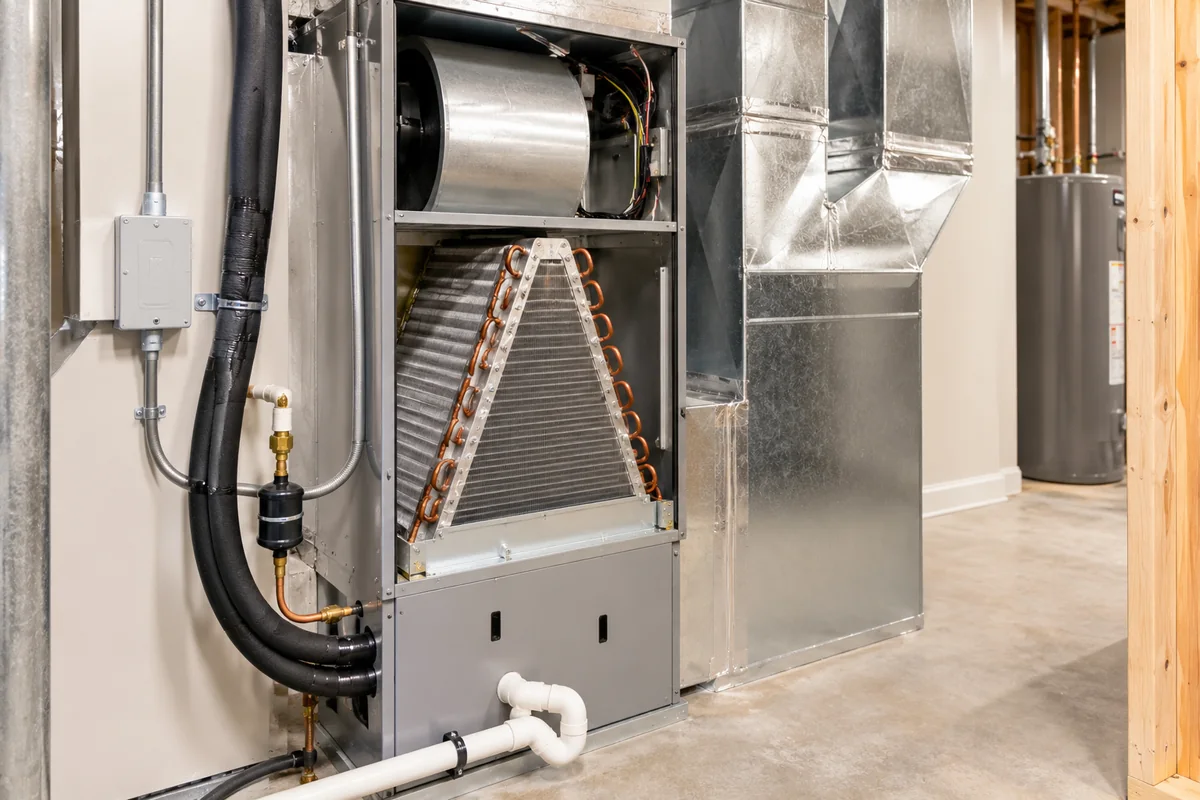
Use the manufacturer’s approved pairing table to identify the coil and metering device, then the blower table to confirm airflow at the installed duct static pressure. This matters because the pairing affects delivered cooling, humidity removal and efficiency; low airflow can reduce output and contribute to coil icing. Our guide to evaporator coil freezing explains how airflow restrictions and refrigerant-side faults lead to different troubleshooting steps. A coil’s nominal tonnage does not replace the pairing and refrigerant checks.
- Record the exact outdoor model and refrigerant. Do not stop at “42,000 BTU” or a brand family name.
- Find the manufacturer-approved indoor combinations. Confirm coil model, expansion device and the specified air handler or furnace/blower arrangement.
- Check the certified match. For an AHRI-listed system, match the exact combination and its certification number; use the appropriate system efficiency and capacity ratings, not a standalone condenser listing.
- Check airflow at installed static pressure. Confirm that the blower and duct design deliver the intended CFM through the filter, coil and distribution system at the stated static pressure.
- Validate design-condition capacity. Confirm sensible and latent performance at the outdoor heat and indoor humidity the project must handle.
- Verify site limits. Check approved refrigerant piping, voltage, installation space, condensate drainage and manufacturer instructions.
For a replacement job, include the existing indoor coil, furnace and duct conditions in the scope. Keeping an old component simply because it physically fits can invalidate the intended match. Our air-conditioning connection guide explains the separate roles of power, refrigerant piping, controls and drainage.
How Many Watts Does a 3.5-Ton Air Conditioner Use?
One published 3.5-ton Goodman system uses 2,810 W at 75°F outdoor air, 3,440 W at 95°F and 4,025 W at 110°F under the indoor test conditions shown below. These are three operating points for one documented equipment combination, not a wattage range guaranteed for every 3.5-ton AC. Electrical input changes with weather, indoor conditions, matched coil, airflow and compressor load. The 42,000 BTU/h tonnage is cooling capacity, not watts consumed.
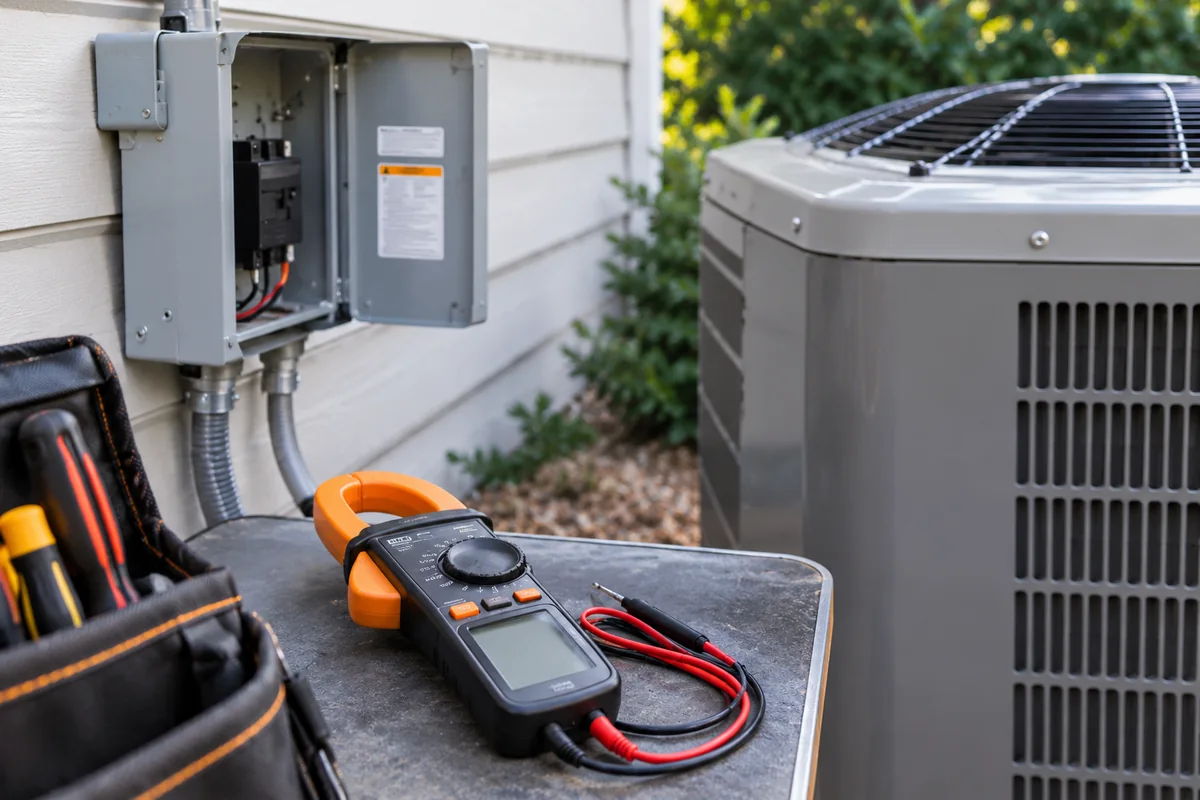
The following values come from Goodman’s published expanded performance data for the GLXS5BA4210A* outdoor model with the CAPTA4230*3A* indoor-coil configuration at 80°F indoor dry bulb, 67°F indoor wet bulb and 1,400 CFM. The source is an OEM performance table, not an Airproz model test.
| Outdoor air | Total cooling capacity | Electrical input shown in table |
|---|---|---|
| 75°F | 42,890 BTU/h | 2,810 W |
| 95°F | 40,000 BTU/h | 3,440 W |
| 110°F | 36,750 BTU/h | 4,025 W |
Source: Goodman GLXS5B-R32 engineering specification, expanded cooling performance table. For operating-cost estimates, use power at the relevant duty points; for circuit and protection sizing, use the selected unit’s MCA/MOCP and installation instructions instead of this performance table.
Calculate energy cost from power and run time
Use energy (kWh) = electrical power (kW) × operating hours. A system drawing 3,440 W continuously for eight hours uses 3.44 × 8 = 27.52 kWh. At an assumed $0.20/kWh tariff, the electricity cost for those eight hours is $5.50 (rounded). To estimate a real day, replace the eight steady-power hours with the unit’s expected hours at each operating load—or use measured daily kWh—then multiply by your actual tariff. Cycling, modulation and outdoor temperature change the total.
Do not calculate instantaneous watts by dividing 42,000 BTU/h by the unit’s SEER2 number. SEER2 is a seasonal energy-efficiency ratio based on a prescribed test procedure; it is not a fixed instantaneous efficiency at 95°F. To compare operating cost, use matched-system efficiency information together with a load and climate model, or measured electrical data from comparable duty. See our AC running-cost method for the energy and tariff steps.
3-Ton vs. 3.5-Ton Air Conditioner: Which Size Should You Choose?
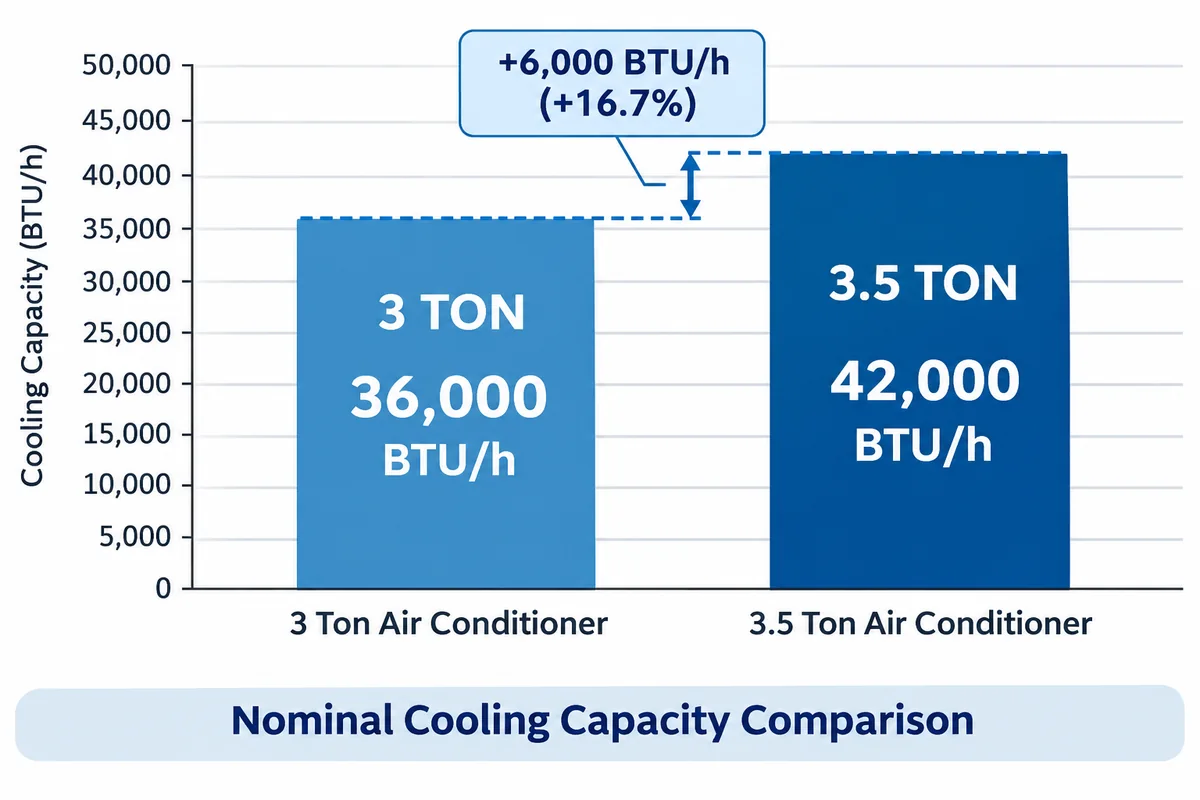
Choose 3 tons when its matched system meets the calculated design load, sensible/latent requirements and airflow; step up to 3.5 tons when the verified 3-ton performance falls short but a documented 3.5-ton match meets them. The nominal difference is 6,000 BTU/h (about 16.7%), but the decision uses real capacity at the project’s design temperature rather than an automatic half-ton safety margin.
| Comparison | 3-ton system | 3.5-ton system |
|---|---|---|
| Nominal cooling capacity | 36,000 BTU/h | 42,000 BTU/h |
| Difference | Baseline | 6,000 BTU/h more, about 16.7% greater nominal capacity |
| Right way to decide | Compare actual performance with design load | Compare actual performance with design load |
| What tonnage alone cannot show | Humidity removal, watts, correct airflow and efficiency | Humidity removal, watts, correct airflow and efficiency |
To apply the sizing method, assume the calculated design load is 33,000 BTU/h and a matched 3-ton system provides 35,000 BTU/h at that design condition. Check its sensible and latent performance and airflow; if those also meet the project, select the 3-ton option. For a second project with a 39,000 BTU/h load, suppose the same 3-ton match provides 35,000 BTU/h while an approved 3.5-ton match provides 40,000 BTU/h at that condition. If the larger match also meets humidity and airflow requirements, select the 3.5-ton option. Replace these demonstration capacities with the real expanded performance tables before specifying equipment.
If the project has a wide load range across seasons or rooms, compare verified staged or variable-capacity options, blower settings and duct/zoning design. Our inverter air conditioner guide explains how variable-speed compressor control changes output as cooling demand shifts. A nominal capacity increase alone does not solve bad air distribution or moisture control. For US-market split-system documentation and certification terminology, see our US mini-split specification guide for that equipment category.
What Should You Verify Before Ordering or Installing a 3.5-Ton Split System?
Before accepting a quotation, obtain one matched-system submittal that connects your project load to a specific outdoor unit, indoor coil, efficiency rating and installation scope. A product listing that says only “3.5 ton 15.2 SEER2 R32” leaves important decisions open.
| Check | What a complete answer should contain |
|---|---|
| Building and climate | Location, outdoor/indoor design conditions, Manual J load or equivalent project load and the target humidity |
| Equipment | Outdoor model, indoor coil and air handler/furnace/blower models, refrigerant and approved control/metering configuration |
| Verified performance | Total and sensible cooling at design conditions; relevant airflow, static pressure and temperature assumptions |
| Efficiency and region | AHRI certification number (when applicable), SEER2/EER2 for the actual combination, and destination-region compliance |
| Electricity and installation | Voltage/phase/frequency, MCA/MOCP, approved pipe run, drain routing, clearances and field-work boundaries |
| Delivery and service | Lead time and warranty terms for the specific quoted equipment; commissioning and service responsibilities |
Airproz product fit: Our air conditioner product catalog lists split AC families. For a 42,000-BTU/h ducted central split request, send us the destination market, design-condition load, required refrigerant and indoor coil/air handler details. We can then check availability of a suitable model pairing and the supporting model-specific documents before preparing a proposal. The public catalog does not currently identify a confirmed 3.5-ton certified central split match, so the final selection depends on that model check.
If the project instead uses separate wall-mounted indoor units rather than one ducted central system, the Airproz R32 SA inverter split AC series is a different product option, with published 9,000–24,000 BTU/h capacity classes. Size each room or zone for that configuration; this series is not a 42,000-BTU/h ducted condenser-and-coil combination.
If you are preparing a project schedule or distributor request, send the load and the proposed coil/blower details with your required rating standard and destination. Use the Airproz contact page to request a model-specific submittal and compatibility check; the technical selection should follow the approved documentation rather than a generic tonnage quote.
Is a 3.5-Ton Split-System Air Conditioner Right for Your Project?
A 3.5-ton split-system air conditioner is the right choice only when the building’s design load, the matched system’s actual cooling output, and the installation conditions agree. The nominal label is 42,000 BTU/h. Confirm the load, indoor coil, R-32 configuration, SEER2 rating and electrical supply separately.
Begin with the cooling and humidity requirements, then request the indoor/outdoor model match and expanded capacity table. If a 3-ton system meets the load, do not upsize without a technical reason. If a documented 3.5-ton combination is required, choose by the actual design-condition performance and certified rating, then verify duct airflow and installation details before ordering.
Frequently Asked Questions
Is a 3.5-ton air conditioner the same as a 42,000-BTU air conditioner?
Yes. In US cooling-capacity terminology, 3.5 refrigeration tons equals 42,000 BTU/h nominal cooling capacity. The actual delivered capacity depends on the matched equipment and operating conditions.
Will a 3.5-ton air conditioner cool a 2,000-square-foot house?
A 3.5-ton system is one possible size for a 2,000-square-foot house, not a size selected by area alone. Obtain a residential Manual J load result and compare it with matched equipment output: use 3 tons if that approved combination meets the load and humidity needs, or evaluate 3.5 tons if a verified 3-ton match falls short and the larger match meets them.
Can I use any 3.5-ton evaporator coil with a 3.5-ton condenser?
No. Use a manufacturer-approved condenser, indoor coil, metering device and blower combination. Check refrigerant compatibility, expanded performance and any applicable AHRI certificate before ordering.
Is 15.2 SEER2 always better than 13.4 SEER2?
A genuine 15.2 SEER2 matched-system rating indicates higher seasonal rated cooling efficiency under the same test framework. It does not guarantee a particular bill saving, and a 13.4 SEER2 split AC may not meet minimum rules in every US region.
Can an R-32 3.5-ton condenser use an older R-410A indoor coil?
Do not assume so. Refrigerant, coil, metering device and safety requirements must match the manufacturer-approved system. Reuse only when the exact manufacturer documentation expressly permits the configuration.
Does a 3.5-ton AC use 3,500 watts?
About 3,500 W can be plausible at one operating point, but it is not a fixed draw for all 3.5-ton units. A published Goodman example lists 3,440 W at 95°F outdoors, 2,810 W at 75°F and 4,025 W at 110°F, with the stated indoor conditions and coil. Use your selected system’s performance data to estimate its input and metered kWh for actual running cost.
Do I need 3 tons or 3.5 tons if the current AC struggles on hot days?
First check whether the current system has proper airflow, clean heat exchangers, correct refrigerant performance and adequate duct delivery. Then compare the measured or calculated design load with candidate equipment ratings before deciding to increase tonnage.
What is the difference between 16 SEER and 15.2 SEER2?
SEER and SEER2 use different rating test procedures, so the printed numbers should not be treated as directly equal. Compare certified systems on the same rating basis, including EER2 and relevant regional requirements.