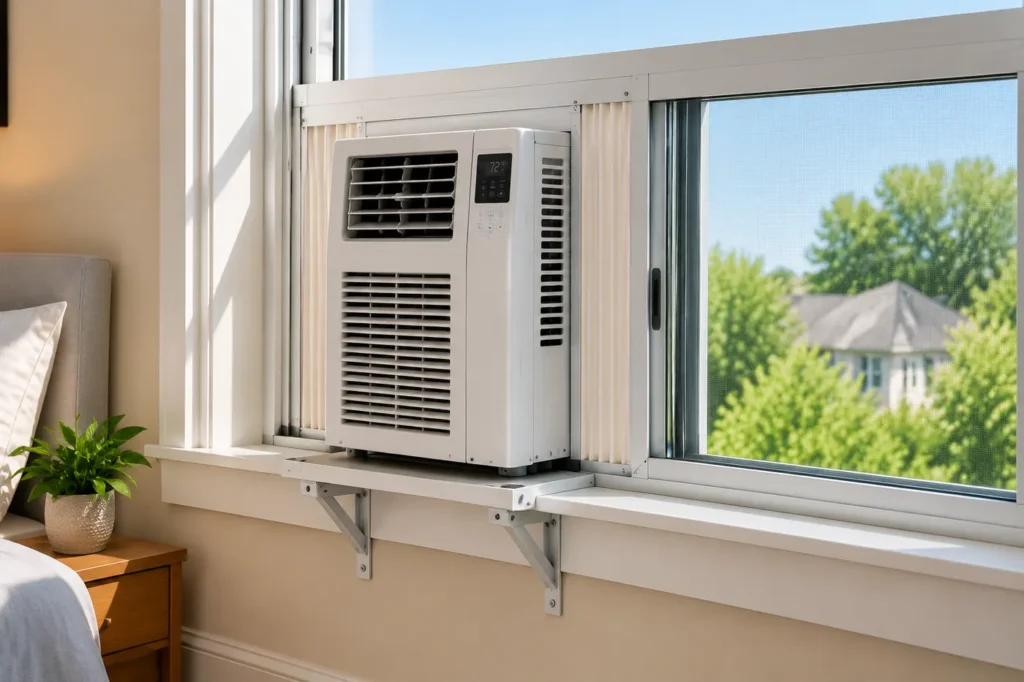
Air conditioners for horizontal sliding windows work best when the equipment is designed for a side-to-side opening. A slider/casement window air conditioner is the first option if its cabinet, support kit, and required opening fit your window. A portable air conditioner with a vertical window exhaust kit is the easier alternative when you cannot mount a heavy unit in the window. For long-term, multiroom, or heating-and-cooling needs, a properly sized ductless mini-split may make more sense.
The deciding factor is not just room size. Measure the clear opening, check how the sash moves, and read the exact model’s installation instructions before choosing. A standard window AC built for an up-and-down sash is not a ready-made match for a sideways slider.
Which Air Conditioner Works With a Horizontal Sliding Window?
Choose a purpose-built slider/casement AC when you want a unit mounted in the window. Choose a portable AC when you need an exhaust-only window connection. Choose a ductless mini-split when the window cannot safely support equipment or you want a more permanent solution. Each option sends indoor heat outdoors, but the window takes on a different job.
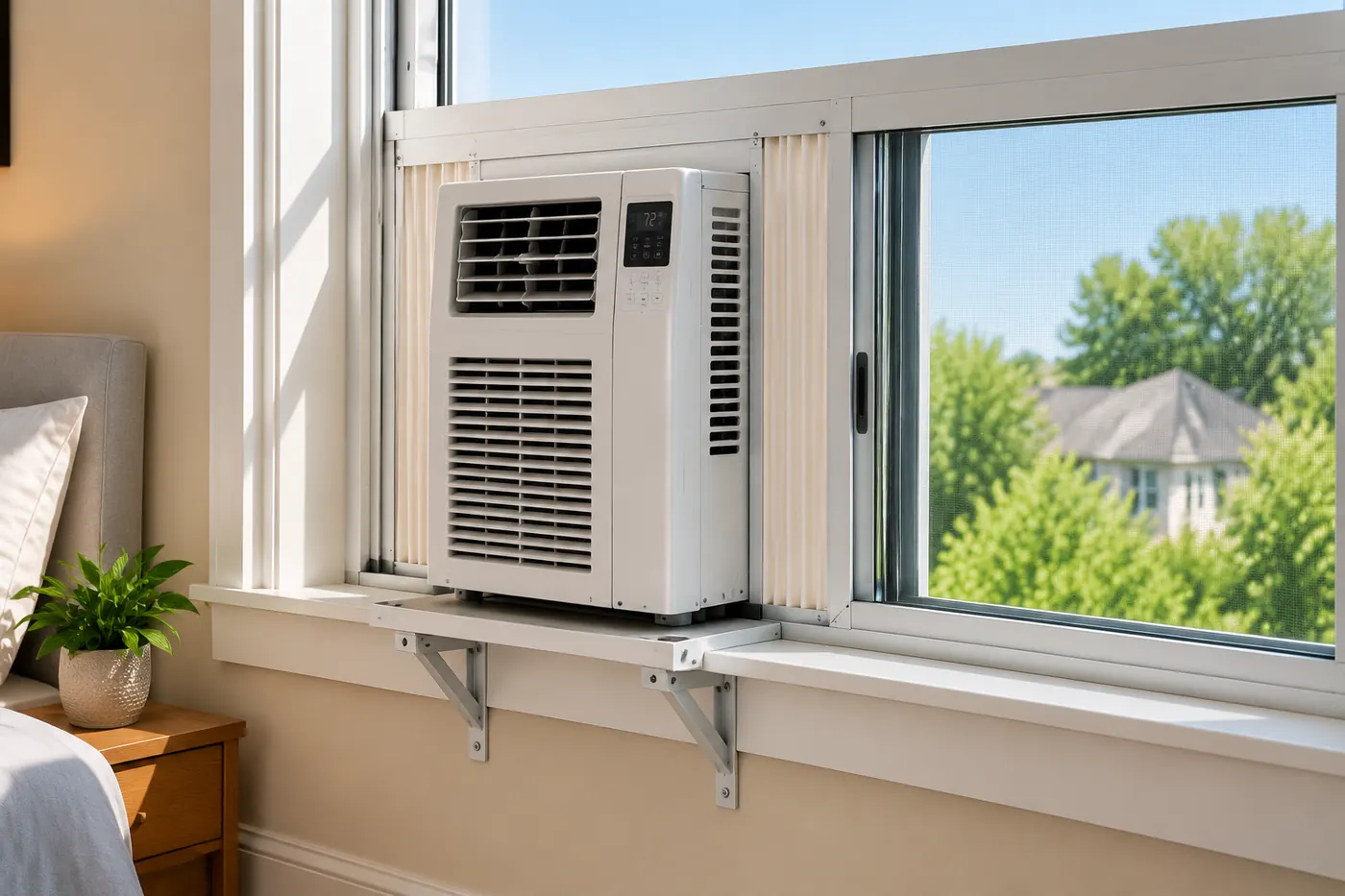
| Type | Where the cooling equipment goes | What the sliding window needs | Usually a good choice when |
|---|---|---|---|
| Slider/casement window AC | Cabinet sits in the approved window opening on its support platform | Exact opening dimensions, dedicated bracket, frame and seals | You want a compact, fixed single-room setup and the window is suitable |
| Portable air conditioner | Whole unit stands on the room floor | A compatible vertical exhaust-panel kit and a tight hose connection | You rent, need easier removal, or the window cannot hold a cabinet |
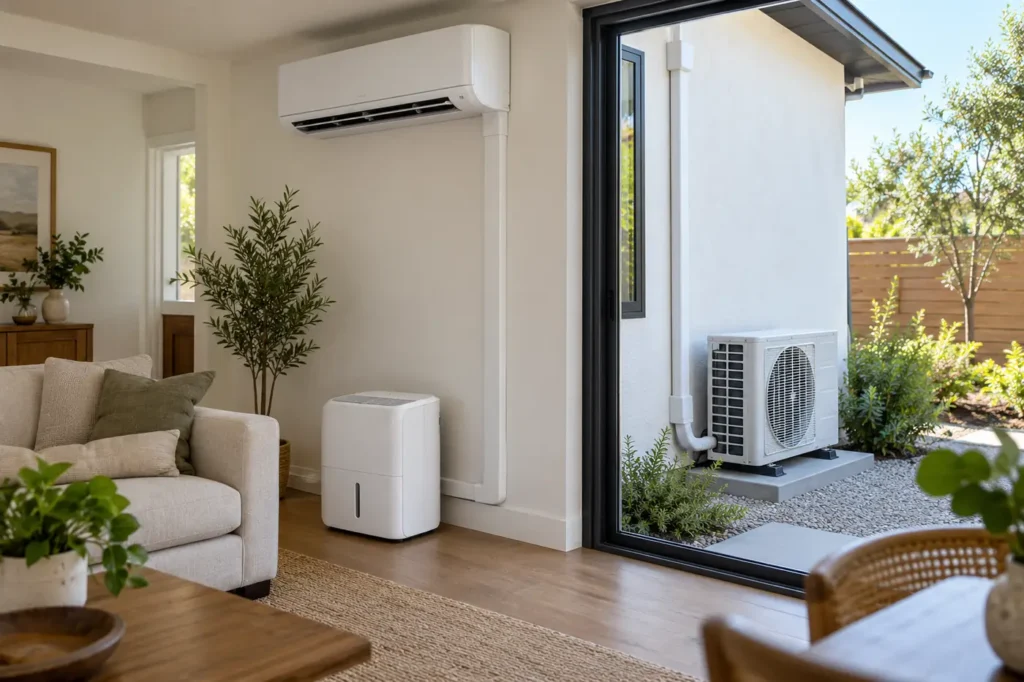
| Ductless mini-split | Indoor wall unit plus separate outdoor unit | No window opening needed; approved refrigerant, condensate and electrical routes | The room needs a lasting system or the window must stay usable |
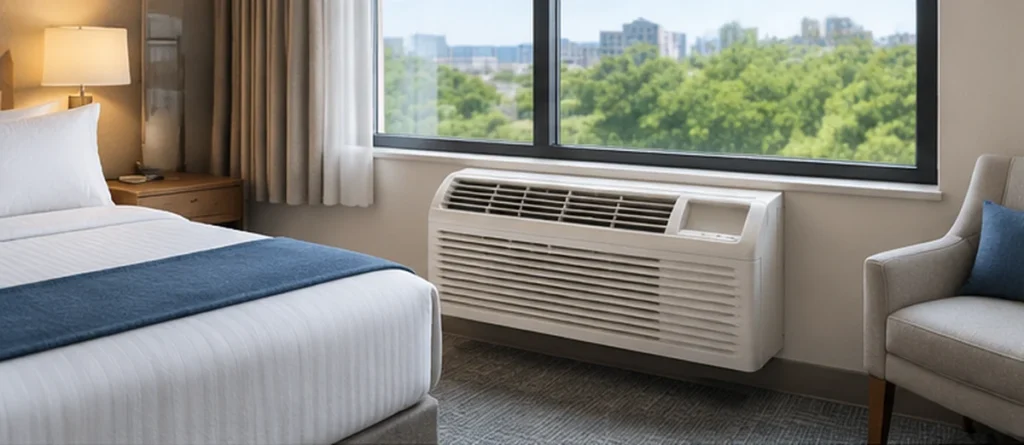
| Through-wall room AC | Unit sits in a correctly designed exterior-wall sleeve | No window opening needed | A suitable wall opening and approved sleeve already exist or can be built |
Slider/casement units are not ordinary window units
A slider window air conditioner is commonly a tall, narrow room AC with a matching installation system. It is sold for horizontal sliders and, on certain models, hinged casement windows. The sliding sash closes toward the side of its cabinet, while an approved platform and bracket support its weight.
For example, the Frigidaire FHSC082WB1 product details list an 8,000 BTU/h slider/casement AC with a 14½-inch cabinet width, a 15½-inch required window opening width and a 21½-inch minimum opening height. This model is discontinued, but its published dimensions show why you should compare each model’s installation-opening requirements with your own measurements.
Portable ACs connect a hose instead of placing the machine in the window
A portable air conditioner remains indoors. Its window kit holds an exhaust outlet in a vertical opening and seals the space around it. Some kits use a single outlet; others have special adapters for dual-hose systems. You must match the exact hose, connector, panel length and installation method. The Honeywell portable AC installation guidance explains why these kits differ by window type.
A ductless mini-split avoids using the sash
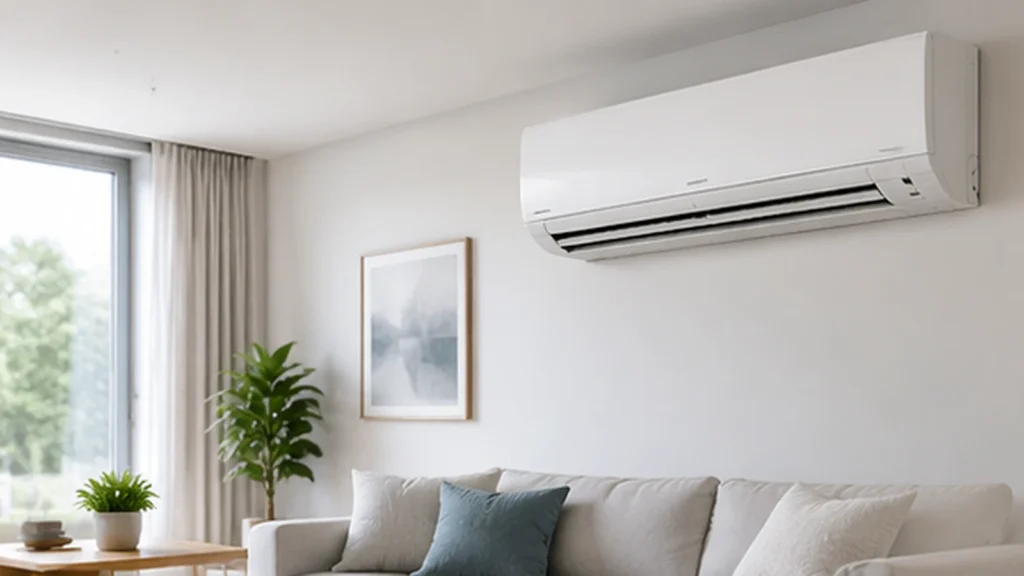
A mini-split can be a better fit when the only available window is an emergency escape opening, the frame is too weak, or permanent room cooling is the goal. It needs suitable outdoor-unit space, a condensate path, electrical supply and a professionally planned refrigerant route. Unlike a window unit, it does not depend on the width of the sliding opening. Our guide to AC system types explains where ductless systems fit alongside window units.
For a closer look at the separate indoor and outdoor equipment, see our mini split air conditioner guide. It explains how this type of system cools a room without taking up the sliding-window opening.
How Do You Measure a Horizontal Sliding Window for an AC?
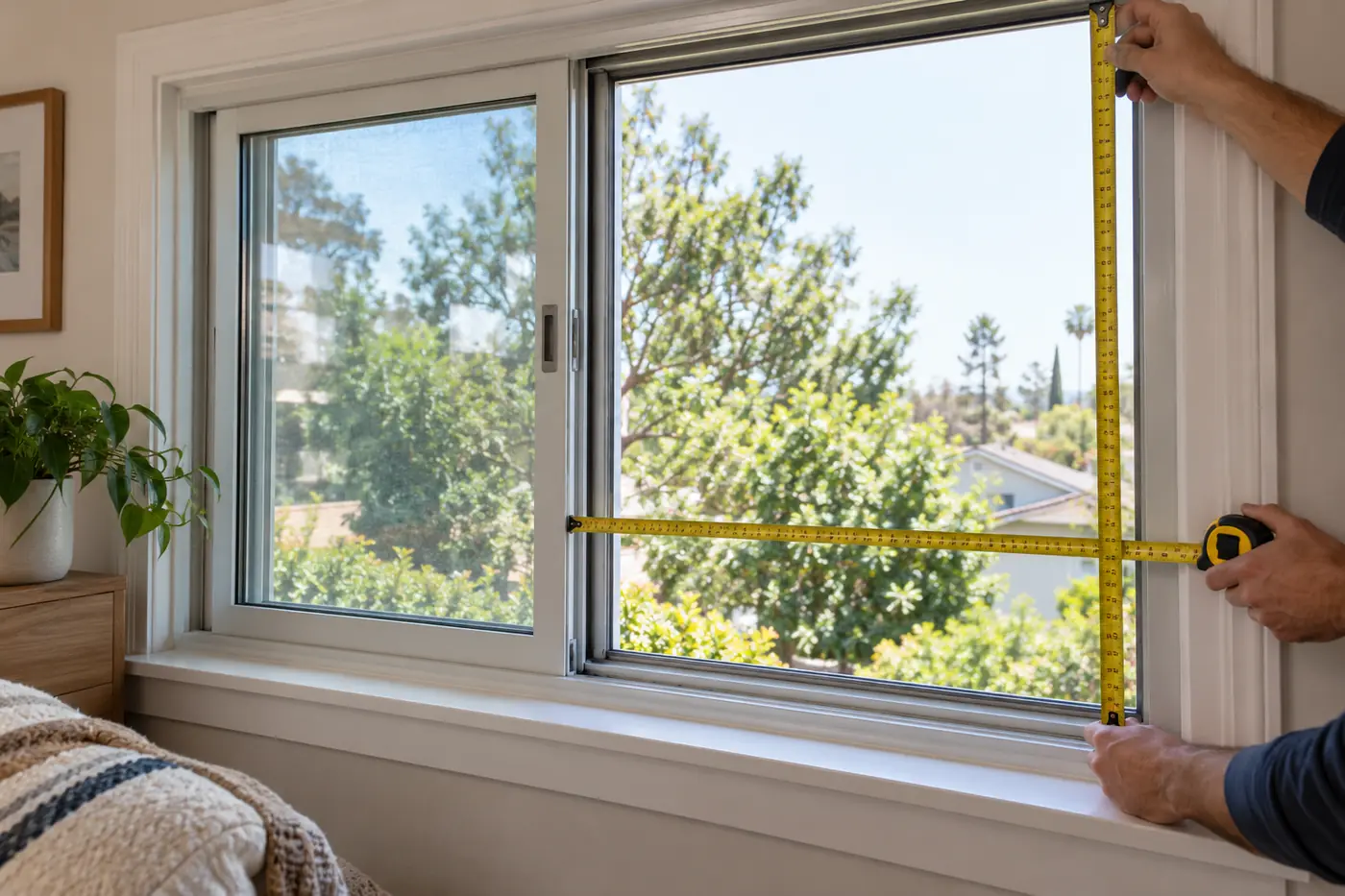
Open the moving sash and measure the usable clear width from its open edge to the opposite frame, then measure the clear height inside the opening. Compare those measurements with the installation-opening limits, not just the dimensions of the AC cabinet. The window track, handles, stops and trim may reduce the space you can actually use.
- Identify the window. A horizontal slider moves left or right. A casement window swings on hinges. A vertical sliding window moves up and down. They need different support or seal arrangements.
- Measure clear width. With the slider open, measure the unobstructed horizontal distance available to install the unit, not the full width of the two-panel window assembly.
- Measure clear height. Measure inside the opening from its lower supporting surface to the top obstruction. Check at more than one spot if the frame is uneven.
- Check the support surface. Look at the sill material, track design, exterior clearance and where the manufacturer-approved platform or bracket would attach. A screen or flimsy track is not a load-bearing support.
- Check what remains usable. Confirm sash locks, drain direction, exterior airflow, power-cord reach and whether the installation would block required escape or access.
| Measurement or check | Slider/casement window AC | Portable AC with slider kit |
|---|---|---|
| Clear horizontal width | Must fall within exact unit’s permitted installation width | Must allow the exhaust adapter and safe closure of the sash |
| Clear vertical height | Must reach the unit’s minimum window-opening height | Must fit the kit’s assembled vertical panel length |
| Window support | Approved platform, support brace and anchoring are essential | Panel and sash are secured, but AC weight stays on the floor |
| Exterior space | Rear condenser airflow, clearances and drainage are required | Hose outlet must vent outdoors without obstruction |
| Kit check | Cabinet, frame, seals, fasteners and bracket for that model | Slider panel, exhaust coupling, hose and foam seals for that model |
Worked fit check: Suppose the clear opening is 15½ inches wide and 38 inches high. The Frigidaire example lists a 15½-inch required width (both its listed minimum and maximum) and a 21½-inch minimum height, so those two opening dimensions pass its published width and height checks. Next, check the bracket attachment points, sill shape, sash lock and outdoor clearances shown in the installation manual. If the usable width is only 14 inches, that example window unit would not fit its required opening, even if its cabinet looks narrow enough.
For a portable kit, compare the vertical opening height with the kit’s allowed length. Do not confuse the room’s horizontal window width with the vertical panel length. The Midea Duo installation manual shows different panel combinations and a separate installation arrangement for sliding windows.
What Size Air Conditioner Do You Need for a Sliding Window?
Match cooling capacity to the room’s heat load first, then find a compatible unit that fits the window. A larger cabinet or bigger BTU number is not automatically a better choice. An oversized unit can cool the air quickly but leave the room humid; a unit that is too small may run constantly without reaching the desired temperature.
The following is a starting chart for room window ACs, based on the ENERGY STAR room-sizing guidance. Use it to choose an initial capacity range, then adjust for the room conditions described below.
| Room floor area | Initial window-AC capacity to consider |
|---|---|
| 100–150 sq ft | 5,000 BTU/h |
| 250–300 sq ft | 7,000 BTU/h |
| 300–350 sq ft | 8,000 BTU/h |
| 400–450 sq ft | 10,000 BTU/h |
| 450–550 sq ft | 12,000 BTU/h |
For example, a 320 sq ft room falls in the 8,000 BTU/h starting band in that chart. If the room has west-facing glass, strong sun, frequent occupants, heat-producing appliances or poor insulation, its actual load can be higher. A shaded, well-insulated room can behave differently. Use those conditions to check the final design rather than simply jumping to the next size.
For a more detailed capacity check, see our air conditioner sizing guide. It explains how floor area, insulation, window exposure and climate affect the cooling demand.
How to compare portable AC cooling ratings
Check whether a portable AC’s advertised BTU value is its DOE seasonally adjusted cooling capacity (SACC) or a different rating. Use the same rating method when comparing two portable units; do not treat a larger advertising number as guaranteed delivered cooling. A window AC’s published capacity and efficiency may use different product-category test methods. The U.S. Department of Energy’s portable AC information and the model’s current label help identify the category.
When comparing electricity use, read the specific model’s rated input watts and the rating conditions. A useful estimate is input power in kW × operating hours × electricity price per kWh. For example, 0.75 kW × 8 hours × $0.20/kWh = $1.20 for eight hours at that input. To estimate your own cost, replace 0.75 kW with the model’s rated input power and use your expected running hours and electricity rate. Actual consumption changes as the compressor cycles.
How Do You Install a Slider/Casement Window Air Conditioner?
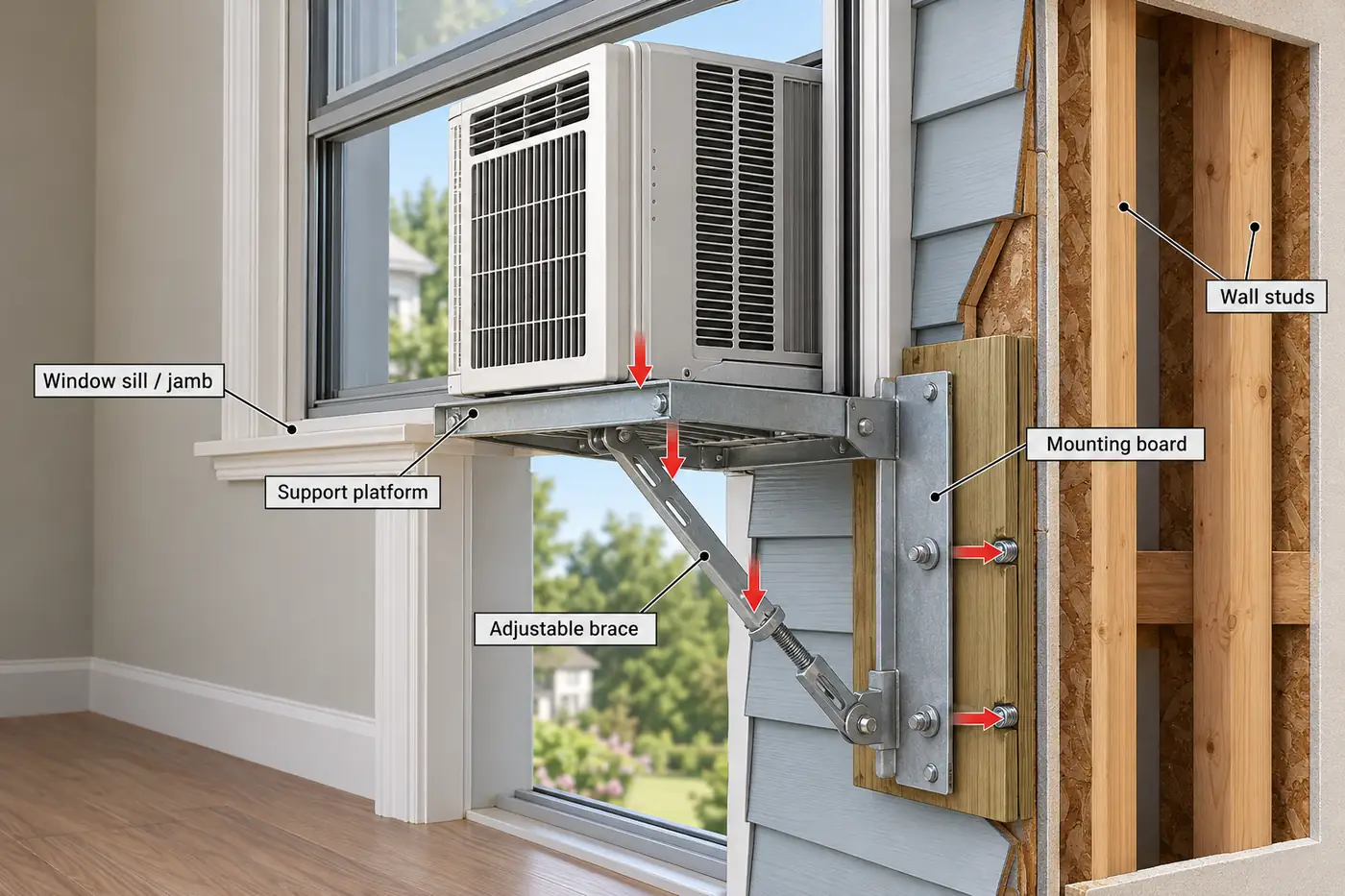
Use the installation kit and support arrangement specified for the exact slider/casement model, not a universal shelf or an improvised foam-only mount. The unit normally rests on a properly fixed platform or support brace, with a frame and seals that close the open space above and beside it.
- Confirm the chosen model and opening. Recheck clear width, height, support surface, permissible frame type, outside clearance and electrical supply against the current manual. Confirm with building management before drilling a rented or shared window frame.
- Prepare the approved support. Install the platform and bracket in the manufacturer-specified locations. Do not rely on the movable sash, window screen or adhesive seal to carry the machine’s weight.
- Lift the unit into place with enough help. Window units can be heavy and may project outdoors. For example, the Koldfront CAC8000W installation manual calls for two or more people to lift its unit onto the prepared platform.
- Close and secure the sash. Bring the sliding sash against the cabinet and its frame as instructed. Install the specified safety and window-lock brackets; check that the sash cannot push the cabinet outward or leave an unsafe opening.
- Install the supplied panels and weather seals. Close gaps at the upper opening and tracks without blocking condenser louvers or the drainage arrangement. Check the exterior side after sealing.
- Connect power and check operation. Use the grounded receptacle and electrical circuit required by the model. Run the system, look for movement, air leaks, restricted outdoor airflow and water draining somewhere it should not.
Stop and change the plan if the sash frame cannot take the required brackets, the platform cannot be anchored as directed, the unit blocks a required emergency exit, or water would be directed into the wall or neighboring property. Those are fit and safety problems, not gaps that more foam tape can solve. Do not rotate a standard horizontal-window AC onto its side; its refrigerant, drainage and compressor arrangement is not designed to work that way unless the manufacturer explicitly approves a specific orientation.
How Do You Install a Portable Air Conditioner in a Horizontal Sliding Window?
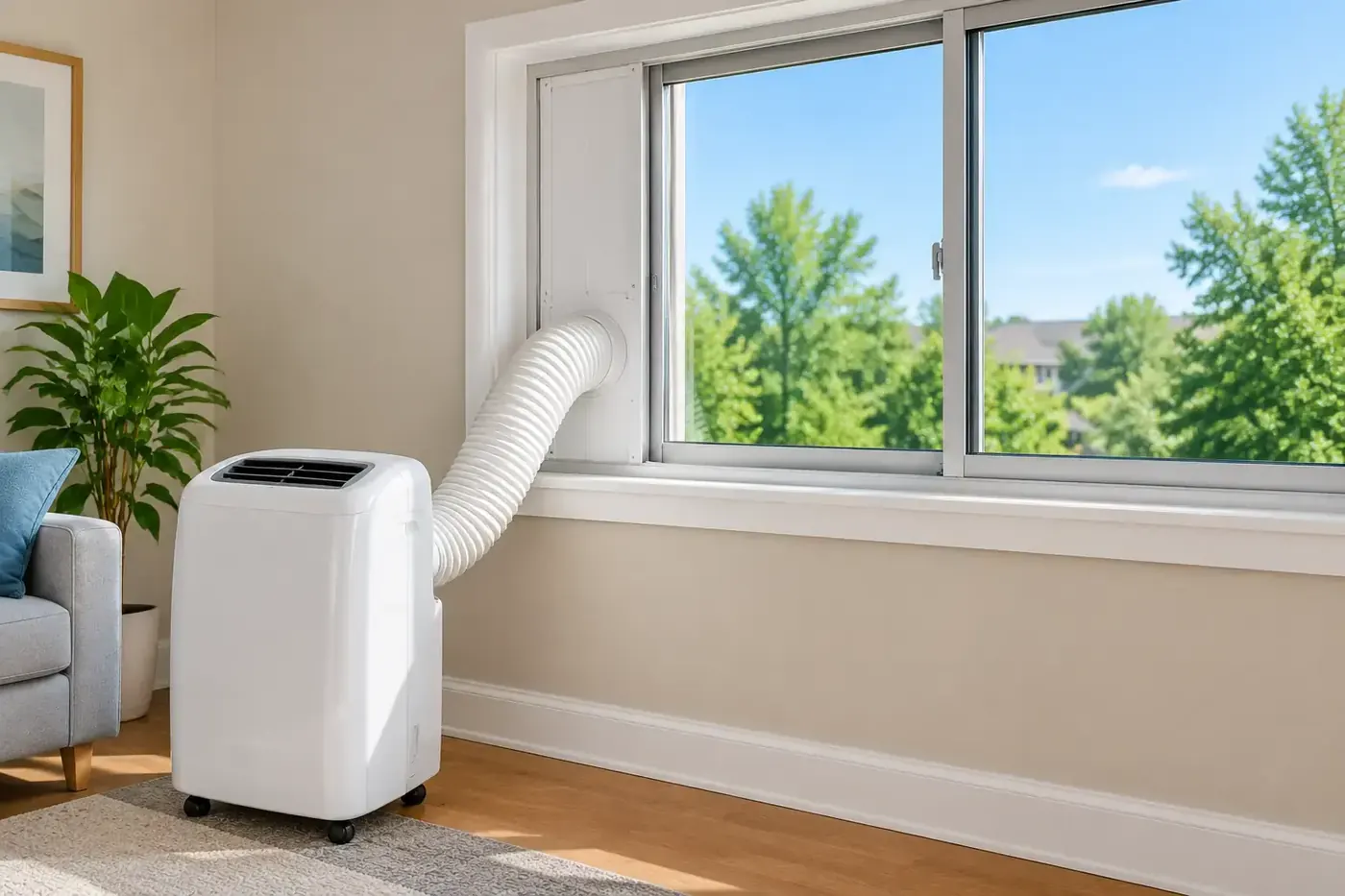
Stand the portable AC on the floor and install its exhaust panel vertically in the side-to-side window opening. The panel carries the hose connector, not the weight of the AC. Use the panel, adapter, hose length and drainage method approved for that portable model.
- Position the portable unit. Choose a level floor space near a grounded outlet and the slider. Leave the airflow clearances shown in the manual. Keep the hose route short and as straight as the instructions require.
- Build the vertical window panel. Select the combination of panels that covers the measured opening height. A kit intended for a sliding window can differ from a standard up-and-down window kit, especially for dual-hose products.
- Fit the adapter and seal the frame. Set the assembly in the window track, secure it as directed, and add the supplied foam seals. Close and lock the moving sash against the panel. The hose outlet must face outside, not into a wall cavity or another room.
- Connect the exhaust hose. Use the approved connector and check that the hose is not kinked, overstretched or crushed. Do not assume a hose from another model is interchangeable.
- Set up drainage if required. Follow the manual for cooling, dry or heat-pump operation; some modes require a drain hose or regular emptying of a tank.
- Test the whole setup. Run the AC, confirm hot exhaust goes outdoors, check for a loose panel or warm air leaking back through gaps, and verify that condensate follows the intended drain path.
The Midea Duo user manual gives a useful manufacturer example: its slider-window method includes a specific sliding-window adapter, brace, bolts on both sides of the slider assembly and foam seals. For a different portable AC, check its own kit list for the required panel lengths, hose adapters, locking parts and foam seals.
What if the sliding-window kit is too short or too tall?
Use a manufacturer-approved extension or shorter panel arrangement, or select another compatible kit. Some manufacturers permit trimming a solid extension piece, while others prohibit cutting the exhaust port panel. Never cut the hose adapter or obstruct the outlet simply to fit the window. If an exact model has no suitable kit, consider a professionally fitted rigid panel only where its instructions permit one, or choose another cooling type.
A horizontal slider may also have a removable insect screen. Check whether the screen obstructs exhaust and follow the model’s instructions about removal. A secure panel still needs outdoor clearance, weather protection and a usable window lock.
Can You Put a Regular Window Air Conditioner in a Side-Sliding Window?
Usually not with its standard installation kit. Most conventional window ACs are designed for double-hung or single-hung windows, where the lower sash moves vertically and holds the unit in a specified mounting arrangement. A side-sliding sash closes from a different direction, leaving the wrong gaps and changing how the cabinet is supported.
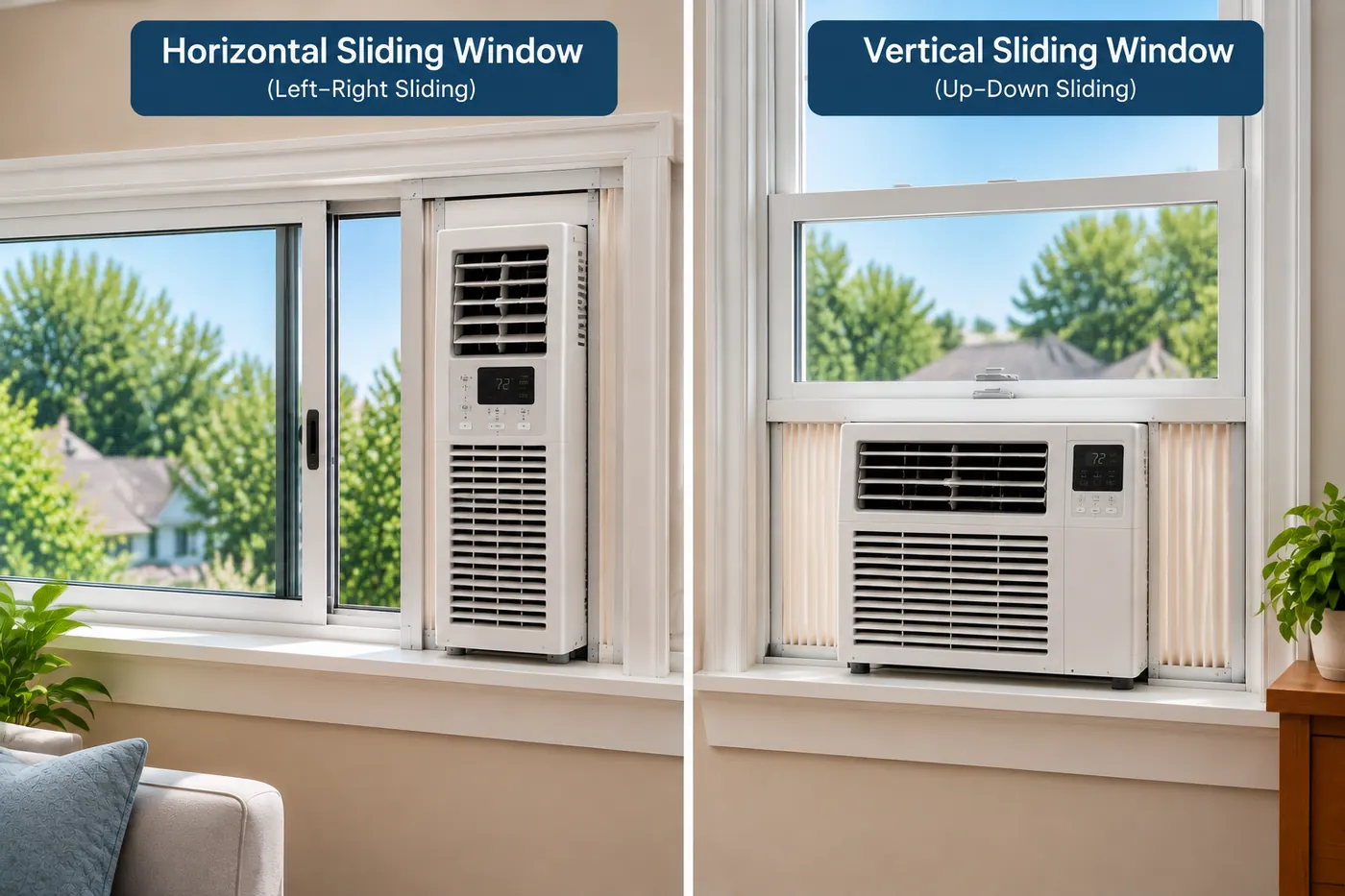
A U-shaped window AC is not automatically suitable either. Its shape generally accommodates a vertically moving sash; a sideways track is different. A universal support bracket or a home-made panel cannot change the allowed installation orientation or the unit’s ventilation needs.
You may find an approved window adapter for a specific standard unit, but only use it if the manufacturer explicitly lists your window configuration and installation method. If no approved match exists, choose a slider/casement-rated unit, a portable AC with the right exhaust kit, or a ductless system.
A casement window that swings outward is also different from a horizontal slider. Some window units are marketed for both, but their manuals can provide different instructions for each. When a product listing says casement, check whether its manual covers your actual window type—hinged casement or horizontal slider—and follow those installation steps.
Which Is the Best Air Conditioner for Your Sliding Window?
The best choice is the first one that meets both the cooling need and the installation limits. Start with window fit and building rules. Then compare capacity, sound, efficiency, floor space, how often the unit must be removed and the total work needed to install it.
| Your situation | Strong starting option | What can change the answer |
|---|---|---|
| Bedroom with an approved, sturdy slider opening | Slider/casement window AC matched to the room | Noise, outside clearances, allowed anchoring and sash security |
| Rental or seasonal cooling | Portable AC with a suitable vertical panel kit | Building permission, floor area, hose route and exhaust leakage |
| Very narrow or unusually short opening | Portable AC if the panel and adapter actually fit | No compatible panel; consider a mini-split instead |
| Multiple rooms or year-round use | Ductless mini-split or another properly designed fixed system | Outdoor unit location, installation cost, electrical supply and local rules |
| Need heating as well as cooling | Compatible heat-pump system with published heating performance | Outdoor temperature, heating load, defrost, circuit capacity and installation limits |
| Window must stay openable for required egress | A non-window-mounted cooling solution | Exit rules, building configuration and alternative equipment locations |
Slider/Casement AC Models and Window Size Requirements
The Frigidaire FHSC082WB1 is a discontinued but well-documented example of an 8,000 BTU/h slider/casement window AC. Its manufacturer page states an approximately 15½-inch required window width and 21½-inch minimum opening height. The Keystone KSTSW08B is another example of an 8,000 BTU/h slider/casement unit; its published product specification lists a 15.5–16.3-inch window-width range and a 21.3-inch minimum window height. Compare each model’s listed width and minimum opening height with your clear window measurements. Then check its required support, sash position and exterior clearances before selecting a unit.
For a room with no secure support platform, a correctly vented portable can be more practical even if its nominal cooling rating seems similar. For a permanent installation, a mini-split can avoid blocking the sash and may better suit multi-zone projects. A mini-split needs space for its outdoor unit, a refrigerant line route, condensate drainage and a suitable electrical supply. Plan those connections before choosing the system.
For the practical installation sequence, our mini split heat pump installation guide covers equipment placement, pipework, drainage, electrical work and final checks.
What about a window heat pump for a sliding window?
A window heat pump can heat as well as cool if it uses a reverse-cycle refrigeration system. Many window heat pumps are designed for vertically moving sashes. For a horizontal slider, choose a model whose installation instructions specifically allow that opening and mounting method. Also check its heating capacity at your outdoor design temperature, defrost operation and condensate drainage.
Where no suitable slider-mounted heat pump exists, a properly selected ductless heat pump is often the clearer permanent heating-and-cooling path. Our split-system air conditioners are another option for keeping the sliding window free. They use separate indoor and outdoor equipment instead of placing the cooling cabinet in the window opening. For a specific example, see our R32 inverter air conditioner SA Series. This wall-mounted split system is listed for 220–240 V, 50 Hz power, so check the room load, local power supply and destination-market requirements before choosing a model.
What Problems Should You Check After Installing a Sliding-Window AC?
Start with the symptom, then inspect the mounting, sealing, airflow and drainage that could explain it. This is usually more useful than replacing the machine before checking the window connection.
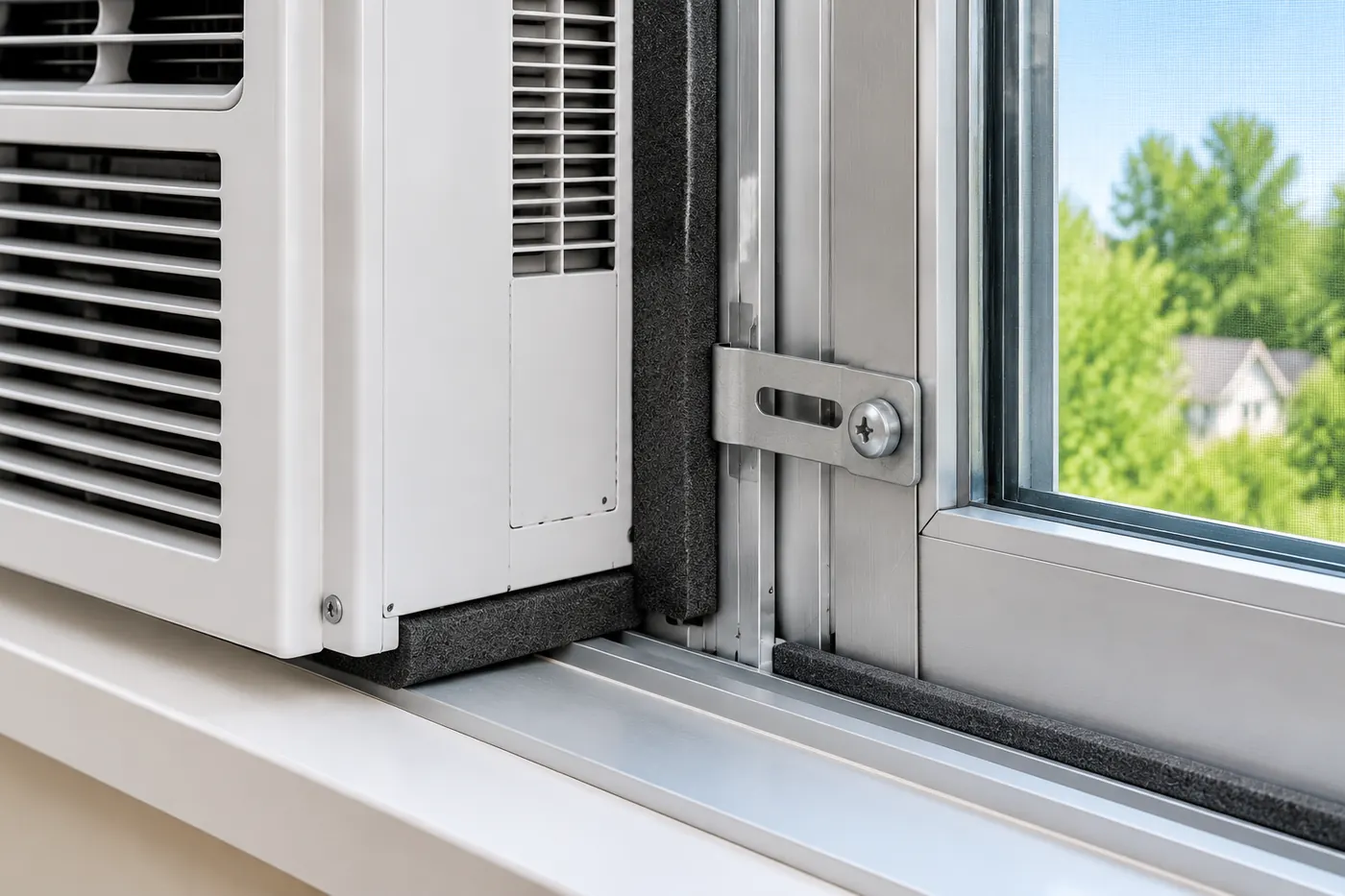
| What you notice | Check first | What to do next |
|---|---|---|
| Warm air around the window | Gaps at the sash edge, upper fill panel or portable hose adapter | Refit approved seals and secure the kit without blocking vents |
| Poor cooling | Dirty filter, obstructed outdoor discharge, wrong capacity or a loose exhaust connection | Clear accessible obstructions, clean the filter and compare room demand with rated output |
| Water on the sill or floor | Panel seal, unit drainage direction, clogged drain path or portable tank | Stop if water can reach electrics; check the model’s condensate instructions |
| Excess vibration or rattling | Loose platform/bracket, sash lock or kit panel | Switch off and have the approved support resecured before operating |
| Portable AC exhaust hose keeps falling | Wrong adapter, excessive hose bend or unsupported kit | Use the matching connector and brace specified by the manufacturer |
| Window will not lock or move safely | Panel occupies the track or required lock point | Change kit or equipment choice; do not leave the sash unsecured |
Clean the filter at the interval given in the model’s manual and recheck weather seals after removing and reinstalling seasonal equipment. If the unit moves in its mount, the receptacle overheats or water enters the wall, stop using it until the installation is corrected. Sealing and bracket adjustments should follow the exact unit instructions; electrical faults and structural concerns need qualified help.
If the seals, exhaust connection and accessible filter are in good condition but the room still does not cool, our guide to why your air conditioner is not cooling explains how to narrow the cause by checking airflow, settings and operating symptoms.
Air conditioners for horizontal sliding windows are easiest to choose once you separate the two main installation options. A purpose-built slider/casement window AC fits and is supported in the opening. A portable AC stays on the floor and uses a vertical exhaust panel. A ductless mini-split leaves the sliding window out of the installation.
Before deciding, confirm the clear opening, approved support or vent kit, room cooling requirement, electric supply, exterior airflow and building rules. If even one of those essential conditions fails, move to another unit type instead of forcing a conventional window AC into the wrong frame.
Need a longer-term cooling solution that avoids the sliding window? If you are planning a building or multiroom installation, explore our split air conditioner product families and contact our team. Share the room or building cooling load, location, power supply, outdoor-unit space and installation limits. Our team can help compare suitable split-system types, installation requirements and practical next steps for your project.
Frequently Asked Questions
Can an air conditioner be installed in a window that slides left to right?
Yes. Use a slider/casement-rated window unit that fits and is supported as its manual requires, or use a portable AC with a compatible vertical exhaust kit. A standard window unit is not automatically suitable.
Can I turn a normal window AC sideways to fit a tall, narrow opening?
No. Do not rotate a standard window AC onto its side unless its manufacturer explicitly permits that position. Its compressor, water drainage and mounting design may not work safely when rotated.
Do I need a special kit for a horizontal sliding window air conditioner?
A slider/casement window unit needs its model-specific installation frame, support hardware and seals. A portable AC needs a compatible sliding-window exhaust panel, hose adapter and seals. The two kits do different jobs and are not interchangeable.
Can I use a portable air conditioner without its window vent?
Not for normal cooling. The machine must release the heat it collects outdoors through an approved exhaust route. Sending hot air into the same room does not provide useful room cooling.
Are vertical window air conditioners the same as horizontal slider ACs?
The terms are often used loosely. Some sellers call a tall, narrow slider/casement AC a vertical window unit. Check the approved window movement and installation orientation in the manual, not the retail label.
Is a window heat pump suitable for a sideways-sliding window?
Only if the exact heat-pump model is approved for that opening and its heating performance suits the climate. Most importantly, do not assume a vertically opening window heat pump can be adapted to a horizontal slider. A ductless heat pump is another option when a suitable window-mounted model is unavailable.
What if I cannot drill holes in the frame or block the window?
Start with a portable AC and its approved, removable vent kit if building rules allow it. If the window must stay clear for emergency escape or no kit can fit safely, consider a ductless system or another approved cooling location.