A PTAC air conditioner (packaged terminal air conditioner) is a self-contained unit that cools one room through an exterior wall. It sits in a wall sleeve, with the room-facing fan and controls indoors and the heat-rejection side facing outdoors. Many PTAC units also heat the room, either with electric resistance heat or, in a packaged terminal heat pump (PTHP), by running the refrigeration cycle in reverse.
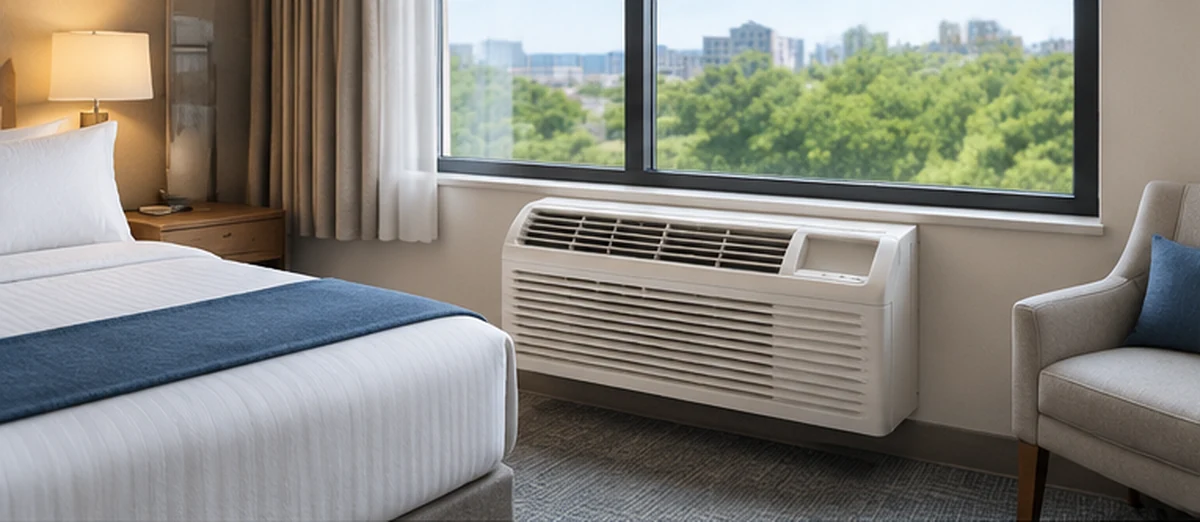
You will often see this type of hotel air conditioner under a window. It can also serve apartments, senior living rooms, and other spaces that need their own temperature control. This guide explains the equipment, how heating differs between models, when it fits, and what to check before an installation or replacement.
What Does PTAC Stand for, and What Is Inside the Unit?
PTAC stands for packaged terminal air conditioner. “Packaged” means its main cooling components are together in one room unit. “Terminal” means the equipment serves a local room or zone instead of sending air through a building-wide duct system.
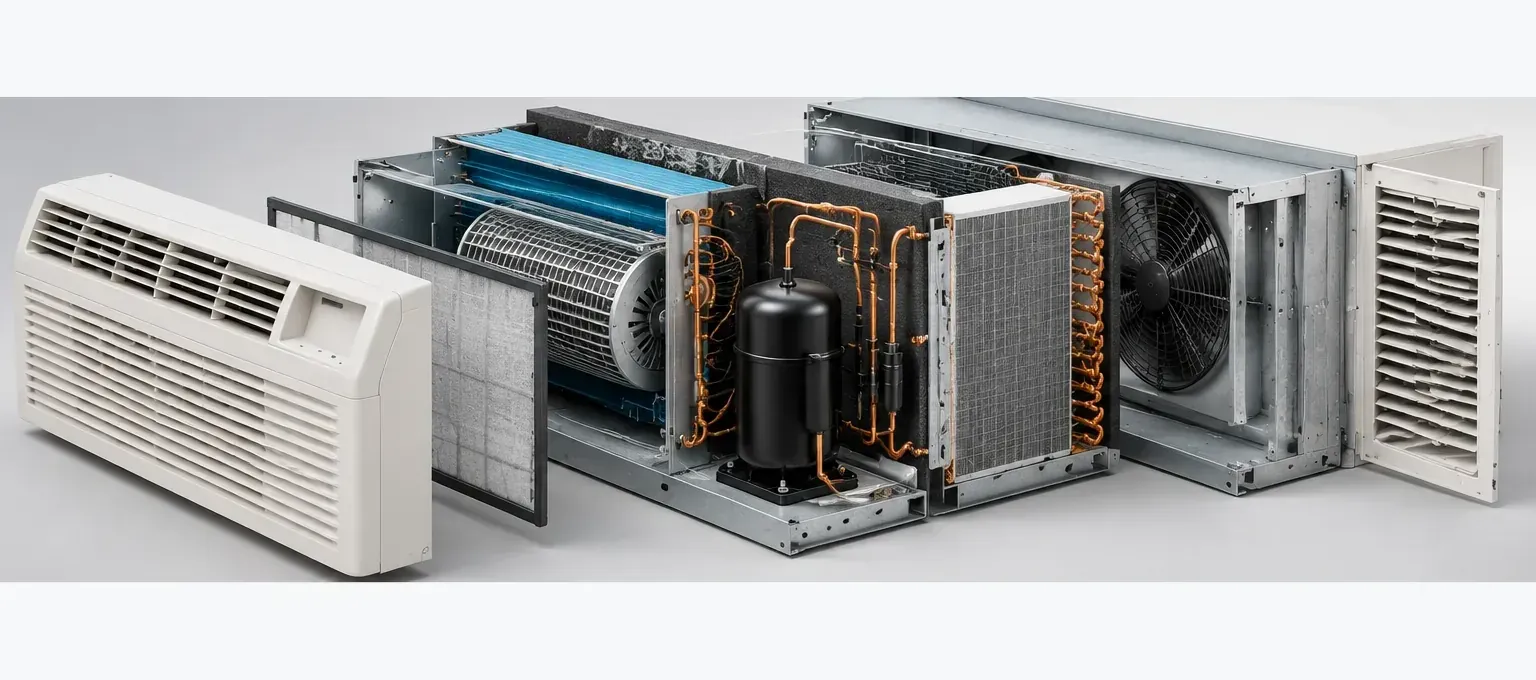
The usual assembly has a removable chassis fitted into a wall sleeve, plus an exterior grille. The chassis contains a compressor, refrigerant coils, fans, a filter, controls, and—where specified—a heating system. The grille lets the outdoor side exchange heat with outdoor air. The room-facing grille takes in room air and supplies conditioned air back into the same space.
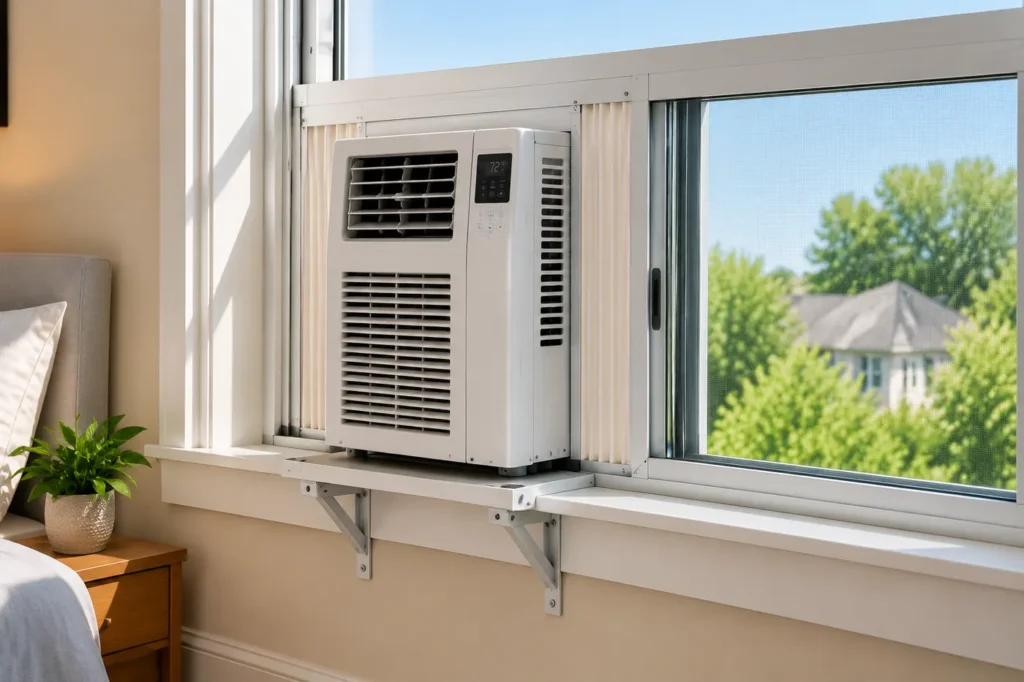
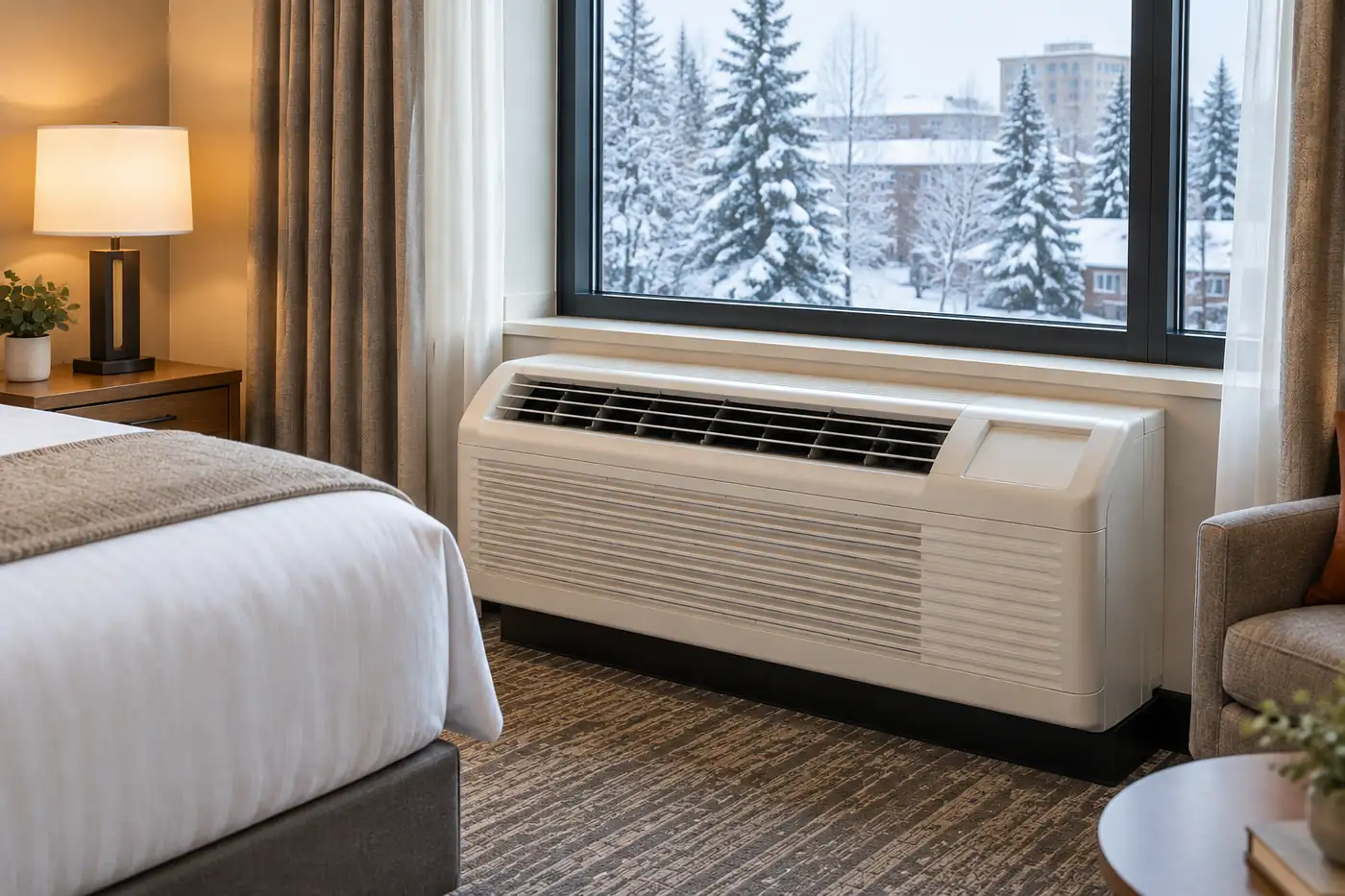
A PTAC normally sits low on an exterior wall, often under a hotel room window. It is not a rooftop packaged air conditioner. A rooftop unit normally connects to ducts that serve multiple spaces; a PTAC normally conditions one room directly. A standard window AC and a through-the-wall room AC also have different cabinet, venting, and sleeve requirements, so they are not automatic replacements for a PTAC.
The US Department of Energy defines the PTAC and its heat-pump version as distinct equipment categories. That distinction matters when you check heating performance or an equipment label. See the DOE’s PTAC and PTHP definitions.
How Does a PTAC Air Conditioner Work?
A PTAC cools by moving heat from room air to outdoor air through a sealed refrigerant circuit. It does not need a separate outdoor condenser or field-installed refrigerant pipes between indoor and outdoor units.
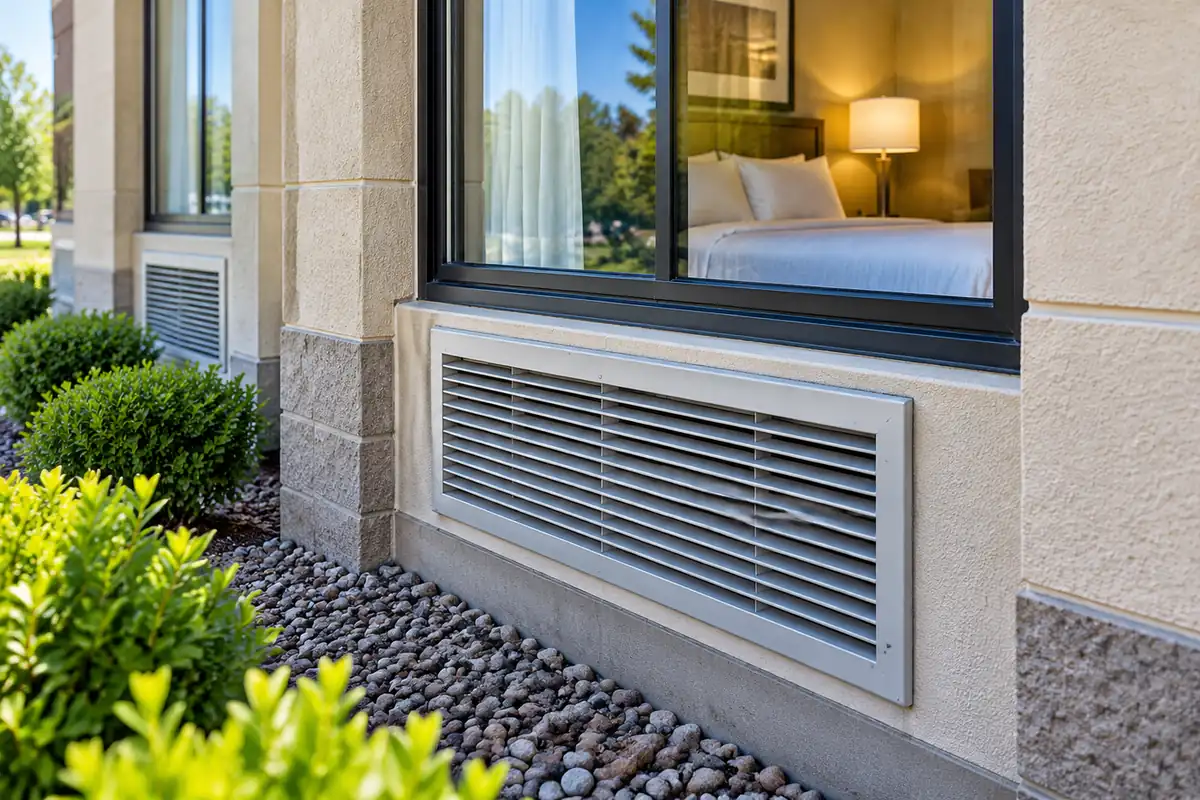
- A fan pulls warm room air through the return grille and filter.
- The indoor cooling coil absorbs heat from that air. Moisture may also condense on the coil when conditions allow.
- The compressor moves refrigerant through the circuit to the outdoor coil, where heat is released outside.
- A fan sends the cooled air back into the room while condensate drains according to the unit and sleeve design.
The indoor and outdoor air paths perform different jobs. Outdoor air passing over the outdoor coil is not automatically fresh air supplied to guests. Some PTAC units have a separate outdoor-air damper, but its setting, airflow and operating conditions determine how much outside air enters the room. If a hotel or apartment needs a specified ventilation rate, confirm it through the building’s ventilation design rather than assuming the PTAC meets it.
The room thermostat or on-unit controller cycles or modulates the cooling system to meet the set temperature, depending on the model. If the room feels cool but damp, first check the cooling load, airflow, filter condition and control settings. Choosing a much larger nominal unit may make the compressor run in shorter cycles and reduce moisture removal. Our guide to oversized air conditioners explains how to check short cycling and humidity without assuming capacity is the only cause.
Can a PTAC Heat a Room? PTAC vs. PTHP
Yes. Many PTAC units provide heat, but a regular PTAC with resistance heat works differently from a packaged terminal heat pump (PTHP). The heating method matters more than the words “heat included” on a product listing.
| Equipment configuration | Where the heat comes from | What changes in use |
|---|---|---|
| PTAC with electric resistance heat | Electric heating element warms passing room air | Straightforward heating, but electric input becomes approximately the same amount of heat output at the unit |
| PTHP / PTAC heat pump with auxiliary heat | Reversed refrigerant cycle moves heat from outdoors into the room; backup heat helps when needed | Often uses less electricity for the same delivered heat while the heat pump can cover the load; output and efficiency vary with outdoor temperature |
| PTAC with specified hydronic or steam heat | Building hot-water or steam system feeds the unit’s heating coil | Depends on an available building heating supply and compatible controls |
A PTHP has a reversing valve that changes the refrigerant flow for heating. In mild weather, it can move more heat into a room than the electrical energy it uses. An electric resistance heater instead turns electrical energy directly into heat. A heat-pump model may switch to auxiliary heat during low outdoor temperatures, defrost or when more heat is needed. Check the model’s heating-capacity table and control sequence at your winter design temperature, not just its nominal cooling BTU figure.
For example, a hotel in a mild winter climate may benefit from PTHP heating, while a cold-climate retrofit needs to check how often auxiliary resistance heat will operate and whether the electrical circuit can support it. The right choice may change when winter temperatures, electricity tariffs or building heat supply change. Our air-source heat pump heating guide explains heat transfer and backup heat in more detail; use the specific PTHP model data for this room.
Where Are PTAC Air Conditioners Used, and When Are They a Good Fit?
A PTAC is a practical choice when an individual room needs cooling, and often heating, with direct access to an exterior wall. It is especially useful when a property already has compatible PTAC sleeves and wants to replace room units without building a new refrigerant piping network.
Common applications include hotel and motel guest rooms, some apartments, senior living spaces and small offices. Each room has its own controls, so one guest can choose a different temperature from the room next door. Property staff can also service one room without stopping an entire shared cooling system.
Choose a PTAC when each room has a suitable exterior wall, independent temperature control matters and the in-room operating sound meets the property’s needs. Because the compressor and fans share the room chassis, compare published sound levels with a mini-split for noise-sensitive rooms. If the building needs a specified outdoor-air rate, plan that ventilation through the building design and the selected equipment’s verified outdoor-air performance. For a suite with several closed rooms, provide separate room conditioning or an approved air-distribution arrangement so conditioned air reaches each space. Seal and drain each sleeve correctly to prevent drafts and moisture entering the wall.
For a new hotel, compare the cost of all room units, wall openings, electricity, ventilation, acoustics and maintenance over the planned operating period. For a property already built around PTACs, the existing sleeves may make a compatible replacement the most practical starting point. A working sleeve saves construction only when it fits the new chassis, grille, drainage and electrical setup.
PTAC vs. Mini-Split vs. Window Air Conditioner: What Is Different?
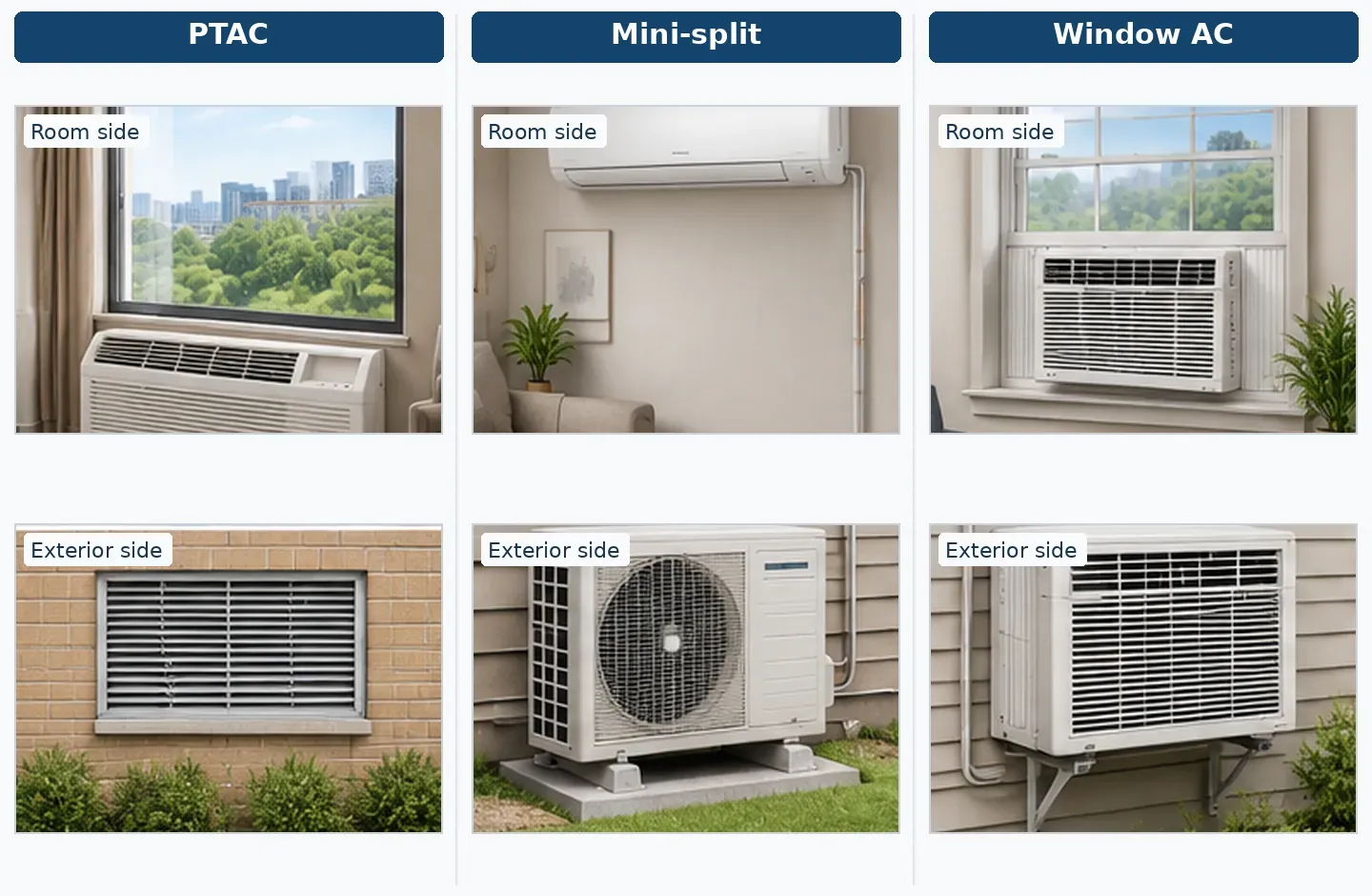
A PTAC puts its cooling components in one through-wall chassis; a mini-split separates the indoor head from an outdoor compressor; a window AC uses a window opening. All can cool a room, but they solve installation and maintenance in different ways.
| Feature | PTAC | Ductless mini-split | Window AC |
|---|---|---|---|
| Main layout | One chassis in an exterior wall sleeve | Indoor unit connected to separate outdoor unit | Self-contained unit mounted in a suitable window |
| Refrigerant connection at the site | Normally none between separate units | Refrigerant piping and electrical/control connections between units | Normally none between separate units |
| Indoor sound | Compressor and fans are near the room | Compressor is outside; indoor fan remains | Compressor and fans are near the window |
| Typical replacement concern | Sleeve, outdoor grille, heater, voltage and controls | Approved indoor/outdoor match, line route, drain and outdoor space | Window support, fit, drainage and vent clearance |
| Heating options | Resistance heat or PTHP, depending on model | Heat pump on heating-capable systems | Depends on the exact unit |
| Building use | Individual hotel or apartment rooms with an exterior wall | One or several zones where indoor/outdoor placement works | Individual rooms with suitable windows |
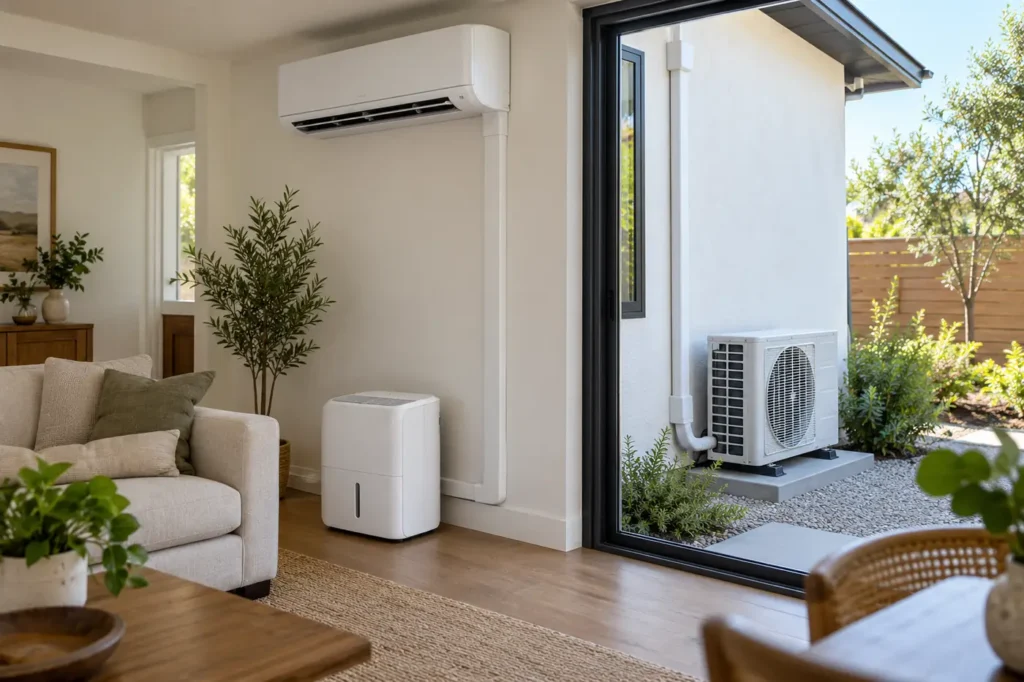
If you already have a row of PTAC sleeves in hotel rooms, first assess a replacement that fits those openings. If you are designing a new property and indoor noise or low-load operation matters, compare current, rated PTAC/PTHP models against a properly selected inverter mini-split system. A mini-split needs outdoor unit locations, refrigerant lines and condensate routes; those constraints can outweigh the indoor sound advantage. Our mini-split air conditioner guide explains the separate indoor and outdoor units and common layout options.
Compare cooling efficiency using ratings measured on a consistent basis. A PTAC’s EER describes cooling output divided by electrical input at specified rating conditions; a mini-split’s SEER2 is a seasonal metric measured under a different procedure. For an operating-cost comparison, use the candidate models’ performance data with the same room load, climate and expected operating schedule. AHRI lists PTAC certified cooling-capacity and EER ratings in its PTAC certification information.
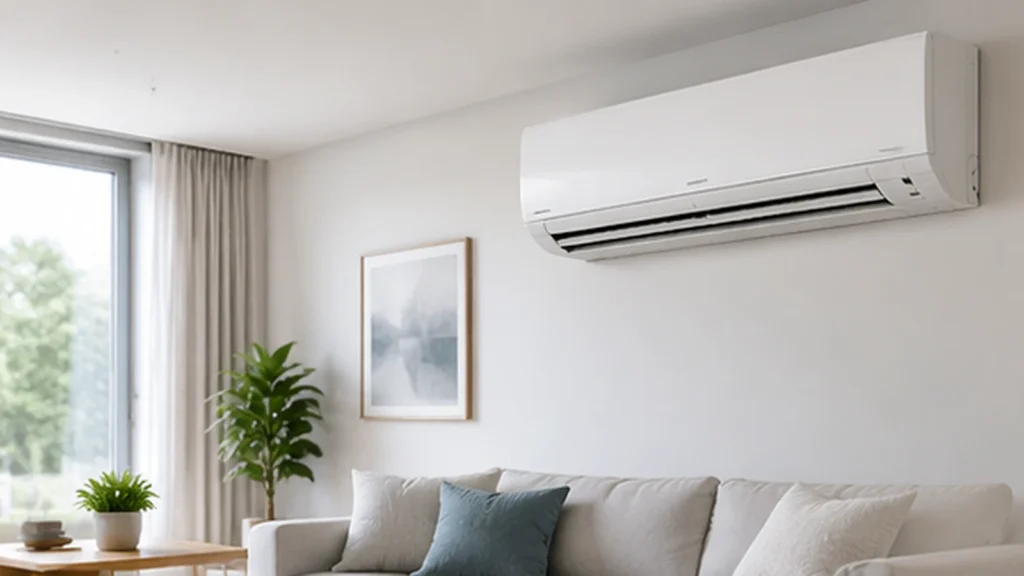
Our current air conditioning range includes wall-mounted split air conditioners. For a new hotel or major renovation with suitable outdoor-unit locations, compare this separate indoor-and-outdoor layout with PTACs on room capacity, indoor sound, installation space and service access. A split-system installation requires outdoor equipment, refrigerant piping, electrical connections and condensate routing instead of reusing a PTAC chassis and wall sleeve. One example in our split-system range is the R32 inverter split air conditioner; its listed models use 220–240 V, 50 Hz, so confirm the destination market’s electrical supply and applicable requirements before considering it. For other system layouts, see our guide to AC system types.
What Size PTAC Do You Need for a Room?
Choose PTAC capacity from the room’s calculated cooling load and, for heating models, its design heating load. Room area alone is not enough to set the final model size.
The cooling load changes with windows and sun, wall insulation, outdoor climate, occupancy, lighting, equipment, and any outdoor air that must be cooled. Heating also depends on heat loss through the envelope and on ventilation or infiltration. A room on the sunny top floor can need more cooling than an equally sized shaded room; the same room may have a different winter heating need. Our air conditioner sizing guide gives more detail on room-load inputs, while final PTAC capacity must match the selected model’s ratings.
Capacity is usually stated in Btu/h. For scale, 12,000 Btu/h equals one refrigeration ton, a unit of cooling capacity. Use the calculated room load to choose the capacity range, then compare the candidate model’s rated output and electrical requirements at the relevant design conditions.
Before choosing a model, record:
- Room dimensions, windows, sun exposure, insulation and the design indoor temperature.
- Outdoor design conditions and expected people, equipment and lighting loads.
- Needed heating mode, including whether a PTHP would use backup heat in winter.
- The existing sleeve’s exact width, height, depth, support, wall condition and exterior grille if this is a replacement.
- Available voltage, circuit rating, plug/receptacle or hardwire method, condensate path, thermostat and any building controls.
Match the room’s cooling load to the candidate PTAC’s rated cooling capacity at the relevant design conditions. For a PTHP, also compare its heating output at the winter design temperature with the room’s heating load and check when auxiliary heat is used. Then confirm the chassis and approved grille fit the sleeve, and match the available voltage, circuit protection, heater input, condensate path and control connections to that model. A mismatch calls for a different unit or a change to the planned installation.
How Is a Packaged Terminal Air Conditioner Installed or Replaced?
A PTAC is installed through an exterior wall in a compatible sleeve, with an outdoor grille, correctly sized electrical supply and an approved condensate path. For a replacement, confirm the sleeve’s width, height, depth and support along with the exterior grille airflow, drainage, power supply and controls against the new model’s approved installation details. A matching chassis can reduce wall construction; an incompatible sleeve or connection changes the replacement work.
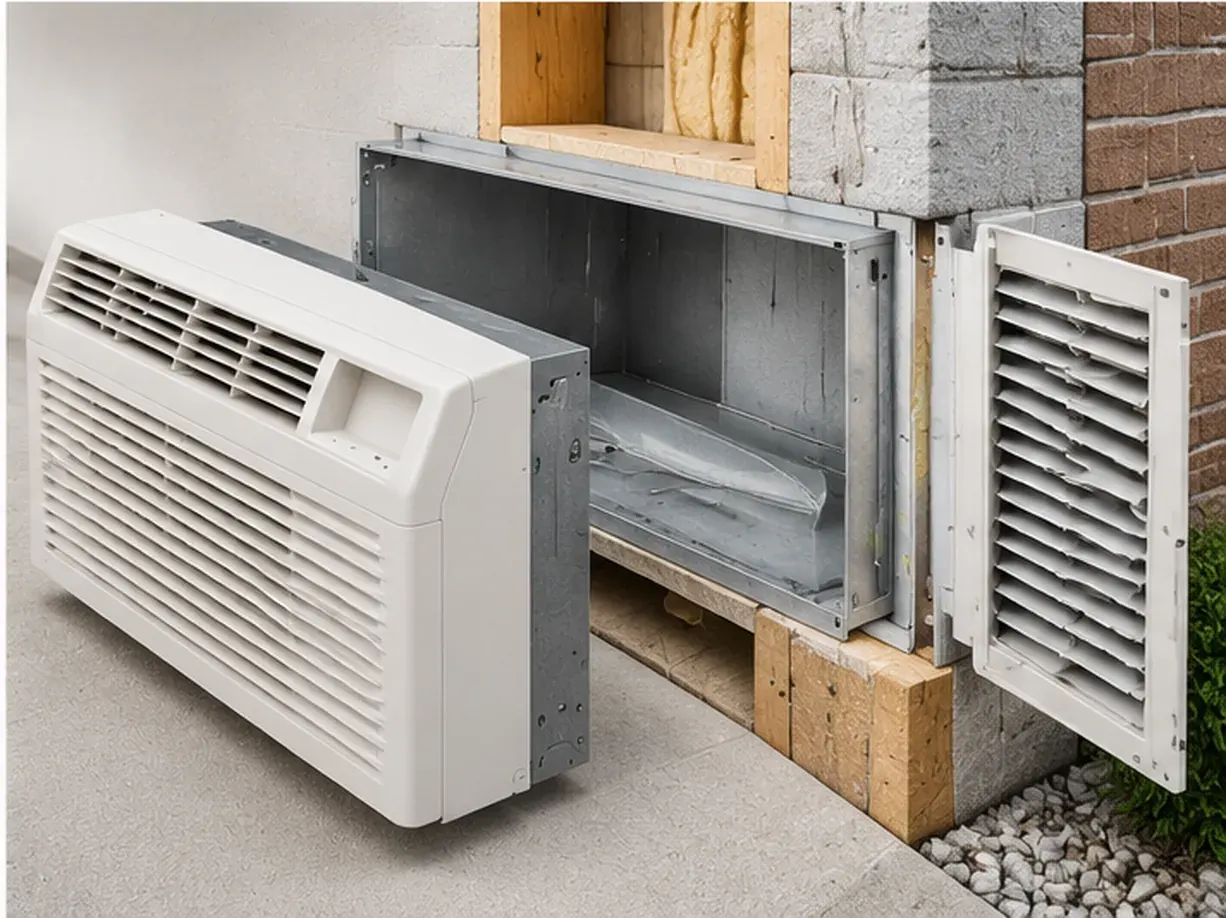
Installing a PTAC in a new wall opening
A new installation begins with a location that can support the equipment and let both the outdoor coil and room-facing air paths stay clear. The building team must check the wall structure, weather seal, exterior grille position, drainage and electrical supply before fitting the sleeve.
- Confirm the exact model and installation instructions. Obtain its required wall opening, sleeve, exterior grille, drain arrangement, power connection and service clearances.
- Prepare the wall and sleeve. Have the installer check support, flashing, sealing and the manufacturer’s specified level or slope so rain and condensate do not flow into the building.
- Install the matching grille and electrical connection. The grille must allow the outdoor coil to breathe. The circuit, disconnect and connection method must match the unit’s nameplate and local requirements.
- Fit and secure the chassis, then check operation. Confirm cooling, any heating mode, controls, airflow, condensate flow, vibration and whether outdoor air is entering as intended.
Use qualified building and electrical trades for a new exterior-wall opening and for supply wiring. They should follow the selected model’s instructions for structural support, weather sealing, electrical protection and safe commissioning.
Replacing a PTAC in an existing sleeve
Measure the old sleeve before ordering a replacement, even when both units are described as “standard size.” A common sleeve family is roughly 42 inches wide and 16 inches high, but depth, fastening points, outdoor grille airflow and other details vary. For example, an Amana PTAC wall sleeve lists a width of 42 inches and height of 16 1/16 inches, with specific depths. Those dimensions describe that sleeve, not every PTAC.
For a replacement, read the old unit’s full model label, measure the sleeve, check corrosion and water damage, and identify the exterior grille. Match the replacement model to the manufacturer’s approved sleeve and grille compatibility information. Then check voltage, heater input, plug arrangement, circuit protection, wall thermostat and property-management controls. If the new electric heater requires more power, have a qualified electrician confirm the circuit, breaker and connection rating before installation.
If the sleeve leaks, is not supported correctly, or sends water inward, repair the sleeve and wall detail before inserting a new chassis. After installation, check the room-facing airflow, outdoor airflow, heating and cooling operation, condensate drainage and controls with the actual product procedure.
How Do You Maintain a PTAC and Check Common Problems?
Keep the filter and air paths clean, maintain the outdoor grille and drainage, and investigate changes in airflow, noise or heating performance early. PTACs put many serviceable parts in one room cabinet, so blocked grilles and poor drainage can affect both comfort and the wall around the unit.
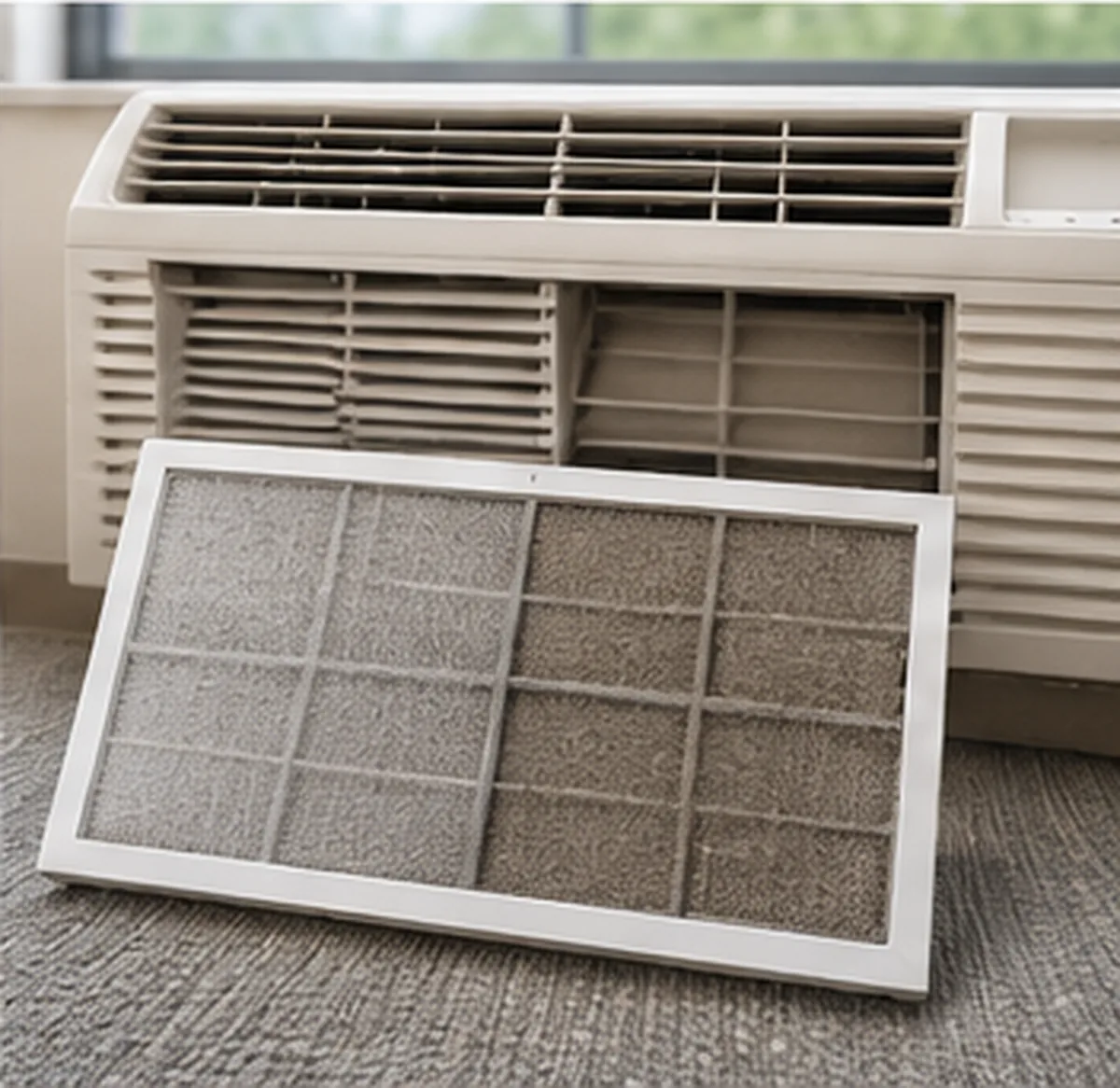
Start with the filter-cleaning interval in the model manual. A dirty filter restricts room airflow, which can reduce cooling and cause coil frosting. If the indoor coil freezes, the frozen AC coil guide explains how to recognize the symptom and what to check safely before resuming cooling. Check that furniture and curtains are not blocking the return and supply grilles. Outdoors, keep the louvered grille free of leaves and other obstructions without covering its air openings. Clean accessible surfaces only as the manufacturer permits.
If the room is not cooling, compare the thermostat setting and mode with the measured room temperature; then inspect the filter and blocked airflow. For additional symptom-based checks, see our air conditioner not cooling guide. If ice is visible or airflow is very weak, stop cooling and have the unit checked rather than repeatedly restarting it. If there is water inside the room, inspect the drainage route, sleeve alignment, seals and whether the condensate is being carried away as the design requires. Address water intrusion promptly, because it can damage the wall and room finishes.
For weak heating, first identify whether the model has resistance heat or a PTHP. On a PTHP, a short change in fan or heat output during defrost may be normal; repeated loss of heat or an electric breaker trip needs service. Electrical, refrigerant and internal heater work should be handled by qualified technicians. After any repair, confirm the original symptom is gone under the relevant operating mode.
What Affects PTAC Installation and Running Costs?
The total cost depends on whether you are replacing a compatible chassis or creating a new wall opening, and on the unit’s heating method and operating hours. For hotels, looking only at the equipment price misses the electrical work, room downtime, controls, ventilation and later energy use.
A replacement in a sound, compatible sleeve may avoid major wall work. New construction must account for sleeve installation, weatherproofing, grille, power supply and condensate management. A mismatch in voltage or heater capacity can add circuit work even when the new unit physically fits.
Running cost changes with the climate, room heat loss, control settings, occupancy and rated efficiency. Electric resistance heating has an approximate coefficient of performance (COP) of 1 at the heater. A PTHP can exceed COP 1 while it transfers heat effectively, but its heat-pump capacity and COP fall or change with outdoor conditions and auxiliary heat use. Compare the specific models at the conditions your building will face, not just the price tag or the word “heat pump.” Use measured electricity consumption where available, or estimate kWh from realistic electrical input and operating hours; our AC running cost guide explains the calculation.
A useful property-level comparison lists the installed work for each room, expected occupied and unoccupied operating hours, service access, replacement inventory and likely downtime. This makes it easier to see why an existing-sleeve PTAC replacement can be attractive in one hotel, while a new mini-split layout can make more sense in another.
Frequently Asked Questions About PTAC Air Conditioners
Does a PTAC provide fresh air for a hotel room?
Some PTACs have an outdoor-air damper, but it does not automatically deliver the required fresh-air rate. Check the selected model’s measured or stated outdoor-air performance, the damper setting and the building’s ventilation plan. Mechanical ventilation may still be needed.
Does a PTAC need ductwork?
A standard horizontal PTAC normally conditions one room directly without building-wide ducts. Where adjacent rooms need conditioned air, use a compatible, manufacturer-approved distribution accessory if that specific model supports it, or choose separate room equipment or a system designed for duct distribution. Its standard room grille alone cannot reliably deliver air to other rooms behind closed doors.
Do PTAC air conditioners contain refrigerant?
Yes. A refrigerant circuit inside the chassis carries heat from the room to the outdoor coil during cooling. It is a sealed system in normal use. Suspected leaks, damaged refrigerant parts or abnormal pressures need qualified service, not a routine user top-up.
Can any 42-inch PTAC replace an old unit?
No. A similar sleeve width does not confirm a safe replacement. Check height, depth, outdoor grille airflow, chassis support, drainage, voltage, heater electrical load and controls against the replacement maker’s approved instructions.
Can a PTAC heat pump work when it is cold outside?
It may still heat, but available heat-pump output and backup-heat operation depend on the exact PTHP model and outdoor temperature. Check the heating performance data at your winter design conditions and confirm the auxiliary heater and electrical supply can cover the remaining load.
The Bottom Line: Is a PTAC the Right Air Conditioner?
A PTAC air conditioner is a compact, through-wall system for heating and cooling a single room. It is often a sensible starting point for hotel rooms or apartments with existing compatible sleeves. Choose between resistance-heat PTACs and packaged terminal heat pumps based on how the room will be heated, not on the general PTAC label.
For a new building or major remodel, compare the PTAC option with mini-splits using room loads, indoor noise, exterior installation space, ventilation, energy use and service access. Confirm the room load, wall opening and electrical service against the specific model’s data. If your hotel or residential project can use a split-system layout, send our team the building layout, climate, room count and available outdoor-unit locations. We can help you compare the wall-mounted split options in our current range against those site conditions.