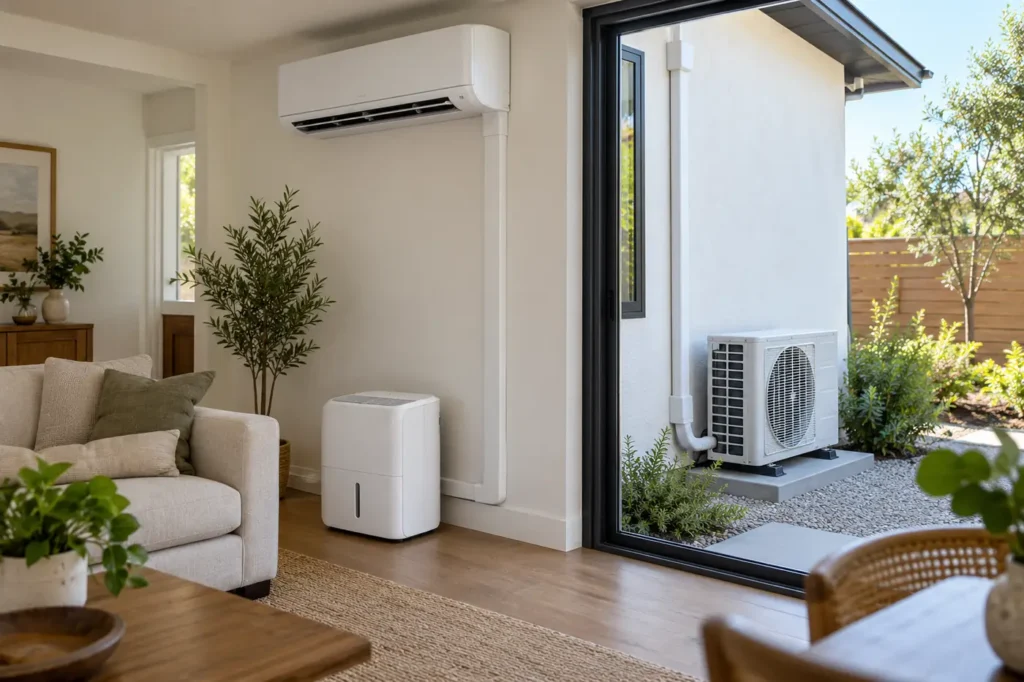
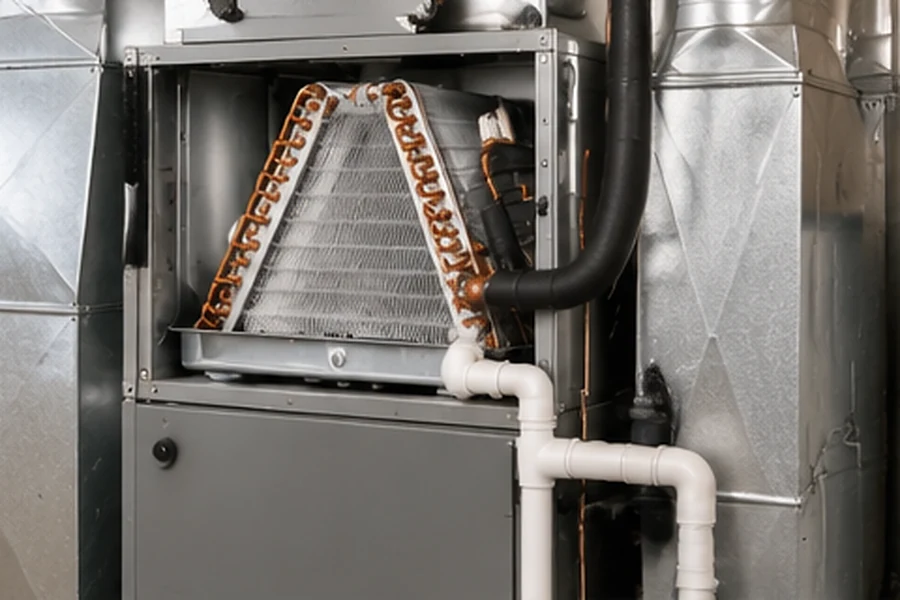
A portable AC with a heat pump can cool a room in warm weather and heat it in cooler weather using the same refrigerant system. It is most useful for one room that needs both functions without a permanent outdoor unit. It still needs a correctly installed outdoor air duct or window kit, and its heating output may fall as outdoor temperatures drop. For year-round primary heating in a cold climate, compare it with a properly sized mini split instead of assuming a portable model can do the same job.
The first decision is to confirm that the unit has refrigerant-based heat-pump heating, not simply a resistance heater labeled “heat.” Then check its heating temperature range, cooling capacity, vent arrangement, drainage, electrical supply, and noise for the actual room.
What Is a Portable AC With a Heat Pump?
A portable heat pump air conditioner is a movable, self-contained room unit that both cools and heats by transferring heat. It usually sits on the floor with wheels and connects to an outdoor opening through one or more ducts. Unlike a mini split, it does not require a separate wall-mounted indoor head and outdoor condenser to operate.
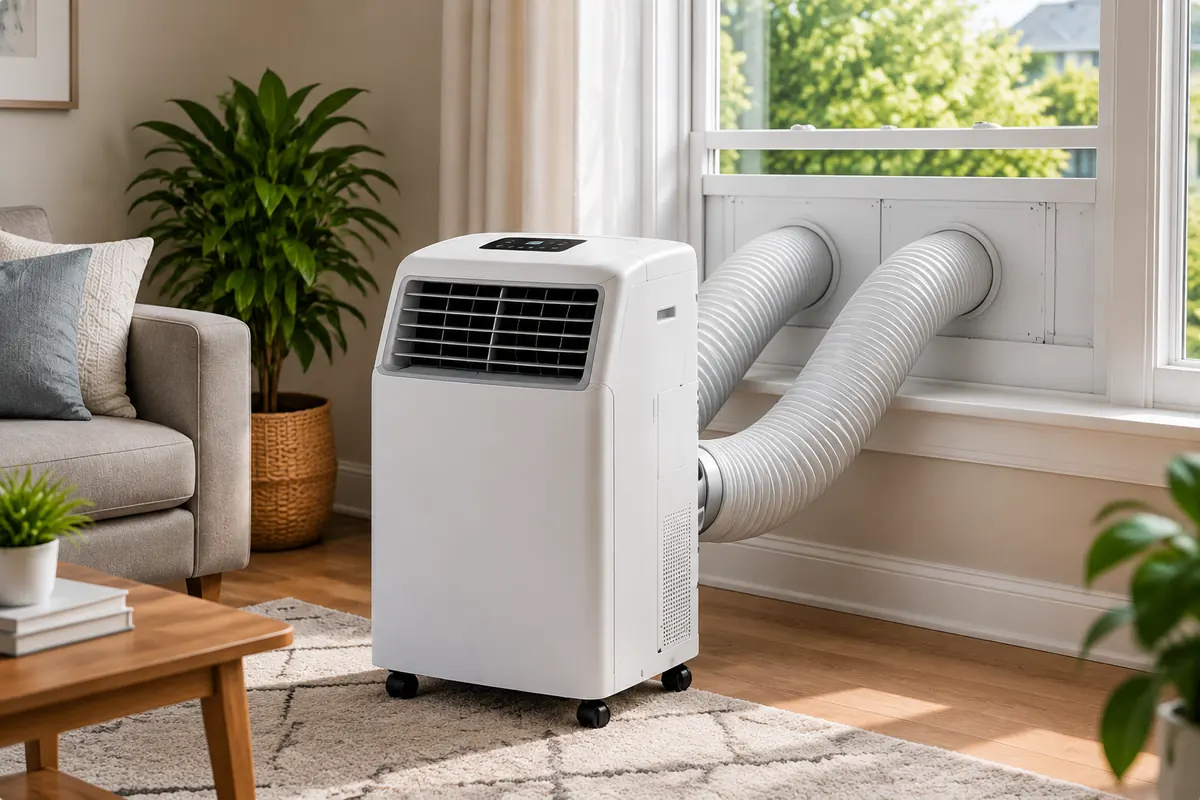
A normal cooling-only portable AC moves room heat outdoors. A reversible portable heat pump can reverse the refrigerant cycle so it takes heat from an air source and delivers that heat into the room. The control panel may also offer fan and dehumidifier modes, but those extra modes vary by model.
Does “portable AC with heat” always mean a heat pump?
No. Some portable air conditioners use a separate electric resistance element for heating. Others use a reversing valve and compressor to provide heat-pump heating, and certain designs may have more than one heat mode. The words “heat,” “heater,” or “4-in-1” alone do not identify the mechanism. Check three things before ordering: (1) copy the complete model number, including its final letters; (2) find the words heat pump or an equivalent refrigerant-based heating description in that model’s manual, not just “heat,” “4-in-1,” or “inverter” on a listing; and (3) read the permitted heating temperature, heating capacity, and heat-mode drain instructions. If the manufacturer only confirms a resistance element, do not compare it as a heat pump.
Why model suffixes matter: Whynter publishes the ARC-1230WNH with Heat mode but the otherwise similar ARC-1230WN without Heat mode. Midea lists MAP14HS1TBL as a Duo model with heating; its manual specifies a 41–86°F (5–30°C) heat-pump operating range. Check the manual for any other model to find that model’s own heating range and technology.
How Does a Portable AC With a Heat Pump Work?
In cooling mode, it moves heat from the room to outdoors. In heating mode, a reversing valve changes the refrigerant path so the unit can move heat into the room. A compressor, heat-exchange coils, fans, and refrigerant make that transfer possible. The electrical input drives the process rather than having to create all the delivered heat directly.
- Cooling: Warm indoor air passes a cold coil. Refrigerant takes up heat, cooled air returns to the room, and the other coil rejects heat through the outdoor duct arrangement.
- Heating: Refrigerant flow is reversed. The room-side coil gives off heat, while the outside-air side gathers heat. The ducting must connect to an approved outdoor air path.
- Moisture handling: Condensate forms at a cold coil. Where that water collects can change between cooling and heating. Some models need manual draining or a continuous drain in heat mode.
- Controls: The thermostat cycles or adjusts operation. An inverter compressor can vary speed rather than only running at full power, subject to the model’s controls and operating range.
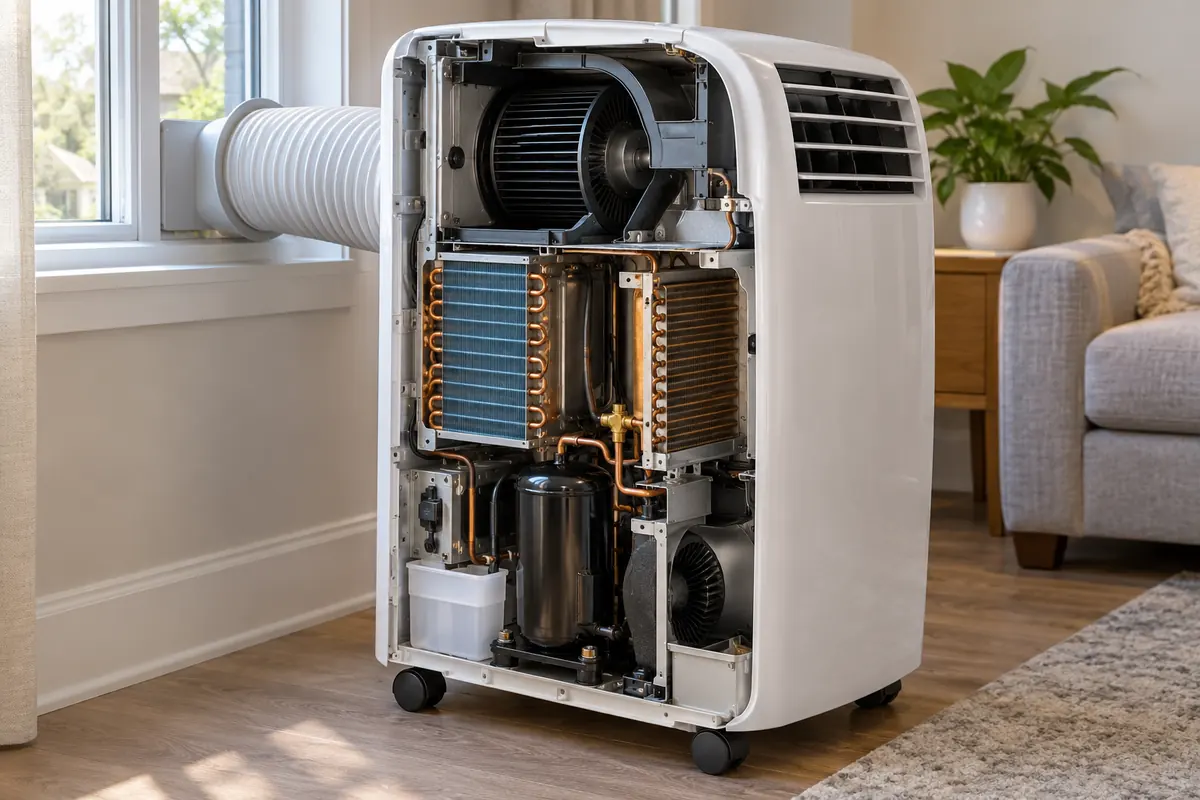
The unit still needs a manufacturer-approved outdoor duct path in both modes. An incorrect hose layout can reduce useful heating or cooling output.
Does a Portable Heat Pump Need to Be Vented Outside?
Yes. A typical portable AC with heat-pump heating requires a manufacturer-approved vent or duct connection to outdoors in both heating and cooling modes. In summer it rejects heat outside. In heat mode the outdoor exchange air is cooled, so the discharged air can feel cold rather than hot. Releasing it into the same room defeats the heating or cooling task.
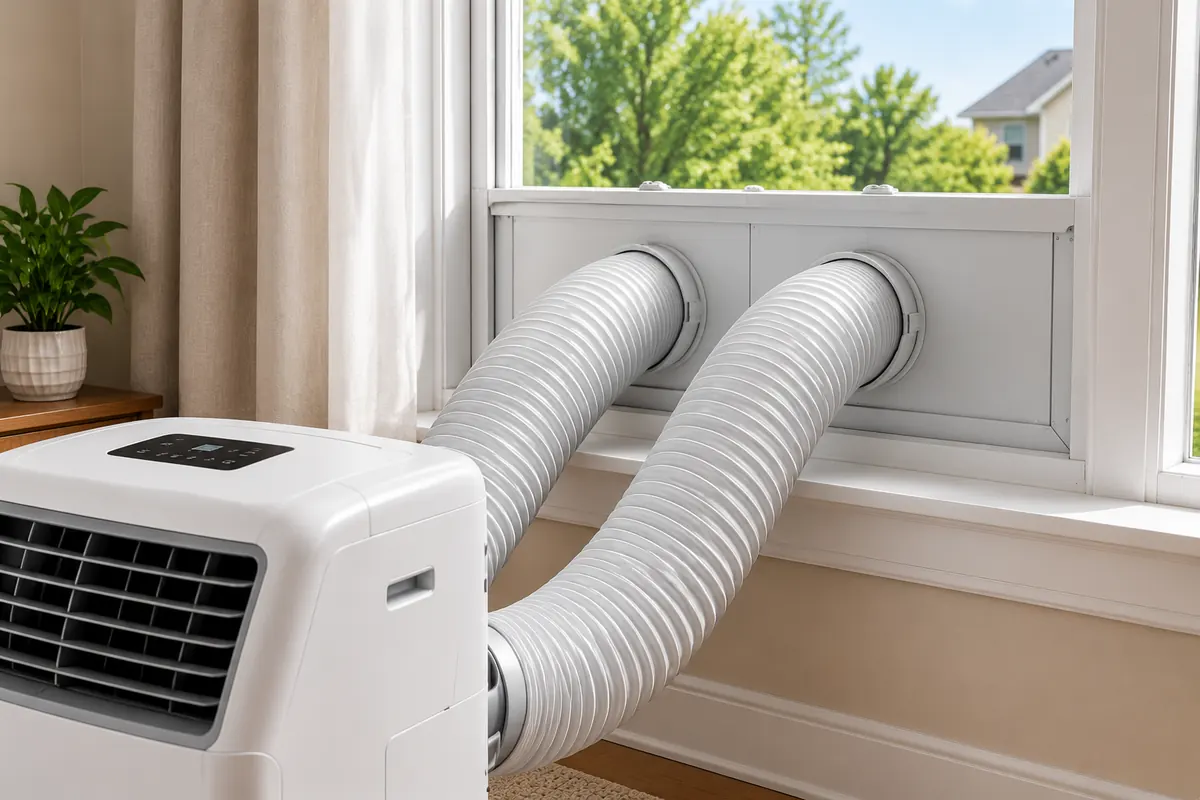
Single-hose vs. dual-hose portable heat pumps
A conventional single-hose unit can exhaust conditioned indoor air, while a correctly configured dual-hose or hose-in-hose design separates outdoor intake and exhaust and often reduces replacement-air losses. Replacing exhausted indoor air can draw hot or cold air through gaps and adjoining rooms. Use the manufacturer’s mode-specific hose arrangement when comparing these designs.
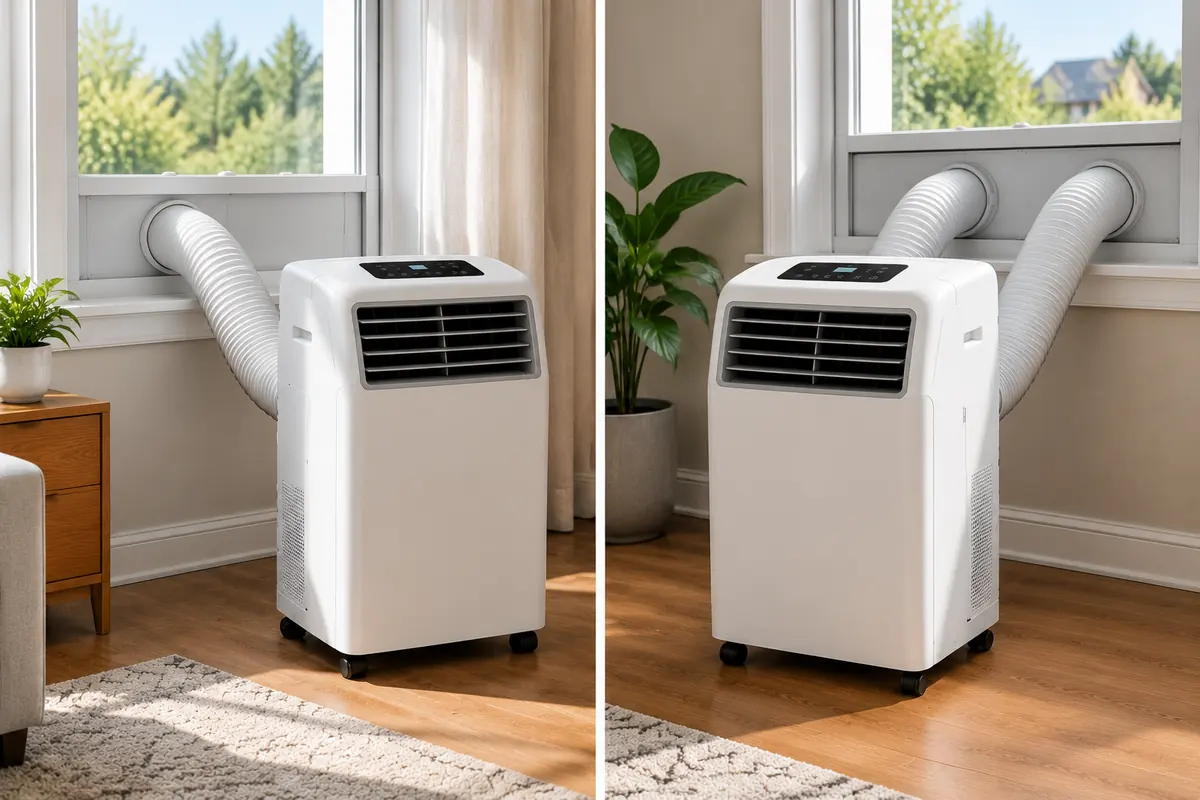
| Duct arrangement | What it generally does | Selection consequence |
|---|---|---|
| Single hose | Discharges air outside; some models use room air for equipment cooling or heat exchange | Often simpler, but replacing exhausted indoor air can add load |
| Two separate hoses | One path for outside intake and one for discharge | Often limits unwanted room-air loss when both paths are used as designed |
| Combined hose-in-hose | Two air paths inside one larger assembly | Can provide the dual-duct benefit with one visible assembly; confirm the product design |
Do not assume both hoses remain connected in heat mode. For example, GE’s support guidance tells owners of certain GE-branded dual-hose models to disconnect the intake duct when using heat mode. Other products have different instructions. Use the exact model manual, not a generic diagram, for both modes.
Keep the supplied duct close to its approved length, avoid sharp bends, seal the window adapter, and leave the specified clearances around the cabinet. Do not discharge into an attic, suspended ceiling, or another occupied indoor area. If the window cannot accept the manufacturer’s kit, the unit may not be a practical option. Check whether the window opens vertically or horizontally, its clear opening width/height, the supplied adapter’s minimum and maximum fit, weather sealing, and any building or rental restrictions. A hose that reaches the window is not enough if its panel cannot seal or obstructs a required exit.
Are Portable Heat Pumps Efficient?
They can be more efficient in heating than an electric resistance space heater when the compressor is operating under suitable conditions, but they are not automatically as efficient as a fixed mini split. Performance depends on outdoor temperature, hose losses, room air leakage, compressor control, and the exact test conditions used for any published numbers.
A heat pump’s coefficient of performance (COP) is the ratio of useful heating output to electrical input at one operating condition. If a unit delivers 2.4 kW of room heat while drawing 0.96 kW, its COP at that condition is 2.5. That means 2.5 units of heat delivered per unit of electricity; it does not mean the unit always has COP 2.5. In colder conditions, available heating output and COP may decline; defrost or electric backup can change actual electricity use.
What does inverter control change?
An inverter can adjust compressor speed as room demand changes, which may reduce frequent starts, temperature swings, and power use at part load. Actual power savings and cold-weather heating output depend on the model’s performance at the intended operating conditions. Compare the same test metric and conditions across models. Inverter describes compressor control; heat pump describes the heating method, so check both features separately. For the control sequence and part-load behavior, read how inverter air conditioners work.
Cooling BTU vs. heating BTU: read both ratings
Cooling BTU/h measures cooling output, while heating BTU/h measures delivered heat at a stated heating condition; check both ratings separately. For portable AC cooling comparisons in the United States, DOE seasonally adjusted cooling capacity (SACC) accounts for factors such as duct and infiltration effects. An older or parallel ASHRAE-style cooling BTU number may be much higher. Do not compare a 14,000-BTU ASHRAE label directly with a 10,000-BTU DOE SACC label as though the tests are identical. DOE’s portable air conditioner test method treats the duct arrangement and energy use explicitly.
For heating selection, use the model’s heating capacity in BTU/h or watts at your expected winter outdoor temperature. Also check its permitted heating range, then compare available output with the room’s heat loss. Cooling SACC serves the separate task of comparing cooling performance.
| Rating | What it measures | What it cannot tell you |
|---|---|---|
| Cooling SACC (BTU/h) | U.S. DOE seasonally adjusted cooling output for portable ACs | The model’s heating output in winter |
| Cooling CEER (BTU/Wh) | Cooling efficiency under the applicable portable AC test method | Heating COP or cold-weather heat output |
| Heating capacity (BTU/h or kW) | Heat delivered, at the stated heating test condition | Whether the same output remains available at a colder outdoor temperature |
| Heating COP (ratio) | Useful heating output divided by electric input at the same condition | Efficiency at other temperatures or through defrost cycles |
Use SACC and CEER for cooling comparisons; use heating capacity and COP at the relevant outdoor temperature to judge heating. An EnergyGuide cooling estimate applies to its stated cooling assumptions. Under U.S. labeling, DOE’s portable AC method concerns cooling, and the referenced ENERGY STAR room-air-conditioner acquisition category excludes portable air conditioners.
How Do You Choose the Right Portable Heat Pump AC?
Choose one that fits the room’s cooling and heating loads, has a workable outdoor duct route, and can supply useful heat at the temperatures you expect. The order matters: a high BTU label does not solve a cold-weather capacity shortfall or an impossible window installation.
| Check | What to look for | Why it can change the choice |
|---|---|---|
| Heating method | Explicit heat-pump mode versus resistance-only heat | Changes expected electricity use and operating conditions |
| Cooling output | DOE SACC or other clearly identified local rating | Prevents mismatched BTU comparisons |
| Heating output | Model-specific BTU/h or watts at stated outdoor conditions | Determines whether it can maintain room temperature |
| Outdoor limit | Allowed heating ambient range and defrost behavior | Some portable models stop heat-pump operation before freezing weather |
| Ducts and window | Mode-specific hose instructions, kit dimensions, seal | Air leaks and wrong ducting reduce useful performance |
| Drainage | Heat-mode tank capacity, continuous drain location or pump | Water collection may interrupt heating |
| Electrical supply | Voltage, rated current, plug and breaker instructions | Avoids overloaded or incompatible circuits |
| Noise and space | Published sound conditions, cabinet depth, clearances | Important in bedrooms, offices and small rooms |
| Warranty and returns | Coverage for the complete unit versus compressor, authorized seller, return or freight charges | A heavy machine may cost more to return or service than expected |
First check the allowed heating temperature, then compare the model’s available heat output at the design outdoor condition with the room’s heat loss at that condition. If matching-condition data are unavailable, request them before relying on the portable unit as primary heat.
| Your heating conditions | Practical decision |
|---|---|
| Outdoor temperature is inside the approved heating range and documented heating output covers the room’s heat loss | The model may be suitable after checking ducts, drainage, noise, and supply |
| Temperature is permitted, but documented heat output is below the room’s requirement | Plan another heater or a correctly sized system; the portable unit alone is insufficient |
| Expected outdoor temperature is below the model’s approved heat-pump range | Do not rely on that model’s heat-pump mode; choose an approved alternative |
| Heating output at the actual winter condition is not published | Do not infer it from cooling SACC or the box’s room-size claim; get suitable data before using it for primary heat |
Examples from published Midea and Whynter specifications:
| Documented model | Published cooling rating | Published heat information | Important follow-up |
|---|---|---|---|
| Midea Duo MAP14HS1TBL | 12,000 BTU/h DOE cooling | Heat mode listed; the manual covering this model gives 41–86°F for heat-pump operation | Check the exact manual’s heat-mode drain and useful heat at the intended winter temperature |
| Whynter ARC-1230WNH | 12,000 BTU/h SACC cooling | Manufacturer lists 12,000 BTU/h heating and Heat mode | Check its required heat-mode pump/drain, approved ambient range, and heating output at the room’s winter condition |
These published ratings show what to check: match heating output at the expected outdoor temperature to the room’s heat loss, then confirm the drain and duct arrangement. Whynter’s similarly named ARC-1230WN is listed without Heat mode—the model suffix changes the available features.
How much capacity does a room need?
Use the room’s actual cooling and heating demand, not floor area alone. A sunny upper-floor room can need more cooling than a shaded room of equal size; a drafty room in winter can need much more heat. A room heat-loss or cooling-load calculation is the best basis where the unit is expected to maintain a set temperature. Room-size suggestions from the manufacturer can be a first filter, not a capacity guarantee.
As a practical example, a model labeled 12,000 BTU/h DOE SACC for cooling should not be assumed to provide 12,000 BTU/h of heating. Read its separate heat-mode rating and operating-temperature table. If the room needs 8,000 BTU/h of heat at its coldest design condition but the model only documents 6,000 BTU/h at that condition, the portable heat pump alone is too small for that task.
Our air conditioner sizing guide explains how room area, insulation, windows, and climate affect an initial cooling-load estimate. Use it as a starting point, then check the portable model’s DOE SACC and its heating output at the expected winter outdoor temperature separately.
Can a portable heat pump run from a normal outlet?
Some residential models use a standard 115–120 V outlet, but not all units share the same electrical requirements. Check the model nameplate, rated amps, power cord, plug type, manufacturer circuit instructions, and local electrical requirements. Plug it directly into a suitable wall outlet; do not use a power strip or an undersized extension lead. Larger commercial portable heat pumps may need a different circuit or connection.
Portable Heat Pump vs. Mini Split, Window Heat Pump and Space Heater
Choose a portable heat pump for temporary room-by-room heating and cooling with a workable duct. Choose a purpose-built window heat pump when the opening and building rules allow it. Choose a mini split for regular long-term conditioning, especially where winter output matters. Choose a space heater for occasional heat without cooling.
| Option | Strongest fit | Main limitation | Best question to ask |
|---|---|---|---|
| Portable heat pump AC | Rental, seasonal room, temporary office; heating plus cooling | Vent/window setup, indoor noise, model-specific cold-weather output | Can it deliver required heat at the expected outdoor temperature? |
| Purpose-built window heat pump | One-room heating and cooling where a suitable window or wall opening is permitted | Window dimensions, support, weather sealing, approved heating-temperature range | Is it a heat pump, and can it fit and meet the design heating load? |
| Installed mini split heat pump | Regular room or multi-room comfort over many seasons | Site installation, outdoor-unit placement, initial cost | Does certified heating output cover the winter load? |
| Electric resistance space heater | Short occasional heating in a small area | Every unit of input electricity becomes roughly one unit of heat; no cooling | Is heat needed briefly enough to justify the simpler device? |
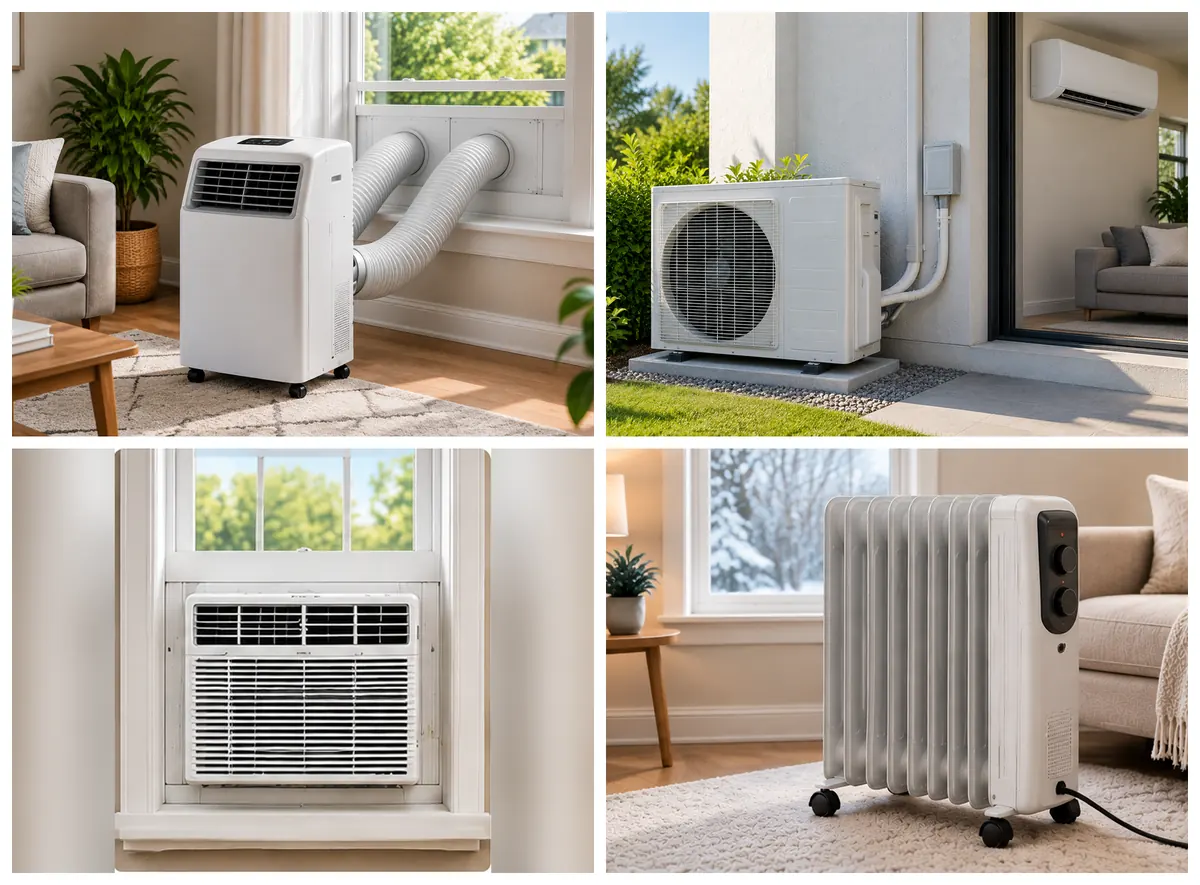
A window heat pump stays in an approved opening and does not use the same portable floor cabinet and hose arrangement. A cooling-only window AC, or one with a resistance heater, is not the same as a window heat pump. A mini split keeps the outdoor heat-exchange section outside the building rather than using the same portable enclosure and a window hose. That usually improves the practical installation options for continuous service, but the exact costs and efficiencies still depend on the models and climate. If you’re weighing permanent heating options, our heat pump pros and cons guide explains what changes the whole-home choice; our mini split installation guide covers the work and checks needed for a fixed system.
Where Does a Portable Heat Pump Work Best?
It works best in an enclosed room with a suitable outdoor vent route, moderate heating conditions, manageable drainage, and a compatible power supply. Its wheels make it movable, but it must be reconnected and sealed correctly each time it changes rooms.
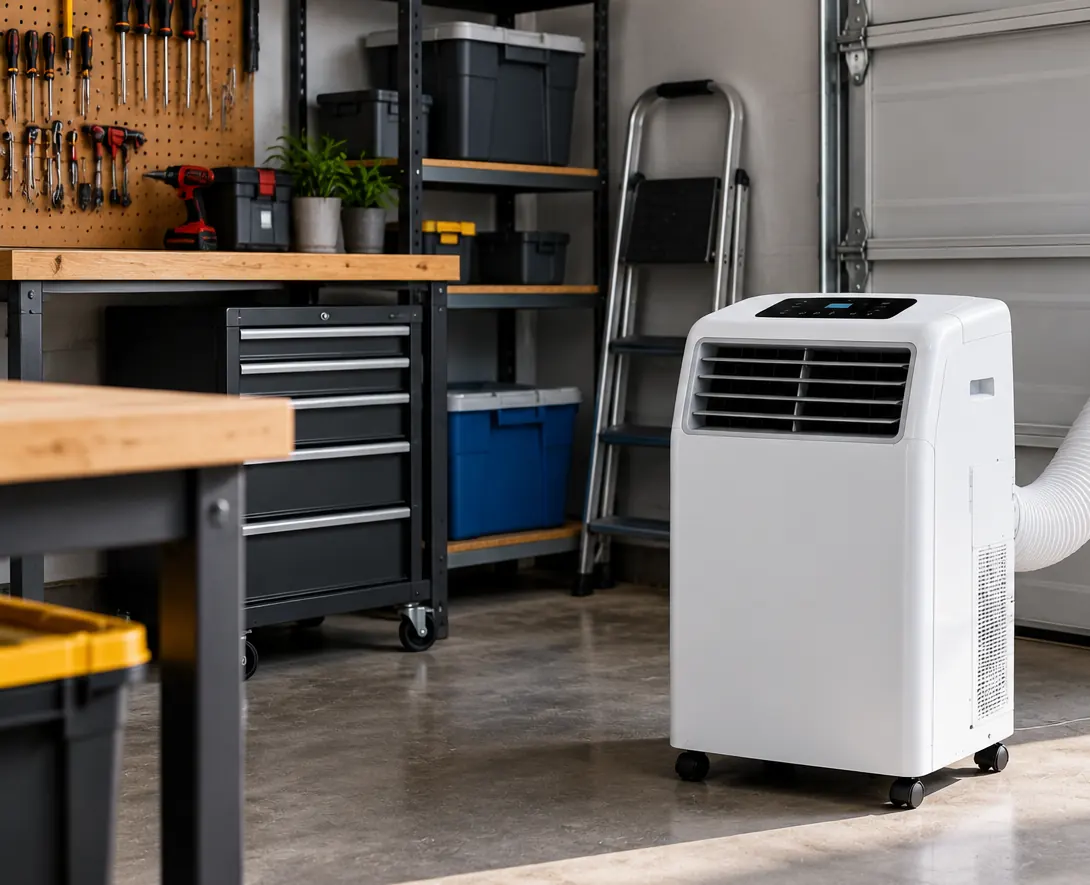
Can it heat a garage?
Yes, sometimes, but a cold or poorly insulated garage can exceed a portable heat pump’s heating ability. Check the actual winter air temperature, door leakage, insulation, room load and the manufacturer’s minimum heat-mode temperature. A model intended for mild outdoor conditions may shut down or struggle in a freezing garage. Ensure the exhaust reaches outdoors, keep it away from fuel, solvents, and other flammable vapors, and never treat an AC/heat pump as ventilation for vehicle exhaust. A garage used for active workshop work may need a different heating design.
Is it a good choice for a basement?
It can work for a basement room if there is a safe way to run the duct outdoors and remove condensate. The hard part is often the window or wall opening and a gravity-drain route, not the floor area. Check indoor humidity and how the unit drains in heating and dehumidifying modes. Keep outdoor-air ducts out of unconditioned cavities and follow the wall/window installation instructions. If there is no suitable outside opening, a ductless or existing central system is often more realistic.
Is it suitable for a bedroom or rental?
It can suit a bedroom or rental when the window kit is allowed, but noise and floor space deserve special attention. Compare noise at comparable operating settings, not a single lowest-speed figure. Confirm the window closes around the kit, the door can operate, and the outlet is safe. For a rental, obtain permission where any opening or permanent alteration is required.
How Much Does a Portable Heat Pump Cost to Buy and Run?
For a U.S. purchase-price example, Whynter’s official online store listed the heat-pump ARC-1230WNH at $699.99 on October 29, 2026. A unit averaging 1.0 kW for six hours at $0.20/kWh costs $1.20 in electricity for that period. The same store listed the cooling-only ARC-1230WN at $659.99 on that date. These are dated, model-specific U.S. prices. For your total cost, check the current offer for the exact model plus any window or drain parts, taxes, shipping, returns, and warranty terms. Actual running cost depends on power draw, hours, electricity price, and operating conditions.
To estimate the electricity used, multiply input power by operating hours:
Electricity cost = input power (kW) × running hours × electricity price ($/kWh).
Illustrative example using assumed average input and electricity price: At the same $0.20/kWh rate, a unit averaging 0.6 kW over six hours costs $0.72, compared with the $1.20 example above at 1.0 kW. Heating demand, thermostat cycling, outdoor temperature, and defrost change actual energy use; use a suitable energy meter or electricity-bill data to refine the estimate.
Compare the cost of delivering the same room heat, not just the wattage printed on two products. For a worked example, suppose the room needs an average 2.0 kW of useful heat for six hours and electricity costs $0.20/kWh:
| Illustrative heating method | Electricity needed for that heat | Six-hour cost |
|---|---|---|
| Resistance heater, assumed COP ≈ 1 | 2.0 kW × 6 h = 12.0 kWh | $2.40 |
| Heat pump, assumed COP 2.5 at that same condition | (2.0 ÷ 2.5) kW × 6 h = 4.8 kWh | $0.96 |
This illustrative equal-heat comparison assumes the COP values shown in the table. Colder outdoor air, defrost, duct losses, auxiliary resistance heat, and part-load cycling can change actual COP and cost. Check that the unit can also deliver the required 2.0 kW of room heat in the intended weather.
How Do You Install and Maintain a Portable Heat Pump Safely?
For safe installation, match the window kit, ducts, drain and electrical supply to the exact model’s manual; for maintenance, clean its filters, inspect the hose seals and clear condensate as directed. A correctly sized unit can still underperform when a hose leaks, exhaust airflow is blocked, or condensate interrupts operation.
- Check the manual and nameplate. Confirm heating mechanism, permitted temperatures, supply voltage, outlet and clearances before placing the unit.
- Plan the outdoor opening. Measure the clear window opening in its actual operating direction; check the kit’s permitted dimensions and weight/support needs. Fit and seal the panel as the model specifies, while keeping the required clearance and window security.
- Connect the right duct arrangement. Cooling and heating may use different hoses on the same machine. Never invent a hose extension or block an active air inlet.
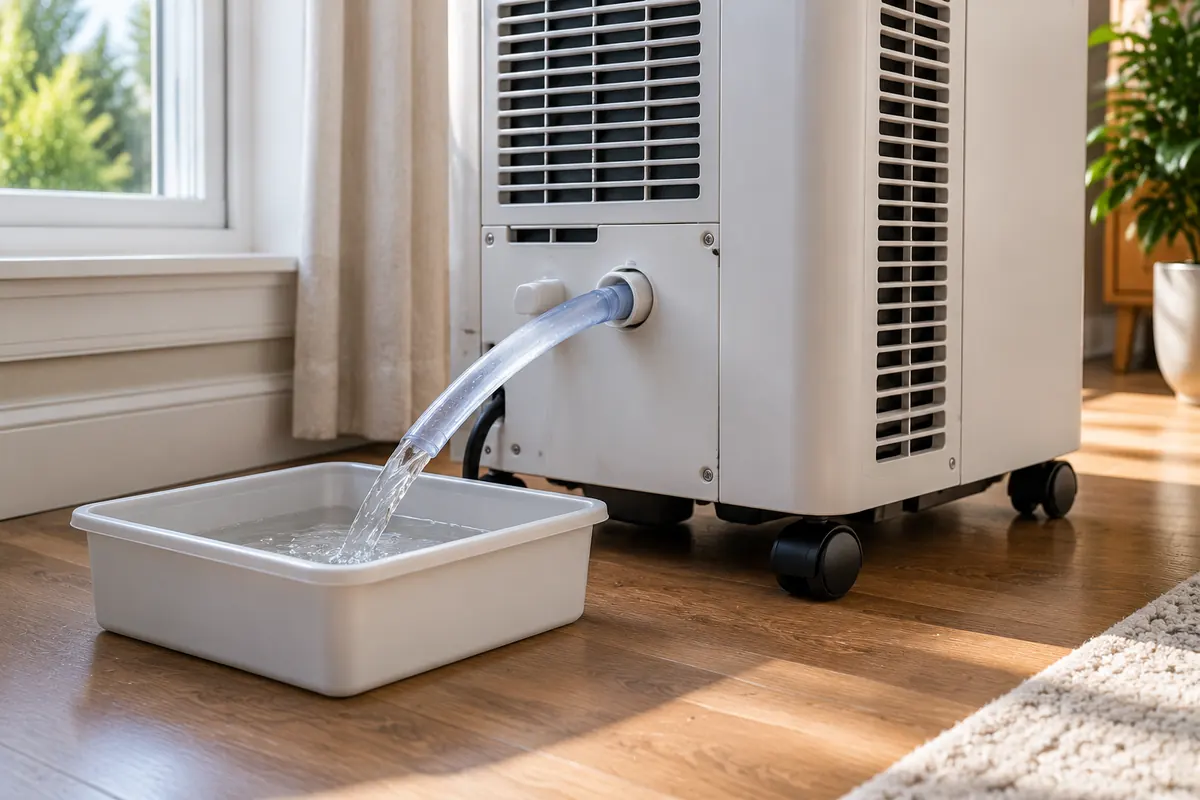
- Set the heat-mode drain path before operation. Identify the correct drain port and whether the manual requires a continuous hose, gravity drop, or an approved condensate pump. Gravity drainage cannot push water uphill; measure the height and route. The Midea Duo manual covering MAP14HS1TBL requires a hose in heat mode and permits up to 6 ft (1.8 m) of pump lift for that model’s built-in pump. Do not apply this lift limit to other brands. Secure the hose, avoid kinks, and test drainage as instructed.
- Operate and observe. Confirm conditioned air, stable operation, no error code or water leak, and acceptable room temperature over a meaningful period.
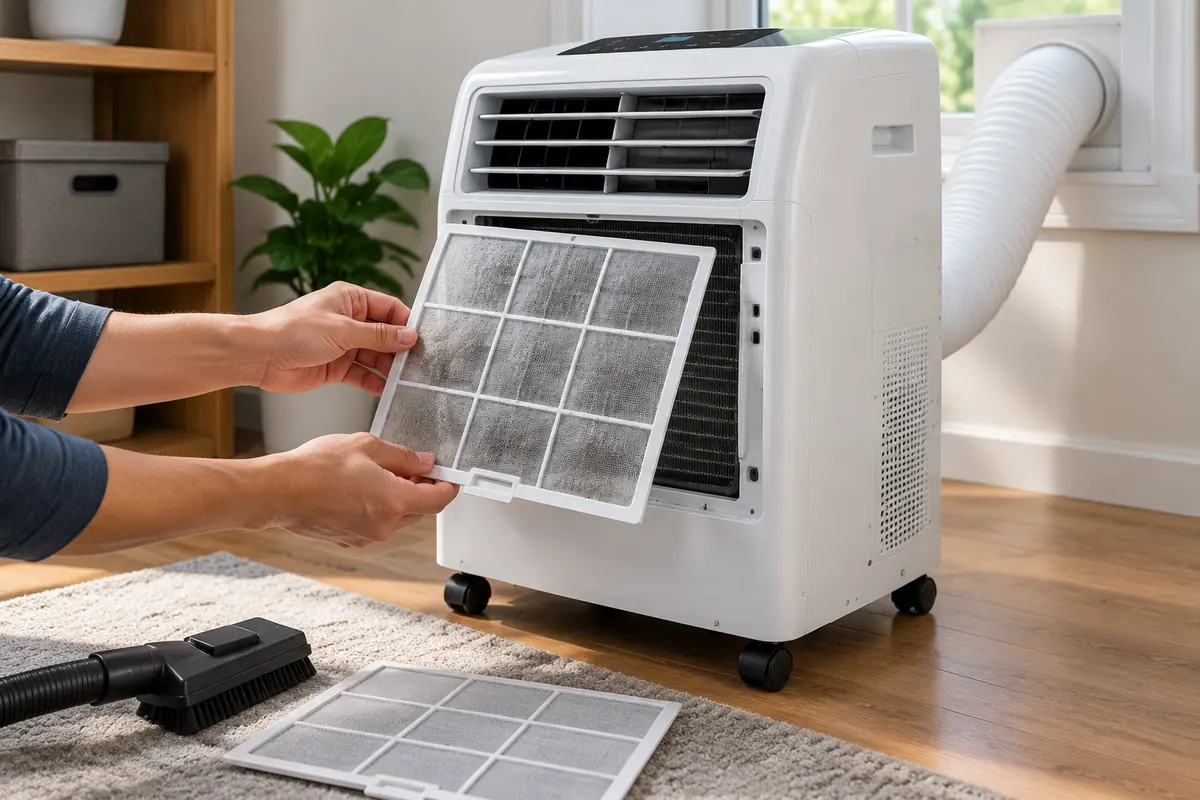
- Maintain the air path. Clean washable filters as directed, inspect duct seals, empty/flush condensate according to the manual, and keep the cabinet unobstructed.
If heating stops or feels weak, start with the visible symptom, not a guessed refrigerant fault:
| Symptom | First safe checks | Action and confirmation |
|---|---|---|
| Cool air or weak heat in Heat mode | Check Heat mode, setpoint, room airflow, outdoor temperature against the model’s range, and its startup/defrost guidance | Correct permitted settings or blocked accessible filters; after the specified delay, confirm sustained warm output and room response. An outdoor-temperature shutdown is not fixed by turning up the thermostat |
| Unit stops or shows a full-tank warning | Read the exact model’s error-code description; inspect approved drain routing and pump status without opening electrical parts | Empty or reconnect the drain as instructed; confirm water is removed and the warning does not return. If it repeats, contact service |
| Weak airflow or repeated short operation | Check accessible filter, inlet/outlet clearance, window panel leaks and bent hoses | Clean or reseat permitted parts; confirm unobstructed air path and stable operation |
| Circuit breaker trips repeatedly, burning smell or electrical damage | Stop operation; do not open panels or repeatedly reset protection | Have qualified service/electrical personnel inspect before reuse |
Is a Portable AC With a Heat Pump Worth It?
Yes, when you need both cooling and supplemental heating for one room without a permanent HVAC installation, and the unit’s vent, drain, noise, and heating-temperature limits fit the site. It is less compelling when you need reliable primary heat through a cold winter, cannot vent outdoors, or have several rooms to condition. In those cases, a properly sized installed heat pump or an existing central system deserves a separate comparison.
If permanent installation is possible, our guide to how a mini split system works explains its separate indoor and outdoor units. Only a reversible heat-pump model provides heating as well as cooling.
If a portable unit cannot cover the winter load or cannot be vented and drained safely, we can help compare fixed air-conditioning and heat-pump product options. For a permanent installation, review our fixed split air conditioner options; confirm that the exact model supports heating as well as cooling, and that its voltage, permitted operating conditions, and heating output fit your project. For a useful recommendation, send us the building use, destination market, outdoor design temperatures, heating and cooling loads, available electrical supply, and installation limits through our contact page.
Frequently Asked Questions
Does a portable heat pump work without a window?
Only if the manufacturer approves another genuine outdoor vent route. A suitable wall opening may be possible for certain models, but running the hose into the same room, attic, or closed interior area is not a working substitute. If you cannot route air outdoors safely, choose another heating and cooling arrangement.
Do portable heat pumps still work below freezing?
Some portable heat pumps can operate below 32°F (0°C), but only if the specific model’s approved heating range includes those temperatures. Also check its published heat output at the expected outdoor temperature against the room’s heating load; operating permission and adequate output are separate requirements.
Is a dual-hose portable heat pump always better?
No, not always. A dual-hose design can reduce losses from exhausting conditioned indoor air, but actual performance depends on the model’s ratings, window sealing, noise and the required heating-mode duct arrangement.
Can I leave the portable heat pump on all night?
Only when the model is approved for normal unattended operation and its setup follows the manual. Confirm a correctly rated wall outlet, clear air paths, secure window panel and safe drainage. In a bedroom, check the actual operating noise and whether defrost or a full tank can interrupt heating.
Does a portable heat pump need to drain water in heating mode?
Often yes. Condensate can collect during heat-pump heating, and some units stop when the tank fills. Check whether your model needs periodic emptying, a continuous gravity drain, or an approved pump and where its heat-mode drain outlet is located.
Is a portable heat pump the same as a portable air conditioner with a heater?
Not necessarily. Both can offer warm and cool modes, but one may move heat through a reversible refrigeration system while another uses electric resistance heat. Verify the exact heating technology in the model documentation before comparing efficiency.
Sources and Further Reading
- U.S. Department of Energy: Portable Air Conditioners — definition and scope of portable air conditioning.
- U.S. DOE: Portable Air Conditioner Test Procedure — portable cooling SACC and CEER test concepts, not a model’s heating COP.
- U.S. DOE FEMP: Purchasing Energy-Efficient Room Air Conditioners — specifies that portable air conditioners are excluded from the referenced ENERGY STAR room-AC acquisition category.
- ENERGY STAR: Air-Source Heat Pumps — heat-transfer principle and energy use compared with resistance heating; not a portable-model certification claim.
- GE Appliances: Exhaust Vent Hose — outdoor venting and brand-specific dual-hose heat-mode instructions.
- Manufacturer model information: Midea Duo MAP14HS1TBL user manual, printed pp. 8 and 18 (heat-pump range and heat-mode drain); Whynter ARC-1230WNH and ARC-1230WN published specifications (heating feature and cooling/heating ratings). The Whynter U.S. official online store listings for those exact models were checked for the dated purchase-price examples on October 29, 2026.