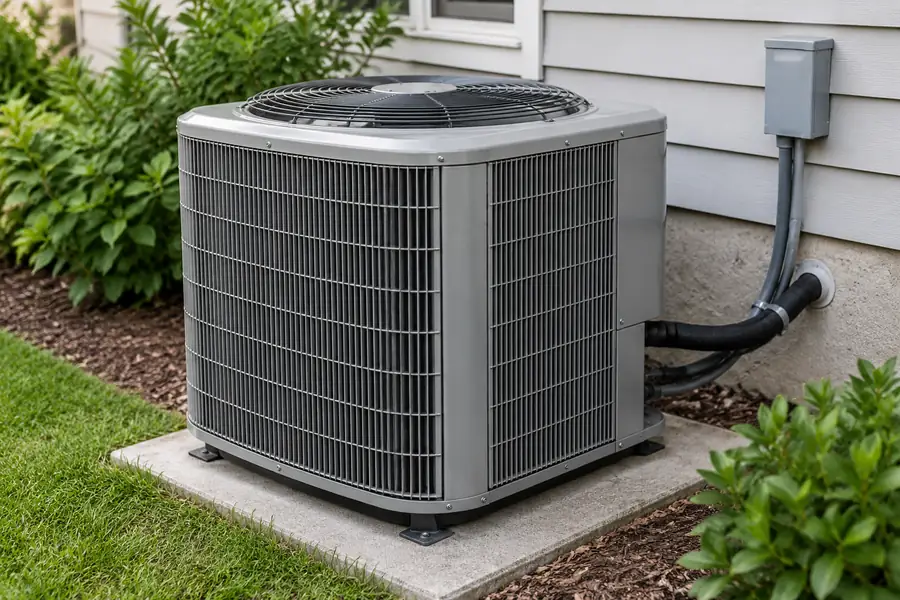
An air conditioner capacitor is an electrical part that helps certain compressor and fan motors start and run. If it fails, the outdoor unit may hum without starting, the fan may stop, or the AC may blow warm air. The same signs can also come from the motor, contactor, power supply, or controls. A qualified technician checks the measured µF value against the part’s printed tolerance. For a U.S. residential service call in 2026, cost guides estimate professional capacitor replacement at about $200–$400. This guide explains capacitor types, 45/5 µF ratings, service life, and when capacitor repair or a whole-system replacement makes sense.
If an outdoor unit keeps trying to start, smells burnt, or trips its breaker, turn the cooling system off and arrange qualified service. A capacitor can hold a dangerous charge after the equipment is disconnected. You can record symptoms and model details without opening the electrical compartment.
What Does an Air Conditioner Capacitor Do?
In many conventional single-phase air conditioners, a motor capacitor helps the compressor or fan motor start and run. It works with the motor windings to create the phase shift needed for torque—the turning force that starts or keeps the motor moving. The electrical supply powers the motor; the capacitor supports its designed starting or running function.
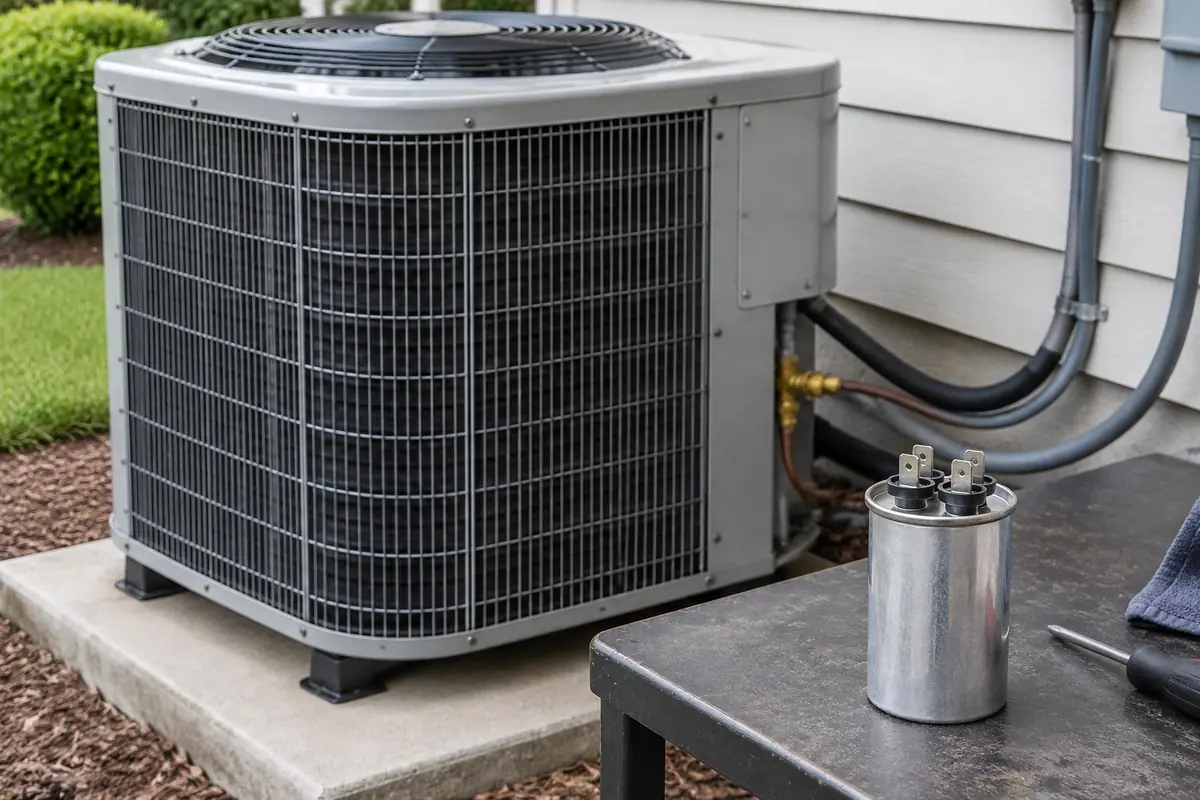
When the thermostat calls for cooling, the indoor blower moves room air and the outdoor equipment must move heat outside. A compressor that cannot start, or a condenser fan that stops, can interrupt that process even when the thermostat display and indoor fan still work. For more on the separate job of the compressor, see our guide to HVAC compressor types.
A run capacitor stays in the motor circuit during normal operation. A start capacitor, when the equipment uses one, provides extra starting torque for a short time and is taken out of the circuit by an approved starting device. Copeland’s start-component engineering bulletin makes that duty difference clear.
Fixed-speed single-phase compressors often use motor capacitors. Inverter compressors use electronic drives, and some modern fan motors have their own electronic controls. Check the exact model and service diagram to identify the applicable motor circuit and components.
Start, Run, Dual-Run, and Fan Capacitors: What Is the Difference?
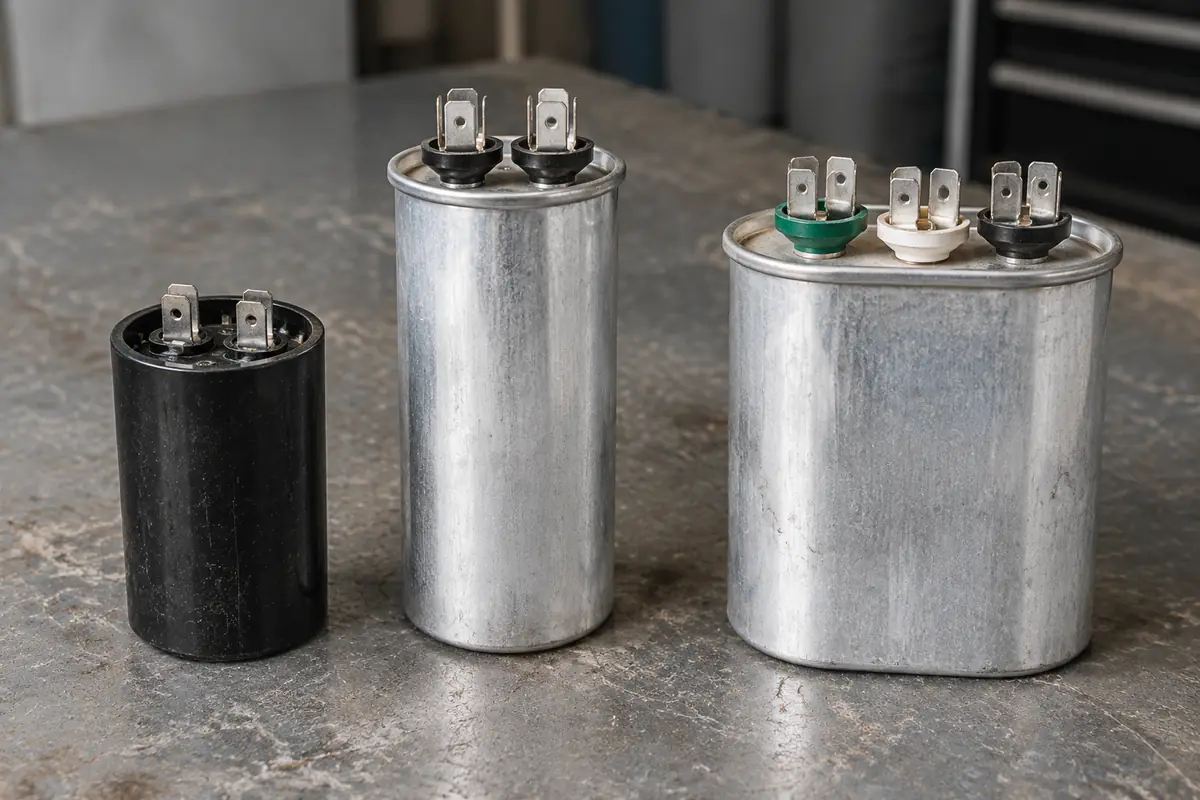
A start capacitor briefly boosts starting torque; a run capacitor remains in the circuit during operation; a dual-run capacitor contains two run sections; and a fan capacitor serves a fan motor. In many outdoor units, the dual-run sections serve the compressor and condenser fan. It is not automatically a start-plus-run kit.
| Capacitor type | Main job | Where it is used | Key point |
|---|---|---|---|
| Start capacitor | Adds starting torque for a short period | Certain single-phase compressors and starting kits | Must be removed from the circuit after startup by the intended device |
| Single run capacitor | Supports a motor through normal operation | Selected compressor, condenser-fan, or indoor-blower motors | Capacitance must suit that exact motor circuit |
| Dual-run capacitor | Combines two separate run sections | Many conventional outdoor units | Often marked C, HERM, FAN; each section has its own µF rating |
| Fan capacitor | Serves a fan motor; may be a single run section or part of a dual unit | Outdoor fan or some indoor blowers | “Fan capacitor” names the motor served, not a separate electrical duty |
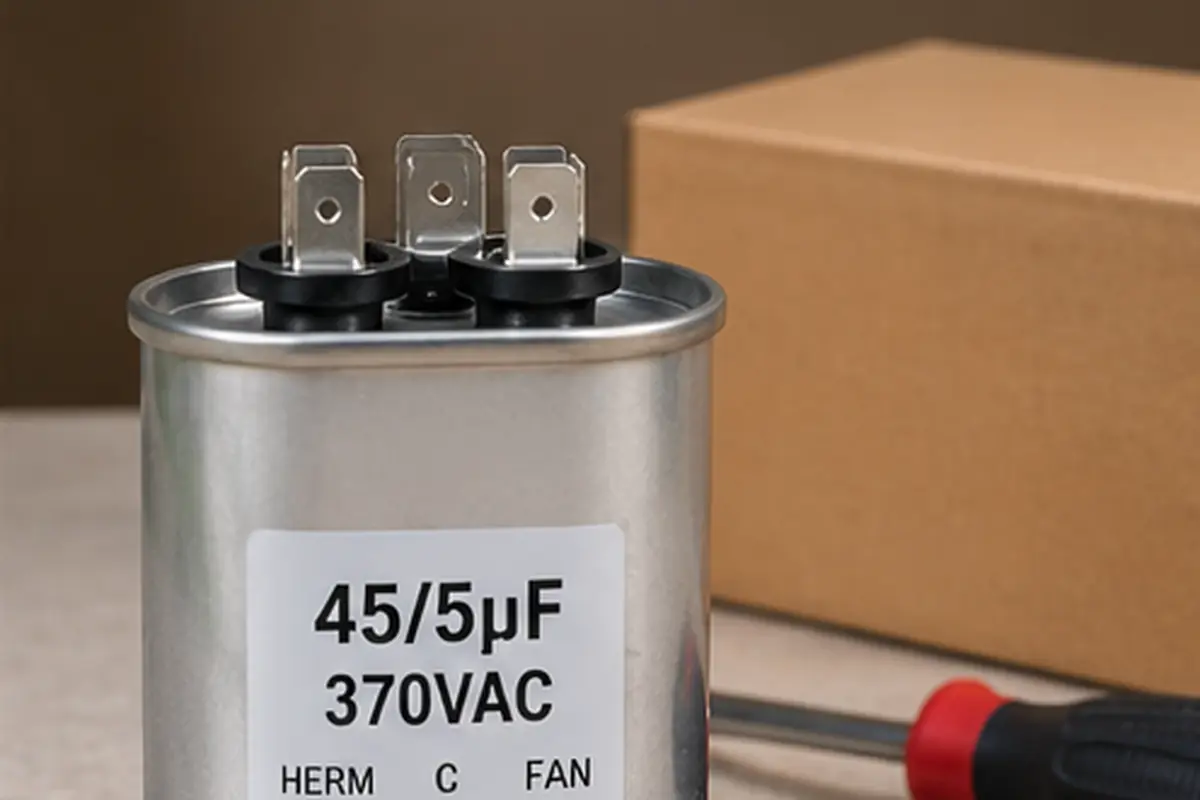
A common dual-run can has terminals marked C (common), HERM (compressor section), and FAN (condenser fan section). The labels identify different circuit connections. Wire color is not a dependable substitute for the unit’s wiring diagram.
When does an AC need a start capacitor?
A start capacitor is used only when the compressor and starting design call for it. A hard-start assembly may include a start capacitor and an approved relay or other switching device. Adding an oversized capacitor because the compressor hums can hide a voltage, motor, mechanical, or control fault. The correct first move is to diagnose the actual starting circuit.
Is a dual capacitor the same as two separate capacitors?
It performs two run-capacitor functions in one housing, but it is not automatically interchangeable with two separate capacitors. The equipment’s approved wiring and specifications determine whether separate parts are suitable. If either section is outside its specified tolerance, a technician normally replaces the whole dual-run unit with the specified part or an equipment-approved arrangement.
Where Is the Capacitor on an Air Conditioner?
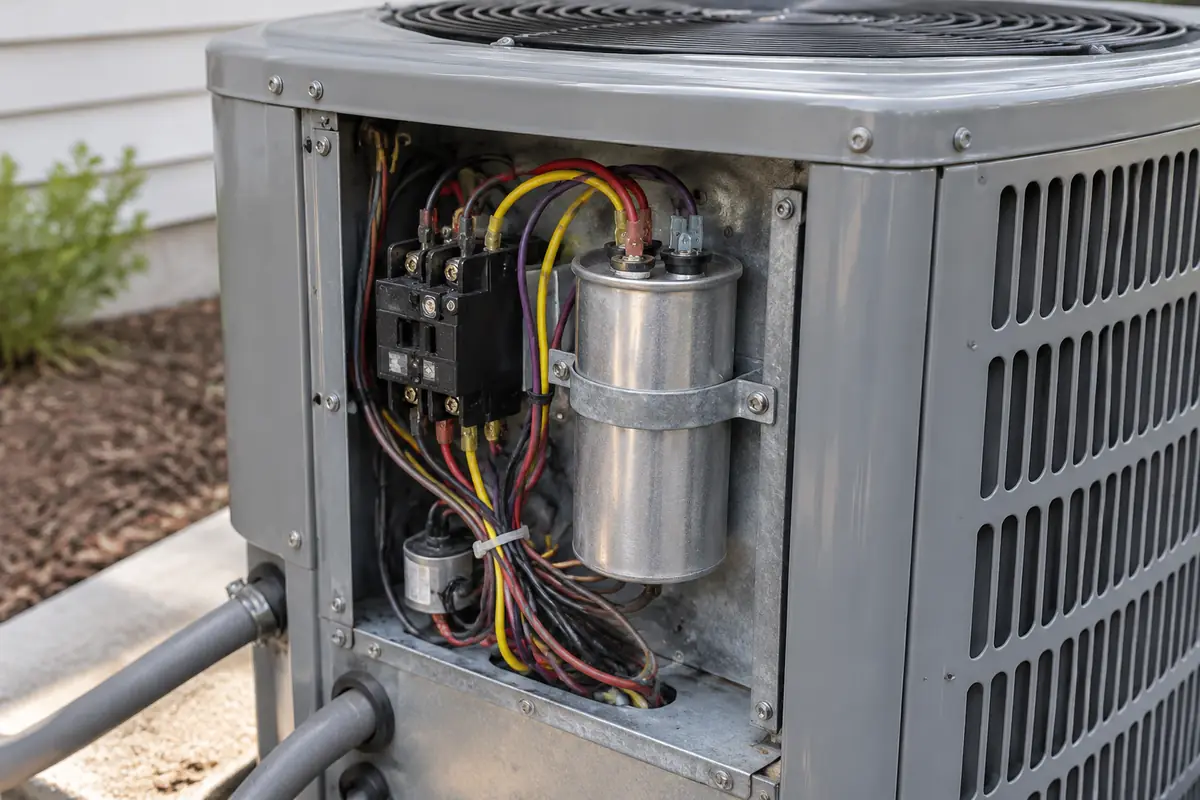
On many conventional split-system central AC units, the outdoor run capacitor sits inside the outdoor unit’s electrical compartment, often held by a bracket near the control components. It may look like a round or oval metal can with insulated electrical terminals.
A window AC or portable unit may place a capacitor inside its own cabinet. An indoor blower may use a separate capacitor. Some inverter equipment has electronic drive capacitors rather than the familiar serviceable outdoor dual-run can. Use the exterior model number to find the matching service diagram, which identifies the electrical compartment and capacitor arrangement.
You can find the outdoor unit’s model and serial number on the exterior rating label without opening the cover. If the label is damaged, photograph the readable numbers and any error code shown on the normal display. A technician can then locate the correct compartment using the model-specific service information.
What Are the Symptoms of a Bad Air Conditioner Capacitor?
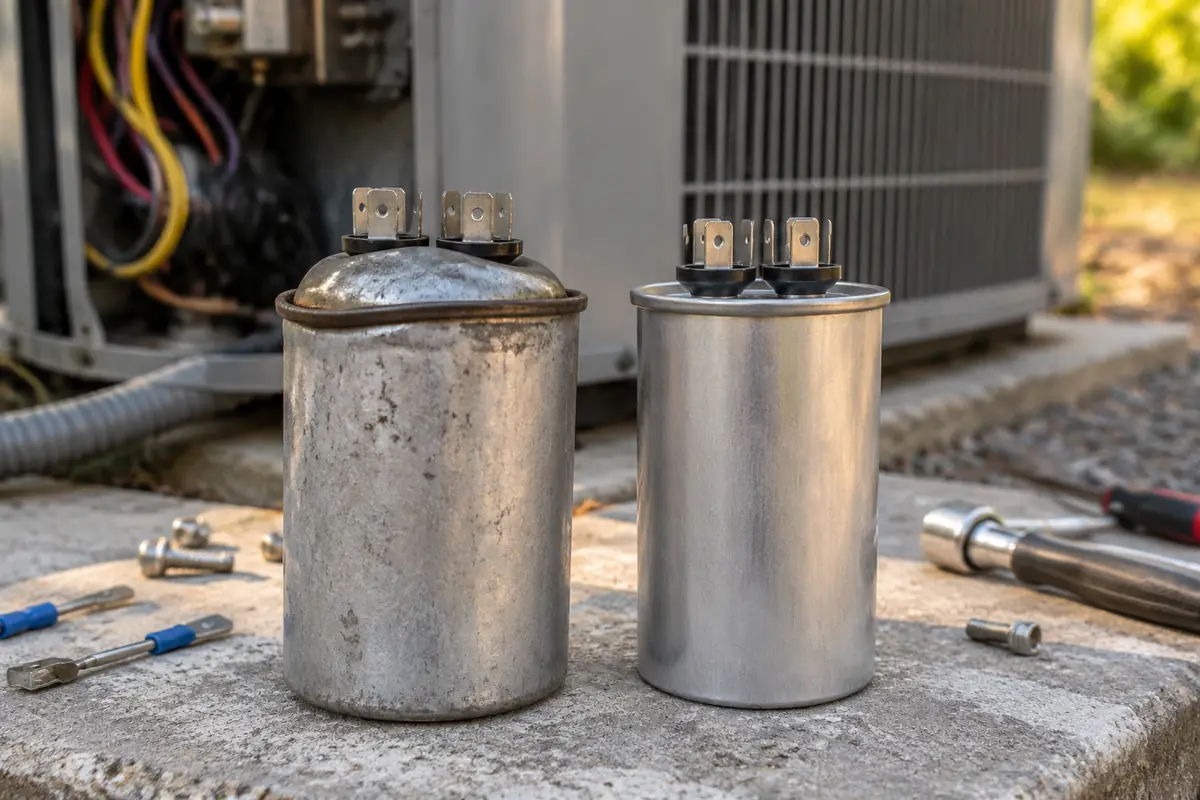
Typical warning signs include a hum without a normal start, an outdoor fan that does not run when called, intermittent cooling, and visible swelling or leakage discovered during service. The next step is to separate indoor airflow problems from outdoor motor-starting problems.
| What you notice | What it could mean | What to record or do safely |
|---|---|---|
| Outdoor unit hums but the fan does not spin | Fan-run capacitor, fan motor, wiring, or a control problem | Turn cooling off. Note whether the outdoor fan stopped and whether the compressor seemed to start; report both observations. |
| Outdoor unit clicks or hums, then stops | Compressor starting circuit, supply voltage, overload, contactor, or locked compressor | Stop repeated starting attempts. Record any click, hum, trip, and how quickly the unit shuts down. |
| Indoor air moves but stays warm | Outdoor compressor/fan is not operating, or another cooling fault | Note whether the indoor blower still moves air; from a safe distance, record outdoor fan operation during a cooling call. |
| Cooling works at first, then cuts out | Heat-related motor protection, controls, airflow, or another fault | Record the approximate run time, when cooling fades, and any display or error message before shutdown. |
| Capacitor is swollen, leaking, or scorched | Physical capacitor or connection damage | Keep cooling off. If damage is visible without opening the unit, report it; do not touch the capacitor or terminals. |
| Breaker trips repeatedly or there is a burning smell | Potential electrical fault, not necessarily the capacitor | Leave the AC off and report the trips or smell. Do not reset the breaker repeatedly or open the electrical cabinet. |
When reporting the fault, note three separate observations: whether the indoor blower moves air, whether the outdoor fan runs during a cooling call, and whether the outdoor unit hums, clicks, trips protection, or stops shortly after starting. Also record any visible error code. These details help a qualified technician choose which circuit to inspect first.
For example, suppose the indoor fan blows air but the outdoor fan is still. The compressor may be off, overheated, or starting without proper condenser airflow. Do not keep testing cooling by repeatedly restarting the AC; sustained operation without the required outdoor airflow can damage the system.
Can a bad capacitor cause short cycling or a frozen coil?
A failing capacitor can contribute to repeated failed starts or protective shutdowns that resemble short cycling. A frozen indoor evaporator coil more often calls for an airflow and refrigerant-side check rather than assuming an outdoor capacitor fault. Rapid cycling can also involve thermostat controls, equipment sizing, or pressure protection.
Does a humming AC always need a capacitor?
No. A motor can hum because it is not developing enough torque, yet the reason may be low voltage, a failed relay, a jammed fan, or an internal motor fault. A technician needs to check the electrical supply and related motor circuit before replacing a part.
How Do You Tell If an Air Conditioner Capacitor Is Bad?
Swelling, leakage, or a motor that will not start may suggest a bad capacitor; a qualified technician checks whether the relevant section measures within its printed µF tolerance and the equipment specification. A smooth-looking capacitor can still test outside its rated range.
Checks you can make without opening the AC
- Set the thermostat to a normal cooling request and note any displayed error. Avoid repeated test starts if the outdoor unit struggles.
- From outside the enclosure, note whether the outdoor fan runs, whether the compressor seems to start, and whether the unit repeatedly switches off. Do not touch the fan or place objects through the grille.
- Record the approximate time from call-for-cooling to shutdown, any unusual smell or sound, and recent power interruptions.
- Photograph the exterior model and serial label and tell the service company what the system was doing when the fault began.
If you see smoke, smell burning, or have repeated breaker trips, stop the cooling request rather than continuing these checks.
How does a technician test an AC capacitor with a multimeter?
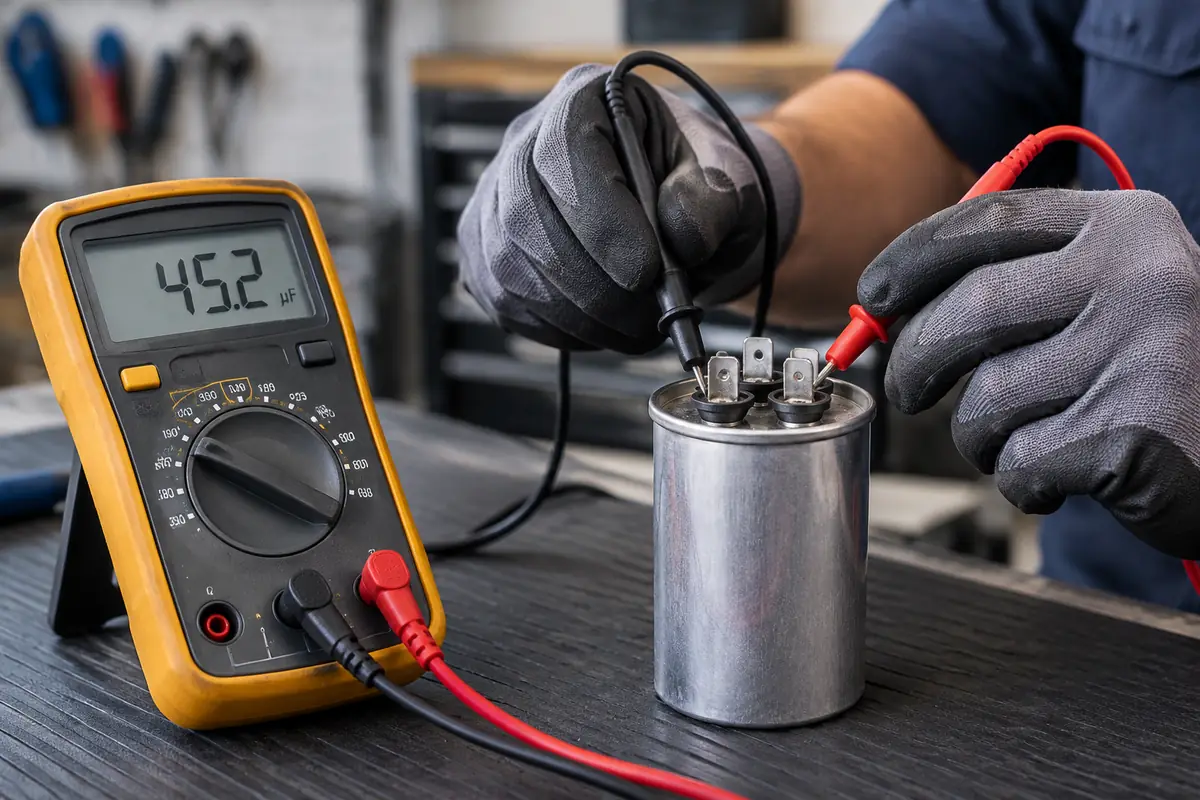
The correct test compares measured capacitance in microfarads (µF) with the capacitor’s marked rating and permitted tolerance. A qualified technician isolates power, accounts for stored electrical charge, then tests the correct terminals with a capacitance-capable meter.
For a dual-run unit, the technician tests the compressor section and the fan section separately. A reading can be valid for one section and out of range for the other. If the system still fails to start after a capacitor replacement, the technician checks the motor, contactor, start relay, wiring, and electrical supply.
Copeland’s bulletin on compressor start components specifies qualified service practices. Do not open the electrical compartment, handle wiring, or short capacitor terminals with a screwdriver for a home test.
What reading means the capacitor has failed?
A measurement outside the tolerance printed on the capacitor is a reason to investigate and normally replace that capacitor section or assembly. Do not apply one universal ±6% rule to every product. Read the actual tolerance, such as ±5% or ±6%, and use the motor and equipment instructions.
Worked example (calculated values, not field measurements): A 45/5 µF dual-run capacitor marked ±5% has separate acceptable bands: 42.75–47.25 µF for its 45 µF section, and 4.75–5.25 µF for its 5 µF section.
Lower limit = rated µF × (1 − tolerance ÷ 100); upper limit = rated µF × (1 + tolerance ÷ 100).
| Capacitor section | Marked ±5% range | Example reading | What the result means |
|---|---|---|---|
| 45 µF compressor section | 42.75–47.25 µF | 40.0 µF | Below the example tolerance. Have the specified capacitor section or assembly assessed and replaced where indicated. |
| 5 µF fan section | 4.75–5.25 µF | 4.9 µF | Within the example tolerance. A fan, control, or wiring fault could still explain the symptom. |
For a real service decision, use the actual part’s printed tolerance, equipment instructions, and the technician’s test conditions. If the original starting fault continues, the technician should inspect the related motor and control circuit.
The technician also considers meter accuracy and repeatability before deciding which component needs replacement.
What Does a 45/5 Air Conditioner Capacitor Mean?
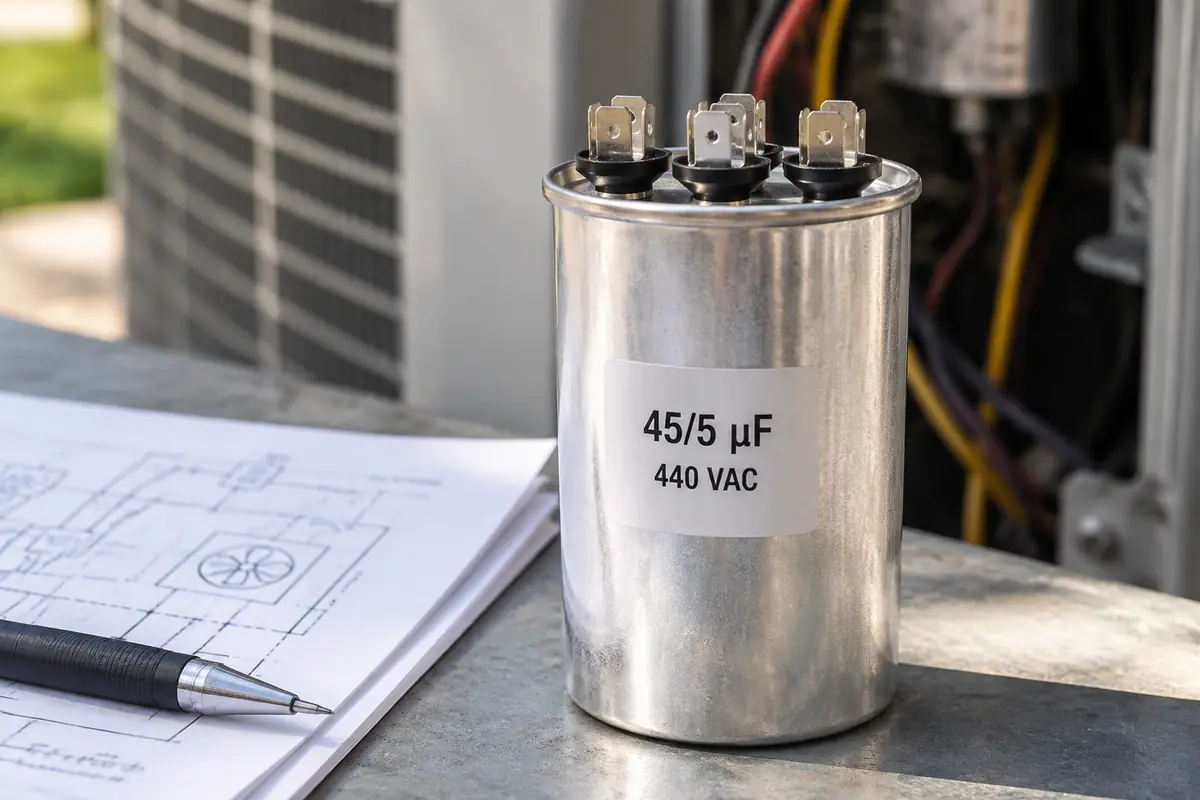
A 45/5 µF dual-run capacitor has a 45 µF run section, commonly for the compressor, and a 5 µF run section, commonly for the condenser fan. It does not mean a capacitor can be adjusted between 45 and 5, and it does not mean a 45 µF start capacitor plus a 5 µF run capacitor.
| Marking | What it means | How it affects replacement |
|---|---|---|
| 45/5 µF or 45+5 MFD | Two separate capacitance values | Both values must match the specified motor circuits |
| 370 VAC or 440 VAC | Rated AC voltage withstand value | Replacement must meet the specified voltage rating; higher may be permitted, lower is not |
| ±5% or ±6% | The individual capacitor’s tolerance | Use the printed tolerance to interpret test readings |
| 50/60 Hz | Rated operating frequency | Must suit the equipment electrical supply and component specification |
| C / HERM / FAN | The three connection groups on many dual-run cans | A qualified technician follows the actual wiring diagram, not wire colors |
Do not select a capacitor by the air conditioner’s tonnage alone. Two units with the same cooling capacity can use different motors and capacitor ratings. A 45/5 can is only suitable where the model’s approved parts information specifies those values.
Before ordering a replacement, verify all five items:
- Exact unit and motor: Match the full model and the service parts information, not just cooling capacity.
- Capacitance and tolerance: Confirm each required µF value and permitted range; a dual-run part has separate compressor and fan sections.
- Electrical ratings and duty: Check the permitted VAC, 50/60 Hz rating, and whether the circuit calls for a start or run capacitor.
- Connections and mounting: Have a technician match the manufacturer’s diagram, terminal arrangement, bracket, and clearance.
- Approved equivalent: If the original part is unavailable, obtain an equipment- or motor-approved equivalent rather than relying on a similar metal can or wire color.
Can a 440 VAC capacitor replace a 370 VAC capacitor?
Often yes, if the capacitance, duty, frequency, physical fit, and equipment approval also match. The voltage number is a withstand rating, not a setting that pushes extra voltage into the motor. A 370 VAC part should not replace a system-specified 440 VAC part. Always follow the exact motor or equipment parts list for the final selection.
How Long Do Air Conditioner Capacitors Last, and Why Do They Fail?
An AC capacitor has no fixed replacement age: some last around 10–20 years, while heat, electrical stress, aging materials, moisture, or poor connections can cause earlier failure. Age alone does not tell you whether the part still meets its rating. Carrier and Trane identify heat exposure and electrical stress as important contributors.
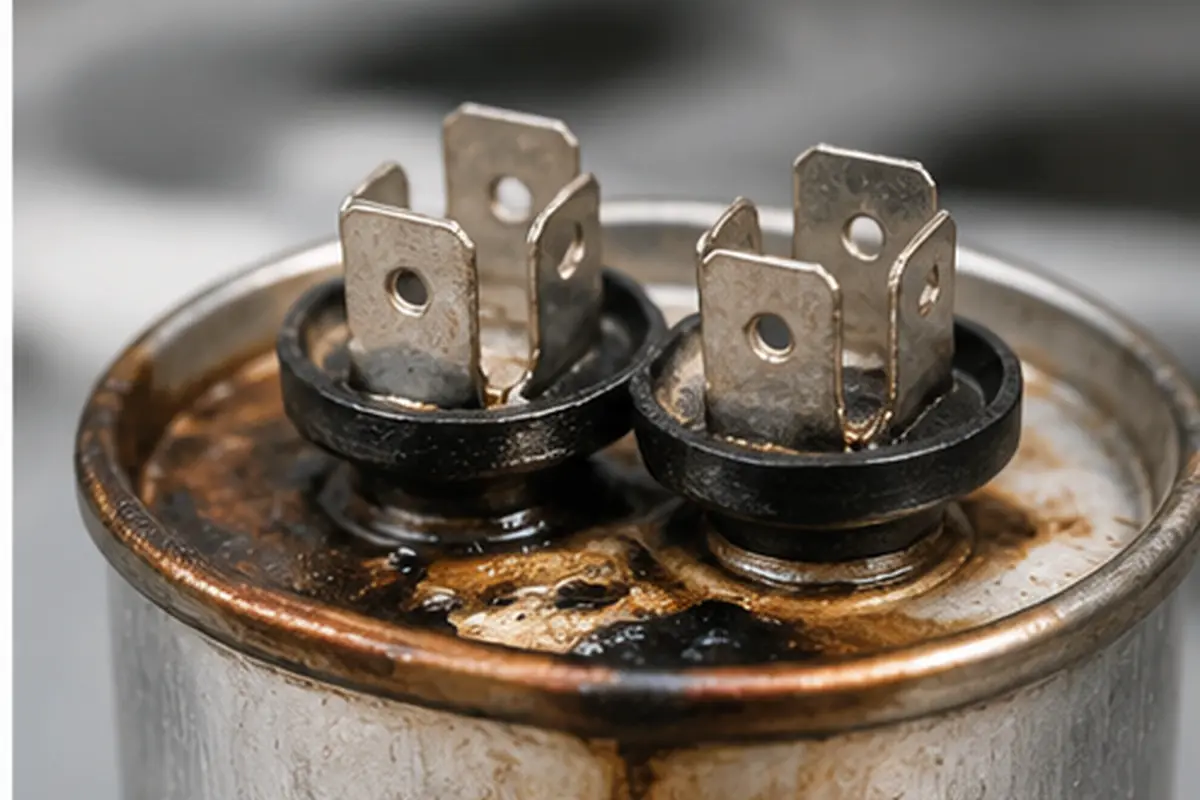
Common reasons include a hot electrical compartment, aging dielectric material, voltage surges or abnormal supply conditions, poor connections that create heat, moisture intrusion, or a motor/start-circuit fault that puts abnormal stress on the part. A bulged top or leakage is an important service finding, but some weak capacitors look normal.
How can you reduce repeat failures?
Have the cause of the last failure checked instead of only installing another capacitor. If terminals show heat damage, check the connections and contact condition; if the cabinet runs hot, check the unit’s intended airflow and fan operation; if failures follow power problems, verify supply voltage and electrical protection. A technician should also confirm the correct µF/VAC part and assess the motor and start components. Repeated failure calls for a root-cause check, not a larger capacitance by guesswork.
Avoid blocking the outdoor unit with stored items or dense vegetation. Keep the specified clearance around the condenser and arrange coil cleaning or service according to the equipment maintenance instructions.
How Much Does Air Conditioner Capacitor Replacement Cost?
For a U.S. residential service call in 2026, third-party cost guides place a typical capacitor replacement at about $200–$400 including the part and professional labor. Labor, travel, diagnosis, access, and service timing can affect the total.
| Cost element | Useful 2026 U.S. planning figure | What may change it |
|---|---|---|
| Professional replacement, part and labor | Around $200–$400 for many standard visits | Region, access, after-hours service, extra faults |
| Capacitor part alone | Often roughly $8–$45 for common types | OEM brand, dual/single type, rating, supplier |
| Diagnostic or service fee | May be billed separately or folded into the invoice | Local company pricing and whether more tests are needed |
The August 2026 Angi cost review reports a $200–$400 U.S. replacement range, and Carrier’s capacitor guide provides a similar reference. Compare quotes by checking whether the diagnostic fee is included or charged separately.
Example quote (illustrative): Suppose a company quotes $280 for installed replacement and $95 for diagnosis. If the $95 visit is charged in addition, the billed total is $375 before tax or other repairs. If the $95 is credited toward the quoted $280 repair, the total remains $280. Ask the service company which treatment applies before comparing quotes.
Replacing the wrong part costs more than confirming the fault first. If a condenser fan motor is seized, for example, a new fan capacitor will not free the motor. The repair decision should follow the confirmed failed component.
Should You Replace the Capacitor or the Whole Air Conditioner?
A confirmed failed capacitor on an otherwise healthy unit is generally a repair job, not a reason to replace the entire air conditioner. Replacement of the whole system becomes worth discussing when there are additional major faults, repair parts are unavailable, or the unit no longer fits the building’s cooling needs.
| Diagnosis | Sensible next step | What changes the choice |
|---|---|---|
| Capacitor out of tolerance; motor and controls are sound | Replace with the specified part and test operation | If it fails again, look for the underlying electrical cause |
| Capacitor tests good; outdoor unit still fails to start | Check voltage, contactor, motor, relay, controls, and protection | Repair the actual failed component, not the capacitor by guesswork |
| Fan/compressor damage is confirmed | Compare repair scope and age with a replacement system | Repair cost, available parts, system performance, and warranty |
| AC runs correctly but room never cools enough | Review airflow, building load, and equipment capacity | A capacitor swap cannot fix an undersized system |
Before calling a capacitor repair complete, a qualified technician should confirm the exact replacement part and rating, normal starts and running operation of the relevant fan and compressor, electrical readings within the applicable equipment limits, and restored cooling. If the original symptom remains, further diagnosis is needed rather than assuming the new capacitor solved the fault.
Our air-conditioner types guide can help when the question genuinely becomes choosing a different system. When a full system replacement is justified by larger faults or unmet cooling demand, match the new AC to the building’s cooling load and design conditions.
Why the exact model matters for Airproz equipment
The exact Airproz model matters because different units specify different compressor-capacitor values, and cooling capacity alone cannot identify an approved replacement part. Airproz publishes the following figures for its fixed-speed R410A T1 YT Series under Compressor → Capacitor (uF):
| Airproz model | Published compressor capacitor value |
|---|---|
| TCF1-18CYT | 60 µF |
| TCF1-18HYT | 55 µF |
| TCF1-28CYT | 55 µF |
The table reports published compressor-capacitor ratings. For the correct replacement assembly, use the exact unit’s service parts list to confirm the voltage rating, terminal layout, mounting and approved equivalents, plus the fan-section µF rating where a dual-run assembly is fitted.
For an Airproz unit, share the full model and serial number, supply voltage and frequency, exterior nameplate photo, observed fault and any qualified technician measurements when requesting model-specific equipment documentation. Our technical-support and warranty FAQ explains our support channel, or you can contact Airproz with the details. For hands-on electrical diagnosis or replacement, arrange a qualified local HVAC technician.
Air Conditioner Capacitor FAQs
Can an air conditioner run without a capacitor?
A motor designed to use a run capacitor generally cannot operate as intended without that capacitor. Inverter-driven and electronically controlled motors use different circuits; the model’s service diagram identifies the correct arrangement.
Should I keep running the AC if the capacitor is bad?
No. If the motor is failing to start, the outdoor fan has stopped, or the unit keeps tripping protection, turn cooling off until the fault is repaired. Repeated failed starts can overheat equipment.
Does a bad AC capacitor always look swollen?
No. Swelling, leakage, and burn marks are important damage signs, but a capacitor can lose capacitance while its case looks normal. A technician compares the measurement with the printed rating and tolerance.
Can I test an air conditioner capacitor with a normal multimeter?
Yes, if the meter has a capacitance (µF) measurement function. A qualified technician first makes the circuit safe, including any stored charge, then compares each measured section with its marked rating and tolerance.
Can I replace a 45/5 µF capacitor with a 50/5 µF one?
Not as a routine substitution. The compressor-side capacitance would change from 45 to 50 µF. Use the exact motor/equipment rating or an explicitly approved replacement; a bigger number does not mean better starting or cooling.
Why does my new capacitor fail again?
Repeat failure points to a problem that needs diagnosis, such as abnormal heat, voltage, connections, a stressed motor, or an incorrect part. Ask the technician to check the whole starting and running circuit rather than fitting another can without testing.
The Bottom Line on Air Conditioner Capacitors
An air conditioner capacitor supports the starting or running of specific motors, and the correct replacement is determined by the actual circuit and nameplate rating. Use the symptoms to decide when to stop the AC and call for service. Then confirm which section failed, the exact µF and VAC requirements, and whether another motor or control problem caused it. A correctly diagnosed capacitor failure is usually a straightforward repair; a whole-system replacement is a separate decision.