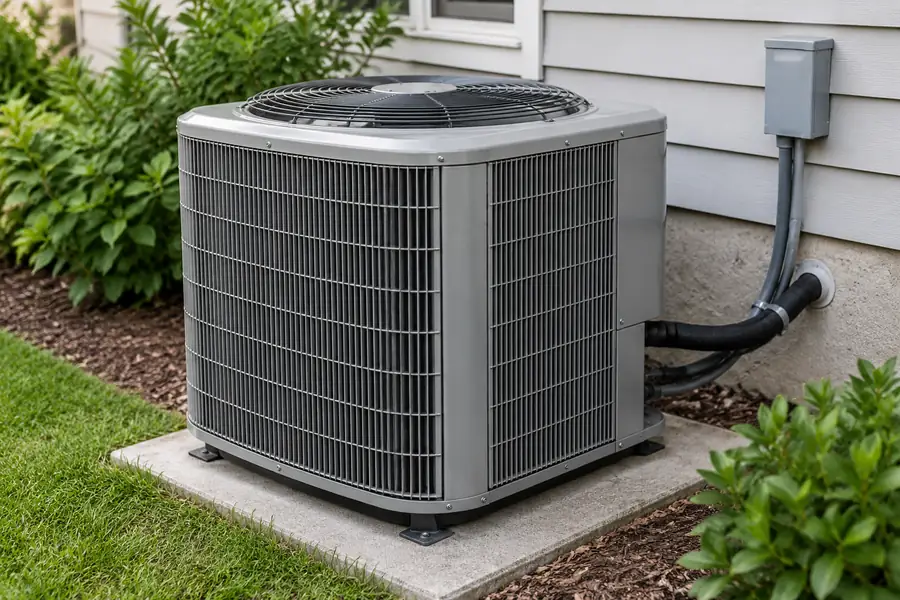
An air conditioner contactor is a coil-operated switch that connects or disconnects power to the outdoor compressor and, in many conventional systems, the condenser fan. A fault may leave the outdoor unit off, cause repeated chatter, or keep a controlled load running after cooling stops. A qualified technician checks the cooling command, coil signal, switched power, and connected load before choosing a repair. A replacement must match the unit’s specified coil voltage, contact arrangement, motor-duty ratings, and mounting. Similar symptoms can also come from a thermostat, safety device, capacitor, or motor. Some inverter-driven systems use different power-control designs and may not have the same separate contactor.
Before you suspect the contactor, check what you can safely observe: Set the thermostat to COOL and a temperature below the room temperature; allow any normal restart delay shown in your manual; note whether the indoor fan and outdoor unit run and whether you hear a single click or repeated chatter. If you smell burning, see smoke, or the breaker trips again, stop using the system and arrange qualified service. Do not remove the electrical cover or press the contactor by hand.
What Is an Air Conditioner Contactor?
An air conditioner contactor is an electrically operated switch that uses a coil to turn power to an assigned outdoor compressor or fan circuit on and off. In many conventional systems, a low-voltage cooling command controls the switch while its main contacts handle higher-power loads.
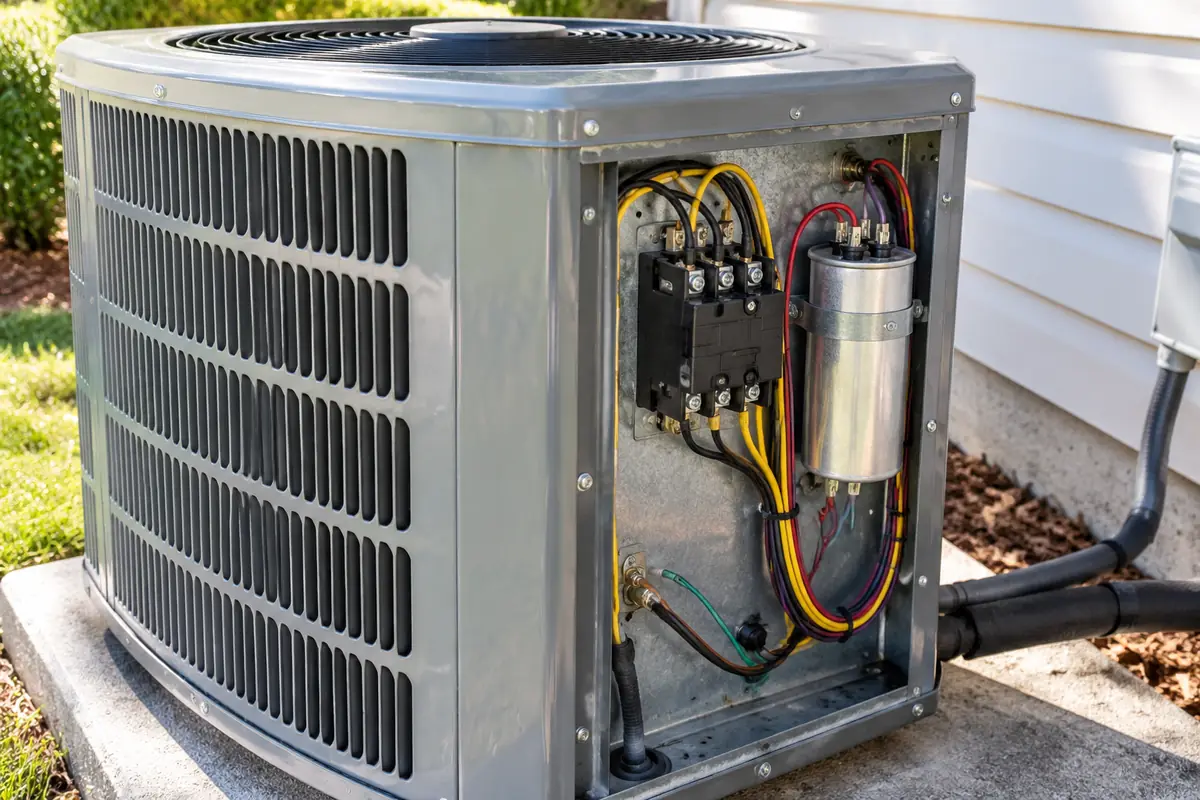
In a common conventional split system, a thermostat asks for cooling. The control circuit energizes the contactor’s coil. A magnetic mechanism pulls the main contacts together, allowing power to reach the compressor and, in many designs, the outdoor fan. When cooling demand ends, the coil loses power and the normally open contacts separate. For a model-specific example, the Lennox ML14XC1 three-phase outdoor-unit service instructions describe their own electrical arrangement and warn about line voltage on units with single-pole contactors. For a single-phase residential condenser, follow the wiring diagram supplied for that exact model.
The coil and the power contacts do different jobs. A typical residential unit may use a 24-volt AC control coil while the power contacts switch a higher-voltage circuit. Many residential systems use a 24VAC coil. Read the coil marking on the installed contactor and the unit schematic because other models use different control voltages. Contactors are built with different contact arrangements and motor-duty ratings.
People also call this part the air conditioner compressor contactor, condenser contactor, outside unit contactor, or AC contactor switch. Those names often refer to the same switching function in a traditional central-air outdoor unit, but the installed part number and wiring arrangement still matter.
How Does an Air Conditioner Contactor Work?
In many conventional AC systems, a cooling call energizes the contactor coil after the control circuit allows it. The coil pulls the main contacts closed so power can reach the assigned outdoor load; when the command ends or a control removes coil power, the contacts open. The signal controls the switch, while the contacts carry the load current.
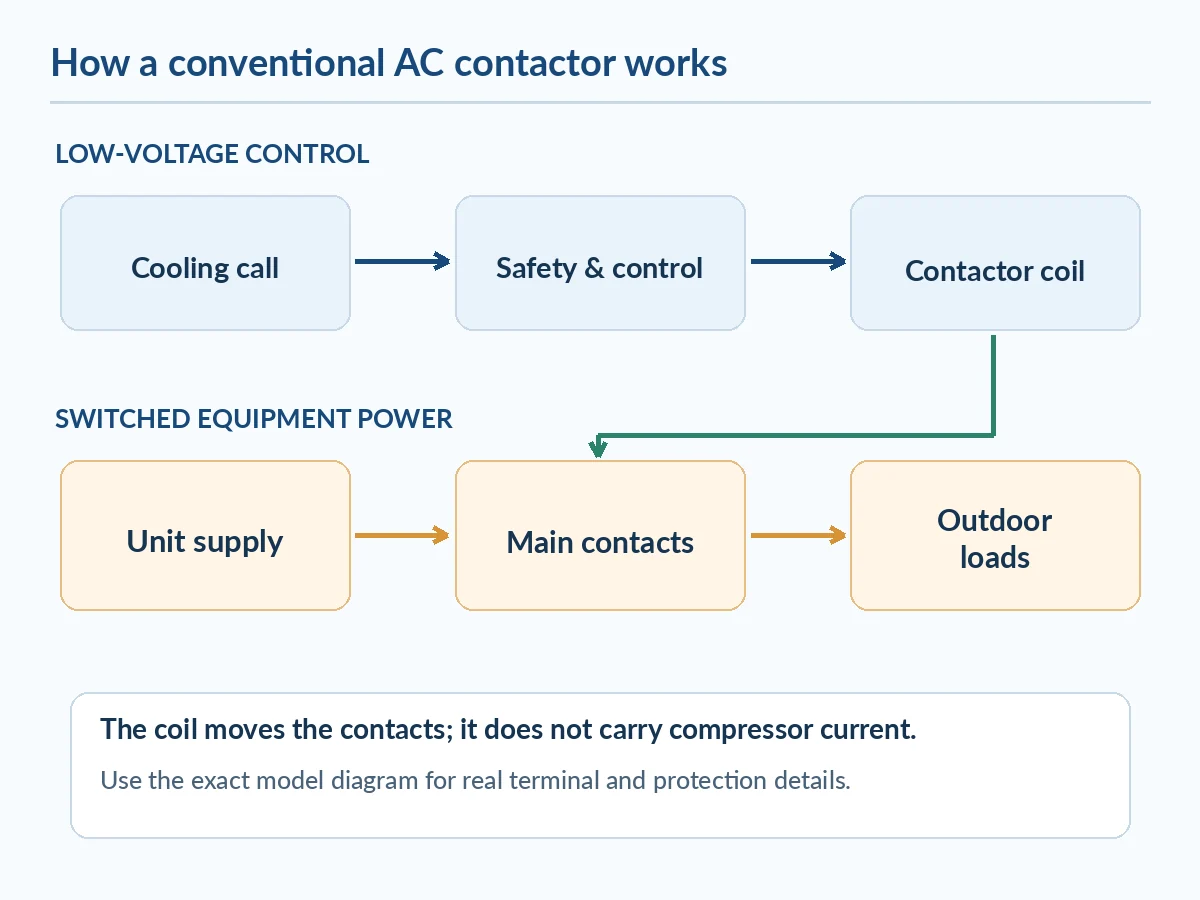
- A cooling request begins. In many conventional systems, the thermostat’s Y or Y1 circuit carries the cooling call to the equipment controls. Use the Y or Y1 labels on the equipment diagram to identify the cooling command; wire colors alone cannot identify a circuit’s function.
- The control path must be complete. A board, pressure switch, condensate safety, delay timer, or another model-specific device may prevent the contactor from being energized. The precise sequence comes from the unit’s diagram.
- The coil is energized. A compatible voltage creates a magnetic force that closes the main normally open contacts.
- Power reaches the load. The compressor and outdoor fan receive their assigned supply through the equipment’s designed circuits; the capacitor, if used, has a separate motor function.
- The call ends or a control opens. The coil drops out and the contacts open, stopping the loads controlled by that contactor.
A single click as cooling starts can be normal. Repeated chatter, loud buzzing or no pull-in during a valid call points to a control or switching problem that needs checking. A thermostat may be satisfied, a short-cycle delay may be active, or a protective control may be open.
Important inverter distinction: A variable-speed mini-split or inverter AC may use electronic control boards, relays, and an inverter power stage instead of the same contactor arrangement. Never assume that a traditional central-AC wiring sketch applies to an inverter model. Check its actual service documentation.
Where Is the Contactor, and How Is It Different from a Capacitor?
In many conventional central AC units, the contactor is inside the outdoor condenser’s electrical compartment, behind a service panel. It switches power to an assigned motor circuit, while a capacitor, where fitted, helps certain motors start or run. The contactor has a coil mechanism and power and control terminals. Its exact position varies by model; homeowners should not remove electrical covers to search for it.
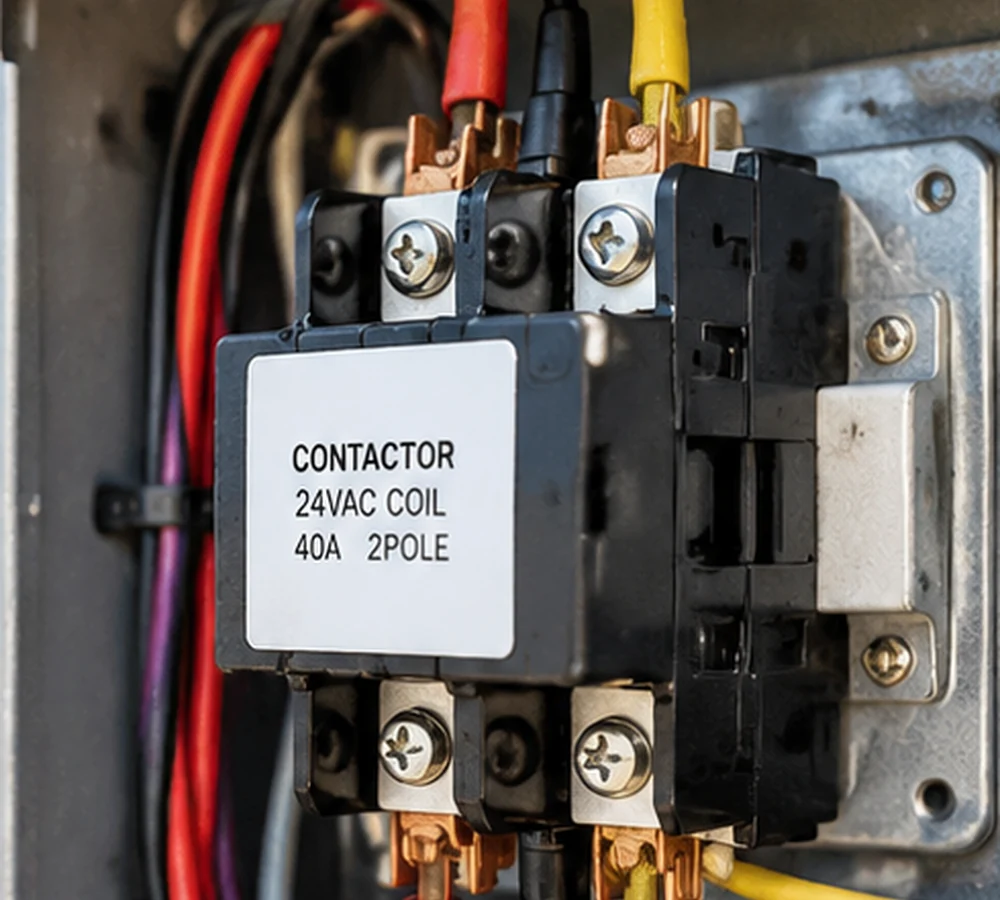
A contactor can be confused with other parts near it. They may share a compartment but do not do the same work.
| Component | Main job | What a fault may look like |
|---|---|---|
| Contactor | Switches power to an assigned compressor or fan circuit when controlled | Outdoor load does not receive power, repeated chatter, or load will not turn off |
| Run or start capacitor | Helps certain AC motors start or operate correctly | Humming motor, poor starting, overheating, or a fan that does not start |
| Control relay or control board | Routes or processes a lower-power control command | No signal reaches the contactor even though the thermostat requests cooling |
| Disconnect or breaker | Provides overcurrent protection or a means to disconnect supply | Unit has no supply power, breaker trips, or disconnect is open |
The contactor switches power; a capacitor supports the starting or running of certain motors. If the outdoor unit hums but does not start, a technician checks the motor, capacitor, supply and contactor against the unit diagram and observed symptoms.
A contactor is also not the service disconnect. Some contactor designs switch only one supply leg; other conductors may remain energized even when the contactor is open. Safe isolation requires the equipment’s proper disconnecting procedure, not a contactor that happens to be released.
What Are the Symptoms of a Bad Air Conditioner Contactor?
A bad AC contactor may leave the outdoor unit off, cause repeated clicking or chatter, or keep a controlled load running after the cooling call ends. Similar signs can come from control-signal, power-supply, or motor problems, so the next check depends on what the system is doing.
| What you notice | What it can mean | Better next action |
|---|---|---|
| Indoor fan runs but outdoor unit stays off | No cooling call reaches the outdoor unit; open safety; breaker or disconnect issue; failed coil or contacts | Check thermostat mode and setting; then have a technician trace the control and power paths |
| Repeated clicking or chattering near the outdoor unit | Unstable control voltage, loose or failing connection, control cycling, or defective contactor mechanism | Stop the system if cycling is persistent; have the control circuit checked before buying a new contactor |
| Loud buzzing at the outdoor unit | Vibrating contactor coil or mechanism, but also a motor or electrical problem | Turn off the system if buzzing is abnormal, especially with heat or odor; request service |
| Outdoor fan or compressor keeps running after cooling demand ends | Welded/stuck contacts, an ongoing call, another control fault, or a model-specific normal sequence | Use the system control to stop it; if it does not stop, isolate it using a safe accessible disconnect and arrange service |
| Burn marks or overheated electrical smell | Damaged contact, terminal, wire, or another electrical part | Stop operation, do not touch the compartment, and call a qualified professional |
| Outdoor unit starts inconsistently | Contactor wear, loose connections, time delay, capacitor, or motor issue | Record the pattern and any displayed fault code; verify causes rather than replacing on symptoms alone |
If your main symptom is simply that the AC is not cooling, start with our air conditioner not cooling troubleshooting guide. This article focuses on whether the contactor or its control circuit is involved.
Burning smells, smoke, repeated breaker trips, or visibly damaged wiring are stop-use signs. Keep clear of the electrical enclosure and use a qualified HVAC/electrical professional. Do not hold a contactor closed by hand or bypass its control circuit to make the unit run.
How Should an Air Conditioner Contactor Be Tested?
A proper contactor test first asks whether the contactor was supposed to close, then whether it received the right control signal, and finally whether its power contacts and connected load behaved as designed. A low-voltage signal problem and a failed contactor require different repairs.
| Observed state | What it suggests | Next professional check |
|---|---|---|
| No click during an expected cooling call | The coil may lack a valid command, or the coil/mechanism may have failed. | Confirm the actual cooling request, specified coil signal, control return and safety path. |
| A click, but outdoor loads stay off | A click does not prove that all power contacts carry the required supply or that the motors are sound. | Check supply, each switched path, terminals, and downstream capacitor or motor as applicable. |
| Rapid repeated chatter | The control supply or mechanism may be unstable. | Check the commanded coil voltage under the event and inspect related connections. |
| Outdoor equipment continues after the call ends | The controls may still be calling, or contacts may be stuck closed. | Distinguish a continuing control command from welded or stuck contacts before replacing anything. |
The table helps you describe the symptom to a technician. Checking coil voltage and switched power requires the equipment diagram, proper isolation and professional electrical test procedures.
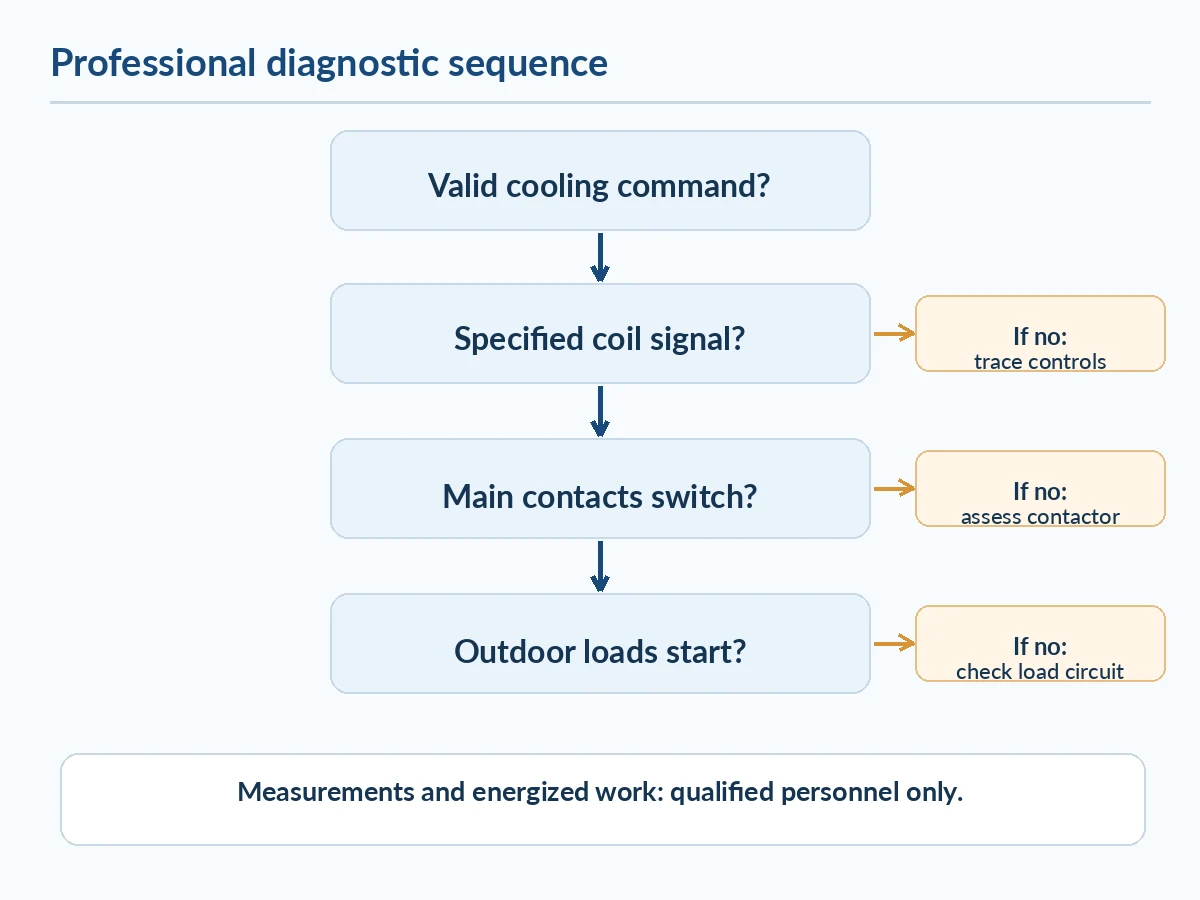
What you can check without opening the unit
Confirm the thermostat is in cooling mode, the requested temperature is below room temperature, and any thermostat or system fault message is recorded. Check whether the outdoor unit is running, whether the indoor blower works, and whether a breaker has tripped. You may visually inspect the exterior for blocked airflow or obvious damage, but do not remove the electrical cover or reset a breaker repeatedly. A brief built-in restart delay can be normal.
What a qualified technician checks
A qualified technician verifies the cooling command, the specified coil signal, the contactor’s switched power paths, and the connected compressor or fan circuit. The technician also investigates failed contacts or unstable control supply using the unit’s wiring diagram and approved electrical procedures. Live-voltage tests, continuity checks, and handling stored capacitor energy require trained personnel.
- Is there a valid cooling command? Verify that the thermostat and equipment controls actually request the outdoor unit. If not, inspect the thermostat setting, delay, safety switches, board outputs, and wiring before condemning the contactor.
- Does a stable, correct control signal reach the actual coil terminals? A technician checks the model-specified voltage across the coil terminals during a valid cooling request, following the manufacturer’s procedure. A reading from one wire to cabinet ground, or from a wire with no connected load, does not by itself prove that the coil has a complete, stable supply. If the signal drops when the coil is connected, examine the control return, safety devices, transformer, and wiring before blaming the contactor.
- Do the main contacts carry power correctly when commanded? Contacts that fail to close, carry excessive voltage drop, overheat, or remain welded shut can justify replacement after the surrounding connections are assessed.
- Does the downstream equipment start normally? A correctly closing contactor does not prove the capacitor, compressor, outdoor fan, or supply is healthy. Those parts need their own checks.
- What caused the problem? A loose terminal, unsuitable part, unstable supply, or failing load can damage a replacement again. Correct the contributing condition before closing the job.
Example A — missing coil command: Suppose the outdoor unit stays off after its normal restart delay. A qualified technician finds that the required coil signal is missing during a cooling request. The next step is to trace the control circuit and safety devices, not to order a new contactor.
Example B — coil pulls in but a power path fails: Suppose the mechanism closes, yet a controlled load does not receive the required supply. The technician checks the separate switched paths, terminals, and downstream load, then confirms the failed part and any overheating cause before replacing it.
Compare coil readings with the specified contactor’s data and the required test conditions. Then check whether the commanded power contacts switch the assigned load. A normal coil reading can still leave worn contacts undetected; open contacts may also be normal when cooling is not requested.
What Does an AC Contactor Wiring Diagram Show?
A contactor wiring diagram separates the control-coil circuit from the line-voltage circuit and shows which contacts close when the coil is energized. Use the diagram for your exact unit to identify the coil circuit, supply lines and switched loads before any service work.
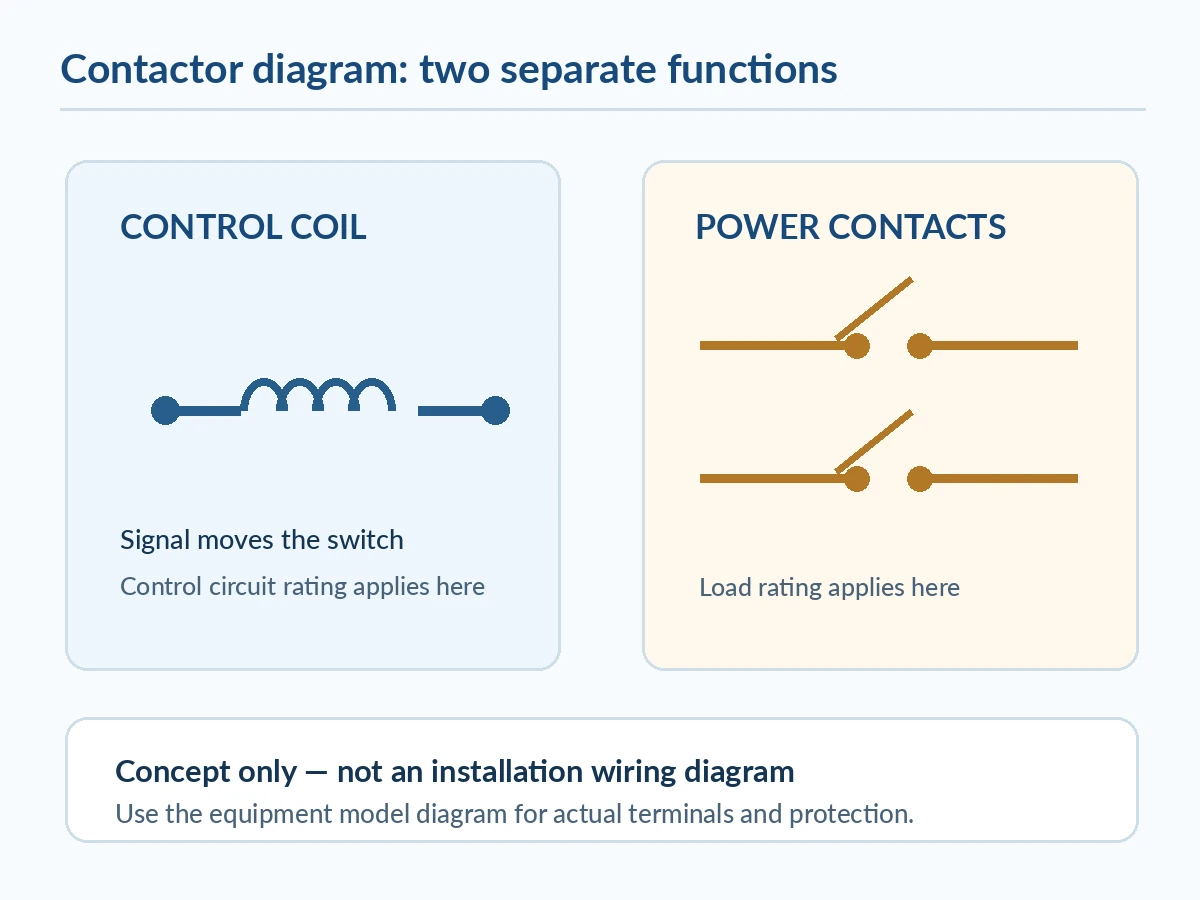
For a traditional, normally open contactor, read the diagram as two related paths:
- Control path: thermostat or controller command → required safety/logic devices → contactor coil → intended control return.
- Power path: equipment supply and approved protection → switching contacts → the assigned outdoor electrical load.
In a system with a 24VAC control circuit, the coil may be marked for 24VAC while its main contacts have separate, much higher voltage and current ratings. Do not connect a coil according to a contact rating, and never assume wire color proves function. A one-pole design may leave another line energized when it is open. The service diagram, terminal labels, and exact equipment configuration determine every actual connection.
A two-pole part is not an automatic upgrade for a single-pole part. Some equipment uses a shunted or continuously connected path for an additional circuit, such as a crankcase heater that warms compressor oil when needed. Changing which supply path opens can change when that heater works. The technician must use the exact equipment schematic and an approved replacement; moving each wire to a similar-looking terminal is not a reliable method.
If a wiring diagram on the access panel is missing or illegible, obtain the exact equipment manual before service. For ordinary homeowners, the useful part of this diagram is understanding why “24-volt signal present” and “power delivered to the compressor” are different questions. Physical wiring and energized testing belong to a qualified technician.
How Do You Choose the Right Replacement Contactor?
Choose an AC contactor that matches the equipment’s specified coil voltage, pole and contact arrangement, motor-duty ratings, terminals, and mounting requirements. Start with the exact OEM replacement or a manufacturer-documented equivalent rather than a similar-looking part with the same advertised amp number.
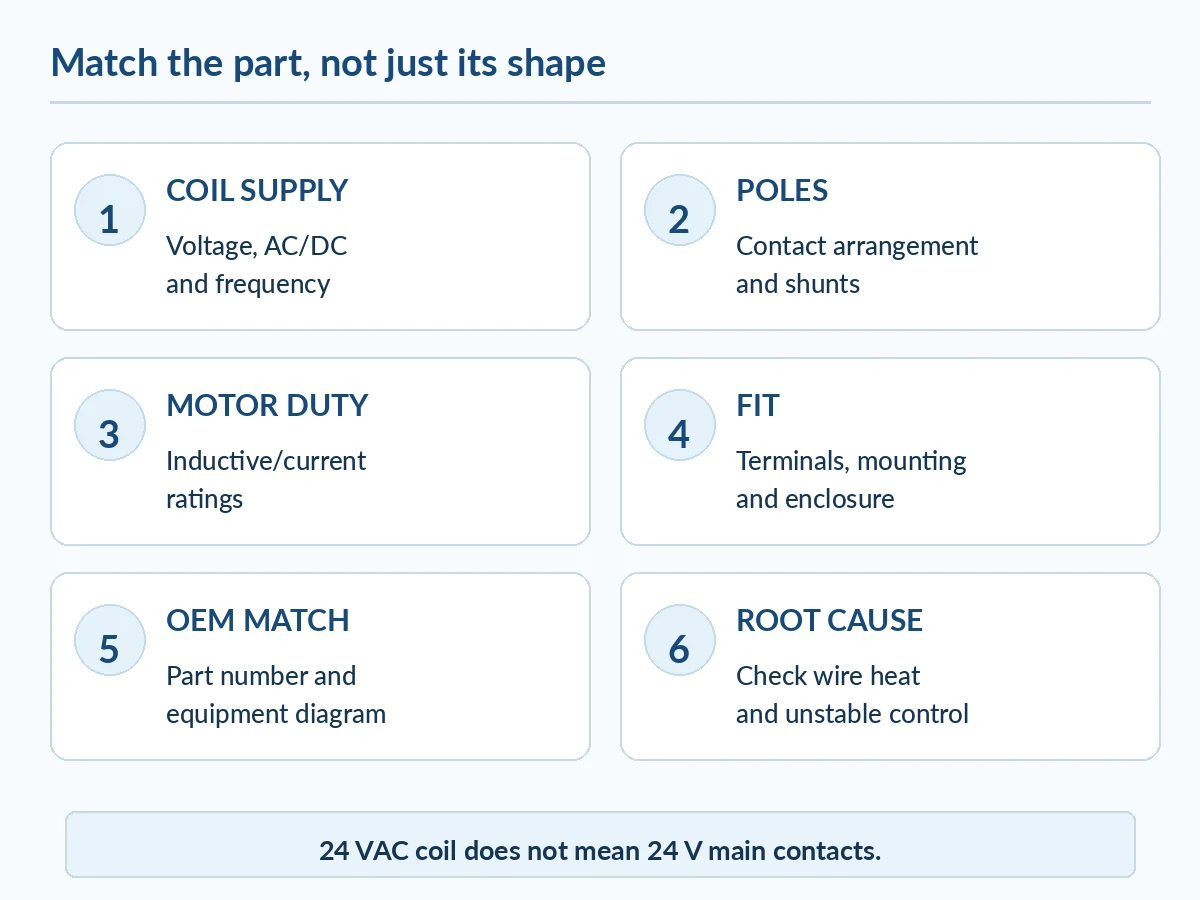
| What to match | Why it changes the decision | What to check |
|---|---|---|
| Coil voltage, AC/DC, and frequency | An incompatible coil may not operate correctly or may fail | Coil marking and manufacturer’s control-circuit requirement |
| Contact arrangement and pole count | One-pole, two-pole, shunted and auxiliary arrangements do not all switch the same paths; a heater or other added circuit may be affected. | Original wiring diagram, exact approved part, and any auxiliary or heater connections |
| Motor-duty current and electrical ratings | A compressor has starting and running loads; resistive and motor ratings are not interchangeable | Applicable motor-duty/inductive ratings, equipment load, and OEM requirements |
| Main-contact and auxiliary-contact configuration | Extra contacts or a different normal state can change controls | Original electrical design and normally open/closed functions |
| Terminal type, mounting, and enclosure fit | Incorrect fit or terminal connection can cause loose, hot, or strained wiring | Part number, mounting dimensions, wire/terminal specifications |
| Service conditions | Temperature, vibration, and enclosure conditions affect suitability | Manufacturer application guidance and site requirements |
For example, Eaton lists the C25CNB130T definite-purpose contactor with separate ratings for its 24VAC coil, pole arrangement, inductive load and resistive load.
| Eaton C25CNB130T specification | Published value | Why it matters |
|---|---|---|
| Coil power | 24 VAC, 50/60 Hz | Controls the coil; not the motor power rating |
| Contact arrangement | Single-pole with shunt | Not automatically equivalent to a two-pole contactor |
| Inductive full-load rating | 30 A | Applies to the published inductive-load condition |
| Resistive load rating | 40 A | Applies to a different kind of load, not every 40 A motor |
The 30 A and 40 A values are not interchangeable. They refer to different load duties on that one Eaton model. The correct part must meet the actual equipment and motor-start requirements as well as the coil supply, contact layout, terminals, and mounting. Schneider Electric’s contactor selection guidance also treats these as separate checks. Choose the replacement from the unit’s part specification, matching the coil voltage, poles, motor-load rating and terminal arrangement—not the AC tonnage or the largest amp value in a listing.
Record the full AC outdoor-unit model, original contactor number and markings, a clear nameplate image, and the wiring diagram. If the original part has been altered, trace the approved equipment documentation rather than copying an unknown previous repair.
How Is an Air Conditioner Contactor Replaced?
A qualified technician replaces a failed contactor by confirming the fault and approved part, isolating the equipment and stored energy, recording the original connections, fitting the specified replacement, and testing a complete start-and-stop cycle. This is electrical service inside the condenser and requires trained personnel and the model’s approved procedure.
The technician verifies that the equipment is de-energized before touching conductors, checks terminal torque and wire condition against the manufacturer’s requirements, and restores guards and covers before restarting the unit. Any damaged connection or cause of repeated chatter should also be corrected to protect the replacement.
What should be verified after replacement?
The repair is complete only when the system starts, runs, and stops correctly under a normal cooling call. The technician checks the contactor’s operation, compressor and outdoor-fan response, supply and connection condition, protective operation, and whether any initial fault remains. A contactor that failed after repeated chatter or overheating also needs a root-cause check.
Electrical safety rules such as OSHA 29 CFR 1910.333 set requirements for relevant US workplace electrical work. Local rules and equipment instructions govern the actual installation. Homeowners should not push the contactor in with an object, jumper terminals, or probe live electrical connections.
How Much Does Air Conditioner Contactor Replacement Cost?
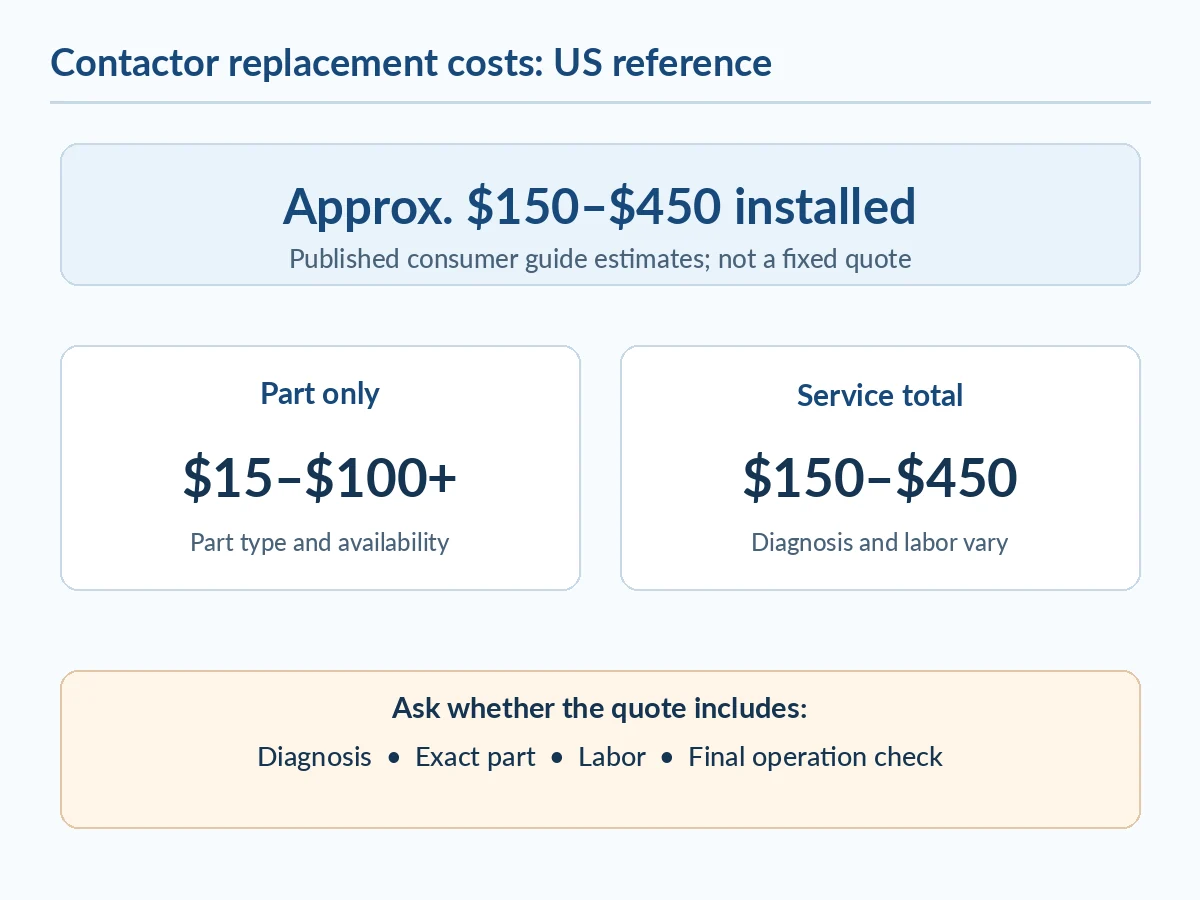
For U.S. residential AC repairs, published installed contactor replacement prices commonly fall around $150–$450. Your written quote will vary with the local service rate, the exact contactor, diagnosis and any additional electrical repairs.
| Cost item | Illustrative US range | What changes it |
|---|---|---|
| Replacement contactor itself | Roughly $15–$100+ | OEM vs compatible model, poles, coil, motor-duty rating, distributor availability |
| Total professional replacement | Roughly $150–$450 | Service visit, diagnosis, labor, area rates, access and additional damaged parts |
| Extra diagnostic work or electrical repair | Not included in every advertised price | Whether the thermostat, controls, capacitor, terminal, or motor also needs work |
The reference sources are HomeGuide’s residential contactor cost guide (published February 11, 2025) and PickHVAC’s October 7, 2026 pricing guide. Actual local rates may fall outside the ranges.
Before accepting a written repair estimate, ask:
- Is the diagnostic or trip charge already included in the installed total, credited toward repair, or billed separately?
- Is the proposed contactor the original equipment part or a documented compatible replacement for this exact unit?
- Does the price cover burned terminals, wiring or another damaged part, or will those require a separate approval before work continues?
- Does the quote include final start/stop and safety-control checks, and what part or labor warranty applies?
If the compressor, control board, or wiring also needs repair, the job is no longer a simple contactor-only replacement. An installed price may already include the part, visit and labor. Read the written quote before adding separate charges so you do not count the same service twice. Outside the United States, ask for a local written estimate rather than converting US labor rates directly.
When Is Replacing the Contactor the Wrong Fix?
Replacing the contactor is the wrong fix when it lacks a valid cooling command, when the control supply is unstable, or when the contactor switches correctly but the compressor, fan, or another component has failed. The repair should address the actual faulty part of the control or power circuit.
- No cooling command or coil signal: look toward thermostat settings, cooling-delay logic, wiring, control board output, or open safety switches. A healthy contactor cannot close without the command it requires.
- Contactor closes but compressor hums or does not run: inspect the capacitor where used, supply, compressor protection, motor circuit, and the compressor itself. The contactor may be functioning normally. For a broader explanation of motor designs and inverter differences, see our HVAC compressor types guide.
- Frequent chatter: investigate control-supply stability and connections before replacing the part. A fresh contactor may chatter too if the signal is unstable.
- Breaker trips repeatedly: stop resetting it. A short, motor problem, or wiring fault may be present and needs qualified diagnosis.
- An inverter AC has an error code or will not start: follow its own power board, drive, safety, and service diagnostics. It may not use a traditional external contactor to switch the compressor in the way described above.
For a fault in your Airproz unit, send us the full outdoor-unit model, a readable nameplate photo taken without opening an electrical enclosure, any displayed fault code, and the original part number or service diagram if safely available. Use our contact page so we can help identify the applicable equipment information. For on-site electrical testing or repair, use a qualified local HVAC technician.
Bottom line: An air conditioner contactor is the controlled power switch in many conventional AC outdoor units. If cooling fails or the unit chatters, first establish whether the coil was commanded, whether the contacts switch correctly, and whether the motor circuit is healthy. Match a replacement to the exact equipment specifications, and leave energized electrical diagnosis and replacement to a qualified professional.
Frequently Asked Questions
Why is my air conditioner contactor buzzing?
Buzzing can come from a vibrating contactor coil or mechanism, but it can also reflect unstable control voltage or another motor or electrical problem. A quiet click can be normal; persistent loud buzzing or chatter needs service. Stop using the unit if you notice heat, burning smells, or repeated cycling. The cause should be verified before the contactor is replaced.
Can a bad AC contactor make the outdoor fan or compressor run continuously?
Yes. Welded or stuck contacts can keep an assigned load running after the cooling call ends, but a continuing control signal can cause a similar symptom. If the unit will not stop normally, arrange a safe shutdown and professional service.
Why is my AC contactor not pulling in?
The coil may not be receiving its required control signal, or the coil or mechanism may be defective. Thermostat settings, built-in delays, an open safety device, a wiring issue, or a control-board problem can prevent a valid command. A technician checks the specified signal and circuit before deciding whether the contactor itself needs replacement.
Are 24V, 30A, and 40A AC contactors interchangeable?
No. A 24VAC marking describes coil supply, while a 30A or 40A marking describes a specified contact-load rating; they are different ratings and do not establish compatibility. Pole count, motor-duty classification, terminals, and manufacturer requirements must also match. Use the exact approved replacement or a documented equivalent.
Can you test a contactor with a multimeter?
A qualified technician can use appropriate measurements to check the command, coil, and switching contacts. A meter test must follow the model’s electrical diagram, isolation steps, and safety requirements. A continuity reading taken without knowing the contact state does not prove the part is good. Homeowners should not carry out live cabinet tests.
Does a clicking AC contactor mean it is working?
Not always. A click suggests the mechanism moved, but it does not prove that the power contacts carry the required supply or that the outdoor motor works. If the outdoor unit still will not run, a qualified technician should check the control signal, switched power paths, and downstream components.
Is an AC contactor the same as a capacitor or relay?
No. A contactor switches an electrical load, a capacitor supports certain motor functions, and a relay is another type of electrically operated switch with its own ratings and intended use. Parts must be identified by the exact circuit and manufacturer specification when ordering replacements.
Does every central air conditioner or inverter mini-split have a contactor?
No. Many conventional central air conditioners use a contactor, while some inverter mini-splits switch or control power through boards, relays, and drive electronics instead. Check the exact model diagram to identify its switching components.
How long does an air conditioner contactor last?
An air conditioner contactor has no single fixed service life or universal age-based replacement interval. How long it lasts depends on switching frequency, electrical load, heat, vibration, contact condition, and control-signal stability. Replace it when a qualified inspection or test confirms faulty switching, coil trouble, or unsafe contact damage.