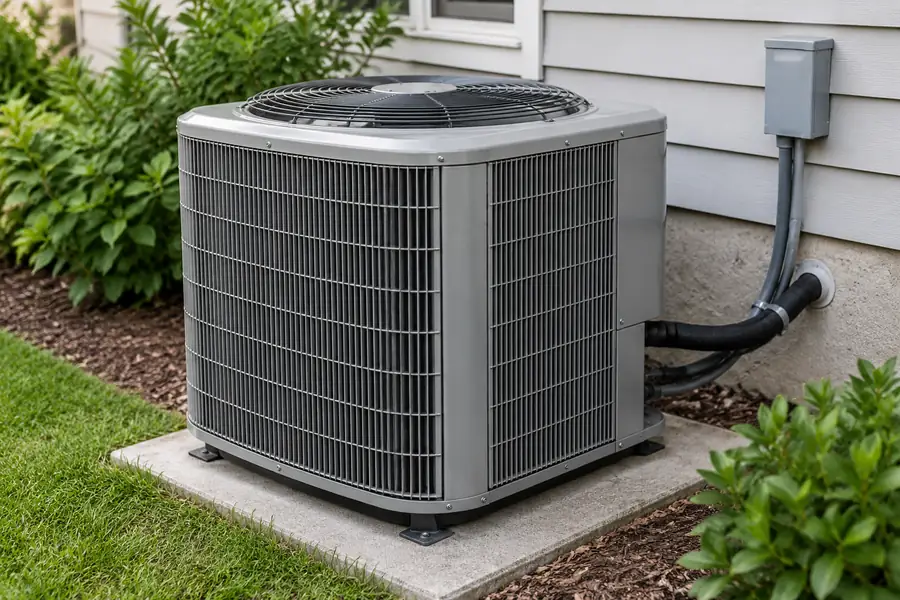
A heat pump has four main refrigeration components: an evaporator, a compressor, a condenser, and an expansion device. Together, they move heat from a cooler place to a warmer one. A complete heat pump system also needs refrigerant lines, controls, and a way to collect and deliver heat. Reversible models commonly add a reversing valve, while air-to-water and ground-source systems need different water-side equipment.
If you are identifying parts in a real unit, start by separating the four refrigeration functions from the other parts that make the complete system work. The same physical coil can serve as the evaporator in one mode and the condenser in another.
What Are the Four Main Components of a Heat Pump?
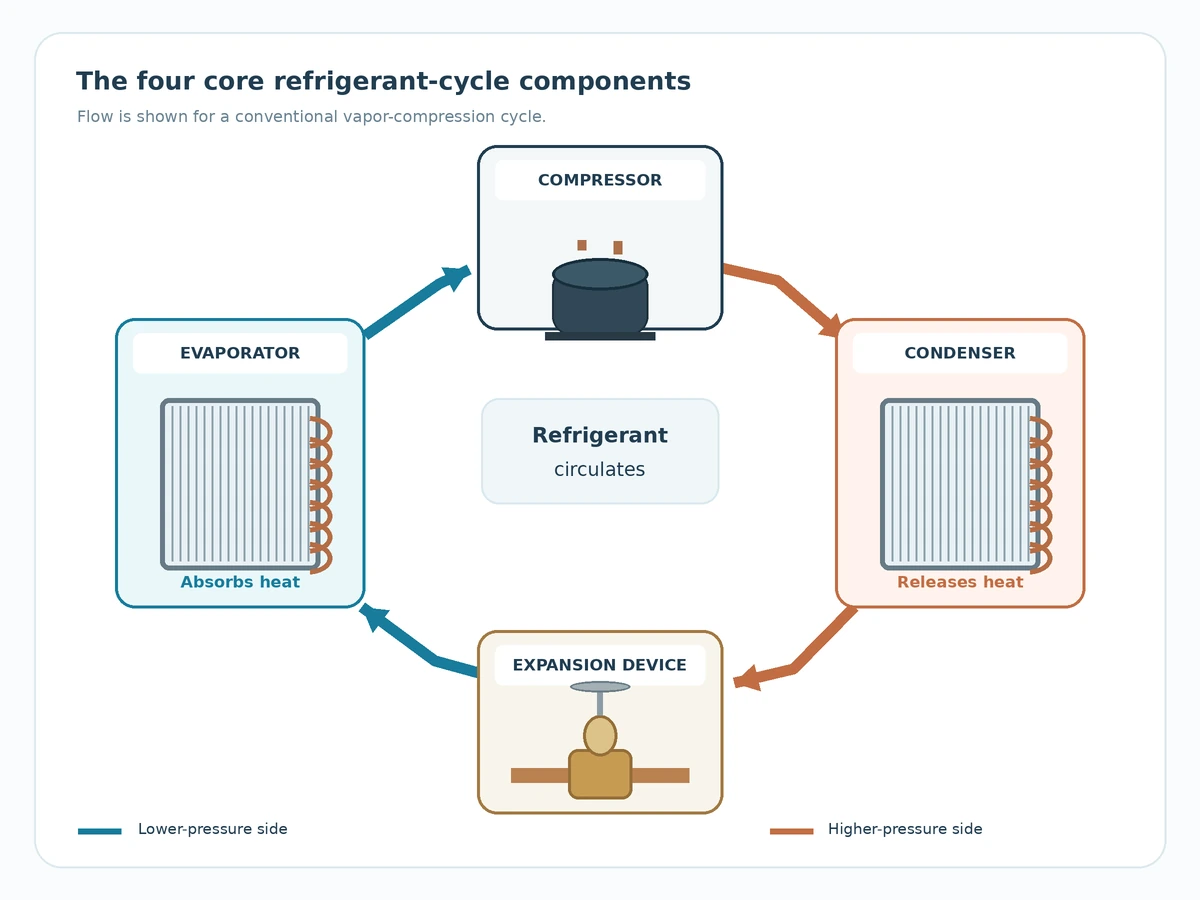
The four core components are the evaporator, compressor, condenser, and expansion device. These are the main functional parts of the vapor-compression cycle used by most electric building heat pumps. The heat exchangers may be labeled by their heating or cooling duty instead of being permanently called an evaporator or condenser.
| Main component | What it does | What happens to the refrigerant | What to look for |
|---|---|---|---|
| Evaporator | Takes heat from the source | Low-pressure refrigerant absorbs heat and evaporates | The heat exchanger absorbing heat in the current mode |
| Compressor | Raises pressure and temperature | Low-pressure vapor becomes hot, higher-pressure vapor | Sealed compressor assembly and suction/discharge connections |
| Condenser | Delivers heat to the destination | Hot refrigerant rejects heat and condenses | The heat exchanger releasing heat in the current mode |
| Expansion device | Lowers pressure and meters flow | Higher-pressure liquid passes to a lower-pressure mixture | Metering valve or other expansion device before evaporation |
Think of it as a loop: evaporation → compression → condensation → expansion → evaporation again. Refrigerant is the working fluid inside that sealed loop; it is not itself one of the four hardware parts. The Air-Conditioning, Heating, and Refrigeration Institute (AHRI) explains the same heat-moving process for air-source equipment.
Evaporator: where the heat enters
The evaporator absorbs heat into the refrigerant. In heating mode on an air-source heat pump, this is usually the outdoor coil. Outdoor air passes over the coil, and refrigerant inside it boils at a lower temperature than the surrounding air. That allows heat to enter the circuit even when the outdoor air feels cold.
For an air-to-water unit, this component may be an air-to-refrigerant coil; for a ground-source unit, the source-side heat exchanger may take heat from circulating ground-loop fluid instead. A blocked air coil or insufficient source flow reduces how much heat can enter the system. The component name alone does not tell you its installed location.
Compressor: where pressure and temperature rise
The compressor draws in refrigerant vapor and discharges it at a higher pressure and temperature. This is how the heat pump can deliver heat at a temperature useful to the building. Many current systems use scroll, rotary, or other compressor designs; inverter-driven designs can vary motor speed within their operating limits.
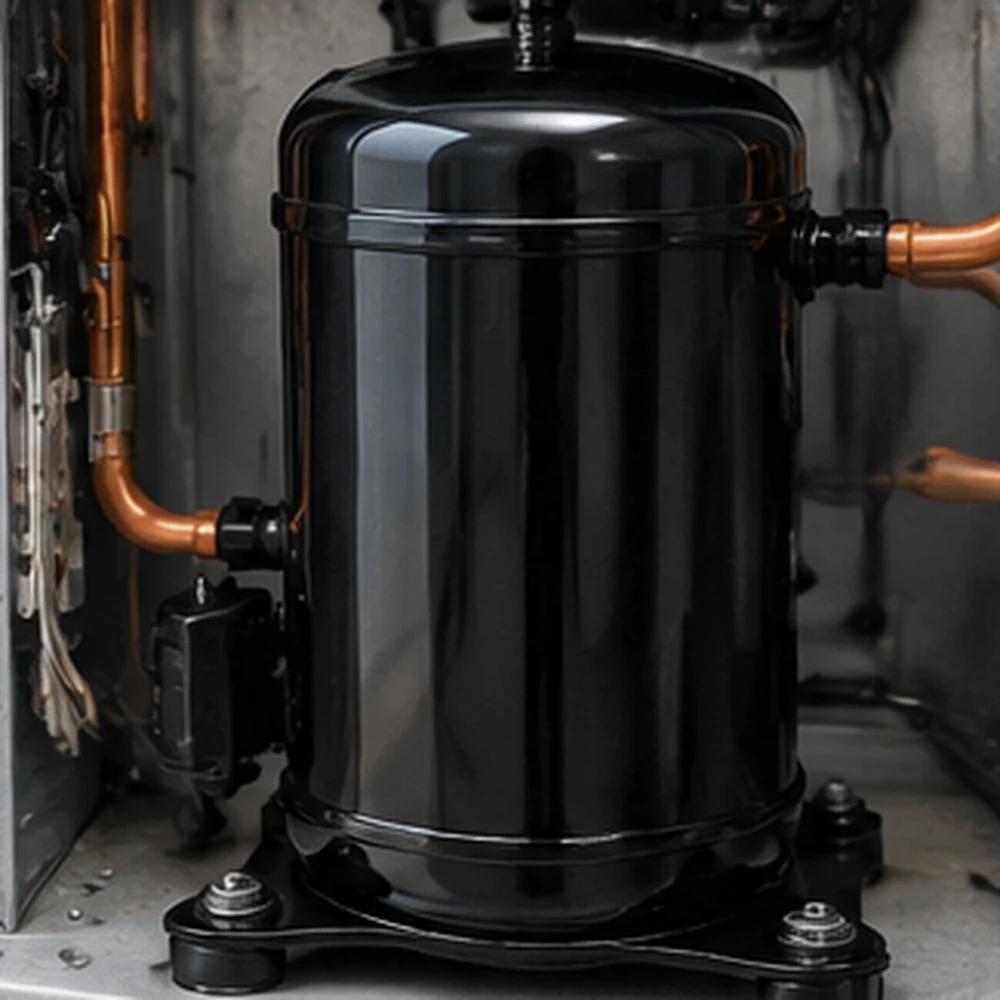
Do not judge compressor quality only by its name or whether it is variable speed. Its suitable operating range, refrigerant, required temperature lift, system matching, and actual performance data all matter. The compressor needs vapor at its inlet, not uncontrolled liquid refrigerant.
For the differences between rotary, scroll, reciprocating, screw, and centrifugal designs, see our HVAC compressor types guide.
Condenser: where useful heat leaves
The condenser transfers refrigerant heat into the air or water being heated. As hot vapor gives up heat, it condenses toward liquid. In space-heating mode, the condenser is usually the building-side heat exchanger. In an air-to-water heat pump, a refrigerant-to-water exchanger transfers heat to a separate heating-water circuit; refrigerant and water do not mix.
If you need to compare finned air coils with refrigerant-to-water plate exchangers, our guide to types of heat exchangers explains the different constructions and what they need to handle.
In cooling mode on a reversible air-source system, the outdoor coil becomes the condenser. This is why it is misleading to call every outdoor coil a “condenser” regardless of the current mode.
Expansion device: where pressure falls
An expansion valve or other metering device lowers the refrigerant pressure before evaporation. The lower pressure lets the refrigerant boil at a suitable source-side temperature. A thermostatic expansion valve (TXV), electronic expansion valve (EEV), or another metering arrangement may be used, depending on the design.
The device does not simply “make cold.” It creates a pressure drop and controls the refrigerant feed as part of the full cycle. Reversible systems may use different metering paths, check valves, or bidirectional arrangements. Consult the correct model schematic rather than assuming every unit has one valve in the same position.
What Other Components Make a Heat Pump System Work?
Four components explain the refrigeration cycle, but not the complete HVAC system. Fans or pumps move air or water across heat exchangers. Refrigerant lines join the sealed circuit. Sensors, electrical controls, and protective devices coordinate safe operation. Not every heat pump uses every component listed below.
| Other component | Main job | When it matters |
|---|---|---|
| Reversing valve | Reroutes refrigerant between heating and cooling modes | Conventional reversible heat pumps and many defrost arrangements |
| Indoor blower and outdoor fan | Move air across coils | Air-to-air systems and air-source outdoor units |
| Water circulation pump | Moves heating water or ground-loop fluid through its heat exchanger and piping | Water-based heating and source-loop systems; pump location and supply scope depend on model and design |
| Refrigerant lines and insulation | Connect parts of the sealed refrigerant circuit | Especially split systems with refrigerant connections between units |
| Control board and thermostat | Read heating/cooling requests and command components | Nearly all electrically controlled systems; exact logic varies |
| Temperature and pressure sensors | Provide readings for controls and protection | Operation, monitoring, metering, and defrost |
| Accumulator and filter-drier | Help protect refrigerant-circuit operation where fitted | Design-specific; they are not universal on every model |
| Condensate pan and drain | Remove water condensed from indoor air | Cooling or dehumidifying air-side systems |
| Auxiliary heat | Adds heating when the design calls for it | Some air handlers or hybrid systems; not a standard part of every unit |
These are system components, not necessarily parts included with the outdoor unit. Check whether the circulation pump, expansion vessel, controller, and any buffer tank are factory-installed, separately supplied, or installer-supplied. The exact arrangement depends on the selected system.
Why a reversing valve matters
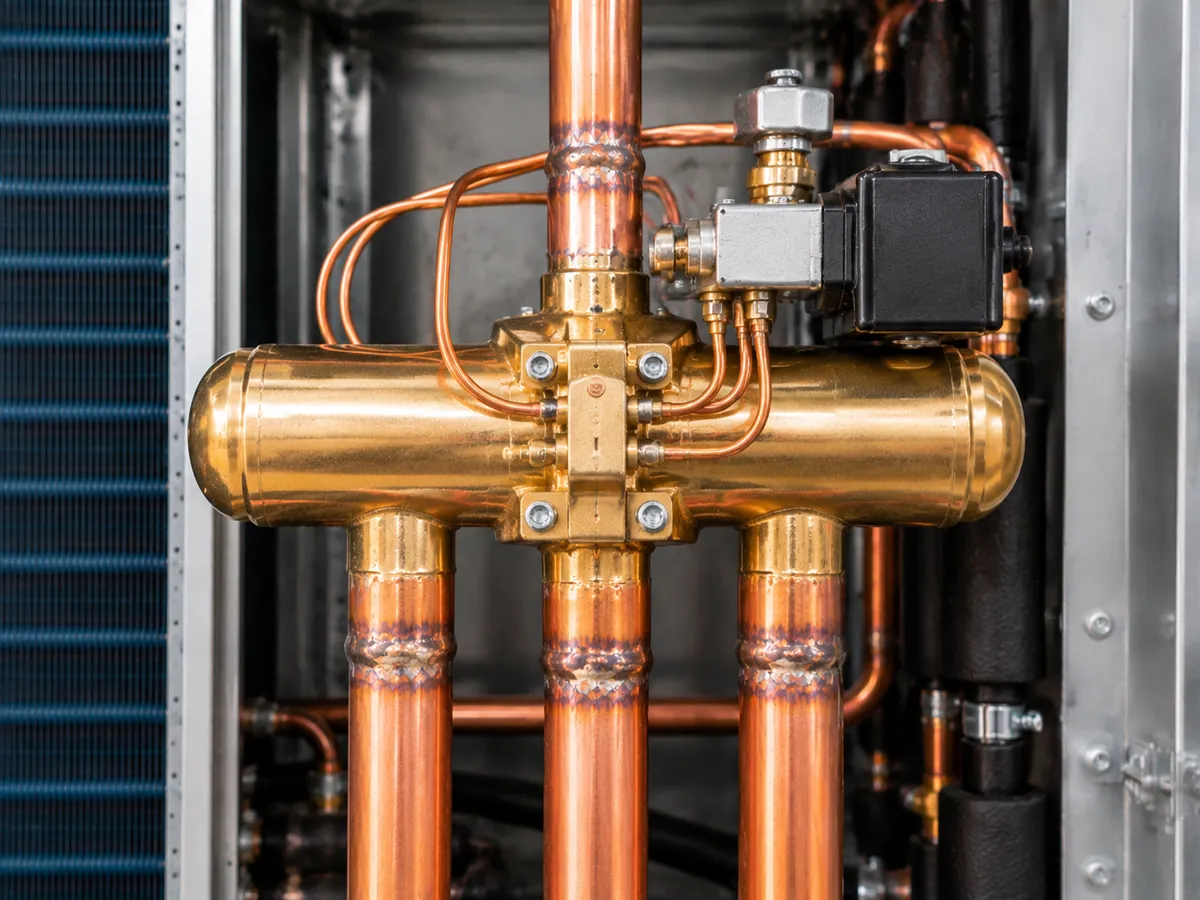
The reversing valve changes which coil receives hot compressor discharge gas. In a conventional reversible air-to-air heat pump, that lets the system heat indoors in winter and cool indoors in summer. It also allows many air-source designs to run a defrost cycle that warms the outdoor coil. The ASHRAE heat pump handbook describes the reversing valve used to switch heating and cooling roles; the installed arrangement still depends on the model.
A reversing valve is not one of the basic four vapor-compression functions. A heating-only appliance or another heat pump configuration may not use one. The thermostat’s energize-in-heating versus energize-in-cooling signal is model-specific; never guess a valve wiring connection from the word “heat pump.”
Fans, pumps, sensors, and defrost controls
Air-side fans transfer heat only when the correct air can reach the coils. An indoor blower moves conditioned air through rooms or ducts. An outdoor fan moves outdoor air across the source or rejection coil. An air-to-water heat pump instead needs suitable circulation on the building-water side; it may not have an indoor air blower at all.
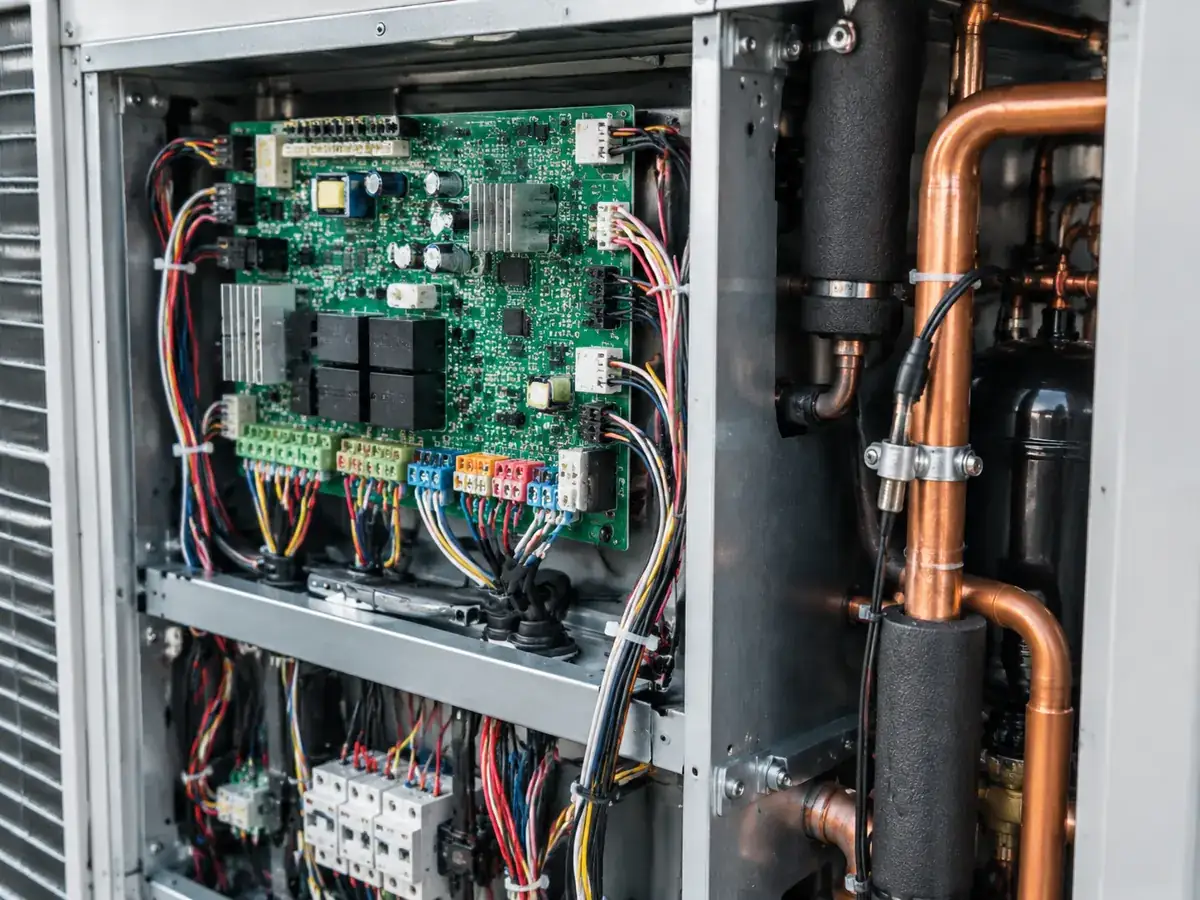
Controls use temperature, pressure, and other signals to manage compressor output, fans, pumps, and operating modes. In cold, damp weather an outdoor coil may frost during heating. Many systems temporarily change operation to melt frost. A short defrost event may be normal; persistent heavy ice needs investigation, not automatic refrigerant charging. Exact defrost sensors and sequence depend on the equipment.
Where Are Heat Pump Components Located?
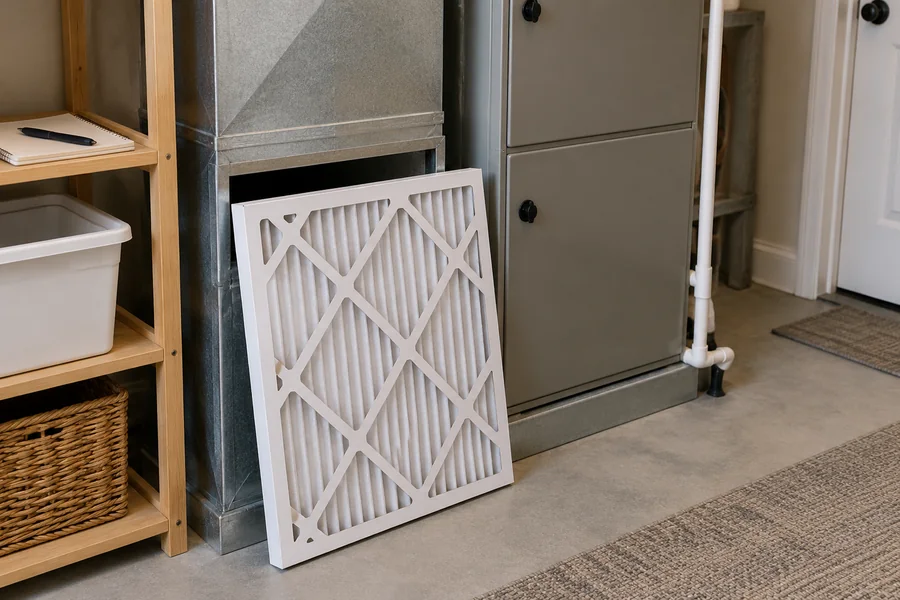
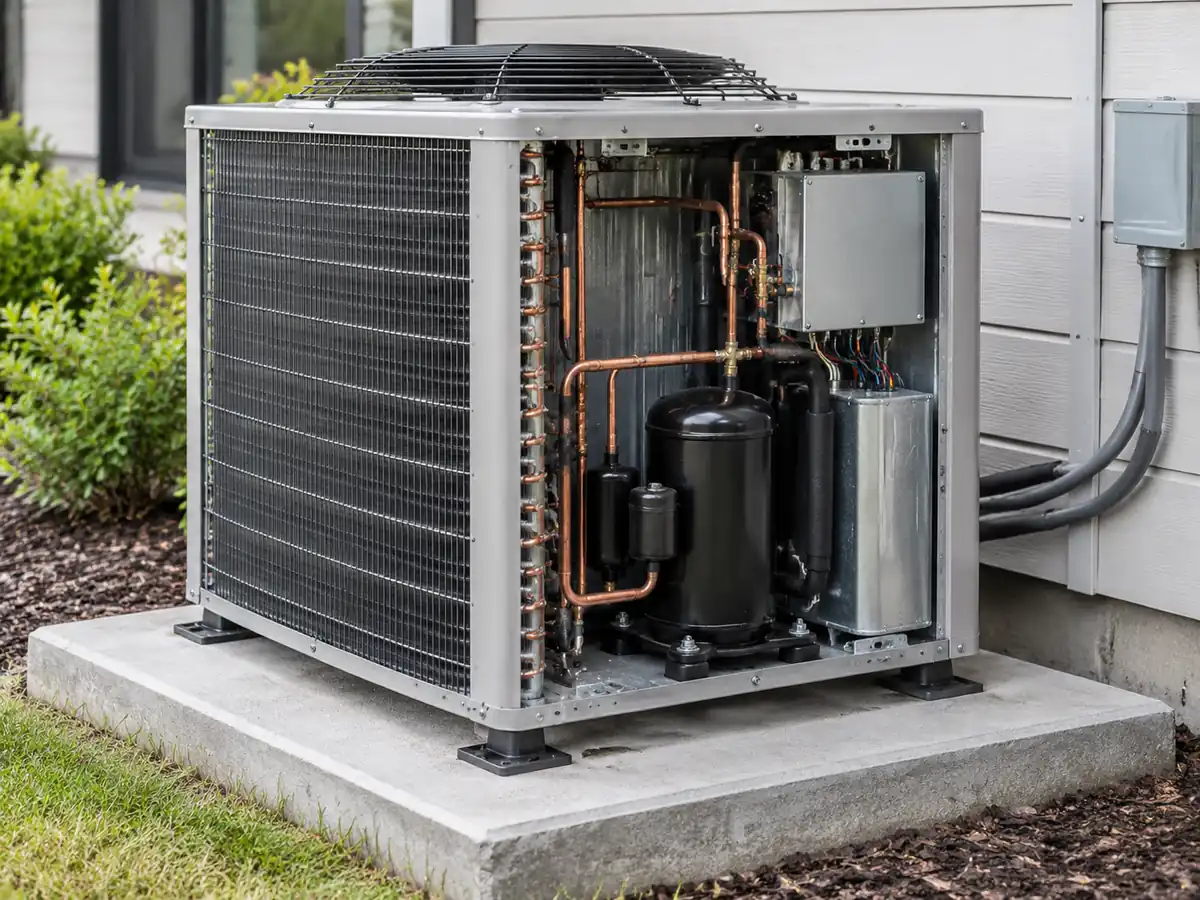
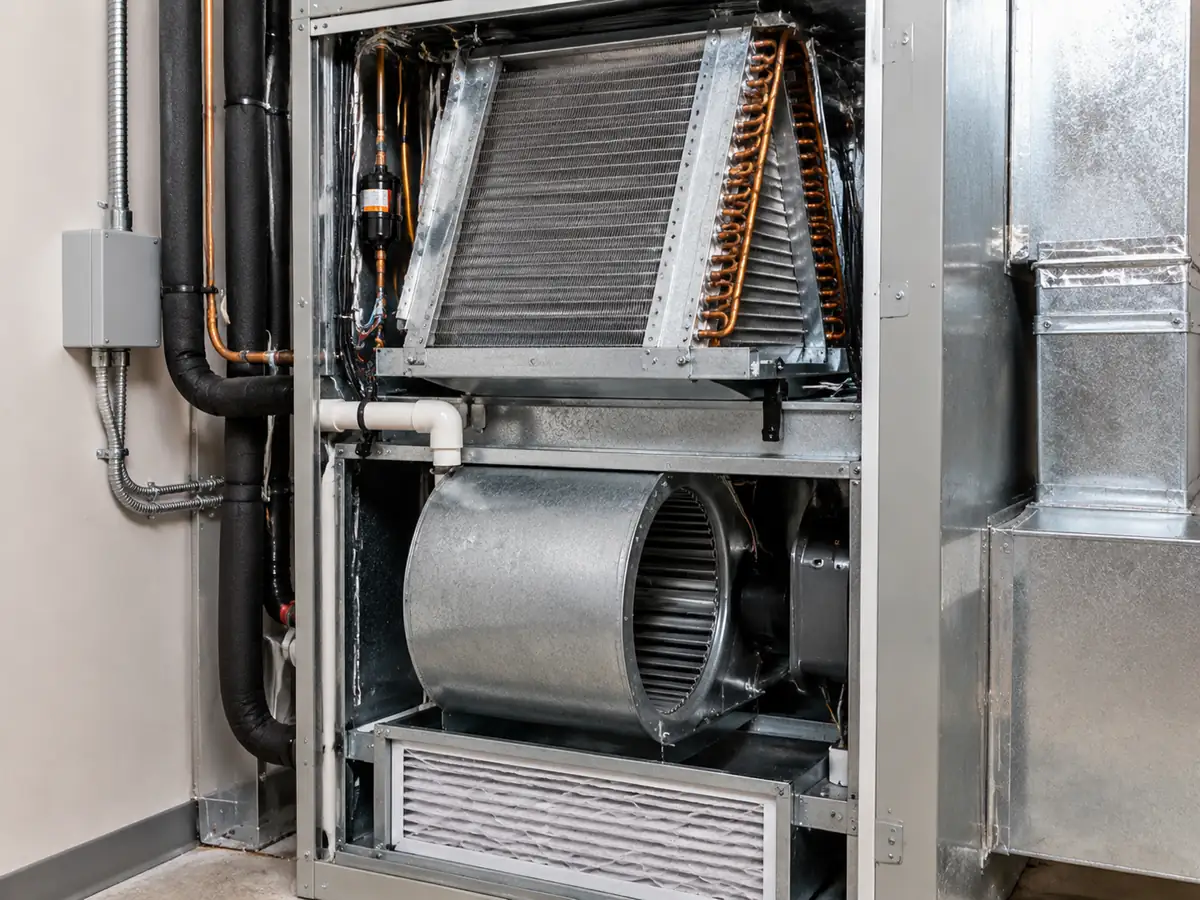
Look at the system layout, not only the part name. In a conventional split air-to-air heat pump, the outdoor unit commonly contains the compressor, outdoor coil, outdoor fan, reversing valve, and controls. The indoor air handler contains an air coil, blower, filter, and condensate equipment. Refrigerant lines and control wiring connect the sections.
| System arrangement | Usually outdoors or at the heat source | Usually indoors or at the heat destination | What to confirm |
|---|---|---|---|
| Ducted split air-to-air | Compressor, outdoor coil/fan, mode controls | Air-handler coil, blower, filter, ducts | Confirm approved indoor/outdoor pairing, refrigerant line-set limits, and control wiring. |
| Ductless mini-split | Outdoor refrigeration section and fan | One or more indoor heads with coil and fan | Confirm compatible indoor heads, permitted line lengths, and electrical/control connections. |
| Packaged air-to-air | Most refrigeration and air-moving equipment in one cabinet | Supply/return connections or distribution | Confirm supply/return air connections, airflow, and installation clearance for the packaged cabinet. |
| Air-to-water monobloc | Refrigeration equipment and outdoor air exchanger; water ports | Pumps, emitters, valves, and possibly tanks | Confirm water-side connections, required flow, freeze protection, and supplied hydraulic parts. |
| Ground-source or water-source | Ground loop, source-water piping, or shared source | Heat pump exchanger and air or water distribution | Confirm the ground/source-loop design, fluid, circulation pump, manifold, and installer scope. |
A split unit does not always mean a refrigerant split
“Split” can describe several product arrangements. A conventional ductless or ducted refrigerant-split system has refrigerant lines between sections. A monobloc air-to-water system commonly has water connections leaving the outdoor appliance instead. A split air-to-water product may place some refrigeration equipment indoors, but the actual interfaces must come from that model’s documents.
For specific piping or terminal identification, use our heat pump schematic guide. A generic picture helps you recognize functions; it is not a pipe-sizing or wiring instruction.
How Do the Components Change Between Heating and Cooling?
The compressor and expansion functions remain, but the two heat exchangers trade jobs in a reversible heat pump. The reversing valve routes hot gas to the side that must reject heat in the selected mode.
| Operating mode | Outdoor coil | Indoor air coil | Main result |
|---|---|---|---|
| Heating | Evaporator: absorbs outdoor heat | Condenser: gives heat to indoor air | Warms the building |
| Cooling | Condenser: releases indoor heat outdoors | Evaporator: absorbs indoor heat | Cools and often dehumidifies the building |
| Defrost, where reverse-cycle defrost is used | Temporarily receives hot refrigerant | Heating delivery may pause or be supported by controls | Removes frost from the outdoor coil |
For example, a homeowner may see steam near an outdoor unit in winter and think the compressor has failed. Steam during a normal defrost event can be harmless. However, a coil that stays buried in ice, repeated trips, or poor room heating is a reason for a service check. First confirm the outdoor unit has clear airflow and the thermostat is requesting the intended mode. Do not open refrigerant lines or energized panels.
Not every unit supports active cooling. Some air-to-water heat pumps are configured for heating only; some can provide chilled water only when the unit and downstream system are designed for cooling and condensation control. Check the actual model’s operating modes before assuming the reversing valve is present or active.
How Do Heat Pump Components Differ by System Type?
The four refrigeration functions are the same basic idea, but the source and delivery equipment change. This affects what parts you need, what must be maintained, and what information an installer needs.
Air-to-air heat pump: coils, fans, and air delivery
An air-to-air heat pump moves heat between outdoor air and indoor air. It normally needs indoor airflow across the indoor heat exchanger and outdoor airflow across the external exchanger. A ducted system needs a suitable blower and duct network; a ductless system uses indoor fan-coil heads. Filter condition and available airflow matter because the best compressor cannot deliver the expected room comfort through blocked airflow.
For a ductless refrigerant-split installation, our mini split heat pump installation guide explains how the indoor and outdoor units, refrigerant lines, drainage, and electrical connections fit together.
Air-to-water heat pump: a water circuit after the condenser
An air-to-water heat pump sends refrigerant heat into heating water through a heat exchanger. The water side then needs a working path through circulation pump(s), pipework, valves, and the building’s radiators, underfloor heating, or fan coils. Depending on the design, it may also need a buffer tank, expansion vessel, strainer, antifreeze provisions, or a domestic-hot-water cylinder. A buffer tank is not mandatory for every installation; the minimum flow and water-volume requirements of the specific unit decide whether an arrangement is suitable.
For a model-level example, see our R32 Monobloc Space Heating Heat Pump, whose published specifications list a built-in inverter circulation pump. Confirm the remaining hydraulic accessories and required flow against the exact selected model.
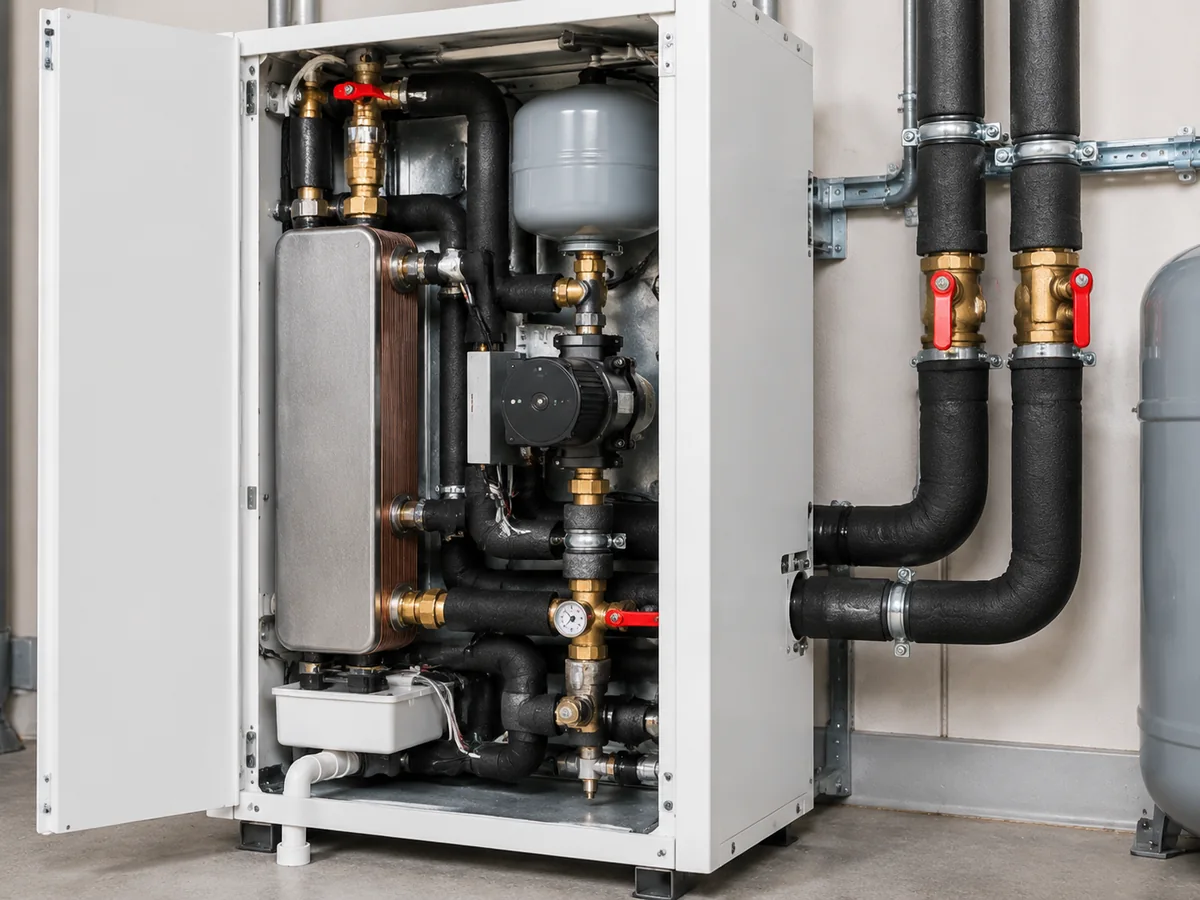
For a concrete example, imagine two otherwise similar homes: one uses low-temperature underfloor heating, and the other needs hotter water for existing radiators. The heat exchangers and compressor carry out the same jobs, but the hotter-water application generally asks the compressor to create a larger temperature lift. That can lower efficiency and change available capacity. Compare model performance at the required outdoor and leaving-water temperatures rather than using a nominal rating alone. See how an air-to-water heat pump works for the water-side sequence.
Ground-source heat pump: a ground or water loop instead of an outdoor air coil
A ground-source system exchanges heat with soil or groundwater through a loop or water-source connection. It generally needs circulation pumps, source piping, and a heat exchanger matched to the loop fluid and design. It does not require the same outdoor fan-and-coil arrangement as a typical air-source outdoor unit. The U.S. Department of Energy’s geothermal heat pump overview explains the ground loop, heat pump, and building distribution parts.
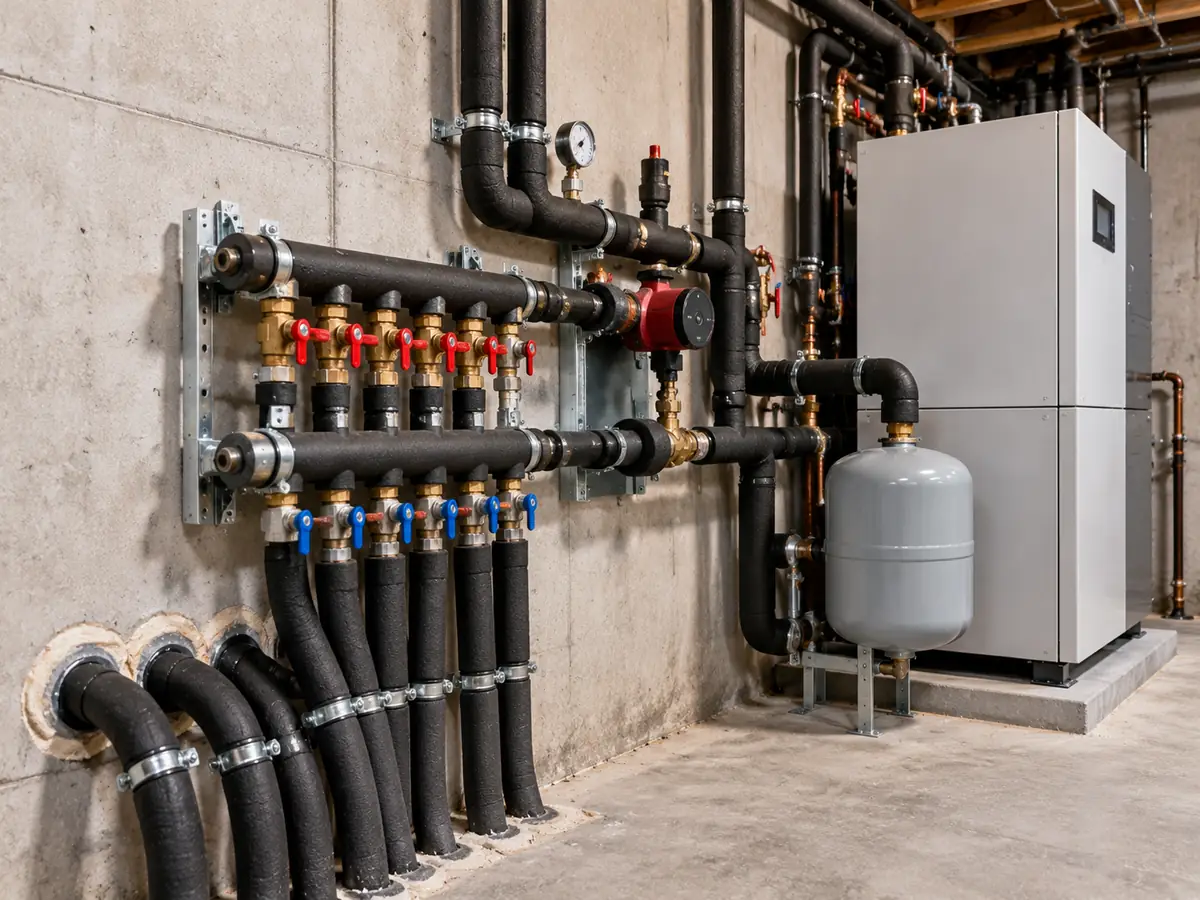
The ground loop is a system component, not a second compressor. Loop temperature, flow, fluid type, water quality where applicable, and heat-exchanger design affect how well the compressor can do its job.
Which Component Matters Most—and What Can Go Wrong?
There is no single component whose importance makes the others optional. The compressor is often called the heart of a heat pump because it raises refrigerant pressure and temperature. But an inadequate heat exchanger, restricted airflow, failed water pump, or incorrect controls can stop the whole system from meeting its heating or cooling job.
| What you notice | Component group worth checking | Useful first step | When to get service |
|---|---|---|---|
| Weak heating or cooling | Airflow, water flow, controls, coils, and refrigerant circuit | Check filter, thermostat mode, blocked vents, and accessible outdoor airflow | If filters and accessible settings are clear but heating or cooling stays weak, request diagnosis using the model data. |
| Outdoor coil stays heavily iced | Airflow, defrost sensors/controls, refrigerant system | Check outdoor clearance safely and record whether a normal defrost cycle removes the ice. | A short defrost cycle may be normal. If heavy ice remains or returns quickly, record conditions and fault codes; arrange service. Never chip off ice. |
| Indoor water leakage during cooling | Drain pan/line, coil icing, airflow | Turn off cooling if water threatens property or electrics; check accessible drain outlet | If water could reach electrics or property, stop cooling and arrange drain and airflow checks before restarting. |
| Unit trips or will not start | Power, safety controls, electrical and compressor system | Check user-accessible controller and breaker status once, without opening panels. | If the breaker trips again, do not reset it repeatedly. Stop the unit and request qualified electrical service. |
| Air-to-water system heats poorly | Flow, water-temperature setting, source conditions, exchanger | Check displayed status and accessible pressure/flow information against the manual | If flow alarms, poor heating, or abnormal water temperatures persist, have the water circuit and controls checked against the unit manual. |
What you can check without opening the refrigeration circuit
- Confirm whether the unit is intended to heat, cool, or make hot water, and that its controller is in the correct mode.
- Inspect user-accessible filters, room vents, and outdoor clearances. Remove only loose debris you can reach safely.
- Record the error code, outdoor conditions, operating mode, and when the symptom occurs. For water systems, record displayed leaving-water temperature and any permitted user-display flow or pressure reading.
- Compare the symptoms with the user manual for the exact model, then give those details to a qualified technician if the problem remains.
Never remove covers exposing electrical parts, bypass safety controls, vent refrigerant, or treat pressure readings from another model as targets. Refrigerant-side repair and electrical diagnosis belong to properly qualified personnel.
How Should You Check the Component List Before Choosing a Heat Pump?
Choose the application and operating conditions first; then check whether the proposed components and system connections actually support that task. A parts list alone cannot confirm capacity, efficiency, noise, freeze protection, or installation compatibility.
| What to tell the supplier or installer | Why it changes the component choice |
|---|---|
| Heating, cooling, domestic hot water, or a combination | Determines required modes, heat exchangers, controls, and distribution connections |
| Local outdoor design conditions and building load | Affects heating capacity, compressor operating range, and defrost needs |
| Air delivery or required water supply temperature | Determines air-handler or hydraulic components and temperature lift |
| Ducted, ductless, monobloc, refrigerant-split, or ground-loop layout | Determines interfaces, fans/pumps, line routes, and service access |
| Power supply, permitted refrigerant, and market requirements | Must match the approved model, electrical components, safety design, and relevant documentation |
| Available service access and local replacement-part support | Helps avoid choosing equipment that is difficult to maintain at the site |
The approved refrigerant also affects the compressor, safety design, and destination-market requirements. If you are choosing between refrigerant platforms, use our R290 vs R32 heat pump comparison before narrowing the exact model.
For a separate R290 air-to-water product example, review the R290 Monobloc Heating Heat Pump and check its published model data against your required operating temperatures, water circuit, and power supply.
Ask for the exact unit and compatible indoor equipment, a model-specific component or piping schematic, the operating-mode description, and performance data at your design conditions. On air-to-water systems, also check minimum water flow, water volume, leaving-water-temperature range, and freeze-protection requirements. On an air-to-air split system, check the approved indoor/outdoor pairing and required airflow. These are more useful than a claim that a unit has “premium parts” without details.
Compare heating capacity and coefficient of performance (COP) at the same operating conditions. COP means useful heating output divided by electrical input at the stated test point. Compare the outdoor or source temperature and the required supply-air or leaving-water temperature, and check whether published electrical input includes fans, circulation pumps, or backup heat. A unit rating and whole-system electricity use are not necessarily the same. For a general definition of COP, see the U.S. Department of Energy efficiency guidance.
To check the right configuration, send us these project details:
- Heating, cooling, or domestic-hot-water duty, plus the building design load or capacity target.
- Outdoor design temperature and required indoor air delivery or heating-water supply temperature.
- Destination market, available power supply, and preferred ducted, ductless, monobloc, split, or ground-loop layout.
- Existing equipment details, connection drawings, or site layout when available.
Check what the quotation actually includes. Mark each circulation pump, valve, controller, tank, and required protection item as factory-installed, separately supplied, or installer-supplied. A main-unit price does not always cover the complete installed heat pump system. Confirm the final scope against the exact model documentation.
At Airproz, we can help identify the suitable product family and the model-specific components that need confirmation. Review our heat pump product range or send us your project requirements. We will use the applicable technical documents and your operating conditions to discuss the equipment and accessory options.
Frequently Asked Questions About Heat Pump Components
What are the four main components of a heat pump system?
The evaporator, compressor, condenser, and expansion device are the four main refrigeration components. The evaporator absorbs heat, the compressor raises refrigerant pressure and temperature, the condenser releases heat, and the expansion device lowers pressure before the cycle repeats. Fans, pumps, controls, and refrigerant lines complete the wider system.
Is the reversing valve one of the four main components?
No. It is an additional part commonly used in reversible heat pumps. The reversing valve directs refrigerant so the indoor and outdoor heat exchangers can exchange heating and cooling roles. Heating-only and other designs may use different arrangements.
What is the most important component of a heat pump?
The compressor is often called the heart of the system, but no single part can guarantee performance. It creates the pressure rise needed to deliver heat. Without suitable heat exchangers, flow, controls, and correct system matching, a working compressor still cannot deliver the expected result.
Does a heat pump have two units?
Some do, but not all. Many residential air-to-air systems have an outdoor unit and indoor air handler or fan-coil unit. Packaged systems combine equipment in one cabinet; air-to-water and ground-source layouts can use different assemblies and distribution circuits.
Does every heat pump have a reversing valve and an outdoor fan?
No. A reversible air-source heat pump commonly has both, but a heating-only unit may not require a reversing valve, and a ground- or water-source heat pump may use a pump and source-side heat exchanger rather than an outdoor air fan. Always check the exact equipment layout.
Are the circulation pump and buffer tank included with every heat pump?
No. Water-based heat pumps need suitable circulation, but the pump’s location and supply scope vary by model. A buffer tank is not needed in every design. Check the selected unit’s minimum flow and water-volume requirements, then confirm which parts are factory-installed, ordered separately, or provided on site.
The Main Point to Remember
The components of a heat pump start with four refrigeration functions: evaporation, compression, condensation, and expansion. A complete system also needs the correct source-side equipment, heat delivery, control, and protection components. The right list changes between reversible air-to-air, air-to-water, and ground-source systems. When checking a real unit, match its model and operating mode before deciding which part you are looking at or which configuration you need.