Airproz B2B Brand Ranking Series · Saudi Arabia · Updated July 2026
Wrong AC brand, unsold inventory. Here's how the top 10 in Saudi Arabia compare on T3 rating and SASO compliance.

Riyadh’s summer regularly hits 50°C — and for an air conditioner, that’s not just weather, it’s a specification test.This guide ranks the top 10 AC brands in Saudi Arabia for 2026, built for B2B buyers rather than consumer shoppers.
A unit designed for European summers can start failing within a season if it isn’t engineered for Saudi heat, so getting your shortlist right matters more here than in most markets.
Finding the best air conditioner brand for Saudi Arabia comes down to three things: T3 climate ratings, SASO certification, and whether a brand actually engineers for 50°C+ operation — not just relabels a standard unit and calls it Gulf-ready. Get the shortlist wrong, and your inventory sits in the warehouse instead of moving.
Key Takeaways
- Saudi Arabia’s AC market is expanding steadily, driven by Vision 2030 construction and continued population growth in major cities.
- T3 climate rating is the first filter for any brand you consider. A standard T1 unit installed in Riyadh or Jeddah will underperform and wear out early.
- SASO energy efficiency certification is mandatory, model by model, for every AC imported into the Kingdom. No certificate, no customs clearance.
- The top three brands by B2B channel strength are Daikin (widest spare parts network), LG (strong inverter tech at accessible pricing), and Carrier (deepest commercial-project penetration).
Saudi Arabia’s AC Market in 2026: Why the Brand Landscape Is Shifting
Saudi Arabia is one of the world’s largest air conditioning markets by per-capita cooling demand. Vision 2030 construction — NEOM, the Red Sea Project, Qiddiya, and new housing across Riyadh, Jeddah, and Dammam — is adding cooling load faster than existing distribution channels can absorb.
Vision 2030 and the Surge in Cooling Demand
For an importer, Vision 2030 means more projects, more specifications, and more scrutiny of which brands get approved. Mega-projects are setting their own sustainability standards, and those standards flow down through the engineering consultants who write HVAC schedules. If your brand isn’t on a major consultancy’s approved vendor list, you’re locked out of the commercial segment before you quote.
Residential demand runs on a different engine: population growth and the national housing program.Saudi Arabia’s population is estimated at roughly 35–36 million as of 2026 (UN/GASTAT-based estimates), with well over 80% living in urban centers — Riyadh, Jeddah, Mecca, Medina, and Dammam.
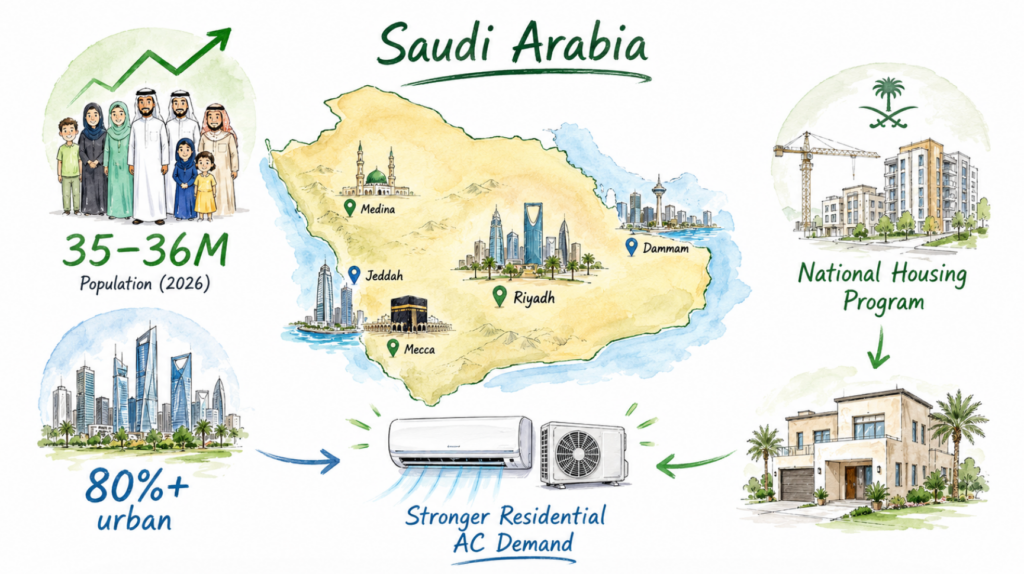
Every new housing unit needs at least one split AC, and most need several.That base demand alone keeps Saudi Arabia among the world’s largest AC import markets.
Tougher Efficiency Standards Are Reshuffling the Field
The Saudi Standards, Metrology and Quality Organization (SASO) has steadily raised minimum energy efficiency requirements for imported air conditioners. Brands that invested early in inverter technology and R32 refrigerant are positioned to absorb the next regulatory step without re-engineering their lines. Brands still shipping older fixed-speed units are not.
For a B2B buyer, this means the brand you commit to today needs to be compliant not just with today’s rules, but with where SASO is heading next — regulatory readiness is worth weighing as heavily as unit cost.
For more on vetting a manufacturer partner from a procurement standpoint, see our B2B buying guide for HVAC manufacturers and OEM suppliers.
Top 10 AC Brands in Saudi Arabia 2026 at a Glance
This is a B2B assessment, not a consumer survey. It ranks the 10 AC brands with the strongest Saudi presence in 2026 against what matters to importers, distributors, and commercial specifiers: T3 availability, SASO coverage, spare parts depth, channel type, and the kind of buyer each brand suits best.
Before you commit to any single brand, it’s worth stepping back and weighing the trade-offs across different AC types for your distribution model. The right brand paired with the wrong product type still produces an unhappy customer.
| Rank | Brand | T3 | SASO | Best For |
|---|---|---|---|---|
| 1 | Daikin | Yes | Full | Premium distributors |
| 2 | LG | Yes | Full | Volume + inverter portfolios |
| 3 | Mitsubishi Electric | Yes | Full | VRF / commercial |
| 4 | Carrier | Yes | Full | Spec-market commercial |
| 5 | Panasonic | Partial | Strong | Mid-market residential |
| 6 | Gree | Yes | Strong | Wholesale volume |
| 7 | Midea | Yes | Growing | Value + private-label base |
| 8 | Trane | Limited | Full (comm.) | Institutional projects |
| 9 | York | Limited | Full (comm.) | Commercial projects |
| 10 | Hisense | Partial | Growing | Budget distribution |
Ratings reflect publicly available product and channel information as of 2026, not independent lab testing of every model. Always confirm current specs directly with the brand before a purchase decision.
For a cross-check on any brand’s published cooling capacity, EER, or COP figures, the AHRI Performance Certified directory is a useful independent reference against marketing claims.
#10–#6: The Value and Commercial Contenders
#10 Hisense — The Entry-Level Volume Play
Hisense keeps gaining shelf space in Saudi retail, particularly at the budget and mid-range end. Pricing is competitive and SASO compliance is improving across its range. Spare parts availability is thinner than the top five, though, and its commercial-project presence is minimal.
Hisense suits a distributor focused on price-sensitive replacement demand. Don’t expect it to win a consultant-led commercial tender against Carrier or Daikin.
#9 York — Commercial Spec Player, Narrow Residential Reach
York (Johnson Controls) holds a strong commercial position — chillers, rooftop units, and VRF specified for offices, malls, and institutional projects. It operates locally in the Kingdom through the Al Salem Johnson Controls joint venture. Its residential split range exists but doesn’t compete head-to-head with LG or Daikin on retail shelf presence.
For commercial-only buyers, York is a credible spec brand with strong ties to Saudi engineering consultancies. For a residential-heavy portfolio, it’s a commercial complement, not the lead brand.
#8 Trane — The Institutional Specialist
Trane owns much of the institutional specification market — hospitals, universities, government buildings, industrial facilities. Its applied commercial equipment is among the most specified in the Kingdom. Its residential and light-commercial range is limited by comparison, and its channel strategy favors project sales over wholesale.
Trane on the spec sheet is an asset for institutional tenders. It isn’t a volume driver for a distributor moving container loads of split ACs.
#7 Midea — The Fast-Growing Value Powerhouse
Midea has grown quickly in Saudi Arabia’s value and mid-range segments, with a range spanning residential splits, light commercial, and VRF. Its factory scale keeps unit costs competitive, and its SASO-certified model list keeps expanding.
Midea also runs as an OEM base for several regional brands — useful for a distributor who wants a private-label line built on Saudi-compliant specs. After-sales infrastructure still trails Daikin and LG in the Kingdom, though the gap is narrowing.
#6 Gree — The Wholesale Volume Leader
Gree is the world’s largest AC manufacturer by unit volume, and its Saudi presence reflects that scale. Its split ACs are widely available in wholesale channels at competitive factory pricing. T3-rated coverage is broad, and SASO certification covers most Saudi-market models.
The trade-off is brand positioning: Gree skews value-segment, which caps the margin a distributor can capture versus a premium brand. For price-competitive wholesale, though, it delivers volume.
#5–#1: The Premium Tier
#5 Panasonic — Strong Brand, Narrower T3 Coverage
Panasonic carries strong brand recognition, especially among consumers familiar with Japanese electronics. Its inverter splits are well-regarded for reliability. Its T3-specific range is narrower than Daikin’s or LG’s, though, and its commercial-project presence is lighter than Carrier or Mitsubishi Electric.
Panasonic works well as a premium residential anchor brand. It’s a weaker single-brand choice for a distributor covering both residential and commercial channels.
#4 Carrier — The Specification-Market Anchor
Carrier carries real weight with engineering consultants, government procurement, and commercial developers. A Carrier spec on a hospital or hotel project is rarely questioned. Its commercial product depth — chillers, air handlers, rooftop units, VRF — opens doors that residential-only brands can’t.
Its residential split range performs well but sits at a premium that limits wholesale volume. Pairing Carrier (commercial specs, premium residential) with a mid-market brand for volume tends to build a more versatile portfolio.
#3 Mitsubishi Electric — VRF Excellence, Residential Premium
Mitsubishi Electric dominates VRF systems for commercial and high-end residential projects, and its City Multi series is among the most specified in the Kingdom for mid-to-large buildings. For commercial buyers, it’s close to essential.
Its residential split line is reliable but priced at the premium end. Carrying it for commercial VRF alongside a more price-competitive residential brand is a structurally sound two-brand play.
#2 LG — Inverter Leadership at Scale
LG may be the most versatile brand in the Saudi market right now. It competes at the premium end with inverter technology that rivals Daikin’s, while staying accessible enough to capture mid-market volume. Its Saudi spare parts and service network are among the best in the Kingdom.
LG’s dual-inverter compressors also help units reach higher SASO star ratings as efficiency standards tighten. For a distributor building a residential and light-commercial portfolio, LG is often the safest volume anchor.
#1 Daikin — The Most Complete B2B Proposition
Daikin takes the top spot because it performs strongly across every B2B-relevant dimension at once: the widest T3 range, the most comprehensive SASO coverage, and the most extensive spare parts network among international brands. It’s specified for commercial VRV projects and still carries enough consumer recognition to sell through retail at premium margins.
Daikin isn’t the cheapest option. But fewer warranty claims, faster parts turnaround, and higher spec-sheet acceptance in commercial tenders compound over the life of a distribution agreement.
Notable Mentions: Beyond the Top 10
Zamil Air Conditioners, based in Dammam, is Saudi Arabia’s largest domestic AC manufacturer, producing split ACs, packaged units, and chillers. For government and institutional tenders with local-content requirements, Zamil is often a mandatory inclusion on the brand list. It’s the domestic benchmark you’ll be measured against in any tender that specifies “Saudi-made or equivalent.”
Airproz sits in a different lane entirely — it isn’t a retail brand competing for shelf space in the ranking above.It’s an OEM/ODM manufacturer that Saudi distributors and small local AC dealers partner with to produce their own private-label lines: T3-rated, SASO-certified R32 inverter split units built to Saudi spec, sold under the distributor’s own name.
For a local dealer who wants the margin and branding control that comes with a private-label range, this is the option worth knowing about alongside the 10 brands above.
What Makes an AC Brand Saudi-Ready: T3 Rating, SASO & Refrigerant
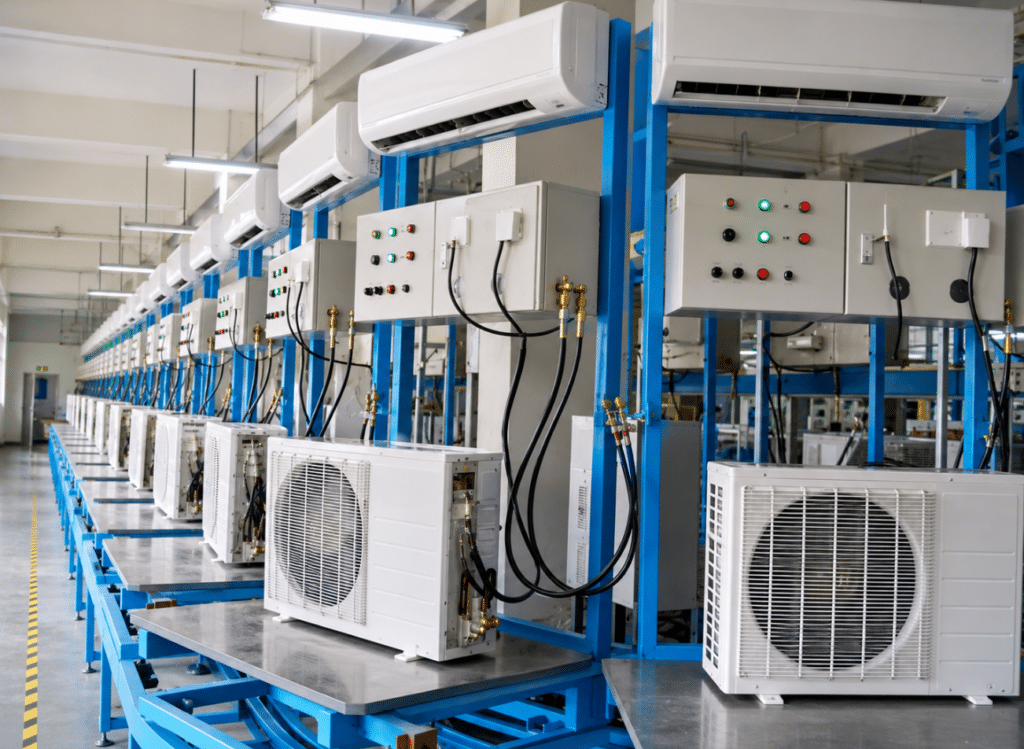
Marketing copy can claim “suitable for Middle East conditions.” The spec sheet either backs that up or it doesn’t. Three technical checks separate genuinely Saudi-ready brands from relabeled temperate-climate units — and give you a way to evaluate any brand independent of what their sales team tells you.
T1 vs T3: The First Filter
T1 and T3 are compressor climate classifications.
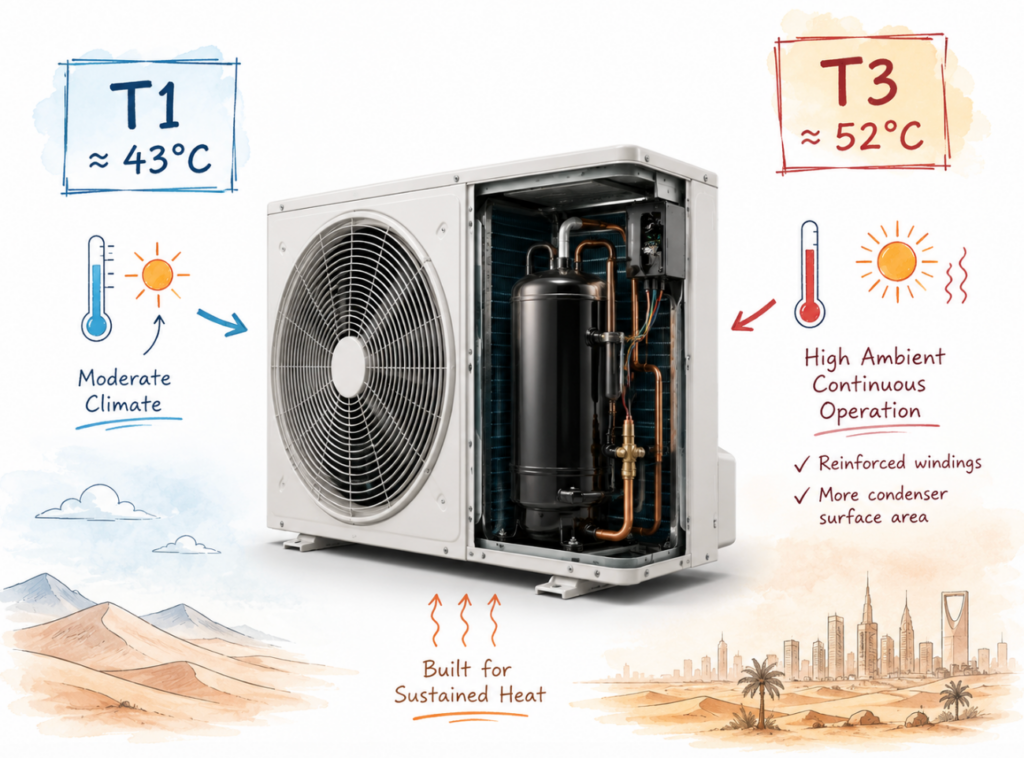
A T1 compressor is built for moderate climates, with a design ceiling around 43°C outdoor temperature.
A T3 compressor is built for continuous operation up to roughly 52°C, with reinforced windings and more condenser surface area to handle sustained heat.
In Riyadh and Dammam, where summer temperatures routinely pass 48°C, a T1 unit will run hot, lose a meaningful share of its rated cooling capacity, and wear out well ahead of a properly rated T3 unit.This isn’t a marginal difference — it’s the reason units that look identical on a spec sheet perform very differently after one Saudi summer.
For more on how T3 products are sourced for the wider Gulf region, see our guide on selecting T3-rated AC units for Gulf climate conditions; the same principles apply, only more so, in Saudi Arabia.
SASO Certification: The Import Gatekeeper
Every air conditioner imported into Saudi Arabia needs a valid SASO energy efficiency label — a star rating plus annual energy consumption, tested under Saudi (T3) conditions rather than the T1 conditions used in many European or Asian catalogs. A unit that scores well on a European label can score noticeably lower once tested under SASO’s T3 conditions.
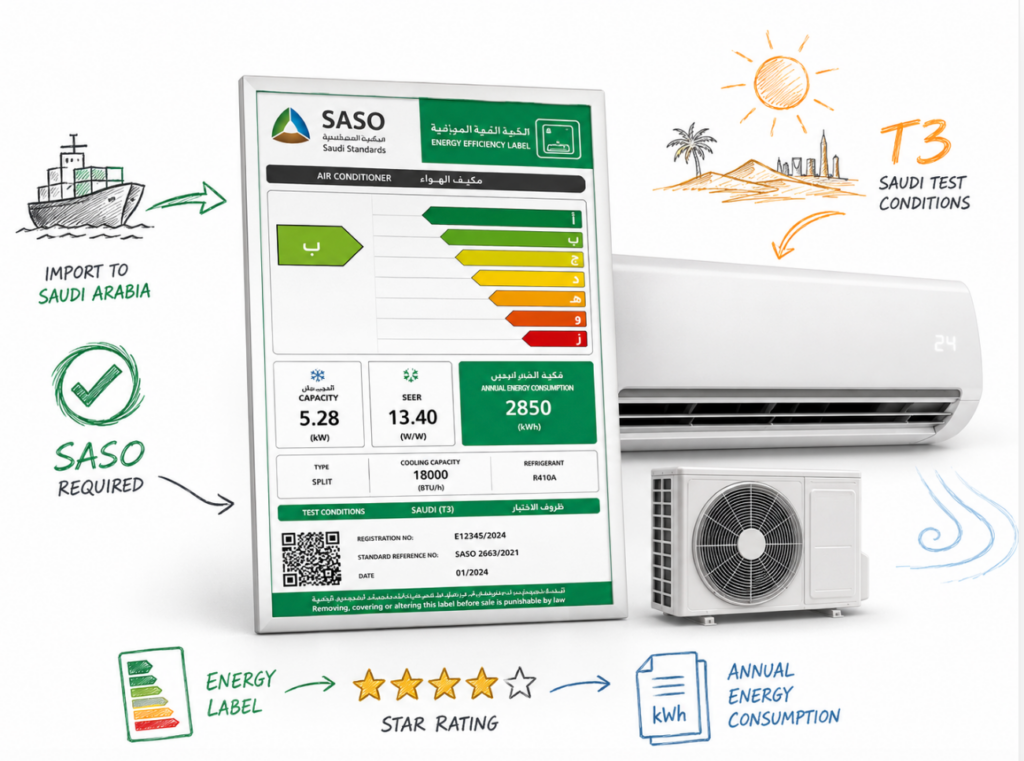
Certification applies model by model, not brand by brand.If a supplier says “our products are SASO certified” without naming specific models and certificate numbers, ask again.
The real question isn’t “is your brand SASO certified” — it’s “send me the certificate for each model I’m ordering.” Requirements do tighten over time, so confirm the current thresholds with SASO directly before finalizing any order, rather than relying on last year’s documentation.
Refrigerant: Where the Market Is Heading
Saudi Arabia is aligned with the Montreal Protocol’s phase-out schedule for older refrigerants. Here’s where each stands in 2026:
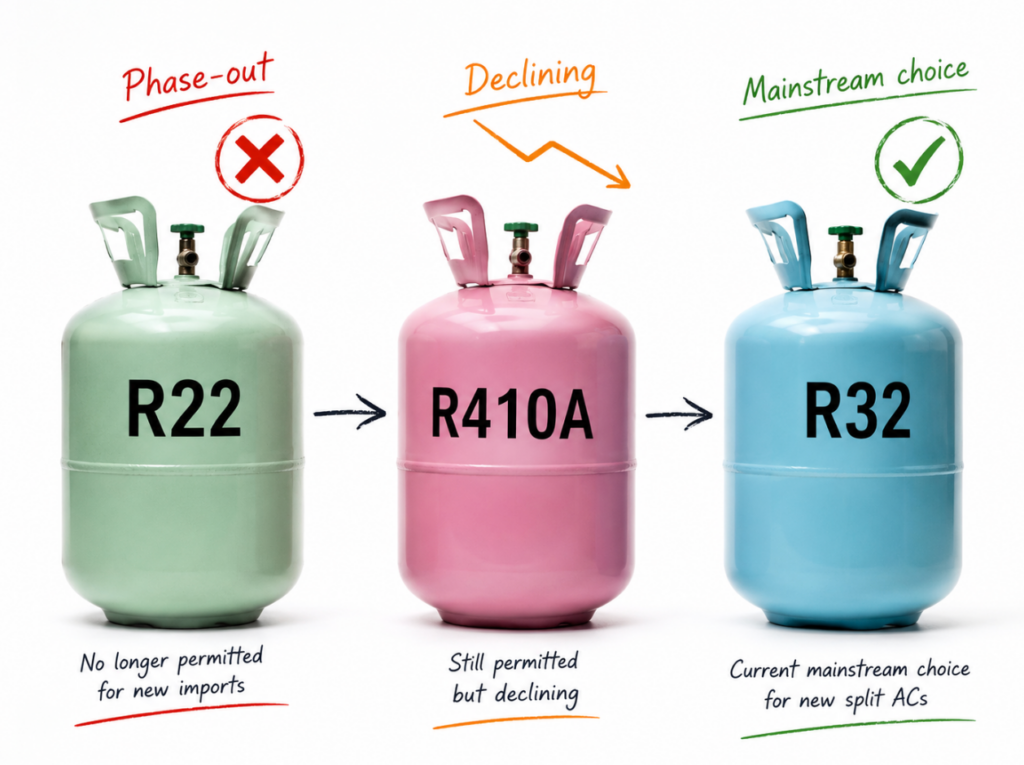
- R22: No longer permitted for new AC imports. Any brand still offering it is selling through old inventory that won’t clear customs as new stock.
- R410A: Still permitted but declining, as the market shifts toward more efficient alternatives.
- R32: The current mainstream choice for new split ACs — better efficiency than R410A and aligned with where regulation is heading.
Inverter technology matters here too: a fixed-speed unit, regardless of brand, tends to struggle to reach a 4- or 5-star SASO rating, because most of its operating hours are at partial load, where fixed-speed compressors are least efficient.
For a look at what a Saudi-ready inverter unit’s spec sheet should include, see our R32 inverter split air conditioner built for high-ambient operation.
How to Source the Right AC Brand for Your Saudi Distribution Channel
Rankings and specs get you to a shortlist.Which brand — or brands — you build your business around depends on your channel.
A Riyadh wholesaler moving thousands of units a year to small retailers has different needs than a Jeddah contractor bidding on hotel projects.This is also where the question shifts: it’s less “what’s the best air conditioner brand for Saudi Arabia overall” and more “what’s the best fit for my volume, margin, and after-sales capacity.”

5 Questions Before You Sign a Distribution Agreement
- Is the minimum order quantity (MOQ) per model or per brand? Some brands require separate MOQs for each SKU; others aggregate across the brand. Know which one you’re committing to.
- What spare parts stocking commitment does the brand expect? Brands with strong after-sales networks typically require a defined parts inventory. The exact figure varies by brand and territory, so get it in writing before you sign.
- Who handles warranty claims first — you or the brand’s regional office? If it’s you, ask about reimbursement rate and turnaround time. Slow reimbursement is a quiet cash-flow drain.
- Does the brand support annual SASO re-certification for each model? Some brands manage this centrally; others expect the local distributor to handle it. Clarify this up front, not six months in.
- What’s the brand’s channel conflict policy? If it also sells direct to large retailers or developers in your territory, “exclusive distribution” may not mean what the agreement title suggests.
The Multi-Brand Pattern We See Across Saudi Distributors
Across our Saudi distributor partners, a familiar pattern shows up again and again. Many start out as a single-brand distributor for one of the top-five international AC names.
Brand recognition helps win retail shelf space, but the arrangement has limits — commercial tenders often specify a different brand, and the parent brand’s margin structure leaves little room to compete on price against Gree or Midea in wholesale.
The distributors who outgrow that ceiling tend to restructure into three tiers.A premium international brand covers commercial specification projects and premium residential work.
A mid-market brand handles volume residential distribution.For the third tier, many partner with an OEM factory — Airproz among them — to build a private-label range of T3-rated, SASO-certified R32 inverter split ACs sold under their own brand name.
That private-label tier is usually where the margin sits, since the distributor controls branding and pricing instead of working inside someone else’s mandated program. It’s a pattern worth borrowing: use international brands where recognition opens doors, and use OEM and private-label partnerships to build margin and channel control where brand name matters less than compliance and price.
B2B Sourcing Checklist: Before You Place a Container Order
| Verify | Ask For |
|---|---|
| T3 compressor rating | Compressor T3 test certificate |
| SASO registration (per SKU) | SASO certificate, star rating, validity date |
| Refrigerant type | Spec sheet with refrigerant and charge |
| Spare parts availability | Parts catalog with lead times to KSA |
| Warranty terms | Written policy on duration & claims |
| T3-condition performance | Lab test report at high outdoor temp |
Adding a Saudi-compliant AC line to your portfolio? Airproz manufactures T3-rated, SASO-certified R32 inverter split ACs with full compliance documentation, at factory-direct pricing for volume importers and private-label programs.
Frequently Asked Questions
Which is the best air conditioner brand for Saudi Arabia if I’m a distributor?
It depends on your channel.Daikin and LG offer the widest parts networks and brand recognition for residential distribution.
Carrier, Mitsubishi Electric, and Trane dominate commercial specification lists.Gree and Midea lead on price for wholesale volume.For private-label sourcing, a direct OEM partnership lets you control branding while meeting Saudi import standards — ask for T3 certification and model-level SASO documentation before committing to any supplier.
Does every AC brand need SASO certification to sell in Saudi Arabia?
Yes. Every imported air conditioner needs SASO energy efficiency certification, applied per model rather than per brand. Without a valid SASO label, a unit won’t clear Saudi customs. If you’re sourcing from an OEM factory, confirm they can provide SASO test reports for each specific model — a blanket “our products are certified” claim isn’t sufficient documentation.
What’s the difference between T1 and T3 AC units, and which one works in Saudi Arabia?
T1 compressors are built for moderate climates, with a design ceiling around 43°C. T3 compressors handle continuous operation up to roughly 52°C. In Saudi Arabia, where inland cities routinely exceed 48°C in summer, T3 is not optional — a T1 unit will run hot, underperform, and wear out early.
Can I import from a Chinese OEM and sell under my own brand in Saudi Arabia?
Yes, and it’s a growing channel. Each SKU needs SASO model-level certification, the units need to be T3-rated for Saudi conditions, and you need a Saudi-registered entity as importer of record. Several OEM manufacturers, including Airproz, supply private-label units with full SASO documentation. Build certification lead time into your launch schedule, since testing timelines vary by lab.
Which refrigerants are compliant with Saudi Arabia’s AC import rules in 2026?
R22 no longer clears customs for new equipment. R410A is still allowed but declining. R32 is the current mainstream choice — SASO-compliant and better on efficiency than R410A. Confirm the latest SASO refrigerant list directly before ordering, since rules can update.
Every brand on this list represents a different mix of price, support, and market position. The right one depends on your channel and your volume. If you’re ready to control the brand — and the margin — yourself, Airproz’s team can walk you through T3 engineering, SASO documentation, and factory-direct pricing for OEM and private-label programs.