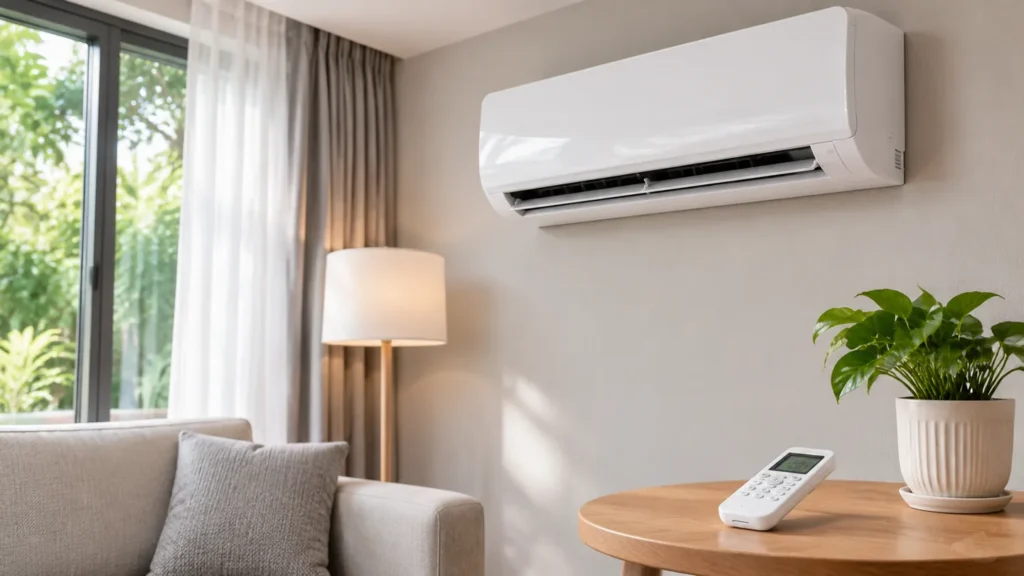
The right air conditioner for a small window must match the window type, the clear opening and the room’s cooling load. Start by measuring the usable window width and height, then check each model’s minimum installation dimensions. A compact 5,000 BTU cabinet can still need a window more than 21 inches wide. For a small room, 5,000–6,000 BTU/h is often the first capacity range to check, but the room area and heat gain decide the load.
A window that is only 12–15 inches wide, or 10–11 inches high, may rule out many common units. A tall casement model, portable AC with proper outdoor exhaust, or ductless split system can make more sense. The sections below show how to tell before ordering.
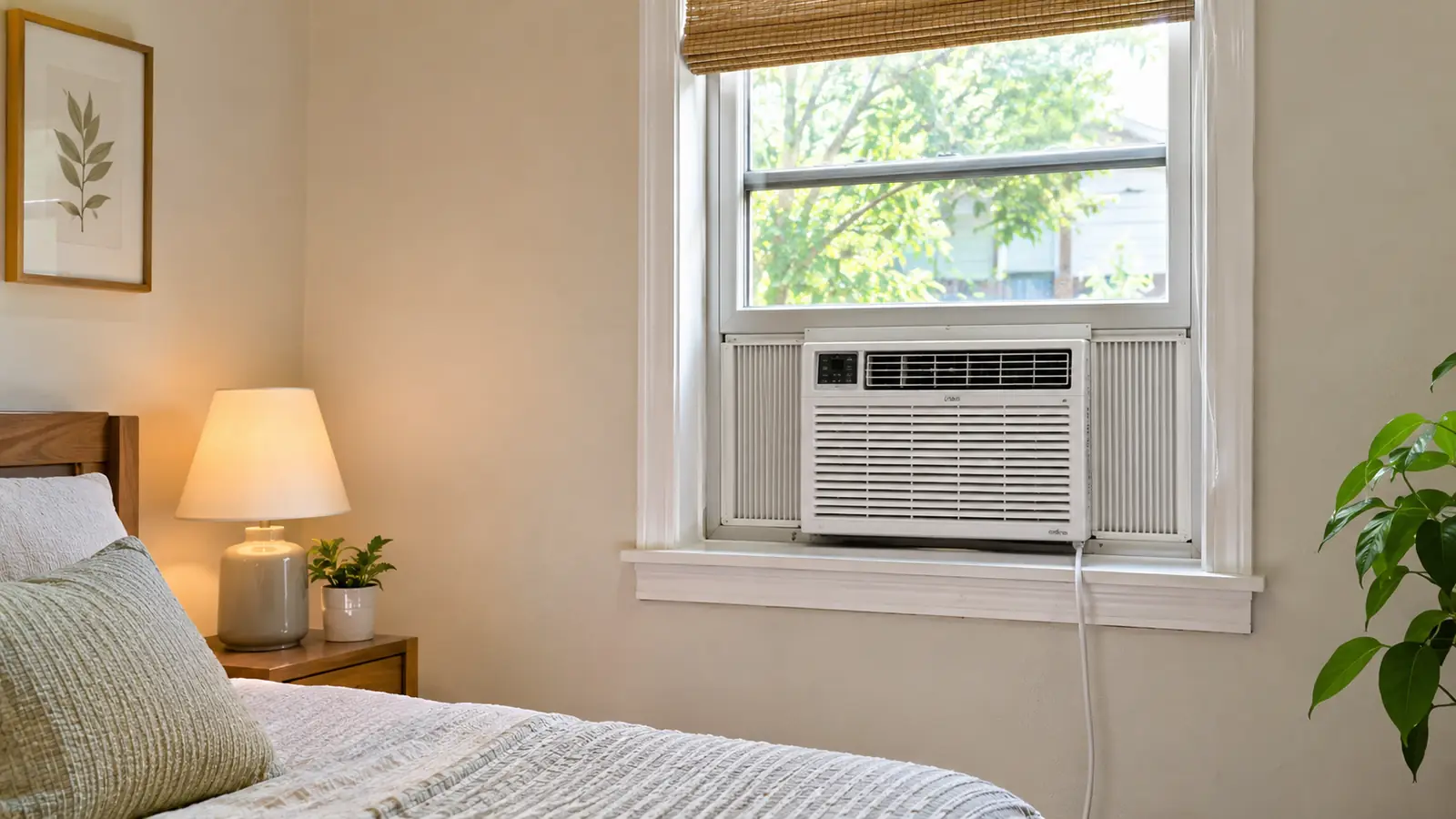
Which Air Conditioner Types Work in Small Windows?
Choose a compact standard window AC for a compatible up-and-down sash, or a purpose-built slider/casement unit for a narrow, tall opening that moves sideways. A U-shaped unit needs an approved up-and-down sash, enough sill depth and the specified support bracket; the sash closes into the gap between its indoor and outdoor sections. A saddle-style unit rests across a compatible sill, so sill shape, wall thickness and clearance below the window matter. If none of these mounting arrangements fits, use a properly vented portable AC or a ductless system.
| Design | Window it is made for | Best reason to consider it | What can rule it out |
|---|---|---|---|
| Compact standard window AC | Compatible single-hung or double-hung sash | A small room and a wide-enough opening | Minimum installation width is often much greater than cabinet width |
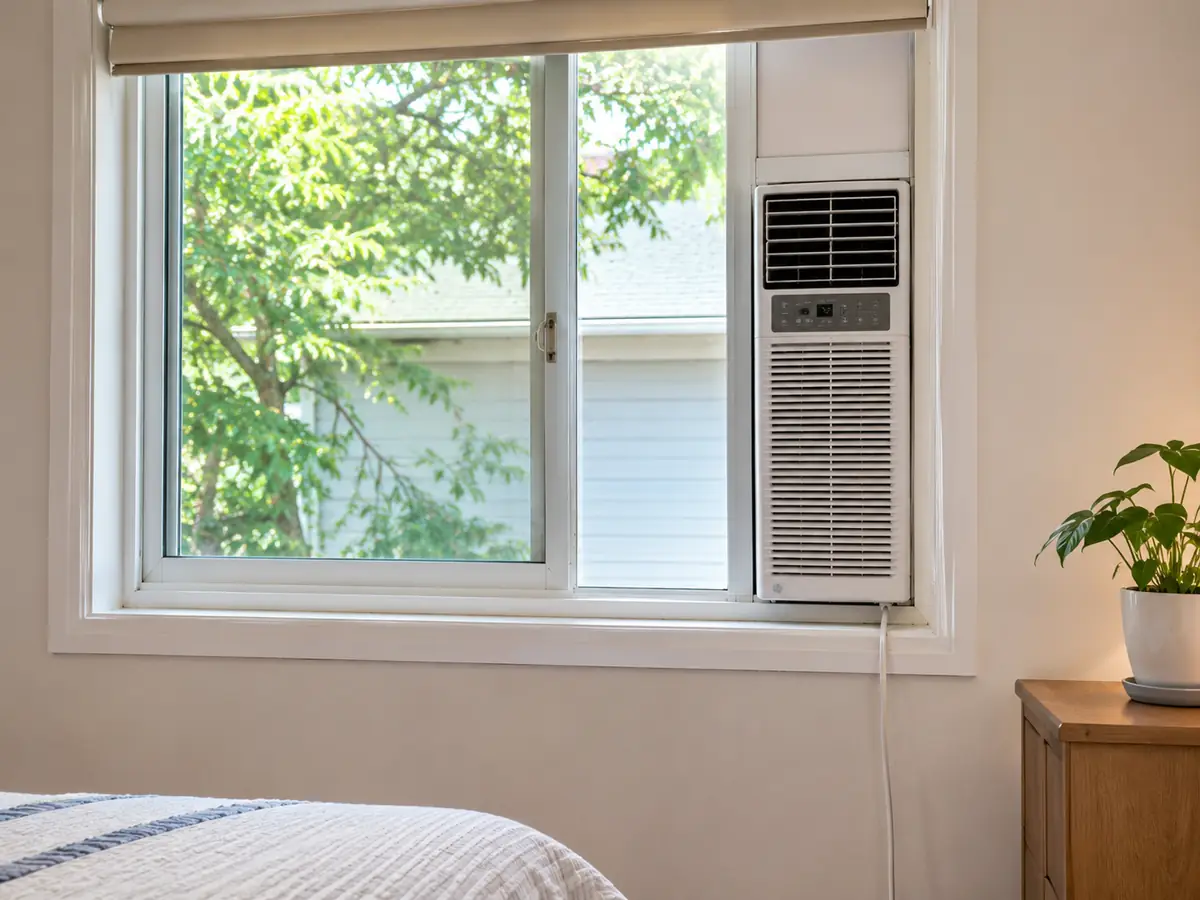
| Slider/casement (vertical) AC | Horizontal sliding or outward-opening casement window, as specified | A narrow but relatively tall opening | Its cabinet and upper filler need substantial vertical clearance |
| U-shaped window AC | Approved vertical sash and sill arrangement | Keeping more glass clear and reducing indoor compressor noise | Bracket, sill depth, sash travel or minimum opening limits |
| Saddle or over-the-sill AC | Approved window and sill geometry | Lower sightline when the exact model fits | Thick wall, radiator, sill or sash incompatibility |
| Portable AC with outdoor exhaust | Window that can accept its approved vent kit | No safe way to hang a window unit | Cannot route and seal its exhaust hose outdoors |
Compact, mini and low-profile do not mean the same thing
A mini window air conditioner usually means a small cabinet or a low cooling-capacity unit. A low-profile window air conditioner is built to block less of the window. A slim or narrow window AC refers to cabinet shape or the minimum opening width. These labels do not give a shared size standard. The installation table for the exact model decides whether it fits.
Likewise, a small horizontal window AC may mean a low cabinet used in a vertically opening sash, while a small vertical window AC usually means a tall unit for a sideways sliding or casement window. Follow the direction the window opens, not the search term. A U-shaped unit still needs its specified sash, bracket and sill conditions; it is not a universal solution for a 12-inch opening.
How Do You Measure a Window for an Air Conditioner?
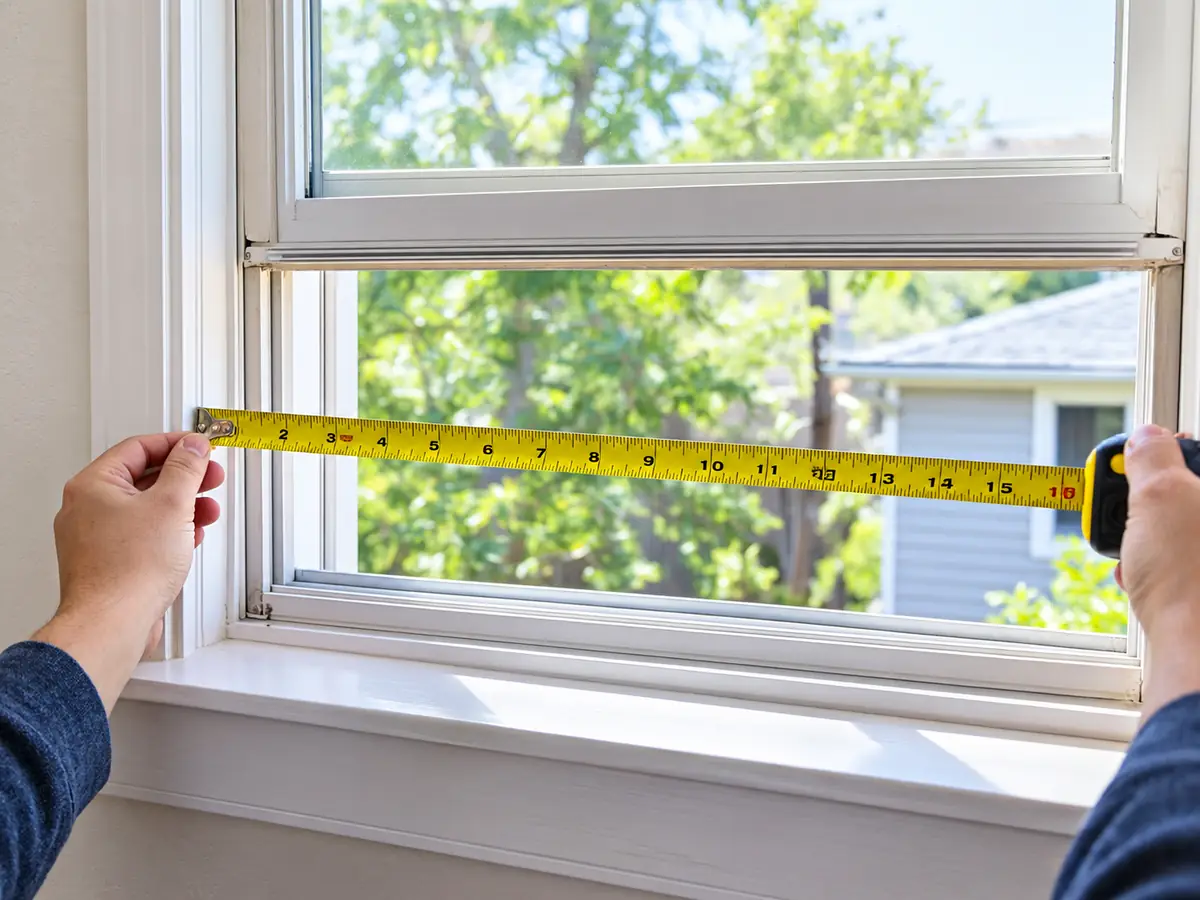
Measure the clear opening width, the actual open height, and the sill where the unit will rest. Then compare those measurements with the manufacturer’s installation range—not just the product photo or cabinet dimensions.
- Identify how the window opens. A double-hung sash moves up and down. A horizontal slider moves left and right. A casement opens on hinges. A basement hopper may tilt inward. Do not assume one installation kit fits all four.
- Measure the usable clear width. Measure between the inner stops or tracks at the level where the unit and mounting kit must fit. Check at more than one height if the frame is uneven. Record the smallest usable value.
- Measure the true open height. Raise or slide the sash fully to the position allowed for installation. Measure the clear opening, not the glass height. Window hardware, screens and stops may reduce the usable space.
- Check the sill and outside clearance. Record sill depth, thickness, projection, storm-window frame, exterior obstructions and wall depth when the mounting system requires it. Confirm where brackets can attach to sound material.
- Read the exact installation drawing. Compare your numbers with minimum and maximum window widths, minimum opening height, allowed window types, bracket arrangement and required tilt or drainage. Check electrical supply and local mounting rules too.
Take a photo of the full window and a close-up of the sill, then write the numbers in inches or millimeters. This makes it easier to check a manual or ask a supplier about a specific installation without confusing the glass size with the open space.
What Dimensions Do Small Window Air Conditioners Actually Need?
Many 5,000–6,000 BTU window units have cabinets around 15–17 inches wide, yet require openings around 22–23 inches or wider. A specialist casement model can work in a narrower opening but needs more height. Compare the minimum opening width and height in the model table with your actual clear opening; cabinet width alone cannot establish the fit.
| Manufacturer example | Rated cooling | Cabinet width | Minimum opening width | Minimum opening height |
|---|---|---|---|---|
| GE AWAS05BWA, standard window AC | 5,000 BTU/h | 16.36 in | 21.88 in | 13.38 in |
| Midea MAW05M1BWT, standard window AC, Canadian listing | 5,000 BTU/h | 15.35 in | 23 in | 13 in |
| Keystone KSTSW08B, slider/casement AC | 8,000 BTU/h | Check model drawing | 15.5 in | 21.3 in |
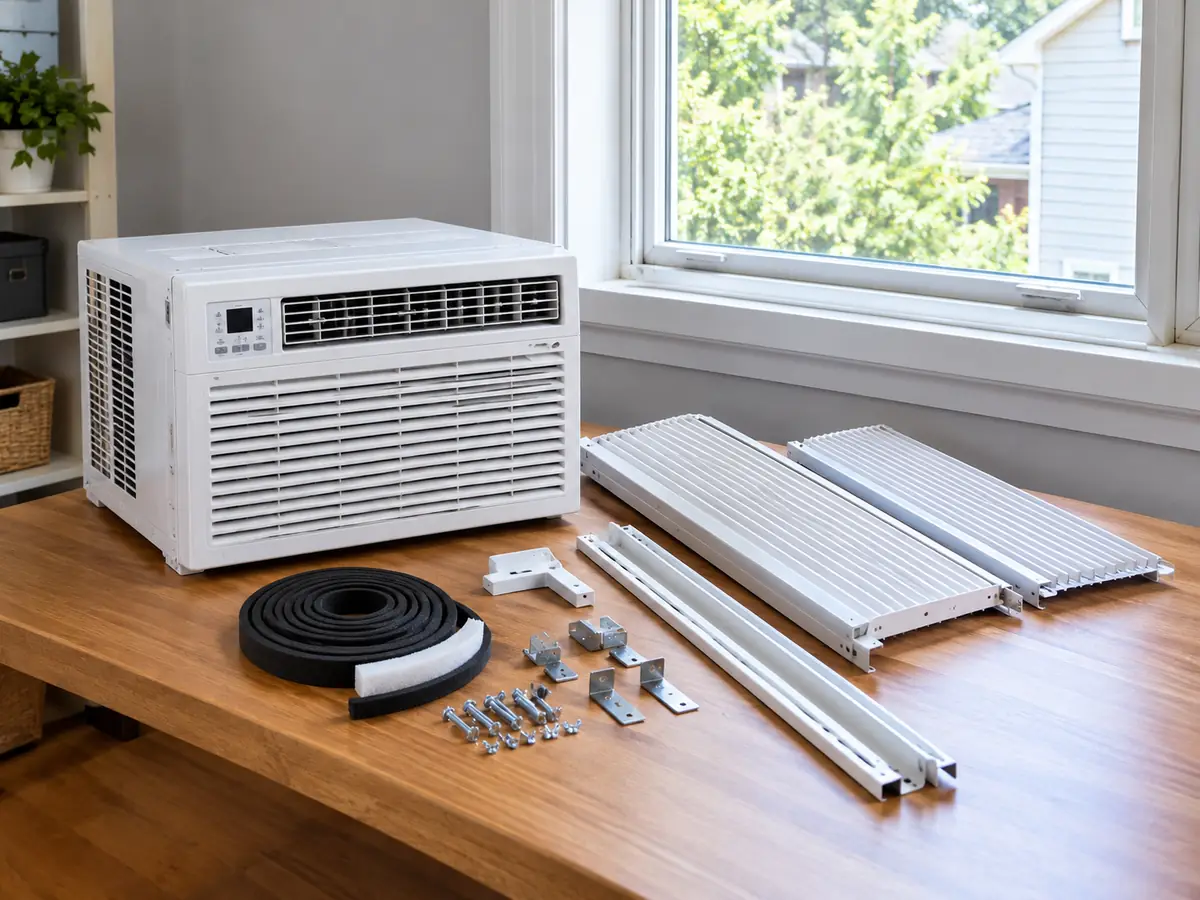
The manufacturer specifications show why finding the smallest window air conditioner means checking two sizes: the cabinet and the complete installed assembly. For the unit you plan to install, use the current installation guide for its exact model and regional version.
Cabinet width versus minimum installation width
Cabinet width is the width of the metal or plastic body. Minimum window width includes the approved way to support, center and seal the unit. Some manuals permit approved installation without accordion side panels; others do not. Do not remove required mounting parts merely to make a unit fit. Only use a reduced-width arrangement when that exact installation manual shows how to secure and seal it.
Cabinet height versus minimum opening height
A cabinet described as 11 or 12 inches high may still need more vertical opening room for the top rail, bracket, sash and installation movement. The GE example is 12.59 inches tall and lists a 13.38-inch minimum window opening. For a narrow slider/casement model, the required opening can be above 21 inches high even though its opening width is much narrower.
Will a 12-, 14- or 15-Inch-Wide Window Fit a Window AC?
None of the three models compared above fits a 12-, 14- or 15-inch-wide clear opening. The narrowest example, Keystone KSTSW08B, requires at least 15.5 inches; GE AWAS05BWA requires 21.88 inches, and Midea MAW05M1BWT requires 23 inches. If your clear opening is 16 inches wide, only the Keystone example becomes a width candidate among these three—and it still needs at least 21.3 inches of clear height and the approved window and mounting arrangement.
| Your measured opening | What the checked examples show | Next step |
|---|---|---|
| 12 inches wide | None of the three examples fits by its stated minimum opening width | Check a permitted portable vent kit or ductless solution; do not force a window cabinet |
| 14 inches wide | Still smaller than the 15.5-inch slider/casement example | Look for an exact model with a documented smaller minimum; otherwise use another cooling method |
| 15 inches wide | Still 0.5 inch below the 15.5-inch example | Re-measure at the fitting point; only select a model whose stated minimum fits |
| 16 inches wide and tall | Potentially within the width range of a specialist slider/casement model | Check its minimum height, full width range, window type and mount |
| 22–23 inches wide with vertical sash | Several compact standard models become candidates | Check the exact model’s width range, sash height, sill and room cooling load |
What about a 10- or 11-inch-high window?
A 10- or 11-inch clear opening is below the published minimum opening heights of all three models in the table. A listing that says “11 inches high” may describe the body, not what the installation kit needs. Short basement windows often have exactly this problem: a wide cabinet may fit from side to side but cannot be installed and supported through the small open height.
If you find a specialty model claiming smaller dimensions, get its current installation manual and check the minimum clear height, mounting hardware and approved window style. A marketing measurement alone is not enough to select it.
How Many BTUs Does a Small Room Need?
Start with the room’s floor area, not the window size. For an ordinary room with an 8-foot ceiling, ENERGY STAR’s U.S. room-air-conditioner guide starts at 5,000 BTU/h for about 100–150 sq ft and 6,000 BTU/h for about 150–250 sq ft. The window must then accept a model that supplies that cooling capacity.
| Room area (sq ft) | Guide capacity (BTU/h) | What to look for |
|---|---|---|
| 100–150 | 5,000 | Compact 5,000 BTU room AC if installation permits |
| 150–250 | 6,000 | 6,000 BTU room AC with appropriate size and window fit |
| 250–300 | 7,000 | Check available 7,000 BTU-class units or a closer load estimate |
| 300–350 | 8,000 | 8,000 BTU window or specialty unit if opening fits |
| 400–450 | 10,000 | Larger window unit or another cooling arrangement |
Source: ENERGY STAR room air conditioner buying guidance. Use the floor-area row as your starting capacity, then adjust for sun or shade, regular occupants and heat sources before choosing a rated model.
Example: a 12 × 14 ft bedroom
A bedroom that is 12 feet long and 14 feet wide covers 12 × 14 = 168 sq ft. The chart points to about 6,000 BTU/h before other conditions are considered. If that room gets strong sun, ENERGY STAR suggests increasing the starting capacity estimate by 10%: 6,000 × 1.10 = 6,600 BTU/h. Compare the nearest available rated capacities with that adjusted estimate and the room’s actual heat sources; do not jump to a much larger unit just to exceed 6,600 BTU/h.
For a heavily shaded room, the guide suggests reducing the estimate by 10%. For more than two regular occupants, add 600 BTU/h for each additional person. For kitchen use, add 4,000 BTU/h. Very high ceilings, weak insulation, large windows, heat-producing equipment or humid outdoor air may need a more detailed cooling-load estimate. Our air conditioner sizing guide explains how room conditions affect the load beyond this small-room chart.
5,000 BTU versus 6,000 BTU: which is better?
Choose 5,000 BTU/h for a room near the 100–150 sq ft range under normal conditions; start at 6,000 BTU/h for a room closer to 150–250 sq ft. Avoid buying a much larger unit only because it fits the opening. An oversized fixed-speed AC may cool the air quickly and stop before it removes enough moisture, leaving the room damp. If the window only fits a larger specialist unit, compare its minimum operating output or consider another type of system instead of treating nominal BTU as the whole decision.
How Should You Install and Seal an AC in a Small Window?
Use the mounting method supplied for the exact model, support the weight securely, and seal the remaining gaps. In a small opening, a poor fit can leave the cabinet unstable, block outdoor airflow or let hot, wet air enter around the sides.
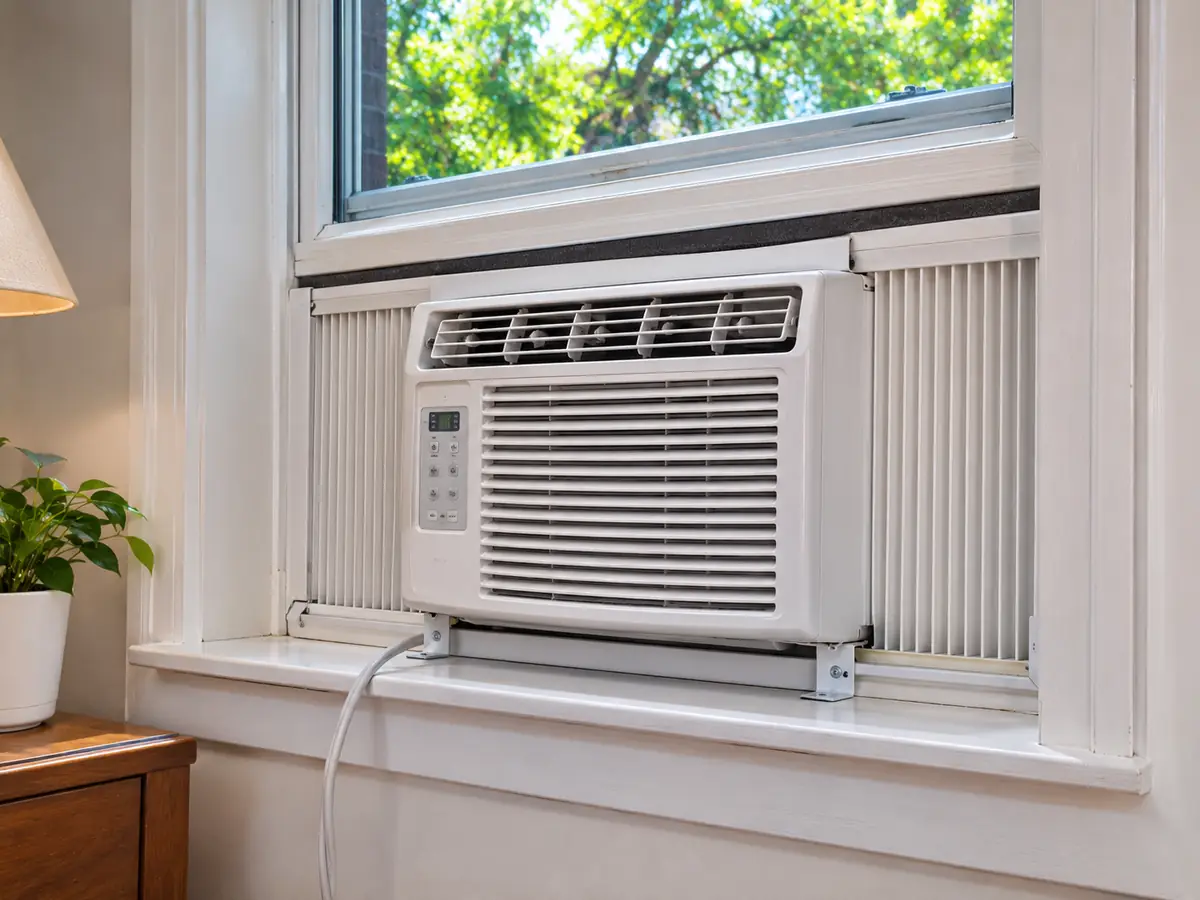
- Confirm the window is allowed to carry a unit. Check the frame, sash, building rules, rental permission and any required support bracket. Do not block a required emergency escape window.
- Place and secure the support. Follow the instructions for sill attachment and brackets. Keep the outdoor section clear of security bars, deep wells, foliage and nearby walls by the distances in the model manual.
- Set the approved position. The manual determines whether and how far the unit should tilt for drainage. Do not apply a made-up tilt angle to every model; some designs use a specific level or drainage arrangement.
- Close and lock the opening as instructed. Install the permitted fillers, window lock and foam seals. Seal gaps without covering the outdoor condenser vents or weep/drain paths.
- Check the outlet and cord. Use the specified voltage, plug and circuit. Keep the plug accessible, do not use an ordinary extension cord to reach an outlet, and have an electrician address inadequate wiring.
- Run and observe the unit. Check that cooled air reaches the room, the sash and brackets stay firm, water drains as designed and no gaps pull outside air into the room. Recheck after the first rain and after cleaning the filter.
What changes in a basement window?
A small basement window air conditioner has two extra problems: the opening may be short, and the outdoor side may face a window well. Confirm the air intake and exhaust have the clearances required by the manufacturer, and do not direct hot discharge into a tight enclosed well. Many basement windows also serve as emergency escape and rescue openings. If installing the AC would block a required exit, use another cooling arrangement.
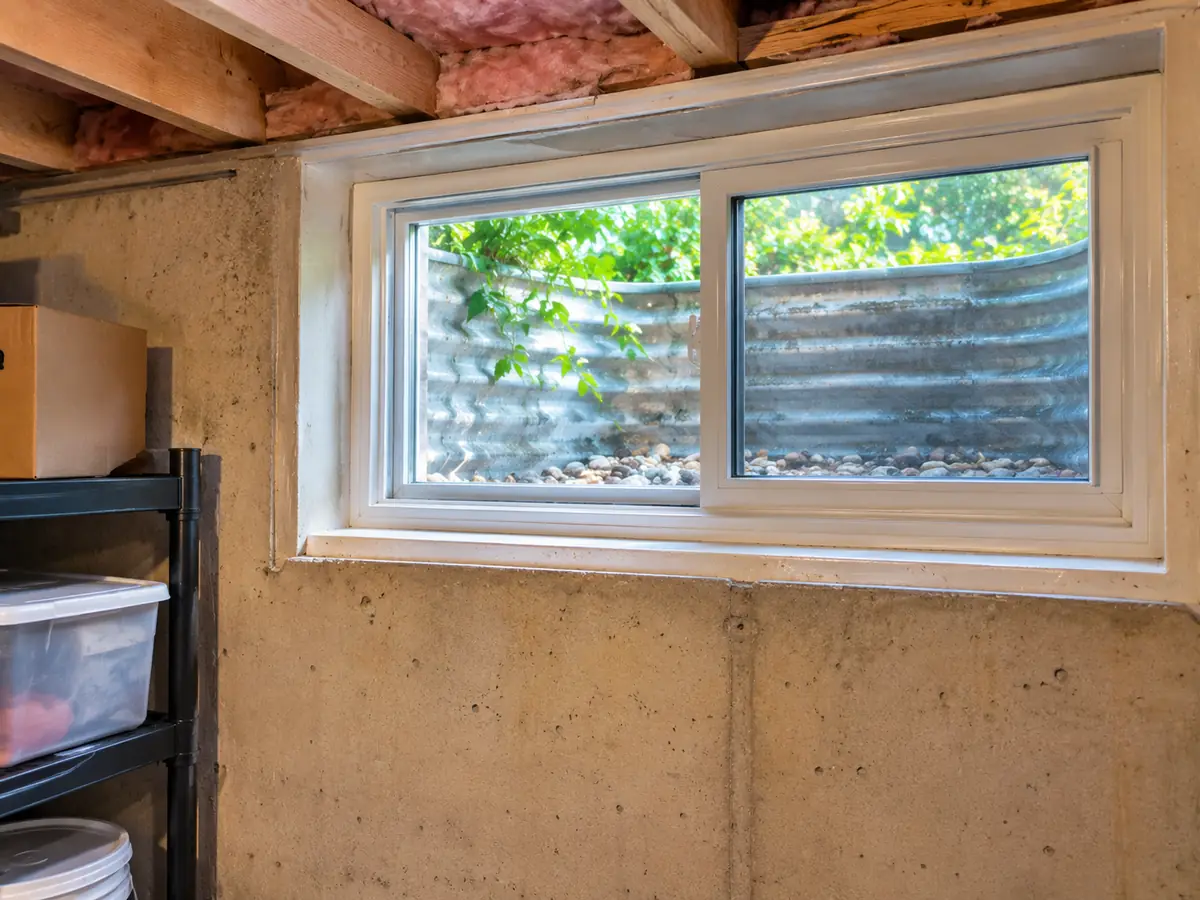
A basement hopper or inward-tilting window cannot simply be treated as a normal double-hung sash. Choose equipment approved for that window or have a suitable alternative installation designed. Never turn a standard window unit sideways: its compressor, condensate path and mounting layout are designed for an upright position.
What If No Window AC Fits the Opening?
If no window AC fits, choose a cooling method that does not need the same cabinet opening. Use a portable AC when a compatible, sealed exhaust kit can vent outdoors through the window. Choose a ductless mini-split when the window cannot accept an AC or exhaust kit but a permitted outdoor-unit location, piping route and power are available. A through-the-wall AC is another option when an approved wall opening, sleeve and outdoor ventilation can be provided. Keep any required escape window clear.
| Situation | First alternative to check | Key condition |
|---|---|---|
| Narrow opening but enough room for a vent plate | Portable AC with a compatible window kit | Hot exhaust must go outdoors through a sealed, permitted route |
| Window too short for every approved cabinet | Ductless mini-split | Permitted outdoor-unit location, piping route, power and condensate drain |
| Suitable exterior wall opening is permitted | Purpose-built through-the-wall AC | Correct sleeve, structure, vent space and drainage; not a repurposed window model |
| Window is a required escape opening | Keep that opening clear; use another permitted cooling route | Building and fire-safety requirements remain satisfied |
Portable systems still remove heat by sending air outdoors through a hose. The required label lists seasonally adjusted cooling capacity (SACC) for comparing portable models. A mini-split leaves the window clear because its indoor unit connects to an outdoor unit through refrigerant piping, control wiring and a condensate drain. Mounting the two units, routing these connections, supplying suitable electrical power and commissioning the refrigerant system add installation work and often increase the upfront cost compared with a compact window AC. Our guide to split AC piping and electrical connections explains the refrigerant, wiring and drainage routes behind that extra work.
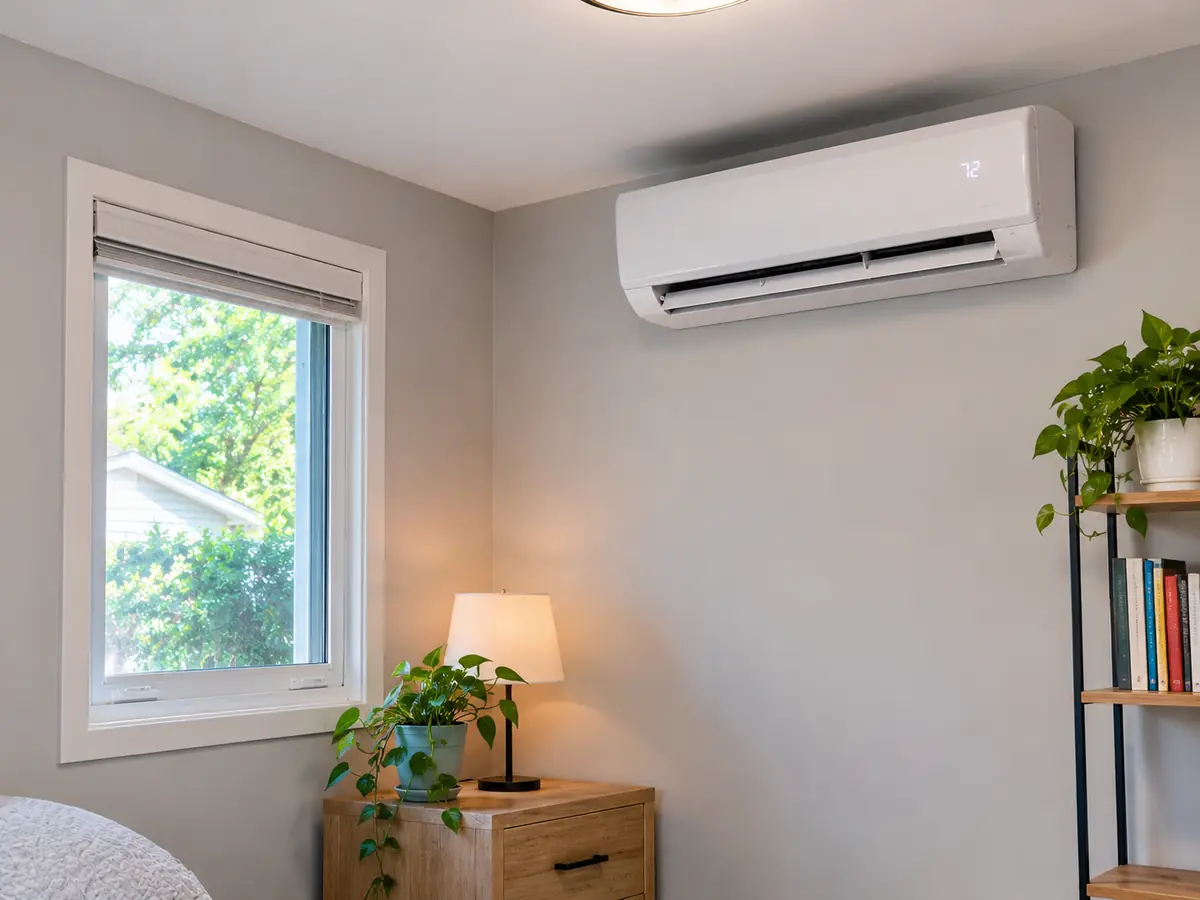
Our guide to air conditioner types compares these layouts. To understand the indoor and outdoor units and how they serve a room without taking up a window, read how a mini-split air conditioner works.
For a project that needs a separately installed split system, the Airproz R32 SA inverter split AC series is one product-family example. Its published models start at 9,000 BTU/h and list 220–240 V, 50 Hz power, so they are not a like-for-like 5,000–6,000 BTU window AC substitute. Confirm the room load, available power, destination-market requirements and installation route before considering a particular model.
What Else Matters When Choosing a Small Window AC?
After confirming fit and BTU capacity, compare efficiency, sound, airflow and everyday access. A unit can be physically small but noisy, hard to clean or expensive to operate.
- Efficiency: For U.S. room ACs, look at the combined energy efficiency ratio (CEER) on comparable model labels and the expected cooling capacity. Do not directly compare CEER with a central split system’s SEER2 as though they were the same measure. Also check the operating controls: how AC Energy Saver mode works explains fan cycling and why a mode name alone does not guarantee lower electricity use.
- Noise: Check the manufacturer’s operating sound levels at the same fan settings. A U-shaped design may keep more compressor noise outdoors, but only if the window and bracket fit.
- Air direction: If the window is near a corner, choose adjustable louvers that can direct air toward the room rather than straight into a nearby wall or bed.
- Cleaning and water: Make sure you can remove the filter without taking the unit out. Keep the outdoor heat exchanger clear and the drainage route accessible under the manual’s maintenance instructions.
- Power: Compare rated input watts and supply requirements in the exact specifications. Electrical input is not the same thing as the cooling capacity shown in BTU/h.
The best small window air conditioner is the one that can be installed securely in your actual opening, cover the room’s cooling load and operate within its electrical and outdoor-clearance limits. A famous brand or the lowest cabinet height cannot make up for a failed fit measurement.
Conclusion: How Do You Choose an AC for a Small Window?
Choose a window air conditioner for a small window by measuring the usable opening, identifying the sash type and checking the exact installation dimensions before comparing BTU labels. For a normal small bedroom, 5,000 or 6,000 BTU/h may be the right starting range. A narrow horizontal slider may call for a tall casement-style model instead; a very short basement opening may rule out window units altogether.
Keep the opening’s width, height, sill and outdoor clearance beside the room’s floor area and cooling conditions. If no approved unit fits, a vented portable system or a properly installed ductless unit is a better next step than modifying safety-critical support parts. For a project where a separate indoor/outdoor system is suitable, see the Airproz split air conditioner range and compare its available capacities and electrical requirements with your actual load and location.
If a ductless split AC is a better fit, send us your room dimensions, location and climate, available electrical supply, and the proposed indoor and outdoor unit locations through the Airproz website. We can use those details to help compare suitable split AC capacities and configurations, then confirm the information needed for a model-specific quote.
Frequently Asked Questions
Can a 5,000 BTU window AC fit a 15-inch-wide window?
Not based on the compact standard models compared here. For example, the GE 5,000 BTU model listed above requires a minimum 21.88-inch opening. A 15-inch clear opening is also below the 15.5-inch minimum of the listed specialist Keystone slider/casement unit. Check another model only if its own manual confirms that fit.
Is an 11-inch-tall window air conditioner suitable for an 11-inch-high opening?
Not automatically. Cabinet height and minimum installation opening height are different measurements. Compare the clear sash height with the minimum opening in the exact installation manual, including rails, brackets and the allowed sash position.
Can I put a standard window AC sideways in a sliding window?
No. Keep a standard window AC in the upright position required by its manufacturer. For a sideways-opening window, look for a properly sized slider/casement model or a different cooling method.
Is 5,000 or 6,000 BTU better for a small bedroom?
For a typical room with an 8-foot ceiling, ENERGY STAR starts with 5,000 BTU/h at about 100–150 sq ft and 6,000 BTU/h at about 150–250 sq ft. Adjust for sunlight, occupancy and other heat loads, then verify that the chosen model fits the window.
Will a low-profile or U-shaped AC fit a very narrow window?
Not simply because it has a lower profile. Low-profile describes the shape or view through the window. A U-shaped unit still needs the approved width, sash travel, sill and bracket. Check the full opening requirements instead of the cabinet photograph.
Can I install a small window AC in my basement escape window?
Do not install one if it blocks an opening that must remain usable for emergency escape or rescue. Also check exterior window-well clearance and water drainage. Use another approved cooling route if those conditions cannot be met.