Yes, portable air conditioners really work. A properly vented portable AC can cool an enclosed room when its tested cooling capacity matches the heat entering that room. But it usually cools less efficiently than a comparable window air conditioner, and it cannot work as intended if the exhaust heat stays indoors. Whether it is worth using depends on your window options, room size, noise tolerance, and operating hours.
- Good fit: One enclosed room, an approved exhaust opening, and a need for temporary or movable cooling.
- Poor fit: No safe way to vent heat outdoors, or several rooms that need daily cooling.
- Check first: Tested capacity, window fit, noise, drainage, and electrical requirements before choosing a model.
How Do Portable Air Conditioners Work?
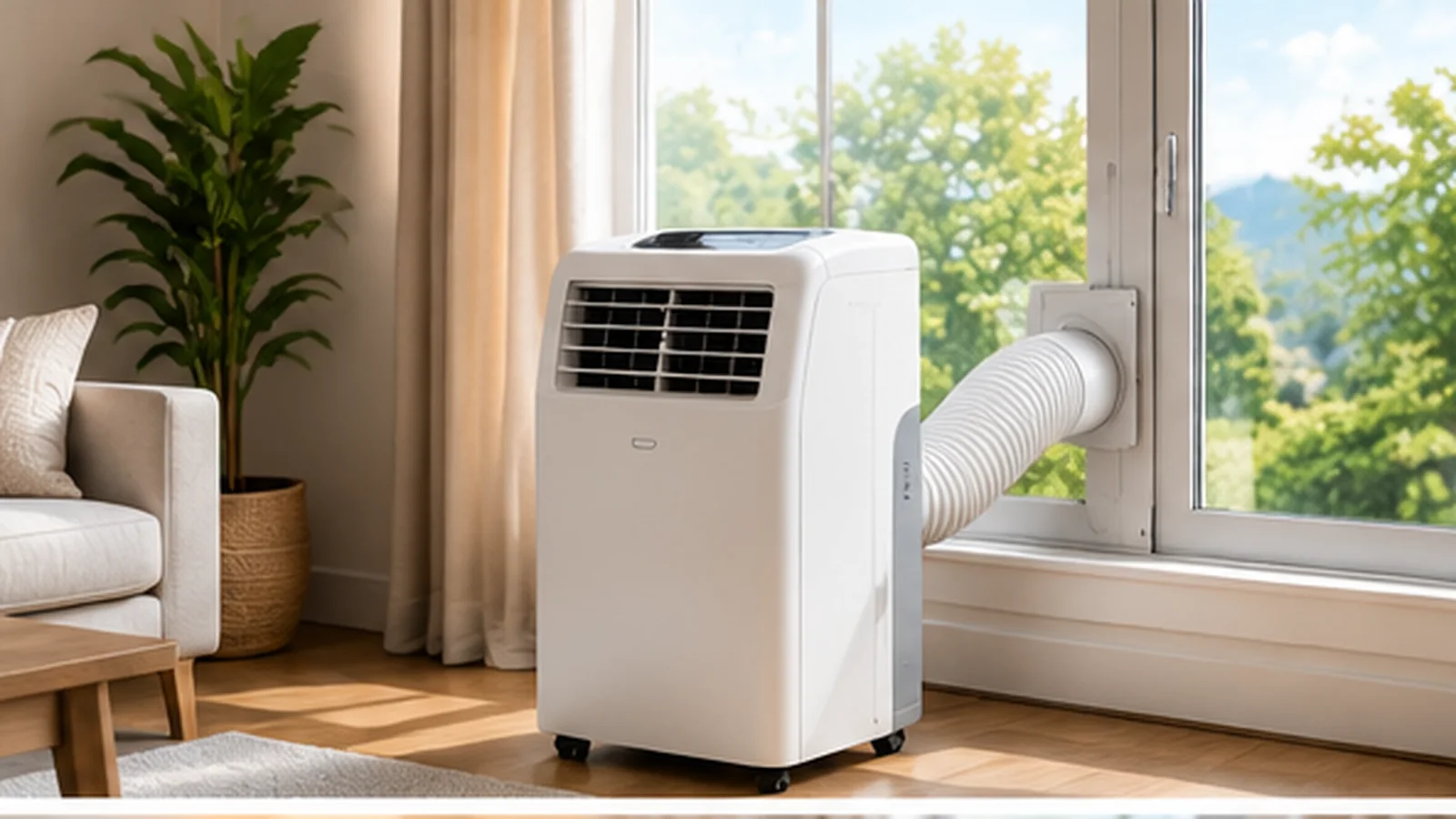
A portable air conditioner works by taking heat and moisture out of indoor air, then sending the heat outdoors through an exhaust hose. It uses the same basic refrigeration process as a window air conditioner. The main difference is that most of its parts sit inside the room rather than through the window.
First, a fan pulls warm room air across a cold evaporator coil. Refrigerant inside the coil absorbs heat, and water vapor in the air may condense on the cold surface. The unit sends cooler air back into the room. The compressor and condenser then release the collected heat into a separate air stream, which travels through the exhaust hose to the outside.
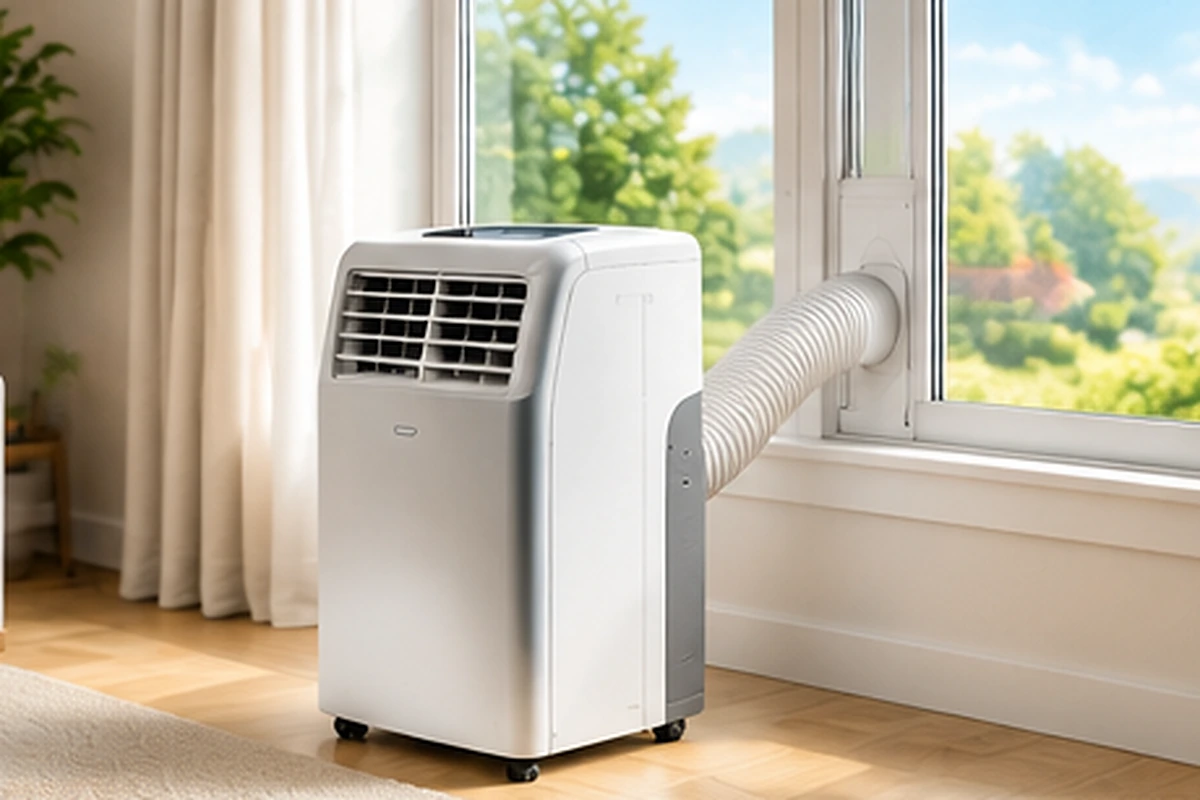
The exhaust hose is part of the cooling system, not an optional accessory. If the unit blows its hot condenser air into the same room, the room does not gain useful net cooling. Its compressor and fan also add electrical heat. This is why a proper outdoor exhaust route matters as much as the cold air you feel near the front grille.
Is a ventless portable air conditioner the same thing?
No. Small products advertised as “ventless portable AC” are often evaporative air coolers. They cool air by evaporating water, rather than moving heat outdoors with a refrigeration system. They can help in some dry conditions, but they add moisture to the air and may be ineffective in humid rooms. Check whether the product has a compressor, refrigerant circuit, and an outdoor exhaust requirement before treating it as a room air conditioner.
How Well Do Portable Air Conditioners Cool a Room?
A correctly installed portable AC can cool one enclosed room, but it often takes longer and uses more energy than a well-matched window unit. It works best when the outdoor heat is vented away, the window kit is sealed, and the room’s heat load is within the model’s tested cooling capacity.
Cooling depends on more than floor area. Sun through large windows, poor insulation, people, computers, cooking equipment, open doors, and hot air leaking around the exhaust kit all add heat. A unit that feels cold at the outlet may still struggle to lower the room temperature if that incoming heat is too great.
Which BTU number should you use?
For U.S.-rated portable ACs, use DOE seasonally adjusted cooling capacity (SACC, Btu/h) to compare cooling output. An “ASHRAE BTU” headline comes from a different test basis, so a model marketed as “12,000 BTU” may have a lower DOE SACC rating. Compare models on the same test basis, then match the tested capacity to your room’s heat load and the manufacturer’s sizing guidance.
For models with US DOE ratings, also look for combined energy efficiency ratio (CEER), in Btu/Wh. SACC describes tested cooling output, while CEER describes rated cooling efficiency under the applicable DOE procedure. At a comparable capacity and under the same test method, a higher CEER generally means more cooling for the electricity used. The temperature change in your room also depends on sunlight, insulation, room heat load, and how well the exhaust is installed. The DOE portable AC guidance identifies the applicable portable-unit standards and testing procedure.
| Rating or specification | What it tells you | How to use it |
|---|---|---|
| DOE SACC (Btu/h) | Tested cooling capacity for portable ACs. | Compare on the same rating basis and match to the room load. |
| DOE CEER (Btu/Wh) | Rated efficiency under the applicable DOE portable AC method. | Compare like-for-like models; higher is generally better. |
| Hose or duct setup | The air paths the product is designed to use. | Check the intended configuration and its installation requirements. |
| Electrical input (W) | Power drawn under the stated operating condition. | Use with your running hours and electricity price to estimate costs. |
| Room condition | What to expect | Useful next step |
|---|---|---|
| Small room, door closed, shaded windows | Temperature should fall if capacity and venting are adequate. | Close gaps around the exhaust kit and let the unit run long enough. |
| Sunny top-floor bedroom or many electronics | Cooling may be slow even if air from the outlet feels cold. | Reduce solar gain, then reassess cooling capacity. |
| Open-plan space or several connected rooms | One portable unit may not reach all areas. | Consider more suitable fixed or multi-zone cooling. |
| Open window or poorly sealed vent adapter | Outdoor heat continuously enters the room. | Seal the kit without blocking the designed exhaust opening. |
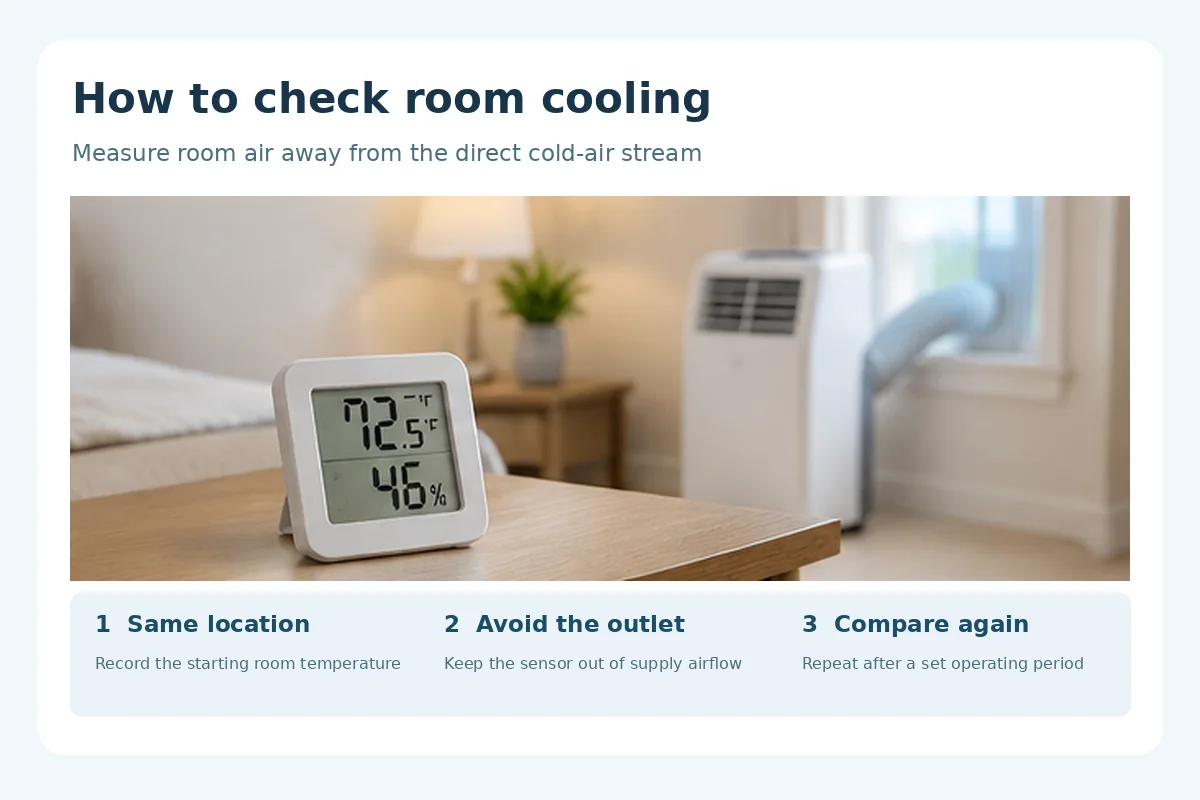
To check whether the room is actually cooling, measure room air—not just the cold air at the outlet. Use a simple, repeatable check:
- Record the room temperature at a spot away from the AC outlet before cooling starts.
- Close the room doors and connect the exhaust kit correctly. Note sunlight and outdoor conditions.
- Run the AC for a set period with the compressor operating, then measure at the same spot and height.
- If the outlet feels cool but the room hardly changes, inspect vent leaks, open doors, solar heat, and whether rated capacity matches the load.
Repeat the reading at the same place and under similar conditions. A falling room temperature shows that the unit is cooling that room; DOE SACC is a separate standardized equipment rating.
Do Portable Air Conditioners Need to Be Vented?
Yes. A refrigerant-based portable air conditioner needs an approved path to exhaust heat outdoors. Most models use a window adapter and one or two hoses. Without that exhaust path, the machine may blow cool air from one side while adding more heat to the same room from the other.
Can you use a portable air conditioner without a window?
Yes, if the unit has a manufacturer-approved way to exhaust hot air outdoors. That may be a suitable exterior-door insert or an approved through-wall connection, where building rules and the unit’s instructions permit it. A window is optional; an outdoor exhaust route is required. Ask the property owner before making a permanent opening. Do not discharge the hose into an attic, ceiling cavity, another occupied room, or a closed garage.
How should the hose and window kit be set up?
Place the unit near an approved outdoor opening, connect the specified exhaust hose and adapter securely, and seal the kit gaps while keeping the required air-intake clearance. Then follow the steps below.
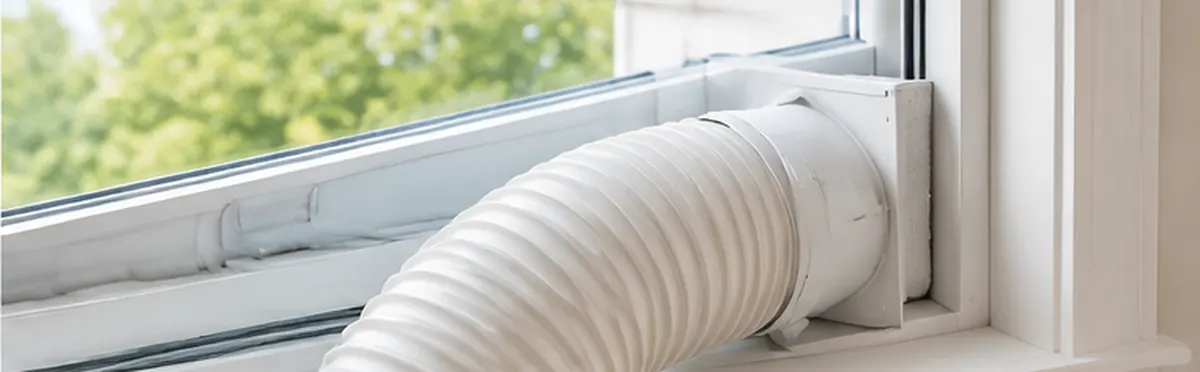
- Place the unit on a level surface with the clearance specified in its manual.
- Use the supplied or manufacturer-approved hose and adapter. Keep the hose as short and straight as the instructions allow; do not crush or extend it with an unapproved duct.
- Seal the gaps around the window or door adapter so outside air does not freely enter.
- Make sure exhaust air actually reaches outdoors and is not redirected into another air intake.
- Keep the electrical connection dry and follow the unit’s approved power connection instructions. Avoid unapproved extension cords.
Before choosing a unit, measure the usable window or door opening and compare it with the supplied vent kit. Confirm that the permitted hose length and bends let you reach outdoors, that intake clearance is available, and that an approved outlet is within the manufacturer’s allowed cord reach. If rental or building rules prohibit every safe exhaust option, a compressor-based portable AC is not suitable for that room.
If the hose gets very hot, slips out of its fitting, or sends exhaust back indoors, correct the setup before judging whether the unit is strong enough. The US Department of Energy’s portable air conditioner information also distinguishes portable units by their duct arrangements and cooling test methods.
Dual-Hose vs Single-Hose Portable AC: Which Works Better?
A dual-hose portable air conditioner is often the stronger choice when hot replacement air is entering a room, while the best model is the one with enough tested cooling capacity for your space. A separate outdoor air intake reduces the need to draw conditioned room air through the condenser.
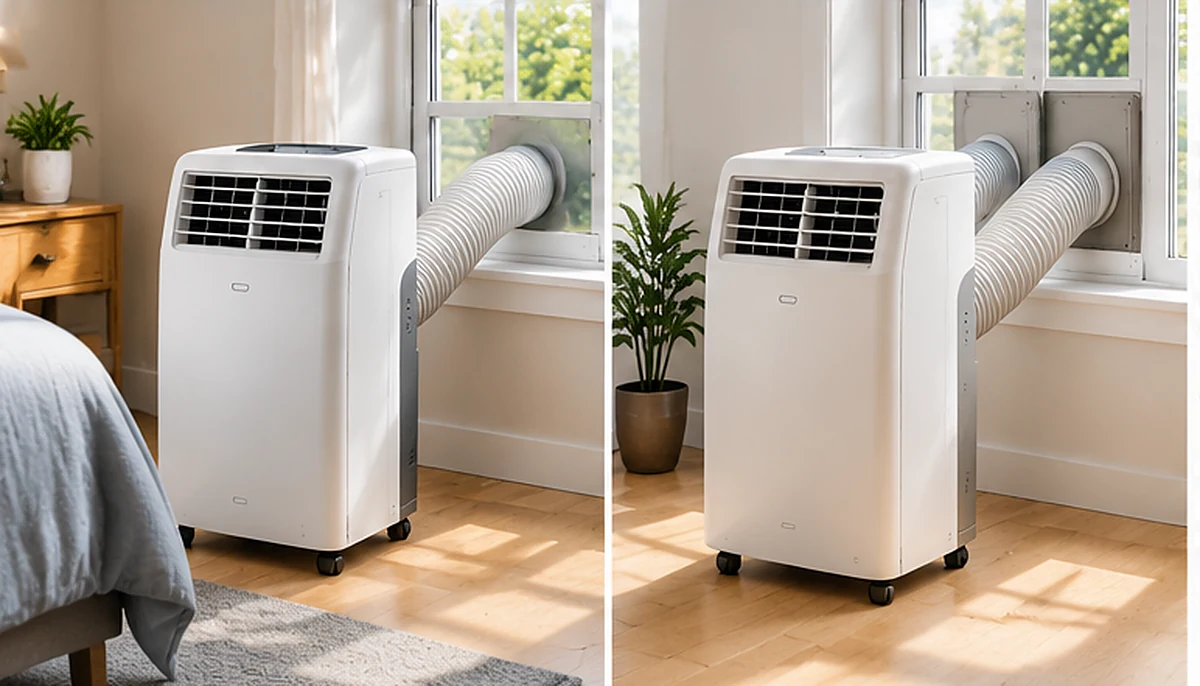
| What changes | Single-hose portable AC | Dual-hose portable AC |
|---|---|---|
| Air used to cool the condenser | Usually draws air from the room. | Usually draws condenser air from outdoors through an intake hose. |
| Air pressure | Exhausting indoor air can create negative pressure and draw warm replacement air inside. | Reduces this particular loss by separating the condenser-air path. |
| Installation | One exhaust hose; typically simpler adapter. | Two hose connections and more space needed near the opening. |
| What to compare | DOE SACC cooling capacity, the same-basis efficiency rating, sound level, hose requirements, and room fit. | |
Choose by test results before hose count: Compare the DOE SACC of models that can meet the room’s load. Next, check CEER on a consistent rating basis, indoor noise, and the vent layout that will fit your opening. For electricity costs, compare each model’s actual input power and expected running hours.
The trade-off matters most when the room is hot, the portable unit runs for hours, or replacement air enters through gaps from other spaces. A single-hose model can still work well in a small, well-matched room. For either design, a blocked intake or badly sealed vent can undo the benefit of an otherwise good unit.
One extra check: if the building has a fuel-burning appliance, significant negative pressure from exhaust equipment can create a backdraft concern. Keep combustion safety and ventilation requirements in mind rather than attempting to “seal the room completely” around every air source.
Do Portable Air Conditioners Work as Well as Window Units?
Usually not. A well-sized window air conditioner generally cools a room more effectively and with less energy than a typical portable unit. A portable unit can still be the right choice when window installation is restricted or a temporary system is needed.
An independent portable-versus-window air conditioner comparison also describes this usual trade-off. A window unit keeps most condenser heat and noise outside. A portable model keeps the compressor and condenser indoors and must move hot air through a hose. Single-hose units may also pull warm replacement air through gaps. This is one reason a portable AC can feel less effective even when both products display similar headline BTU numbers.
| Choice | Best fit | Main drawback |
|---|---|---|
| Portable air conditioner | Temporary cooling, rental restrictions, or windows that cannot hold a window unit. | Floor space, indoor noise, hoses, and possible efficiency loss. |
| Window air conditioner | One room where the window design and building rules allow installation. | Needs a compatible window and secure mounting. |
| Wall-mounted mini-split | Long-term cooling for one or more defined zones. | Professional installation, equipment cost, and a permanent outdoor connection. |
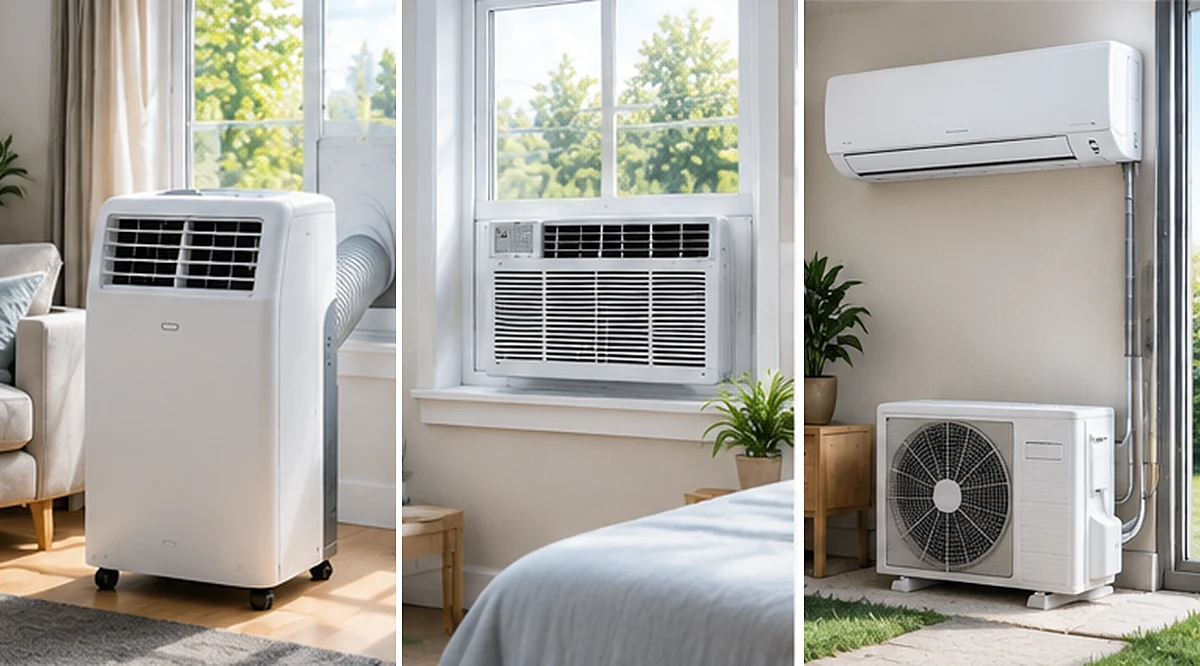
Pick the installation you can actually use first. If a secure window AC is allowed and fits properly, compare that option for regular single-room use. If a window unit is restricted but an outdoor exhaust kit is permitted, a portable AC may be the practical alternative. For several rooms cooled for long daily hours, compare a properly sized fixed system and its installed cost instead of looking only at the purchase price.
Do not compare models solely by a large BTU figure. Check the proper performance label for each equipment category and whether each model can handle the room’s actual load. Ratings from different test methods are not automatically interchangeable. A DOE rating describes defined test conditions; an independent review describes the models it actually tested; your own room check describes your installation. Use each equipment type’s applicable rating to compare models, then use room-temperature readings to check how your installation performs.
For a broader explanation of different air conditioner types and where they fit, see our system guide. If the cooling need is permanent, look at the total installation and running requirements rather than convenience alone.
For a permanent alternative to portable room cooling, our mini split air conditioner guide explains how separate indoor and outdoor units work. It also covers the installation conditions for cooling one room or several defined zones.
Do Portable Air Conditioners Use a Lot of Electricity?
Portable air conditioners can use substantial electricity when they run for many hours, but the cost depends on the unit’s input wattage, actual running time, and your electricity rate. A 1,000-watt unit drawing that power for six hours uses 6 kilowatt-hours (kWh), regardless of the BTU figure on its cooling-capacity label.
Monthly electricity cost = input watts ÷ 1,000 × hours per day × days × price per kWh. Use the electrical input power from the manufacturer’s rating plate or technical sheet. Cooling capacity in Btu/h is not electrical input in watts, so do not convert the advertised BTU figure directly into a bill.
How much does a portable air conditioner cost to run?
At an assumed $0.20/kWh, a 1,000 W portable AC drawing that power for six hours a day over 30 days uses 180 kWh and costs $36 in electricity. The calculation is 1.0 kW × 6 hours × 30 days = 180 kWh, then 180 kWh × $0.20 = $36.
| Example input power | Energy for 180 running hours | Cost at assumed $0.20/kWh |
|---|---|---|
| 800 W | 144 kWh | $28.80 |
| 1,000 W | 180 kWh | $36.00 |
| 1,200 W | 216 kWh | $43.20 |
| 1,500 W | 270 kWh | $54.00 |
How much does use time change the bill? At the same example input of 1,000 W and assumed price of $0.20/kWh, 60 operating hours cost $12, 180 hours cost $36, and 240 hours cost $48. This comparison shows how operating hours change electricity cost when input power and the rate stay the same.
These figures assume the stated power draw for all 180 hours. A unit that cycles off will usually draw less over that period; a variable-speed model may change its power level. Fans, dehumidification, standby use, local tariffs, and cooling demand also affect the actual result. To estimate your cost, replace the example rate and hours with your own values and, where possible, check measured kWh use.
How can you reduce portable AC power use?
Seal the exhaust adapter, shade sun-facing glass, close unused doors, clean the filters as instructed, and set a practical temperature rather than the lowest possible setting. If you need the same room cooled every day throughout a long season, compare a window or mini-split system’s expected total cost instead of choosing on portable purchase price alone. Our air conditioner running-cost guide explains the wider electricity-cost factors.
Do Portable Air Conditioners Need to Be Drained?
Some portable ACs need regular draining, while others remove much of the condensed water through the exhaust. Even a “self-evaporating” model may require its tank to be emptied during very humid weather or in dehumidifier mode.
As moist room air crosses the cold evaporator coil, water condenses. The unit must collect, reuse, evaporate, or drain that water. How it handles condensate depends on the design and operating mode, not just the cooling capacity.
| Drain arrangement | What you need to do |
|---|---|
| Collection tank | Empty the tank when the full-water light or manual says to do so. |
| Self-evaporating design | Normally less manual draining, but check the manual for humid conditions and other modes. |
| Continuous drain connection | Route the approved hose to a suitable drain with the required slope or pump arrangement. |
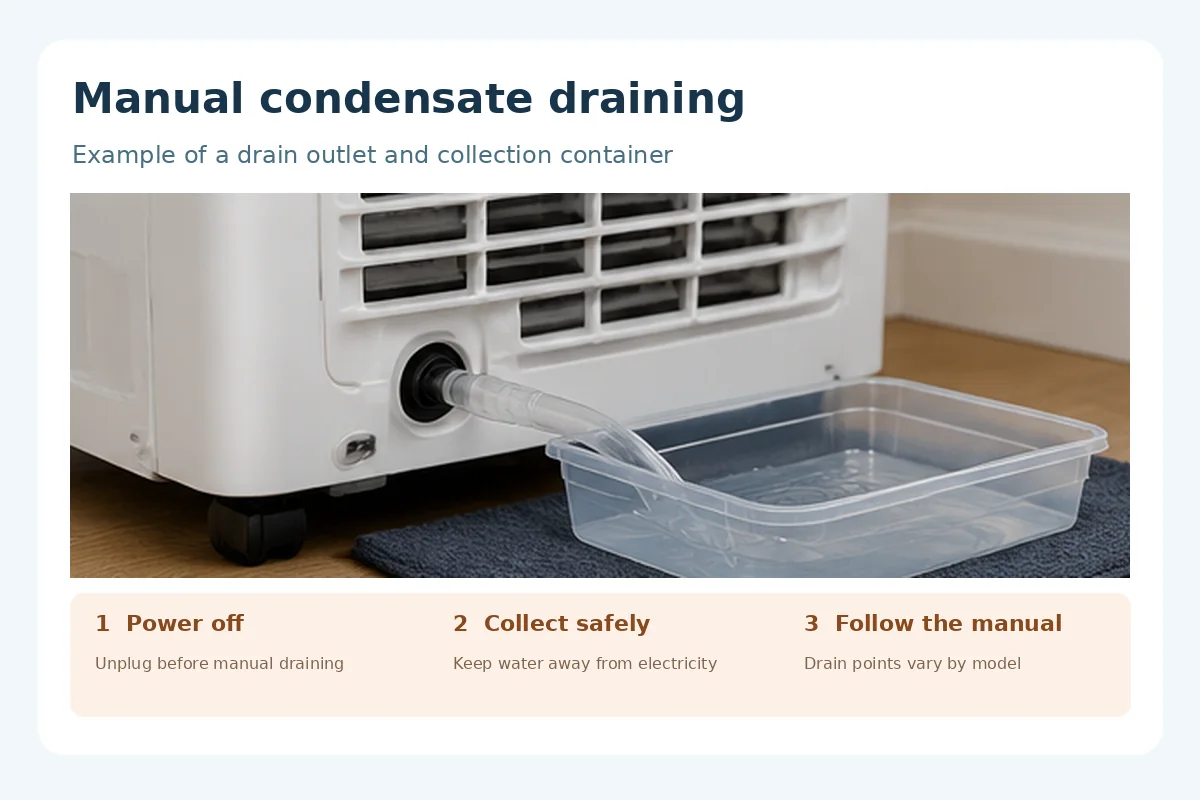
Dedicated dehumidification mode may collect water faster than normal cooling. Check the drain instructions for that specific mode, even on a model advertised as self-evaporating.
Before opening a drain port, turn off and unplug the unit as the manual directs, position a shallow container or approved hose, and protect flooring. Never defeat a full-water shutoff. If water leaks from the cabinet, stop operating the unit and check the cap, hose, tank, and level placement before restarting.
Why Is My Portable AC Running but Not Cooling?
Common reasons a portable AC runs but does not cool are exhaust leaks, high room heat gain, restricted airflow, incorrect settings, or a full-water alarm. If the fan runs but the outlet air never cools, check the cooling mode and the restart delay in the manual before arranging service.
| What you notice | Likely checks | What to do and verify |
|---|---|---|
| Air feels cool near the vent, but the room stays hot | Loose exhaust hose, unsealed window kit, open door, strong sunlight, or insufficient SACC. | Repair the seal and reduce heat gain. Measure room temperature at the same location after running. |
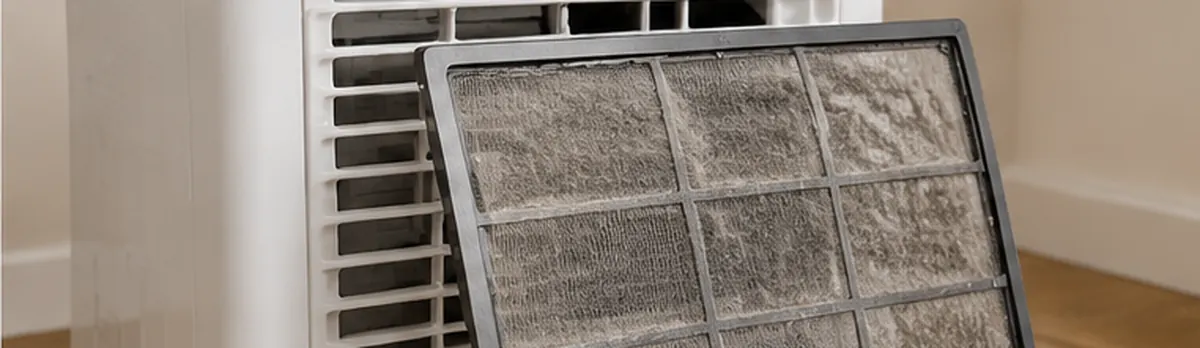
| Airflow is weak | Dusty washable filter, blocked grille, or inadequate clearances. | Clean only as directed by the manual and restore airflow; recheck the output. |
| Unit stops cooling and shows a water alarm | Full tank, blocked drain, or incorrect drain setup. | Follow the model’s drain procedure, clear the alert, then confirm normal operation. |
| Fan runs but the outlet never becomes cooler | Wrong mode or set point; possible compressor, sensor, or refrigeration fault. | Select cooling mode and a suitable set point. If it still fails, arrange qualified service. |
| Water leaks or electrical protection trips | Drain problem or possible electrical defect. | Switch off, unplug where safe, and obtain appropriate service before reuse. |
Cool outlet air, but the room stays warm? Correct exhaust leaks and room heat gain first, then recheck room temperature away from the outlet. No cool outlet air even in cooling mode? Check the settings, drain alarm, and airflow, then allow the restart delay specified in the manual. If it still fails, arrange qualified service. Do not open the sealed refrigerant system, bypass electrical protection, or make a new exhaust opening as a shortcut.
Are Portable Air Conditioners Worth It?
Yes, when you need cooling for one room and cannot install a window or fixed system. They are less attractive for a large area, daily long-hour operation, or several rooms. The right answer depends on whether a practical exhaust opening exists, how often cooling is needed, and what your alternative installation would cost.
Before choosing, confirm these six conditions:
- There is an approved opening to exhaust hot air outdoors.
- The model’s tested cooling capacity is suitable for the room’s heat load.
- The unit fits on the floor with all required intake clearances.
- The allowed power connection works with the room’s electrical supply.
- Its noise level is acceptable for sleeping, working, or other planned use.
- You can manage the unit’s tank or continuous-drain requirements.
When a portable AC is a good choice
A portable AC is a good choice for one room when temporary or movable cooling matters and an approved outdoor exhaust route is available.
- Rental or temporary space: the building allows an exhaust kit but not a window unit or permanent changes.
- One problem room: you mainly need spot cooling during a hot spell, and the correct tested capacity is available.
- Short or seasonal use: easy removal and storage matter more than the lowest yearly power cost.
When to choose another cooling system
Choose a window AC for frequent one-room use when installation is allowed, or compare a properly sized fixed system for larger, multi-room, or permanent cooling needs.
- Window unit permitted: compare a properly fitted window AC first, particularly for regular use.
- Several rooms or large open area: one portable hose-connected unit is unlikely to cool the whole space evenly.
- Permanent room cooling: a professionally installed mini-split may deliver a quieter, more suitable long-term result.
If an approved exhaust route, suitable capacity, floor clearance, or safe power connection is unavailable, solve that first. Compare running hours and overall cost only after the installation is practical.
If a fixed system is possible, see our mini split heat pump installation guide for the piping, drainage, power, and commissioning work involved. This is different from fitting a portable AC window exhaust kit.
For permanent room cooling where a split system can be installed, review our wall-mounted split air conditioner range. Share your location, room or zone cooling load, electrical supply, and installation limits so we can discuss options that suit the project.
So, Do Portable Air Conditioners Really Work?
Yes—for one suitably sized room with a real outdoor exhaust path. They are useful when you need temporary, movable cooling and a window or split system is not practical. They are less convincing for large spaces or long daily use, where a window AC or permanent system may offer better comfort and running efficiency. Check the actual portable cooling rating, install the hose correctly, account for drainage, and estimate electricity use from watts rather than the advertised BTU number.
Portable Air Conditioner FAQs
Can you run a portable air conditioner all night?
Yes, if the unit is correctly vented, its air path is clear, and the power and drainage setup follows its manual. Use a suitable temperature setting, keep the exhaust opening secure, and check noise levels before choosing one for a bedroom. The operating hours also count toward your electric bill.
Will a portable air conditioner cool an entire apartment?
Usually not. Most portable ACs are intended to cool a single enclosed space. Open doors, long hallways, and rooms with separate heat gains make one unit less effective. For several rooms, compare properly sized fixed or multi-zone systems.
Does a portable air conditioner need water added to it?
A standard refrigerant-based portable AC does not need you to add water to make cold air. It normally removes water from humid air instead. A small evaporative cooler may require water to be added, but it is a different type of product and does not exhaust refrigeration heat outdoors.
Can a portable air conditioner work with a casement window?
It can if you use an appropriate, securely fitted vent adapter approved for that unit and window type. A standard sliding-window kit may not fit a hinged casement window. Check the manufacturer instructions, building rules, and weather seal before use; do not leave the exhaust loose in the room.
Do dual-hose portable air conditioners always cost less to run?
No. Dual hoses can reduce the warm replacement air drawn into a room, but actual power use also depends on compressor design, cooling capacity, room load, and controls. Compare suitable models on consistent cooling and efficiency ratings, then estimate cost from their electrical input watts and expected operating hours.
How long should a portable air conditioner take to cool a room?
A correctly vented portable AC with enough cooling capacity should gradually lower the temperature of an enclosed room. How long it takes depends on the starting temperature, sunlight, insulation, and heat entering the room. Measure the room temperature away from the outlet at the same spot over a set interval. If it barely changes, check the exhaust setup and room heat gain before assuming the unit is faulty.