
A window air conditioner with heat provides cooling and heating for one room, but the heating may come from an electric element or a heat pump. For occasional extra warmth, a resistance-heated model can work well. For regular heating, start with a heat pump whose output meets the room’s winter load. In both cases, match the heating capacity, outdoor operating range, window fit and electrical supply.
The most important check is simple: a cooling BTU rating does not tell you how much heat the unit can deliver in winter. Read the separate heating data before treating a window air conditioner and heater combo as your room’s main heat source.
What does a window air conditioner with heat do?
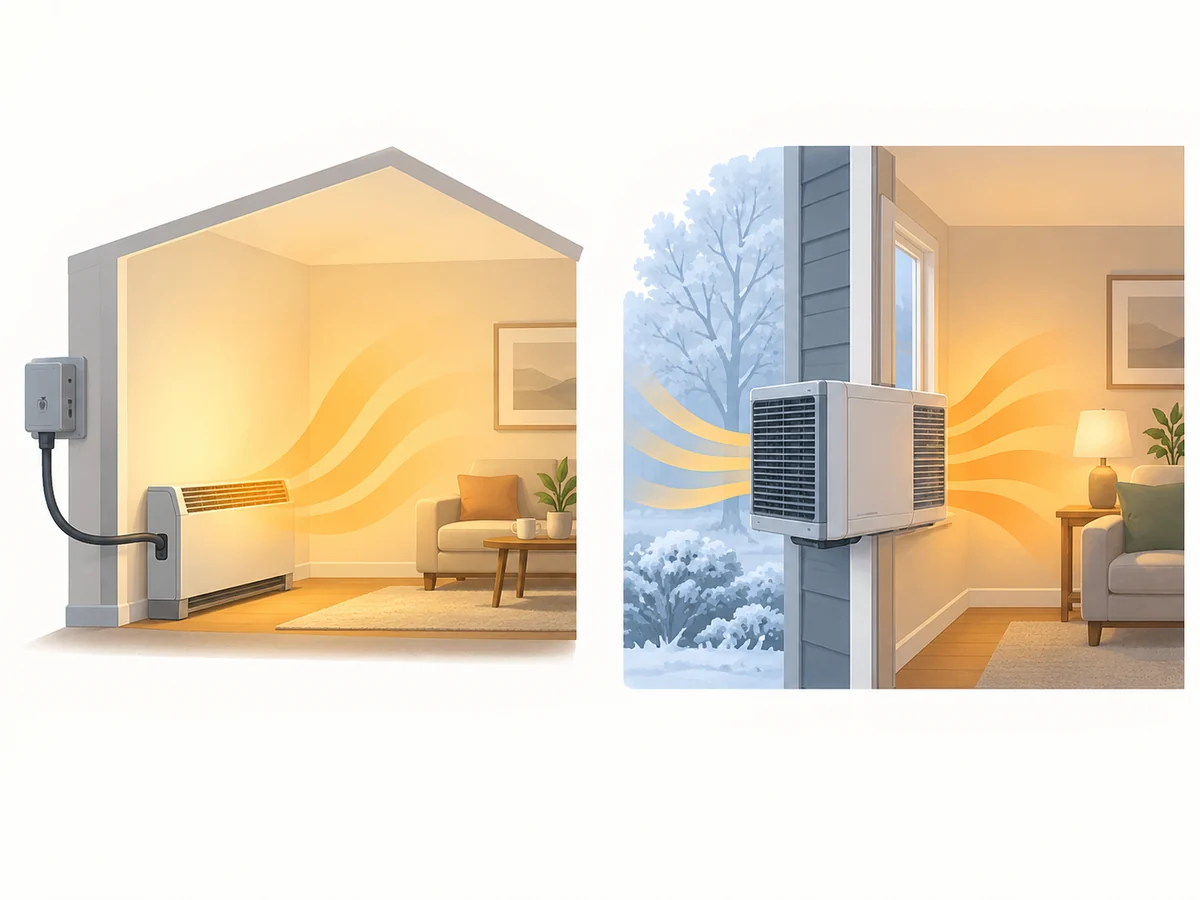
A window air conditioner with heat cools and warms one room from a single unit fitted into a suitable window. Its heating system may use an electric resistance element or a reversible heat pump. That difference affects winter performance and electricity use much more than the words “heat/cool” on the box.

A window air conditioner and heater combines the room-side and outdoor-side equipment in one cabinet. The indoor fan moves room air across a coil or heater. The outdoor section must remain open to outside air. A normal cooling-only window AC does not become a room heater just because its outdoor section feels hot.
Electric resistance heat
An electric element turns electricity into heat, much like a fan heater. Many window AC heater combos use this function for supplemental warmth. Read the heating capacity separately from the cooling capacity. A room that the unit can cool in summer may need more winter heat than its element can supply.
Heat-pump heating
A window air conditioner with a heat pump moves heat from outdoors into the room. A reversing valve changes how the refrigerant circuit works between cooling and heating. Because it moves heat, the machine can deliver more heat energy than the electricity it uses. Its available output and efficiency still change with outdoor temperature.
A heat pump’s efficiency is often shown as its coefficient of performance (COP). COP 2 means two units of heat delivered for each unit of electricity used under the stated conditions. Higher COP means less electricity for the same amount of heat.
| What to compare | Electric resistance heat | Heat-pump heating |
|---|---|---|
| Where the heat comes from | Electricity heats an element | Refrigerant carries outdoor heat indoors |
| Electricity for the same useful heat | Roughly one unit of electricity per unit of heat | Less when the operating COP is above 1 |
| Winter suitability | Heating output and approved operating conditions decide the fit | Low-temperature capacity and operating limits decide the fit |
| Best starting use | Occasional supplemental warmth | Frequent heating within the model’s rated conditions |
Heat pumps with electric backup
Some window heat pumps also contain an electric resistance heater. The compressor supplies heat within its operating range. The electric heater may assist or take over when the controls call for it. These are two heating methods combined in one appliance.
Read the heat-pump output, electric-heat output and electrical input separately. Backup heat raises electricity use, and the model’s installation instructions determine the required circuit. Check its changeover settings—the conditions that turn backup heat on—in the operating manual.
An inverter air conditioner varies compressor speed to match demand. Inverter control alone does not provide heating; a window unit also needs an explicit heat-pump specification, heating performance data and a heating operating range.
Heat pump or electric heat: which should you choose?
For regular heating, start with a heat-pump model that can meet the room’s winter load. For occasional extra warmth, a resistance-heated window unit can be a practical choice. If the unit will be the only heater, check its output at your local cold-weather design temperature before choosing either type.
A room’s heating load is the heat it loses in cold weather. The winter design temperature is the outdoor temperature used to size its heating system. Compare the unit’s heat output at that temperature with the room’s calculated heat loss.
For mild weather and occasional heating
For occasional extra warmth, an electric-resistance model can be a practical choice when its heating output is enough and its installed cost is lower. For daily heating, favor a heat pump with adequate capacity and a lower calculated running cost.
Supplemental heat adds warmth alongside the room’s main heating system. Compare its separate heating output with the extra heat the room needs. For example, LG’s published LW8023HR sheet lists 7,600 BTU/h cooling but only 3,850 BTU/h heating. Those ratings describe different jobs; compare the heating figure with winter heat loss.
For freezing weather and primary heating
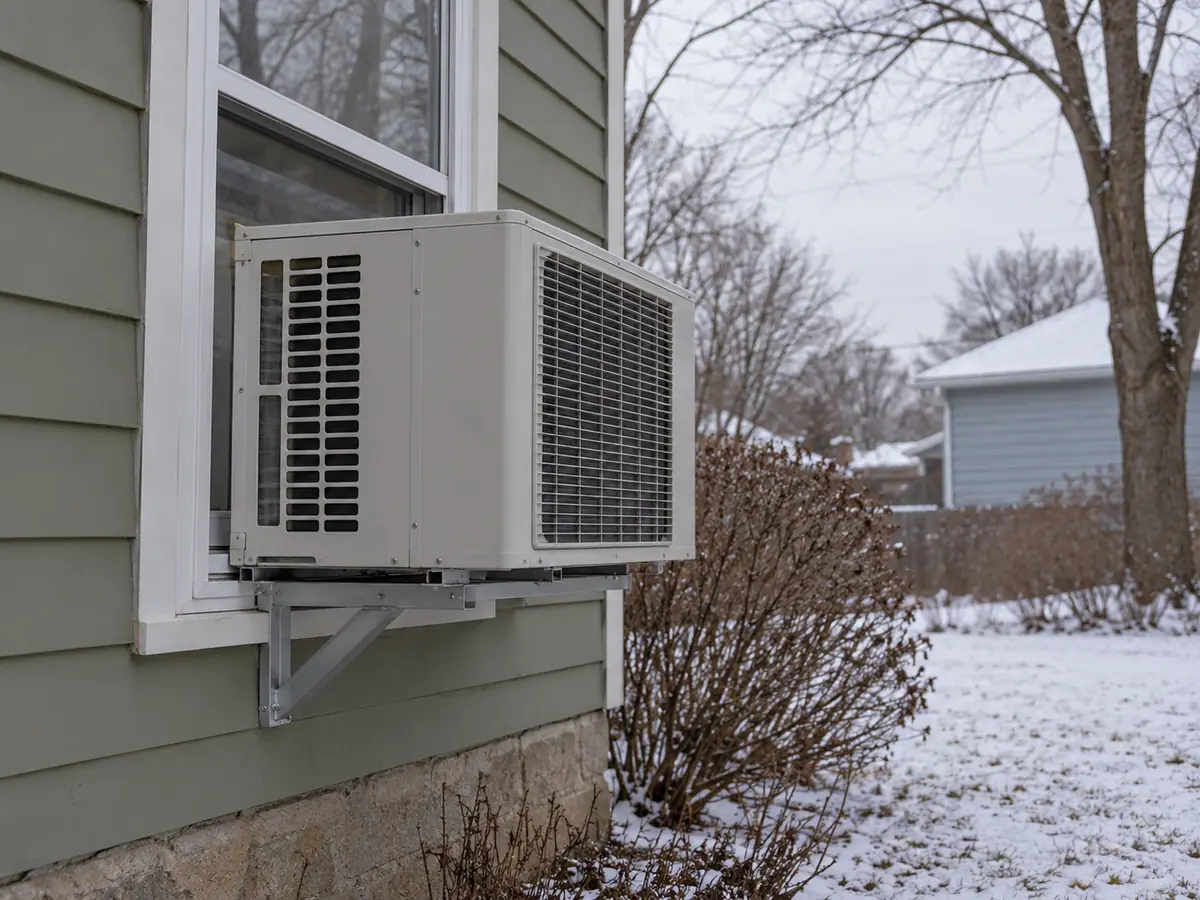
For primary heating in freezing weather, choose a cold-climate heat pump whose published output covers the room’s heat loss at the local winter design temperature. Plan backup heat for any shortfall. The Midea manual covering MAW12HV1CWT and MAW08HV1CWT states that heating stops below 41°F (5°C), with “LO” displayed. A unit with that limit cannot serve as the only heater through freezing weather.
Cold-climate window heat pumps can have very different winter performance. Table 1 of NYSERDA Report 25-21, Clean Heat for All Pilot, identifies the following performance for the Midea America pilot unit.
| Unit and source | Outdoor temperature | Heat output | COP | What this means |
|---|---|---|---|---|
| Midea America pilot PWHP; Report 25-21, Table 1 | 5°F (−15°C) | 9,620 BTU/h | 2.10 | More heat and higher efficiency than at −13°F |
| Same unit and source | −13°F (−25°C) | 5,050 BTU/h | 1.41 | Still operates, but supplies much less heat |
The 5°F entry is marked as Intertek test data in the report. At −13°F, the unit still operates but delivers much less heat. Compare that output with the room’s heat loss at the same outdoor temperature. Match the offered unit’s complete model number and technical-document version when using a performance table. If the offered unit includes electric backup, obtain its separate heating output and electrical requirements.
For a main heater, compare these three items together:
- The room’s heat loss at the local winter design temperature.
- The model’s available heating output at that same temperature, including how defrost affects delivered heat.
- How any shortfall will be covered and controlled.
During defrost, a heat pump clears frost from its outdoor coil. Room heating may pause or change during that cycle. Use the model’s stated behavior to distinguish a normal pause from a fault; persistent ice and falling room temperature need investigation.
Will it work on a 110-, 115- or 120-volt outlet?
Some window AC units with heat work on North American 115/120-volt supplies, but others need a different voltage or circuit. Match the exact model’s nameplate, plug, frequency and circuit requirements. Cooling capacity alone cannot tell you which outlet it needs.
Searches for a “110 volt window air conditioner with heat” usually refer to the North American nominal 120-volt supply family. Products may carry a 115-volt appliance rating. Use the voltage and frequency shown on the unit’s nameplate. A 230-volt appliance needs its specified supply, and a plug adapter does not change the supply voltage.
Check the heating electrical load, even when the existing outlet runs a cooling-only AC successfully. The LG LW8023HR sheet, for example, lists 670 W for cooling and 1,260 W for heating, with a rated heating current of 11 A. The higher heating demand can expose a circuit problem that was less obvious in summer.
- Read voltage and frequency from the model’s electrical data. A 50 Hz export model is not automatically suitable for a 60 Hz installation.
- Compare the plug and required circuit rating with the actual outlet and circuit. Follow any dedicated-circuit requirement.
- Have an electrician check an unknown circuit, damaged receptacle or repeated breaker trip before use.
- Connect directly as the manufacturer instructs. Do not use an extension cord, power strip or improvised plug conversion.
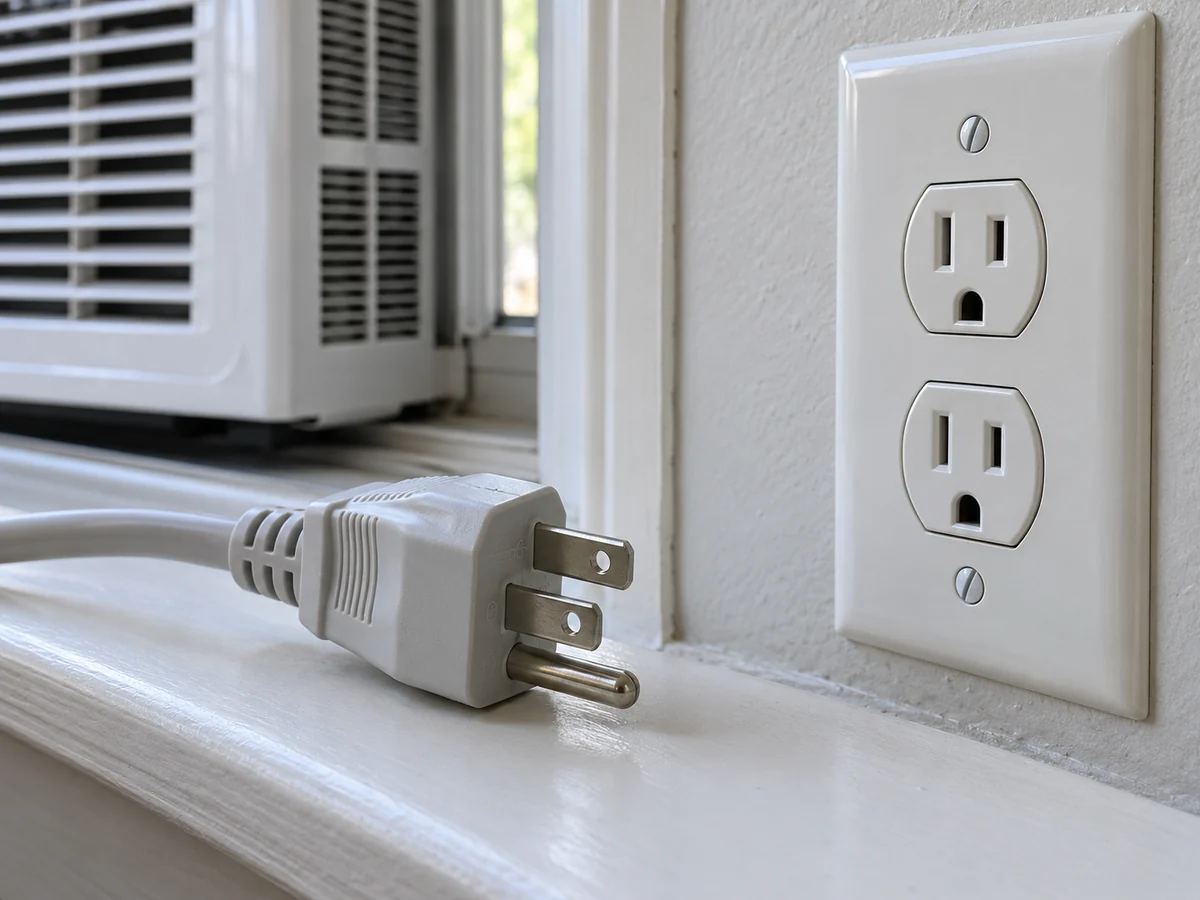
Stop using the unit if the plug or outlet overheats, shows scorching, smells burnt or repeatedly trips protection. Have the fault corrected before restarting; a larger breaker is not a fix for an overloaded or unsuitable circuit.
What size window AC with heat do you need?
Size cooling and heating separately, then choose a model that can do both jobs under the conditions in your room. A cooling-area claim does not establish winter heating coverage. Insulation, air leakage and the indoor-to-outdoor temperature difference all affect heat loss.
For cooling, measure the connected room area and account for sunlight, occupants, ceiling height and heat-producing equipment. For primary winter heating, get the room’s design heat loss using its walls, windows, insulation, air leakage and local winter temperature. The DOE’s HVAC sizing guidance explains why both heating and cooling loads are needed. Our air conditioner sizing guide gives a room-cooling starting method.

Compare 8,000, 12,000 and 18,000 BTU classes
The 8,000, 12,000 and 18,000 BTU/h classes provide about 2.34, 3.52 and 5.28 kW of cooling output. Choose the cooling class from the room’s cooling load, then check heating capacity separately. The larger cooling number does not establish better winter heating coverage.
In equipment data, BTU/h means British thermal units per hour. It measures the rate of heat transfer, not electricity consumption.
| Cooling class | Cooling output | Heating data to obtain | What can rule it out |
|---|---|---|---|
| 8,000 BTU/h | About 2.34 kW | Separate heating output, heating method and operating range | The heater cannot cover the required room heat loss |
| 12,000 BTU/h | About 3.52 kW | Heat output and COP at the winter design temperature; any backup heater | Heat stops before the required outdoor condition, without suitable backup |
| 18,000 BTU/h | About 5.28 kW | The same heating checks, plus circuit and mounting requirements | Cooling is oversized, or the opening, support or power supply is unsuitable |
These conversions use 1 kW ≈ 3,412 BTU/h. A 12,000 BTU window air conditioner with heat does not necessarily draw 3.52 kW of electricity or deliver 12,000 BTU/h of heat. Look up input watts and heating output in their own specification fields.
What if cooling fits but winter heating falls short?
Choose a model with enough heating output, reduce the room’s heat loss, or provide suitable backup heat. Keep the cooling capacity matched to the room. For example, suppose the room loses 6,000 BTU/h at −13°F. A candidate delivering 5,050 BTU/h there leaves a 950 BTU/h shortfall, so it is unsuitable as the sole heater at that condition.
If the room instead loses 4,800 BTU/h at the same temperature, 5,050 BTU/h is above that load. This leaves 250 BTU/h above the calculated heat loss. Keep the candidate on the shortlist while checking its circuit, installation and performance during defrost. Changing the room’s heat loss can change the choice even when the unit stays the same.
Simply jumping to a much larger cooling unit can create a summer problem. An oversized fixed-speed AC may cycle too often and remove moisture poorly. Variable-speed operation helps match changing demand, but its minimum output and room airflow still matter. A unit serving one open room also cannot be sized as though it evenly serves closed bedrooms.
How much electricity does window-unit heating use?
Electricity use equals the heat the room needs divided by the heater’s operating COP. In the example below, delivering 240 kWh of heat uses about 240 kWh of electricity with resistance heat, or 96 kWh with a heat pump averaging COP 2.5. Multiply electricity use by your tariff to calculate cost.
For resistance heat, electrical input and heat output are roughly equal. For a heat pump, use the COP introduced above. It changes with operating conditions. Use temperature-specific data for a cold-weather check, and suitable seasonal heating data for a seasonal estimate.
Cooling efficiency is not heating efficiency
A high cooling-efficiency rating does not establish low heating cost. Room AC listings commonly show a combined energy efficiency ratio, or CEER. It combines cooling performance with defined standby and off-mode energy use. It is not a heating COP. You may also see EER, the energy efficiency ratio for cooling at stated test conditions.
| Rating | Use it for | Before comparing |
|---|---|---|
| EER / CEER | Cooling efficiency; CEER also includes defined standby and off-mode use | Use the same rating method and comparable cooling duty |
| Heating COP | Heat delivered per unit of electricity at stated conditions | Match outdoor and indoor test conditions |
| A published seasonal heating rating | A heating-season comparison under its stated test method | Check the method and units; do not treat the printed number as a COP |
Use heating capacity and COP at the same outdoor temperature when checking a cold night. Do not insert CEER or an unconverted seasonal rating into the COP calculation below.
Manual calculation:
Useful heat (kWh) = average heat demand (kW) × hours
Electricity (kWh) = useful heat ÷ operating COP
Electricity cost = electricity × rate per kWh
For example, suppose a room needs an average 2 kW of heat for 120 heating hours in a month. That is 240 kWh of useful heat. Assume electricity costs $0.20/kWh, resistance COP is 1, and the heat pump averages COP 2.5 over those hours.
| Same 240 kWh heat delivered | Electricity used | Calculated cost |
|---|---|---|
| Resistance heat, COP 1 | 240 ÷ 1 = 240 kWh | $48.00 |
| Heat pump, COP 2.5 | 240 ÷ 2.5 = 96 kWh | $19.20 |
| Difference | 144 kWh | $28.80 |
If the heat pump averages COP 1.5 instead, it uses 160 kWh and costs $32.00 for the same delivered heat. If it stops below its heating limit, calculate the backup heater’s electricity for those hours separately. Do not continue applying a mild-weather COP to heat the unit cannot supply.
Does a higher purchase price pay back?
With an assumed $300 installed-price premium and the earlier $28.80 saving per heating month, break-even is about 10.4 equivalent heating months. The calculation is $300 ÷ $28.80 ≈ 10.4. This uses the earlier 120-hour-per-month example, with both options delivering the same useful heat.
At just 30 heating hours per month with the same average load, COP and tariff, the saving falls to $7.20, and break-even becomes about 41.7 equivalent months. Compare that use with the time you expect to keep the unit. Add different installation, maintenance and backup-heating costs when comparing the full options.
Compare the complete installed cost and support
Compare the same installation and service scope before using the payback result. A lower unit price can be outweighed by electrical work, missing mounting parts or repair shipping.
- Equipment and fitting: unit, approved bracket, window panels, seals and delivery.
- Site work: installation labor, any circuit work and the planned backup heat source.
- Warranty: parts and labor periods, exclusions, registration requirements and who handles a claim.
- Local service: whether in-home repair is available, which parts can be obtained, and who pays if the unit must be shipped away.
Get these items included or clearly excluded in each written offer. For your comparison, replace the example’s $300 price premium with the difference between complete installed offers. DOE room-AC guidance also separates efficiency savings from the up-front price premium.
What must you check before installation?
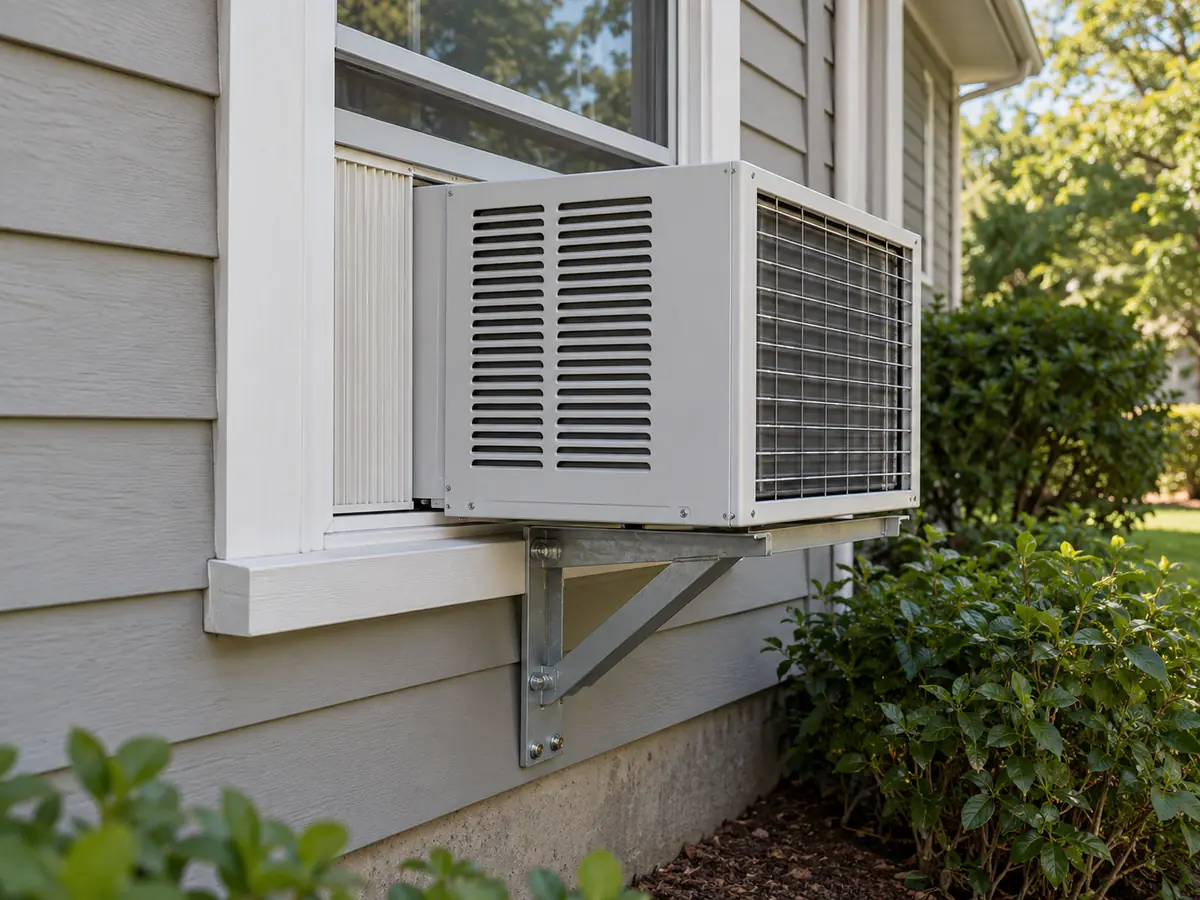
Confirm window fit, structural support, outdoor airflow, water management and electrical supply before installing a heat/cool window air conditioner. The cabinet fitting through the opening is only the first check.
- Match the window type. Measure clear opening width and height, sill depth and any storm-window obstruction. Compare them with the installation drawing, including bracket space. A kit for a vertically opening sash is not automatically suitable for a horizontal slider or casement window.
- Provide the specified support. Check the frame’s condition and use the approved bracket or mounting hardware. Follow lifting instructions and use help appropriate to the unit’s weight. Secure the sash and unit as instructed; do not rely on a loose sash to hold the cabinet.
- Keep outdoor ventilation clear. The rear and side openings must have the clearances required by the model. A deep wall opening can block a window unit’s side louvers. Do not assume a window AC is also approved for through-wall installation.
- Follow the water-management instructions. Use the model’s specified mounting angle, drain arrangement and plugs. Some designs retain water as part of normal operation. Do not drill extra drain holes or copy another model’s tilt angle.
- Seal around the opening. Fit the supplied seals and panels without blocking louvers or drainage. Gaps that leak outdoor air increase winter heat loss and can create a cold draft beside the unit.
- Keep safe access. Leave filter and service access and do not obstruct a required emergency escape opening. For a rental, settle permission for brackets, fasteners and window changes before work starts.
Check the result in both operating modes
After installation, run cooling and heating separately when outdoor conditions allow each mode. Check that the selected mode operates, air circulates into the occupied area, and water follows the intended path. Listen for mounting vibration and check for drafts around the frame.
Record room temperature, outdoor temperature and the selected setting if performance seems weak. A warm outlet alone does not show that the room receives enough heat. Watch whether room temperature moves toward the setpoint with the room in its normal occupied condition.
What needs maintenance during year-round use?
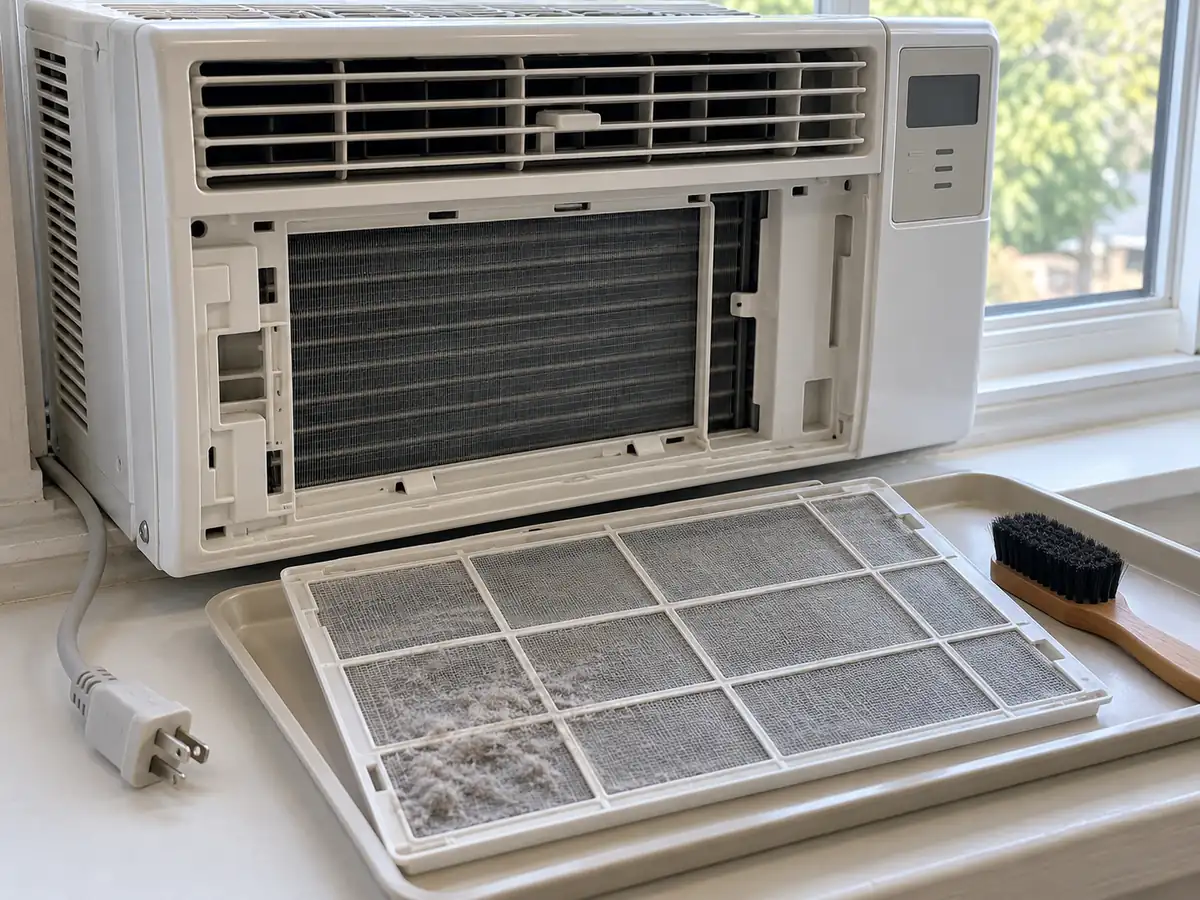
Follow the manual’s schedule for the air filter and any owner-serviceable condensate filter. Condensate is the water collected during operation; some heat-pump designs use filters and pumps to manage it. Keep outdoor air openings clear and check that accessible seals and mounting hardware remain in place.
NYSERDA’s pilot identified condensate handling and low-load control as areas needing improvement. For a year-round unit, include both in the service checks. Low-load control means how the unit runs when the room needs only a little heat. If it repeatedly starts and stops in mild weather, record the setting and room temperature for the service visit.
If a water alarm appears, water leaks indoors or heating repeatedly stops after defrost, follow the manual’s user checks. Arrange service if the fault remains. Switch off and unplug before owner-approved cleaning. Do not remove drain plugs, bypass a water-level switch or open internal electrical parts to keep the unit running.
Why is the window unit not heating the room?
Common reasons include the wrong mode or thermostat setting, restricted airflow, a low-temperature heating limit, or heat loss greater than the unit’s output. Check the settings, outdoor temperature and airflow first, then use the symptom table to narrow the cause.
| What you notice | Check first | What to do next |
|---|---|---|
| Fan runs but there is no warmth | Heat mode is selected and the setpoint is above room temperature | Correct the setting and allow the manual’s startup delay. Fan-only mode does not supply heat. |
| Heating stops as outdoor weather gets colder | Outdoor temperature, heating operating range and any displayed code | If the unit has reached its limit, use the planned backup source. Raising the setpoint cannot override that limit. |
| Airflow is weak | Accessible filter, inlet and outlet obstructions | Switch off and unplug before owner-approved filter cleaning. Clear curtains and furniture, then retest. |
| Warm air comes out but the room stays cold | Air leaks, open doors and heating output at the current temperature | Correct drafts and airflow first. If available heat is below room heat loss, address the shortfall rather than repeatedly raising the thermostat. |
| Heat pauses and frost clears | The model’s stated defrost sequence | Observe whether normal heating resumes. Persistent heavy ice or repeated failure to recover needs service. |
| Breaker trips, a hot plug or a burning smell appears | Stop operation | Have the electrical fault checked before reuse. Do not keep resetting protection or opening live equipment. |
After a safe correction, repeat the check under similar conditions and record whether airflow and room temperature improve. If settings and airflow are correct but heating still fails, give service staff the model, error code, outdoor temperature and the sequence of events. Refrigerant and internal electrical work belong with qualified service personnel.
Is a window unit the right year-round choice?
A window air conditioner with heat is a good fit for one reachable room when the opening, power supply and winter output all match. Choose resistance heat for limited supplemental use when its output is enough. Choose a suitable heat-pump model for frequent heating, and require low-temperature data when it will be the main winter heater.
A window unit makes less sense when it blocks a needed window, cannot be supported safely, or must serve several closed rooms. A mini split air conditioner uses separate indoor and outdoor equipment and can be arranged around individual zones. It needs permanent installation, refrigerant piping and suitable drainage, so it changes the project scope.
Our types of air conditioners guide compares those layouts. Start with the room and installation constraints before moving to a different system format.
For projects using a permanent split-system layout, explore Airproz’s inverter split air conditioners. The catalog lists a standard 220–240 V/50 Hz supply; select a heating-and-cooling model with the electrical configuration and winter output your site requires.
Is it suitable for a bedroom?
Yes, a window heat/cool unit can suit a bedroom when its heating-mode noise, airflow and temperature control fit overnight use. Compare sound at the fan speed needed to keep the room comfortable, and check where the thermostat senses temperature. A quiet cooling setting does not describe heating at full output.

- Temperature sensing: check where the unit or remote measures room temperature. Air near the unit can differ from air near the bed.
- Night controls: check whether the display dims and what Sleep mode changes. A changing setpoint may matter if steady overnight warmth is the priority.
- Automatic operation: confirm whether Auto changes between heating and cooling or only adjusts the fan. Check what mode returns after a power interruption.
Choose in this order
- Set the heating task: occasional extra warmth or the room’s main winter heat source.
- Match winter performance: compare output at the design temperature with heat loss, then plan for any shortfall.
- Check installation: window fit, support, outdoor airflow, water management and electrical supply.
- Compare comfort: heating-mode sound, temperature control and access for maintenance.
- Compare total cost: the complete installed option, electricity use and local service.
A window air conditioner with heat makes sense when it meets that room’s heating and cooling needs and fits the installation. Use these checks to narrow the candidates before comparing the final model offers.
Window air conditioner with heat: common questions
Can I leave a window air conditioner with heat installed all year?
Yes, if the model is designed for the intended year-round use and remains securely mounted, sealed and clear of snow or other obstructions. Keep its air openings clear while it runs. Do not wrap or cover an operating unit. If you remove it for storage, follow its draining, handling and storage instructions.
Can I add a heater to my existing cooling-only window AC?
Do not add an improvised heating element or modify the refrigerant circuit. A cooling-only unit lacks the approved heating assembly and controls. Choose a purpose-built heat/cool unit or a separate approved heating system suited to the room and circuit.
Can one large window heater cool and heat several bedrooms?
A single window unit is a poor choice for bedrooms behind closed doors. Its thermostat senses conditions near the unit, and its airflow may not reach the other rooms. Calculate each room’s needs and use a system with a suitable air-distribution or zoning arrangement rather than choosing a larger BTU label alone.
Will the heat keep working during a power outage?
No. Both resistance-heated and heat-pump window units need electricity for heating and fans. If outage heating is essential, plan a separate approved backup arrangement. Never operate a fuel-burning generator indoors or feed power through an improvised building connection.
Can I replace a through-wall heater with a window heat/cool unit?
Only when the replacement is explicitly approved for that installation and the sleeve, airflow, drainage and electrical requirements match. A cabinet that fits can still have blocked side vents. Check the old opening and the new installation drawing before removing the existing equipment.
Can a window AC heater combo cool and heat at the same time?
A standard single-room heat/cool window unit supplies either cooling or heating at a given time. An automatic mode may switch between them as room temperature changes. It does not provide independent cooling and heating to different rooms.


