The main heat pump compressor types are scroll, rotary (including rolling-piston and twin-rotary), reciprocating, screw, and centrifugal. Rotary or twin-rotary designs are common in compact ductless heat pumps; air-to-water and light-commercial systems may use suitable scroll or rotary compressors. Inverter operation and two-stage capacity control describe how output is controlled; they are not additional mechanical compressor types. Neither scroll nor rotary is always more efficient. Compare the complete heat pump’s heating capacity, electricity input, operating limits, and seasonal rating at the conditions your project needs.
The compressor raises the pressure of refrigerant vapor so the heat pump can release heat at the required temperature. Compressor design affects capacity, speed range, noise, and protection needs. But the final result also depends on the heat exchangers, refrigerant, defrost system, controls, and installation.
Heat Pump Compressor Types at a Glance
The five compressor designs suit different heat-pump sizes and operating jobs. First identify what the system must heat and under what conditions. Then compare suitable compressor models. A name such as “scroll” or “rotary” does not tell you the efficiency or heating capacity of the finished unit.
| Compressor type | Typical application | How it works | What to check |
|---|---|---|---|
| Scroll | Residential, light commercial, air-to-water; selected larger systems | Fixed and orbiting spiral elements compress vapor | Check how cold the outdoor air can be, how hot the water leaving the heat pump must be (leaving-water temperature), the approved refrigerant, and the exact model’s operating limits. |
| Rotary / twin-rotary | Ductless, compact air-source and hot-water heat pumps | A rolling piston and vane compress vapor; some twin-rotary designs help reduce torque pulsation and vibration. | Check approved refrigerant and speed range, heating capacity, electrical input, and whole-unit sound data at relevant test conditions. |
| Reciprocating | Selected industrial, refrigeration and legacy heating equipment | Pistons, cylinders and valves | Service design, vibration, lubrication and control method vary |
| Screw | Larger commercial and industrial heat pumps | Intermeshing rotors | Part-load control, oil management, and compressor lift (the pressure rise required by the system) need model-specific review. |
| Centrifugal | Selected high-flow central plants and industrial configurations | Dynamic compression by impeller | Check stable operation when refrigerant flow is low or the required pressure rise is high. |
A compressor performance map provides model-specific performance data at defined refrigerant-side temperatures or pressures and, when applicable, different speeds. When reviewing one, confirm the exact compressor model, approved refrigerant, evaporating and condensing temperature or pressure conditions, applicable speed range, and the published operating envelope. Check whether the required operating point falls inside that envelope. Operating within the approved envelope does not by itself prove adequate whole-unit heating output. Compare compressor-level information with the finished heat pump’s published heating capacity and electrical input under the relevant project conditions; compressor data cannot replace full-unit performance or seasonal-rating information.
How the other three compressor types compare: Scroll and rotary designs are explained in their own sections below. Reciprocating, screw, and centrifugal compressors have different compression mechanisms and operating limits that matter in larger or specialized heat-pump systems.
Reciprocating Compressors: Where Do They Fit?
A reciprocating compressor compresses refrigerant vapor using pistons in cylinders, with valves controlling suction and discharge. Selected models can serve heat-pump and industrial duties, provided the refrigerant and required operating temperatures are within the approved range.
The pistons and valves create changing gas flow and forces during each cycle, so vibration, mounting, pipe connections, and service access deserve attention. When comparing a reciprocating design, verify the permitted capacity-control method, discharge-temperature limits, lubrication requirements, and the manufacturer’s performance data at the intended operating points. A familiar piston mechanism does not prove that it is easier to maintain or more efficient in every project.
Screw Compressors: What Matters at Part Load?
A screw compressor compresses vapor between intermeshing rotors. Certain models are suited to larger commercial and industrial heat pumps, but the useful choice depends on pressure lift, minimum permitted load, and capacity-control design.
For a plant operating for long periods below peak load, compare the published part-load performance and minimum stable capacity at the expected evaporating and condensing conditions. For oil-injected designs, check the specified oil separation, cooling, and return arrangements; these are part of reliable operation, not optional details to infer from the compressor name. High required supply temperatures may increase pressure lift, so check the exact operating envelope and discharge limits rather than assuming a larger screw compressor will meet the duty.
Centrifugal Compressors: What Limits Stable Operation?
A centrifugal compressor uses a fast-moving impeller to increase refrigerant velocity and a diffuser to raise pressure. It may suit selected large central systems, provided the expected flow and pressure lift remain inside the model’s stable operating range.
At some combinations of low refrigerant flow and high pressure lift, centrifugal compression can become unstable, a condition associated with surge. If the plant has wide seasonal load variation, check its minimum stable output, surge-control strategy, and published operating map at both peak and part-load conditions. High-lift centrifugal models also exist, so do not apply one compressor’s operating limits to every centrifugal design.
How Does a Heat Pump Compressor Work?
The compressor takes in low-pressure refrigerant vapor and squeezes it to a higher pressure. This lets the refrigerant release heat at the temperature the system needs. The compressor moves and pressurizes refrigerant; it does not create the heat the system delivers.
In heating mode, the outdoor heat exchanger typically evaporates refrigerant and the indoor or water-side heat exchanger condenses it. When outdoor air gets colder or the heating system needs hotter water, the compressor often has to raise refrigerant pressure by a greater amount. Engineers call the relationship between outlet and inlet pressure the pressure ratio. A higher pressure ratio can increase electrical demand and discharge temperature, and some systems then deliver less heating capacity. The exact change depends on the refrigerant and the model’s performance map.
To see how the compressor connects with the heat exchangers and other refrigerant-circuit components, follow the heat pump schematic diagram. Use the exact manufacturer’s drawing for installation or wiring decisions.
For an air-to-water heat pump, compare performance at the same outdoor-air temperature and leaving-water temperature. A listed COP (coefficient of performance, meaning useful heat output divided by electricity input) measured in mild outdoor air with lower water temperature does not show how much heat the unit can provide on a colder design day with hotter radiator water. Compressor isentropic efficiency shows how closely compression approaches an ideal process. It is not the complete heat pump’s efficiency. The COP mentioned above describes a specific operating condition. SCOP is a seasonal heating-efficiency rating; SEER2 and HSPF2 are seasonal cooling and heating metrics used for applicable U.S. equipment. Check which test conditions and system boundaries each number covers.
The heat emitters set the water temperature a hydronic system needs. A system designed for lower-temperature underfloor heating may impose different compressor operating conditions from an existing radiator system that needs hotter water. Establish the water temperature needed to meet the building load on the winter design day. If the emitters or distribution system can be improved to work at a lower temperature, the suitable heat-pump options and their expected performance may change.
Keep three results separate: rated capacity at a published test point, available heating capacity at the project design point, and heat actually delivered over operating periods that may include defrost and changing controls. Confirm whether the quoted electrical input and COP include circulation pumps, fans, auxiliary heaters or defrost effects under the relevant test method. Do not compare results measured with different system boundaries as if they were interchangeable.
Outdoor humidity and coil temperature can also affect heating performance. When frost forms on the outdoor coil, defrost operation may temporarily reduce heat delivered to the building and affect electricity use. For a project combining cold outdoor air with high required water temperature, confirm whether the published heating data account for relevant defrost conditions. If there is a heating shortfall, check how the controls and any auxiliary heat cover it. The impact depends on the complete heat pump and its operating conditions, not simply on whether the compressor is scroll or rotary.
Scroll Compressors: How They Work and What to Check
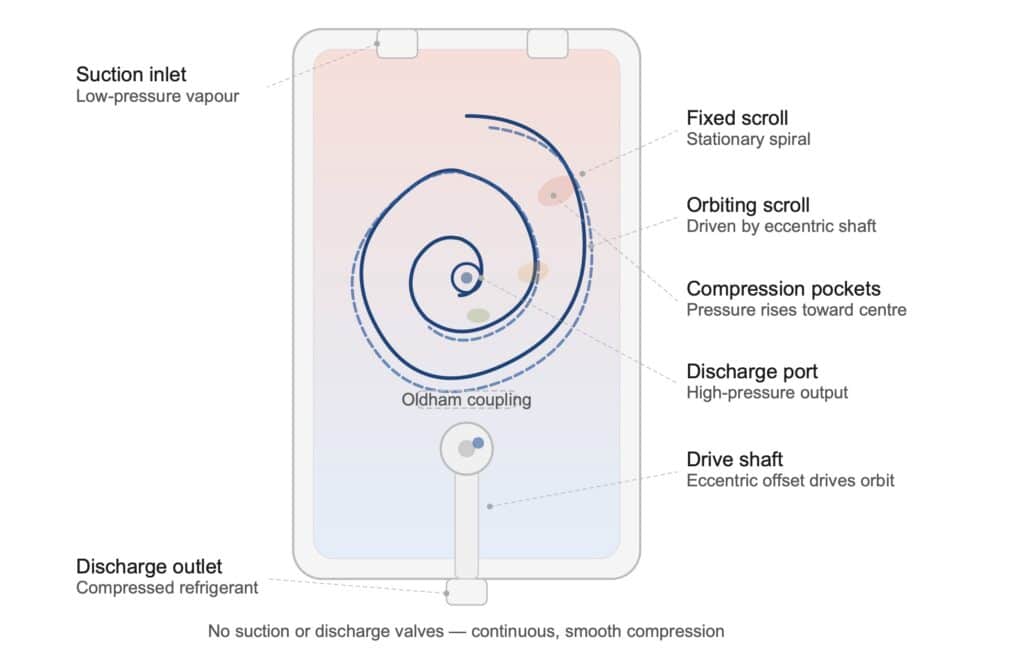
A scroll compressor uses two spiral-shaped parts to squeeze refrigerant vapor into smaller spaces. It is a common option for home and light-commercial heat pumps. But for very cold outdoor air or a large pressure rise, check the exact model’s published operating limits and heating output.
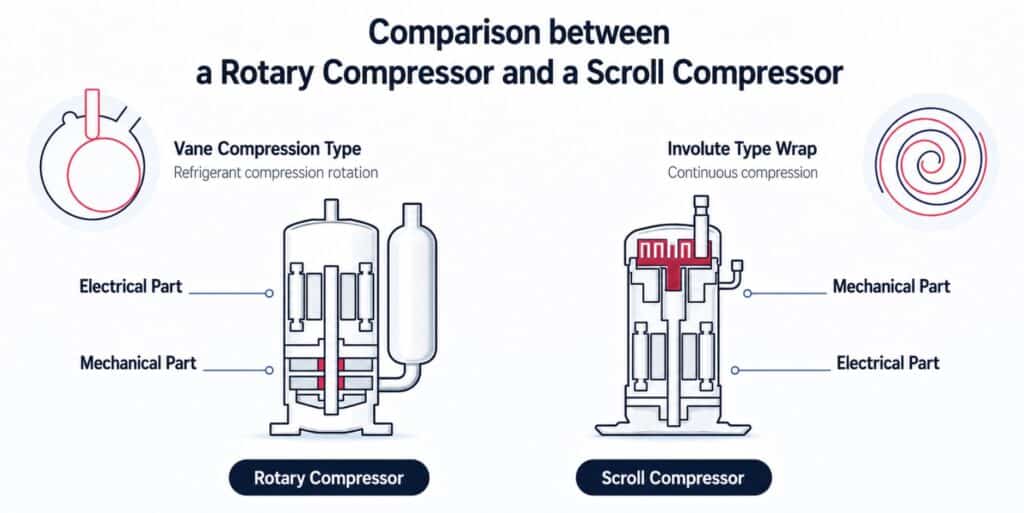
One spiral stays fixed while the other moves in a small orbit. In many designs, an Oldham coupling (a guide that stops the moving spiral from spinning freely) keeps the motion aligned. The moving contact line traps vapor near the outer edge and carries it toward the central discharge. This generally provides relatively smooth compression without the cylinder suction valves used in reciprocating designs. Scroll mechanisms still require lubrication, refrigerant-management protections and appropriate mounting; “few moving parts” does not establish a universal service life.
- Where scroll can fit: space-heating heat pumps, packaged systems, selected air-to-water units and multi-compressor arrangements.
- Possible advantages: a compact compression mechanism for the required duty, relatively smooth operation, and models with either fixed-speed or variable-speed control.
- Limitations: actual capacity and efficiency depend on pressure ratio, speed, refrigerant, and system design. Special low-temperature features are not guaranteed.
- What to check: the manufacturer-approved operating range; rated and cold-design-point heating capacity, power, discharge-temperature limits, noise, oil return, and manufacturer protection guidance.
Some scroll-based heat pumps use enhanced vapor injection (EVI): an additional refrigerant-injection arrangement designed to help performance under demanding conditions. It requires the right circuit and controls and is not built into every scroll compressor. A low published outdoor operating limit shows where a model is allowed to run, not whether its heating output meets the design load. Compare available capacity at the required outdoor-air and supply-water or supply-air temperatures with the calculated heating demand, including documented defrost assumptions. If the output is insufficient, verify a suitable backup arrangement or a different load, emitter or system design. Neither EVI, a larger nominal horsepower label nor a larger backup heater alone proves the system is correctly sized; any backup also needs compatible controls and power supply. For an EVI-equipped model, also verify the approved injection operating range, required controls, and total electrical input alongside heating output at the cold design point; an injection connection by itself is not evidence of adequate system capacity.
Rotary and Twin-Rotary Compressors: How They Work and What to Check
A rolling-piston rotary compressor squeezes refrigerant vapor between a roller, a cylinder, and a vane. It is common in compact heat pumps. A twin-rotary design uses two compression elements and may smooth the turning force, but that does not automatically make it more efficient than a scroll model.
As the roller moves, refrigerant enters the suction region and the trapped chamber shrinks until discharge. In many rolling-piston designs a spring-loaded sliding vane separates suction and compression regions. Twin-rotary models arrange two compression mechanisms on one shaft. How well the compressor works depends on its displacement (the volume it moves per revolution), the suction and discharge openings, motor, lubricant, refrigerant, and speed controls. Vane design and liquid-return protection matter. If liquid refrigerant enters the compressor in the wrong conditions, it can damage either scroll or rotary designs. Do not assume one type safely handles liquid return unless the manufacturer says so. In the same way, do not choose between them using generic lifespan claims alone.
- Where rotary can fit: mini-split heat pumps, smaller air-to-water systems, selected heat pump water heaters and pool heat pumps.
- Possible advantages: compact packaging and a wide range of inverter-driven products.
- Limitations: mechanical, electrical and refrigerant operating limits vary by model; housing vibration and complete-unit sound need measurement.
- What to check: single- versus twin-rotary construction, approved speed range and refrigerant, heating output and electrical input at the actual design temperatures, liquid-return protection, and available service support.
Many hermetic compressor assemblies are replaced as sealed units rather than rebuilt in the field; confirm service strategy and warranty. Compare similar finished systems before judging cost, noise, or service life. A published scroll-versus-rotary study reports results for the systems tested; it does not prove that every rotary compressor is cheaper, louder, or shorter-lived than every scroll compressor.
What Does Inverter, Variable-Speed or Two-Stage Mean?
An inverter adjusts compressor motor speed to match changing demand. A two-stage system switches between two set output levels. Both describe how capacity is controlled; neither tells you whether the compressor is scroll or rotary.
In this section, “two-stage” means switching between two defined capacity levels. It is not the same as two-stage refrigerant compression, which uses two compression steps within a different refrigeration-cycle arrangement.
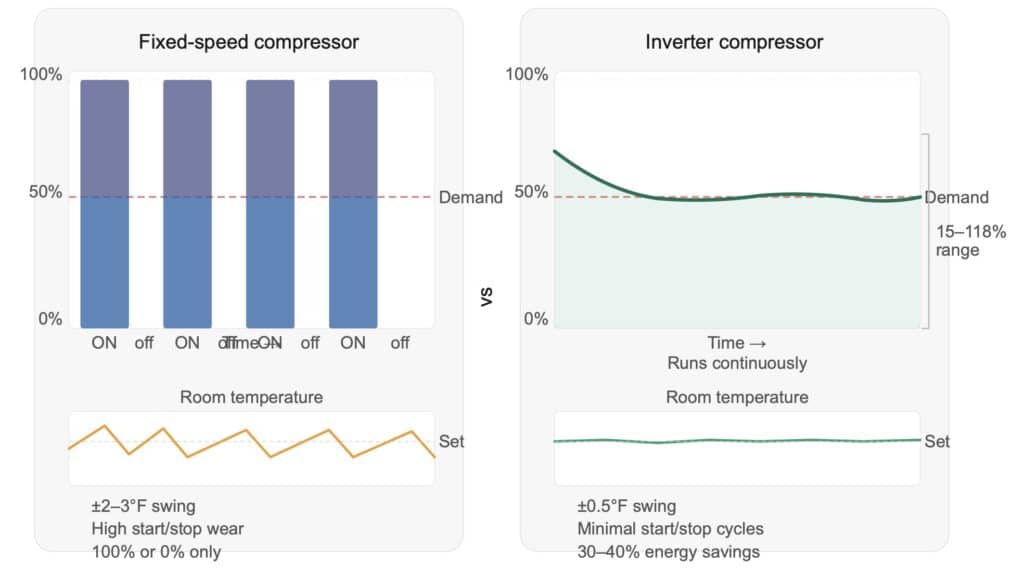
An inverter drive converts incoming AC power into DC and then supplies the compatible compressor motor with controlled-frequency AC power. Changing that frequency changes motor speed within the approved range. Speed modulation helps the unit match part-load demand and can reduce cycling. It does not guarantee a specific energy-saving percentage: fan power, defrost, minimum stable speed, refrigerant circuit and controls all influence the measured seasonal result. For an air-conditioning example of the same control principle, see the inverter air conditioner guide, which explains how compressor speed responds to changing room cooling demand.
The drive must match the compressor motor and its approved control and protection package. A generic inverter cannot simply be added to a fixed-speed scroll or rotary compressor and assumed to produce an approved variable-speed heat-pump system.
How Is Inverter Different from Fixed-Speed or Two-Stage?
Fixed-speed systems usually turn the compressor on and off as demand changes. Two-stage systems use one of two output levels, while inverter systems adjust speed over an approved range. The most efficient option is the one that performs better as a complete heat pump under comparable conditions—not simply the one with the “inverter” label.
| Control method | How output follows demand | Possible benefit | What to check |
|---|---|---|---|
| Fixed speed / single stage | Mostly on/off cycling at a nominal operating point | Simplicity where load and cost targets suit | Cycling behavior, temperature control, start limits, seasonal rating |
| Two stage | Switches between two declared capacity levels | Reduced cycling versus a single fixed output in some applications | Heating or cooling output at each stage, plus the rules that switch between stages |
| Inverter / variable speed | Continuously modulates within approved speed and capacity limits | Load matching, potential part-load benefit and wider controlled operation | Minimum and maximum capacities, power input, defrost, protection and full-system seasonal rating |
An inverter does not prevent all cycling. If its minimum stable heating output is greater than the building load for long periods of mild weather, the system may still switch on and off. Compare the published minimum output with the expected low-load demand and check the controller’s cycling sequence. If short cycling remains a concern, check load matching and controls before selecting a different system or considering a properly designed hydraulic solution; a larger buffer tank is not an automatic cure.
For equipment covered by US rating programs, compare certified SEER2 for seasonal cooling or HSPF2 for seasonal heating, as applicable. For equipment rated under the relevant European method, use SCOP for seasonal heating. Compare ratings only under the same applicable test procedure, system configuration, and climate assumptions. SEER2, HSPF2, and SCOP use different rating methods and must not be ranked against one another by numerical value alone. For applicable split systems, verify the rated indoor-and-outdoor unit combination. For U.S. projects, the mini-split system-rating guide explains how to check the matched indoor-and-outdoor combination and applicable SEER2 or HSPF2 ratings. Separately check heating capacity and electrical input at the project’s winter design temperature: a seasonal rating does not establish cold-day heating adequacy.
Scroll vs Rotary: Which Is Better for a Heat Pump?
Neither scroll nor rotary wins in every heat pump. Compact ductless heat pumps often use rotary or twin-rotary designs, while air-to-water models may use suitable scroll or rotary compressors. Compare the finished units at the same outdoor temperature, required output temperature, load, and electrical conditions instead of choosing by compressor name alone.
A 2021 Purdue conference study compared selected R410A split heat-pump systems using scroll and rotary compressors. In those tested configurations, the rotary versions achieved higher reported seasonal efficiency. This does not prove that rotary is better for all heat pumps: the results depend on the specific units and test conditions, and the study’s SEER/HSPF measures should not be treated as present-day SEER2/HSPF2 ratings.
| Decision factor | Scroll candidate | Rotary or twin-rotary candidate | What to compare |
|---|---|---|---|
| Compression design | Orbiting scrolls create shrinking vapor pockets | Eccentric rolling-piston mechanism and vane | Refrigerant and model/application data |
| Packaging and application | Often used in residential/light-commercial and air-to-water systems | Often used in compact and ductless units | Actual available model envelope and installation constraints |
| Efficiency | Varies with speed, lift, refrigerant and system | Varies with speed, lift, refrigerant and system | Full-unit rated COP and seasonal rating at comparable conditions |
| Cold ambient / high water temperature | Specialized scroll/EVI designs may be available | Suitable rotary designs may also be available | Compare available heating output and total electrical input at the same winter design outdoor-air and required leaving-water temperature, using documented defrost assumptions. If the output is below the calculated heat load, neither compressor label nor nominal capacity makes the unit sufficient: verify backup heating or select a different system configuration. |
| Noise and durability | Must compare assembled-unit noise and protection | Must compare assembled-unit noise and protection | Compare the same noise measure at the same test conditions. Sound power is noise emitted by the unit; sound pressure depends on the measurement distance, location and surroundings. Check which dB metric is stated, and separately review warranty and reliability evidence. |
| Capital and operating cost | Model-specific quotation and system cost | Model-specific quotation and system cost | Comparable installed price, estimated annual load, electricity tariff |
For a compact ductless heat pump, start with available rotary or twin-rotary models that fit the installation space, refrigerant, electrical supply, and load. For an air-to-water heat pump operating at low outdoor temperatures or high water temperatures, compare any suitable scroll and rotary models using published heating output, power input, and operating limits at the same design conditions. If neither meets the duty, examine a different system configuration rather than assuming one compressor family will solve it.
Even if one compressor has higher isentropic efficiency at a single laboratory pressure ratio, another finished heat pump may achieve better seasonal performance because its heat exchangers, speed control, and part-load operation are more suitable.
Which Compressor Design Fits Each Heat Pump Application?
A compressor that fits a ductless home heat pump may not fit a hot-water or industrial heat pump. Each application has different heating loads, output temperatures, and operating patterns. Use the table to shortlist possible designs, then verify exact models.
| Heat pump category | Families to evaluate | What matters for this application | What to ask for |
|---|---|---|---|
| Ductless air-source heat pump | Rotary/twin-rotary; suitable scroll | Cooling versus winter heating, space limits, part-load operation | If winter heating is critical, compare heating output with the cold-day load and outdoor operating limits. If cooling and mild-weather operation dominate, compare cooling-season ratings and part-load control. Verify approved airflow and matched indoor/outdoor ratings for the actual system. |
| Air-to-water heat pump | Scroll; rotary/twin-rotary where suitable | The compressor usually works harder when the system needs hotter supply water, especially in cold outdoor air | Compare heating output and total electrical input at the project air/water design point, including defrost. Check approved water-flow range, pump capacity and circuit pressure loss. If the site cannot provide the required flow, address the hydraulic system before concluding that the compressor family is unsuitable. |
| Heat pump water heater | Rotary or scroll by product design | Water setpoint, source air, recovery load, tank/system controls | Confirm heating capacity and recovery performance at the expected source-air and water-temperature conditions. Check hot-water demand, tank and recovery requirements, and when auxiliary electric heating may operate. |
| Swimming-pool heat pump | Rotary or scroll | Outdoor conditions, pool-water temperature, seasonal use | Verify heating capacity and COP at relevant outdoor-air and pool-water temperatures. Check seasonal heat loss, pool-cover use, required heat-up time, approved water-flow limits, and whole-unit sound data under stated test conditions. For a published inverter-driven system example, review the R32 commercial inverter swimming pool heat pump and its stated operating conditions. Confirm the mechanical compressor type separately. |
| Commercial / industrial heat pump | Scroll banks, screw, reciprocating; special large designs | Long operating hours, lubrication, low-load operation, backup compressors, and both heat-source and heat-delivery temperatures | Performance maps, minimum load, controls, service strategy and safety review |
If an air-to-water heat pump is not delivering the expected heat, first compare the required heating load and water-temperature setpoint with the unit’s available capacity under the current conditions. Then check actual water flow against the manufacturer’s permitted range, along with supply and return temperatures, pump operation, strainers, valves, and available pump head. A large temperature difference may indicate insufficient flow, but it is not conclusive without considering the operating load and design conditions. If the hydraulic system cannot meet the required flow, address that limitation before assuming a different compressor type is needed. Further refrigeration-system diagnosis should follow the manufacturer’s procedures and be performed by qualified personnel.
For a model-specific example, review the published compressor and water-flow specifications of the R32 monobloc space-heating heat pump, then compare its stated test conditions with the project requirements.
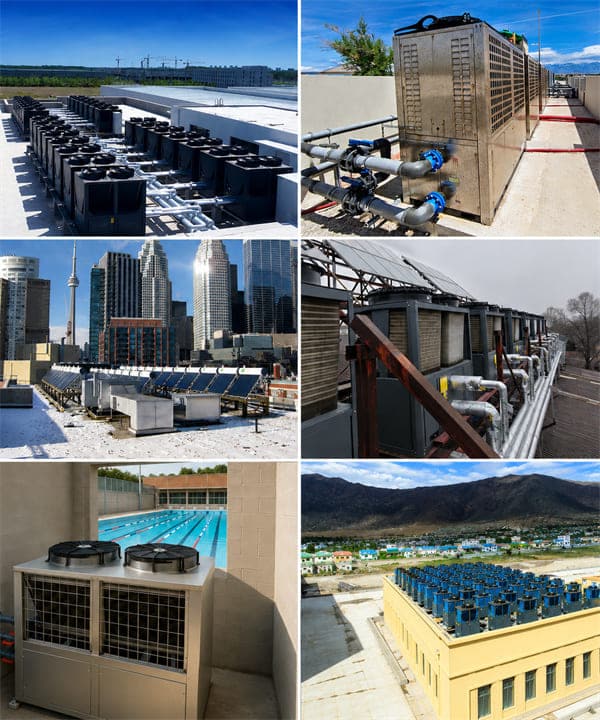
How to Choose a Heat Pump Compressor for Your Application
Start with the relevant load: winter heat loss for space heating, cooling design load for reversible systems, or water-heating duty for hot-water and pool equipment. Then check the exact compressor and complete heat pump at the required operating temperatures, including approved refrigerant, speed control, electrical supply, and operating limits. Horsepower or nominal unit size alone is not enough.
Find the selection check you need:
- What capacity and heating or cooling duty do I need?
- Will the unit meet demand on the coldest design day?
- What if the available winter output is too low?
- Will the unit cycle excessively in mild weather?
- Will it work with my refrigerant, controls and site supply?
- Which technical data should I compare?
- Define the load: for space heating, the winter design heat loss and required supply-air or leaving-water temperature; for reversible equipment, also the summer cooling design load; for hot-water or pool heating, the water-heating demand, target temperature and relevant operating conditions. Use a documented load or heating-duty calculation for the application and relevant design conditions. If only floor area, nominal horsepower or the previous unit size is known, treat the selection as provisional until the design load and required output temperature are established.
- Check the hardest heating condition: ask for heating capacity and electrical input at the project’s cold outdoor design temperature and required supply-water temperature, not only at a milder catalog test point.
- If winter output is insufficient: compare the heat pump’s available capacity at the design condition with the calculated heating load. Identify the shortfall, then compare another suitably rated system or determine how auxiliary or backup heat will cover it. Check the backup power demand, control method, and how the published capacity accounts for defrost.
- Check part load: identify the minimum stable system capacity, cycling behavior, staging and annual operating profile.
- Check compatibility: the approved refrigerant and charge, refrigerant safety class, voltage and frequency, the approved motor drive and controller, oil and refrigerant return, and the installation limits. For site installation, verify electrical phase, available voltage, feeder capacity and protective devices against the complete system’s declared maximum electrical demand, including any auxiliary heater that can run simultaneously. For air-to-water systems check required water flow, pump capacity and pipe losses; for air systems check required airflow, ducts or indoor-unit limits. Site compatibility must be confirmed by qualified installers and applicable electrical requirements.
- Check the product data: comparable full-unit ratings, measured sound levels under a stated test method, model-specific technical information, and—where relevant—warranty and service-part conditions.
Required: application-specific design load, verified capacity and input at the critical operating condition, approved refrigerant and controls, and compatible site power and installation limits. Recommended for comparison: minimum stable output, defrost assumptions, whole-unit noise and relevant service documents. Conditional: EVI, buffer storage, multiple compressors and backup heating only where the load calculation and control/hydraulic design justify them. Usually unnecessary: adding these features solely because they sound more advanced, without a project need.
Important for replacement compressors: low heating output, frequent starts, or high electricity use do not by themselves prove compressor failure. Before ordering, have a qualified technician check fault history, airflow or water flow, controls, and electrical supply, followed by manufacturer-prescribed refrigerant-circuit diagnostics where needed. If replacement is justified, use a manufacturer-approved substitute and verify refrigerant, oil, displacement, motor winding and drive requirements, mounting, connections, electrical ratings, and protections—not horsepower alone. Opening or repairing the refrigerant circuit requires qualified personnel; flammable refrigerants require applicable additional safety measures.
What to check for your application: For an air-to-water heat pump, request heating output, total electrical input and COP at the winter design outdoor temperature and required leaving-water temperature, with defrost assumptions stated. For a ductless air-to-air heat pump, check delivered heating or cooling capacity at relevant outdoor/indoor test conditions, approved airflow and matched indoor/outdoor equipment. For heat-pump water heaters or swimming-pool systems, use the relevant source-air, water-temperature and heating-duty test points. In every case, confirm operating limits, approved refrigerant, electrical requirements and the seasonal rating where applicable. If comparable model-specific data are missing, the selection is not yet verified.
FAQ
Which lasts longer: scroll or rotary?
You cannot reliably say that every scroll lasts longer than every rotary. Service life varies with the exact model, operating limits, start-stop cycling, installation, refrigerant management, and maintenance. Use the model warranty and relevant field reliability data instead of generic “10–15 years” or “15–20 years” claims.
Which refrigerants can scroll and rotary compressors use?
Both scroll and rotary compressors are available in designs for different refrigerants. But a compressor approved for one refrigerant is not automatically suitable for another. Check the exact compressor and system approvals, safety class, and components before specifying R32, R410A, R454B, or R290.
Sources
- Scroll–rotary comparison: The 2021 Purdue conference study tested selected 2.5-ton and 5-ton R410A split heat-pump systems. Its results do not rank all compressor models; the study’s SEER/HSPF figures are not modern SEER2/HSPF2 ratings.
- Cold-climate field information: NREL cold-climate heat-pump data describes the documented equipment and field conditions, not a universal compressor-type ranking.
- Inverter-driven system case study: The U.S. DOE cold-climate case-study directory includes an inverter-driven heat-pump field project; it does not establish a guaranteed benefit for every variable-speed system.
- Certified whole-unit ratings: AHRI’s unitary heat-pump certification information applies to covered complete-system configurations; it is not a ranking of scroll versus rotary compressors.
Conclusion
Choose between scroll- and rotary-based heat pumps using verified whole-unit heating output and electrical input at the design condition, approved refrigerant and installation limits, and comparable part-load or seasonal performance—not the compressor label alone. If model-specific data are missing or the candidate cannot meet the load, the selection remains provisional.
Need help comparing compressor options for your heat pump project? Tell us the heat-pump application, destination market, and any design conditions you already know. If available, include the heating load and required water or supply-air temperature. We can discuss these requirements in relation to the Airproz product range. Exact model availability, performance, configuration, and commercial terms still need confirmation against current technical documents and the applicable quotation.
For broader evaluation criteria, see the existing heat pump manufacturer B2B buying guide. For brand and configuration discussions, see our OEM heat pump page.