Commercial hot water system UAE projects are facing growing pressure to reduce operating costs while maintaining stable hot water supply for hotels, apartments, and other commercial buildings.
For B2B buyers evaluating commercial heat pump sourcing options, OEM production, and certifications, see our heat pump manufacturer guide.
The Growing Energy Cost Challenge for Commercial Hot Water in UAE
Rising Electricity Costs in Commercial Buildings
These systems have become one of the largest sources of electricity consumption in UAE commercial buildings. In hotels, apartment complexes, gyms, hospitals, and other high-demand facilities, hot water supply systems often account for a significant portion of the building’s overall energy usage.
To maintain continuous hot water availability throughout the day, many commercial hot water systems operate for extended hours or even 24/7. As electricity prices and operational expenses continue to rise, the long-term energy consumption of traditional water heating systems is becoming a growing concern for project owners and facility operators.
Compared with modern commercial heat pump hot water systems, conventional electric water heaters typically suffer from lower heating efficiency, higher power consumption, and limited energy-saving control capabilities. Under the current energy cost environment in the UAE, these disadvantages are becoming increasingly noticeable for commercial projects.
Why Hot Water Demand Is Increasing in Hotels and Apartments
The demand for commercial hot water systems in the UAE has increased rapidly in recent years, driven by the recovery of tourism and the continuous growth of commercial real estate projects. Hotels, resorts, serviced apartments, and residential complexes now require larger and more stable hot water supply capacity than before.
In many commercial buildings, hot water usage is heavily concentrated during morning and evening peak hours. A large number of users accessing hot water simultaneously can create sudden pressure on the system, often leading to unstable water temperature or insufficient hot water supply when traditional systems are unable to recover quickly enough.
As customer expectations continue to rise, stable and continuous hot water supply has become an important part of overall service quality in commercial projects. This is pushing more developers and facility operators to look for commercial hot water solutions with higher reliability, faster recovery performance, and better system stability.
Long-Term Operating Costs Are Becoming a Major Concern
For many commercial projects in the UAE, the decision-making process is no longer focused only on the initial equipment purchase cost. Instead, long-term operating expenses are becoming one of the most important factors when selecting a commercial hot water system.
Over time, electricity consumption, routine maintenance, spare parts replacement, and system downtime can significantly increase the total lifecycle cost of traditional water heating equipment. For hotels, apartment buildings, and other facilities operating every day, these long-term expenses can directly affect overall operational profitability.
As a result, improving energy efficiency and reducing long-term operating costs have become key priorities for commercial project owners. This is one of the main reasons why more UAE commercial projects are beginning to switch to commercial heat pump hot water systems.
Heat Pump vs Solar Water Heater: Which System Is More Stable?
Why Solar Water Heating Systems May Struggle During Peak Demand
For many commercial hot water system UAE projects, stable hot water supply during peak usage periods is often more important than daytime heating efficiency alone.
Common Challenges of Solar Water Heating Systems
- Hotels usually experience peak hot water demand during the evening and early morning
- Solar systems mainly rely on daytime sunlight for heating
- Stable night-time hot water supply often requires backup heating systems
- Continuous large-volume water usage may reduce supply stability
- System performance can be affected by cloudy weather conditions
For hotels and apartment buildings with continuous hot water demand, heat pump vs solar water heater comparisons increasingly focus on long-term operating stability rather than daytime energy-saving performance alone.
Heat Pump vs Solar Water Heater Comparison
| Comparison Item | Solar Water Heater | Commercial Heat Pump |
|---|---|---|
| Night-time Heating | Depends on stored hot water | Continuous heating |
| Weather Dependence | High | Low |
| Recovery Speed | Slower | Faster |
| Peak Demand Stability | Limited | More stable |
| Backup Heating Requirement | Usually required | Lower dependence |
| Hot Water Supply Stability | Variable | Stable 24-hour operation |
For a more detailed comparison of heat pump and solar water heater options specifically for UAE residential and commercial projects, see our guide: heat pump vs solar water heater in UAE.
Why Commercial Projects Prefer Heat Pump Systems
Compared with solar water heating systems, commercial heat pump hot water systems are generally more suitable for projects requiring continuous and stable hot water supply.
Why Commercial Projects Prefer Heat Pump Systems
- Continuous 24-hour hot water production
- Faster recovery after peak demand periods
- More stable water temperature control
- Better suited for hotels and apartment buildings
- Lower dependence on weather conditions
- Reduced need for auxiliary heating systems
For hotels, hospitals, and apartment buildings with continuous hot water demand, commercial heat pump hot water systems are often better suited for long-term stable operation.
For hotel developers in Dubai specifically evaluating commercial heat pump water heater options, see our detailed guide: commercial heat pump water heater for hotel in Dubai.
Why More Hotels and Apartments Are Moving Away from Traditional Boilers
Rising Boiler Maintenance Costs in Commercial Projects
For many hotels and apartment buildings, traditional boiler systems require frequent maintenance and regular shutdown inspections, which can increase long-term operating costs and maintenance workload.
Common Boiler Maintenance Challenges
| Issue | Traditional Boiler Systems |
|---|---|
| Maintenance Frequency | Regular inspections and periodic shutdown maintenance |
| Scale Build-Up | Higher risk in hard water conditions |
| Repair Costs | Increase over time as systems age |
| System Downtime | Hot water supply may be interrupted during maintenance |
| Operating Stability | Can decline after years of operation |
In UAE commercial buildings, hard water conditions may also increase scaling risk inside boiler systems, leading to lower heat exchange efficiency and higher maintenance expenses over time.
Gas Consumption and Operating Efficiency Challenges
In many UAE commercial projects, rising gas prices and declining boiler efficiency are becoming major concerns for long-term hot water operation.
Common Boiler Operating Challenges
- Gas costs continue to increase in many commercial buildings
- Boiler efficiency may gradually decline after years of operation
- Higher fuel consumption increases long-term operating expenses
- Energy costs can become difficult to predict and control
- Older systems may struggle to maintain stable efficiency during peak demand periods
For hotels and apartment buildings with continuous hot water demand, these issues can significantly increase long-term operating pressure.
Why Heat Pumps Are Becoming a Better Alternative
As commercial projects place greater focus on long-term operating costs and energy efficiency, commercial heat pump systems are becoming an increasingly popular alternative to traditional boiler systems.
Commercial Boiler vs Heat Pump Comparison
| Comparison Item | Traditional Boiler | Commercial Heat Pump |
|---|---|---|
| Main Energy Source | Gas or electricity | Electricity + ambient heat |
| Operating Efficiency | Lower over time | Stable high COP |
| Maintenance Requirement | Higher | Lower |
| Fuel Dependence | High | Lower |
| Operating Costs | Higher long-term | Lower long-term |
| Hot Water Stability | Moderate | Stable 24-hour supply |
For many commercial boiler replacement UAE projects, heat pump systems offer lower operating costs, more stable performance, and simpler long-term maintenance management.
In recent years, more hotels, apartment buildings, and commercial developments in Dubai and Abu Dhabi have started adopting commercial heat pump hot water systems as part of their long-term energy-saving strategies.
How Heat Pumps Reduce Operating Costs in UAE Commercial Buildings
What Does COP Mean in Commercial Heat Pump Systems?
COP (Coefficient of Performance) is one of the most important indicators used to evaluate the energy efficiency of a commercial heat pump hot water system. The higher the COP value, the less electricity the system consumes to produce the same amount of hot water, resulting in lower operating costs and improved energy efficiency.
Under UAE high ambient temperature conditions, commercial heat pump systems designed for local applications can typically maintain a stable COP between 3.0 and 4.0. This is significantly higher than traditional electric water heating systems, which generally operate at a COP close to 1.0.
The key reason behind this difference is the working principle of air to water heat pump UAE systems designed for high ambient temperature conditions. Traditional electric heaters generate heat directly from electricity, meaning 1 kWh of electricity produces approximately 1 kWh of heat energy. In contrast, commercial heat pumps transfer free heat energy from the surrounding air. As a result, consuming 1 kWh of electricity can generate 3–4 kWh of heat energy, greatly reducing overall electricity consumption.
For commercial projects in the UAE, the focus is not only on the theoretical COP value itself, but also on how stable the system performs under real operating conditions. For example, a heat pump water heater for hotels installed in a 100-room hotel project in Dubai achieved a stable operating COP of 3.2, delivering significantly lower operating costs compared with conventional electric heating systems.
| System Type | COP Value | Heating Efficiency | Electricity Consumption for 1000L 55°C Hot Water |
|---|---|---|---|
| Traditional Electric Heating System | ≈1.0 | Approx. 95% | 116 kWh |
| UAE-Adapted Commercial Heat Pump | 3.0–4.0 | Approx. 98% | 30–38 kWh |
Note: Data based on UAE commercial operating conditions in Dubai, calculated with average inlet water temperature of 25–30°C and electricity cost of AED 0.45/kWh.
For commercial developers also evaluating air conditioning systems for UAE high ambient temperature conditions, see our guide on T3 air conditioner for Middle East and Iran projects.
Heat Pumps Consume Less Electricity Than Traditional Electric Heating Systems
Unlike traditional electric water heaters, commercial heat pump systems do not generate heat directly from electricity. Instead, they use compressors to transfer free thermal energy from the surrounding air into the water heating system. This operating principle allows heat pumps to maintain high energy efficiency even under the hot climate conditions of the UAE.
The long-term energy-saving performance can be substantial in large commercial projects. For example, a 200-room hotel project in Abu Dhabi with an average daily hot water demand of 30 tons typically consumes around 3,480 kWh per day using traditional electric heating systems. In comparison, a commercial heat pump hot water system may consume only 900–1,160 kWh per day under similar operating conditions.
This means the electricity consumption of heat pump systems can be reduced to approximately 26%–33% of conventional electric heating systems. As electricity consumption decreases, operating costs are also significantly reduced.
Based on the average UAE commercial electricity price of AED 0.45/kWh, the traditional electric heating system in the above hotel project would cost approximately AED 1,566 per day in electricity expenses, while the heat pump system would cost only AED 405–522 per day. Over the course of one year, the commercial project could save approximately AED 421,000–429,000 in electricity costs alone.
Why Commercial Projects Focus More on Long-Term ROI
For commercial hot water system UAE projects, long-term return on investment is becoming more important than initial equipment cost.
While commercial heat pump systems typically require a higher upfront investment than traditional electric or gas boilers, the gap is usually recovered quickly through lower monthly electricity costs — payback periods for UAE commercial heat pump retrofits are typically measured in months rather than years, depending on project scale, hot water demand, and local electricity rates.
Over a typical 15-year operating lifecycle, the cumulative savings from lower electricity consumption and reduced maintenance can substantially outweigh the higher initial equipment cost, making commercial heat pump systems increasingly attractive for hotels, apartment buildings, and other high-demand commercial projects in the UAE.
This is one of the main reasons why more UAE commercial projects are switching to commercial heat pump hot water systems in 2026.
| System Type | Initial Investment (AED) | Annual Operating Cost (AED) | Total Cost Over 15 Years (AED) | Payback Period | 15-Year ROI |
|---|---|---|---|---|---|
| Traditional Electric Heating System | 80,000 | 567,000 | 8,585,000 | – | – |
| UAE-Adapted Commercial Heat Pump | 180,000 | 189,000 | 2,915,000 | Approx. 3.4 Months | 5670% |

Note: Initial investment includes equipment and installation costs. Operating costs include electricity and maintenance expenses.
What Makes Heat Pumps More Suitable for UAE Climate Conditions
High Ambient Temperatures Help Improve Heat Pump Efficiency
The UAE climate provides highly favorable operating conditions for commercial heat pump systems. With summer temperatures commonly reaching 35–45°C and winter temperatures usually remaining between 15–25°C, the region offers abundant ambient heat energy throughout most of the year.
For air to water heat pump UAE projects, these high ambient temperatures allow systems to extract heat from the surrounding air more efficiently, helping reduce electricity consumption and improve overall operating performance.
Commercial heat pump systems optimized for UAE climate conditions are typically designed with high-temperature compressors and enhanced heat exchange systems. Under local operating conditions, many systems can maintain a stable COP between 3.2 and 4.2, delivering more stable year-round efficiency compared with systems operating in colder regions.
Why UAE Climate Improves Heat Pump Performance
- Higher ambient temperatures improve heat absorption efficiency
- Reduced need for winter defrost cycles
- More stable year-round COP performance
- Lower seasonal efficiency fluctuations
- Better suitability for commercial hot water applications
Unlike heat pump systems operating in colder European regions, UAE commercial heat pump systems rarely require energy-intensive defrost operation during winter. This helps maintain lower energy losses and more stable long-term operating efficiency.
UAE Commercial Projects Have Lower Dependence on Low-Temperature Heating
The operating requirements of UAE commercial projects are significantly different from those in European heat pump markets.
In Europe, heat pumps are mainly used for low-temperature space heating during winter and must operate under sub-zero conditions for extended periods. In contrast, commercial hot water system UAE projects are primarily focused on stable domestic hot water supply rather than winter heating.
Most commercial buildings in the UAE only require domestic hot water temperatures around 55°C, which aligns very well with the operating characteristics of commercial heat pump hot water systems.
UAE vs Europe: Different Heat Pump Operating Logic
| Comparison Item | UAE Market | European Market |
|---|---|---|
| Main Demand | Domestic hot water | Space heating + hot water |
| Winter Temperature | Mild | Often below 0°C |
| Defrost Requirement | Rare | Frequent |
| Average Operating COP | More stable | Drops during winter |
| System Complexity | Lower | Higher |
| Typical Application | Hotels, apartments | Residential heating |
Because UAE commercial projects do not rely heavily on low-temperature heating, local heat pump systems generally require less complex anti-freezing and defrost protection functions. This allows simpler system operation, more stable efficiency, and lower long-term energy losses.
For hotels, apartments, and other facilities with stable year-round hot water demand, commercial heat pump hot water systems are particularly suitable for continuous large-volume hot water supply.
Unlike European heat pump markets that focus heavily on low-temperature heating, commercial heat pump systems in the UAE are mainly designed for stable year-round domestic hot water supply with lower operating costs.
Why More UAE Commercial Projects Are Choosing Heat Pump Systems
As electricity prices continue to rise across the UAE, more commercial projects are focusing on reducing long-term operating costs and improving overall energy efficiency.
Compared with traditional electric water heaters, these systems provide significantly lower electricity consumption and more stable operating efficiency, making them increasingly attractive for hotels, apartment buildings, resorts, and other commercial applications.
Why Commercial Projects Prefer Heat Pump Systems
| Key Factor | Benefit |
|---|---|
| Lower electricity consumption | Reduced operating costs |
| Stable year-round performance | Better hot water reliability |
| Minimal winter efficiency loss | More stable annual COP |
| Simpler system operation | Lower maintenance complexity |
| Better long-term ROI | Faster investment payback |
At the same time, competition in the UAE commercial real estate market continues to increase. Project developers and facility operators are under growing pressure to control long-term operating expenses while maintaining high service standards.
Although commercial heat pump systems may require higher initial investment, their lower long-term operating costs can significantly improve lifecycle profitability.
In recent years, more hotels, serviced apartments, and commercial buildings in Dubai and Abu Dhabi have started adopting commercial heat pump hot water systems as part of their long-term energy-saving strategies. Combined with local climate advantages, heat pumps are gradually becoming one of the preferred solutions for commercial hot water system UAE projects in 2026.
Common Commercial Projects Using Heat Pump Hot Water Systems
| Commercial Application | Main Hot Water Requirements | Why Heat Pump Systems Are Suitable |
|---|---|---|
| Hotels and Resorts | Commercial heat pump hot water systems can provide a continuous hot water supply while reducing long-term electricity consumption and operating expenses. | Large-volume hot water demand, Stable long-term hot water supply, Lower operating costs |
| Apartment Buildings and Residential Complexes | Centralized hot water supply for multiple households, continuous daily operation, and reduced public area energy consumption | Heat pump systems are suitable for centralized domestic hot water supply and long-term energy-saving operation in residential projects. |
| Gyms, Hospitals, and Labor Camps | Large-volume hot water demand, Stable long-term hot water supplyLower operating costs | High-frequency hot water usage, high system stability requirements, and continuous commercial operation |
What Installers Should Consider Before Choosing a Commercial Heat Pump System
Storage Tank Sizing and Hot Water Demand Calculation
Key Considerations
- Match storage tank capacity with actual hot water demand
- Calculate peak-hour hot water usage for commercial projects
- Different applications require different system configurations
- Hotels, apartments, and hospitals may require different storage strategies
- Proper sizing helps improve the operating efficiency of commercial heat pump hot water systems
Recommended Applications
| Project Type | Typical Hot Water Demand Characteristics |
|---|---|
| Hotels and Resorts | High peak-hour demand in mornings and evenings |
| Apartment Buildings | Continuous daily domestic hot water usage |
| Hospitals and Labor Camps | Stable high-volume hot water consumption throughout the day |
Hot Water Circulation System Design for Commercial Projects
Why Circulation Systems Matter
- A proper return water circulation system helps reduce heat loss
- Stable water circulation improves hot water supply consistency
- Reduces waiting time for hot water at terminal points
- Helps maintain stable water temperature in commercial hot water systems in UAE projects
- Particularly important for hotels, hospitals, and large apartment buildings
Common Design Goals
| Design Objective | Benefit |
|---|---|
| Reduce heat loss | Lower operating costs |
| Improve circulation efficiency | More stable hot water supply |
| Maintain water temperature | Better user experience |
| Optimize system operation | Improved energy efficiency |
Installation Space and Maintenance Accessibility
Important Installation Factors
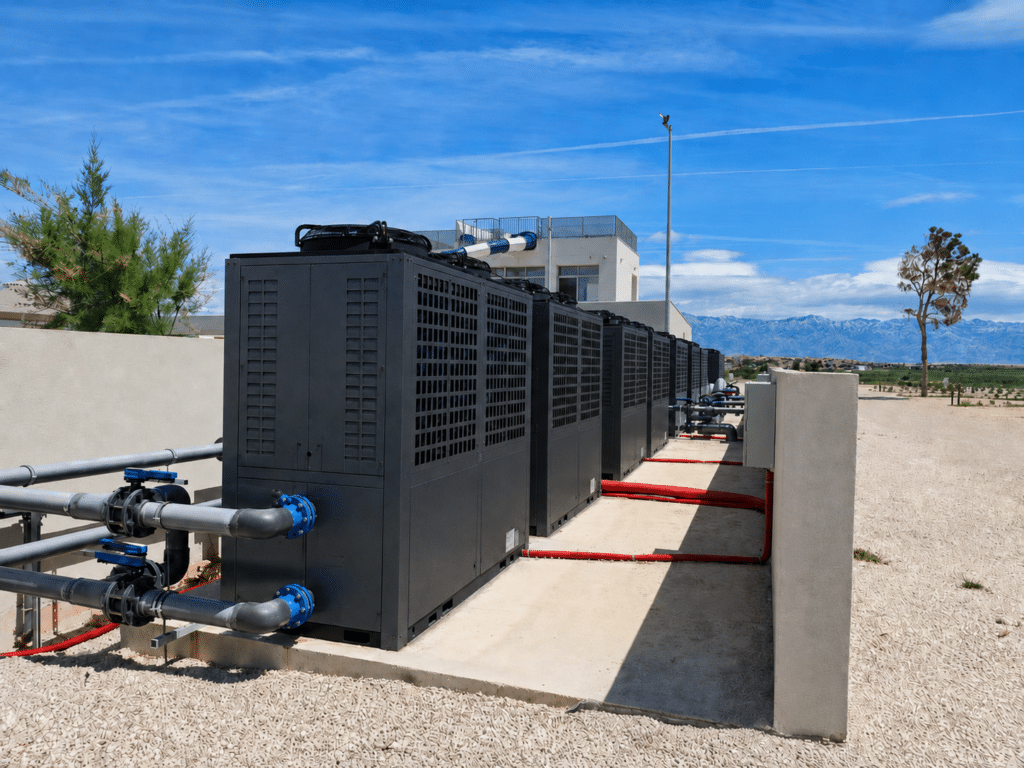
- Equipment layout should allow sufficient airflow and maintenance access
- Commercial heat pump systems require proper ventilation conditions
- Maintenance pathways should remain accessible for long-term servicing
- Installation environments should minimize excessive dust and restricted airflow
- Proper system layout can improve long-term operating reliability
Common Installation Considerations
| Installation Factor | Why It Matters |
|---|---|
| Ventilation space | Improves heat exchange efficiency |
| Maintenance access | Simplifies future servicing |
| Equipment spacing | Reduces operating interference |
| Drainage design | Supports stable long-term operation |
The Importance of Backup Heating Systems
Why Backup Heating Matters
- Backup heating systems help handle peak hot water demand periods
- Improve overall system reliability for commercial applications
- Support stable operation during maintenance or unexpected shutdowns
- Redundancy design is important for hotels, hospitals, and high-demand commercial projects Proper backup design helps maintain uninterrupted hot water supply
Common Backup Heating Options
| Backup Solution | Typical Application |
|---|---|
| Electric backup heater | Peak demand support |
| Multiple heat pump modules | System redundancy |
| Auxiliary boiler system | Large commercial projects |
| Zoned hot water storage | Stable supply management |
FAQ
Q1. Are Heat Pumps Suitable for UAE Climate Conditions?
Yes. The UAE’s high ambient temperatures help commercial heat pump systems operate more efficiently throughout the year. Unlike colder regions, UAE heat pumps rarely require defrost operation during winter, allowing more stable COP performance and lower energy consumption for commercial hot water applications.
Q2. Are Heat Pumps or Solar Water Heaters Better for Hotels?
For most UAE hotels, commercial heat pump systems are generally more suitable because they can provide stable 24-hour hot water supply with lower operating costs. Solar water heaters may help reduce energy consumption, but they still depend heavily on sunlight and usually require backup heating systems.
Q3. How Much Electricity Can Commercial Heat Pump Systems Save?
Compared with traditional electric heating systems, commercial heat pump hot water systems can typically reduce electricity consumption by around 67%–74%, depending on project size and hot water demand.
Q4. How Should Hotels Select the Right Heat Pump Capacity?
Hotel heat pump sizing should be based on room quantity, daily hot water demand, and peak usage periods. Hotels with swimming pools, laundry facilities, or spa areas may require additional heating capacity and storage tank sizing.
Q5. Can Heat Pumps Replace Traditional Boiler Systems?
Yes. Commercial heat pump systems are increasingly replacing traditional electric and gas boilers in UAE commercial projects because they offer lower operating costs, higher energy efficiency, and more stable hot water supply.
Looking for a Commercial Heat Pump Hot Water System for Your UAE Project?
Airproz supplies commercial heat pump water heater systems for hotels, apartments, hospitals, and large-scale commercial developments across the UAE and GCC. Our B2B team can provide system sizing, energy consumption comparisons, and factory-direct pricing.
→ Request a Project Quote | → View Commercial Heat Pump Range |