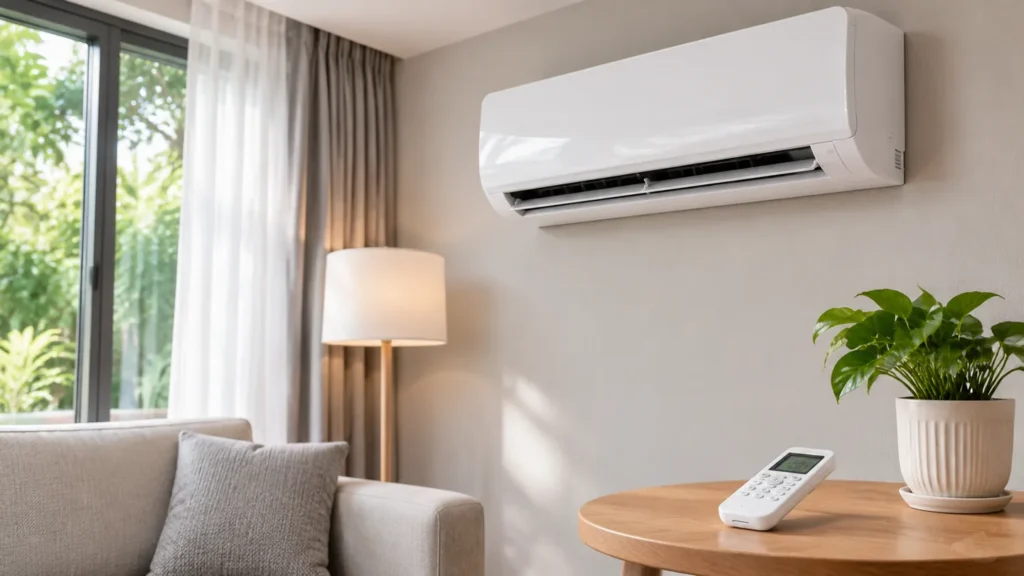
Choose the air conditioner filter type and actual size your system requires, then use the highest MERV rating it can support without reducing required airflow. Check the filter monthly; replace disposable filters or clean washable screens when their condition or service instructions call for it.
First identify the type of filter your unit uses. A central ducted system often takes a replaceable MERV-rated filter. Many ductless mini-splits, window units, and portable ACs instead use washable intake screens. Use the filter specified for that unit, not a ducted-system filter chosen by its MERV number.
What Does an Air Conditioner Filter Actually Do?
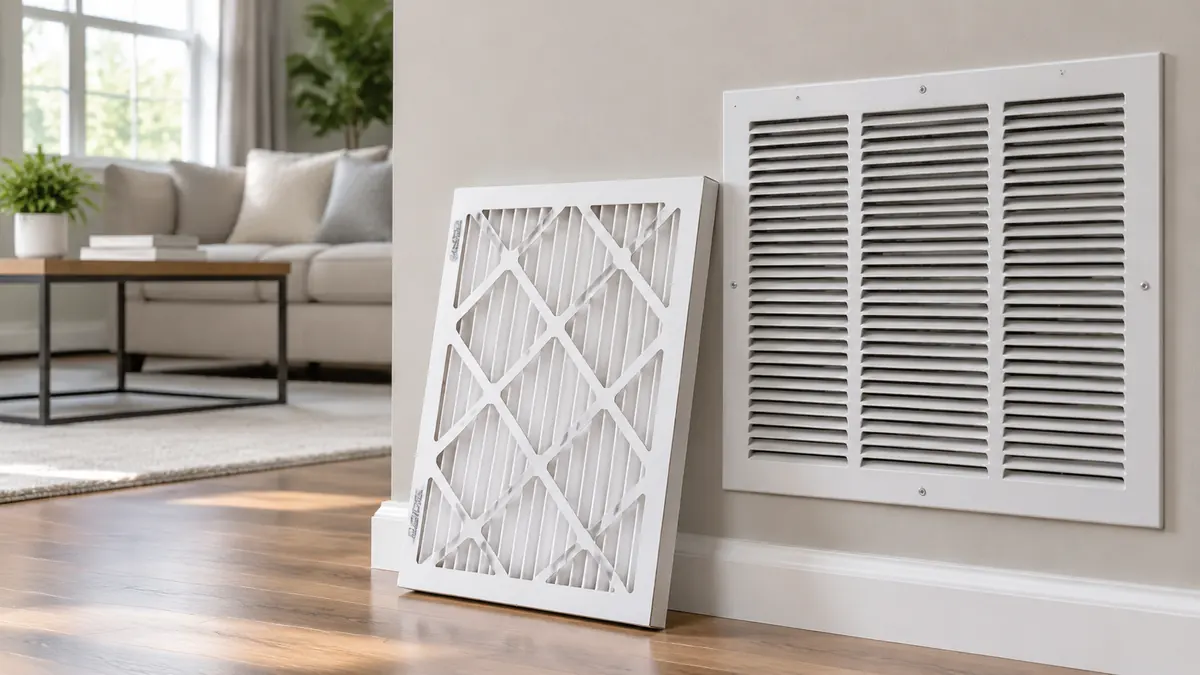
An air conditioner filter traps dust and other airborne particles as air passes through it. This helps protect the indoor cooling equipment and reduces the particles carried back into occupied rooms.
In a ducted central AC or heat pump, the filter usually sits in a return-air grille or a filter cabinet near the indoor air handler. Return air passes through it before reaching the blower and cooling coil. A clogged or poorly fitted filter can reduce airflow and allow dust to bypass the filter.
A ductless mini-split or window AC normally uses a washable mesh screen inside the indoor unit. That screen is important for protecting the coil, but it is not automatically equivalent to a MERV-rated whole-home filter. A portable AC may have more than one intake screen. Locate each intake cover and use the unit’s filter-access instructions to check which screens are washable and which inserts must be replaced.
Filters collect particles, not every indoor pollutant. Most standard particle filters do not remove carbon monoxide, carbon dioxide, or ordinary household gases. Address pollution sources and ventilation separately.
Which Air Conditioner Filter Types Are Available?
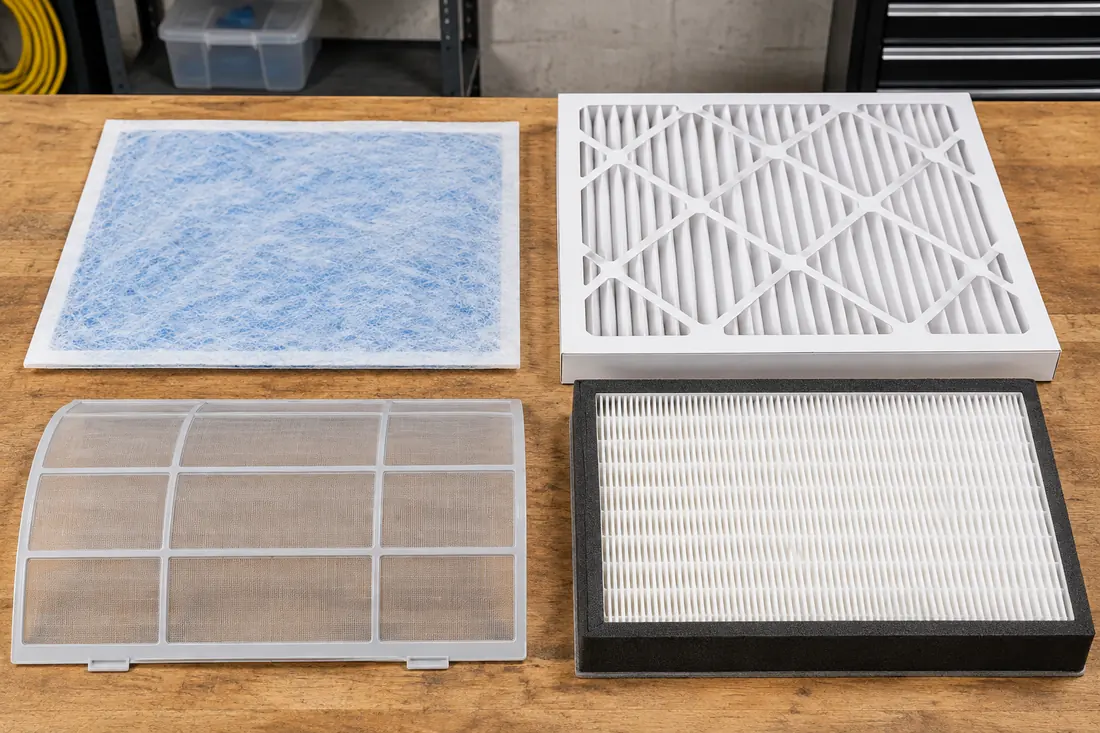
The main AC filter types are fiberglass disposable filters, pleated disposable filters, washable mesh screens, and specialty media. Ducted systems often use replaceable filters, while many mini-splits, window ACs, and portable units use washable intake screens.
| Filter type | What it does well | What to check before use |
|---|---|---|
| Fiberglass disposable panel | Low-cost basic equipment protection and large-particle capture | Often provides less fine-particle removal than pleated media; use only an approved size and rating. |
| Pleated disposable filter | More media surface area and a range of MERV ratings for residential returns | Compare MERV, rated pressure drop, frame fit, and replacement frequency. |
| Washable mesh or plastic screen | Traps larger dust and lint in many mini-splits, window units, and portable ACs | Clean only as the manual directs; dry fully before reinstalling. Usually has no published ASHRAE MERV rating. |
| Washable or reusable electrostatic filter | Reusable option in systems specifically designed for it | Check tested capture efficiency and airflow resistance, not just the marketing term “electrostatic.” |
| High-efficiency media cabinet | Can support deeper, larger-area filters for finer-particle capture | Requires a compatible cabinet, adequate fan capability, and correct seal. |
In a wall-mounted ductless unit, the filter is part of the indoor air path rather than a central return-filter rack. Our mini split air conditioner guide explains the indoor-unit layout, airflow, and access points.
A thicker filter is not automatically a higher MERV filter, and the same MERV label does not mean all products have the same airflow resistance. Pleat design, media area, depth, and operating airflow affect the actual pressure drop.
A HEPA filter is a separate high-efficiency category, not simply another number on the standard MERV 1–16 chart. It needs a filter housing and fan designed for its airflow resistance.
What Does the MERV Rating Chart Tell You?
The MERV chart shows which particle sizes a filter captures more effectively. MERV 8 mainly captures larger particles, MERV 11 improves capture of smaller particles, and MERV 13 has higher rated capture of fine particles; the rating does not show whether a specific filter will preserve your system’s airflow.
MERV stands for Minimum Efficiency Reporting Value. The table below uses the minimum average particle-removal efficiencies for MERV 8, 11, and 13 in the US Environmental Protection Agency’s explanation of ASHRAE Standard 52.2. The three particle-size ranges are in micrometers (µm).
| MERV rating | 0.3–1.0 µm | 1.0–3.0 µm | 3.0–10.0 µm | Practical takeaway |
|---|---|---|---|---|
| MERV 8 | No specified minimum | ≥20% | ≥70% | Basic filtration for larger dust and debris; limited rated performance in the smallest range. |
| MERV 11 | ≥20% | ≥65% | ≥85% | Improved capture of many mid-sized particles compared with MERV 8. |
| MERV 13 | ≥50% | ≥85% | ≥90% | Stronger fine-particle capture, useful for smoke-sized particles if the HVAC system can operate with it. |
The percentages measure particle capture in a standardized filter test. Changes in room-air particle levels depend on how much air passes through the filter, bypass gaps, fan run time, and continuing particle sources. See the EPA’s MERV explanation.
Are MERV, MPR, and FPR the Same Rating?
No. MERV is the standardized filter-efficiency rating, while MPR and FPR are different product-label systems. MPR is used by 3M Filtrete; FPR is used by Home Depot. Their printed numbers are not universally interchangeable with MERV numbers. If a filter package lists only MPR or FPR, find the exact product’s published MERV value, actual size, and pressure-drop data before choosing a replacement.
Is MERV 8, MERV 11, or MERV 13 Best for Your Home?
Choose MERV 13 if your ducted system can keep its required airflow with that filter. Choose MERV 11 when MERV 13 is too restrictive but MERV 11 is supported; keep MERV 8 when the equipment specifies it or higher grades fail the airflow check.
| Your situation | Practical choice | Next action |
|---|---|---|
| Existing system specifies MERV 8 | Keep a properly fitted MERV 8 until compatibility with a higher grade is checked | Check the air-handler manual and ask for rated filter pressure-drop data. |
| More dust or allergen particles are a concern | Consider MERV 11 or MERV 13 | Check the fan, filter slot, seal, and operating airflow before upgrading. |
| Wildfire smoke or fine particles are a concern | Prefer MERV 13 or higher when compatible, plus a suitable portable air cleaner where needed | Compare the filter’s resistance at your system’s airflow; use a portable HEPA unit if the ducted system cannot accommodate a higher-efficiency filter. |
| Weak supply airflow or icing starts after an upgrade | Do not keep operating with a filter that causes inadequate airflow | Stop cooling if the coil is frozen; arrange a qualified airflow and static-pressure check. |
Choose in four steps: (1) Confirm whether the unit takes a rated disposable filter or a washable screen. (2) Check the actual filter size. (3) Select the filtration level for the particles you want to reduce. (4) Confirm that the filter can deliver the airflow your system needs. If a higher rating would restrict airflow, keep the approved filter and consider a correctly sized portable room air cleaner for extra particle removal.
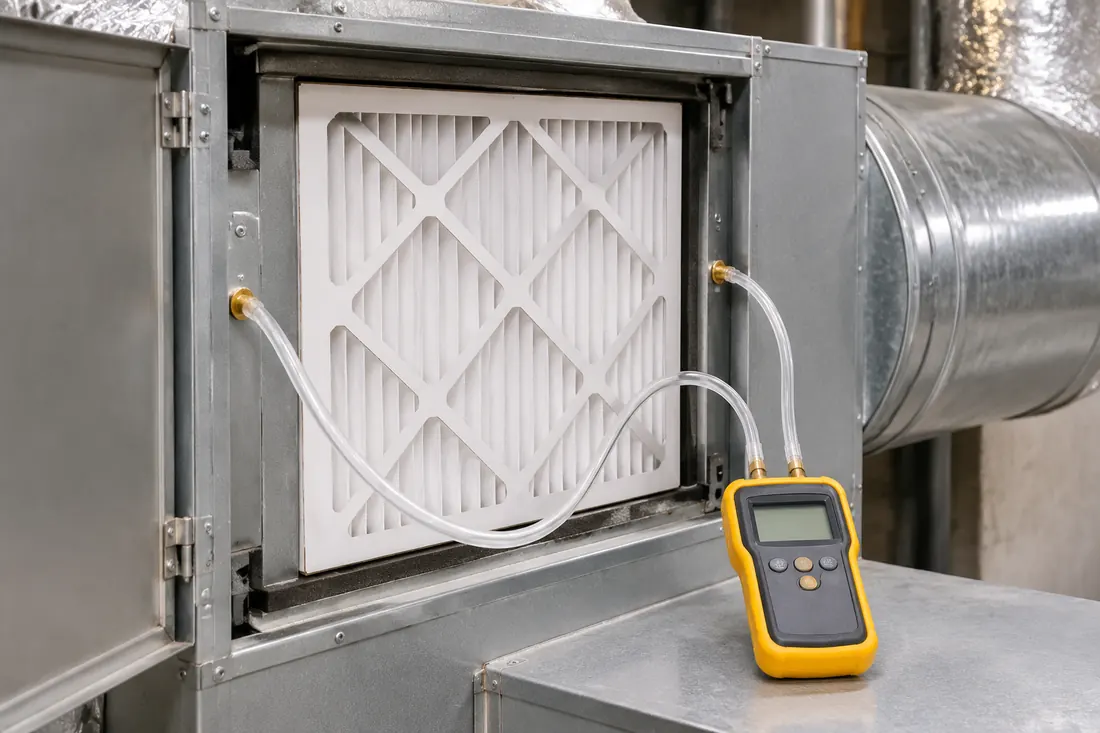
A higher MERV number does not by itself prove greater pressure drop. For the same nominal size, an efficient filter with more media area may have equal or lower resistance than another model with a lower MERV rating. Compare manufacturer pressure-drop curves at the same airflow, not MERV alone. The DOE/PNNL Building America guide to high-MERV filters explains how filter area, depth, and duct design affect system performance.
Before changing the MERV grade, collect these five items:
- Air-handler model and filter location: find the model plate and equipment manual.
- Actual filter slot size: record usable width, height, and depth, including room to seal the frame.
- Required system airflow: use the manufacturer’s operating airflow or verified commissioning data, in CFM or m³/h.
- Filter pressure drop at that airflow: compare each candidate filter’s manufacturer data at the same airflow; do not compare ratings alone.
- Fan capability and installed external static pressure: check the fan data and have a qualified technician measure system static pressure when the available data cannot establish compatibility.
Filter pressure drop and total external static pressure are not the same value. The filter uses part of the available pressure budget, while the measured external system pressure includes other airflow restrictions. Compare the installed operating point with the equipment’s fan data before approving an upgrade.
For a system with limited filter area, a properly designed deeper or larger-area media cabinet can be a better solution than forcing a dense 1-inch filter into a narrow slot. Do not alter a filter rack, add material, or cover a return grille to make a filter fit. A technician can measure total external static pressure and confirm airflow against the equipment’s specifications.
For a new ducted installation, our central air conditioner installation guide explains how return-air paths, filter access, and measured airflow fit into system design and handover.
How Do You Choose the Correct AC Filter Size?
Match the filter’s actual width, height, and thickness to the filter rack or grille. It should fit without bending or gaps that let air bypass the media; the nominal label alone does not confirm fit.
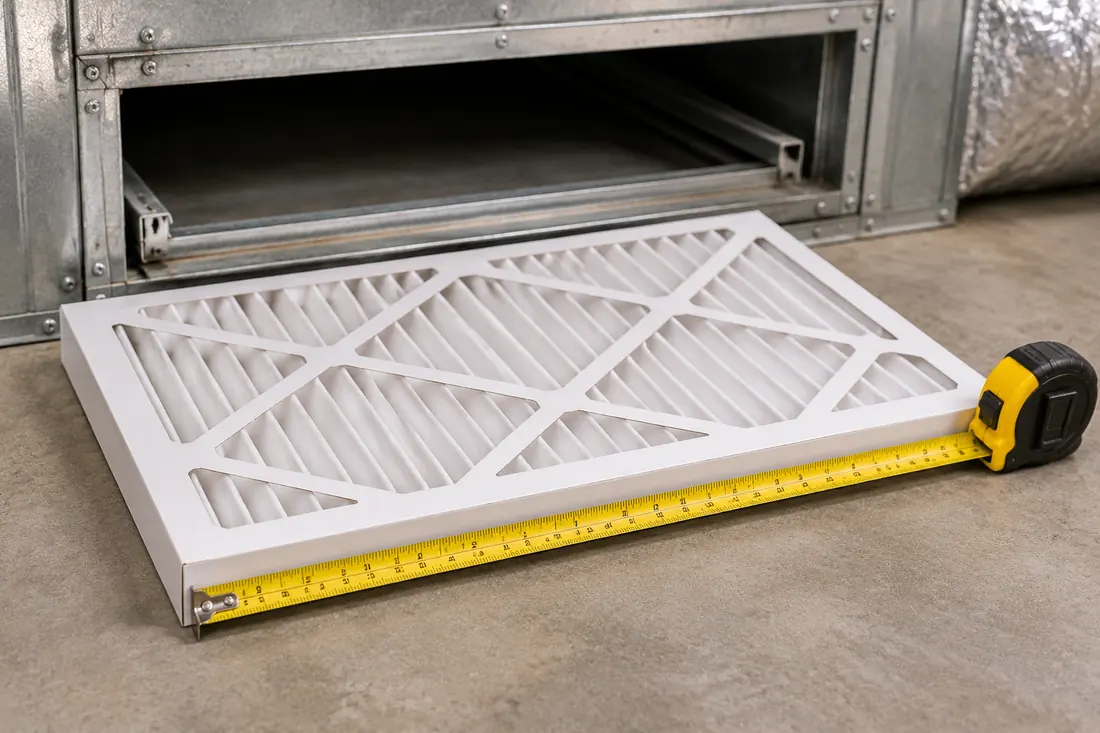
- Find the filter location. Check the return grille, indoor air-handler filter rack, or the unit manual. Some systems have more than one return filter.
- Read the current frame. Record the nominal size and, if listed, the actual dimensions. Common nominal examples include 16 × 20 × 1 and 20 × 25 × 1 inches, but actual dimensions are often slightly smaller. For example, a filter sold as 20 × 20 × 1 inches (nominal) can list actual dimensions of 19.5 × 19.5 × 0.75 inches. Read the actual dimensions on that product and match them to the opening before ordering another brand.
- Measure the opening or existing filter. Confirm width, height, and usable thickness. The replacement must slide in without bowing or leaving large gaps.
- Check direction and seal. On a disposable ducted filter, the airflow arrow points toward the blower or air handler, which is generally away from the room-facing return grille.
- Verify the exact product and rating. A different brand, depth, or pleat design can change pressure resistance even when the printed nominal size is identical.
Do not add a second filter over an existing one unless the system was specifically designed for that arrangement. Two unplanned filters can add resistance and make maintenance confusing.
How Often Should You Change an AC Filter?
Inspect a central AC filter every month. For many 1-inch disposable filters, 60–90 days is a starting replacement window, but replace sooner if it is dirty, wet, damaged, or reaches the product’s stated service limit.
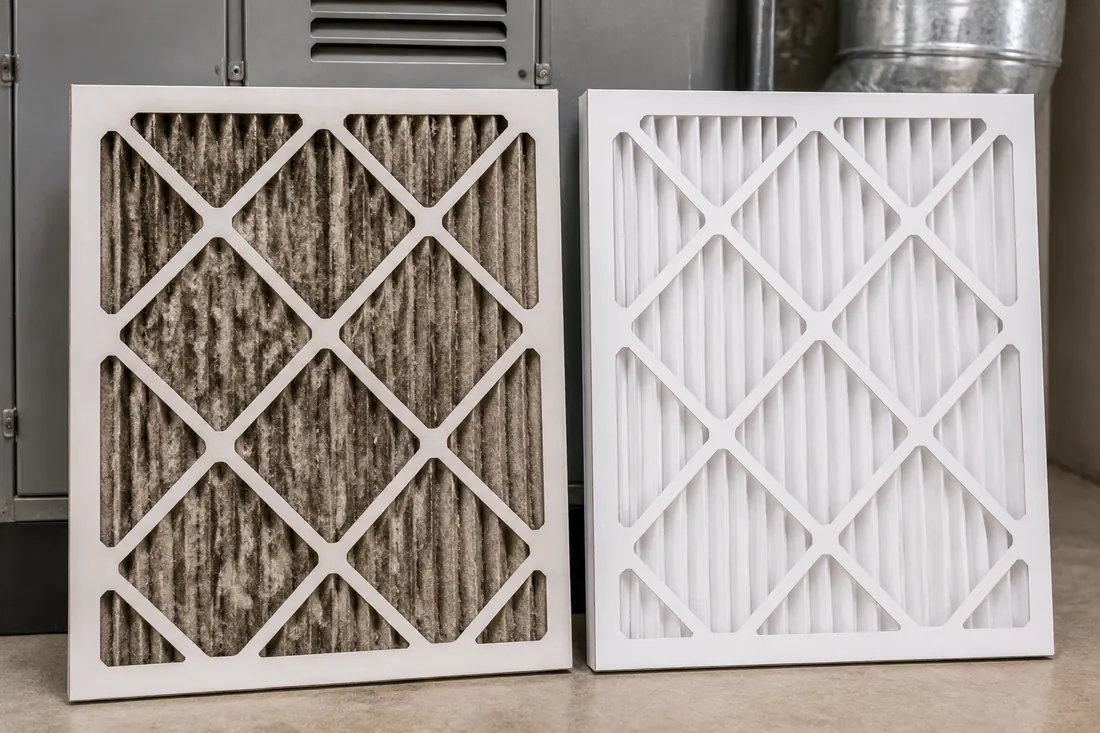
| Condition | What to do |
|---|---|
| Normal operation with a standard disposable filter | Inspect monthly; use the product and system’s specified replacement schedule. |
| Heavy dust, pets, renovations, smoke, or long fan run time | Inspect more often and replace sooner if loaded. |
| Thick media filter in a designed cabinet | Follow the specific filter and cabinet service interval; do not assume a 1-inch filter’s schedule applies. |
| Washable mini-split or window-unit screen | Clean at the frequency in that unit’s manual, and wait until completely dry before installation. |
| Torn, wet, damaged, or poorly sealed filter | Replace it or correct the fit immediately; investigate unwanted moisture. |
A dark-looking filter may still pass some air, and a pale filter can still have high resistance if loaded with fine particles. Use condition and manufacturer guidance together. ENERGY STAR recommends checking the filter monthly and replacing or cleaning it when dirty: clean heating and cooling maintenance.
Track the date, then act on what changes. Record the new filter’s model and installation date. Check it monthly, and replace it sooner if dust loading, damage, moisture, or a manufacturer-set service limit calls for it. If supply airflow drops soon after replacement, check size, fit, and the new filter’s resistance instead of simply changing the calendar interval.
For a complete schedule covering filters, coils, drains, and routine checks, see our air conditioner maintenance guide.
How Do You Replace or Clean Air Conditioner Filters?
For a disposable ducted filter, switch the unit off and install the approved replacement with its airflow arrow pointing toward the blower. For a washable screen, clean it as the unit instructions allow and reinstall it only after it is completely dry.
Replacing a disposable filter in central AC or a ducted heat pump
Switch the unit off and fit the approved replacement with its airflow arrow pointing toward the indoor blower. Follow these steps:
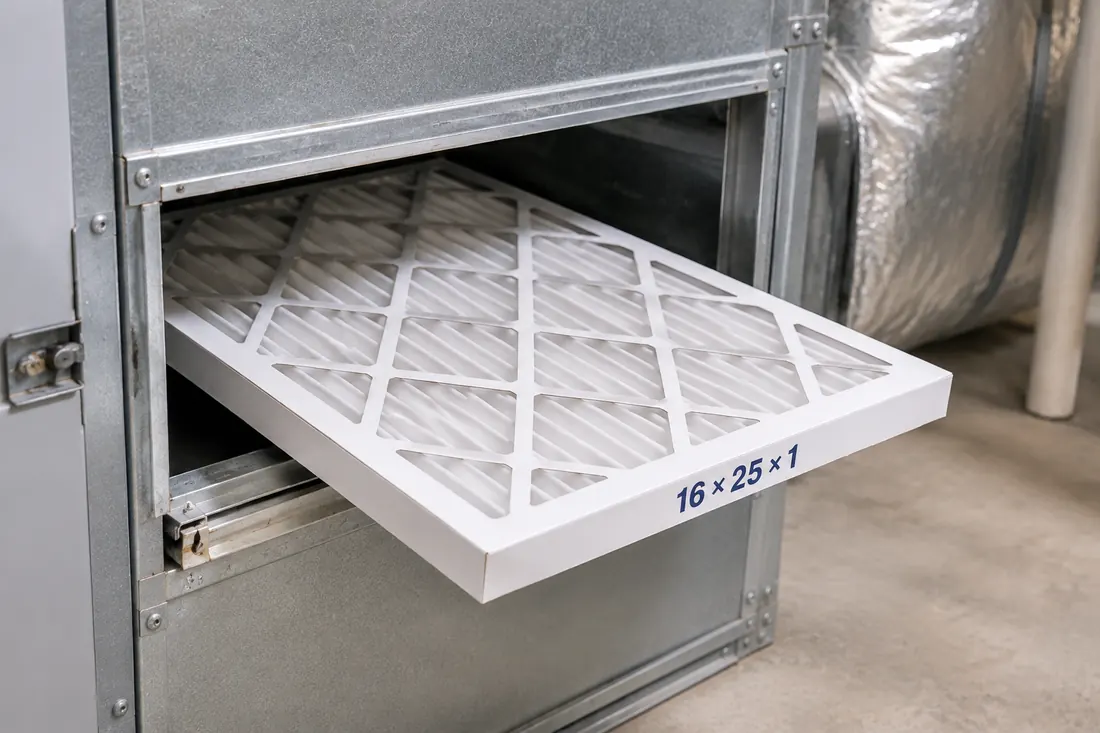
- Switch the system off at the thermostat or normal user control and wait for the fan to stop.
- Open the accessible return grille or filter access panel described in the manual. Do not open a sealed electrical or refrigerant compartment.
- Note the installed filter size and the direction of its airflow arrow. Slide it out carefully to limit dust release.
- Insert the same approved size and a compatible MERV filter. Keep the frame flat, with the arrow toward the indoor blower. Close the grille or filter door fully.
- Restart the system and check that the normal supply registers are delivering air without a new whistle, rattle, or obvious reduction in flow. If airflow is weaker than before, switch off cooling and recheck the approved rating, frame fit, seals, and arrow direction; seek a qualified airflow check if it remains weak.
- Record the date and filter model to make your next inspection easier.
Cleaning a washable mini-split, window AC, or portable AC filter
Remove loose dust, rinse the screen only if the manual permits it, and reinstall only after full drying. Follow these steps:
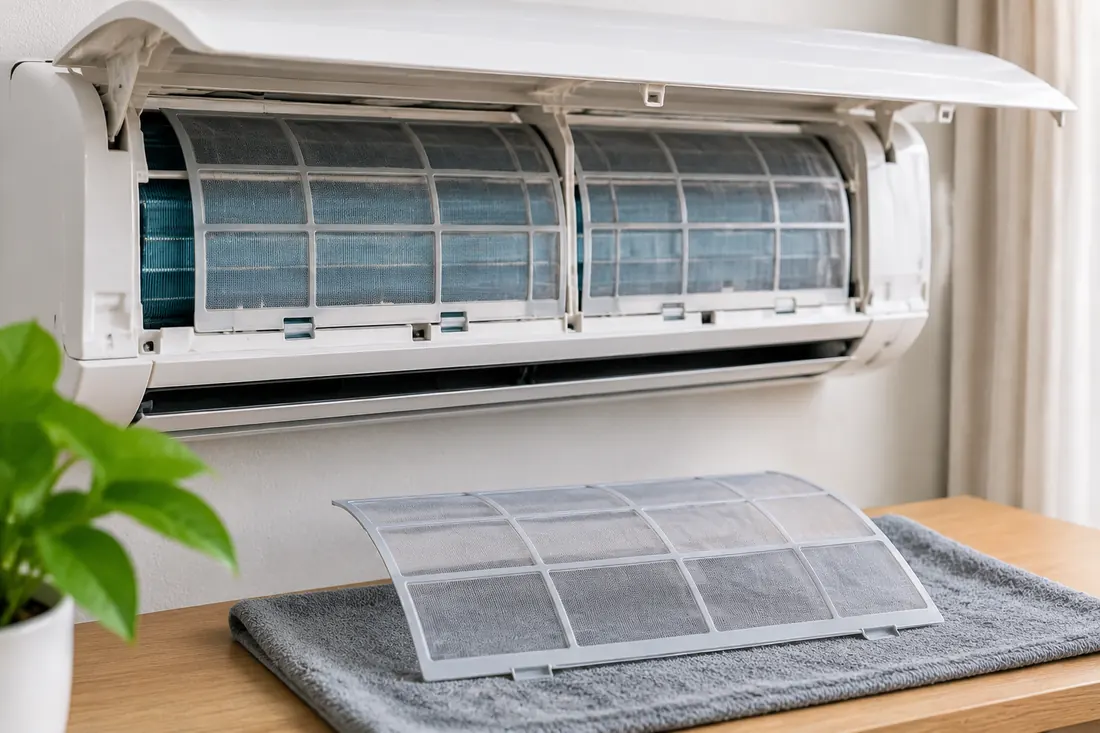
- Turn the unit off and open its user-access filter cover as directed by the manual.
- Lift out the screen. Remove loose dust using a soft vacuum brush; rinse with water only if the manufacturer allows it.
- Let the screen dry completely in a clean, shaded area. Never install a wet screen or operate the unit without its required screen.
- Refit it securely, close the cover, restart the unit, and check for normal airflow without a new whistle or loose cover. If the flow is worse, turn the unit off and check that the screen is dry, fully seated, and not folded.
Some units include disposable, odor-control, or specialist inserts in addition to the main washable screen. Do not wash a disposable pleated or carbon insert unless its specific instructions say it is washable. If filter access requires tools or exposes wiring, follow the service instructions rather than dismantling the unit.
What Are the Signs of a Dirty or Incorrect Air Conditioner Filter?
Weak airflow, return-air whistling, a visibly loaded filter, and recurring coil ice are warning signs of a blocked or poorly fitted AC filter. Check filter loading, fit, and return-air obstructions first; persistent icing or weak airflow calls for a wider system check.
| Symptom | Filter-related check | If the issue continues |
|---|---|---|
| Little air from supply registers | Inspect for dirt, collapsed media, wrong orientation, and a blocked return grille | Have the blower, coil, ductwork, and system airflow checked. |
| Whistling at a return grille | Check whether the filter is folded, too restrictive, or not seated correctly | Inspect the grille, duct restriction, and pressure condition. |
| Ice on the indoor coil or refrigerant line | A blocked filter may limit airflow across the coil | Stop cooling, allow proper thawing, and arrange service; refrigerant or control faults can also cause ice. |
| Dust appears quickly after changing the filter | Check filter frame gaps and whether any return is unfiltered | Inspect duct leakage, cleaning sources, and air distribution. |
| Musty smell or a wet filter | Check for trapped moisture or visible growth | Address drainage or condensation problems; a new filter alone will not fix moisture. |
If cooling stays weak after restoring the correct filter, follow our AC not cooling troubleshooting guide to separate airflow, controls, coil condition, and refrigerant-system symptoms. If ice is visible on the coil or refrigerant line, stop cooling and use our AC freeze-up guide for the next safe steps.
If airflow becomes noticeably worse immediately after a higher-MERV upgrade, restore the manufacturer’s approved filter specification and have the system evaluated before trying another high-resistance product. Do not bypass the filter as a permanent fix.
Can You Use a HEPA Filter or Remove Smoke With an Air Conditioner?
Do not put HEPA media into a standard AC filter slot unless the system was designed for its airflow resistance. A compatible MERV 13 filter can capture some smoke particles as air passes through it, while a correctly sized portable HEPA air cleaner can add room-level particle removal; ordinary particle filters do not remove every smoke gas.
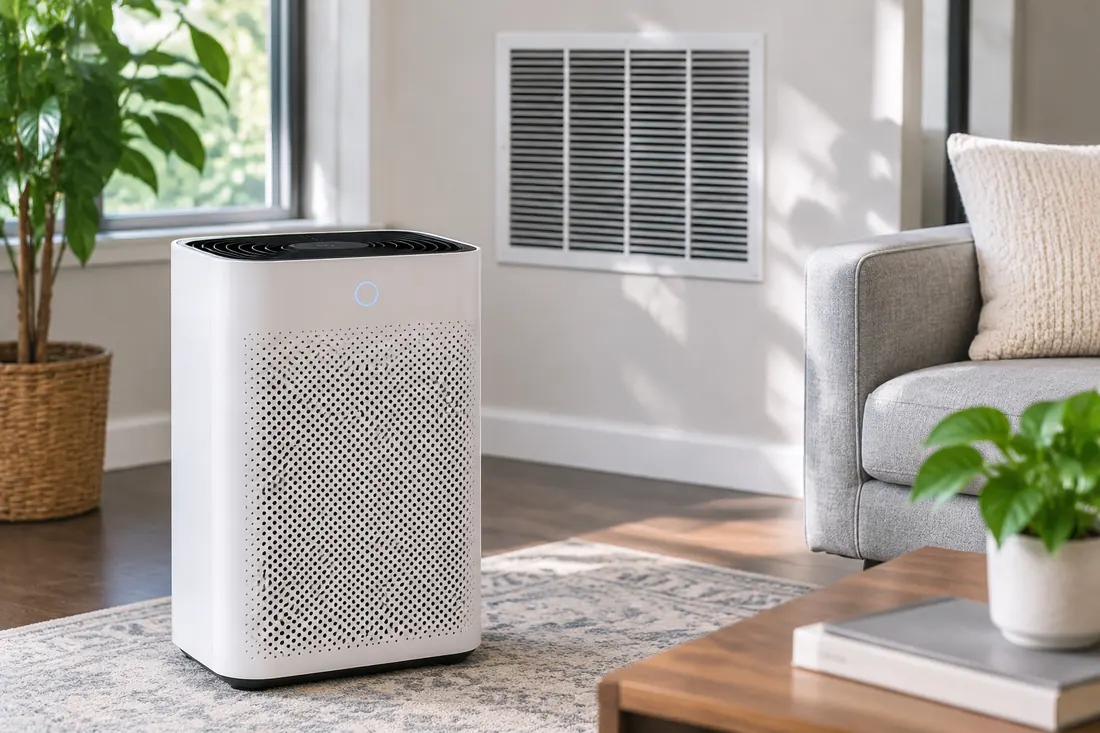
HEPA means high-efficiency particulate air; a true HEPA filter captures at least 99.97% of 0.3-µm particles in its specified test. HEPA media needs a suitable filter housing and fan to maintain required airflow. Installing it in an unapproved residential return grille can reduce cooling airflow. See the EPA’s explanation of HEPA filters.
If wildfire smoke is your concern, use a MERV 13 filter or the highest compatible rating in a ducted system and consider a portable HEPA cleaner with an appropriate clean air delivery rate (CADR) for the room. Keep windows closed when outdoor smoke is severe and manage ventilation according to local health guidance. Basic particle filters do not remove all smoke gases and odors; an activated-carbon product needs sufficient carbon and suitable specifications for gas removal. The EPA’s Guide to Air Cleaners in the Home explains these distinctions.
MERV describes filter capture during a test, not how much room air passes through it each day. A central filter removes particles only while the fan moves air through it. Fan run time, room-air mixing, and leakage around the frame therefore affect real indoor results. For ongoing room-level particle removal, a properly sized portable cleaner can complement an appropriately filtered HVAC system.
For a ductless split or window unit with a simple reusable intake mesh, do not treat a thin add-on “HEPA” sheet or filter pad as a safe upgrade without explicit manufacturer approval. Blocking the intake can affect cooling and coil condition.
What Should Building Operators and HVAC Projects Check?
For each building or bulk AC project, check the unit model, filter type and actual dimensions, required airflow, filter pressure drop at that airflow, return-air layout, and service access. Compare these together before fixing the equipment configuration or replacement-filter schedule.
Before setting a filter requirement, record the equipment model, return-filter locations, filter dimensions and depth, airflow at the design operating point, allowable pressure drop, and how the filter will be accessed for replacement. On packaged or ducted systems, ask for the fan performance and the filter’s pressure-drop information under matching conditions.
For each proposed equipment model, request four items before approving the filtration specification: (1) the filter location and service-access drawing; (2) the approved filter dimensions or washable-screen part number; (3) the cleaning or replacement method and access clearance; and (4) the fan and filter pressure-drop information at the specified airflow when a ducted MERV-rated filter is required. If a model has no confirmed filter dimensions, service-access drawing, or airflow data, request the missing specification for that exact model before approving the filter requirement.
For wall-mounted mini-splits, check the actual indoor-unit filter type and service access rather than assuming a central ducted MERV filter can be installed. When comparing new cooling equipment, review the intended use and configuration in our air conditioner product range.
For a wall-mounted split AC product example, review the Airproz R32 T1 inverter air conditioner SA series. Use the exact indoor-unit documentation to confirm its approved screen or filter, cleaning method, and service access before writing a project maintenance schedule.
Planning a multi-unit AC or OEM project? Send us the destination market, required equipment type or model to match, estimated quantity, airflow or capacity targets, filter access limits, and any filtration requirement in your specification. With those project details, we can compare the proposed indoor-unit type, filter access arrangement, and airflow requirements, then list the model-specific specifications needed to select a suitable configuration. For an equipment enquiry, contact Airproz.
Choosing and Maintaining the Right Air Conditioner Filter
The right AC filter fits the unit, captures the particles that matter for the space, and allows the required airflow. Check it monthly and replace or clean it when its condition or approved service schedule calls for it.
Start with the manufacturer’s specification, use the MERV chart to compare particle capture, then check actual filter dimensions and pressure drop. That approach protects cooling performance while improving particle filtration where your system supports it.
Frequently Asked Questions About AC Filters
Can I put a 1-inch MERV 13 filter in an older central AC?
Only when the installed filter’s pressure drop at your system’s airflow is acceptable and the slot fits it correctly. A MERV 13 label alone cannot confirm compatibility. Check the manufacturer’s airflow and filter guidance; a technician can measure static pressure if needed.
Do ductless mini-split filters have MERV ratings?
Most basic washable mini-split screens do not carry a standard ASHRAE MERV rating. Clean the approved screen as directed, and use separately designed room air filtration when finer particle capture is needed.
Does the filter arrow point toward the return grille or blower?
For a disposable ducted filter, the airflow arrow points toward the blower or air handler, not toward the room. At a typical return grille, the arrow points into the duct.
Can I reinstall a washable AC filter while it is still damp?
No. Reinstall it after it has dried completely. Moisture on a screen can bring dirt into the indoor unit and can contribute to unwanted dampness.
Should I put filters in both the return grille and air handler?
Only if the system was designed for both filter locations. Adding an unplanned second filter increases total resistance and can reduce airflow. Identify the specified filter location and keep all required returns filtered.
Why is the house still dusty after replacing the filter?
Air may be bypassing the filter, entering through leaks, or carrying dust from indoor activities. Check frame seals and filter fit first, then inspect return ducts and dust sources. A higher MERV rating cannot fix a large bypass gap.
What if the replacement filter lists MPR or FPR but not MERV?
Find the exact product’s published MERV rating before comparing its filtration level with another product. Check that model’s actual dimensions and pressure drop at your operating airflow too. Do not convert the printed MPR or FPR number directly into a MERV number.