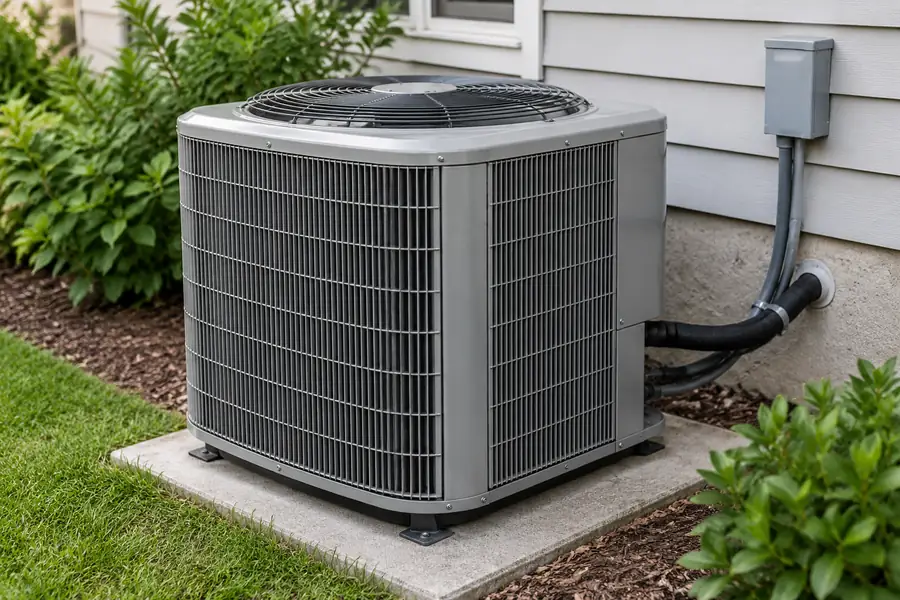
Comparing a DC air conditioner vs AC-powered AC starts with the power available at your site. A DC-powered unit accepts a specified direct-current supply, while an AC-powered unit accepts alternating current from a grid, generator or suitable inverter. Choose around the available supply, required cooling and operating hours. DC can simplify a native battery system; efficient AC-powered equipment often fits grid-connected buildings and existing solar-inverter systems better.
The label “DC inverter” describes compressor control. It does not, by itself, mean you can connect the air conditioner to a battery or solar panel.
What is the difference between DC and AC-powered air conditioners?
A DC-powered air conditioner accepts a specified direct-current supply; an AC-powered unit accepts a specified alternating-current supply. Either type can use variable-speed compressor control. Both use a compressor and refrigerant to move heat outdoors. The supply type and the compressor control method answer different questions.
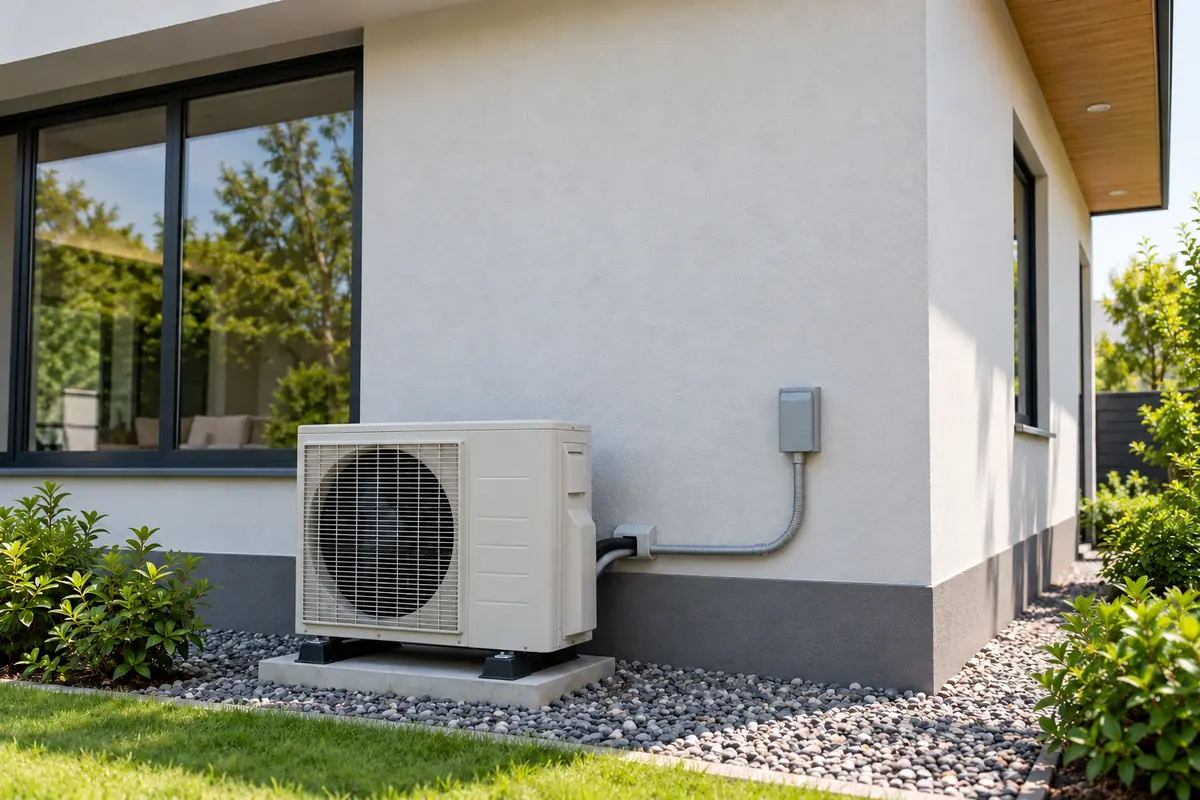
In this article, “AC-powered” means alternating-current powered. “Air conditioner” is written out where the abbreviation AC could cause confusion.
A conventional AC-powered unit accepts the rated AC supply from a grid, generator or suitable inverter. Photovoltaic (PV) panels turn sunlight into electricity. When solar is part of the project, the supply path differs between these four arrangements:
| System | Typical supply path | Nighttime supply | Main condition |
|---|---|---|---|
| AC-powered air conditioner supplied by solar | PV panels → solar inverter → AC input | Grid or a battery-backed inverter | Match AC voltage, frequency, phase and available output |
| Battery DC air conditioner | Battery → approved DC supply path → DC input | Battery | Match the full operating voltage range and current limits |
| Direct-PV air conditioner | PV panel string → approved PV input | An approved alternative source, if the model supports one | Meet PV voltage, current and available-power requirements |
| Hybrid AC/DC solar mini-split | Approved PV input plus a separate AC input | AC supply or an approved backup arrangement | Confirm source blending and operation without the grid |
A battery DC supply path may include a DC converter or other equipment specified by the manufacturer. The table describes system arrangements; the installation manual defines the connections for each model.
Is a DC inverter air conditioner battery powered?
Not necessarily. “DC inverter” describes motor control; the complete unit may still require AC input. Check the unit’s specified input to determine whether it accepts battery DC. Many designs rectify incoming AC into DC, then use electronic switching to control the compressor motor. The internal DC circuit is part of the drive, rather than a battery connection provided for the owner.
Our guide to what an inverter air conditioner is explains how the drive controls compressor speed.
Our R32 inverter air conditioner SA series provides an AC-input example: its published specification lists single-phase 220–240V, 50Hz, alongside a DC inverter compressor description.
For any unit advertised as “full DC,” read the complete equipment input specification. The phrase may describe its compressor and fan motors. Only an explicitly specified DC input establishes DC supply compatibility. Never connect a battery to an internal DC link.
Should you choose a 12V, 24V or 48V DC air conditioner?
Match the air conditioner to the existing DC system first; compare higher-voltage options when designing a new system with substantial cooling demand. For the same electrical power, a higher DC voltage means a lower current. That can ease the demands on cables and connections, particularly over longer cable runs.
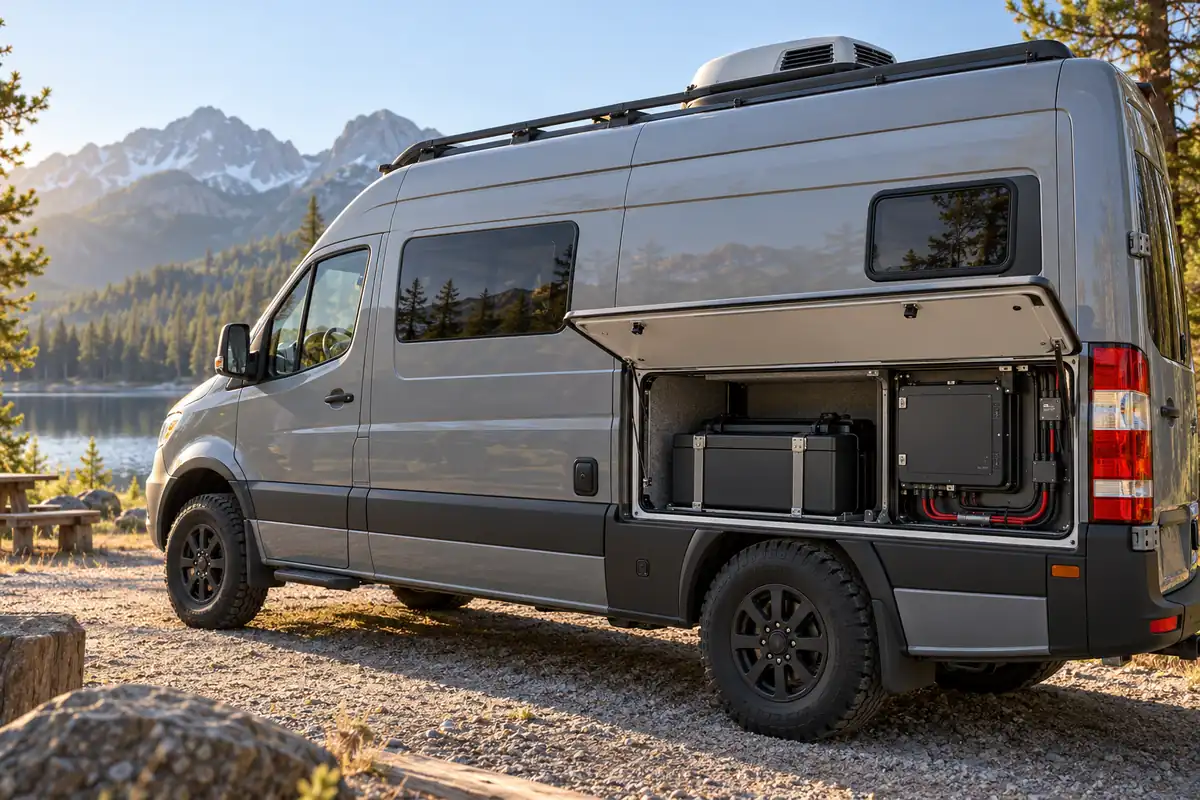
A 12V DC air conditioner can fit a compatible vehicle battery system. A 24V DC air conditioner can fit vehicles and other installations built around 24V. A 48V DC air conditioner can suit a native 48V battery installation. These are supply choices, not cooling-capacity ratings. A small 12V unit and a room-size 48V mini-split may serve very different spaces.
How much current does each voltage require?
At an assumed 600W electrical input, current is 50A at 12V, 25A at 24V and 12.5A at 48V. Use DC current = electrical input power ÷ voltage. These calculations use the stated voltage at the load terminals.
| Assumed input power | DC voltage at the unit | Calculated current |
|---|---|---|
| 600W | 12V | 50A |
| 600W | 24V | 25A |
| 600W | 48V | 12.5A |
The table holds electrical input at 600W to show how voltage changes current. Compare cooling capacity separately at the same operating conditions.
Low voltage also makes voltage drop important. A long or undersized cable can leave less voltage at the air conditioner than at the battery. For a load maintaining the same power, falling voltage increases current. Loose connections can add heat and further voltage loss. Victron’s Wiring Unlimited explains these electrical relationships.
Size cables and protection from the unit’s maximum current, cable route, permitted voltage drop and installation requirements.
Does nominal battery voltage guarantee compatibility?
No. The unit must accept the battery’s operating voltage range, including charging voltage and low-voltage operation. A nominal 48V label is not the complete specification. Battery chemistry, series arrangement and charging settings determine the voltage actually presented to the load.
Compare the battery’s highest charging voltage and expected lowest loaded voltage with the air conditioner’s allowed input range. Also check continuous current, any startup demand, polarity and the battery management system’s discharge limit. A battery management system, or BMS, can disconnect the load when its protection limits are reached.
Is a DC-powered air conditioner more efficient?
DC input can avoid an external DC-to-AC conversion when the energy source is a battery, but it does not automatically make the cooling system more efficient. Compare the complete system at the same cooling duty. Compressor design, heat exchangers, fans and controls all affect how much cooling each watt produces.
Keep three measurements separate:
- Cooling capacity: the heat removed, commonly stated in BTU/h or kW of cooling.
- Electrical input: the watts consumed by the complete operating unit.
- Energy used over time: kWh drawn during the cooling period, including the relevant supply losses.
A unit delivering 3.5kW of cooling does not necessarily draw 3.5kW of electricity. For an efficiency comparison at one operating point, divide cooling output by electrical input using consistent units and the same indoor and outdoor test conditions. Seasonal ratings answer a different question: efficiency over a defined range of conditions. Compare ratings from the same test system and product class.
How much does an external inverter loss matter?
In the following equal-load example, a 90%-efficient external inverter raises battery draw from 600W to about 667W. Suppose a DC-input unit takes 600W at its terminals. Suppose an AC-input candidate also needs 600W at its terminals to provide the same required cooling. Supplying the second unit through an external battery inverter at 90% efficiency requires:
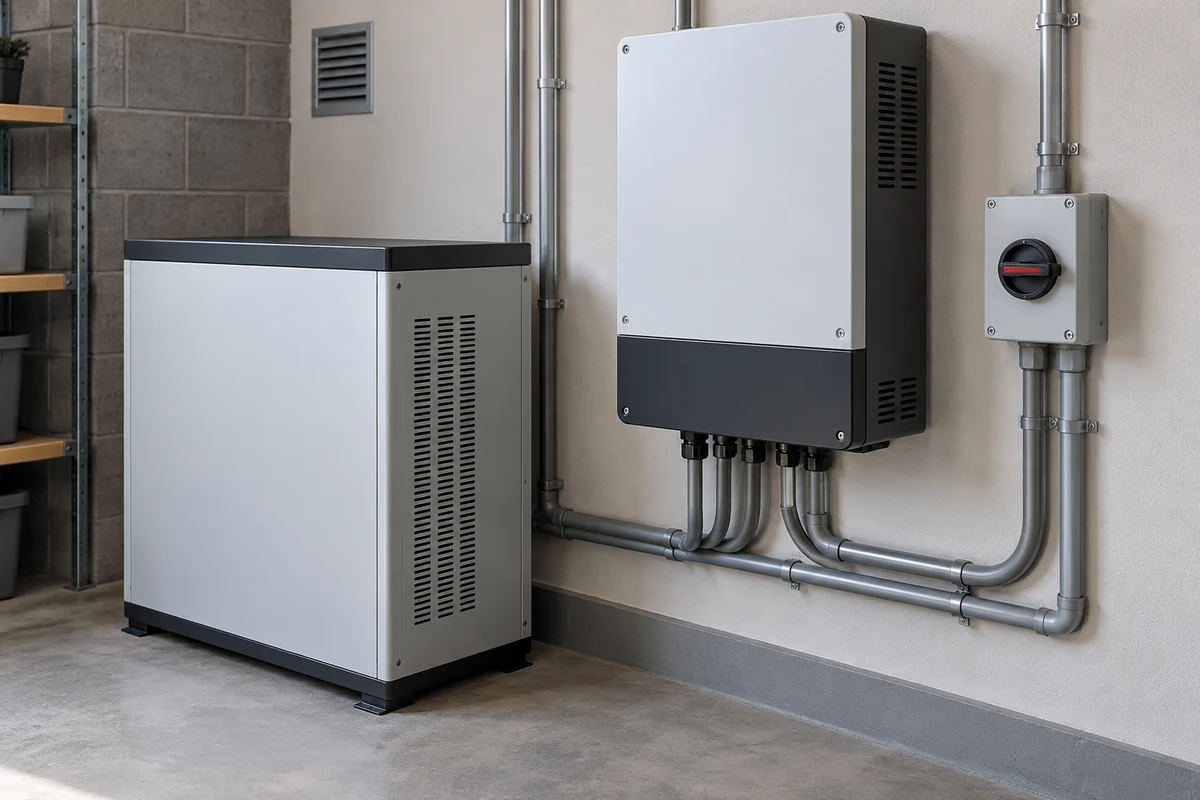
Battery power = 600W ÷ 0.90 = 666.7W.
The external conversion accounts for about 66.7W in this example. Internal compressor-drive and fan consumption are already included in each unit’s 600W input. Do not add them again. Count any separate inverter standby consumption only if it is not already covered by the efficiency input you use.
Now change the AC-input candidate to one that needs only 500W for the same cooling task. At the same assumed inverter efficiency, battery draw becomes 500 ÷ 0.90 = 555.6W. That is less than the 600W DC candidate. A better refrigeration system can outweigh an external conversion loss.
For a real comparison, obtain capacity and total input at your design outdoor temperature, indoor temperature and humidity. Then compare energy at the battery or grid connection over equivalent operating hours. Compare cooling capacity and input while the unit is meeting the required load; use representative energy measurements to assess running consumption.
Which solar setup works with each type of air conditioner?
Use an AC-powered air conditioner with a suitable solar inverter, or choose equipment specifically designed for direct PV input. For off-grid cooling after sunset, include an energy source that remains available at night. Identify whether the unit accepts battery DC, a dedicated PV string, AC power, or separate AC and PV inputs.
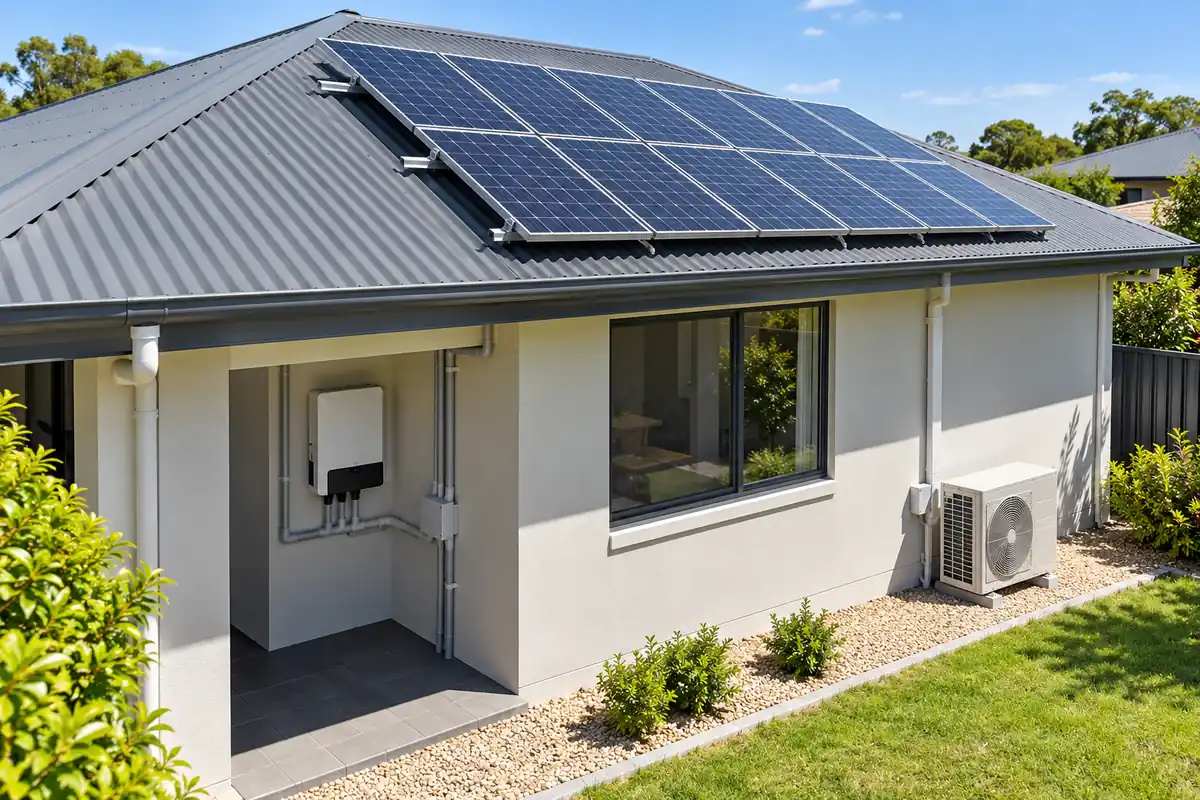
Existing rooftop solar with an AC supply
An efficient AC-powered air conditioner can use solar electricity through the building’s inverter. The PV panels produce DC, and the inverter supplies AC for compatible building loads. The US Department of Energy explains this conversion in its photovoltaic system design guidance.
If that infrastructure already exists and can support the cooling load, keeping it can avoid a second dedicated solar installation. Check the inverter’s available output alongside other loads. For backup use, also check its continuous and transient capability, output voltage and frequency, and the air conditioner’s approved supply requirements.
Direct PV and hybrid AC/DC cooling
A direct-PV air conditioner accepts a dedicated solar-panel string through its specified PV input. A hybrid AC/DC model also accepts a separate AC supply and can supplement solar power when its control system supports that operation. Its internal controller manages the approved inputs. Some models support solar-only daytime operation; others require additional conditions for stable operation.
A maximum power point tracking (MPPT) controller finds an operating point that draws useful power from the PV panels as sunlight changes. Its specified voltage window is important. The string must also stay below the equipment’s maximum permitted open-circuit voltage, including the increase that can occur in cold weather. The installer must check panel current limits as well.
A PV input is not automatically a battery input. A hybrid unit expecting a high-voltage panel string may be incompatible with a 48V battery, even though both supplies are DC. Use only the manufacturer’s approved electrical arrangement.
When sunlight weakens, a supported hybrid system may draw more AC power, reduce cooling output or stop if no adequate source remains. Decide which outcome the room can tolerate before selecting the system. Reducing daytime grid consumption and maintaining cooling through every outage are separate requirements.
Fully off-grid cooling and nighttime operation
An off-grid air conditioner needs enough stored energy or another dependable source for the hours when solar output cannot meet demand. A battery DC system uses an approved DC supply path. An AC-powered unit uses a compatible off-grid inverter supplied by the battery system. Either route needs adequate capacity and power delivery.
For a solar-powered direct-current air conditioner, the complete installation may include panels, a charge controller, batteries, electrical protection and the cooling equipment. A battery may also be required to stabilize the supply for a particular design, even during daylight. Read that requirement before choosing a battery-free arrangement.
Ordinary grid-connected PV equipment generally shuts down during a grid outage. The Department of Energy’s solar resilience guidance explains why backup requires a suitably configured system. Do not assume that panels on the roof will keep a conventional air conditioner running when the grid fails.
Which supply should cover nighttime cooling and outages?
Use grid power for routine nighttime cooling when it is reliable; add a compatible backup system when cooling must also continue during a power cut. A direct-PV unit may support daytime operation without the grid, but it still needs enough sunlight and the model’s approved operating mode.
| Your cooling requirement | Start with this arrangement | What must be available |
|---|---|---|
| Reduce daytime grid use; the grid covers other hours | Direct-PV or hybrid AC/DC equipment, or an AC unit on an existing solar-inverter system | A suitable supply whenever sunlight cannot cover demand |
| Continue cooling after sunset with reliable grid power | Grid supply to the unit’s approved AC input, or through its approved power equipment | Enough grid and circuit capacity; a nighttime tariff that fits the operating budget |
| Continue cooling at night or during a grid outage | A compatible battery-supported system, with an approved generator option where needed for extended outages | Backup-capable operation, enough usable energy and adequate starting and continuous power |
Before adding batteries, decide whether you need lower daytime grid use, routine nighttime cooling or outage protection. These goals can lead to different equipment and costs. A generator used for backup must match the equipment’s supply requirements and be installed for that purpose.
How long can a battery-powered air conditioner run?
Runtime equals usable battery energy divided by average battery-side power demand. In the example below, 4.096kWh supports about 6.8 hours at an average battery draw of 0.60kW, with no charging or other loads. Voltage, allowed discharge, conversion losses and shared loads determine the inputs for your system.
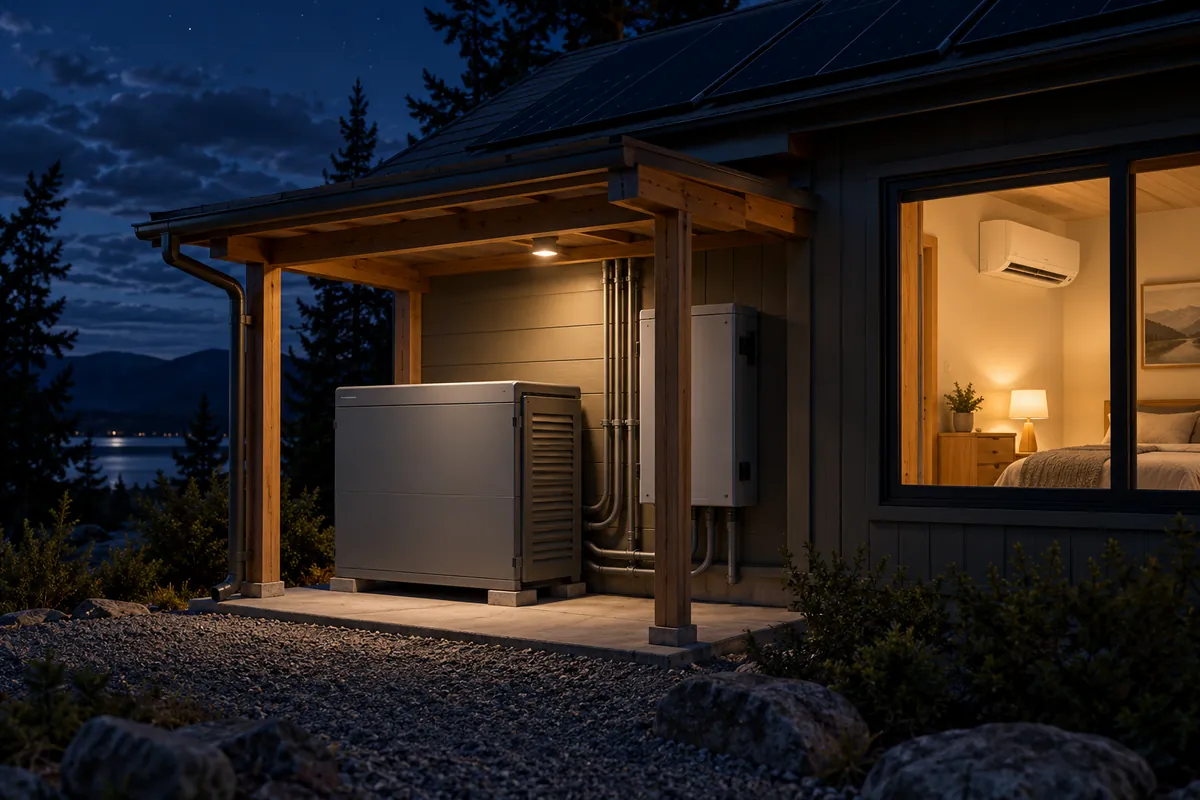
Use these steps:
- Find battery energy in kWh from the manufacturer’s specification. A first estimate from nominal values is voltage × amp-hours ÷ 1,000.
- Apply the usable fraction allowed for the planned operation. If the specification already gives usable kWh, do not reduce it a second time for the same reserve.
- Find the air conditioner’s average electrical demand during the intended cooling period. Use a measured energy total over representative hours or supported performance data for those conditions.
- Include the relevant power-path losses and any other loads drawing from the same battery.
- Divide available kWh by average battery draw in kW to get estimated hours.
A battery runtime example
In this example, the DC unit runs for about 6.8 hours. The calculation uses a nominal 51.2V, 100Ah battery, an 80% usable fraction and an average draw of 0.60kW, with no charging or other loads. For this simplified DC path, assume no additional loss beyond what is already included in those inputs.
Battery energy = 51.2 × 100 ÷ 1,000 = 5.12kWh.
Available energy = 5.12 × 0.80 = 4.096kWh.
Estimated DC runtime = 4.096 ÷ 0.60 = about 6.8 hours.
For an AC-powered unit with the same 0.60kW average terminal input, assume 90% external inverter efficiency. Battery draw is 0.60 ÷ 0.90 = 0.667kW, giving about 6.1 hours.
| Assumed average unit input | DC path in this example | AC path through the assumed 90% inverter |
|---|---|---|
| 0.60kW | About 6.8 hours | About 6.1 hours |
| 1.00kW | About 4.1 hours | About 3.7 hours |
The second row shows why cooling conditions can matter more than a small conversion difference. A hotter room, greater outdoor heat or extra heat gains can keep electrical demand higher. Use the power profile for the required comfort level, rather than a low-output Eco-mode figure alone.
For a real battery system, also allow for its temperature, ageing, discharge limits and cable or DC-converter losses. Shared lights, refrigeration or electronics reduce the energy left for cooling. Separately check BMS and inverter power limits: having enough kWh does not ensure the system can deliver the required instantaneous power.
How much solar generation would replace that energy?
For an assumed 4.8kWh daily cooling input, four equivalent full-output sun hours and a 0.80 delivery factor give an energy-balance estimate of 1.5kWp of panels. First calculate daily cooling energy, then account for losses along the actual charging and supply path. In this example, a unit averaging 0.60kW for eight hours uses 0.60 × 8 = 4.8kWh.
If the assumed solar resource is four equivalent full-output sun hours and the combined delivery factor is 0.80, the energy-balance estimate is 4.8 ÷ (4 × 0.80) = 1.5kWp of panels. The sun hours and delivery factor are example inputs; use site- and season-specific solar yield for a project.
This is a daily energy calculation. Equipment selection must also satisfy PV voltage and current limits and provide enough power at the required time. For continuous off-grid cooling, include the intended cloudy-weather reserve and battery recharge demand. A daily total can balance even while an afternoon cloud leaves the unit short of power.
Which type should you choose for your building or vehicle?
Start with efficient AC-powered equipment for a normal grid-connected building; compare DC-input equipment when the site already has a suitable DC supply or needs a dedicated off-grid cooling system. For a vehicle, start with equipment approved for that vehicle application and battery system. A mains mini-split and a vehicle parking cooler are not interchangeable simply because they can provide similar cooling.
| Your situation | Start by comparing | Why this direction fits |
|---|---|---|
| Reliable grid and no solar system | Suitable AC-powered inverter models | Fits the available supply without adding a separate power system |
| Existing rooftop solar supplying AC loads | AC-powered equipment compatible with that system | Uses existing generation and distribution equipment |
| New solar installation mainly for daytime room cooling | Hybrid AC/DC or an efficient AC unit with PV inverter | Compare dedicated PV use against the flexibility of supplying other loads |
| Native 48V battery site with a matching cooling product | DC-input and battery-inverter AC options | Compare total battery draw, installation needs and service support |
| Cooling must continue all night off grid | Complete battery-supported DC or AC system | Usable stored energy and peak power both control the result |
| Truck or camper with 12V/24V power | Application-approved DC vehicle equipment | Mounting, vibration, battery protection and condensate handling matter |
What data should you compare from two candidate models?
Compare complete-system cooling and electrical data at the same indoor and outdoor conditions. Ask for the following fields from both candidates so the quoted figures describe the same cooling task:
- Complete model and input: AC or DC input, allowed voltage range, and AC frequency and phase where relevant.
- Cooling delivered: cooling capacity at the intended indoor temperature, humidity and design outdoor temperature.
- Electricity required: total unit input at that same operating point, minimum and maximum input, and starting requirements.
- Approved supply arrangement: the battery or PV connection the equipment supports, including any required external controller, inverter or DC converter.
- Source document: the original datasheet or manual, its revision and the conditions attached to the figures.
A compressor rating alone does not describe the whole air conditioner. For battery operation, include the power used by external supply equipment when comparing demand at the battery connection. Starting demand and running demand depend on the model and its control system; the AC or DC input label alone does not establish either one.
When is keeping an AC-powered unit the better choice?
Keep the existing AC-powered unit when it meets the cooling load, works with the available supply and costs less to retain than the expected benefit of changing systems. A new DC unit may avoid an external conversion stage while requiring new wiring, controls, mounting or service arrangements.
Reopen the comparison when the project conditions change:
- The existing inverter cannot support the added cooling load: compare an inverter upgrade with a suitable DC-input system, including their full installed costs.
- The unit cannot deliver enough cooling at the design outdoor temperature: compare capacity and total electrical input at that temperature before choosing the supply type.
- A new site already has a suitable native DC system: compare compatible DC equipment against adding an AC supply path.
- Parts or local service are difficult to obtain: weigh replacement support alongside energy use and the cost of downtime.
Compare the complete installed cost: cooling unit, inverter or DC converter, panels, charge controller, battery, protection, cables, mounting and labour. Include future battery replacement and availability of control boards or specialist service. For an existing shared solar inverter, allocate only the additional cost caused by the cooling system when comparing options.
Put the conversion difference into annual energy before paying for a different system. Reuse the earlier equal-load example: both units need 600W at their terminals for the same cooling task, and the external inverter is assumed to be 90% efficient. The battery-side difference is about 66.7W.
Suppose that average difference continues for eight hours per day over 200 cooling days. The annual energy difference is (600 ÷ 0.90 − 600) ÷ 1,000 × 8 × 200 = about 107kWh. Valuing that battery-side energy at an assumed $0.20/kWh gives about $21 per year before other system costs.
This calculation puts a value on the external conversion difference. For grid-charged batteries, include charging losses when calculating purchased electricity. For an off-grid site, compare the generation and storage cost of supplying the energy saved. Use the same average cooling duty for both candidates; the earlier 500W AC-input example shows how a more efficient unit can reverse the result.
For operating cost, use energy purchased from the grid multiplied by the applicable tariff. Account for when energy is used if the tariff changes by time of day. Where exported solar earns a credit, energy used for cooling also forgoes that export income. Estimate simple payback by dividing the additional installed cost by annual net savings. Include tariff effects and changes in maintenance costs; account for battery and other replacement costs over the comparison period. If annual net savings are zero or negative, the change does not provide a simple payback.
If your project calls for an AC-powered split system, browse the Airproz air conditioner range and compare each model’s electrical supply and capacity at the required conditions.
What should you check before installation and handover?
Before installation, check the cooling load, electrical supply, mounting, airflow, drainage and service access. At handover, verify operation under representative demand and test the intended solar or backup transitions. A system can have enough battery energy yet deliver too little cooling, or have enough cooling capacity but trip its electrical supply.
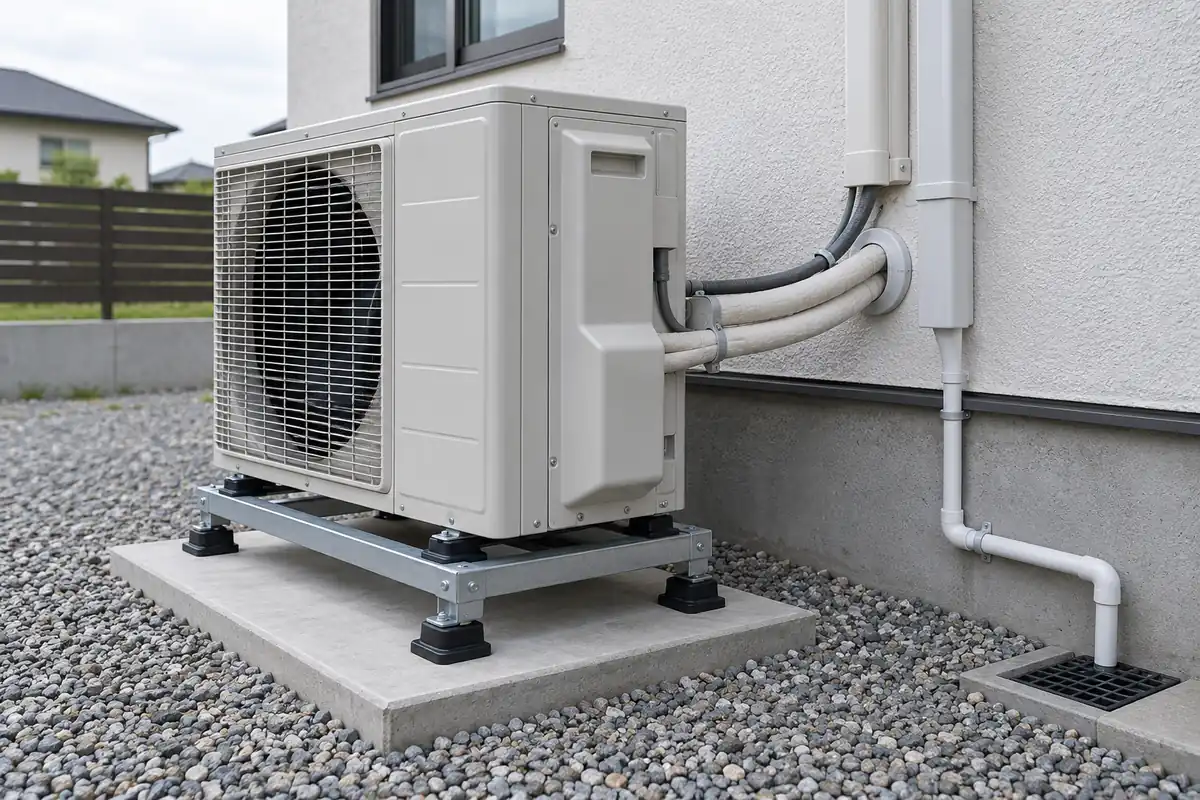
- Cooling task: establish the room or cabin load from size, insulation, solar gains, occupants and equipment. For humid spaces, include moisture removal. Check capacity and electrical input at the intended outdoor temperature rather than selecting from voltage or floor area alone. For building and room applications, our air conditioner sizing guide explains how to match cooling capacity to the space and design conditions.
- Power system: match input type, operating voltage range, AC frequency and phase where relevant. Include maximum input, startup requirements, BMS limits and other loads sharing the supply.
- Electrical installation: have a qualified installer select cable size, protection, isolation and earthing for the actual system. Use appropriately rated DC switching and protection on DC circuits. Panels and batteries can remain energy sources after the AC grid is disconnected.
- Physical installation: follow the exact mounting, airflow clearance, refrigerant piping and drainage requirements. Vehicle equipment needs approved mounting and a suitable roof structure; a building unit needs its own approved installation arrangement.
- Service: identify replacement components, fault-code documentation and local refrigerant/electrical service before relying on the equipment for essential cooling. Check access for cleaning coils, draining condensate and replacing parts.
Compare service support as well as power use. Check whether replacement controls and fans are available and who can service the refrigerant system. Dust, salt exposure and restricted access can increase cleaning and repair work. If a specialist unit saves energy but local parts or repair support are difficult to obtain, include that service burden in the choice and operating budget.
At handover, record supply voltage under load, electrical input or energy over a stated period, room conditions and whether the system maintains the target temperature. For solar hybrids, test the approved transition from strong sunlight to reduced PV availability. For battery operation, check the configured low-voltage response using the manufacturer’s procedure rather than repeatedly forcing the battery into a protective shutdown.
If the unit stops as load rises, separate a supply problem from a cooling-system problem. Compare voltage at the battery and unit while operating, and review BMS or inverter alarms. A large voltage difference points toward the supply path; falling voltage at both locations calls for battery and load checks. A qualified technician should resolve the cause before changing protection settings or replacing the air conditioner.
DC air conditioner vs AC-powered AC: the practical choice
For a grid-connected building or an existing AC solar system, start with efficient AC-powered equipment. For a compatible native DC system, compare DC-input equipment against an AC unit plus inverter using total power demand, installed cost and service support. Dedicated solar cooling also calls for a comparison of direct-PV or hybrid equipment with an AC unit supplied by a solar inverter. For either route, compare total electrical input at the required cooling duty and size nighttime storage separately.
For an Airproz project discussion, send us the location, cooling load or room details, design outdoor temperature, operating hours and available electrical supply. Include the battery and solar-system specifications if those are part of the project. Contact Airproz to discuss the product direction against those conditions.
Frequently asked questions
Can I connect an ordinary AC-powered air conditioner directly to a battery?
No. An ordinary AC-input air conditioner needs a compatible AC supply, usually provided from a battery through a suitable inverter. Direct battery connection can damage the equipment and create an electrical hazard. Converting the unit itself would require redesigning and validating its power system; replacing a plug or bypassing its rectifier is not a suitable conversion method.
Why does a 12V air conditioner stop even when the battery shows charge?
A 12V air conditioner can stop when voltage at the unit falls below its operating limit or the BMS disconnects the supply, even while the battery still shows charge. Voltage can fall within the battery or along the cables. Other protection faults can also stop the unit; use the fault code to select the next check. Have the installer compare loaded voltage at both ends of the supply and read the relevant alarms. Correct the supply fault or capacity shortfall rather than lowering protection settings to force continued operation.
Can a DC-powered air conditioner also provide heating?
Yes, if the model is a reversible heat pump; DC input alone does not establish a heating function. For year-round off-grid use, calculate winter heating energy separately from summer cooling. The relevant heating capacity, outdoor-temperature performance and available winter solar energy can lead to a different battery and panel requirement.
Will a hybrid solar air conditioner keep running during a power outage?
Only if its approved operating mode and available power support operation without the grid at that time. A direct-PV model may support daytime operation when sunlight is sufficient. At night, continued operation needs a compatible stored-energy or backup supply. Ask for the model’s grid-loss behaviour and approved backup connection before treating it as an outage-cooling system.