For Indian homes, start with a correctly sized, current-label 5-star inverter split AC. Under the 2026–2028 BEE split-AC rules, the five-star band starts at ISEER 5.60. Compare exact models with similar rated cooling capacity, the same label period and their labelled annual electricity consumption to find the most efficient option for your room.
Start with three decisions: compare current-model specifications, estimate the electricity cost using your own tariff, and check the cooling size required for your room. A high ISEER can cut energy use for comparable cooling, but the lowest electricity bill and best-value purchase depend on room load, hours used, installed price and local service.
Which AC consumes the least electricity in India?
Among the four comparable 5,100 W manufacturer-published examples in this guide, Panasonic CS/CU-NU18BKY5WX has the lowest listed annual electricity consumption at 681.01 kWh/year and the highest ISEER at 5.80. LG AS-Q20YNZE follows at 684.40 kWh/year and ISEER 5.77. For your room, first match cooling capacity, then check the exact current BEE label, installed price and local service.
Use this five-step path before comparing offers:
- Match the room load and cooling capacity. Check roof exposure, sun, occupancy, insulation and the cooling output needed at peak heat.
- Verify the current BEE label. Check the precise indoor/outdoor model combination, 2026–2028 label period, star band and ISEER.
- Compare ISEER and labelled annual kWh. Use similar-capacity models under the same test method; higher ISEER is a normalized efficiency clue, while kWh is a label-specific test result.
- Calculate total cost. Multiply the kWh difference by your marginal electricity tariff and compare it with the full installed-price premium.
- Check peak-heat performance, installation, service and warranty. A slightly higher ISEER is less useful if the AC cannot deliver the required cooling or is difficult to maintain locally.
For additional brand and service context, see our India AC brand comparison. The efficiency ranking below uses model specifications rather than brand reputation.
What are the BEE AC star-rating rules for 2026–2028?
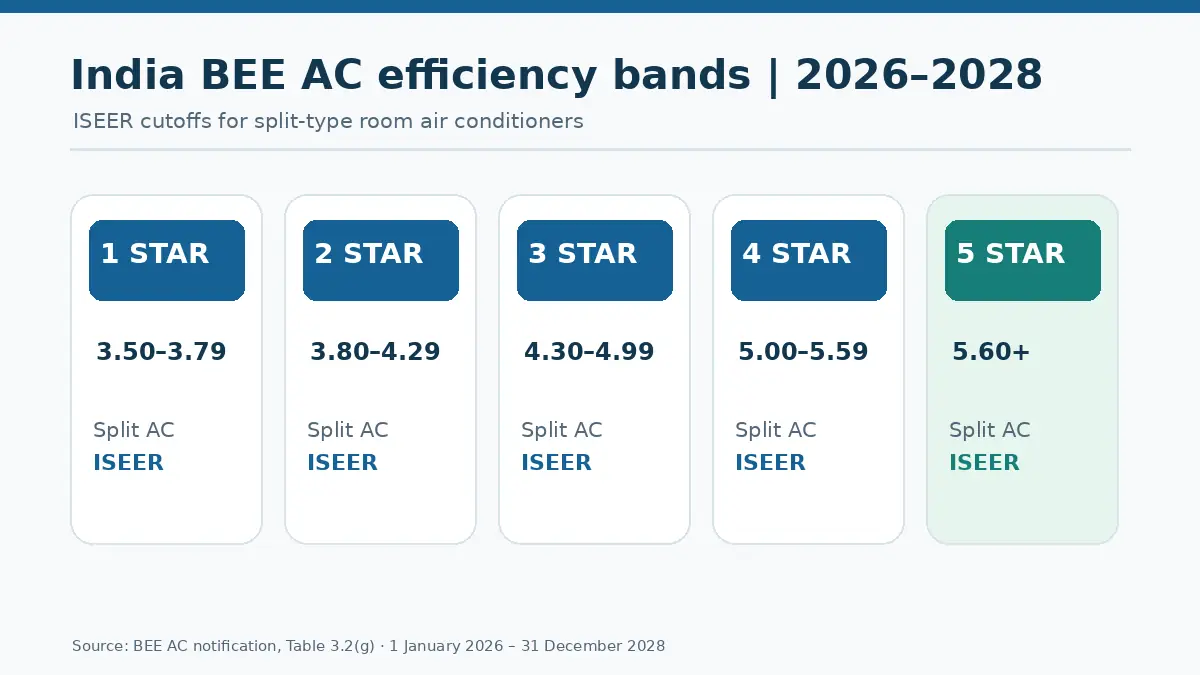
From 1 January 2026 through 31 December 2028, a split room AC needs ISEER 5.60 or higher for a 5-star rating. BEE publishes separate bands for split-type and unitary-type room air conditioners. The following figures come from the official room-AC notification.
| BEE star level | Split-type room AC — ISEER | Unitary-type room AC — ISEER |
|---|---|---|
| 1 star | 3.50–3.79 | 2.90–3.09 |
| 2 stars | 3.80–4.29 | 3.10–3.29 |
| 3 stars | 4.30–4.99 | 3.30–3.49 |
| 4 stars | 5.00–5.59 | 3.50–3.69 |
| 5 stars | 5.60 or higher | 3.70 or higher |
Split-type and unitary-type ACs use different BEE ISEER bands. Compare models within the correct AC type and label period. For an older model, use its printed ISEER and original label validity when checking it against current rules.
Under the 2026–2028 split-AC bands, ISEER 5.20 is in the four-star range, while 5.60 starts the five-star range. A five-star icon on an older listing may belong to an earlier label period. Use the exact product's registered label and validity period to confirm its official rating.
The 2026 split-AC five-star threshold is ISEER 5.60. A value such as 5.80 is an individual model specification, not the regulatory minimum.
How to verify a genuine 2026 BEE label
Look for the exact model identifier, star level, ISEER, annual energy consumption, cooling capacity, variable- or fixed-speed classification, and label validity. Check the information against BEE’s official Star Label portal. Verify the model rather than trusting a product listing’s star icon, and distinguish an efficiency label from other product safety compliance documents.
Which 2026 high-ISEER inverter AC models are worth comparing?
Four 2026 manufacturer-published 5,100 W examples are worth comparing: Panasonic CS/CU-NU18BKY5WX (ISEER 5.80; 681.01 kWh/year), LG AS-Q20YNZE (5.77; 684.40 kWh/year), Panasonic CS/CU-NU18BKY4WX (5.20; 759.55 kWh/year), and Panasonic CS/CU-SU18BKY3W (4.50; 877.74 kWh/year). Check the exact model’s current BEE label and installed price before buying.
2026 split ACs: same 1.5-ton class and 5,100 W rated cooling
| Exact model and cooling output | 2026 band based on ISEER | Published ISEER | Published annual kWh | Best for | Limitation and evidence |
|---|---|---|---|---|---|
| Panasonic CS/CU-NU18BKY5WX 1.5 ton · 5,100 W | 5-star range | 5.80 | 681.01 | Long-running rooms needing a high-efficiency 1.5-ton candidate | Manufacturer 2026 store listing verified; BEE registration and actual installed price still require checking |
| LG AS-Q20YNZE 1.5-ton class · 5,100 W | 5-star range | 5.77 | 684.40 | A second high-efficiency shortlist option at the same published capacity | LG 2026 India AC catalogue figures; current BEE registration, dealer SKU and local availability not independently matched |
| Panasonic CS/CU-NU18BKY4WX 1.5 ton · 5,100 W | 4-star range | 5.20 | 759.55 | Price-versus-energy comparison for a regularly used room | 2026 manufacturer store listing; check any older catalogue/label still displaying different star level |
| Panasonic CS/CU-SU18BKY3W 1.5 ton · 5,100 W | 3-star range | 4.50 | 877.74 | Shorter daily use where a lower upfront price may outweigh yearly savings | 2026 manufacturer listing; real price and verified label required before deciding |
Specification sources reviewed on 23 October 2026: Panasonic India's 2026 product listings and LG India's 2026 RAC catalogue. The figures are manufacturer-published. Current exact-model BEE registration, local availability and installed prices should be checked for the intended purchase.
Which model should you shortlist first?
Among these published 5,100 W examples, Panasonic CS/CU-NU18BKY5WX has the highest listed ISEER at 5.80, followed closely by LG AS-Q20YNZE at 5.77. Their labelled annual consumption differs by 3.39 kWh, so installed price, hot-weather output, warranty and local service will usually be more useful tie-breakers. The three-star and four-star examples offer lower-star alternatives to evaluate against their actual price premium and running hours.
Which energy-efficient AC is best for your situation?
| Situation | What to prioritize | Check before buying | Avoid |
|---|---|---|---|
| 8–12 hours daily | High verified ISEER and a reasonable lifetime-cost premium | Same-size current labels, local tariff, real installation and running hours | Assuming a fixed percentage saving |
| Occasional 2–3 hours daily | Right size and affordable total installed cost | Payback of 4/5-star premium versus 3-star models | Paying more only for a badge |
| Top floor, west-facing room, extreme heat | Enough delivered cooling at peak ambient temperature | Capacity-versus-temperature and input-power table | Treating 55°C operation as full-capacity delivery |
| Humid coastal bedroom | Moisture removal and stable low-load operation | Dehumidification, noise, coating and local maintenance | Oversizing without humidity review |
| Hotel, rental block or multi-unit development | Room-by-room loads and total ownership cost | Model schedule, verified labels, parts, installation and service coverage | One tonnage for every room |
How should you compare Daikin, Samsung, Carrier, Voltas and Blue Star?
To compare Daikin, Samsung, Carrier, Voltas and Blue Star, first select current models that match your required cooling capacity. Then compare each model’s ISEER, BEE-labelled annual kWh, installed price and local service using the same label period. Add only models with verified source specifications to a final purchase table.
Does the highest ISEER always make the best purchase?
No. Choose the highest-ISEER model only when its added purchase cost is justified by the energy saving and the unit meets your cooling needs. With long daily use, lower annual kWh can repay a higher upfront price. With occasional use, a lower-priced, correctly sized model can cost less overall.
How do I read ISEER and annual electricity consumption on an AC label?
ISEER describes seasonal efficiency; annual energy consumption describes the standardized electricity quantity shown on the label. Read both, alongside rated cooling capacity and the label period.
ISEER is the Indian Seasonal Energy Efficiency Ratio. The calculation uses the Cooling Seasonal Total Load (CSTL)—the cooling delivered across the test season—and Cooling Seasonal Energy Consumption (CSEC)—the electricity needed to deliver it:
ISEER = Cooling Seasonal Total Load (CSTL) ÷ Cooling Seasonal Energy Consumption (CSEC).
Both the cooling load and electricity are energy quantities. The standard uses specified Indian cooling-season temperature bins and operating-hour assumptions. Higher ISEER generally means less electrical energy is needed for the same seasonal cooling load in that test framework.
A label reading 681.01 kWh/year represents 681.01 standardized electricity units under BEE's stated test method. Your household consumption depends on local weather, set temperature, room heat load, hours used and maintenance.
Which number should I compare first?
First check ISEER to compare standardized seasonal efficiency among correctly sized ACs under the same BEE label period. Then compare labelled annual kWh to understand the electricity quantity used in the BEE test framework. Do not interpret a smaller unit’s lower kWh as proof that it is more efficient.
Is a 5-star AC worth it over a 3-star AC?
A five-star AC is often worth the extra price when it runs for many hours each day and the expected electricity saving pays back the price difference. For occasional use, a correctly sized, lower-priced three-star AC may cost less overall. Compare the models' labelled annual kWh and installed prices to decide.
Compare two ACs serving a similar cooling load and using the same BEE label rules. An old five-star badge, a smaller cooling capacity or a different testing cycle can make a direct kWh comparison misleading.

For the same delivered seasonal cooling load, an example ISEER of 4.50 versus 5.80 gives 1 − 4.50 ÷ 5.80 = about 22.4% lower standardized energy use for the higher-ISEER example. This is a same-load mathematical illustration; calculate household costs using the actual model labels, usage and tariff.
A clearer bill comparison uses the specific labels. In the fictional same-capacity example below, the electricity rate and price premium are illustrative, not current market quotations.
| Assumption or result | Example three-star AC | Example five-star AC |
|---|---|---|
| Labelled annual energy | 900 kWh | 700 kWh |
| Electricity cost at ₹8/kWh | ₹7,200 per label year | ₹5,600 per label year |
| Label-based annual difference | — | ₹1,600 |
| Extra upfront cost of five-star model | — | ₹8,000 assumed |
| Simple payback if use matches the label comparison | — | 5 years |
The example excludes financing, repairs, tariff slabs and any mismatch between actual operating hours and the label test. More intensive use may improve payback; low use may extend it. A ₹/kWh input should reflect the marginal tariff you actually pay, including applicable energy charges, not an assumed nationwide fixed rate.
How can I calculate an AC’s electricity cost in India?
Multiply the electricity consumption in kWh by your applicable tariff in ₹ per kWh. For comparing two labels, subtract the lower annual-kWh number from the higher one, multiply by your tariff, then divide any price premium by the estimated annual saving.
- Annual electricity cost (₹) = labelled annual kWh × tariff (₹/kWh). This gives a label-basis illustration, not a calibrated household forecast.
- Potential annual bill difference (₹) = (AC A label kWh − AC B label kWh) × tariff. Use models with similar capacity and the same label methodology.
- Simple payback (years) = extra upfront price ÷ positive annual electricity saving. If the saving is zero or negative, there is no positive simple payback from electricity savings alone.
Enter the annual kWh from the two comparable AC labels, your electricity tariff and any extra installed cost of AC B. The calculator estimates the labelled annual cost difference and simple payback. The worked example above remains available without the calculator.
Compare the electricity cost of two AC labels
Enter both ACs’ labelled annual kWh, your marginal electricity tariff in ₹/kWh, and the extra installed price of AC B. The calculator estimates each label-based annual cost, the difference and simple payback. Use comparable capacities and the same BEE label period for a meaningful result.
Use the same cooling-capacity class, label period and energy test basis. Electricity tariffs and actual use may differ. No contact details are required.
What AC tonnage and room size will avoid wasted electricity?
Start with about 1 ton for a smaller bedroom and compare 1.5-ton options for a medium-size room; the Panasonic 5,100 W model cited here lists roughly 120–170 sq ft as a reference application. These are starting points: rooftop heat, west-facing windows, poor insulation, humidity and occupancy can change the required cooling capacity.

For a final size decision, calculate the room’s peak heat load rather than treating floor area as a fixed tonnage rule. Confirm that the selected model can deliver adequate cooling at your city’s outdoor design temperature. The table below shows which conditions can change the load.
Check these conditions before finalizing tonnage
| What you notice | Why it affects AC size or power use | What to check |
|---|---|---|
| Top floor, thin roof or west-facing glass | Sun and roof heat can raise peak cooling demand | Room heat-load calculation and shade/insulation options |
| Frequent open doors or large glass areas | Warm air and solar gain add to the cooling requirement | Air sealing, shading, glazing and occupancy |
| Coastal humidity or damp bedrooms | Moisture removal matters as well as temperature | Latent cooling, airflow and low-load operation |
| Many occupants, appliances or long operating hours | People and equipment add internal heat | Peak occupancy and coincident device loads |
- Sun exposure and roof: top-floor or west-facing rooms often carry heavier afternoon loads.
- Climate and humidity: peak dry heat and humid coastal weather stress cooling and moisture removal differently.
- Occupancy and appliances: people, computers, lighting and kitchen equipment add heat.
- Insulation and air leakage: poor sealing increases the cooling load.
- Operating temperatures: verify the actual model’s cooling-capacity table at the local outdoor design condition, not just its maximum operating temperature claim.
For multi-room hotels, apartments and commercial fit-outs, have the building loads and intended simultaneous operation calculated before approving unit quantities. Related reading: AC system types and project selection.
Do inverter ACs consume less electricity than fixed-speed ACs?
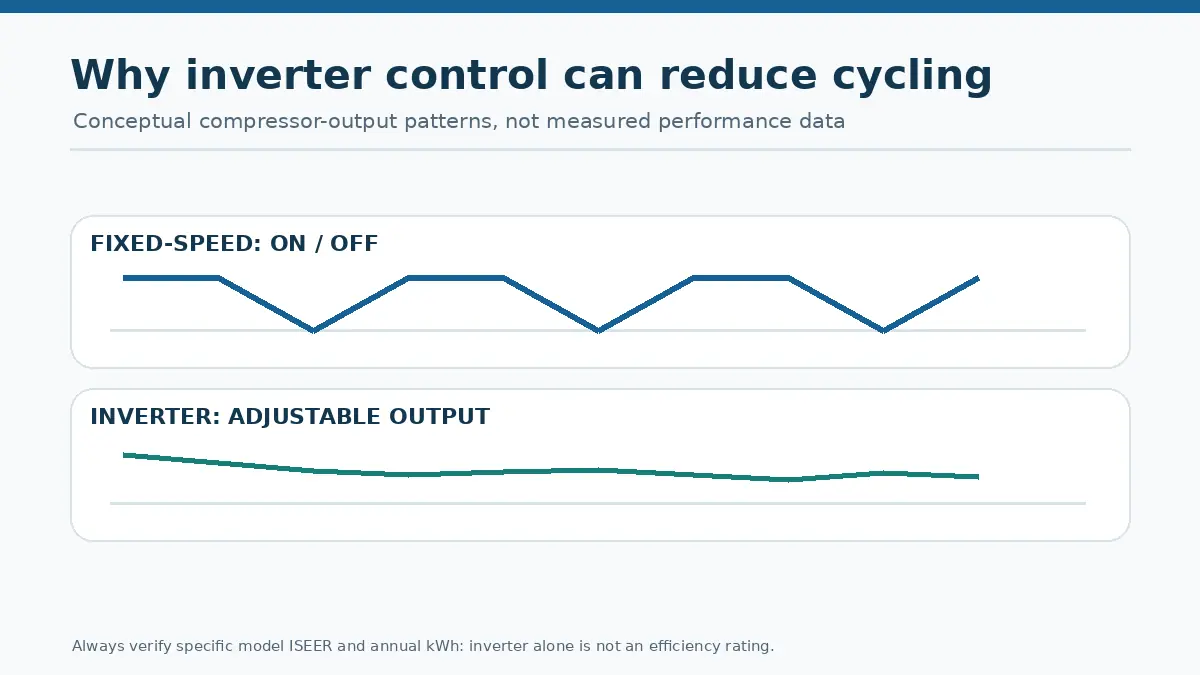
Yes, inverter ACs often use less electricity under changing cooling loads because the compressor can slow down instead of repeatedly operating at full speed. For a real purchase, compare the exact models’ current BEE ISEER and labelled annual kWh; inverter technology alone does not determine the more efficient product.
| Feature | Inverter / variable speed | Fixed speed |
|---|---|---|
| Compressor control | Modulates output over its permitted range | Cycles mainly between on and off |
| Where it helps | Long or variable-load cooling periods | Simpler applications where running hours and purchase price dominate |
| How to compare efficiency | Current BEE ISEER and label kWh | Current BEE ISEER and label kWh |
| Main caution | A poorly sized or inefficient inverter model can still waste power | Frequent cycling and variable demand can raise energy use |
Wi-Fi, AI modes, convertible capacity, copper tubing and refrigerant choice affect convenience or equipment design. For energy efficiency, compare the exact models' current BEE ISEER, annual kWh and capacity.
What matters for saving power in Indian summer heat and humidity?
For hot Indian summers, the biggest practical checks are cooling capacity retained at peak outdoor temperature, a properly matched room load, shading, clean filters and unobstructed outdoor airflow. In humid regions, also check moisture removal and low-load control. Use the model’s cooling-output and input-power data for the temperatures your site actually reaches.

What hot-weather performance data should you check?
Ask for the AC’s delivered cooling capacity and electrical input at the outdoor temperatures your building reaches. A stated 55°C operating limit shows that the system can operate up to that condition; it does not specify the cooling output it will retain there.
Protect the system from unnecessary load
Set a practical thermostat temperature for the people and activity in the room; close doors and windows when cooling; use blinds or external shading in sun-exposed spaces; keep filters clean and outdoor airflow unobstructed. Drainage, refrigerant charge, pipework and electrical installation must follow the manufacturer’s instructions. Refrigerant-circuit work belongs to qualified technicians.
Why does humidity matter?
An AC must often remove both sensible heat (lower the air temperature) and latent heat (remove moisture). An oversized or badly controlled system may cool the air quickly but have less effective dehumidification under some conditions. A good set temperature and equipment sizing matter more than simply choosing the maximum tonnage.
How should Indian buyers, distributors and OEM importers verify efficiency claims?
Verify an India-market AC claim in three steps: (1) match the exact indoor/outdoor model code to its current BEE registration and label validity, (2) check ISEER, rated cooling capacity and annual kWh against the seller’s specification and quotation, and (3) confirm the applicable safety, import and service documents for that exact model. Home buyers should then check installed price and local warranty; OEM buyers should request a SKU-by-SKU evidence schedule.
For home buyers in India
- Confirm the exact indoor and outdoor model pairing shown on the quotation and delivered carton.
- Check the matching BEE label: validity period, star band, ISEER and annual kWh.
- Ask for installed total price: brackets, wiring, pipes, draining, optional stabilizer, labor and any other extras.
- Check local support: who installs it, what the warranty actually covers, spare parts and service availability.
- Choose for the room: heat load, outdoor design temperature, humidity and operating hours.
For distributors, hotels and OEM projects
Before selecting a product or negotiating a volume order, prepare a model-by-model schedule with these fields:
| RFQ and project input | Why it matters |
|---|---|
| Destination city, building use, quantities and room-load schedule | Determines capacity mix, high-heat design and order scope |
| Exact indoor/outdoor pair, rated watts, ISEER and annual kWh | Prevents model-code swaps and unsupported efficiency claims |
| Current BEE registration and label evidence per covered SKU | Shows whether the offered exact configuration has applicable verified labelling |
| Applicable BIS/QCO obligations and importing-party responsibilities | Separates product safety/market rules from BEE rating |
| Voltage/frequency, refrigerant, hot-weather capacity and installation scope | Confirms site compatibility, performance and technician requirements |
| Local warranty path, parts, delivery terms and lifetime cost assumptions | Makes total project economics and after-sales obligations auditable |
Can an Airproz AC be ordered as a BEE 5-star India model?
We cannot yet confirm a specific BEE five-star-registered Airproz model for India from the product evidence reviewed. For an India-market project, send us the target capacity, efficiency level, electrical requirements and destination. We can review suitable configurations and the documents required before making a model-specific compliance claim.
Explore the Airproz air conditioner range for available configurations. For an India-market distribution, hotel or OEM project, send us the destination, estimated quantity, required cooling capacities, target efficiency, electrical specifications and delivery plan. Our team can review possible configurations and the documentation needed for your project.
Frequently asked questions
Which AC uses the least electricity in India in 2026?
Among the four comparable 5,100 W manufacturer examples in this guide, Panasonic CS/CU-NU18BKY5WX has the lowest listed annual label consumption at 681.01 kWh/year (ISEER 5.80). Other capacities may have different lower-kWh models, so choose the correct cooling capacity and verify the current exact-model BEE label.
What is the minimum ISEER for a five-star inverter split AC in India in 2026?
ISEER 5.60 under BEE’s 2026–2028 split-type room-air-conditioner rating table. Do not substitute the 5.80 value of a particular product for the regulatory threshold.
Is a 2025 five-star AC still five-star under 2026 norms?
Not necessarily. The physical unit has not changed, but its old star label reflects an earlier band. Check its actual ISEER and the BEE registration/label validity period; do not automatically re-label every old five-star product as four-star.
How many electricity units does a 1.5-ton five-star inverter AC use?
One 2026 manufacturer example, Panasonic CS/CU-NU18BKY5WX, lists 681.01 kWh/year on its published specification. Other 1.5-ton five-star AC models can have different labelled annual kWh, and actual household use depends on weather, setpoint and operating hours.
Can an AC with lower annual kWh still be less efficient?
Yes. A smaller AC may show fewer annual kWh even if its ISEER is lower, because it delivers less total cooling. Compare similar rated cooling capacities, the same BEE period and the actual room load. Lower kWh across different tonnages does not mean better efficiency or comfort.
Does setting the AC to 26°C save power?
Yes. Compared with a lower cooling setpoint, 26°C will generally reduce cooling demand if the room remains comfortable and adequately dehumidified. The actual saving depends on weather, the building and how the AC is used.
Is ISEER the same as the SEER or SEER2 number on an imported AC?
No. ISEER uses India’s specified seasonal test method; SEER/SEER2 use other market test procedures and units. Use the applicable India-market BEE figures when assessing products sold under Indian labeling requirements.
Which AC is most energy efficient in India? The final decision
Among the four comparable 5,100 W manufacturer examples reviewed here, Panasonic CS/CU-NU18BKY5WX has the highest published ISEER (5.80) and the lowest published annual label consumption (681.01 kWh/year). LG AS-Q20YNZE is close at 5.77 and 684.40 kWh/year. For an India-market purchase, pick the correctly sized current-label model with the best combination of efficiency, installed cost and service support.
If the decision is about a whole hotel, housing project or wholesale product line, use the same rules model by model and calculate the expected lifecycle cost for the way those units will be operated. The winner is the compliant AC that delivers the required cooling with the lowest defensible total cost for your actual application—not simply the appliance carrying the biggest efficiency slogan.
Sources and verification
Regulatory standard: Bureau of Energy Efficiency (BEE) room-air-conditioner star-label notification, valid 2026–2028; BEE Star Label portal for checking the registered model. Applicable safety requirements should be checked separately with the Bureau of Indian Standards.
Manufacturer specifications reviewed on 23 October 2026: Panasonic India 2026 product listings for CS/CU-NU18BKY5WX (5,100 W, ISEER 5.80, 681.01 kWh), CS/CU-NU18BKY4WX (5,100 W, ISEER 5.20, 759.55 kWh), and CS/CU-SU18BKY3W (5,100 W, ISEER 4.50, 877.74 kWh); LG India's 2026 RAC catalogue for AS-Q20YNZE (5,100 W, ISEER 5.77, 684.40 kWh). Figures are manufacturer-published and should be checked against the exact registered product and label validity for a purchase.
Evidence grades used: Official BEE bands = legal thresholds; Manufacturer-published = exact product values advertised by the producer; BEE-registered = current exact-model entry independently checked (not completed for the four examples here); Worked example = arithmetic illustration only, not measured household energy saving. Availability, pricing and registration can change.
The savings and payback tables are worked examples based on the stated inputs, not field measurements. Images are AI-generated illustrations of AC use and installation settings.