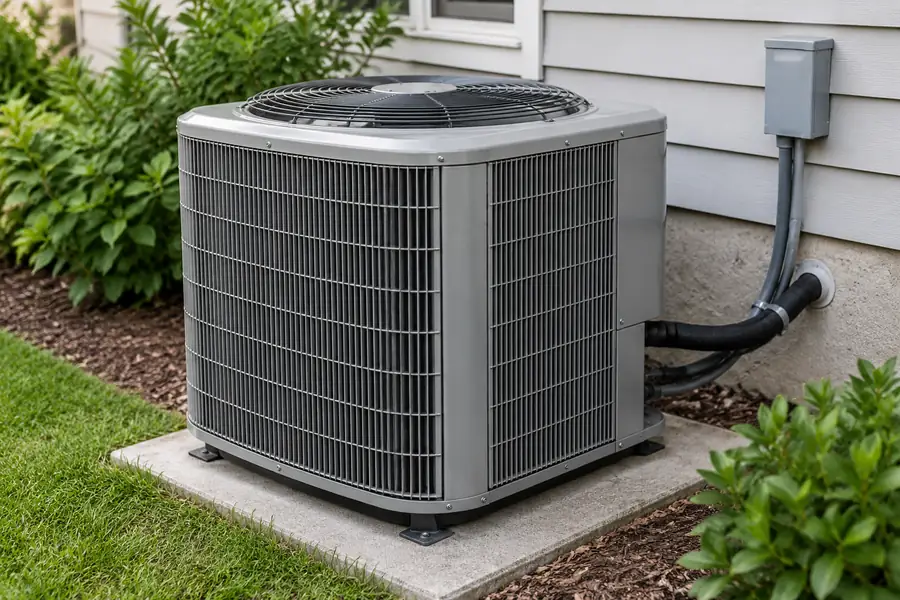

A typical pool heat pump uses 2–5.5 kWh of electricity per hour (2,000–5,500 watts running), depending on its size and operating conditions. Because it delivers 3–7 units of heat for every unit of electricity consumed, it costs far less to run than an electric resistance heater.
Your pool heater’s power bill just showed up bigger than expected, and now you’re trying to figure out how much electricity does a pool heater use before you sign off on the next order. Fair question — it’s the first thing every buyer asks once summer bills start rolling in.
A pool heat pump doesn’t burn power the way people assume; it moves heat instead of generating it, so a 3–7 hp unit typically draws 2,000–5,500 watts running, not the 15,000+ watts an electric resistance heater needs for the same job. But the real number depends on compressor type, COP rating, pool size, and climate — and getting that wrong on a spec sheet costs you callbacks. Here’s the actual math, not marketing claims.
Key Takeaways
- A pool heat pump draws 2,000–5,500 watts running, delivering 3–7 units of heat per unit of electricity
- Monthly electricity cost ranges from $80–150 for small pools to $800–3,000+ for commercial hotel pools
- Inverter compressors cut electricity use by 30–40% compared to fixed-speed on-off models
- The gap between a heat pump and an electric resistance heater is 60–80% lower running cost over a season
How Much Electricity Does a Pool Heater Use? The Real kWh Numbers
A pool heat pump’s electricity use depends primarily on its compressor size, COP rating, and how many hours a day it actually runs. The table below gives realistic ranges for both residential and commercial installations.
By Pool Size (Residential vs Commercial)
The larger the heating capacity, the higher the electricity consumption. However, commercial units often achieve better overall efficiency because of larger heat exchangers and inverter compressors. So before you quote a client, know which tier their pool falls into — the gap between tiers is bigger than most buyers expect.
Real Monthly Electricity Cost Examples
The table below shows typical monthly electricity cost tiers by pool type, surface area, and heat pump size.
| Pool Type | Typical Surface Area | Typical Heat Pump Size | Est. Monthly Electricity Cost* |
|---|---|---|---|
| Small villa / above-ground pool | 20–40 m² | 5–8 kW | $80–150/month |
| Standard residential pool | 40–80 m² | 8–15 kW | $150–400/month |
| Hotel / resort commercial pool | 150–400 m²+ | 20–50 kW+ | $800–3,000/month |
*Illustrative ranges based on average seasonal runtime and mid-range electricity tariffs; actual cost varies by climate, pool size, and local energy prices.
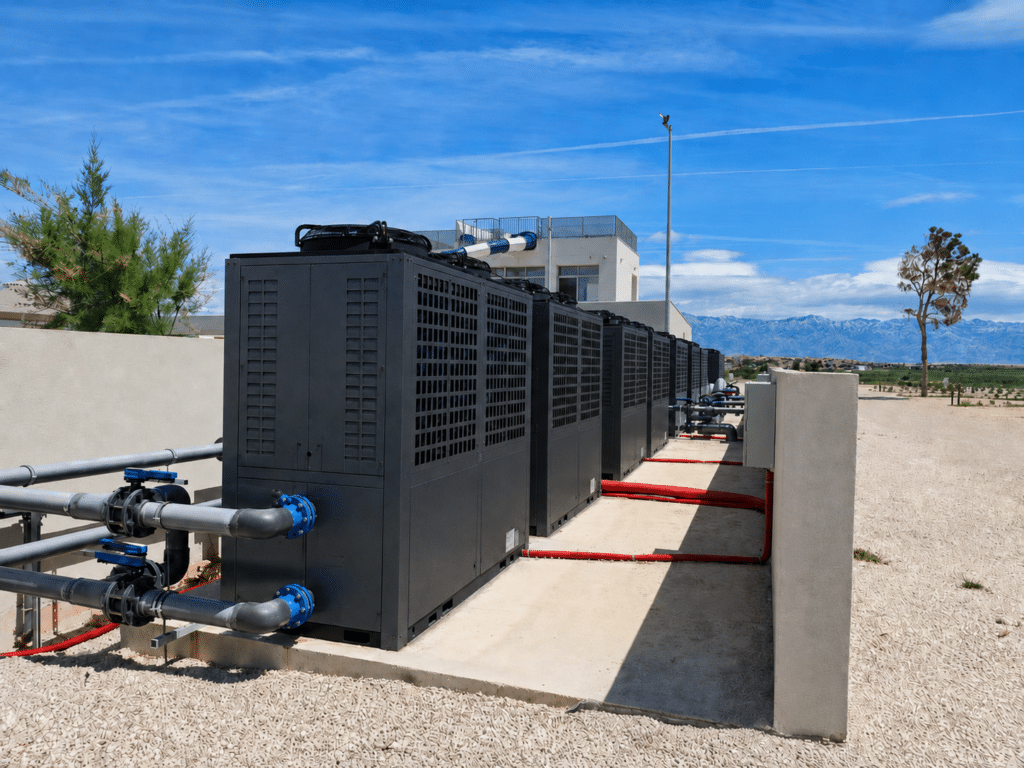
The numbers above show that a residential pool’s commercial pool heat pump running cost sits in an entirely different range from a small villa system. That’s by design — commercial units run longer duty cycles and push more water volume. But the efficiency advantage of a heat pump over gas or electric resistance is consistent across every tier of the table. For a full product overview, see our full pool heat pump lineup. For background on how COP is measured, read the U.S. Department of Energy’s COP testing data.
Power Draw by Heat Pump Capacity
Here’s what the electrical draw actually looks like at each capacity tier, based on typical COP performance:
| Heat Pump Capacity | Running Power (Electrical) | Typical COP |
|---|---|---|
| 5 kW | ~1.1 kW | 4.5 |
| 8 kW | ~1.7 kW | 4.8 |
| 12 kW | ~2.4 kW | 5.0 |
| 20 kW | ~3.8 kW | 5.3 |
| 30 kW | ~5.5 kW | 5.5 |
This is the inverter pool heat pump energy savings story in numbers — as capacity and COP climb, the electricity needed per kW of heat delivered actually drops, not rises.
How to Calculate Your Pool Heat Pump Electricity Cost
Most buyers asking “how much electricity does a pool heater use” actually want to run their own numbers. Here’s the formula:
Running Power (kW) × Operating Hours × Electricity Rate = Daily CostExample: a 3.5 kW unit running 8 hours a day on a $0.18/kWh tariff:
3.5 kW × 8 h/day × $0.18 = $5.04/dayMultiply the daily figure by 30 for a monthly estimate, and adjust the operating hours up or down based on pool size, cover use, and target temperature.
What Actually Drives Pool Heat Pump Power Consumption
Two factors determine how much electricity a pool heat pump burns in the real world: compressor technology and the COP at your local temperature.
Inverter vs On-Off Compressors
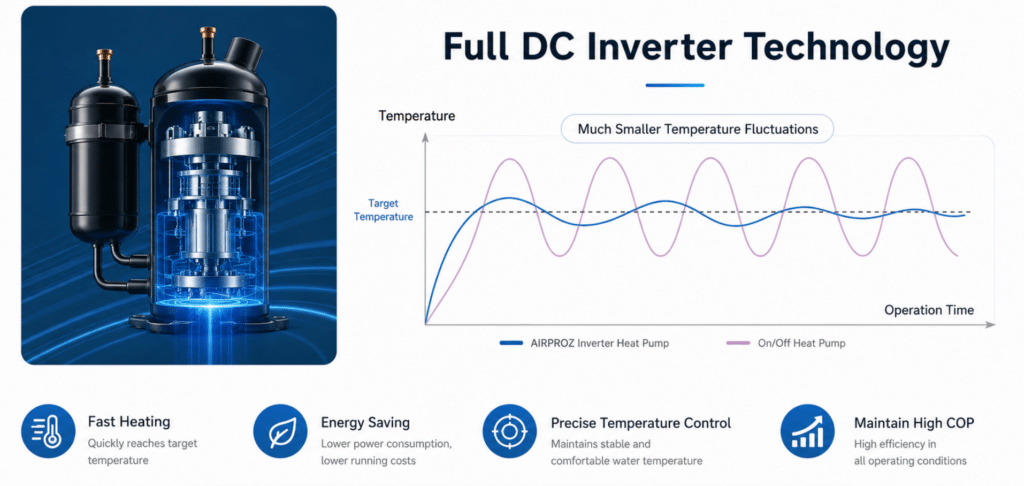
A fixed-speed on-off compressor runs at 100% power until the target temperature is reached, then shuts off completely. It’s simple and reliable, but it cycles on and off hundreds of times per season — each restart draws an inrush current spike, and the system spends energy re-pressurising every cycle. An inverter compressor modulates its speed continuously to match the heating load, so it never actually turns off — it just slows down. The result is lower average power draw, smoother temperature control, and less wear on components. Electricity cost isn’t set by the heater’s size — it’s set by how many hours a day the compressor actually runs.
COP and Ambient Temperature
Pool heat pump COP explained simply: COP — coefficient of performance — is the ratio of heat output to electricity input. A heat pump with a COP of 5 delivers 5 kW of heat for every 1 kW of electricity it consumes. Think of COP as “return on electricity” — a COP of 5 means every $1 spent on electricity produces about $5 worth of heat. For every 1 unit of electricity in, you get 3–7 units of heat out, and that ratio drops as outside air gets colder. That’s why the same pool heat pump costs more to run in winter than in summer, even when set to the same water temperature.
What should you actually ask a supplier? Not “how many kW,” but “what’s the COP at my region’s average pool-season temperature.” For a deeper technical discussion, see how refrigerant choice affects efficiency. For the official industry standard, see the ANSI/ASHRAE 146 testing standard for pool heaters.
Pool Heat Pump vs Gas vs Electric Resistance Heater: Running Cost Compared
When a client is deciding between systems, the comparison usually comes down to three options. Here’s how they stack up.
| Metric | Heat Pump | Gas Heater | Electric Resistance Heater |
|---|---|---|---|
| Upfront cost | Medium–High | Low–Medium | Low |
| Annual running cost | Low ($300–1,200*) | Medium ($600–2,000*) | High ($1,500–4,000*) |
| Annual energy use | ~2,000–8,000 kWh* | N/A (measured in fuel volume, not kWh) | ~6,000–20,000 kWh* |
| Lifespan | 10–15 years | 5–10 years | 3–7 years |
| Energy efficiency | 300–700% (COP 3–7) | 80–90% | 100% |
| Best for | Year-round pools, cold climates | Occasional use, low gas-price regions | Small pools only |
*Residential pool ranges; commercial pools multiply these figures by 2–5×.

The table makes one thing clear: the pool heat pump vs electric heater comparison isn’t close on running cost. A heat pump uses 60–80% less electricity than a resistance heater to deliver the same heat. The upfront premium pays back quickly. If your client’s pool runs 6+ months a year, the heat pump pays for the price gap within one season — that’s the number that actually closes deals. For more on the hardware that drives those savings, see the difference between compressor types.
Example Project — Cutting a Resort Pool’s Power Bill With Inverter Heat Pumps
This section shows a realistic before-and-after comparison for a commercial pool converting from a fixed-speed on-off system to an inverter-driven heat pump. The figures below are illustrative reference values based on typical performance differentials. Request a project-specific ROI calculation for your exact pool size and local tariff.
| Metric | Before (Fixed-Speed On-Off System) | After (Inverter Heat Pump System) |
|---|---|---|
| Pool type | Hotel/resort commercial pool, ~30kW heating load | Same pool |
| System type | Fixed-speed on-off compressor | Inverter-driven compressor |
| Avg. electricity use | ~2,150 kWh/month | ~1,380 kWh/month |
| Avg. monthly electricity cost | ~$320/month | ~$205/month |
| Monthly savings | — | ~$115/month (~36% reduction) |
| Equipment cost premium (inverter vs on-off) | — | ~$2,800 |
| Simple ROI period | — | ~24 months |
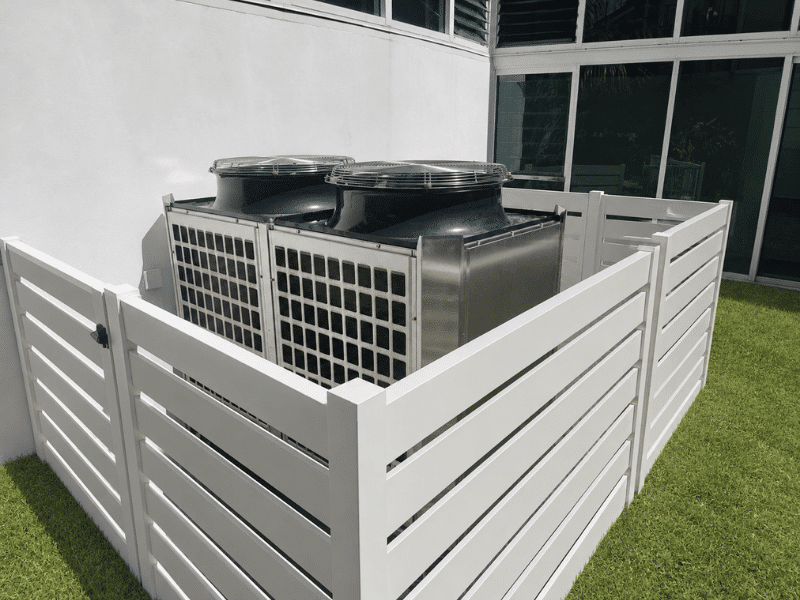
This is the kind of before/after your quote should show a hotel FM — not adjectives, numbers. When you can show that a hotel pool heat pump ROI calculation comes out to roughly 24 months on the inverter premium, the decision becomes straightforward. For a look at the equipment that makes these numbers possible, see a 30kW commercial unit like this one.
Planning a resort or hotel pool retrofit? Send us your pool specs and we’ll help you size the right inverter unit for lower running costs.
How to Spec a Lower-Consumption Pool Heat Pump for Your Next Project
Getting the spec right upfront prevents callbacks and keeps your client’s operating costs where they expect them. Here’s a short checklist for your next project.
Sizing Checklist
- Confirm pool surface area (m² or ft²) — not just volume. Surface area drives heat loss.
- Calculate the required temperature rise from the coldest month’s average ambient temperature to the target pool temperature.
- Factor in wind exposure, shading, and whether the pool has a thermal cover (cover cuts heat loss by 30–50%).
- Size the heat pump for the shoulder season, not just peak summer — an undersized unit runs flat out in spring/autumn and burns excess kWh.
- Oversizing beyond what your COP/sizing calculation suggests typically causes short-cycling and lower effective COP — this is standard HVAC sizing practice, not an Airproz-specific rule. Right-sizing saves power.
Questions to Ask Your Supplier
- What is the COP at my region’s average pool-season ambient temperature? Don’t accept the rated COP at 26°C if your pool runs at 15°C ambient for half the season.
- Is the compressor inverter or fixed-speed? If the pool runs 8+ months per year, inverter pays for itself in under 3 seasons.
- What refrigerant does it use? R32 (GWP 675) is increasingly preferred over R410A (GWP 2,088) for new installations.
- What is the sound level at full load? For hotels and resorts, noise above 60 dB at 1 meter causes complaints.
- What warranty and after-sales support is available in my market? This matters more for commercial projects than any single spec number.
Remember this baseline when comparing suppliers: if you don’t yet know how much electricity does a pool heater use for the specific unit you’re evaluating, ask for the COP at your local temperature and the estimated monthly kWh — any supplier who can’t provide those numbers hasn’t done the homework. For a complete framework on evaluating manufacturers, read our B2B heat pump buying guide.
Tell us your pool size, location, and target water temperature. We’ll estimate the monthly electricity cost and recommend the right heat pump capacity for your project.
Frequently Asked Questions
How much electricity does a pool heater use per hour compared to a gas heater?
A pool heat pump typically draws 2–6 kW per hour depending on size, while a gas heater has no electricity draw but burns significantly more fuel per BTU delivered — heat pumps generally cost 60–80% less to run over a season.
What size pool heat pump do I need to keep running costs low?
Sizing depends on pool surface area, desired temperature rise, and local climate — an oversized unit cycles inefficiently, while an undersized one runs constantly at higher COP loss.
Does an inverter pool heat pump really use less electricity than an on-off model?
Yes — inverter compressors modulate output to match load instead of cycling on/off at full power, typically cutting electricity use by 30–40% in real-world operation.
How do I compare pool heat pump running costs across different suppliers?
Ask for COP figures under the same test conditions (per the ANSI/ASHRAE 146 standard, typically 80°F/26°C ambient), not just rated capacity — otherwise the numbers aren’t comparable.
Is a commercial pool heat pump’s electricity use different from a residential one?
Yes — commercial units run longer duty cycles and higher capacities (20–50kW+), so total kWh is much higher, but per-BTU efficiency is often better due to inverter tech and larger heat exchangers.
For OEM pool heat pump supply, technical specs, and custom solutions for your market, visit Airproz.com.