The shortlist of major air conditioner brands in Spain isn’t complicated — Daikin, Mitsubishi Electric, Fujitsu, LG, Panasonic, Bosch, Hitachi. But which one is right for you depends on whether you’re recommending a single unit to a homeowner or stocking a container for a network of installers. Same brands, completely different answer. This guide covers the brand landscape first — who makes what, where each excels, and what real-world trade-offs matter for each buyer type — then moves into the B2B procurement decisions that come into play when you’re sourcing at scale.
Key Takeaways
- Spain’s AC market spans five climate zones, each demanding different specs — one brand can’t cover them all
- CE certification and R32 compliance are mandatory entry requirements in 2026, not optional differentiators
- For distributors, OEM private label sourcing can offer significantly more pricing flexibility than established brand distribution — but buyers must weigh CE certification transfer, after-sales responsibility, and MOQ against the margin upside
- R32 (GWP 675) is the standard for new orders; R410A (GWP 2,088) faces tightening F-Gas pressure and should only be specified for legacy replacements
Best Air Conditioner Brands in Spain in 2026
The air conditioner brands in Spain that dominate search results — Daikin, Mitsubishi, LG — all have legitimate engineering strengths. But from a distribution standpoint, each comes with trade-offs you won’t see in a five-star review. Below, we break down each brand by what it does best, who it’s for, and what B2B buyers should know.
Daikin — The Gold Standard in Spain, and Why That’s a Double-Edged Sword for Distributors
Daikin is the market leader for good reason. The brand pioneered inverter technology, consistently delivers A+++ energy ratings, and its FTXP series dominates Spanish residential installations. The national service network is the most comprehensive of any HVAC brand in the country. Its warranty terms set the industry benchmark. If a customer asks for Daikin by name, you want it on your wall.
Best for installers and engineers serving homeowners who prioritise brand recognition and national warranty coverage.
However, from a B2B procurement standpoint, Daikin’s dominance creates real structural constraints. Pricing discretion is tightly controlled by Daikin headquarters. Most Spanish distributors working with Daikin operate on 12–15% net margin. There is no OEM or private label option — every unit carries the badge, which means your customers can price-shop you against every other Daikin dealer in their province. Annual sales quotas are required to maintain authorized status. Spare parts pricing is among the highest in the market.
B2B noteIf your customers ask for Daikin by name, stock it. If you’re building a margin-positive distribution business, Daikin alone won’t get you there.
Mitsubishi Electric, Fujitsu, and Panasonic — Japanese Precision, European Distribution Constraints
Mitsubishi Electric’s MSZ-AY series delivers precise temperature control, full copper construction, and A++ efficiency — widely considered the engineering benchmark in the Spanish residential market. Fujitsu’s ASY series features high-density heat exchangers and Japanese manufacturing quality. Panasonic differentiates with Nanoe™ air purification and advanced sensor-based energy savings.
Best for established engineers and installers with existing customer bases who can absorb higher procurement costs for premium reliability.
However, from a B2B procurement standpoint, the Japanese brands share structural limits. Distributor networks in Spain are relatively closed — new entrants have little price negotiation room. During peak season (May–July), European warehouse stock for these brands frequently runs short, creating fulfillment risk for distributors without large safety inventory. After-sales service is tied to brand-authorized providers, meaning out-of-warranty costs run higher for independent installers.
B2B note: These brands are an excellent fit if you already have a stable customer base. They’re a difficult starting point for new distributors building from scratch.
Bosch, Hitachi, and Baxi — European Names, Commercial Project Credibility
Bosch’s Climate series brings German engineering heritage and smart connectivity. Hitachi (under Johnson Controls) offers FrostWash self-cleaning and heavy-duty components built for long service life. Baxi has optimized its range for Spanish climate conditions and maintains strong local after-sales support.
Best for commercial project tenders where a recognised European name adds credibility.
However, from a B2B procurement standpoint, these three occupy an awkward middle ground. Residential pricing isn’t competitive with Korean or Chinese alternatives. Baxi’s smaller scale means bulk supply reliability doesn’t match the volume Japanese players. None of the three supports OEM or private label manufacturing. In commercial tenders, the “European name” carries weight, but net margins for distributors are still constrained — typically 15–18% on residential product.
B2B note: Among the established air conditioner brands in Spain, Bosch, Hitachi, and Baxi work best as a secondary line for specific tenders — but it’s difficult to build a full distribution business around them.
LG, Samsung, Haier, and Midea — Where B2B Flexibility Starts to Open Up
LG offers strong Wi-Fi control, A++ efficiency, a credible VRF commercial line, and more accessible pricing than the Japanese tier. Samsung has steadily gained share in the Spanish market. Haier and Midea both offer mature CE-certified product lines with the greatest pricing flexibility in the group.
Best for larger distributors who can manage their own after-sales support and value pricing flexibility.
However, from a B2B procurement standpoint, there are real differences within this tier. LG and Samsung carry brand premiums, and their OEM support is limited. Haier and Midea provide more flexibility on price and product customization, but their after-sales networks in Spain are still developing — your business may end up absorbing warranty service costs.
B2B note: This group is the middle ground between brand dependency and sourcing flexibility — the transition zone where distributors first feel what private-label margins could look like.
Air Conditioner Brands in Spain — At a Glance
| Brand / Type | CE Certified | R32 | OEM / Private Label | Distributor Margin | After-Sales | Best For |
|---|---|---|---|---|---|---|
| Daikin | ✅ | ✅ | ❌ | Low (12–15%) | Brand network | Installers / Engineers |
| Mitsubishi Electric | ✅ | ✅ | ❌ | Low–Medium | Brand network | Engineers / Installers |
| Fujitsu | ✅ | ✅ | ❌ | Low–Medium | Brand network | Engineers / Installers |
| Panasonic | ✅ | ✅ | ❌ | Low–Medium | Brand network | Engineers / Installers |
| Bosch / Hitachi | ✅ | ✅ | ❌ | Medium | EU authorized | Commercial distributors |
| LG / Samsung | ✅ | ✅ | Limited | Medium (15–20%) | Own network | Large distributors |
| Haier / Midea | ✅ | ✅ | Partial | Medium–High | Still building | Price-focused buyers |
| OEM CE Manufacturer | ✅ | ✅ | ✅ | High (25–35%) | Buyer-built | OEM / Private label buyers |
The OEM Alternative — What B2B Buyers Choose When Margins Matter More Than the Logo
Across every tier of the Spanish market, established brands share one common trade-off for distributors: the stronger the brand, the less room you have to build your own business around it. The OEM alternative changes the equation.
A CE-certified air conditioner produced by a dedicated OEM manufacturer for the European market matches the efficiency and refrigerant compliance (R32) of the major brands, but with fundamentally different commercial terms. For distributors with an established installer network, a CE-certified OEM manufacturer can offer meaningfully better commercial terms than branded distribution. The trade-off is real: you gain pricing control and margin flexibility, but you take on after-sales responsibility, spare parts sourcing, and warranty management that brand networks currently handle for you. Whether that trade-off works depends on your business model, not just the margin number.
When evaluating OEM partners, focus on three things: CE certification that transfers to the importer’s legal entity, R32 compliance across the full product range, and an MOQ that matches your cash flow — typically 80–100 units for a first container. Finding a reliable manufacturer with CE certification and R32 compliance is the critical first step. The goal is a partner with a documented track record of shipping certified product to European distributors.
For a complete partner evaluation framework, read our guide on how to evaluate a heat pump and AC manufacturer for B2B supply in Europe. To browse current product specs, view Airproz CE-certified air conditioner range for European distributors.
CE, R32, and ErP — What to Check Before You Buy Any Brand
Before you settle on a brand, you need a compliance filter. Three technical requirements determine whether a product can be legally sold in Spain: CE marking, refrigerant type, and ErP energy labelling.
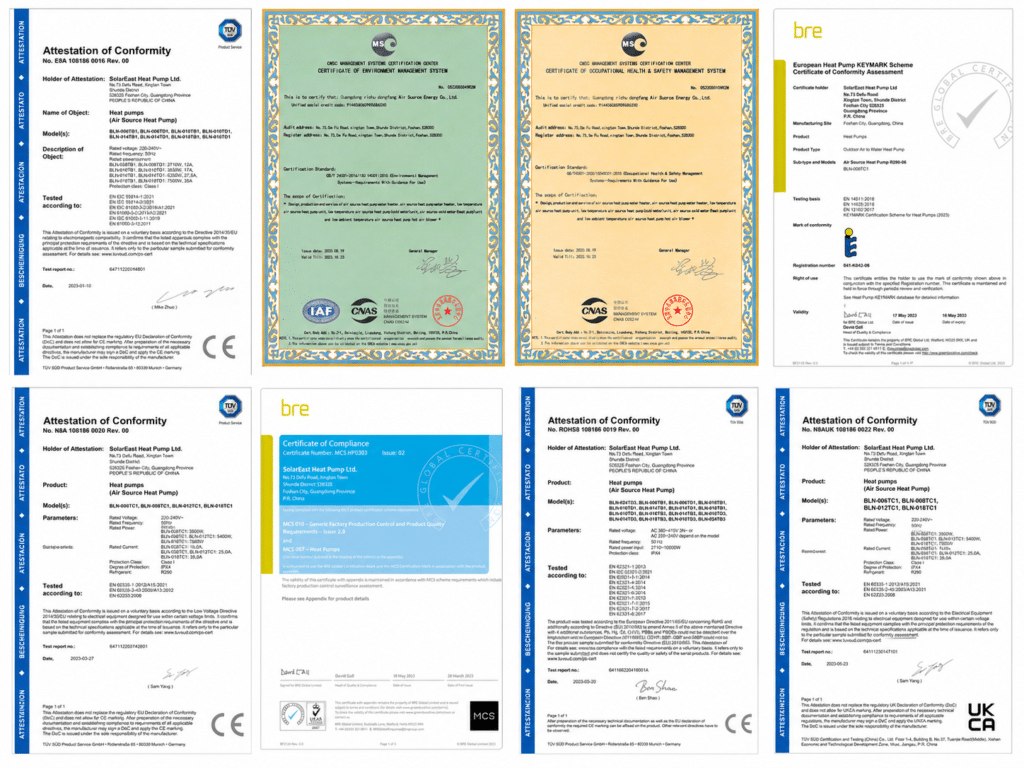
What CE Marking Actually Covers for Air Conditioners Sold in Spain
CE marking for air conditioners isn’t one certificate. It’s a bundle of requirements spanning multiple EU directives. For a product to qualify as a genuine CE certified air conditioner for the Spanish market, it must satisfy the Low Voltage Directive (2014/35/EU), the Electromagnetic Compatibility Directive (2014/30/EU), and the Ecodesign Directive (2009/125/EC).
Two documents every buyer should request before negotiating price:
- A Declaration of Conformity listing all applicable EU directives
- A third-party test report from an accredited lab — not a factory self-declaration
A supplier offering only a self-declaration without independent testing is not providing a genuine CE certified air conditioner. They’re providing paperwork, not compliance. This distinction matters more in 2026 because Spanish customs are increasingly requesting third-party documentation at the point of import.
R32 vs R410A — Which Refrigerant for Spain in 2026?
The refrigerant decision for new orders in 2026 is straightforward. Here’s the direct comparison:
| R32 | R410A | |
|---|---|---|
| GWP | 675 | 2,088 |
| EU F-Gas quota pressure | Low | High (tightening) |
| Compliance risk post-2030 | Low | Medium–High |
| Main application | Residential split AC (standard) | Legacy systems / some VRF |
| B2B recommendation | ✅ First choice for new orders | ⚠️ Replacement parts only |
R32 is the new standard. With a GWP of 675, the R32 vs R410A air conditioner decision is simple: R32 faces minimal compliance risk through 2030, while R410A (GWP 2,088) is under sustained quota pressure from the EU F-Gas Regulation phasedown schedule. Every major brand — Daikin, Mitsubishi, LG — has already moved residential splits to R32.
For a deeper technical dive with efficiency comparisons, see our full refrigerant comparison guide for EU heat pump and AC buyers.
ErP Label and Seasonal Efficiency — What SEER and SCOP Mean in Practice
Every AC unit sold in Spain carries an ErP label with two numbers that matter for procurement: SEER (cooling) and SCOP (heating). In 2026, the effective market entry threshold is SEER ≥ 6.1, which maps to A++ for most residential splits.
For B2B buyers, these numbers double as sales tools. A unit with SEER 6.1+ versus a baseline SEER 5.0 saves a Spanish household roughly €120–180 per year in electricity. That saving — documented — is what closes a price-sensitive customer. Make sure your supplier’s spec sheets include SEER and SCOP data your sales team can quote. And when you’re evaluating suppliers, the R32 vs R410A air conditioner question matters here too — R32 units consistently clear the A++ threshold, while R410A legacy designs often struggle to reach it.
Spain’s Climate Zones — Why Location Changes the Right AC Choice
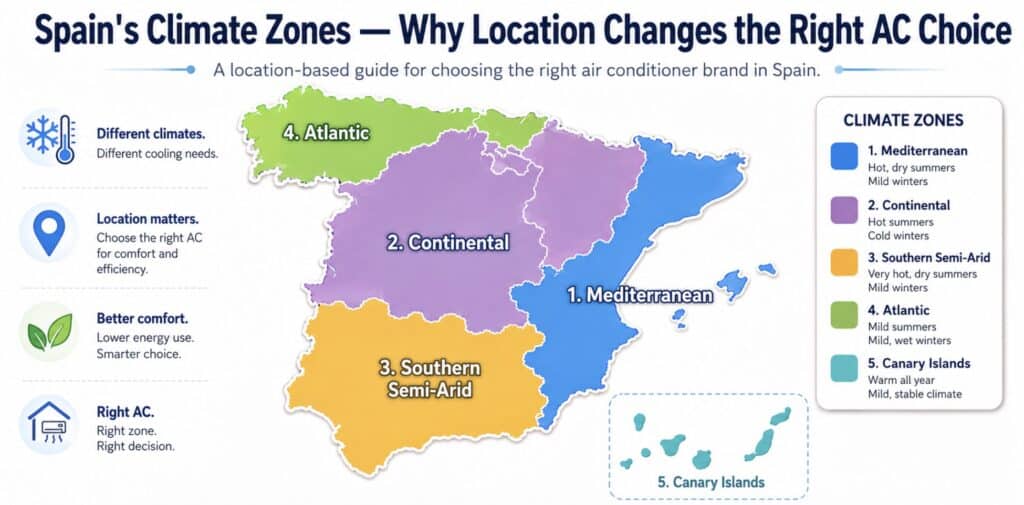
Spain’s air conditioning demand is anything but uniform. To choose the right product range — and the right air conditioner brands in Spain for your business — you need to understand which climate zones your customers operate in.
| Climate Zone | Key Cities | Peak Summer | Winter Low | Recommended System |
|---|---|---|---|---|
| Mediterranean | Barcelona, Valencia | 38°C | 5°C | Inverter Split AC |
| Continental | Madrid, Zaragoza | 42°C | -2°C | Inverter Split + Heating Mode |
| Southern Semi-Arid | Seville, Córdoba | 46°C | 6°C | High-capacity T1 Split AC |
| Atlantic | Bilbao, Santiago | 28°C | 3°C | Air-to-Water Heat Pump |
| Canary Islands | Las Palmas | 32°C | 16°C | T1 Split, Year-round Cooling |
For distributors, this diversity means a single-brand approach rarely covers every requirement your customers bring. A Daikin-only range works for the Mediterranean but misses the Atlantic heat pump demand — where the heat pump Spain EU subsidy 2026 program makes air-to-water systems particularly viable. An LG-heavy inventory covers the south but may underperform in Continental heating mode.
Heat Pump Subsidies and What They Mean for AC Distributors
Spain’s energy transition agency continues driving heat pump adoption through the IDAE subsidy framework, and in 2026 the numbers are substantial. The heat pump Spain EU subsidy 2026 program covers 30–70% of installation costs for air-to-water heat pump systems, depending on household income and region (Spain’s official energy efficiency agency (IDAE)). For AC distributors, this creates a real revenue opportunity: customers who search for cooling increasingly leave with a heat pump quote if you can offer both.
If you’re not already pairing split AC with heat pump options, you’re leaving subsidy-adjacent revenue on the table. We’ve broken down the practical procurement differences in our guide on how air conditioners and heat pumps compare for Spanish project buyers.
Brand vs OEM — A B2B Sourcing Perspective for Spanish Distributors
When you’ve reviewed the major air conditioner brands in Spain and the margins still don’t add up, it’s time to look at the OEM path. A Valencia-based residential AC distributor saw net margin drop from 16% to under 11% after their Japanese brand supplier increased pricing in 2024. The transition to a CE-certified OEM manufacturer restored margin to 23% on the first container — a 12-point improvement — while maintaining equivalent product quality and passing Spanish customs without additional inspection.
The Problem — When Brand Margins Get Squeezed to Nothing
A medium-sized distributor in Valencia had been selling the same air conditioner brands in Spain for six years, moving roughly 400 residential split units per year through a network of local installers. Their primary brand was a well-known Japanese manufacturer. In 2024, during contract renewal, the manufacturer increased supply pricing. Net margin dropped from 16% to under 11%. At roughly €55 profit per unit, total annual margin barely covered warehouse costs and two salaries.
The brand’s logic was simple: high demand, limited distribution slots, leverage on their side. The distributor’s logic was equally simple — they had no pricing power because every unit carried the same badge their competitors across town also sold.
What They Required — CE, R32, MOQ Under 100 Units, and Full Documentation
After evaluating options, the distributor compiled a specific requirement list before approaching any new supplier:
Product specifications
- Capacity range: 1.0 HP – 2.5 HP residential split units
- Refrigerant: R32
- Efficiency: SEER ≥ 6.1 (ErP A++)
- Noise: Indoor unit ≤ 22 dB
Compliance documentation
- CE Declaration of Conformity transferable to importer’s name
- Third-party test report (not factory self-declaration)
- Certificate of Origin
Commercial terms
- First order MOQ: 80 units (approx. one 20-foot container)
- Private label packaging and printing
- Lead time: 8 weeks or less
They researched compliant suppliers and connected with a CE-certified manufacturer that met every spec. The unit they evaluated was a CE-certified R32 inverter split unit for European distribution, matching their requirements at a landed cost that gave room to rebuild margin. They specifically sought a manufacturer whose products were CE certified and R32 compliant — one whose documentation package would pass Valencia customs without surprises.
From First Inquiry to First Container — The 8-Week Timeline
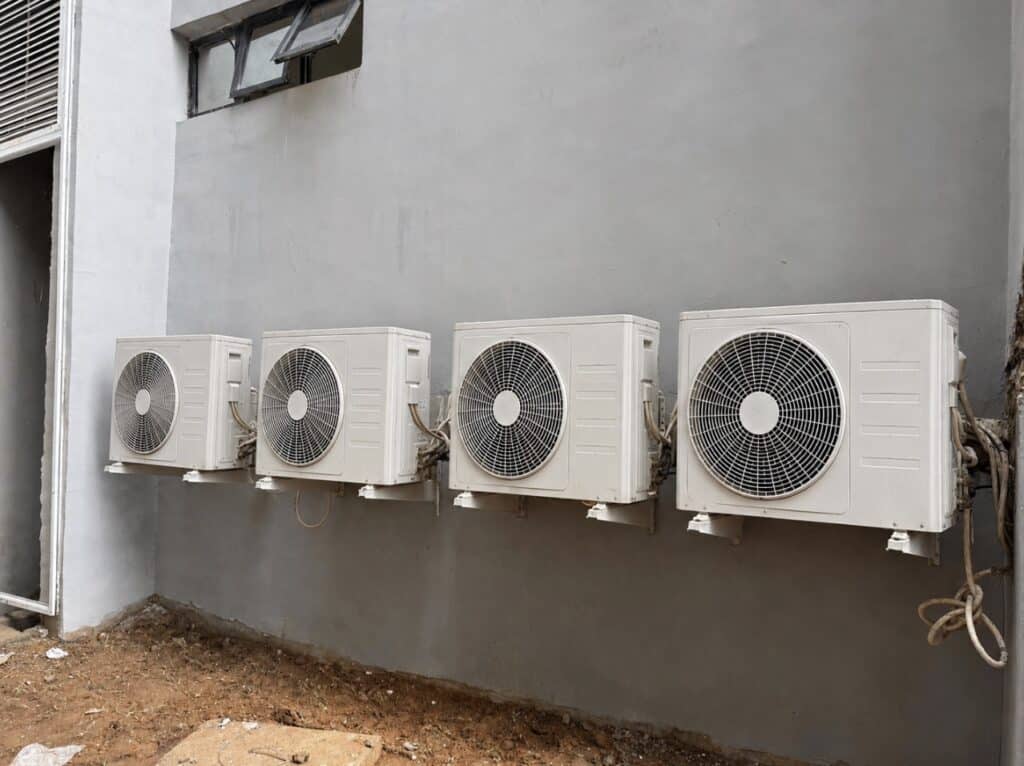
The transition followed a structured process:
| Week | Action | Responsible Party |
|---|---|---|
| Week 1 | Send product spec sheet; receive quote with CE document checklist | Buyer + Manufacturer |
| Week 2 | Compliance review of Declaration of Conformity; confirm private label design | Buyer’s compliance advisor |
| Week 3 | Place order; pay 30% deposit; finalize packaging artwork | Buyer |
| Week 4–6 | Production; manufacturer provides progress photos | Manufacturer |
| Week 7 | Container loaded at Guangzhou port; bill of lading issued | Freight forwarder |
| Week 8–9 | Sea freight to Valencia; customs clearance with CE documentation | Freight forwarder + Buyer |
| End of Week 9 | 80 units in warehouse, private label, ready to distribute | Buyer |
The Outcome — Higher Margin, Same CE Compliance, Full Control
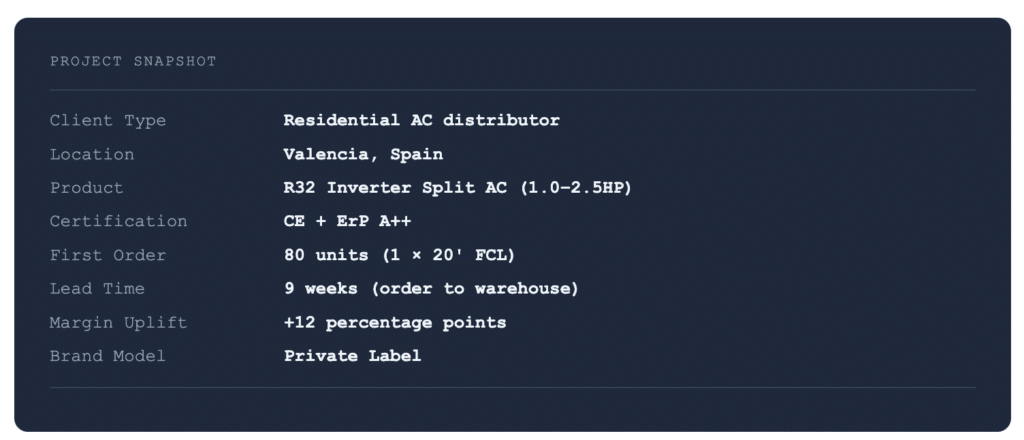
The first container delivered a net margin of approximately 23% — 12 points higher than what they had earned with the Japanese brand. That translated to roughly €65 more profit per unit. CE documentation passed Spanish customs without additional inspection. During the first cooling season, they placed stock with 15 local installers under their own brand. Installer feedback reported performance comparable to the previous brand, with a similar complaint rate over six months.
The distributor now orders two containers per year, has built a recognizable local brand in the Valencia region, and controls both pricing and customer relationships entirely. For more detailed project references, see more OEM supply references from Airproz.
Facing the same margin pressure from your current brand?
Tell us your product specs, target volume, and compliance requirements. We respond within 24 hours with a matching product, spec sheet, and full CE documentation package ready for Spanish customs.
FAQ — Air Conditioner Brands and B2B Sourcing in Spain
Which air conditioner brands in Spain are best for B2B distributors?
There’s no single answer — it depends on what you’re optimising for. If your customers ask for brands by name, Daikin, Mitsubishi Electric, and Fujitsu deliver excellent quality with reliable after-sales. If you’re optimising for margin, a CE certified air conditioner sourced through an OEM manufacturer typically offers significantly more pricing flexibility — though buyers must factor in after-sales responsibility and CE documentation transfer before switching. For a full brand-by-brand breakdown across every tier, read our detailed pros and cons breakdown for B2B AC buyers.
Is R32 or R410A better for air conditioners sold in Spain in 2026?
R32 is the right choice for any new order. The R32 vs R410A air conditioner decision is clear — R32 (GWP 675) faces minimal F-Gas compliance risk, and all major air conditioner brands in Spain — Daikin, Mitsubishi, LG — have transitioned residential splits to R32. R410A (GWP 2,088) faces accelerating quota tightening and should only be specified for legacy system replacement parts.
What certifications must an air conditioner have to be legally sold in Spain?
Three are mandatory. CE marking covering the Low Voltage Directive, EMC Directive, and Ecodesign Directive — backed by a Declaration of Conformity and third-party test report. An ErP energy label meeting current SEER/SCOP thresholds. And F-Gas compliant refrigerant documentation. For OEM importers, the CE Declaration of Conformity must be legally transferred to the importer’s entity. A factory self-declaration alone does not constitute a verifiable CE certified air conditioner.
Does Spain have subsidies for air conditioners or heat pumps in 2026?
Spain’s 2026 subsidy programs under IDAE prioritise heat pump systems for heating, not standalone air conditioning. The heat pump Spain EU subsidy 2026 framework covers 30–70% of installation costs for air-to-water heat pump systems, depending on household income and region. For AC distributors, this creates a natural bundling opportunity — offer an inverter air-to-water heat pump alongside traditional split AC to capture both the cooling sale and the subsidy-eligible heating installation.
How do I import air conditioners from China to Spain as an OEM buyer?
Four steps. Confirm the CE certification is legally transferable to your name as the importer. Verify R32 compliance across all units. Ensure commercial invoices include correct HS codes and a Certificate of Origin. Work with a Spanish customs broker who has HVAC import experience — Valencia and Barcelona ports see regular AC container traffic, and experienced brokers know the documentation requirements. Budget 8–10 weeks from order to warehouse for your first container.
Ready to compare manufacturers, not just the biggest air conditioner brands in Spain?
Download our B2B product catalog with CE certification details, R32 spec sheets, and MOQ information for Spain and the EU market — no minimum commitment required.
For OEM and private label air conditioning solutions for the Spanish and EU market — and a different take on air conditioner brands in Spain — visit Airproz.com.