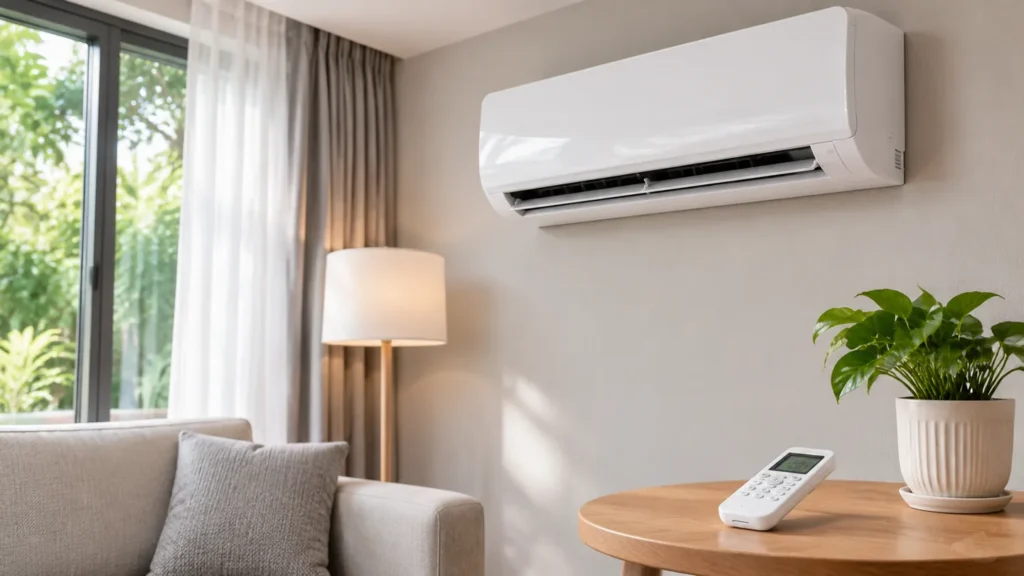
An air conditioner for a bedroom should cool the space without disturbing sleep. For most bedrooms with a suitable window, a correctly sized inverter window AC is a practical choice. A ductless mini-split is attractive when you want a quieter permanent system and can install an outdoor unit. A dual-hose portable AC is a useful fallback when permanent work is restricted, but it still needs a way to vent heat outdoors. Start with room size, then check the real noise level at night and the installation limits.
The best bedroom air conditioner is not simply the model with the highest BTU rating or lowest advertised decibel number. You need enough cooling for the hottest nights, steady humidity control, and sound that is acceptable from the bed. The guide below shows how to compare those factors without mixing different rating methods.
Which Type of Air Conditioner Is Best for a Bedroom?
Choose a window AC when your window supports one, a mini-split for a permanent low-noise setup, or a properly vented portable AC when neither installation works. Each removes heat from the bedroom, but the way it rejects that heat changes noise, efficiency, and installation needs.
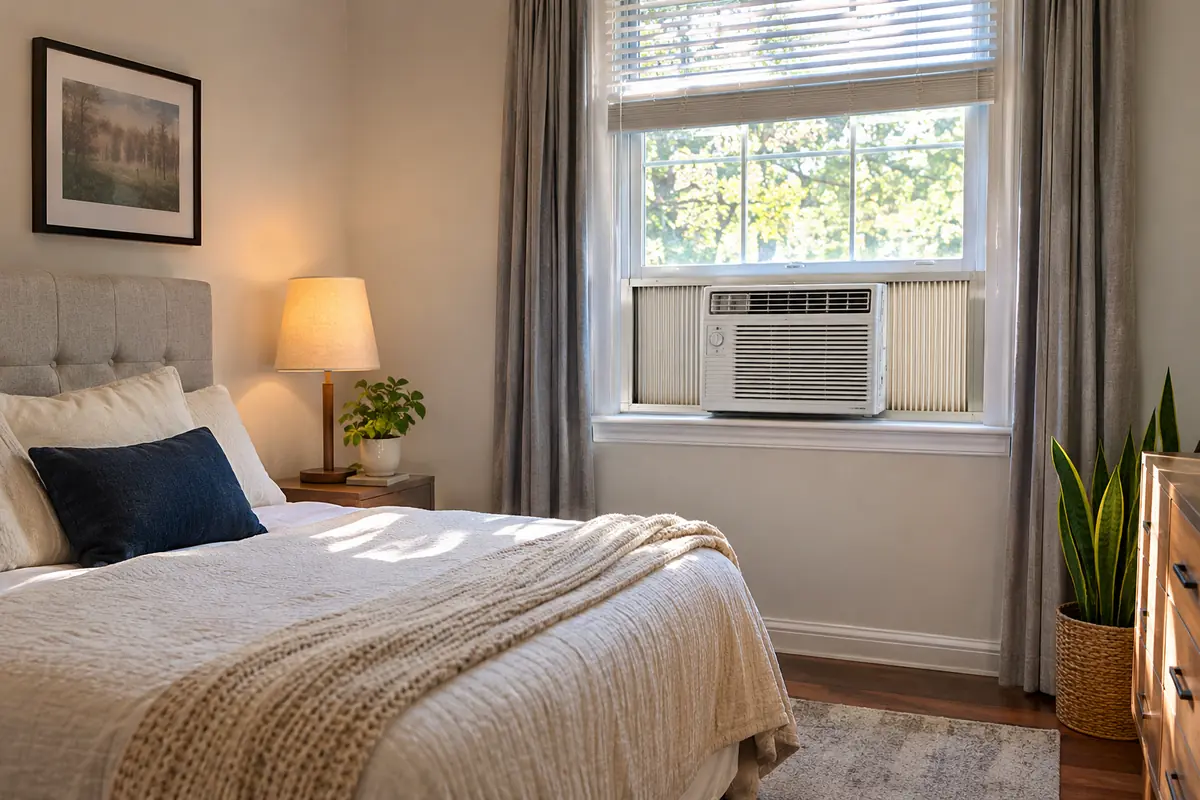
| Bedroom air conditioner type | Best use | Main advantage | What can rule it out |
|---|---|---|---|
| Inverter window AC | Bedroom with a compatible window and permission to install | Compact, no floor space, compressor can slow down instead of always stopping and starting | Window size, frame support, exterior rules, or outdoor clearance |
| Conventional window AC | Simple, low-cost room cooling | Widely available and straightforward to replace | Fixed-speed cycling may be more noticeable at night |
| Ductless mini-split AC | Permanent bedroom or attic conversion | Outdoor compressor and flexible indoor-unit placement | Requires approved wall penetrations, outdoor equipment, and professional installation |
| Dual-hose portable AC | Rental or unusual window where a window unit will not fit | Can be removed; flexible placement | Needs a sealed outdoor exhaust/intake route, floor space, and drainage checks |
| Through-the-wall AC | Room with a suitable existing sleeve | Keeps the window clear | Sleeve dimensions, weather sealing, and building rules must match |
| Existing central AC | Bedroom already served by a correctly balanced system | No separate room unit may be needed | A hot bedroom may still need airflow, insulation, or controls corrected |
Window AC or mini-split for better sleep?
A mini-split places its compressor outdoors, so much of the mechanical noise stays outside the room. The indoor fan still makes sound, and the unit must be installed correctly. A typical window AC puts the compressor near the opening, while U-shaped or saddle-style window units may place more of the noise-producing equipment outside. An inverter design can also run at a lower output for longer periods. Compare measured indoor noise at the fan speed you will actually use, rather than assuming every mini-split or inverter window unit is silent.
An inverter is a compressor control method, not a guarantee of a particular noise level. ENERGY STAR also explains how U-shaped and saddle-style window designs can reduce indoor compressor noise when the window and support requirements allow them. Some units make brief clicks, airflow noise, or vibration that a single decibel figure does not describe. See our broader guide to different types of air conditioners if you are comparing whole-home and room systems.
Are portable bedroom air conditioners a good option?
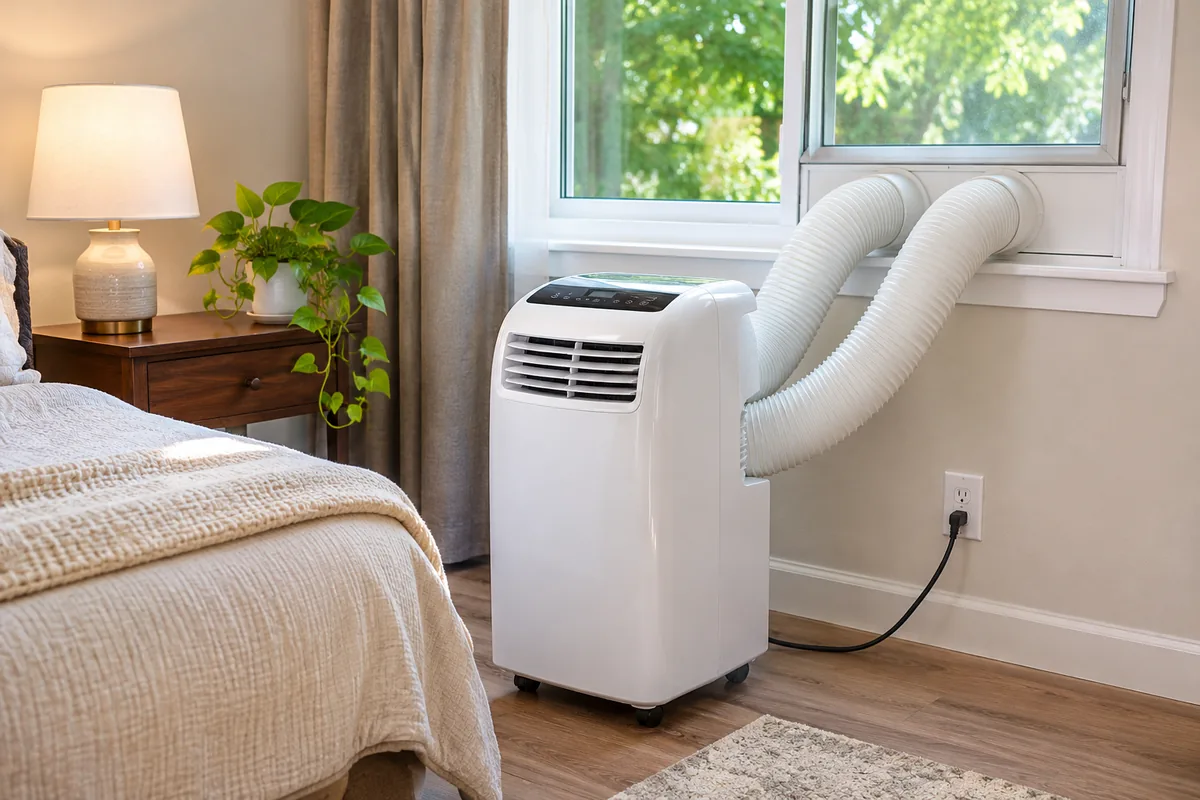
A portable air conditioner is useful when you cannot mount a window unit or install a mini-split. A dual-hose model is worth comparing first, because it separates the outside-air intake and hot-air exhaust rather than relying entirely on room air for condenser cooling. Hose layout, seals, and the exact model still determine how well it performs. The fan and compressor sit in the bedroom, so the sound may be more noticeable beside the bed than with a mini-split.
For a portable unit, check the label for its seasonally adjusted cooling capacity (SACC) in BTU/h and the stated test conditions. Do not treat a large marketing BTU figure as the same measurement as the cooling capacity shown on a conventional window-unit sizing chart. The U.S. Department of Energy explains portable AC testing and SACC.
What Size Air Conditioner Does Your Bedroom Need?
Match bedroom floor area to the capacity table, then adjust for sun, ceiling height, insulation, and heat sources. For a typical room with an 8-foot ceiling, around 6,000 BTU/h suits a 200 sq ft bedroom, while a 300 sq ft room falls around the 7,000–8,000 BTU/h boundary before load adjustments. These are starting points, not a substitute for a room-specific cooling-load check.
| Bedroom floor area | ENERGY STAR starting capacity for room/window AC | Example |
|---|---|---|
| 100–150 sq ft | 5,000 BTU/h | Small bedroom or guest room |
| 150–250 sq ft | 6,000 BTU/h | 200 sq ft bedroom |
| 250–300 sq ft | 7,000 BTU/h | Mid-size bedroom |
| 300–350 sq ft | 8,000 BTU/h | Larger bedroom |
| 350–400 sq ft | 9,000 BTU/h | Large bedroom with standard conditions |
| 400–450 sq ft | 10,000 BTU/h | Very large bedroom |
| 450–550 sq ft | 12,000 BTU/h | Bedroom suite or larger enclosed room |
These bands follow ENERGY STAR’s room air conditioner buying guidance. They are for conventional room-AC capacity selection under the stated conditions. Use the exact certified rating system and product sizing instructions for a portable unit, rather than matching the table’s numbers directly to its SACC.
How to work out bedroom size
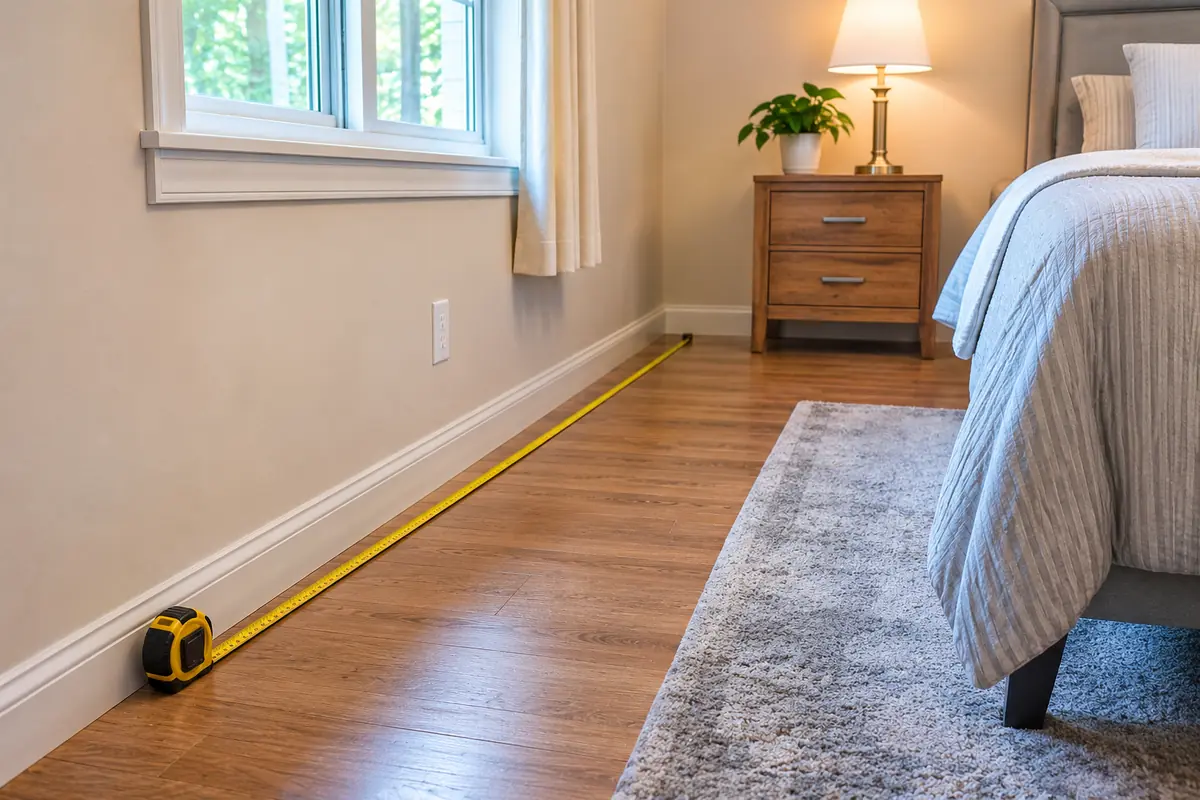
Measure the inside length and width of the bedroom in feet. Multiply them to get area:
Bedroom area (sq ft) = length (ft) × width (ft).
For example, a 10 ft × 20 ft bedroom measures 200 sq ft. The table points to 6,000 BTU/h for a conventional room/window AC. Next check what makes the room harder or easier to cool. A 15 ft × 20 ft room measures 300 sq ft, right at the boundary of two table bands. Compare a roughly 7,000–8,000 BTU/h window-unit option after checking the actual heat load; do not treat 300 sq ft as an automatic order for one particular model.
How sun, people, and ceiling height change the answer
ENERGY STAR’s starting adjustments include about 10% less capacity for a heavily shaded room and about 10% more for a very sunny room. If more than two people regularly occupy the room, its guidance adds 600 BTU/h for each additional person. These adjustments describe the original room-AC chart, not an exact mathematical formula for every building.
A top-floor or attic bedroom can have a much larger roof heat gain than another bedroom of the same area. High ceilings, poor air sealing, large west-facing glazing, computers, and nearby unconditioned spaces also matter. In those cases, use a room-by-room cooling load calculation, such as a Manual J assessment for a residential installation, before selecting a permanent system.
Do not oversize just to make the room cool faster. An oversized fixed-speed unit can shut off before it removes enough moisture, leaving a cold but damp-feeling room. ENERGY STAR and the U.S. Department of Energy’s room-AC guidance both stress matching capacity to the space. For the broader method, see our air conditioner sizing guide.
How Quiet Should a Bedroom Air Conditioner Be?
Look for a low indoor sound rating at the operating speed you expect to use overnight, then check how the compressor and fan sound in normal operation. For sound-sensitive bedrooms, compare models whose published indoor sound is in the low 40s dBA or lower. Also consider how the unit sounds in actual operation.
Decibels (dB) describe sound level; A-weighted decibels (dBA) reflect how human hearing responds to different frequencies. The same unit can sound quite different on low fan, high fan, and when its compressor starts. A specification that reports only its quietest mode does not tell you what it sounds like while working hard on a hot evening.
| What to compare | What to look for | Why it matters at night |
|---|---|---|
| Indoor noise in dBA | Same fan setting, test method, and distance where available | Numbers measured under different conditions are not directly comparable |
| Compressor behavior | Smooth variable-speed operation versus repeated on/off cycles | Cycling can wake a light sleeper even if average sound is low |
| Sound character | Low rumble, vibration, clicking, or sharp high-pitched tone | Sound quality affects comfort beyond the headline number |
| Nighttime airflow | Whether a low, steady fan still cools the bedroom | The quietest mode may not carry enough cooling on hot nights |
| Mounting and panels | Firm support, intact seals, and no loose parts | A rattling frame may be louder than the AC itself |
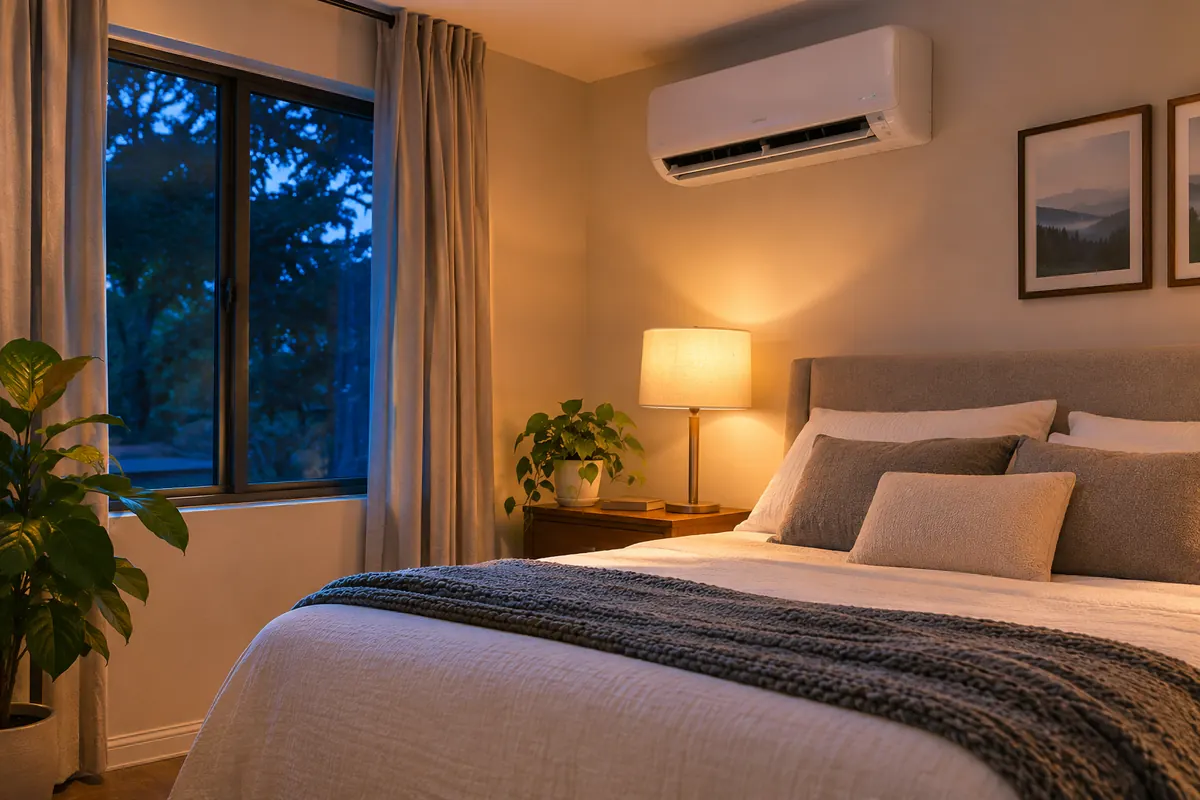
Independent testers such as RTINGS’ bedroom air-conditioner reviews compare sound under defined settings. Use that type of test alongside the manufacturer’s specifications, not as proof that every person will hear the unit the same way. Sound also depends on where your pillow is, the wall and window construction, and whether the fan blows directly across the bed.
Can a bedroom air conditioner be completely silent?
No conventional compressor-based room air conditioner is silent while cooling. It must move air, and its compressor or outdoor equipment makes some noise. A mini-split can move much of the compressor sound outside; a window inverter model may reduce abrupt cycling. For a light sleeper, a quiet continuous sound can be less distracting than a louder start-stop pattern, even when two published dBA figures are close.
How can you make a bedroom AC quieter?
First check for a loose window frame, unsupported unit, rattling panels, blocked filter, or an exhaust hose touching furniture. Keep the manufacturer’s clearances and drainage slope. A stable installation and clean filter can reduce avoidable noise. Move the bed out of the direct airflow path if possible. Do not cover vents, wrap a running AC in soundproof material, or block the outdoor coil to reduce sound; those changes can cause overheating or poor performance.
Can You Cool a Bedroom Without a Suitable Window?
Yes, but the cooling system still has to release heat somewhere outside the bedroom. If the window cannot accept a window unit or portable exhaust kit, a professionally installed mini-split is often the cleanest permanent choice. A through-wall unit works if the building has a suitable approved sleeve. A portable refrigerant AC works only when its exhaust can be routed and sealed to an allowed outdoor opening.
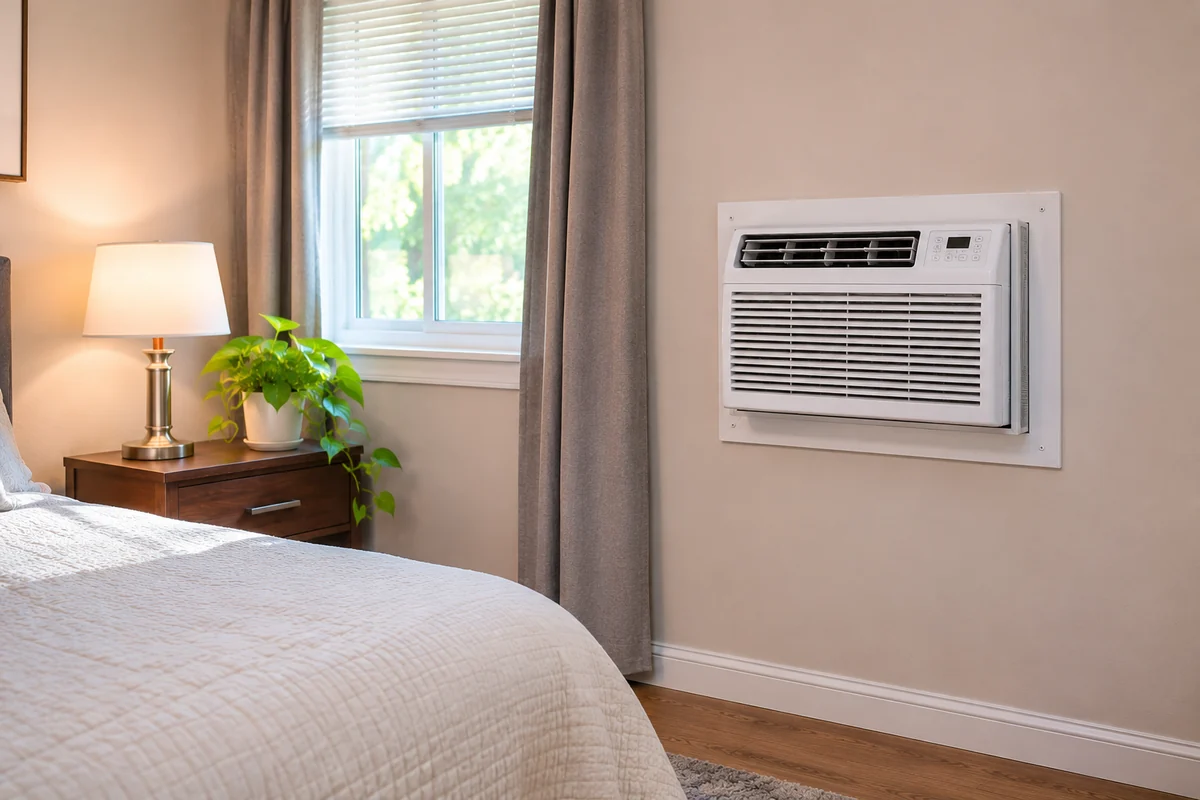
A product advertised as a “windowless portable air conditioner” deserves careful checking. If it has a refrigerant compressor and cools a room continuously, it must reject the heat it collects. A machine that blows cool air at one side but dumps heat back into the same closed bedroom will not reduce the room’s overall heat load. A fan and an evaporative cooler are different products: they can change how air feels, but they do not work like a vented refrigerant air conditioner. Evaporative coolers also add moisture and are least suitable for humid conditions.
For rental homes, first check permitted vent locations and the window style. Never vent a portable AC into an enclosed attic, wall void, or hallway. Keep the exhaust hose as short and direct as the instructions allow, seal the panel, and confirm condensate drainage. A poorly sealed opening can bring warm outdoor air back into the bedroom.
What Changes for a Small, Large, Sunny, or Attic Bedroom?
Choose capacity from the room’s heat load, not the label “small bedroom” or “large bedroom.” The same floor area can need different cooling when one room sits under a hot roof and another is shaded between conditioned rooms.
Small bedroom: about 100–150 sq ft
Start with the 5,000 BTU/h conventional room-AC band. A larger unit may not be more comfortable. Check that it can run quietly at low output and remove moisture during mild but humid nights. A very small window may decide which products physically fit, regardless of capacity. Measure the clear opening, sash travel, support requirements, and exterior clearance before ordering.
Bedroom around 200 sq ft
The standard chart starts near 6,000 BTU/h. A sunny west-facing window or warm attic ceiling may call for more than this simple area estimate. Compare the right room-AC rating and calculate the actual load for unusually hot rooms. Do not buy an 8,000 or 10,000 BTU/h model solely because the bigger number looks safer.
Bedroom around 300 sq ft or more
At 300 sq ft, the standard table moves from 7,000 to 8,000 BTU/h, depending on which side of the area boundary applies. Above 400 sq ft, around 10,000 BTU/h enters the standard chart. An open door to a landing or living space makes the true cooling area larger. If the bedroom is part of an open plan, measure the connected space and consider whether a single room unit can distribute air effectively.
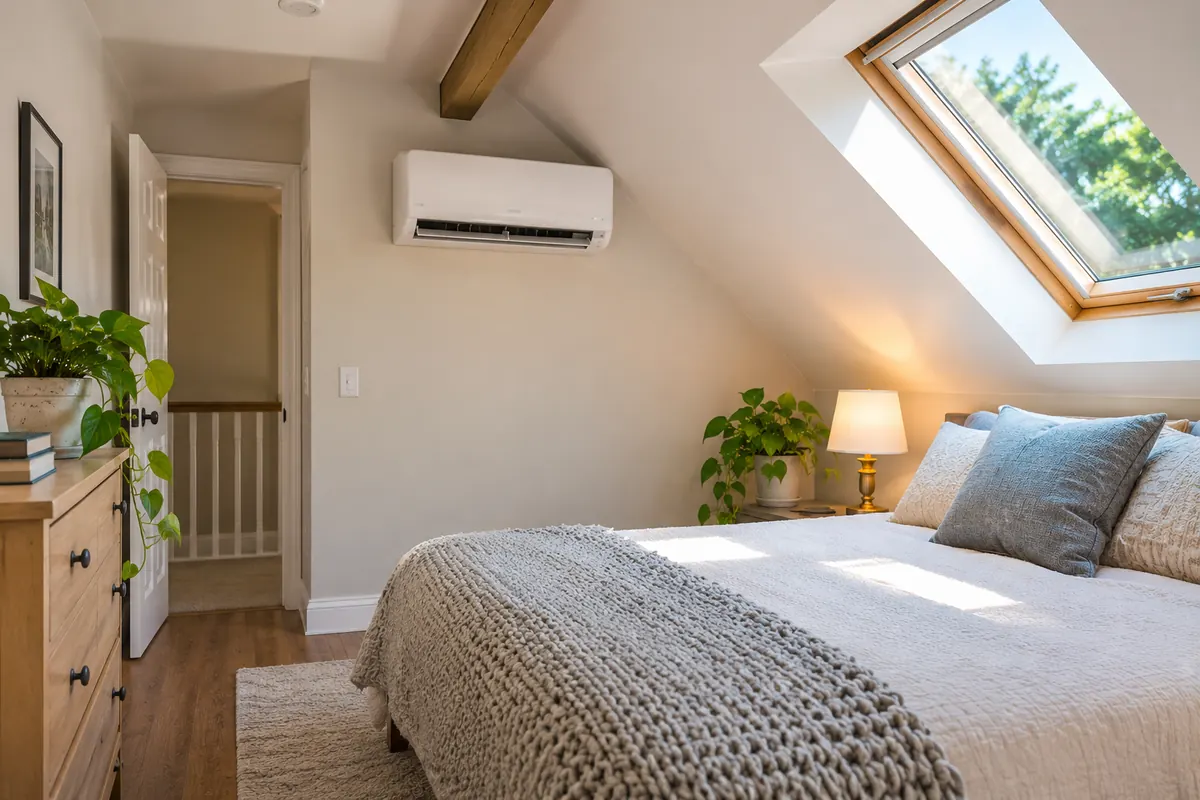
Attic bedroom or room with a hot roof
Roof insulation, solar heat, eaves, skylights, ventilation, and air leakage can dominate the load. Start with the same floor-area calculation, but use a proper room load assessment before choosing a mini-split or other permanent equipment. A larger compressor alone will not fix poor roof insulation or an unsealed hot attic. Correct the building heat gain where practical, then size the cooling system.
What Are Sleep Mode and the Best AC Temperature for Sleeping?
Sleep mode changes how an air conditioner runs at night, but the exact behavior depends on the model. It may lower fan speed, dim panel lights, change the target temperature gradually, or set an off timer. Read the model’s instructions; “sleep mode” is not a universal quietness or energy rating.
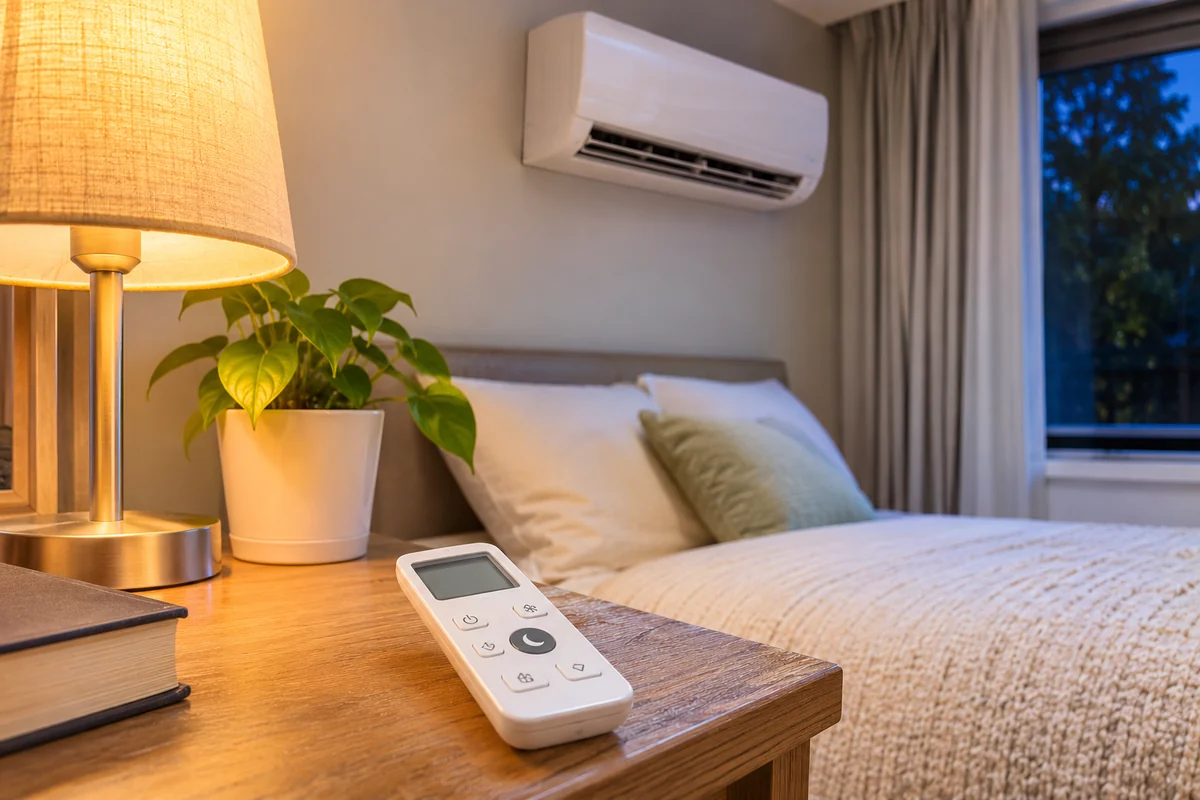
For sleep comfort, Sleep Foundation’s bedroom-temperature guidance discusses a relatively cool bedroom, often around 65–68°F (18–20°C) for many adults. That is a sleep-environment recommendation, not a rule that every air conditioner should be set to 65°F. A person may be comfortable at a warmer setpoint with a ceiling fan, light bedding, good humidity control, and lower electricity use.
Try this practical sequence: select a temperature you find comfortable, run the unit long enough to bring down the bedroom temperature before bed, then test sleep mode for an entire hot night. If you wake up hot, check whether the unit raised its target temperature or reduced its fan too much. If the room feels cold and clammy, consider whether the unit is oversized or cycling too often.
Humidity matters as well as temperature. The U.S. Environmental Protection Agency recommends keeping indoor relative humidity below 60%, ideally around 30–50%. In muggy conditions, comfort may improve more from better moisture removal than from setting the thermostat several degrees lower. Keep the filter, drain, and water collection parts clean.
How Much Does It Cost to Run a Bedroom AC Every Night?
Nightly electricity cost depends on actual power use, hours, and your local electricity rate. BTU/h is cooling output, not the number of watts drawn from the outlet. For a useful estimate, read the unit’s rated power and then compare it with measured or labeled energy use at similar conditions.
The simple formula is:
Nightly cost = average electrical input (kW) × hours run × electricity price ($/kWh).
Use these calculation inputs: assume a bedroom unit averages 0.55 kW, operates for 8 hours, and electricity costs $0.20/kWh:
- Electricity used: 0.55 × 8 = 4.4 kWh.
- Nightly electricity cost: 4.4 × $0.20 = $0.88.
- Over 30 similar nights: $26.40, before taxes or fixed charges.
This is a worked example, not a test result or an Airproz product specification. An inverter may reduce output as the bedroom cools, so actual average watts can differ greatly from maximum rated watts. Compare room-unit efficiency ratings such as combined energy efficiency ratio (CEER) where applicable and check local energy labels. Portable units use different efficiency and capacity procedures; compare within consistent categories and climate/usage assumptions rather than sorting every device by one unqualified number.
For a more useful monthly estimate, use a plug-in energy meter only if it is rated for the appliance and the manufacturer’s electrical instructions allow it, or review energy-monitoring data supplied by the device. Record several typical nights, especially during the hottest period. In a multi-room or business project, use expected operating hours and the site electricity tariff instead of assuming every room has the same load.
How Do You Install and Use a Bedroom AC Without Disturbing Sleep?
Install the unit securely, keep the outdoor heat path clear, and test it at the settings you will use while sleeping. Even a low-noise model can rattle or cool poorly if the bracket, hose, or filter is wrong.
- Check fit and permission. Measure the actual window opening or wall sleeve; check building rules, landlord approval, exterior clearances, and the unit’s mounting instructions.
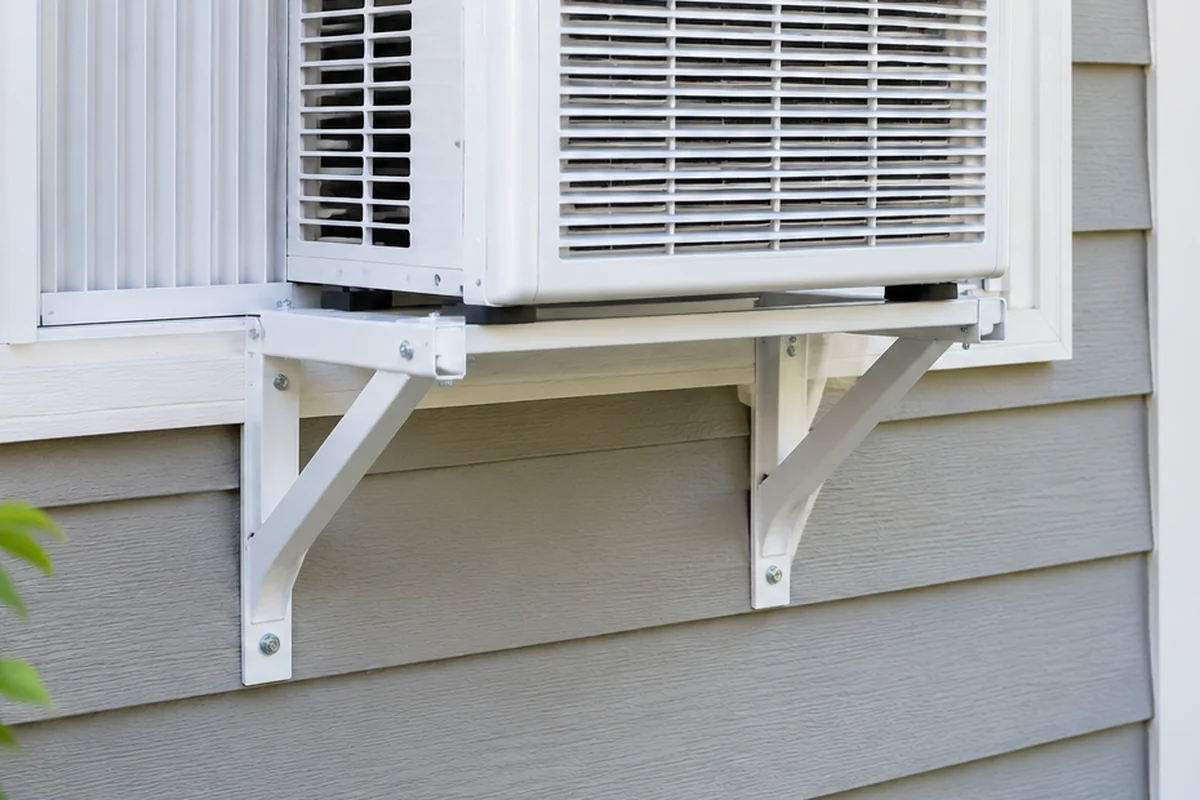
- Support and seal the equipment. Use the approved bracket or support method. Seal gaps without blocking condensate drainage or required outdoor airflow.
- Check power. Match the required voltage, circuit and grounded outlet. Follow the manual’s plug and cord instructions; do not improvise with extension leads or power strips.
- Place the air outlet carefully. Avoid a strong cold draft across the pillow. Keep indoor return and supply air paths open.
- Test the real night setting. Run cooling with the bedroom door closed, check low and medium fan, and listen for starts, vibration, dripping, and vent or hose rattles.
- Maintain airflow and drainage. Clean filters to the stated schedule; monitor water collection and the drain route. Stop and correct leaks or electrical faults before continued use.
If a room with central AC stays warm, first check blocked supply registers, a closed door that prevents return airflow, poor sun shading, and thermostat location. Adding a large portable unit may hide an airflow problem rather than fix it. A qualified HVAC technician can test duct balancing and room cooling load when the difference persists.
Which Bedroom AC Works Best in Common Situations?
Select the unit for the room’s cooling demand and actual installation conditions. These are starting choices; the final capacity must still match the room conditions and the unit’s certified ratings.
| Bedroom situation | Practical starting choice | Check before you decide |
|---|---|---|
| 120 sq ft room, normal ceiling, suitable window | Window AC near the 5,000 BTU/h room-AC band | Fit, low-speed indoor sound, humidity |
| 200 sq ft bedroom with compatible window | Window AC near the 6,000 BTU/h room-AC band | Afternoon sun, allowed window mounting, cycling |
| 300 sq ft bedroom | Window AC around the 7,000–8,000 BTU/h starting range | Actual heat load, noise at cooling speed |
| No window-unit permission but a vent opening is allowed | Properly sized dual-hose portable AC | Certified SACC, hose seal, power, drainage and floor space |
| No suitable outdoor vent and permanent work is allowed | Ductless mini-split | Outdoor-unit location, installation approval, load calculation |
| Hot top-floor attic bedroom | Load-sized mini-split or suitable room AC | Roof heat, insulation, glazing, summer design conditions |
| Bedroom already served by central AC | Improve existing airflow and controls first | Return-air path, duct balance, thermostat, insulation |
If two models appear equally quiet, compare the sound rating at a fan speed that can handle the bedroom load, then review installation requirements, service access, energy use, and controls. For a light sleeper, a small change in the type of noise may matter more than one or two published decibels.
What Should You Check Before Buying a Bedroom Air Conditioner?
Check installation fit, cooling capacity, nighttime sound, electrical requirements, and moisture control before comparing extra features. A smart app or a headline BTU number cannot make up for a poor fit or blocked outdoor airflow.
- Capacity and rating: room area, room cooling load, and the exact tested capacity unit or SACC method.
- Noise: indoor dBA at named settings, whether the compressor is indoors or outdoors, and vibration at the mount.
- Fit: window opening or wall sleeve, permitted outdoor equipment, exhaust seal, hose path, and drainage.
- Electricity: voltage, frequency, circuit, unit power, and the local label used for efficiency comparisons.
- Overnight comfort: sleep mode details, fan controls, light dimming, reliable thermostat, dehumidification, and easy filter care.
- After-sale practicality: service access, parts, product documentation, installation support, and applicable market requirements.
For a multi-bedroom building, distributor, or OEM project, compare rooms in groups by actual size and heat exposure instead of ordering one model for every room. At Airproz, we can discuss appropriate system categories and project requirements using the air-conditioner range. Send the room conditions, power supply, destination market, intended installation, and the noise conditions you need to meet when asking about suitable options. The selected model’s documents identify its performance and approved markets.
Final Recommendation: Choose Comfort, Not Just the Biggest BTU Number
The best air conditioner for a bedroom is the one that meets the room’s cooling load at a noise level you can sleep through and fits the available installation. A suitable inverter window AC is a strong practical choice for many bedrooms; a mini-split often suits a permanent low-noise installation, while a correctly vented portable unit serves rooms with tighter mounting limits. The room-size table shows capacity by floor area. Check the bedroom’s actual heat gain and the noise at the fan setting you expect to use. That order helps avoid oversized, noisy, or poorly vented equipment.
Frequently Asked Questions
Is an 8,000 BTU air conditioner too big for a 200 sq ft bedroom?
It can be oversized under ordinary conditions. ENERGY STAR’s baseline chart starts at 6,000 BTU/h for a 200 sq ft room with an 8-foot ceiling. Heavy sun, an attic roof, or poor insulation can raise the load. Compare the actual cooling requirement and the model’s operating range instead of choosing 8,000 BTU/h automatically.
Is a 5,000 BTU window air conditioner enough for a small bedroom?
It is a standard starting point for about 100–150 sq ft under the room-AC chart’s assumptions. Check ceiling height, sunlight, fit and humidity. A hot attic bedroom can require a different capacity despite having the same floor area.
Can I use a portable air conditioner in a bedroom with no window?
Only if there is another approved way to vent heat outdoors. A portable refrigerant AC cannot cool a closed room effectively while discharging its condenser heat back into that room. A mini-split or an approved through-wall option may be better when no safe outdoor exhaust route exists.
What is a quiet dBA rating for a bedroom air conditioner?
A low-40 dBA or lower indoor rating at a useful operating speed is a reasonable maximum to consider for many sensitive sleepers. Compare models measured at similar distances and settings. Compressor cycling, rattling, and tone may be more distracting than the headline number suggests.
Is sleep mode the same as quiet mode on an air conditioner?
No. Quiet mode usually prioritizes lower fan or compressor noise, while sleep mode may also change temperature over time, dim lights, or activate a timer. The behavior is model-specific. Check whether sleep mode still delivers enough cooling on a hot night.
Is 65°F the best air conditioner setting for sleep?
Not for everyone. Roughly 65–68°F is a commonly discussed cool sleep-environment range, not a mandatory AC thermostat setting. Choose a comfortable temperature, then adjust humidity, airflow, bedding, and running cost for your situation.
Is a dual-hose portable air conditioner always quieter than a single-hose model?
No. Two hoses describe the air path used to reject heat, not the sound rating. Compare measured noise at the fan speed needed for cooling, the compressor’s behavior, and whether either hose or panel vibrates during the night.
Why does my bedroom feel damp even when the AC makes it cold?
The unit may be cycling off before it removes enough moisture, or the room may have another moisture source. Check capacity, fan settings, humid outdoor-air leaks, drainage, and room relative humidity. If dampness or visible mold persists, locate and fix the moisture source rather than simply lowering the thermostat.