Choose a thermostat for heat pump and air conditioning that matches the equipment’s control interface, compressor stages, O/B reversing-valve action, backup heat, and power supply. A central AC and furnace need the correct conventional heating and cooling stages; a reversible heat pump needs heat-pump controls. Ductless or communicating inverter systems need an approved controller or interface.
Start by identifying which type of heating and cooling system you have. The right controller category changes with the equipment:
Use the system table and five-step compatibility check below to confirm the exact model before ordering.
Do Heat Pumps and Air Conditioners Need Different Thermostats?
Not always. One thermostat model can serve either system if it supports the right controls; a reversible heat pump also needs its reversing-valve and heating-stage functions. A cooling-only thermostat cannot run heat-pump heating, while a conventional AC and furnace use separate heat and cool calls.
Many North American central systems use 24-volt control circuits, but that does not make every thermostat interchangeable. The thermostat must support the type of equipment, each heating and cooling stage, and any backup heat. Some inverter, ductless, and communicating systems use a brand-specific controller instead of ordinary 24-volt calls.
Quick rule: Choose the controller by the complete heating-and-cooling setup, not by the word “AC” or “smart” on the box.
How the control signals differ
A conventional AC thermostat calls for cooling and separate furnace heating, while a reversible heat pump also needs a signal to switch the outdoor unit between heating and cooling. Standard 24V heat pumps commonly use O/B for that changeover; other systems need backup-heat outputs or an approved communicating controller.
- Conventional air conditioner + furnace: Cooling and furnace heating are separate calls. A non-heat-pump thermostat may support the system when its stage ratings match.
- Air-source heat pump: The outdoor unit changes between heating and cooling. The thermostat must support a heat-pump configuration and the required O/B reversing-valve function.
- Heat pump + backup heater: The thermostat also needs the correct auxiliary-heat and, where provided, emergency-heat controls.
- Ductless or communicating heat pump: The manufacturer may require its supplied wall controller or an approved interface. Replacing it with a basic on/off thermostat can remove modulation or other functions.
For how ductless indoor and outdoor units are arranged and controlled, see our mini split air conditioner guide. Ductless systems can use their own room controls instead of standard 24V thermostat terminals.
The Six Checks That Decide Thermostat Compatibility
A thermostat is compatible when its control interface, compressor stages, O/B valve action, backup-heat functions, operating power, and any special system controls match the installed equipment. Use these six checks to compare a candidate model with the actual HVAC configuration.
| What to check | What to find on your system | What the thermostat must support |
|---|---|---|
| Control type | 24V low-voltage, line-voltage, or communicating controller | The exact electrical and communication interface |
| Compressor stages | Single-stage, two-stage, or variable-capacity | Enough supported heat-pump stages or the approved variable-speed control |
| Changeover | O or B reversing-valve logic | The correct heat/cool changeover configuration |
| Backup heat | No backup, electric AUX, emergency heat, or gas furnace | The proper extra stage and control sequence |
| Power | R and C connections, available conductors, or approved adapter | Required operating power for that exact thermostat model |
| Special controls | Zoning panel, OEM bus, fan-coil, or proprietary interface | Explicit support from the equipment/control manufacturer |
1. Identify voltage and the control interface
Use a 24V thermostat only with a compatible 24V control circuit, a line-voltage controller with equipment designed for line-voltage control, and an approved interface for proprietary communication. Never use a 24V smart thermostat to replace a 120/240V line-voltage controller. Identify the control interface from the equipment documentation.
If you are comparing thermostat wiring with the cable linking split AC units, our guide to air conditioning connections explains the different power, control, and communication links.
2. Count compressor stages, not just wires
If the heat pump uses Y1, choose a thermostat supporting one compressor stage; if it uses Y1 and Y2, choose one supporting both stages. Variable-capacity equipment may instead need an approved communicating controller for modulation. Use the equipment controls specification rather than the wire count.
3. Confirm the reversing-valve setting
Set O/B to the equipment’s required reversing-valve action: energized in cooling (O) or energized in heating (B), as specified in its controls manual. An incorrect setting can call for cooling when heat is selected, or the reverse. Do not copy the setting from a different system.
4. Count backup heating functions
Choose a thermostat that supports every installed backup-heating function: electric AUX stages, emergency-heat operation where provided, or a dual-fuel changeover sequence for a gas furnace. These functions are not interchangeable. Count them using the equipment control diagram.
5. Check how the thermostat gets power
Choose a thermostat whose stated power method works with your control circuit, such as a usable C-wire or an approved adapter when the model needs continuous 24V power. A spare blue conductor is not proof of a C connection; check its terminals at both ends and the thermostat instructions.
The same brand can require a C-wire for one system but not another. Copeland states that Sensi Lite and Sensi Smart need a C-wire on heat pump systems, while Sensi Touch and Touch 2 need one on all systems. A Sensi Lite installation on a conventional furnace-plus-AC system may have different power requirements. Compare the exact model and system type in Sensi’s published C-wire requirements.
6. Check zones and manufacturer-specific functions
For a zoned heat pump, choose a thermostat approved for the installed zone panel; for proprietary communication, use the manufacturer-approved controller or interface. Also match fan, humidity, defrost coordination, and variable-capacity functions where the existing system relies on them.
Which Thermostat Fits Each Heating and Cooling System?
Choose a conventional heat/cool thermostat for a central AC and furnace, a heat-pump-rated model with the correct stages and O/B setting for a reversible central heat pump, or an approved controller for a communicating or ductless system. The table identifies the required control type for nine common setups.
| Your system | Suitable thermostat type | Compatibility decision |
|---|---|---|
| Conventional central AC + gas furnace | Conventional heat/cool thermostat with matching stages | Check the furnace and AC stages; O/B heat-pump support is not required for a conventional-only setup |
| Single-stage 24V heat pump, no backup | Heat-pump thermostat with O/B and matching 1-stage capacity | Match O/B operation, 1 compressor stage, and the model’s power requirement |
| 24V heat pump with electric AUX heat | Heat-pump thermostat with supported compressor and AUX stages | Count the heat-pump compressor and electric AUX stages separately |
| Heat pump with emergency heat | Model that supports the required E/emergency-heat operation | Verify whether E is a separate output or combined with AUX on this model |
| Two-stage compressor heat pump | Thermostat rated for at least the actual two compressor stages | Verify two compressor outputs plus any additional AUX stages |
| Heat pump + gas furnace (dual fuel) | Dual-fuel-capable thermostat or manufacturer-approved controller | Check the allowed compressor/furnace changeover and lockout controls |
| Inverter, communicating, or proprietary heat pump | Original/approved communicating controller; approved interface where available | Use the approved controller or gateway; compare retained modulation and diagnostics |
| Ductless mini-split heat pump | Manufacturer wall control, remote, or specified interface | Use the documented room control or manufacturer-approved interface |
| Zoned central heat pump | Thermostat approved for the zone control panel | Confirm thermostat support on the actual zone panel model |
How to use the table: Standard 24V candidate means you can check an exact thermostat model against the required stages, O/B, AUX/E, and power needs. Approved interface needed means the equipment maker must list a supported gateway or controller. Not a direct replacement means a conventional thermostat cannot be connected to an unsupported communicating or line-voltage system. For a standard 24V candidate, match its stated voltage, compressor and AUX/E stages, O/B action, and power method to the equipment. If a required function is missing, choose another supported model or an approved interface.
For central AC without a heat pump, identify the actual heating equipment first. A thermostat labeled only “for air conditioning” may control cooling but not the furnace or electric heater.
How Do Thermostat Terminal Labels and Stage Ratings Work?
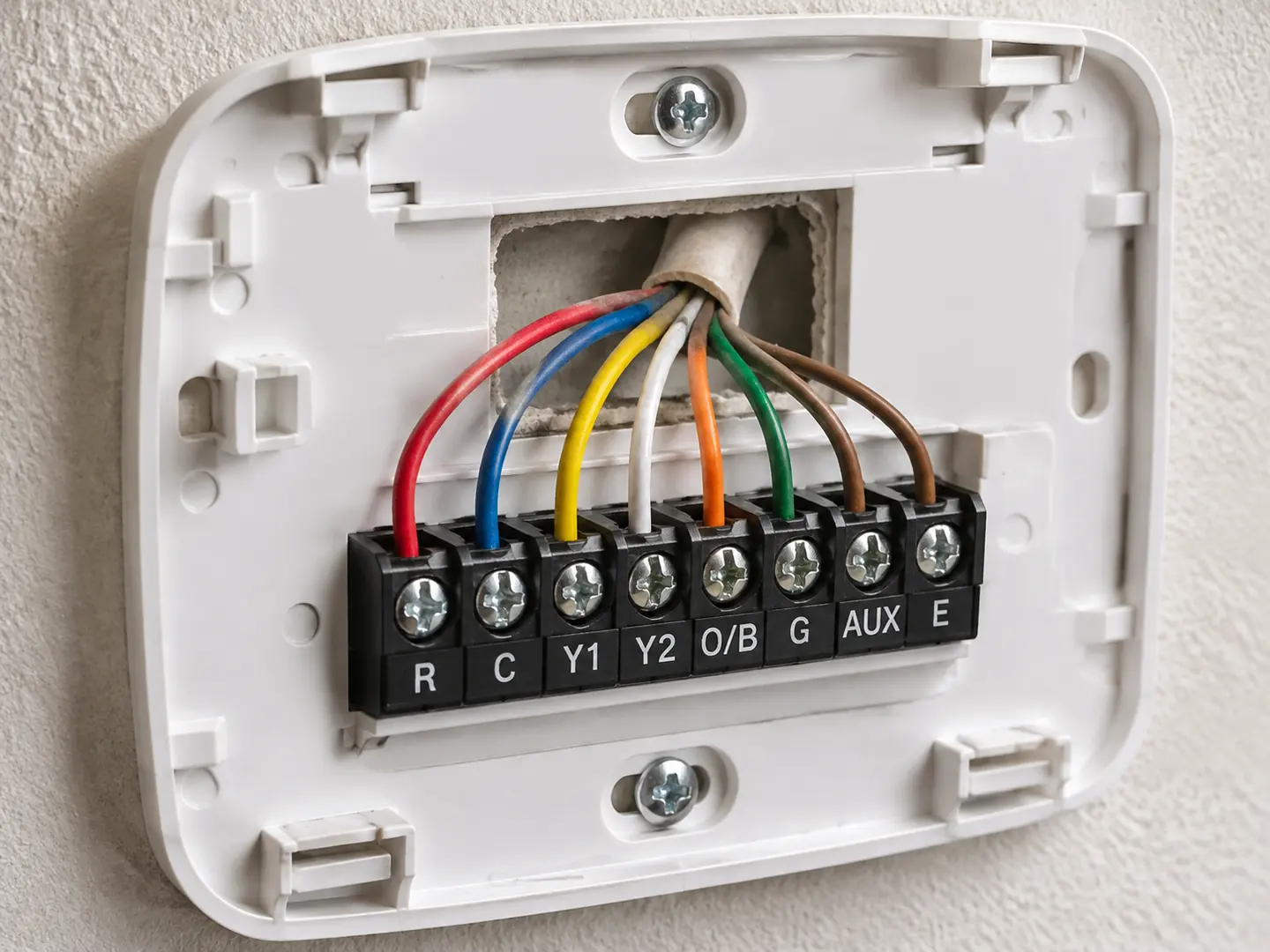
R and C provide 24V control power, Y1/Y2 call compressor stages, O/B controls heat-pump changeover, and AUX/E handles backup or emergency heat where installed. Match these functions and the exact stage ratings against the indoor and outdoor equipment manuals.
| Label | Typical role | What to check |
|---|---|---|
| R, Rc, Rh | 24V supply for control circuits | One or two transformer arrangements and model-specific jumper rules |
| C | 24V common | Actual continuous power path for smart controls |
| Y, Y1, Y2 | Compressor cooling/heating calls | Required number of compressor stages |
| G | Indoor blower/fan call | Who controls the fan in each mode |
| O/B | Reversing valve | When equipment energizes the valve |
| W, W2, AUX | Heating or auxiliary heat functions | Conventional furnace vs heat-pump backup logic |
| E, EM HEAT | Emergency heating function | Separate or combined with AUX on this exact equipment |
Why “2H/1C” is not a universal heat pump rating
“2H/1C” does not by itself prove that a thermostat can run two compressor stages plus an additional AUX stage. On some controls, the two heating stages mean one compressor stage and one backup stage. Check the detailed heat-pump stage matrix for separate compressor and AUX outputs.
Example: two compressor stages plus electric AUX. A conventional two-stage heat pump can use Y1 for its first compressor call and Y2 for its second; a separate AUX call operates electric backup heat. The thermostat must support both compressor calls and the required auxiliary stage. A model advertised only as “2H/1C” may lack the needed outputs.
Why wire colors can mislead you
Wire colors do not reliably identify thermostat functions because installers can use the same color for different terminals. A blue conductor is not always C; it may be used for O/B or another circuit. Read the terminal markings and equipment diagram. For connections, see our heat pump thermostat wiring guide.
Should You Choose a Programmable, Wi-Fi, or Smart Thermostat?
Choose a programmable thermostat for basic schedules, a Wi-Fi model for remote access, or a smart model for supported automation features. In every case, first confirm the exact model supports your heat-pump stages, O/B operation, backup heat, and power supply.
| Control type | Useful feature | Heat pump condition |
|---|---|---|
| Basic heat pump thermostat | Local temperature and mode selection | Must match O/B, stages, backup heat, and power |
| Programmable heat pump thermostat | Setpoint schedules for workdays or occupancy | Use recovery settings suitable for your backup heating |
| Wi-Fi heat pump thermostat | Phone access, alerts, remote setpoint adjustment | Check C-wire/power accessory and offline operation |
| Smart thermostat | Learning, sensors, reports, or utility features | Confirm exact equipment support before enabling advanced features |
| OEM communicating thermostat | Capacity modulation and equipment-specific control | Keep the approved communication link and feature set |
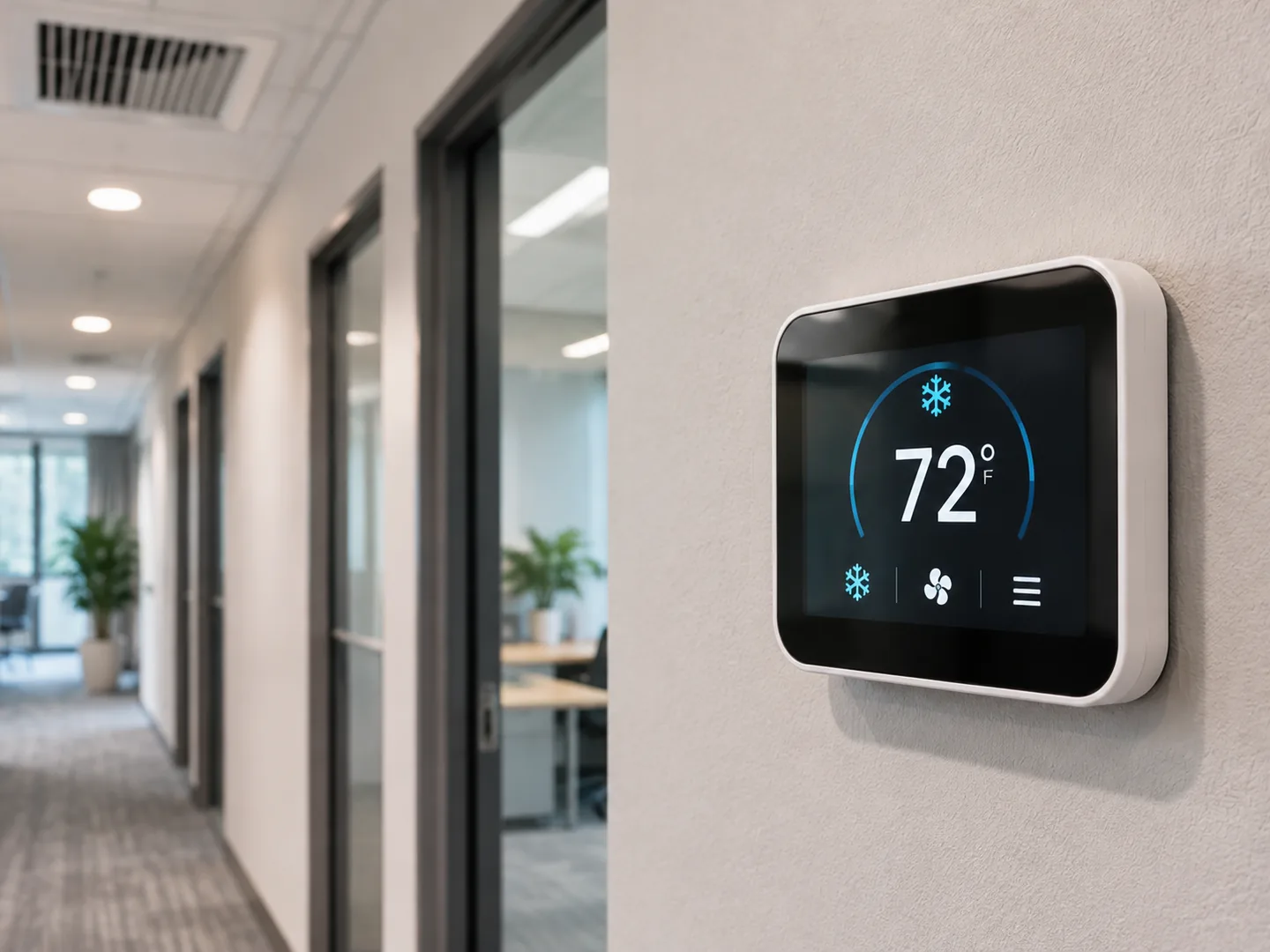
Not every split air conditioner uses a conventional wall thermostat. For example, our R410A T1 inverter air conditioner PAT Series lists a wireless remote controller among its included accessories. Check the exact model’s supported control interfaces before choosing a third-party thermostat.
Program your heat pump without unnecessary backup heating
Use heat-pump-aware recovery settings or a gradual temperature schedule to limit unnecessary electric AUX calls during warm-up. Large setpoint jumps can trigger resistance backup heat on some systems. An approved communicating controller may manage capacity differently, so use its supported scheduling features.
Ask what happens when Wi-Fi is unavailable
Choose a Wi-Fi thermostat that continues the required heating and cooling controls locally during an internet outage, as stated in its specifications. Remote app functions can stop without internet, but the supported equipment control sequence should continue.
For Wi-Fi models, compare which functions continue without internet, whether scheduling supports gradual heat-pump recovery, and whether a power accessory is required. The ENERGY STAR smart thermostat guidance explains efficiency-related features. Compare running costs using your actual heating demand and backup-heat settings.
What Changes With Auxiliary Heat, Emergency Heat, and Dual Fuel?
Electric AUX needs the required supplemental heating stages, emergency heat needs a supported emergency mode, and dual fuel needs approved switching between the heat pump and fuel-fired heater. Each setup uses different staging or lockout rules, so choose the controller for the backup heat actually installed.
Heat pump with electric auxiliary heat
Choose a heat-pump thermostat with AUX control for each separately controlled electric backup stage, and configure when those stages can run. Starting AUX too early increases resistance-heat use; restrictive settings can leave the building short of heat during high demand. Follow the matched equipment control instructions.
Emergency heat is not the same button as AUX
AUX supplements heat-pump heating; Emergency Heat is a separate mode that normally runs designated backup heat without regular compressor heating. Choose a thermostat that supports the installed emergency-heat sequence. AUX and E may share a terminal or use separate outputs, depending on the model.
Dual-fuel heat pump with a gas furnace
Use a dual-fuel thermostat or approved controller that switches between heat-pump heating and gas-furnace heating in the sequence required by the matched equipment. In a common arrangement, the compressor heat call stops before the furnace starts. Do not copy electric-strip AUX operation into a furnace setup.
Use the equipment’s control instructions to identify the furnace interface, any required outdoor-temperature input, the allowed heating modes, and compressor/furnace lockout settings. For example, ecobee’s dual-fuel instructions require preventing simultaneous heat-pump and auxiliary-heat operation in the listed dual-fuel setup. Configure the installed heat pump and gas furnace to use their specified changeover sequence, not electric-strip AUX settings.
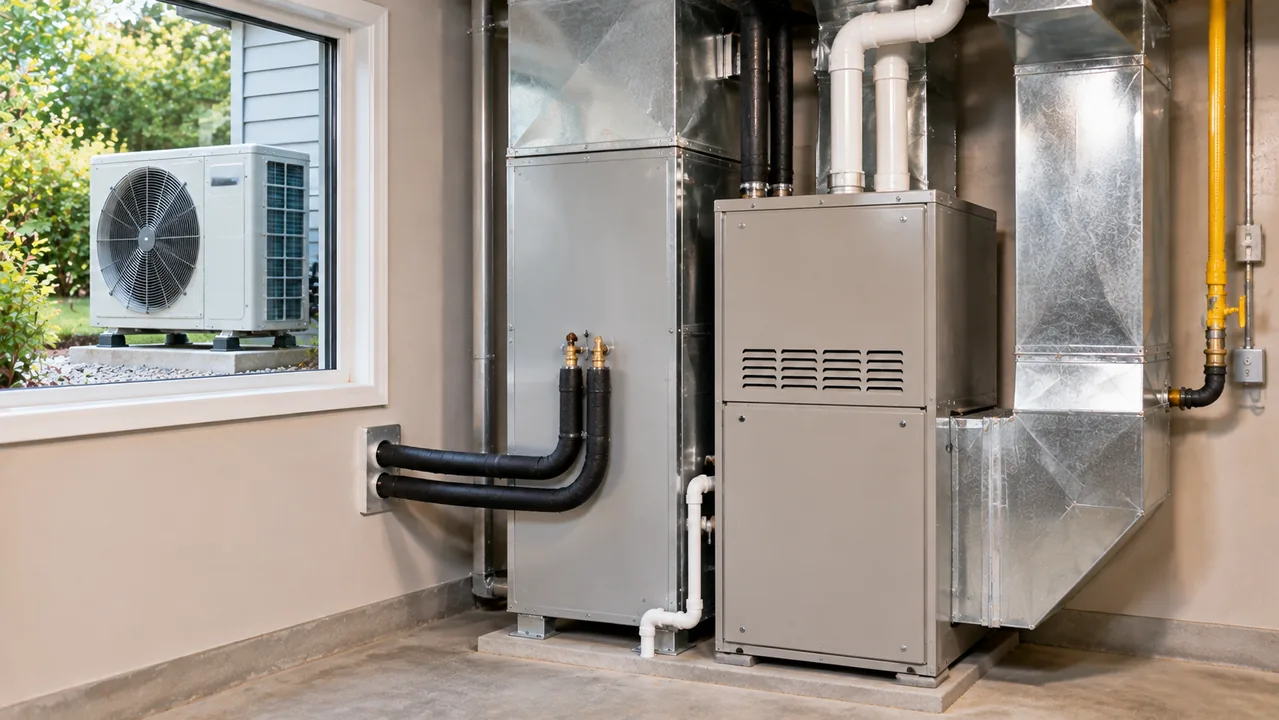
Two-stage heat pump plus auxiliary heat
Choose a thermostat that supports both Y1 and Y2 compressor stages plus the separate AUX output or outputs required by the installed backup heater. A “two-stage heating” label alone does not guarantee this combination. Check the model’s detailed heat-pump stage specifications.
How to Confirm Thermostat Compatibility Before Ordering
Before ordering, record the indoor and outdoor equipment models, identify the existing control functions, compare them with the exact thermostat specifications, and arrange a final setup check. Follow these five steps to collect the information and verify the match.
- Identify the whole HVAC system. Write down the indoor unit, outdoor unit, furnace or backup heater, and any zone panel. Include model numbers and installed control accessories.
- Record the existing control. Turn off equipment power using the correct isolation procedure before opening a thermostat cover. Photograph visible terminal labels and the existing wire positions. If the display is built into a proprietary controller, note its model instead of assuming the terminals are standard.
- Count functions. Record compressor stages, O/B valve action, auxiliary or emergency heat stages, fan control, and any dual-fuel changeover. Identify whether a usable common wire and required supply are present.
- Use the exact compatibility checker. Enter the verified system details requested by the official checker for Google Nest, ecobee, Copeland Sensi, or Honeywell Home. Compare its supported voltage, O/B operation, compressor stages, AUX/E functions, power method, and excluded equipment types with the installed indoor unit, outdoor unit, and heater or zone panel. Select the model only when all required controls are supported.
- Confirm setup and commissioning. Have the installer or responsible technician verify heating, cooling, reversing-valve direction, indoor fan, auxiliary heat, emergency mode where installed, and dual-fuel transition. Keep the thermostat and equipment setup records together.
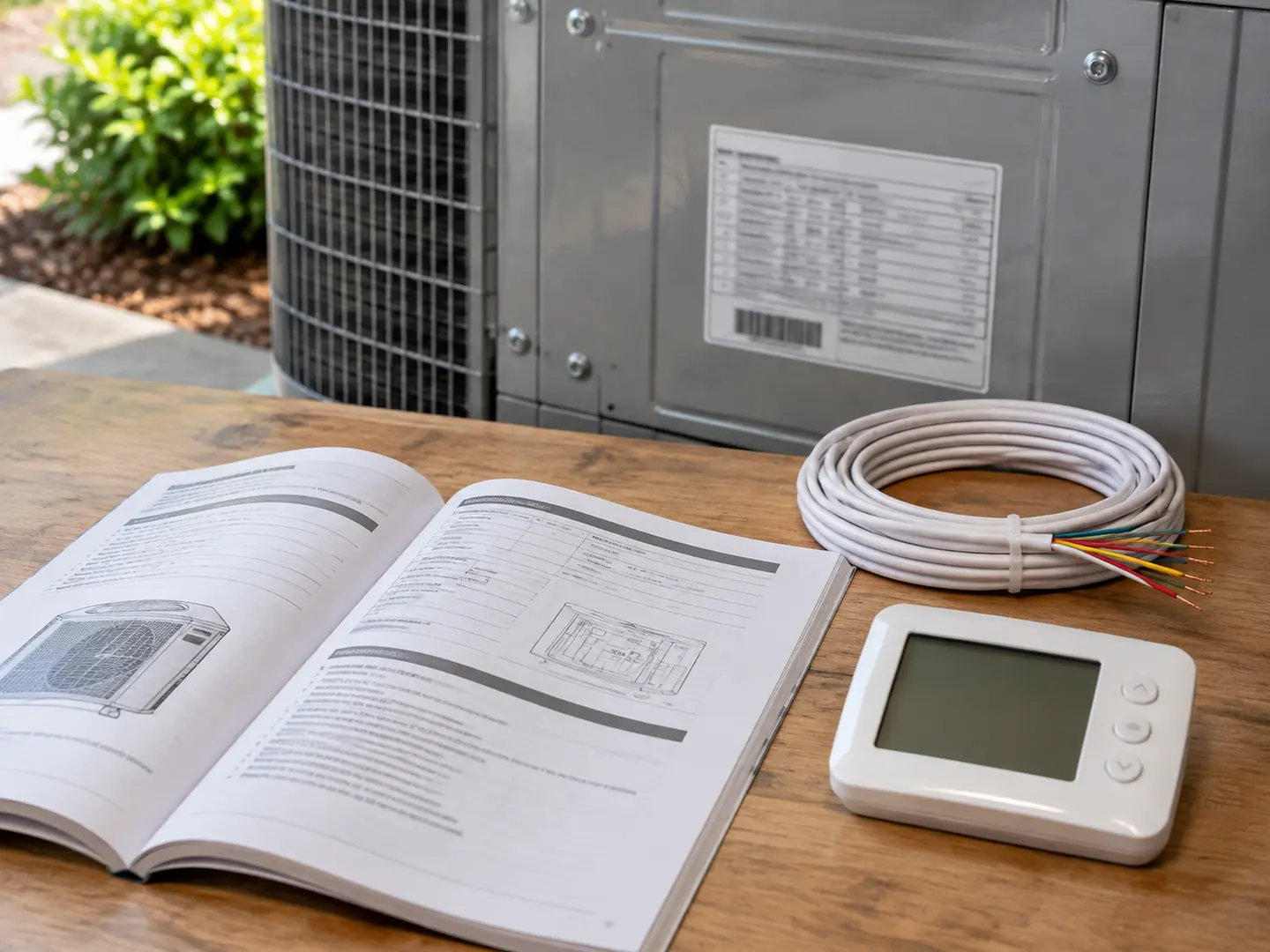
Thermostat compatibility is one part of the completed system check. Our air source heat pump installation guide explains how the installer checks control settings, operating modes, backup heat, and equipment response during commissioning.
Before ordering: Keep a record of the equipment and controller model numbers, approved wiring functions, and required heating modes. This makes the installer’s final setup check faster.
What Should You Do if a Smart Thermostat Is Not Compatible?
If a smart thermostat is incompatible, keep the approved original controller or choose a manufacturer-approved interface or a different model that supports every required function. Never bypass proprietary communication terminals or repurpose wires to power an unsuitable controller.
- Communicating inverter system: Keep the OEM wall control when it is required for capacity modulation. Ask the equipment supplier whether an approved gateway provides the remote-control functions you need.
- No usable C-wire: Select a thermostat with an officially supported power method, or have the wiring corrected by a qualified installer. Do not substitute another terminal just because the wire color looks right.
- Insufficient heating stages: Choose a thermostat with the full compressor and auxiliary-stage capacity. Do not remove a backup heating function from the plan to fit a cheaper model.
- Dual-fuel control mismatch: Use a model or control kit intended for the heat pump and furnace combination, with the proper changeover settings.
- Zoning or mini-split control mismatch: Verify the compatible control panel, manufacturer interface, or native room controller instead of wiring around it.
Air-to-water systems also need model-specific control checks. Our R32 monobloc space heating heat pump has integrated system controls and a local display. Choose an external room controller only from interfaces supported in the exact model documentation.
What changes when a communicating inverter controller is replaced? An interface that offers only staged on/off calls cannot pass the original controller’s full range of capacity commands. Compare the approved gateway part number and its stated support for capacity adjustment, fault reporting, humidity control, and any required remote features. If the new interface omits a required function, keep the original communicating controller or select another approved interface. PNNL’s smart thermostat guidance explains how replacing a proprietary communicating control can change system functions and efficiency. The ENERGY STAR thermostat FAQ also discusses using manufacturer-recommended controls with variable-capacity heat pumps.
What Information Should You Send for an Airproz Control Review?
Send Airproz the indoor and outdoor unit models, existing controller model, terminal information, and required heating and cooling functions. For an OEM project, also include the destination market, quantity, and any zoning or building-control needs.
Send these four details first:
- Indoor and outdoor unit model numbers (or equipment documentation).
- Existing thermostat or controller model.
- A photo showing the current terminal labels, if safely available.
- Required heating, cooling, scheduling, and smart-control functions.
For OEM or larger projects, also include the destination market, required supply, expected quantity, backup heating type, zoning, and any building management system (BMS) or custom-interface needs. If you do not know a control stage or terminal function, share the equipment manual instead of guessing.
Our OEM/ODM heat pump information explains the project context for controller and smart-home integration. Send us your model numbers and control requirements so we can review which thermostat functions and approved interface options fit your project.
Bottom line: The right thermostat for heat pump and air conditioning operation is the one that supports your equipment’s control signals, stages, backup heating, and power requirements. Smart features come after that compatibility check.
Frequently Asked Questions
Can I use a regular air-conditioner thermostat with a heat pump?
Only if that exact thermostat supports reversible heat pump control, including the required O/B changeover, compressor stages, and backup heat. A cooling-only or conventional furnace-and-AC thermostat is not automatically suitable.
Do heat pump smart thermostats always need a C-wire?
No. Power requirements depend on the thermostat model and the HVAC system. Many Wi-Fi models require a usable C connection or an approved power accessory; check the published instructions for the exact model.
Are AUX heat and emergency heat the same?
No. AUX heat supplements heating when the system calls for extra capacity. Emergency heat is a distinct operating mode on equipment that offers it, often using backup heat without normal compressor heating. The terminals may be separate or combined depending on the control.
Can a smart thermostat control a ductless or inverter heat pump?
Use a smart thermostat only when the heat pump maker supports that controller or a specific interface. A generic 24V thermostat may not work with proprietary controls and can remove variable-capacity features.
Can one thermostat run a heat pump and gas furnace?
Yes, with a compatible dual-fuel thermostat or manufacturer-approved controller and the correct changeover configuration. Confirm the system permits the selected heat pump and furnace sequence.
Is a 2H/1C thermostat enough for a heat pump with auxiliary heat?
It may be enough for a supported single-stage heat pump with one auxiliary heating stage. It is not enough to assume compatibility with a two-stage compressor plus an additional auxiliary stage. Check each rating separately.
Can I replace a thermostat connected to a zoning panel?
Only with a thermostat supported by the specific zoning panel. The panel can coordinate zone requests, compressor stages, and reversing-valve control. Check the panel model and its approved thermostat requirements before replacing the wall control.
Will a Wi-Fi thermostat automatically lower heating costs?
No. Scheduling and control features can help, but savings depend on the building and setup. Large rapid heat-up requests can call electric auxiliary heat on some systems, so use heat-pump-appropriate recovery settings.