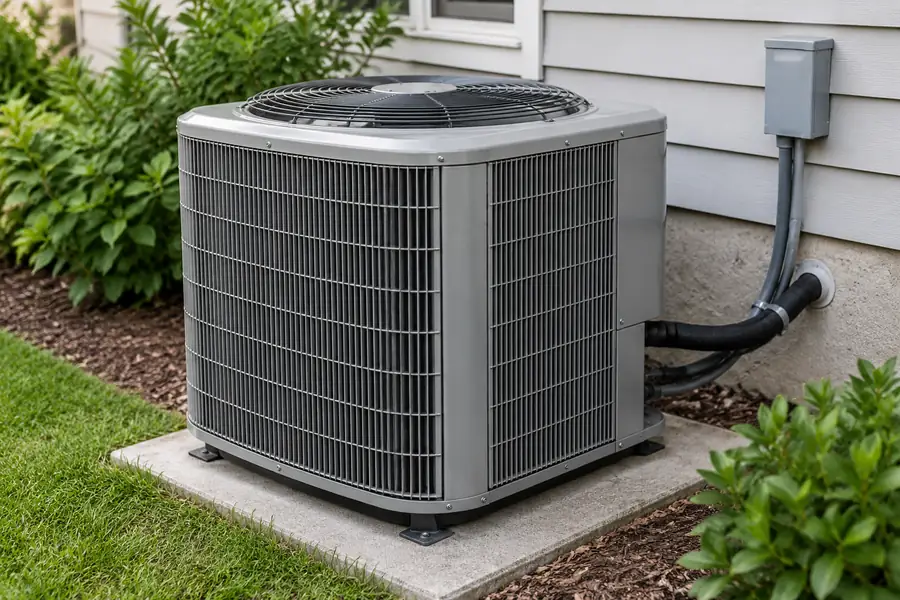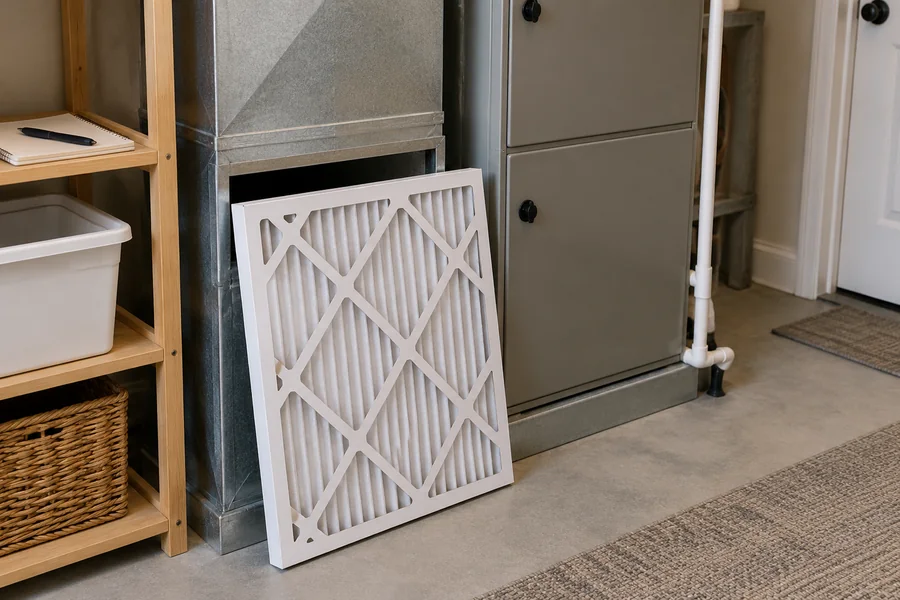
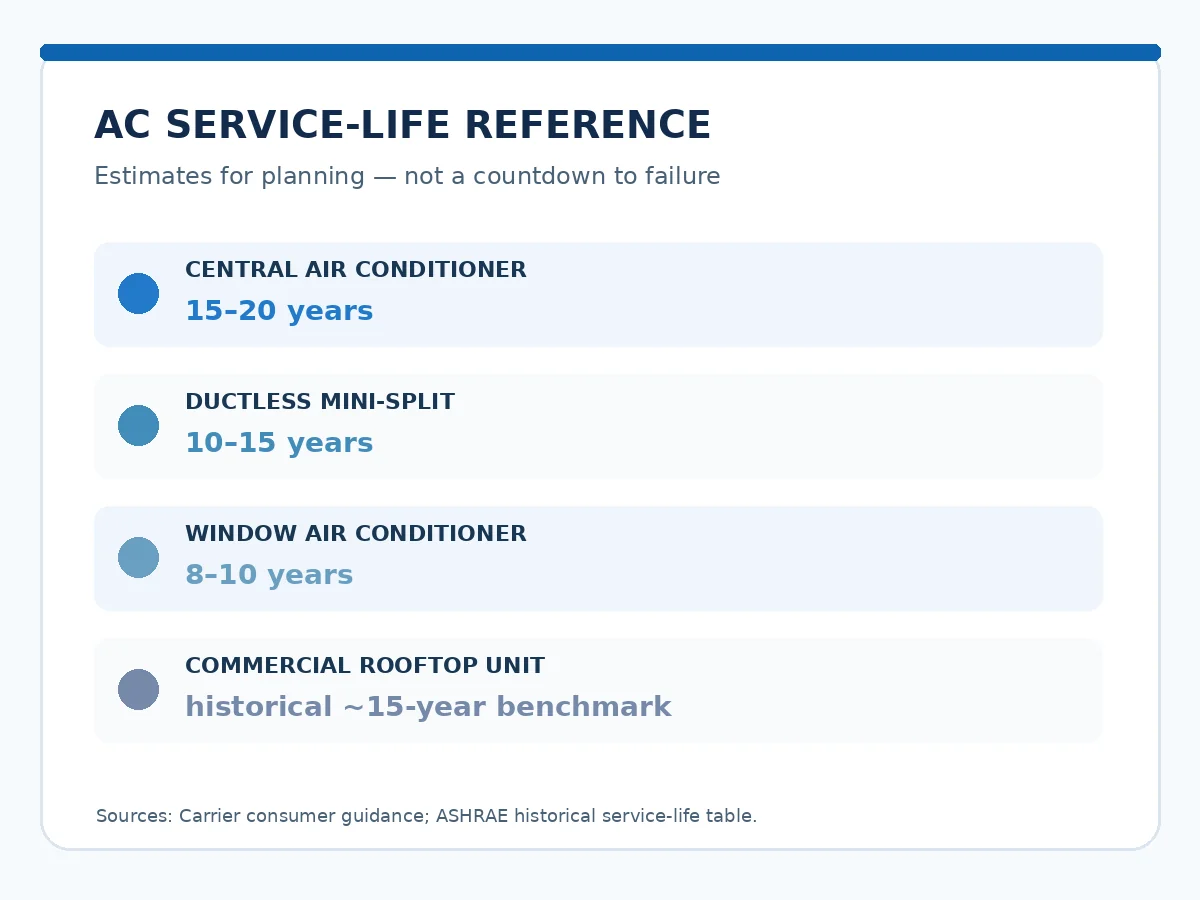
How long do air conditioners last? Most central air conditioners serve about 15–20 years. Ductless mini-splits are commonly planned around 10–15 years, while window units often serve about 8–10 years. Installation, operating hours, climate and maintenance affect the service life of each system.
At 10 years, review cooling performance, repair history and maintenance costs. Keep a reliable system in service. Compare replacement options when major faults recur, comfort declines or operating costs rise.
What Is the Average Lifespan of an Air Conditioner by Type?
Central air conditioners typically last 15–20 years, ductless mini-splits around 10–15 years, and window air conditioners about 8–10 years. Commercial packaged and water-cooled equipment require separate planning because runtime, equipment class and maintenance conditions differ. Use the table below to compare the categories.
On a phone, swipe within tables to view the remaining columns.
| Air conditioner type | Typical service-life reference | What it means |
|---|---|---|
| Central air conditioner (ducted split system) | 15–20 years | Manufacturer guidance for central AC; review indoor and outdoor equipment condition together. |
| Ductless mini-split AC | 10–15 years | General manufacturer planning range; installation, airflow and outdoor conditions shape long-term performance. |
| Window air conditioner | 8–10 years | Common residential reference; an older ASHRAE table lists 10 years. |
| Portable air conditioner | Varies widely by model and duty cycle | Use the model’s service history, warranty and parts availability to plan repair or replacement. |
| Commercial rooftop packaged AC | About 15 years in older industry references | Plan by runtime, faults, service access and downtime consequences. |
| Commercial water-cooled packaged AC | Application-dependent | Review water quality, operating hours, maintenance records and equipment classification. |
How to read the figures: The residential ranges reflect published manufacturer guidance, while the ASHRAE historical service-life tables describe older equipment populations. ASHRAE notes limitations in parts of those older datasets. Use these values to plan inspections and budgets; use the actual unit’s condition and repair history to decide what to do.
How long does a central air conditioner last?
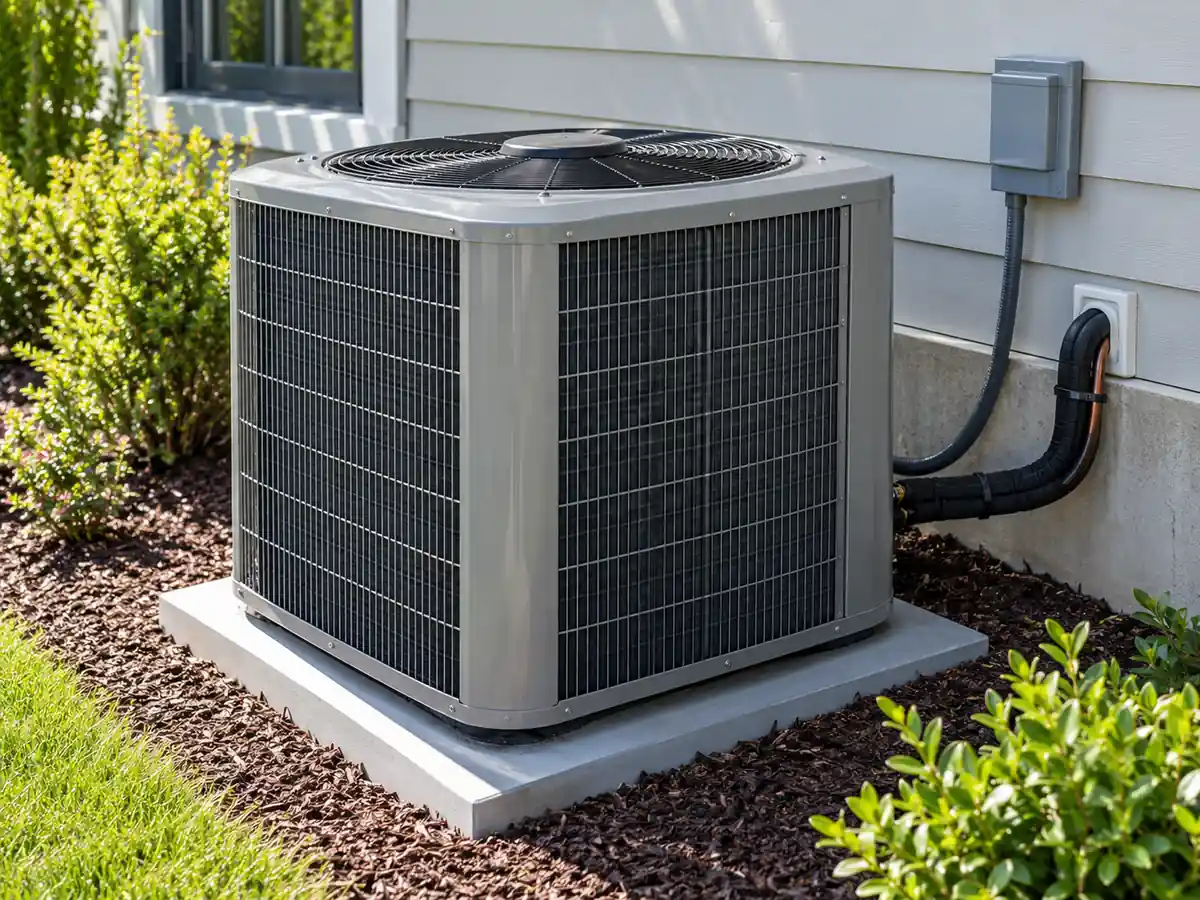
A central air conditioner commonly serves about 15–20 years with sound installation and maintenance. A ducted system includes an outdoor condenser and compressor as well as an indoor coil, blower or air handler. Inspect the condition of these components and the ductwork when planning repairs or equipment replacement.
Keep a well-performing 17-year-old central AC on a maintenance plan. For a 9-year-old unit with repeated major failures, price both a lasting repair and a correctly sized replacement. A new installation should be selected from a cooling-load calculation; the air conditioner sizing guide explains the risks of oversizing and undersizing.
How long does a ductless split AC or mini-split last?
Ductless mini-splits are commonly planned around 10–15 years. Indoor filters, fans and drains require regular care, while the outdoor compressor, coils and electronics need suitable operating conditions and periodic inspection.
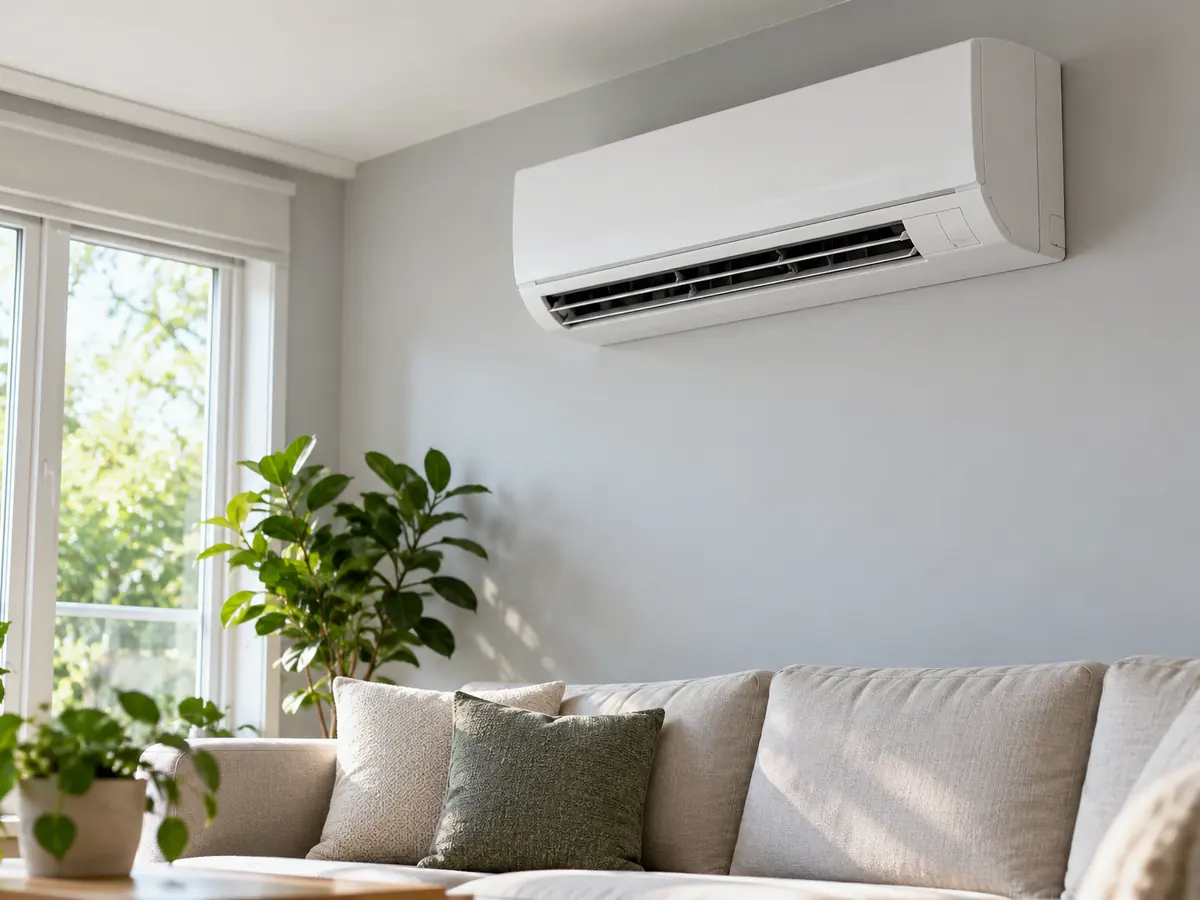
Inverter control adjusts compressor output to match cooling demand. For reliable operation, focus on the installed system: clean airflow, correct refrigerant charge, proper line-set installation and the model’s published ambient operating limits.
How long does a window air conditioner last?
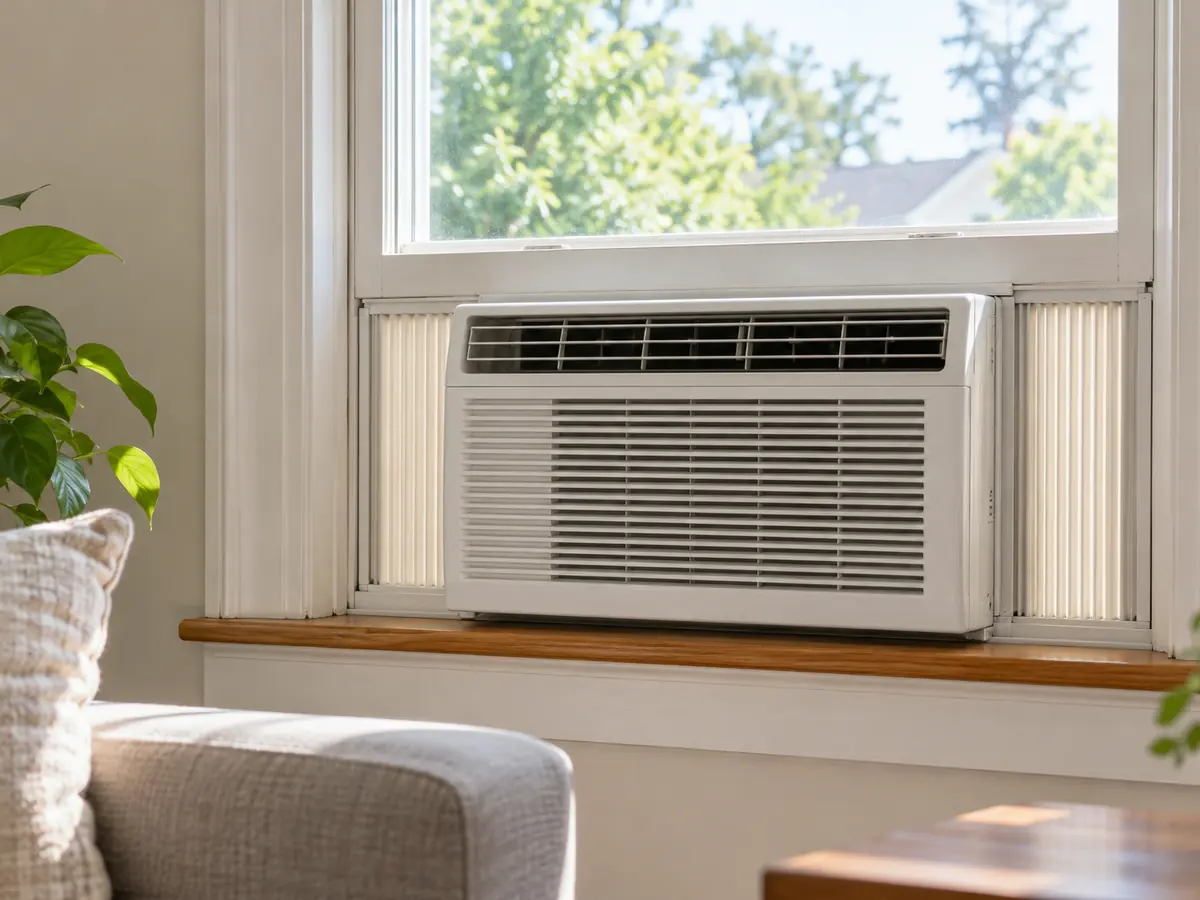
A window air conditioner often serves around 8–10 years. Clean the accessible filter, keep drainage clear and check the window support and seal against the manufacturer’s instructions. Inspect older units for corrosion, vibration, water leaks and reduced cooling. A major sealed-system repair on a low-cost older unit can make replacement the more economical option.
How should commercial building owners read an AC lifespan estimate?
Assess rooftop packaged units, water-cooled systems and chillers by their own equipment class. Record operating hours, planned maintenance, failures, parts supply and downtime criticality. Use the ASHRAE service-life reference for early budgeting, then prioritize actual site equipment by condition and operating risk.
What Determines How Long an Air Conditioner Lasts?
Installation, airflow, maintenance, climate and operating hours shape wear over time. Each factor points to a practical inspection or selection action.
| Factor | Effect on equipment | What to do |
|---|---|---|
| Equipment sizing and installation | Oversizing, undersizing and installation faults can cause cycling or poor airflow. | Use a cooling-load calculation and check the approved equipment match and commissioning records. |
| Dirty filters and coils | Restricted airflow and weak heat transfer increase operating stress. | Clean accessible filters; schedule coil and blower inspection. |
| Hot, dusty or coastal location | High cooling demand, clogged outdoor coils and corrosion exposure. | Choose for design ambient conditions and adjust inspection intervals to local exposure. |
| Long cooling season | More accumulated operating hours. | Track run hours where available, alarms and service history. |
| Electrical or refrigerant-system faults | Persistent faults can damage costly components. | Have the cause diagnosed and corrected before replacing affected components. |
| Controls and air distribution | Unstable controls, duct leaks or airflow issues can reduce comfort. | Check thermostat settings, fans, ducts and zoning. |
Do extreme heat and coastal air shorten AC life?
Yes. Extreme heat can increase operating hours, and coastal salt can accelerate corrosion of exposed parts. In hot regions, check the model’s high-ambient capacity and operating limits. For coastal locations, review coil protection, drainage and cleaning access.
A high-ambient or T3-rated configuration may support operation in a hotter climate; corrosion protection addresses a different exposure. Include runtime, site conditions and recorded faults in the maintenance plan so both issues are managed.
Does running an air conditioner all day wear it out faster?
Not necessarily. Long operating hours add accumulated use, but steady low-speed operation is normal for a correctly sized inverter air conditioner. Investigate frequent short cycling, recurring faults or declining cooling capacity rather than treating continuous operation by itself as a failure sign.
Does poor maintenance shorten an air conditioner’s lifespan?
Poor maintenance increases the chance of airflow and heat-transfer problems. Blocked filters reduce indoor airflow; fouled coils make cooling less effective. The U.S. Department of Energy recommends filter care, coil inspection and keeping debris away from outdoor equipment. Follow the manufacturer’s schedule, with more frequent attention where dust and heavy use demand it.
How Long Does an Air Conditioner Compressor Last?
An air conditioner compressor typically lasts about 10–15 years, and some last longer with suitable installation and maintenance. Electrical conditions, refrigerant-system health, airflow and operating hours affect compressor life. If the compressor fails, inspect the rest of the system before choosing component replacement or a new air conditioner.
Do scroll, rotary and inverter compressors last different amounts of time?
Yes. Compressor lifespan differs across actual models and operating conditions; the labels scroll, rotary and inverter do not by themselves establish a dependable lifespan ranking. Scroll and rotary refer to mechanical compressor designs, while inverter describes variable-speed control. Evaluate rated operating limits, protective controls, installation and service support. For more detail, see the scroll versus rotary compressor guide.
What are possible signs of compressor or system trouble?
Starting failure, weak cooling and unusual vibration call for checks across the complete AC system. The same symptom can come from a compressor, fan, electrical control, airflow restriction or refrigerant-system problem.
| Observed symptom | Components to check | Next action |
|---|---|---|
| AC will not start | Electrical supply, contactor, protection devices, capacitor where fitted and compressor controls | Qualified electrical and starting-circuit inspection |
| Weak or uneven cooling | Filter, fan, coil, controls, refrigerant circuit and compressor | Measure airflow and inspect heat transfer and refrigerant-system performance |
| Unexpected noise or vibration | Fan, mounts, piping contact, cabinet and compressor | Identify the sound source and correct the affected component |
| Repeated breaker trips or burning smell | Potentially hazardous electrical or mechanical fault | Stop operation; arrange qualified inspection before restarting |
Safety: Stop using the system for repeated breaker trips or burning smells. A qualified technician should handle electrical panels, protection devices and the sealed refrigerant circuit.
How Can You Tell Whether Your Air Conditioner Is Near the End of Its Life?
The clearest warning signs are repeated breakdowns, declining cooling performance, higher electricity consumption under similar conditions, and major repairs becoming difficult or expensive. Check those signs alongside the unit’s age and service record. ENERGY STAR recommends evaluating older air conditioners after 10 years, especially when repair costs or energy use rise. The table below shows the next action.
Find your air conditioner’s age in four steps:
- Read the data label. Find the model and serial numbers on an accessible manufacturer label. Leave electrical and refrigerant panels closed.
- Check the date code. Use the manufacturer’s published information or official support team to determine the manufacturing date.
- Check the installation record. Compare invoices and service documents with the manufacturing date; equipment can be stored before installation.
- Document the best available date. If original paperwork is missing, have a contractor record a supported age estimate alongside equipment condition.
Use the current condition to choose the next action:
| Current condition | What to investigate | Best next step |
|---|---|---|
| Older unit, stable cooling and no known safety problem | Service records and routine performance | Continue maintenance and review condition at scheduled visits |
| Frequent repairs or recurring faults | Root cause, parts support and combined repair cost | Compare repair and installed replacement proposals |
| Hot and cold rooms or poor airflow | Filters, duct leakage, blower, controls and changed room load | Correct the diagnosed airflow or system problem |
| Rising electricity use | Annual kWh during comparable weather and occupancy | Check operating efficiency before modeling replacement savings |
| Confirmed major coil, compressor or refrigerant-system failure | Complete repair scope, warranty, compatible parts and remaining equipment condition | Price repair against a correctly sized replacement |
| Burning smell or repeated electrical trips | Electrical safety fault | Stop operation and arrange a qualified inspection |
A well-maintained 17-year-old AC can remain useful. For a 9-year-old system with repeated major failures, compare the written repair proposal with a full replacement scope. For a deeper repair decision, read When to Replace Your Air Conditioner: 4 Signs and Repair Decisions.
Should You Repair or Replace an Old Air Conditioner?
Repair an air conditioner when the fault is isolated, suitable parts are available and the remaining system is sound. Replace it when repeated major repairs, high operating costs or downtime make a new installation the better long-term option. Compare complete installed costs, energy use and warranty support over the same ownership period.
- Confirm the fault. Ask the contractor what failed, why it failed and what the repair will restore. Include related airflow, controls or electrical issues in the scope.
- Get both complete written prices. The repair quote should cover parts, labor and refrigerant work if needed. The replacement quote should cover equipment, compatible indoor components, removal, electrical or duct changes, commissioning and permits where applicable.
- Compare long-term use. Review likely service needs, warranty contribution, downtime and estimated annual energy cost under comparable conditions. Size any new system from the current cooling load.
Illustrative cost example: A diagnosed repair is $1,200 and a fully installed replacement quote is $4,000. The repair costs 30% of replacement ($1,200 ÷ $4,000). Repair is attractive when it restores a reliable system; recurring major faults or scarce parts strengthen the replacement case.
| Cost or decision item | Repair option | Replacement option |
|---|---|---|
| Complete initial cost | Diagnosis, parts, labor, taxes and refrigerant work where needed | Installed equipment, matched components, permits, removal and required site changes |
| Warranty support | Covered repair parts and labor, including conditions and exclusions | New equipment and installation warranty terms |
| Operating electricity | Expected annual kWh after repair | Modeled annual kWh for the correctly sized new installation |
| Service and downtime | Remaining equipment condition, previous failures and parts support | Planned servicing, installation interruption and access to local service |
| Other project impacts | Remaining comfort issues and unresolved faults | Electrical and duct changes, refrigerant and destination-market requirements |
Annual electricity cost difference = (old annual kWh − new annual kWh) × electricity price per kWh. Compare the same weather and operating schedule for both options. Use actual consumption where available; obtain a model-based estimate for the new system. For example, a 600 kWh annual reduction at $0.20/kWh equals $120 per year in electricity savings before maintenance or finance costs.
Does a 10-year-old AC need to be replaced?
No. A 10-year-old air conditioner can remain in service when it cools reliably and repair costs are reasonable. Review its maintenance and energy-use history; compare replacement options if major faults recur. ENERGY STAR’s ten-year guidance is a useful prompt to evaluate older equipment.
Does R-22 or R-410A refrigerant age make replacement compulsory?
No. An existing R-22 or R-410A air conditioner does not require replacement solely because it uses that refrigerant. For major repairs, check the applicable local rules, refrigerant availability, compatible parts and the manufacturer-approved service procedure. Keep the specified refrigerant and approved service method.
What Maintenance Helps an Air Conditioner Last Longer?
Keep filters, coils, airflow paths and condensate drainage in good condition. Follow the model’s maintenance schedule, with more frequent checks during dusty, heavily used or corrosive operating conditions.
Owner-accessible checks:
- Clean or replace accessible filters on the manufacturer’s schedule.
- Keep supply and return openings clear; remove loose vegetation and debris around the outdoor unit.
- Observe unusual noise, icing, water leaks, poor cooling and protective shutdowns; note when they occur.
- Keep model and serial numbers, installation dates and repair invoices together.
Tasks for a qualified HVAC technician:
- Inspect electrical protections, drive or starting controls and recurring faults.
- Measure installed airflow and inspect coils, blower performance and condensate drainage.
- Diagnose leaks and assess the refrigerant circuit using manufacturer-approved procedures.
- Review commissioning data and operating performance against the equipment’s service specifications.
For seasonal window units, follow the manufacturer’s storage instructions; storage position and removal practices differ by model. Keep electrical and refrigerant repair work with qualified personnel.
How Should Contractors and Project Buyers Plan Air Conditioner Replacement?
For a multi-unit project, rank equipment by condition, service history, downtime impact and parts support. Replace high-risk units first, plan repairs for serviceable equipment and keep reliable assets on a documented maintenance program.
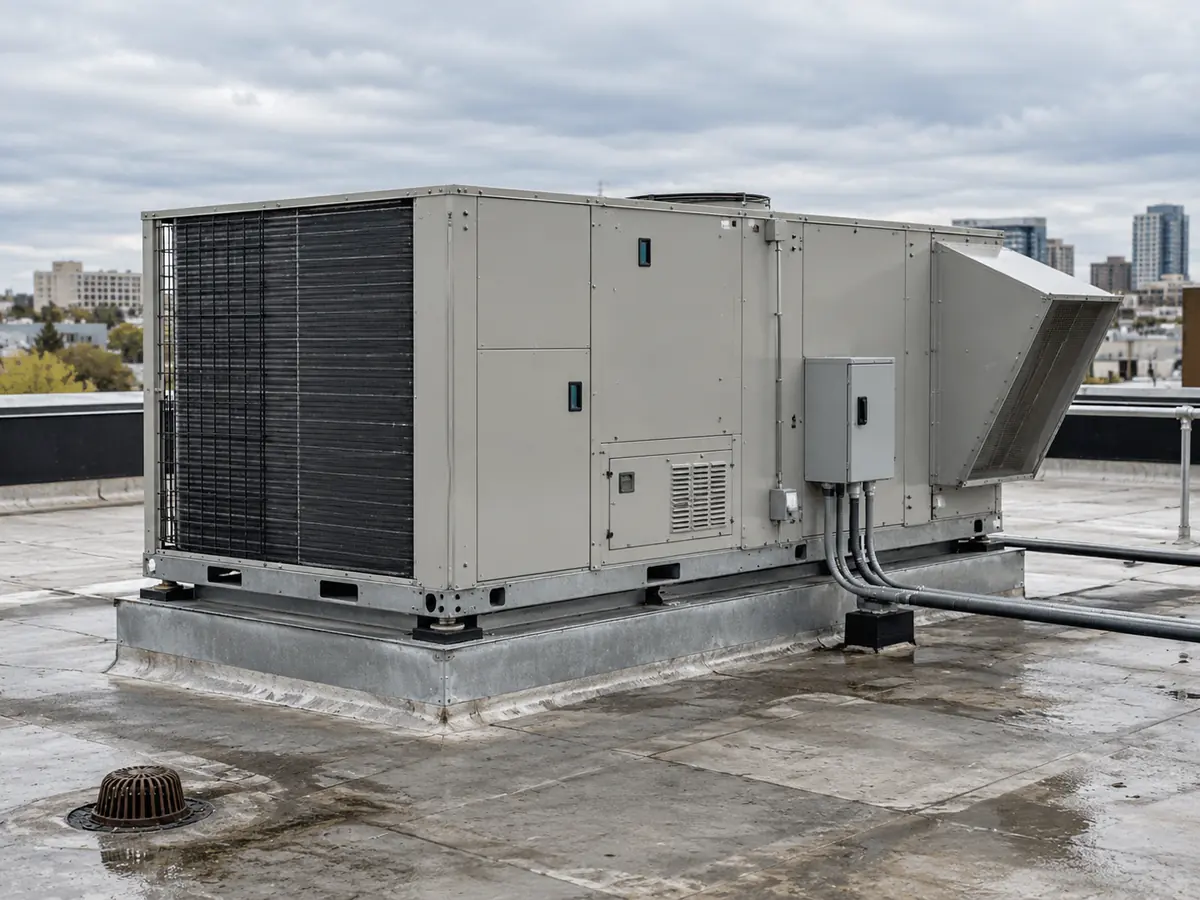
Build an asset register with model, installation date, faults, service history, run hours where available, room criticality and expected repair availability. Group similar systems for purchasing, then set the actual order of replacement from operating risk and condition.
Example asset register (illustrative):
| Asset | Installed | Condition | Downtime impact | Parts support | Priority / action |
|---|---|---|---|---|---|
| RTU-A | 2010 | Confirmed major fault and repeated outages | High: critical area | Limited | High: scope replacement and compare feasible repair |
| RTU-B | 2013 | Serviceable, with a recurring minor fault | Moderate | Available | Review: correct fault and monitor performance |
| RTU-C | 2009 | Reliable cooling and documented service | Low | Available | Maintain: retain under periodic review |
For live projects, add capacity at design temperatures, ambient operating limits, corrosion exposure, refrigerant, compliance requirements and the responsible service contact.
For new split-AC projects, Airproz lists an R32 inverter split AC series in published 9,000–24,000 BTU capacity classes. Select against the required cooling load, site design temperature, destination market and available model documentation. For equipment configurations and documentation discussions, see Airproz OEM/ODM services.
For a home repair decision: Get a written fault diagnosis, itemized repair quote and fully installed replacement option from a local HVAC contractor.
For distributors and project teams: Send Airproz the needed capacity, application, design ambient temperature, destination market and compliance documentation requirements when discussing new equipment or phased replacement.
Frequently Asked Questions About Air Conditioner Lifespan
Can an air conditioner last 20 years or more?
Yes. Some central air conditioners work beyond 20 years with favorable installation, conditions and care. Compare current cooling performance and repair history to decide whether continued use remains worthwhile.
Can a window AC last 15 years?
Yes, some window units reach 15 years. Keep one in service when it cools reliably, drains properly and operates safely. Investigate persistent rust, leakage or unusual noise promptly.
Does an AC warranty tell you how long the unit will last?
No. An air conditioner’s warranty period describes coverage, rather than how long the equipment will operate. A 10-year compressor warranty does not predict a failure at year ten. Review registration, parts, labor, refrigerant and exclusion terms when considering repair costs.
Will a new compressor make an old AC last another 10 years?
No. Replacing a compressor does not automatically give an older air conditioner another 10 years of service. It renews one component; the condition of the coils, fans, controls and refrigerant circuit still affects the value of the repair. Have the original failure cause identified before authorizing compressor replacement.
Is a mini-split’s lifespan the same as a central AC’s?
Not usually. Ductless mini-splits are commonly planned around 10–15 years, compared with about 15–20 years for central air conditioners in the published guidance cited here. The actual service life of either system depends on installation quality, climate, operating hours and maintenance.
Should I replace an AC just because electricity costs rose?
No. A higher electricity bill by itself is not a reason to replace an air conditioner. Check whether electricity rates increased or the system used more kWh under comparable weather and occupancy. If measured consumption rose, inspect airflow, controls and system performance before estimating the savings from replacement.
Is it worth repairing a 15-year-old air conditioner?
Yes, when the fault is limited and the rest of the system is sound. Compare the complete repair price, available parts, warranty support and recent fault history with a fully installed replacement proposal.
Bottom Line: How Long Do Air Conditioners Last?
Most central air conditioners serve about 15–20 years, ductless mini-splits around 10–15 years and window air conditioners around 8–10 years. Keep equipment that cools reliably and is economical to maintain. When major faults recur, compare the full repair cost, future electricity use and an installed replacement option.
For commercial fleets, schedule replacement according to condition, maintenance records, available parts and downtime consequences. The same approach works for a single home AC: use the service-life reference as a starting point, then decide from the specific equipment.