You found a factory. The spec sheet looks good. The price is right. Then your US distributor asks one question: “Is it AHRI listed?” — and the whole deal stalls. For anyone sourcing a mini split air conditioner for US market, this is the question that comes up faster than most buyers expect
For anyone sourcing a mini split air conditioner for US market, that question comes up faster than most buyers expect. Without a verified AHRI listing, many contractors, rebate programs, and project specifiers may reject the model before they even discuss price. This guide keeps it practical. You will learn how to check AHRI listings, read SEER2 and HSPF2 numbers, understand where Energy Star helps, and ask better questions before sampling from an OEM factory.
One terminology note before we start: “Mini split air conditioner” covers two different products in the US market — cooling-only AC units, and reversible mini split heat pumps that do both cooling and heating. The compliance rules aren’t identical. This guide separates them where it matters.
Key Takeaways
- Before ordering, check whether the exact indoor + outdoor combination is listed in the AHRI Directory.
- For US projects, ask for SEER2. If the unit also heats, ask for HSPF2 too.
- A low factory price means little if the supplier cannot support documentation, model matching, and private-label registration.
What Actually Happens When Your Mini Split Isn’t AHRI Certified
AHRI is not just another certificate. In many US projects, it is the proof people ask for before they trust the performance data. A mini split without a verified AHRI listing may not be rejected by law, but it can be rejected by contractors, rebate reviewers, or project engineers during the buying process.
AHRI maintains a public database of certified HVAC performance data. For mini split systems, buyers should check the listed indoor + outdoor combination and review the rated capacity, SEER2, EER2, and HSPF2 where applicable.
Three Real Situations Where AHRI Certification Gets Checked
- Utility rebate applications: Most rebate programs require an AHRI certificate number. No listing means application rejected before review.
- Commercial project spec sheets: Engineers commonly write “AHRI certified required” — no certification means no bid consideration.
- Contractor documentation checks: Experienced HVAC contractors verify paperwork before installation; missing AHRI records create documentation risk that can stall a project.
AHRI Listed vs Factory Self-Reported — What’s the Real Difference?
Think of it like a food nutrition label. A figure that the factory printed on a datasheet and a figure independently tested and verified by a third-party lab are two completely different levels of credibility. An AHRI listing means the performance data has been verified in an independent laboratory and is publicly searchable by anyone. A self-reported number on a supplier PDF is just a claim.
For B2B buyers, this distinction matters because your customer’s customer — the contractor, the project engineer, the rebate administrator — will look up the AHRI listing themselves. They won’t accept a PDF you downloaded from a supplier.
How to Look Up Any Mini Split in the AHRI Directory — Three Steps
- Go to
ahridirectory.org - Enter the brand name or model number
- Check that the indoor + outdoor unit combination is listed together — AHRI certification is system-level, not unit-level
This is the most common supplier misrepresentation point. An outdoor unit with a listing does not automatically cover every indoor unit paired with it. Always verify the specific combination you intend to purchase.
For a full overview of supplier evaluation and procurement processes, see AirProz’s air conditioner project .

SEER2 — The Number That Decides Whether Your Unit Can Be Sold in the US
The US Department of Energy changed the efficiency testing standard in 2023, shifting from SEER to SEER2. Many buyers are still working from old reference numbers, which can lead to costly specification errors when a unit that “meets the minimum” on paper fails the actual compliance check.
Why SEER Became SEER2 — And Why Your Old Reference Numbers Are Wrong
The key difference is test conditions. SEER2 measures cooling efficiency under higher external static pressure — more representative of real-world installation conditions than the original SEER test. The result: the same unit tested under SEER2 scores roughly 5% lower than under SEER. A unit that measured SEER 15 under the old test might measure SEER2 14.3 under the new one.
If a supplier quotes you SEER, ask for SEER2. If they can’t provide it, that’s your answer.
The Minimum Numbers — A Planning Reference Table
| Product Type | US Region | Min. SEER2 | Also Required |
|---|---|---|---|
| Split-system AC (< 45,000 BTU) | Southeast | 14.3 | — |
| Split-system AC (≥ 45,000 BTU) | Southeast | 13.8 | — |
| Split-system AC | North | 13.4 | — |
| Residential split-system heat pump / ductless heat pump | All US | 14.3 | 7.5 HSPF2 |
This table is a simplified reference for planning discussions only. Final compliance must be verified by product class, capacity, region, manufacture date, and installation date. Always check current requirements at AHRI’s residential heat pump standards page or the DOE website before final specification.
For some AC categories and regions, EER2 may also apply. Treat this table as a starting point, not the final compliance decision.
If Your Mini Split Also Heats — You Need to Know HSPF2 Too
SEER2 measures summer efficiency. HSPF2 measures winter efficiency. If the product is a reversible mini split heat pump, both numbers are required. A product profile that only shows SEER2 — without HSPF2 — is an incomplete compliance picture for heat pump models.
Energy Star Mini Split Heat Pumps — What It Helps With, Even When Tax Credits Change
A common misconception among buyers is that Energy Star status is the finish line for US market compliance. It isn’t. Energy Star is a voluntary certification program administered by the EPA, separate from the DOE’s minimum efficiency requirements. But it matters in practice because many utility rebate programs and some tax credit pathways reference it.
Energy Star vs ENERGY STAR Most Efficient — Not the Same Label
Standard Energy Star status is like a passing grade. ENERGY STAR Most Efficient is the honor roll. The two tiers have different eligibility requirements for rebates and tax credits. Buyers must check by exact model number in the EPA product database — certification is model-specific, not brand-wide. A brand having some Energy Star models does not mean every model from that brand qualifies.
Federal Tax Credits — What Changed After 2025
For systems purchased and installed between January 1, 2023 and December 31, 2025, qualifying air-source heat pumps could claim 30% of project cost up to $2,000 under IRS Section 25C. From January 1, 2025, ENERGY STAR stated that eligible air-source heat pumps had to be recognized as ENERGY STAR Most Efficient to qualify. For 2026 projects, do not assume federal tax credit eligibility. Always verify the latest rules directly on the ENERGY STAR air source heat pump tax credit page before using tax credits in sales materials or buyer conversations.
Utility Rebates — Often More Valuable Than the Federal Credit Anyway
Utility rebates are a separate system from federal tax credits, and some programs still reference Energy Star or Most Efficient status. Programs such as Mass Save, NYSERDA, and PG&E often have their own product lists and qualification rules. Some may reference Energy Star, AHRI, NEEP, or other efficiency databases. Always check the exact model number against the local program before making rebate claims.
Mini Split AC vs Central Air — Which One Actually Makes Sense for Your Project?
There is no universal answer, but there is a clear decision framework based on building type, existing infrastructure, and project requirements.
| Mini Split AC | Central Air Conditioner | |
|---|---|---|
| Ductwork needed | No | Yes |
| AHRI certification | Yes | Yes |
| Typical SEER2 range | 14–30+ (varies by model & matched system) | 14–22 |
| Zone control | Per room / per unit | Whole building |
| Retrofit suitability | High — no duct access needed | Requires existing or new duct system |
| Best for | Additions, hotels, no-duct spaces | Existing duct systems, large open plans |
Five Scenarios Where Mini Splits Win
- Hotel room retrofits — independent temperature control per room, no duct modification required
- Historic buildings or older structures where walls cannot be opened for ductwork
- New commercial builds with no pre-installed duct system
- Multi-zone offices, clinics, or schools needing independent room control
- Converted spaces — garages, workshops, additions — where central ducting is impractical

When Central Air Still Makes More Sense — Be Honest With Your Clients
Central air conditioning is the stronger choice for large-footprint commercial buildings with good existing ductwork, applications requiring centralized air filtration, and facilities needing unified building-wide HVAC management. An honest assessment here builds reader trust and reduces downstream misspecification. The right product for a project depends on the project, not on which system is newer or more popular.
How the Big Brands Set the Bar — Mitsubishi, Daikin, LG, Fujitsu, and Carrier
What Their Public Listings Actually Teach You
Their public documentation shows what a US-ready mini split usually includes: matched indoor/outdoor listings, clear efficiency data, Energy Star status where applicable, and stable model numbers.
| What to Compare | Why It Matters |
|---|---|
| Matched indoor/outdoor listings | Shows how certification is structured |
| SEER2 / HSPF2 tiers | Helps set realistic efficiency targets |
| Energy Star status | Shows which models support rebate claims |
| Model number stability | Helps distributors manage catalogs |
| Parts and warranty support | Reduces after-sales risk |
The Question Private-Label Buyers Should Actually Be Asking
For distributors building a private-label program, the question is not whether a factory can match a brand’s design or price. It is whether the factory can provide a verifiable AHRI directory listing, third-party SEER2 test data, stable compliance documentation, and a structured private-label model number registration pathway. Those are what determine whether a sourcing relationship translates into actual US market access — not the spec sheet.
Sourcing from an OEM Mini Split Air Conditioner Manufacturer — What to Ask Before You Sample
Like checking the title deed before buying a property, you verify the AHRI certificate before agreeing to sample. The order matters. An OEM mini split air conditioner for US market distribution starts with documentation, not with the unit itself.
AHRI-Ready vs Already AHRI-Certified — Two Very Different Starting Points
A model with an existing AHRI listing can move quickly. A model that is “AHRI-ready” — meaning it could be certified but hasn’t been yet — may still require testing, listing paperwork, and model-combination review before it can be confidently sold into certification-sensitive channels. Factor that into your timeline before sampling.
What to Ask for Before You Sample
| Ask for | Why |
|---|---|
| AHRI certificate number | To verify the exact model combination |
| SEER2 / HSPF2 test report | To confirm US efficiency performance |
| DOE compliance document | To avoid basic compliance gaps |
| Energy Star status | To support rebate eligibility where applicable |
| Private-label model support | To confirm your brand can be registered |
| Spare parts documentation | To reduce after-sales risk |
What Airproz Can Help With
Airproz supports OEM and private-label buyers with model documentation review, product specification matching, packaging customization, and supplier-side coordination for US-market requirements. For certification-sensitive orders, confirm your target model, brand registration path, and documentation scope before sampling.
For a detailed overview of supplier evaluation and OEM procurement processes, see AirProz’s project.

US Mini Split Procurement Checklist — Save This Before Your Next Supplier Call
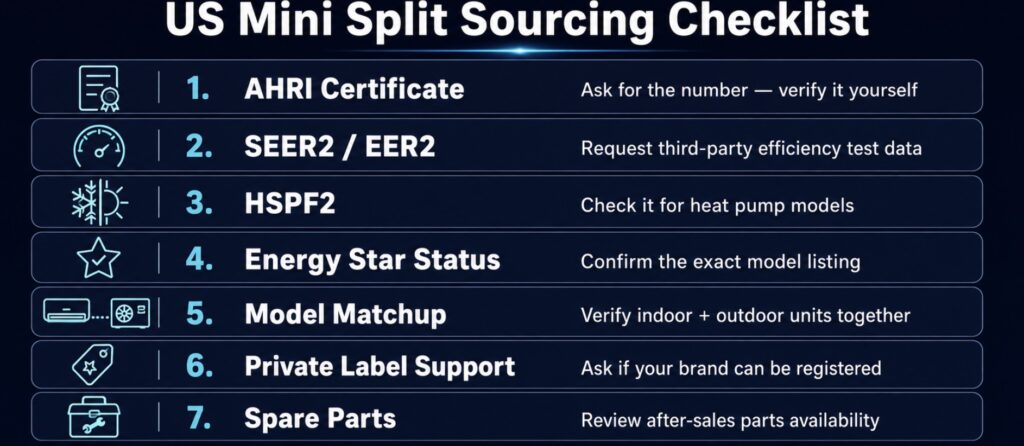
Mini Split Air Conditioner for US Market Sourcing Checklist| Checkpoint | What to Ask | Why It Matters |
|---|---|---|
| AHRI Certificate | Give me the certificate number — I’ll look it up myself | Prevents false performance claims |
| SEER2 / EER2 | Third-party test report, not factory self-reported | Required for DOE compliance |
| HSPF2 (heat pump models) | Is HSPF2 listed in the AHRI directory? | Required for all reversible mini splits |
| Energy Star Status | Is this exact model number in the ENERGY STAR product database? | May affect rebate and tax credit eligibility |
| Model Matchup | Indoor + outdoor combination certified together? | AHRI certification is system-level, not unit-level |
| Private Label Support | Can model numbers be registered under my brand? | Critical for OEM distributors |
| Spare Parts | US-compatible parts stocked or documented? | Reduces after-sales and warranty risk |
Frequently Asked Questions
Do I really need AHRI certification to sell mini splits in the US?
Without a verified AHRI listing, many contractors, project specifiers, and rebate programs will decline to work with the model before price even comes up. It is not a legal absolute in every single scenario, but in practice it functions as the entry requirement for most professional US distribution and installation channels.
What is the difference between SEER and SEER2 — does it matter for my project?
Yes. SEER2 uses a different test condition (higher external static pressure) that produces lower numbers than SEER for the same unit. Since January 2023, US federal minimums are expressed in SEER2. If a supplier only provides a SEER figure, ask specifically for SEER2 — and verify it against a third-party test report, not the spec sheet.
How do I check if a mini split qualifies for Energy Star status in 2026?
Go to the ENERGY STAR product database and search by the exact model number — certification is model-specific, not brand-specific. Note that the federal tax credit program under IRS Section 25C applied to systems installed by December 31, 2025. For 2026 installations, verify current IRS and ENERGY STAR guidance before making any rebate or tax credit claims.
Can a Chinese OEM factory actually get AHRI certification?
Yes. Some OEM mini split manufacturers maintain active AHRI directory listings, including under private-label or custom model number arrangements. The key step is to verify the certificate number yourself in the AHRI directory — not from a supplier-provided PDF — and confirm that the specific indoor and outdoor unit combination you intend to order is listed together.
What makes Mitsubishi or Daikin mini splits so expensive — and are factory alternatives worth considering?
Brand premium covers more than engineering — it includes long-term AHRI listing maintenance, parts availability, dealer network, and warranty infrastructure. For OEM and private-label buyers, factory alternatives can be worth evaluating if the supplier can match on what actually determines US market access: verifiable AHRI data, stable documentation, and a clear private-label registration path.
How do I know if an indoor and outdoor unit are certified as a matched pair?
Search the AHRI Directory by both indoor and outdoor model numbers. For split systems, certification usually applies to a matched combination, not to every possible pairing a supplier offers.
Which US states have the highest demand for mini split air conditioners?
The Southeast and Southwest consistently drive the highest volume — Florida, Texas, Georgia, and Arizona lead in cooling-only mini split installations due to long cooling seasons and high humidity. The Northeast, particularly Massachusetts, New York, and Connecticut, has seen strong growth in reversible mini split heat pumps driven by state-level electrification incentives and cold-climate rebate programs like Mass Save and NYSERDA. California remains a significant market across both residential and light commercial segments, with strict Title 24 energy codes pushing buyers toward higher-SEER2 ductless systems. For OEM and private-label distributors, the Northeast and California tend to attract buyers who ask more documentation questions — AHRI listings, Energy Star status, and utility rebate eligibility come up early in the conversation.
Sourcing a Mini Split Conditioner for US Market
Airproz supports B2B buyers sourcing mini split air conditioner and heat pump solutions for different markets. Share your target capacity, voltage, refrigerant type, efficiency tier, and private-label requirements. We will help review available model options and documentation needs before you move to sampling.
Sourcing a mini split air conditioner for US market? Contact Airproz →
Evaluating multiple heat pump product lines across markets? Read our Heat Pump Manufacturer B2B Buying Guide.